Printed in Brazil - ©2006 Sociedade Brasileira de Química 0103 - 5053 $6.00+0.00
Article
*e-mail: [email protected]
Synthesis and Antiproliferative Activity of Novel Limonene Derivatives with
a Substituted Thiourea Moiety
Isis M. Figueiredo,a Luciane V. dos Santos,a Willian F. da Costa,a João E. de Carvalho,b
Cleuza C. da Silva,a Juliana L. Sacoman,b Luciana K. Kohnb and Maria H. Sarragiotto*,a
a
Departamento de Química, Universidade Estadual de Maringá, Avenida Colombo 5790, 87020-900 Maringá-PR, Brazil
b
Centro Pluridisciplinar de Pesquisas Químicas, Biológicas e Agrícolas, Universidade Estadual de Campinas, CP 6171, 13083-970 Campinas-SP, Brazil
No presente trabalho descrevemos a síntese e a avaliação da atividade antiproliferativa, frente a linhagens de células tumorais humanas, de derivados do R-(+)-limoneno (3-18) contendo uma unidade tiouréia substituída. Os derivados com substituintes arílicos (3-6) exibiram atividade citostática frente a todas linhagens testadas, com inibição de 50% do crescimento celular (GI50) em concentrações na faixa de 2,5 a 24 µmol L-1. Os compostos 3, 10, 12 e 16 foram os mais ativos, com GI50 na faixa de 0,41 a 3,0 µmol L
-1, frente a
diferentes linhagens celulares.
A series of R-(+)-limonene derivatives bearing a substituted thiourea moiety (3-13) and five S-methyl analogs (14-18) were synthesized and evaluated for their in vitro
antiproliferative activity against human cancer cell lines. Compounds bearing aromatic substituents (3-6) exhibit cytotastic activity in the full panel of cell lines tested, with GI50 values in the range of 2.5 to 24 µmol L-1. Compounds 3, 10, 12 and 16 were the most active with GI50 values in the range of 0.41 to 3.0 µmol L
-1, against different cell lines.
Keywords:limonene derivatives, thioureas, antiproliferative activity
Introduction
In the last years several approaches have been employed for cancer therapy, and to discover and develop novel therapeutic agents for the treatment of malignancy. In this context, the use of natural products as prototypes has been pointed out as one of the successful approaches to discover novel anticancer drugs.
Monoterpenes are a class of compounds, which occurs naturally in plant, and possess a range of pharma-cological properties. Several studies have demonstrated the efficacy of this class of compounds as potential
anticancer agents.1-3 D-Limonene, a monoterpene found
in a variety of foods and essential oils, have been shown to exert chemopreventive and chemotherapeutic activities in a variety of carcinogen-induced animal
tumor models.4-7 Dietary administration of D-limonene
causes complete regression of N-nitrosourea (NMU)-induced and 7,12-dimethylbenzyl[a]anthracene (DMBA)-induced mammary carcinomas with minimal toxicity.8,9
As a result of its chemopreventive and chemo-therapeutic potential, limonene is under clinical trials. Phase I and pharmacokinetic study in patients with advanced cancer confirm its low toxicity and support D-limonene as prototype of a novel class of
chemo-therapeutic drugs.10
The potential use of limonene as an anticancer agent led us to focus our attention on the synthesis and antiproliferative activity evaluation of new limonene derivatives, as part of our research program in this area. We present herein the synthesis and the results of the antiproliferative activity evaluation of a series of limonene
derivatives (3-13) bearing a substituted thiourea moiety,
Results and Discussion
Synthesis
The synthetic route for the preparation of limonene derivatives is presented in Scheme 1. The limonene
isothiocyanate (2) was obtained from the reaction of
the limonene (1) with HSCN, in chloroform, according
to a previously reported procedure.11,12 Treatment of 2
with different amines (primary, heterocyclic and
aromatic) afforded compounds 3-13. For primary and
heterocyclic amines the reactions were carried out at
25 oC for 15 h, by using 2 equivalents of the amine in
chloroform as solvent, and the title thioureas were obtained in 67 – 97% yield. However, limited yields
(20-30%) were observed for the reaction of 2 with
aromatic amines such as aniline, o-toluidine, o
-anisidine and p-bromoaniline. In these cases, reactions
were performed with a large excess of amine, at 100 oC
for 24 h. The products (3-13) were characterized by
analysis of their spectroscopic data. The presence of the C=S group was evidenced by the IR absorption
bands at 1523-1566 and 1250-1410 cm-1, together with
the signal at δ 177.3 – 181.8 in the 13C NMR spectra.
The monoterpene moiety was characterized by the
signals at δH/δC 5.30-5.40 (1H, brs, H-2)/119.7-120.5
(C-2), 1.30-1.49 (3H, s, H-8)/24.1-24.9 (C-8), 1.34-1.50 (3H, s, 9)/24.2-25.4 (C-9) and 1.61-1.73 (3H, s,
H-10)/23.0-23.5 (C-10) in the 1H/13C NMR spectra. The
NMR data were also consistent for the substituents attached to the nitrogen atom N-1, as showed in the Experimental Section. The EI-mass spectra showed
peaks at m/z 58 and at m/z (M+• - 135) as main fragments.
The proposed mechanisms for the fragmentation are shown in Figure 1.
The S-methylated derivatives (14-18)were prepared
from the reaction of the corresponding thioureas with
methyl iodide at 0 oC, in chloroform, for 24 h in
quantitative yields. The 1H NMR spectra of the
S-methylthioureas showed signal at δ 2.78 – 2.85
corresponding to the SCH3 group. The formation of
S-methythiourea was also evidenced by the presence of the
signals at δ16.9 – 18.5 (S-CH3) and δ143.7 – 169.2 (C=N)
in the 13C NMR spectra, besides of the absorption at
1600-1690 cm-1 (C=N), in the IR spectra.
Antiproliferative activity
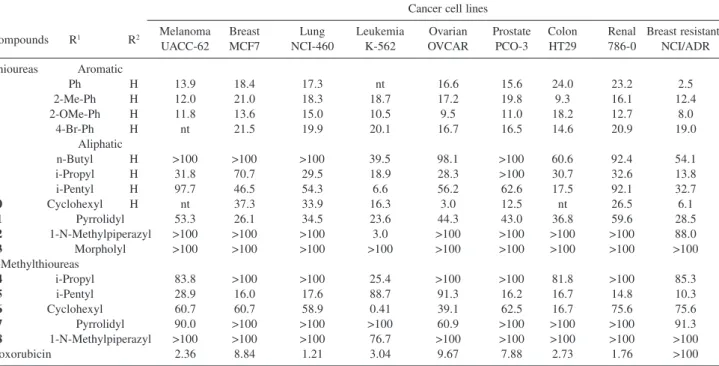
The results of the antiproliferative assays are showed
in Tables 1 and 2. The response parameter GI50 (Table 1)
refers to the drug concentration that produce a 50% reduction of cellular growth when compared to untreated control cells. Table 2 includes data for the compounds that
reached TGI and LC50 values. The TGI and LC50 parameters
refer, respectively, to the drug concentration for total growth inhibition, and that for killing 50% of the cells.
As shown in Table 1, the compounds bearing aromatic
substituents (3-6) exhibit cytotastic activity against all
cancer cell lines tested, with GI50 values in the range of
2.5 to 24 µmol L-1. Analysis of TGI and LC50 data
presented in Table 2 show that compounds 3-5 had higher
potency for total growth inhibition, and for killing 50%
of the cells. From this series, compound 3 was the most
active, with GI50 and TGI values of 2.5 µmol L-1 and
22.5 µmol L-1, respectively, against breast resistant NCI/
ADR cancer cell line. On the other hand, compounds 7
-18 of the aliphatic series exhibit different profiles and
dependence on the nature of the substituent on the nitrogen atom. Compared to aromatic series, the specificity was increased with the most of the compounds
Figure 1. Proposed mechanism for formation of the fragments a) m/z 58 and b) m/z (M+· - 135).
of the aliphatic series exhibiting smaller GI50 values for leukemic K-562 cell line. From the thiourea aliphatic
series, compounds 9 and 12 showed potent activity and
particular selectivity against leukemic K-562 cell line
with GI50 values of 6.6 and 3.0 µmol L-1, respectively.
The replacement of the 1-N-methyl group of the
compound 12 for an oxygen results in the inactive
compound 13. The thiourea 10 exhibits potent
antiproliferative activity against ovarian OVCAR and
breast resistant NCI/ADR with GI50 3.0 and 6.1 µmol
L-1, respectively. S-methylation of thioureas bearing
aliphatic substituents results in changes in the antiproliferative activity profiles. Conversion of the
thiourea 10 to the S-methylthiourea analogue 16, led to
the most potent compound, with GI50 value of0.41 µmol
L-1 and high selectivity against leukemia K-562 cell lines.
Conclusions
In this paper we report the synthesis and cytotoxic evaluation of a series of new limonene derivatives containing a substituted thiourea moiety. The results show
the potentiality of some compounds, particularly 3, 10,
12 and 16, as inhibitors of tumor cells proliferation. Some
compounds bearing aromatic substituents were also able to kill 50% of the breast resistant NIC/ADR (compounds
Table 1. GI50 values (in µmol L-1 concentrations) of the limonene derivatives (3-18)
Cancer cell lines
Compounds R1 R2 Melanoma Breast Lung Leukemia Ovarian Prostate Colon Renal Breast resistant
UACC-62 MCF7 NCI-460 K-562 OVCAR PCO-3 HT29 786-0 NCI/ADR
Thioureas Aromatic
3 Ph H 13.9 18.4 17.3 nt 16.6 15.6 24.0 23.2 2.5
4 2-Me-Ph H 12.0 21.0 18.3 18.7 17.2 19.8 9.3 16.1 12.4
5 2-OMe-Ph H 11.8 13.6 15.0 10.5 9.5 11.0 18.2 12.7 8.0
6 4-Br-Ph H nt 21.5 19.9 20.1 16.7 16.5 14.6 20.9 19.0
Aliphatic
7 n-Butyl H >100 >100 >100 39.5 98.1 >100 60.6 92.4 54.1
8 i-Propyl H 31.8 70.7 29.5 18.9 28.3 >100 30.7 32.6 13.8
9 i-Pentyl H 97.7 46.5 54.3 6.6 56.2 62.6 17.5 92.1 32.7
10 Cyclohexyl H nt 37.3 33.9 16.3 3.0 12.5 nt 26.5 6.1
11 Pyrrolidyl 53.3 26.1 34.5 23.6 44.3 43.0 36.8 59.6 28.5
12 1-N-Methylpiperazyl >100 >100 >100 3.0 >100 >100 >100 >100 88.0 13 Morpholyl >100 >100 >100 >100 >100 >100 >100 >100 >100 S-Methylthioureas
14 i-Propyl 83.8 >100 >100 25.4 >100 >100 81.8 >100 85.3
15 i-Pentyl 28.9 16.0 17.6 88.7 91.3 16.2 16.7 14.8 10.3
16 Cyclohexyl 60.7 60.7 58.9 0.41 39.1 62.5 16.7 75.6 75.6
17 Pyrrolidyl 90.0 >100 >100 >100 60.9 >100 >100 >100 91.3
18 1-N-Methylpiperazyl >100 >100 >100 76.7 >100 >100 >100 >100 >100
Doxorubicin 2.36 8.84 1.21 3.04 9.67 7.88 2.73 1.76 >100
nt = not tested.
Table 2. TGI values and LC50 (values in parenthesis), in µmol L-1 concentrations
Cancer cell lines
Compounds R1 R2 Melanoma Breast Lung Leukemia Ovarian Prostate Colon Renal Breast resistant
UACC-62 MCF7 NCI-460 K-562 OVCAR PCO-3 HT29 786-0 NCI/ADR
Thioureas
3 Ph H 34.6 55.5 86.6 >100 >100 58.9 >100 86.6 22.5 (76.6)
4 2-Me-Ph H 29.7 (80.9) 86.9 47.2 >100 49.5 >100 >100 29.8 (65.0) 30.0 (65.0)
5 2-OMe-Ph H 39.2 64.6 39.5 >100 32.0 58.0 >100 26.8 (57.7) 26.9
6 4-Br-Ph H >100 >100 71.0 >100 72.0 >100 95.0 71.0 71.0
9 i-Pentyl H >100 >100 >100 95.0 >100 >100 >100 >100 >100 S-Methylthioureas
15 i-Pentyl >100 68.3 87.8 >100 >100 >100 87.8 58.0 70.6
16 Cyclohexyl >100 >100 >100 82.5 >100 >100 93.0 >100 >100
3 and 4), melanoma UACC-62 (compound 4), and renal
786-0 (compounds 4 and 5) cancer cell lines.
Experimental
IR spectra were recorded on KBr pellets in a Bomem model MB-100 spectrophotometer. Mass spectra were
measured on Shimadzu GC/MS, QP 2000A, at 70 eV. 1H
and 13C NMR spectra were recorded on a Varian Mercury
Plus 300 MHz in CDCl3 and TMS as internal reference.
Column chromatography was performed on silica gel Merck 230-400 mesh ASTM.
General procedure for thioureas 3 – 13
To a solution of limonene isothiocyanate 2(1 mmol)
in CHCl3 (10 mL) was added drop-wise the amine (2
mmol).11,12 The solution was kept at room temperature for
15 hours and then the solvent was removed under reduced pressure. For aromatic amines, reactions were performed
with a large excess of amine, without solvent, at 100 oC
for 24 h. The residue was purified by column chromato-graphy using hexane and a mixture of hexane-ethyl acetate in increasing polarity as solvent.
N-[1-(4R)-(4-isopropyl-1-methylcyclohexenyl)]-N’-[2-(phenyl)]thiourea (3). Yield: 30%; IR νmax/cm-1: 3387
(N-H), 3156 (C-H arom), 1590 (C=C arom), 1540 and 1298
(C=S); EI-MS m/z (rel. int.): 288 (M+•, 5), 153 (100, M+•
-135, [H2NCSNHC6H5]+); 1H NMR (300 MHz, CDCl
3):
δ 1.18 and 1.62 (1H each, m, H-5), 1.40 (3H, s, H-8),
1.45 (3H, s, H-9), 1.61 (3H, s, H-10), 1.84 and 1.90 (4H, m, 3 and 6), 2.59 (1H, m, 4), 5.36 (1H, brs,
H-2), 7.20 (2H, d, J 7.5 Hz, H-2’ and H-6’), 7.29 (1H, t, J
7.5 Hz, H-4’), 7.43 (2H, t, J 7.5 Hz, H-3’ and H-5’); 13C
NMR (75.5 MHz, CDCl3): δ 23.5 (C-10), 24.2 (C-9),
24.3 5), 24.5 8), 26.7 3), 31.2 6), 41.1 (C-4), 59.5 (C-7), 120.5 (C-2), 125.2 (C-2’ and C-6’), 127.1 4’), 130.2 3’ and C-5’), 134.3 1), 136.8 (C-1’), 179.5 (C=S).
N-[1-(4R)-(4-isopropyl-1-methylcyclohexenyl)]-N’-[2-(2-methylphenyl)]thiourea (4). Yield: 30%. IR νmax/cm-1: 3367
(N-H), 3173 (C-H arom), 1643 (C=C arom), 1621 (C=C),
1533 and 1251 (C=S); EI-MS m/z (rel. int.): 302 (M+•,
10), 167 (100, M+• - 135, [H
2NCSNH-2-methylphenyl]
+),
91 (45), 58 (70), 41 (46); 1H NMR (300 MHz, CDCl
3): δ
1.39 (3H, s, H-8), 1.45 (3H, s, H-9), 1.61 (3H, s, H-10), 1.75 (2H, m, H-5), 1.93 (4H, m, H-3 and H-6), 2.29 (3H,
s, CH3-Ar), 2.48 (1H, m, H-4), 5.30 (1H, brs, H-2), 7.20
(1H, m, H-6’), 7.25 (1H, m, H-5’), 7.28 (1H, m, H-4’),
7.31 (1H, m, H-3’); 13C NMR (75.5 MHz, CDCl
3): δ 18.1
(CH3-Ar), 23.5 10), 24.1 8), 24.2 5), 24.4
(C-9), 26.6 (C-3), 31.2 (C-6), 41.4 (C-4), 59.2 (C-7), 120.5 2), 127.7 6’), 127.8 5’), 127.9 2’), 128.7 (C-4’), 131.9 (C-3’), 134.3 (C-1), 136.0 (C-1’), 179.9 (C=S).
N-[1-(4R)-(4-isopropyl-1-methylcyclohexenyl)]-N’-[2-(2-methoxyphenyl)]thiourea (5). Yield: 31%; IR νmax/cm-1:
3370 (N-H), 3048 (C-H arom), 1599 and 1535 (C=C), 1460
and 1250 (C=S); EI-MS m/z (rel. int.): 318 (M+•, 7), 183
(27, M+• - 135, [H
2NCSNH-2-methoxyphenyl]
+); 123 (93,
[H2N-2-methoxyphenyl]+·), 93 (27), 58 (100), 41 (43); 1H
NMR (300 MHz, CDCl3): δ 1.42 (3H, s, H-8), 1.48 (3H, s,
H-9), 1.63 (3H, s, H-10), 1.77 (2H, m, H-5), 1.90 (4H, m,
H-3 and H-6), 2.00 (1H, m, H-4), 3.84 (3H, s, OCH3), 5.36
(1H, brs, H-2), 6.92 (1H, m, H-3’), 6.94 (1H, d, J 7.8 Hz,
H-6’), 6.98 (1H, t, J 7.8 Hz, H-5’), 7.20 (1H, t, J 7.8 Hz,
H4’); 13C NMR (75.5 MHz, CDCl
3): δ 23.4 (C-10), 24.3
(C-5), 24.6 (C-8), 24.6 (C-9), 26.7 (C-3), 31.2 (C-6), 41.7
(C-4), 55.8 (OCH3), 59.3 (C-7), 110.3 (C-4’),120.5 (C-2),
121.0 (C- 5’ and C-6’), 124.5 (C-3’), 134.1 (C-1’), 134.2 (C-1), 154.6 (C-2’), 179.3 (C=S).
N-[1-(4R)-(4-isopropyl-1-methylcyclohexenyl)]-N’-[2-(4-bromophenyl)]thiourea (6). Yield: 20%; IR νmax/cm-1: 3281
(N-H), 3103 (C-H), 1578 and 1530 (C=C, arom.), 1488
and 1364 (C=S); EI-MS m/z (rel. int.): 366 (M+•, 7), 215
(23), 58 (100); 1H NMR (300 MHz, CDCl
3): δ 1.24 and
1.68 (1H each, m, H-5’), 1.42 (3H, s, H-8), 1.48 (3H, s, 9), 1.63 (3H, s, 10), 1.68 and 1.97 (1H each, m, H-3), 1.96 (2H, m, H-6), 2.59 (1H, m, H-4), 5.36 (1H, brs,
H-2), 7.09 (2H, d, J 8.7 Hz, H-2’ and H-6’), 7.54 (2H, d,
J 8.7 Hz, H-3’ and H-5’); 13C NMR (75.5 MHz, CDCl
3):
δ 23.5 (C-10), 24.4 (C-5), 24.6 (C-8), 24.6 (C-9), 26.7
(C-3), 31.2 (C-6), 40.9 (C-4), 59.7 (C-7), 120.4 (C-2), 120.6 (C-4’), 126.8 (C2’ and C-6’), 133.4 (C3’ and C-5’), 134.4 (C-1), 136.0 (C-1’), 179.4 (C=S).
N-[1-(4R)-(4-isopropyl-1-methylcyclohexenyl)]-N’-[2-(butyl)]thiourea (7). Yield: 97%; IR νmax/cm-1: 3269
(N-H), 1543 and 1342 (C=S); EI-MS m/z (rel. int.): 268 (M+•,
10), 133 (100, M+• - 135, [H
2NCSNH-butyl]
+), 58 (68), 41
(60); 1H NMR (300 MHz, CDCl
3): δ 0.95 (3H, t, J 7.2 Hz,
H-4’); 1.35 (3H, s, H-8), 1.39 (3H, s, H-9), 1.41 (2H, m, H-3’), 1.60 (2H, m, H-6), 1.64 (3H, s, H-10), 1.82 (2H, m, H-5), 1,99 (3H, m, H-3 and H-4), 2.01 (2H, m, H-2’),
3.54 (2H, q, J 6.0 Hz, H-1’), 5.40 (1H, brs, H-2); 13C
NMR (75.5 MHz, CDCl3): δ 13.7 (C-4’), 20.1 (C-3’), 23.2
N-[1-(4R)-(4-isopropyl-1-methylcyclohexenyl)]-N’-[2-(isopropyl)]thiourea (8). Yield: 84%; IR νmax/cm-1: 3272
(N-H), 1538 and 1325 (C=S); EI-MS m/z (rel. int.): 254
(M+•, 7), 119 (100, M+• - 135, [H
2NCSNH-isopropyl]
+),
58 (65), 41 (60); 1H NMR (300 MHz, CDCl
3): δ 1.23
(6H, d, J 6.0 Hz, NHCH(CH3)2), 1.35 (3H, s, H-8), 1.40
(3H, s, H-9), 1.65 (3H, s, H-10), 1.78 (2H, m, H-5), 1.99 (5H, m, H-3, H-4 and H-6), 4.40 (1H, m, H-1’), 5.40 (1H,
brs, H-2); 13C NMR (75.5 MHz, CDCl
3): δ 22.6
(NHCH(CH3)2), 23.2 (C-10), 24.2 (C-5), 24.9 (C-8), 25.2
(C-9), 26.6 (C-3), 30.9 (C-6), 42.5 (C-4), 47.2 (C-1’), 58.3 (C-7), 120.0 (C-2), 134.0 (C-1), 179.8 (C=S).
N-[1-(4R)-(4-isopropyl-1-methylcyclohexenyl)]-N’-[2-(isopentyl)]thiourea (9). Yield: 80%; IR νmax/cm-1: 3258
(N-H), 1643 (C=C), 1537 and 1322 (C=S); (KBr); EI-MS
m/z (rel. int.): 282 (M+·•, 10), 147 (100, M+• - 135,
[H2NCSNH-isopentyl]+), 58 (70); 41 (65); 1H NMR (300
MHz, CDCl3): δ 0.93 (6H, t, J 7.5 Hz, NHCH(CH2CH3)2),
1.30 and 1.83 (1H each, m, H-5), 1.34 (3H, s, H-8), 1.38
(3H, s, H-9), 1.51 (4H, m, NHCH(CH2CH3)2), 1.61(2H,
m, H-3), 1.65 (3H, s, H-10), 1.99 (3H, m, H-4 and H-6),
4.23 (1H, m, H-1’), 5.36 (1H, brs, H-2); 13C NMR (75.5
MHz, CDCl3): δ 10.0 (NHCH(CH2CH3)2), 23.3 (C-10),
24.3 (C-5), 25.1 (C-8), 25.4 (C-9), 26.6 (C-3), 27.0
(NHCH(CH2CH3)2), 31.0 (C-6), 42.8 (C-4), 58.2 (C-7),
58.3 (C-1’), 119.7 (C-2), 134.1 (C-1),180.7 (C=S).
N-[1-(4R)-(4-isopropyl-1-methylcyclohexenyl)]-N’-[2-(cyclohexyl)]thiourea (10). Yield: 80%; IR νmax/cm-1: 3258
(N-H); 1540 and 1338 (C=S); EI-MS m/z (rel. int.): 294
(M+•, 10), 58 (100), 41 (60); 1H NMR (300 MHz, CDCl
3):
δ 1.37 (3H, s, H-9), 1.34 (3H, s, H-8), 1.60 (m, H-4’),
1.65 (3H, s, H-10), 1.67 (4H, m, H-3’and H-5’),1.80 (2H, m, H-6), 1.81 (4H, m, H-3 and H-5), 1,93 (1H, m, H-4), 2.02 (4H, m, H-2’and H-6’), 4.12 (1H, m, H-1’), 5.36
(1H, brs, H-2); 13C NMR (75.5 MHz, CDCl
3): δ 23.3
10), 24.2 5), 24.7 3’and C-5’), 24.9 8), 25.2 (9), 25.4 (4’), 26.6 (3), 31.0 (6), 32.9 (2’and C-6’), 42.7 (C-4), 53.9 (C-1’), 58.3 (C-7), 120.0 (C-2), 134.0 (C-1), 179.7 (C=S).
N-[1-(4R)-(4-isopropyl-1-methylcyclohexenyl)]-N’-[2-(pyrrolidyl)]thiourea (11). Yield: 67%; IR νmax/cm-1: 3395
(N-H), 1643 (C=C), 1531 and 1347 (C=S); EI-MS m/z
(rel. int.): 266 (M+•); 233 (28); 131 (100, M+• - 135;
[H2NCSNH-pyrrolidyl]+), 114 (92); 93 (30); 58 (38); 41
(58); 1H NMR (300 MHz, CDCl
3): δ 1.25 and 1.78 (1H
each, m, H-5), 1.49 (3H, s, H-8), 1.55 (3H, s, H-9), 1.64 (3H, s, H-10), 1.77 and 2.04 (1H each, m, H-3), 1.98 (2H, m, H-6), 1.98 (4H, m, H-2’and H-3’), 2.70 (1H,
tdd, J 12.0, 2.4 and 2.1, 4), 3.55 (4H, m, 1’ and
H-4’), 5.37 (1H, brs, H-2); 13C NMR (75.5 MHz, CDCl
3):
δ 23.3 (C-10), 24.1 (C-5), 24.6 (C-8), 24.9 (C-9), 25.5
(C-2’and C-3’), 26.6 (C-3), 31.1 (C-6), 40.8 (C-4), 49.2 (4H, m, C-1’ and C-4’), 58.9 (C-7), 120.6 (C-2), 134.0 (C-1), 177.3 (C=S).
N-[1-(4R)-(4-isopropyl-1-methylcyclohexenyl)]-N’-[2-(N-methylpiperazyl)]thiourea (12). Yield: 90%; IR νmax/cm-1:
3438 (N-H), 1629 (C=C), 1566 and 1410 (C=S); EI-MS
m/z (rel. int.): 295 (M+•); 195 (20), 121 (34), 93 (64), 58
(100), 41 (97); 1H NMR (300 MHz, CDCl
3): δ 1.46 (3H,
s, H-8), 1.53 (3H, s, H-9), 1.63 (3H, s, H-10), 1.73 (2H, m, H-5), 1.81 and 1.96 (1H each, m, H-3), 1.96 (2H , m,
H-6), 2.30 (3H, s, NCH3), 2.43 (4H, t, J 5.1 Hz, H-2’and
H-3’), 2.81 (1H, m, H-4), 3.78 (4H, t, J 5.1 Hz, H-1’and
H-4’), 5.36 (1H, brs, H-2); 13C NMR (75.5 MHz, CDCl
3):
δ 23.0 (C-10), 23.8 (C-5), 24.2 (C-9), 24.3 (C-8), 26.2
(C-3), 30.7 (C-6), 39.9 (C-4), 45.4 (NCH3), 46.8 (C-1’
and C-4’), 54.2 (C-2’ and C-3’), 58.9 (C-7), 120.3 (C-2), 133.5 (C-1), 180.8 (C=S).
N-[1-(4R)-(4-isopropyl-1-methylcyclohexenyl)]-N’-[2-(morpholyl)]thiourea (13). Yield: 88%; IR νmax/cm-1: 3408
(N-H), 1523 and 1347 (C=S); 1H NMR (300 MHz, CDCl
3):
δ 1.48 (3H, s, H-8), 1.54 (3H, s, H-9), 1.65 (2H, m, H-5),
1.73 (3H, s, H-10), 2.02 (4H, m, H-3 and H-6), 2.75 (1H, m, H-4), 3.73 (8H, m, H-1’, H-2’, H-3’and H-4’), 5.36
(1H, brs, H-2); 13C NMR (75.5 MHz, CDCl
3): δ 23.3
(C-10), 24.3 (C-5), 24.6 (C-8), 24.7 (C-9), 26.5 (C-3), 30.7 (C-6), 44.5 (C-4), 47.4 (C-1’and C-4’), 59.5 (C-7), 66.3 (C-2’and C-3’), 119.7 (C-2), 134.1 (C-1), 181.8 (C=S).
General procedure for S-methylthioureas 14-18
To a solution of thiourea (1 mmol) in CHCl3 (10 mL)
was added methyl iodide (5 mmol) at 0 oC. The mixture
was kept at 0 oC for 24 h and then the solvent and excess
of methyl iodide were removed under reduced pressure to give the salt of the corresponding S-methylthiourea in quantitative yield for all compounds.
N-[1-(4R)-(4-isopropyl-1-methylcyclohexenyl)]-N’-[2-(isopropyl)]-S-methylthiourea (14).IR νmax/cm-1: 3193
(N-H), 1600 (C=N); EI-MS m/z (rel. int.): 268 (7, M+•), 220
(68, M+• – CH
3SH), 205 (57), 128 (100), 127 (60), 93
(77), 58 (91), 43 (96), 41 (85); 1H NMR (300 MHz,
CDCl3): δ 1.49 (6H, d, J 6.3 Hz, NCH(CH3)2), 1.50 (3H,
s, H-8), 1.58 (3H, s, H-9), 1.65 (3H, s, H-10), 1.76 (2H, m, H-5), 1.93 (4H, m, H-3 and H-6), 2.27 (1H, m, H-4),
H-2); 13C NMR (75.5 MHz, CDCl
3): δ 18.4 (SCH3), 22.7
(NCH(CH3)2), 23.3 (C-10), 24.4 (C-5), 25.1 (C-8), 25.7
(C-9), 26.7 (C-3), 30.8 (C-6), 42.7 (C-4), 51.2 (C-1’), 57.4 (C-7), 120.1 (C-2), 134.1 (C-1), 143.7 (C=N).
N-[1-(4R)-(4-isoproyl-1-methylcyclohexenyl)]-N’-[2-(isopentyl)]-S-methylthiourea (15).IR νmax/cm-1: 3347
(N-H), 1690 (C=N); EI-MS m/z (rel. int.): 248 (40, M+•
– CH3SH), 233 (50), 219 (55), 128 (81), 127 (49), 93 (61),
58 (74); 43 (100), 41 (86); 1H NMR (300 MHz, CDCl
3):
δ 0.99 (6H, t, J 7.3 Hz, NCH(CH2CH3)2), 1.33 (1H, m,
5), 1.55 (3H, s, 8), 1.58 (3H, s, 9), 1.65 (3H, s,
H-10), 1.77 (1H, m, H-5’), 1.79 (4H, m, NCH(CH2CH3)2),
1.94 (2H, m, H-3), 2.01 (2H, m, H-6), 2.26 (1H, m, H-4),
2.78 (3H, s, SCH3), 3.78 (1H, m, 1’), 5.37 (1H, brs,
H-2); 13CNMR (75.5 MHz, CDCl
3): δ 10.9 (NCH(CH2CH3)2),
18.4 (SCH3), 23.3 (C-10), 24.4 (C-5), 25.1 (C-8), 25.6
(C-9), 26.7 (C-3), 27.5 (NCH(CH2CH3)2), 30.8 (C-6), 42.8
(C-4), 61.5 (C-7), 63.4 (C-1’), 119.4 (C-2),134.4 (C-1), 169.2 (C=N).
N-[1-(4R)-(4-isopropyl-1-methylcyclohexenyl)]-N’-[2-(cyclohexyl)]-S-methyl-thiourea (16). IR νmax/cm-1: 3186
(N-H), 1685 (C=N), 1591 (C=C); EI-MS m/z (rel. int.):
308 (M+•), 261 (31, M+• – CH
3S
·), 128 (63), 127 (39), 93
(53), 58 (55), 55 (54), 43 (57), 41 (100); 1H NMR (300
MHz, CDCl3): δ 1.34 and 1.81 (1H each, m, H-6), 1.55
(3H, s, H-8), 1.57 (3H, s, H-9), 1.62 (2H, m, H-4’), 1.65 (3H, s, H-10), 1.81 (2H, m, H-5), 1.81 (4H, m, H-3’and H-5’), 1.93 (4H, m, H-2’and H-6'), 1.93 (2H, m, H-3),
2.25 (1H, m, H-4), 2.83 (3H, s, SCH3), 3.88 (1H, m,
H-1’), 5.37 (1H, brs, H-2); 13CNMR (75.5 MHz, CDCl
3): δ
18.5 (SCH3), 23.3 (C-10), 24.4 (C-4’), 24.6 (C-5), 24.8
(C-3’ and C-5’), 25.6 (C-8 and C-9), 26.7 (C-3), 30.7
(C-6), 32.6 (C-2’and C-6’),42.7 (C-4), 56.8 (C-1’), 63.4
(C-7), 119.4 (C-2), 134.3 (C-1), 168.1 (C=N).
N-[1-(4R)-(4-isopropyl-1-methylcyclohexenyl)]-N’-[2-(pyrrolidyl)]-S-methyl-thiourea (17). IR νmax/cm-1: 1677
(C=N), 1584 (C=C); EI-MS m/z (rel. int.): 280 (M+•),142
(52), 128 (93), 127 (69), 84 (44), 70 (42), 57 (42), 43
(100), 42 (87), 41 (40); 1H NMR (300 MHz, CDCl
3):
δ 1.36 and 1.82 (1H each, m, H-5), 1.60 (3H, , H-9), 1.62
(3H, s, H-8), 1.65 (3H, s, H-10), 1.82 (m, H-5), 1.96 (2H, m, H-3), 2.01 (2H, m, H-6), 2.18 (4H, m, H-2’and H-3’),
2.35 (1H, m, H-4), 2.70 (3H, s, SCH3), 4.04 (4H, m,
H-1’and H-4’), 5.37 (1H, brs, H-2); 13CNMR (75.5 MHz,
CDCl3): δ 17.6 (SCH3), 23.5 10), 24.6 5), 25.4
2’and C-3’), 26.2 8), 26.6 9), 27.1 3), 31.1 6), 43.3 4), 53.5 1’and C-4’), 64.1 7),119.9 (C-2), 134.4 (C-1), 164.2 (C=N).
N- [1-(4R)-(4-isoproyl-1-methylcyclohexenyl)]-N’-[2-(N-methypiperazyl)]-S-methyl-thiourea (18). IR νmax/cm-1:
1675 (C=N), 1610 (C=C); EI-MS m/z (rel. int.): 304 (M+•),
195 (43), 136 (55), 121 (28), 93 (100), 81 (53), 58(16), 44
(56), 41 (75); 1H NMR (300 MHz, CDCl
3): δ 1.27 (3H, s,
H-8), 1.28 (3H, s, H-9), 1.65 (3H, s, H-10), 1.76 (2H, m, H-5), 1.80 and 1.97 (1H each, m, H-3), 1.97 (3H, m, H-4
and H-6), 2.34 (3H, s, NCH3), 2.73 (3H, s, SCH3), 3.59
(4H, m, H-1’and H-4’), 3.70 (4H, m, H-2’and H-3’), 5.37
(1H, brs, H-2); 13CNMR (75.5 MHz, CDCl
3): δ 16.9
(SCH3), 23.4 (C-10), 24.3 (C-5), 24.6 (C-8), 24.8 (C-9),
26.9 (C-3), 31.3 (C-6), 42.9 (C-1’and C-4’), 46.2 (C-4),
58.8 (C-7), 61.5 (C-2’and C-3’), 52.2 (NCH3), 121.1
(C-2), 133.9 (C-1), 151.1 (C=N).
Antiproliferative assays
Synthesized compounds were evaluated in vitro
against a nine-cell panel lines consisting of melanoma UACC-62, breast MCF7, lung NCI-460, leukemia K-562, ovarian OVCAR, prostate PCO-3, colon HT29, renal 786-0 and breast resistant NCI/ADR according
NCI standard protocol.17 Doxorubicin was used as
positive control. Assays were performed in a 96-well plate using four concentrations at 10-fold dilutions
(0.25 mg mL-1 to 250 mg mL-1) for each test compound.
The anticancer activity was deduced from dose-response curves and three dose dose-response parameters
(GI50, TGI and LC50) were calculated.
Acknowledgments
We are grateful to CAPES (Brazil) for the fellowship to I. M. Figueiredo.
References
1. Carnesecchi, S.; Schneider, Y.; Ceraline, J.; Duranton, B.; Gosse, F.; Seiler, N.; Raul, F.; J. Pharmacol. Exp. Ther. 2001,
298, 197.
2. Bardon, B.; Foussard, V.; Fournel, S.; Loubat, A.; Cancer Lett.
2002, 8, 187.
3. Xu, M.; Floyd, H. S.; Greth, S. M.; Chang, W-C. L.; Lohman, K.; Stoyanova, R.; Kucera, G. L.; Kute, T. E.; Willingham, M. C.; Miller, M. S.; Toxicol. Appl. Pharmacol. 2004, 195, 232. 4. Elegbede, J. A.; Elson, C. E.; Qureshi, A.; Tanner, M. A.; Gould,
M. N.; Carcinogenesis 1984, 5, 661.
5. Wattenberg, L.W.; Coccia, J. B.; Carcinogenesis 1991, 12, 115. 6. Crowell, P. L.; Gould, M. N.; Crit. Rev. Oncog.1994, 5, 1. 7. Kawamori, T.; Tanaka, T.; Hirose, Y.; Ohnishi, M.; Mori, H.;
8. Chander, S. K.; Lansdown, A.G.; Luqmani, Y. A.; Gomm J. J.; Coope, R. C.; Gould, M. N.; Coombes, R. C.; British J. Cancer
1994, 69, 879.
9. Haag, J. D.; Lindstrom, M. J.; Gould, M. N.; Cancer Res. 1992,
52, 4021.
10. Vigushin, D. M.; Poon, G. K.; Boddy, A.; English, J.; Halbert, G. W.; Pagonis, C.; Jarman, M.; Coombes, R. C.; Cancer
Chemother. Pharmacol. 1998, 42, 111.
11. Silva, C. C.; Marsaioli, A. J.; Tetrahedron Lett. 1993, 34, 6717.
12. Oliveira, C. M.; Silva, C. C.; Collins, C. H.; Marsaioli, A. J.; J.
Braz. Chem. Soc. 2001, 12, 661.
13. Monks, A. D; Skehan, P; Shoemaker, R; Paull, K; Vistica, D; Hose, C; Langley, J; Cronise, P; Vaigro-Wolff, A; Gray-Goodrich, M; Campbell, H; Mayo, J; Boyd, M.; J. Nat. Cancer
Inst. 1991, 83, 757.
Received: January 9, 2006 Published on the web: July 6, 2006