Short Report
S
J. Braz. Chem. Soc., Vol. 22, No. 1, 166-171, 2011. Printed in Brazil - ©2011 Sociedade Brasileira de Química 0103 - 5053 $6.00+0.00*e-mail: [email protected]
NMR Study of 1,4-Dihydropyridine Derivatives Endowed with Long Alkyl and
Functionalized Chains
Margarita Suárez,*,a Dolores Molero,b Esperanza Salfrán,a Hortensia Rodríguez,a
Julieta Coro,a Elena Sáez,b Roberto Martínez-Álvarezc and Nazario Martínc
aLaboratorio de Síntesis Orgánica, Facultad de Química, Universidad de La Habana, 10400
Ciudad Habana, Cuba
bCAI-RMN and cDepartamento de Química Orgánica I, Facultad de Química,
Universidad Complutense, E-28040 Madrid, Spain
Neste trabalho, realizou-se um estudo por ressonância magnética nuclear de 1H, 13C e 15N de
derivados de 1,4-dihidropiridinas que contêm, nos grupos ésteres das posições C-3 e C-5, longas cadeias alquílicas ou funcionalizadas. Atribuíram-se inequivocamente os sinais dos espectros utilizando experimentos 1D e 2D (DEPT, nOe, HMQC, HMBC, COSY).
The 1H , 13C and 15N NMR spectroscopic data for 1,4-dihydropyridine endowed with long alkyl
and functionalized chain on C-3 and C-5, have been fully assigned by combination of one- and two dimensional experiments (DEPT, HMBC, HMQC, COSY, nOe).
Keywords:1H NMR, 13C NMR, 15N NMR, 1,4-dihydropyridines
Introduction
Throughout the recent years the synthesis and structural characterization of novel analogues of 1,4-dihydropyridines (1,4-DHPs) derivatives has received particular attention due to the interesting pharmacological and biological properties that they display.1,2 It is well
known that the 1,4-DHP nucleus serves as scaffold for important cardiovascular drugs, and that the calcium modulating activity is determined by structural requirements.3 It has been proved that 1,4-DHP-calcium
antagonists with a high degree of lipophilicity display a slow onset action after administration as vasodilator and hypertensive medications.4,5
In order to gain a better understanding of the effect of the substitution pattern of the 1,4-DHPs on biological activity, we have prepared several new 1,4-DHPs endowed with long alkyl and functionalised chains.6 In addition
we have reported the study of the ESI mass spectra and sequential product ion fragmentation of 1,4-DHP derivatives endowed with long alkyl chains.7
In connection with our studies of the NMR behaviour of 1,4-dihydropyridine derivatives, in this paper reports
the 1H and 13C assignments of a series of differently
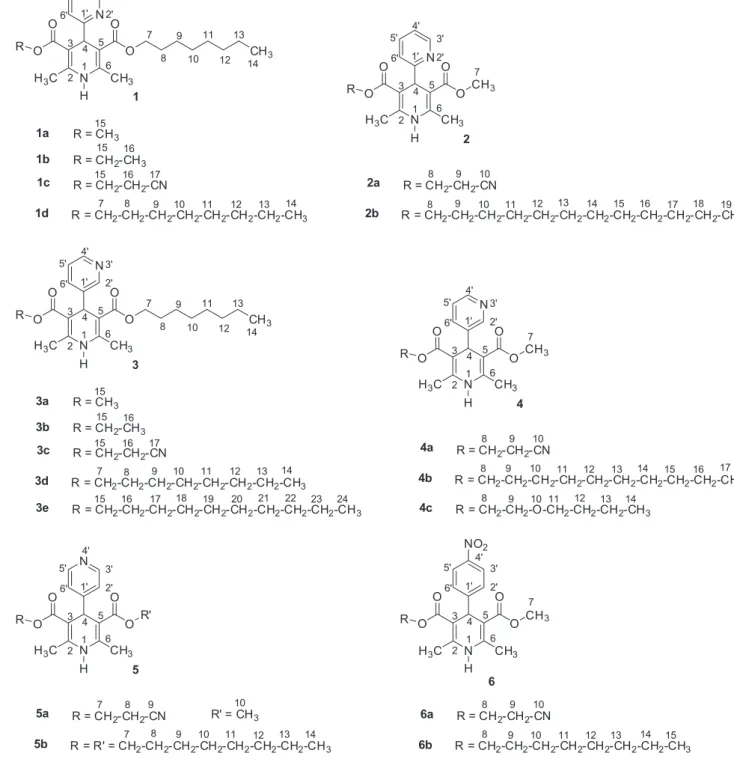
substituted 1,4-dihydropyridines endowed with long and functionalized chains, 1a-d, 2a-b, 3a-e, 4a-c and 5a-b (see
Figure 1). Also we describe the 15N NMR spectra of some
chosen compounds. These data are of interest to determine the effect that this substitution pattern has on the chemical shifts of the 1,4-DHPs ring and to complete the reference data on the previously reported related systems.8,11
Results and Discussion
The 1,4-DHPs derivatives here studied were prepared by a Hantzsch-like synthesis, and obtained as stable crystalline solids with good yields.
In order to assign unequivocally all NMR signals, we used 1D and 2D techniques such as DEPT(135), HMQC and HMBC.
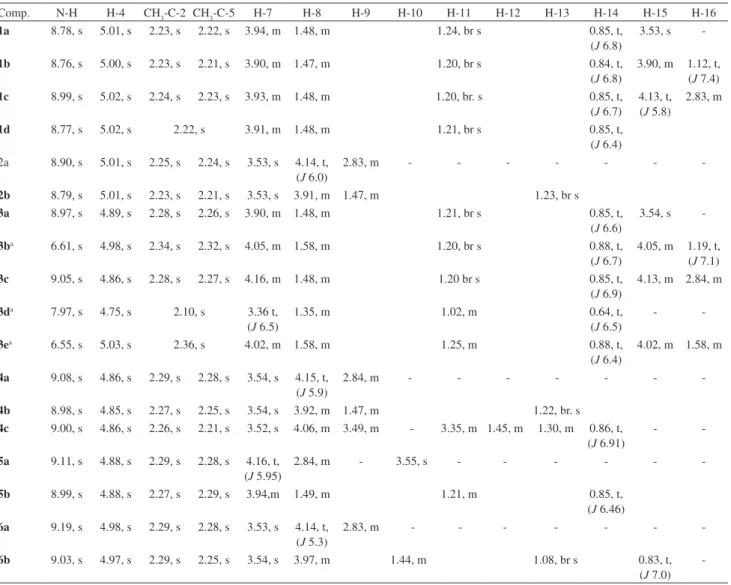
The 1H NMR spectra at 300 MHz of 1,4-DHPs
(Table 1) show a singlet corresponding to the NH proton at 9.19-8.76 ppm when the spectra were registered in
DMSO-d6 or at 6.55-7.97 when they were registered in
CDCl3. Also at 4.75-5.02 ppm appears another singlet corresponding to the H4 proton.
distinguished in compounds 1d, 3d and 3e, because of the
similarity of the substituents on C-3 and C-5. The 1H NMR
spectra of compounds 1, 2, 3, 4 and 5, also show signals
between 7.0-8.5 ppm corresponding to the protons of the pyridine ring on C-4, showing the characteristic multiplicity depending on the position of the nitrogen atom in the pyridine ring. In compounds 6a and 6b endowed with a p-nitrophenyl ring, the aromatic protons appear at 8.1 and
7.4 ppm as an AA’BB’ system.
The alkoxycarbonyl group shows a number of signals which depends of the size of the chain. In these cases, the methylene group joint to the oxygen atom of the
alkoxycarbonyl chain (–O–CH2–R) on C-3 and C-5,
appears at ca. 3.9 ppm as a multiplet due to the presence
of a stereogenic center on C-4. The rest of the aliphatic protons appear as a broad multiplet at ca. 1.2 ppm and
terminal methyl group as a triplet at d 0.8 ppm. The
protons of the α-methylene group corresponding to the
cyanoethyl group in compounds 1c, 2a, 3c, 4a, 5a and 6a appear as a multiplet at d 2.8 ppm while the β-protons resonate at 4.1 ppm forming a triplet.
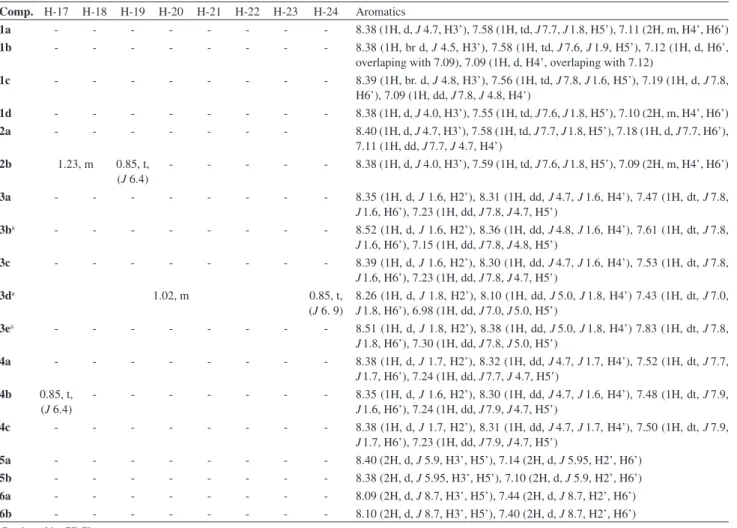
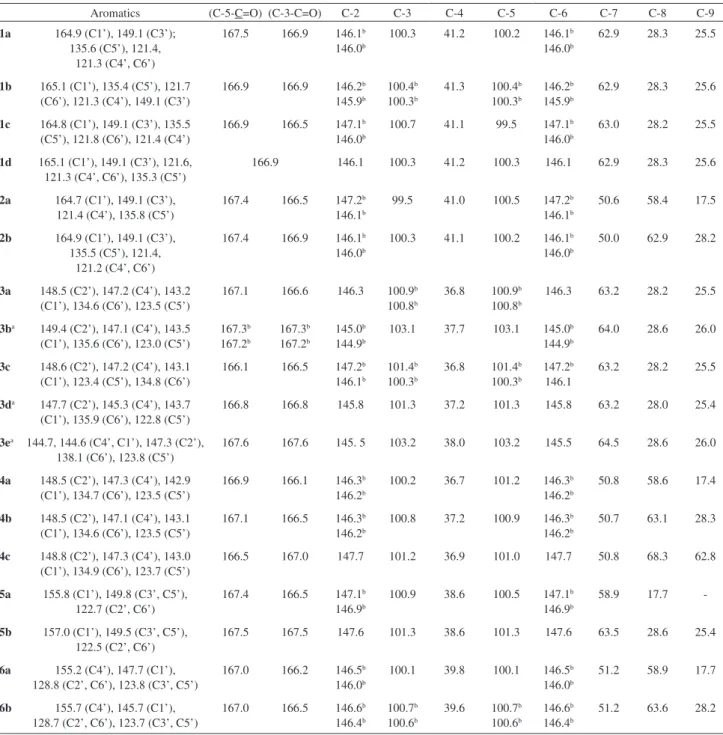
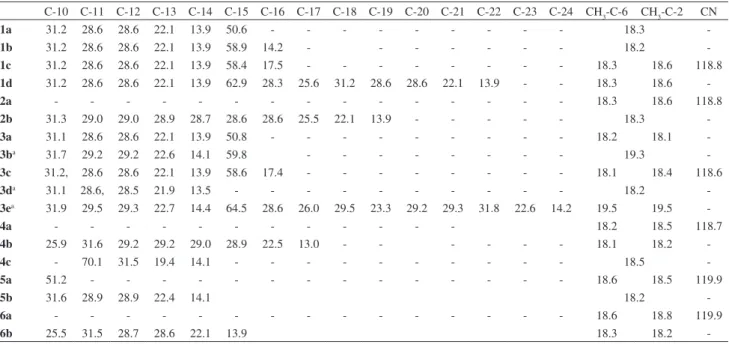
The 13C NMR spectra of these compounds exhibit
signals in the carbonyl, aromatic and aliphatic regions. In order to assign unequivocally the signals corresponding to the heterocyclic ring, we used 1D and 2D techniques: DEPT(135), HMQC and HMBC.
For the 1,4-DHP ring, the spectra showed four quaternary carbon signals (C-2, C-3, C-5, and C-6) and one tertiary carbon signal (C-4). As can be seen in Table 2, the signals corresponding to the 1,4-DHP carbons ring are relatively insensitive to the nature of the substituents on C-3, C-4, and C-5. The 13C NMR
spectra of these compounds show the signal for C-3 and C-5 at lowerd values (ca.100 ppm) than those expected
for typical oleinic carbons atoms, while C-2 and C-6 signals appear at higher d values (ca.146 ppm) and C-4
appears between 36.8 and 41.3 ppm. These indings have been accounted for by the strong push-pulleffect of the groups linked to the oleinic double bonds, similar to that previously observed in other related molecules.8-11 The
alkoxycarbonyl sp2-carbon (COOR or COOR1) on C-3
and C-5 appears at 166-167 ppm. In compounds 1c, 2a, 3c, 4a, 5a and 6a the cyano group appears at ca.119 ppm.
As we can see in Table 2, some carbons of the alkoxy chain do not present remarkable dificulties to be resolved and all nuclei were assigned on the basis of coupling constant and cross peaks on the 2D spectra. The rest of the signals are in agreement with the nature of aromatic or aliphatic carbon atoms. All the compounds showed a similar trend in the chemical shifts of the common moiety of the molecular backbone.
Also the 15N NMR spectrum of the compounds
2a, 4a, 4c and 5a were recorded in order to ensure the
structure. The 15N HMQC, using two different values
Table 1.1H NMR data for compounds 1a-d, 2a-b, 3a-e, 5a-b, 6a-b (d, ppm; J, Hz)
Comp. N-H H-4 CH3-C-2 CH3-C-5 H-7 H-8 H-9 H-10 H-11 H-12 H-13 H-14 H-15 H-16
1a 8.78, s 5.01, s 2.23, s 2.22, s 3.94, m 1.48, m 1.24, br s 0.85, t,
(J 6.8)
3.53, s
-1b 8.76, s 5.00, s 2.23, s 2.21, s 3.90, m 1.47, m 1.20, br s 0.84, t,
(J 6.8)
3.90, m 1.12, t, (J 7.4)
1c 8.99, s 5.02, s 2.24, s 2.23, s 3.93, m 1.48, m 1.20, br. s 0.85, t,
(J 6.7) 4.13, t, (J 5.8)
2.83, m
1d 8.77, s 5.02, s 2.22, s 3.91, m 1.48, m 1.21, br s 0.85, t,
(J 6.4) 2a 8.90, s 5.01, s 2.25, s 2.24, s 3.53, s 4.14, t,
(J 6.0)
2.83, m - - -
-2b 8.79, s 5.01, s 2.23, s 2.21, s 3.53, s 3.91, m 1.47, m 1.23, br s
3a 8.97, s 4.89, s 2.28, s 2.26, s 3.90, m 1.48, m 1.21, br s 0.85, t, (J 6.6)
3.54, s
-3ba 6.61, s 4.98, s 2.34, s 2.32, s 4.05, m 1.58, m 1.20, br s 0.88, t,
(J 6.7)
4.05, m 1.19, t, (J 7.1)
3c 9.05, s 4.86, s 2.28, s 2.27, s 4.16, m 1.48, m 1.20 br s 0.85, t,
(J 6.9)
4.13, m 2.84, m
3da 7.97, s 4.75, s 2.10, s 3.36 t,
(J 6.5)
1.35, m 1.02, m 0.64, t,
(J 6.5)
-
-3ea 6.55, s 5.03, s 2.36, s 4.02, m 1.58, m 1.25, m 0.88, t,
(J 6.4)
4.02, m 1.58, m
4a 9.08, s 4.86, s 2.29, s 2.28, s 3.54, s 4.15, t,
(J 5.9)
2.84, m - - -
-4b 8.98, s 4.85, s 2.27, s 2.25, s 3.54, s 3.92, m 1.47, m 1.22, br. s
4c 9.00, s 4.86, s 2.26, s 2.21, s 3.52, s 4.06, m 3.49, m - 3.35, m 1.45, m 1.30, m 0.86, t, (J 6.91)
-
-5a 9.11, s 4.88, s 2.29, s 2.28, s 4.16, t, (J 5.95)
2.84, m - 3.55, s - - -
-5b 8.99, s 4.88, s 2.27, s 2.29, s 3.94,m 1.49, m 1.21, m 0.85, t,
(J 6.46)
6a 9.19, s 4.98, s 2.29, s 2.28, s 3.53, s 4.14, t, (J 5.3)
2.83, m - - -
-6b 9.03, s 4.97, s 2.29, s 2.25, s 3.54, s 3.97, m 1.44, m 1.08, br s 0.83, t,
-Table 1. Continuation
Comp. H-17 H-18 H-19 H-20 H-21 H-22 H-23 H-24 Aromatics
1a - - - 8.38 (1H, d, J 4.7, H3’), 7.58 (1H, td, J7.7, J1.8, H5’), 7.11 (2H, m, H4’, H6’)
1b - - - 8.38 (1H, br d, J 4.5, H3’), 7.58 (1H, td, J7.6, J1.9, H5’), 7.12 (1H, d, H6’, overlaping with 7.09), 7.09 (1H, d, H4’, overlaping with 7.12)
1c - - - 8.39 (1H, br. d, J 4.8, H3’), 7.56 (1H, td, J7.8, J1.6, H5’), 7.19 (1H, d, J7.8, H6’), 7.09 (1H, dd, J7.8, J 4.8, H4’)
1d - - - 8.38 (1H, d, J 4.0, H3’), 7.55 (1H, td, J7.6, J1.8, H5’), 7.10 (2H, m, H4’, H6’)
2a - - - 8.40 (1H, d, J 4.7, H3’), 7.58 (1H, td, J7.7, J1.8, H5’), 7.18 (1H, d, J7.7, H6’), 7.11 (1H, dd, J7.7, J 4.7, H4’)
2b 1.23, m 0.85, t, (J 6.4)
- - - 8.38 (1H, d, J 4.0, H3’), 7.59 (1H, td, J7.6, J1.8, H5’), 7.09 (2H, m, H4’, H6’)
3a - - - 8.35 (1H, d, J 1.6, H2’), 8.31 (1H, dd, J4.7, J1.6, H4’), 7.47 (1H, dt, J7.8, J1.6, H6’), 7.23 (1H, dd, J7.8, J4.7, H5’)
3ba - - - - - - - - 8.52 (1H, d, J 1.6, H2’), 8.36 (1H, dd, J4.8, J1.6, H4’), 7.61 (1H, dt, J7.8, J1.6, H6’), 7.15 (1H, dd, J7.8, J4.8, H5’)
3c - - - 8.39 (1H, d, J 1.6, H2’), 8.30 (1H, dd, J4.7, J1.6, H4’), 7.53 (1H, dt, J7.8, J1.6, H6’), 7.23 (1H, dd, J7.8, J4.7, H5’)
3da 1.02, m 0.85, t,
(J 6. 9)
8.26 (1H, d, J 1.8, H2’), 8.10 (1H, dd, J5.0, J1.8, H4’) 7.43 (1H, dt, J7.0, J1.8, H6’), 6.98 (1H, dd, J7.0, J5.0, H5’)
3ea - - - - - - - - 8.51 (1H, d, J 1.8, H2’), 8.38 (1H, dd, J5.0, J1.8, H4’) 7.83 (1H, dt, J7.8, J1.8, H6’), 7.30 (1H, dd, J7.8, J5.0, H5’)
4a - - - 8.38 (1H, d, J 1.7, H2’), 8.32 (1H, dd, J4.7, J1.7, H4’), 7.52 (1H, dt, J7.7, J1.7, H6’), 7.24 (1H, dd, J7.7, J 4.7, H5’)
4b 0.85, t, (J 6.4)
- - - 8.35 (1H, d, J 1.6, H2’), 8.30 (1H, dd, J4.7, J1.6, H4’), 7.48 (1H, dt, J7.9, J1.6, H6’), 7.24 (1H, dd, J7.9, J4.7, H5’)
4c - - - 8.38 (1H, d, J 1.7, H2’), 8.31 (1H, dd, J4.7, J1.7, H4’), 7.50 (1H, dt, J7.9, J1.7, H6’), 7.23 (1H, dd, J7.9, J4.7, H5’)
5a - - - 8.40 (2H, d, J 5.9, H3’, H5’), 7.14 (2H, d, J 5.95, H2’, H6’)
5b - - - 8.38 (2H, d, J 5.95, H3’, H5’), 7.10 (2H, d, J 5.9, H2’, H6’)
6a - - - 8.09 (2H, d, J 8.7, H3’, H5’), 7.44 (2H, d, J 8.7, H2’, H6’)
6b - - - 8.10 (2H, d, J 8.7, H3’, H5’), 7.40 (2H, d, J 8.7, H2’, H6’) aRegistred in CDCl
3.
of the N,H coupling constants, allow us to determine the chemical shift of the nitrogen atoms present in the molecule. In the HMQC, using a value of 1J(N,H) 80 Hz,
the hydrogen signal correlates with the N-1 atom at
ca.–239 ppm. However in the HMQC using values of
nJ(N,H) 5 Hz the hydrogen signals showing correlation
were those bonded through more than one bond. This conirms the position of N-1 and allows us to assign the position of the pyridine nitrogen at ca.–66 ppm, which
is in agreement with values reported in the literature12
(see Table 3).
Experimental
Material
Compounds 1, 2, 3, 4, 5 and 6 were prepared according
to the synthetic method described previously.6 The
1,4-DHPs derivatives were purified by recrystallization. Compatible IR and mass spectra and combustion analyses were taken for each compound.
Spectra
All NMR experiments were performed at 298 K for a solution of 30 mg of compound dissolved in 0.7 mL of
DMSO-d6 on a Bruker AVANCE-300 instrument with a
5-mm QNP probe head equipped with shielded Z-gradient coil. 1H NMR spectra were recorded at a proton frequency
of 300.13 MHz with a spectral width of 4.5 kHz and a 2.15 µs (30°) pulse. The acquisition time was 1.8 s and relaxation delay 1 s; 16 scans with 16k data points each
were used. The 13C NMR were obtained using a spectral
width of 20 kHz, a 1.9 µs (30°) pulse, and a 1.7 s acquisition time; 512 scans with 64k data points each were used. Exponential multiplication was applied before Fourier transformation in both cases. The chemical shifts were
referenced to DMSO-d
6. The one-bond heteronuclear
correlation (HMQC) spectra were obtained using the inv4gs program in the Bruker software. The spectra resulted from a 256 × 2048 data matrix with 8 scans per t1 increment.
Table 2. 13C NMR data for compounds 1a-d, 2a-b, 3a-e, 5a-b, 6a-b (d, ppm)
Aromatics (C-5-C=O) (C-3-C=O) C-2 C-3 C-4 C-5 C-6 C-7 C-8 C-9
1a 164.9 (C1’), 149.1 (C3’); 135.6 (C5’), 121.4,
121.3 (C4’, C6’)
167.5 166.9 146.1b
146.0b
100.3 41.2 100.2 146.1b
146.0b
62.9 28.3 25.5
1b 165.1 (C1’), 135.4 (C5’), 121.7 (C6’), 121.3 (C4’), 149.1 (C3’)
166.9 166.9 146.2b
145.9b
100.4b
100.3b
41.3 100.4b
100.3b
146.2b
145.9b
62.9 28.3 25.6
1c 164.8 (C1’), 149.1 (C3’), 135.5 (C5’), 121.8 (C6’), 121.4 (C4’)
166.9 166.5 147.1b
146.0b
100.7 41.1 99.5 147.1b
146.0b
63.0 28.2 25.5
1d 165.1 (C1’), 149.1 (C3’), 121.6, 121.3 (C4’, C6’), 135.3 (C5’)
166.9 146.1 100.3 41.2 100.3 146.1 62.9 28.3 25.6
2a 164.7 (C1’), 149.1 (C3’), 121.4 (C4’), 135.8 (C5’)
167.4 166.5 147.2b
146.1b
99.5 41.0 100.5 147.2b
146.1b
50.6 58.4 17.5
2b 164.9 (C1’), 149.1 (C3’), 135.5 (C5’), 121.4,
121.2 (C4’, C6’)
167.4 166.9 146.1b
146.0b
100.3 41.1 100.2 146.1b
146.0b
50.0 62.9 28.2
3a 148.5 (C2’), 147.2 (C4’), 143.2 (C1’), 134.6 (C6’), 123.5 (C5’)
167.1 166.6 146.3 100.9b
100.8b
36.8 100.9b
100.8b
146.3 63.2 28.2 25.5
3ba 149.4 (C2’), 147.1 (C4’), 143.5
(C1’), 135.6 (C6’), 123.0 (C5’)
167.3b 167.2b 167.3b 167.2b 145.0b 144.9b
103.1 37.7 103.1 145.0b
144.9b
64.0 28.6 26.0
3c 148.6 (C2’), 147.2 (C4’), 143.1 (C1’), 123.4 (C5’), 134.8 (C6’)
166.1 166.5 147.2b
146.1b
101.4b
100.3b
36.8 101.4b
100.3b
147.2b
146.1
63.2 28.2 25.5
3da 147.7 (C2’), 145.3 (C4’), 143.7
(C1’), 135.9 (C6’), 122.8 (C5’)
166.8 166.8 145.8 101.3 37.2 101.3 145.8 63.2 28.0 25.4
3ea 144.7, 144.6 (C4’, C1’), 147.3 (C2’),
138.1 (C6’), 123.8 (C5’)
167.6 167.6 145. 5 103.2 38.0 103.2 145.5 64.5 28.6 26.0
4a 148.5 (C2’), 147.3 (C4’), 142.9 (C1’), 134.7 (C6’), 123.5 (C5’)
166.9 166.1 146.3b
146.2b
100.2 36.7 101.2 146.3b
146.2b
50.8 58.6 17.4
4b 148.5 (C2’), 147.1 (C4’), 143.1 (C1’), 134.6 (C6’), 123.5 (C5’)
167.1 166.5 146.3b
146.2b
100.8 37.2 100.9 146.3b
146.2b
50.7 63.1 28.3
4c 148.8 (C2’), 147.3 (C4’), 143.0 (C1’), 134.9 (C6’), 123.7 (C5’)
166.5 167.0 147.7 101.2 36.9 101.0 147.7 50.8 68.3 62.8
5a 155.8 (C1’), 149.8 (C3’, C5’), 122.7 (C2’, C6’)
167.4 166.5 147.1b
146.9b
100.9 38.6 100.5 147.1b
146.9b
58.9 17.7
-5b 157.0 (C1’), 149.5 (C3’, C5’), 122.5 (C2’, C6’)
167.5 167.5 147.6 101.3 38.6 101.3 147.6 63.5 28.6 25.4
6a 155.2 (C4’), 147.7 (C1’), 128.8 (C2’, C6’), 123.8 (C3’, C5’)
167.0 166.2 146.5b
146.0b
100.1 39.8 100.1 146.5b
146.0b
51.2 58.9 17.7
6b 155.7 (C4’), 145.7 (C1’), 128.7 (C2’, C6’), 123.7 (C3’, C5’)
167.0 166.5 146.6b
146.4b
100.7b
100.6b
39.6 100.7b
100.6b
146.6b
146.4b
51.2 63.6 28.2
3.45 ms, (corresponding to an average 1J(C,H) of 145 Hz),
and the recycle time was 1.44 s. Fourier transformation was done on a 2k × 1k data matrix. The long-range 1H-13C
correlation (HMBC) spectra were obtained using the inv4gslplrnd program in the Bruker software. The spectra resulted from a 256 × 2048 data matrix with 16 scans per t1
increment. A spectral width of 3.5 kHz in f2 and 16.7 kHz in f1 were used. The acquisition time was 0.30 s, the delays were set to 3.45 ms (1/2JC,H) and 65 ms (corresponding to an
average 1/nJ
C,H of 7.7Hz), and the recycle time was 1.44 s.
Fourier transformation was done on a 2k × 1k data matrix.
15N NMR spectra were recorded at 50.687 MHz on
a Bruker Avance-500 instrument. The chemical shifts
were referenced to CH3NO2 at 0.00 ppm. The one-bond
heteronuclear correlation (HMQC) was obtained using the inv4gpqf program in the Bruker software. The spectra resulted from a 128 × 1024 data matrix with 32 scans per
t1 increment. Spectral widths of 6.5 kHz in f2 and 20.5 kHz in f1 were used. The acquisition time was 0.1 s and delay was set to 6 ms (corresponding to 1J(N,H) of 80 Hz) and
Table 2. Continuation
C-10 C-11 C-12 C-13 C-14 C-15 C-16 C-17 C-18 C-19 C-20 C-21 C-22 C-23 C-24 CH3-C-6 CH3-C-2 CN
1a 31.2 28.6 28.6 22.1 13.9 50.6 - - - 18.3
-1b 31.2 28.6 28.6 22.1 13.9 58.9 14.2 - - - 18.2
-1c 31.2 28.6 28.6 22.1 13.9 58.4 17.5 - - - 18.3 18.6 118.8
1d 31.2 28.6 28.6 22.1 13.9 62.9 28.3 25.6 31.2 28.6 28.6 22.1 13.9 - - 18.3 18.6
-2a - - - 18.3 18.6 118.8
2b 31.3 29.0 29.0 28.9 28.7 28.6 28.6 25.5 22.1 13.9 - - - 18.3
-3a 31.1 28.6 28.6 22.1 13.9 50.8 - - - 18.2 18.1
-3ba 31.7 29.2 29.2 22.6 14.1 59.8 - - - - - - - - 19.3
-3c 31.2, 28.6 28.6 22.1 13.9 58.6 17.4 - - - 18.1 18.4 118.6
3da 31.1 28.6, 28.5 21.9 13.5 - - - - - - - - - - 18.2
-3ea 31.9 29.5 29.3 22.7 14.4 64.5 28.6 26.0 29.5 23.3 29.2 29.3 31.8 22.6 14.2 19.5 19.5
-4a - - - 18.2 18.5 118.7
4b 25.9 31.6 29.2 29.2 29.0 28.9 22.5 13.0 - - - 18.1 18.2
-4c - 70.1 31.5 19.4 14.1 - - - 18.5
-5a 51.2 - - - 18.6 18.5 119.9
5b 31.6 28.9 28.9 22.4 14.1 18.2
-6a - - - 18.6 18.8 119.9
6b 25.5 31.5 28.7 28.6 22.1 13.9 18.3 18.2
-aRegistred in CDCl
3; bInterchangeable.
Conclusions
We have recorded the 1H and 13C NMR spectra of
several substituted 1,4-dihydropyridines (1,4-DHPs) endowed with long and functionalized chains in order to assign unequivocally all the chemical shifts. These spectral data are of interest to report the effect of the substitution pattern on the chemical shifts and to complete reference data previously reported. The 1,4-DHPs carbons ring are practically insensitive to the nature of substituents. Also, we present the 15N NMR spectroscopic data of the reported
molecules.
References
1. Goldmann, S.; Stoltefuss, J.; Angew. Chem., Int. Ed.1991, 30, 1559; Richter, M.; Molnar, J.; Hilgeroth, A.; J. Med. Chem.
2006, 49, 2838.
2. Jain, P.; Narang, G.; Jindal, D. P.; Bansal, R.; Calle, C.; Carron, R.; Pemberton, K.; Harvey, A. L.; Pharmazie2006, 61, 400; Evdokimov, N. M.; Magedov , I. V.; Kireev, A. S.; Kornienko, A.; Org. Lett.2006, 8, 899.
3. Triggle, D. J.; Mini-Rev. Med. Chem. 2003, 3, 215; Triggle, D.; J. Cell. Moll. Neurobiol.2003, 23, 293.
4. Boschi, D.; Caron, G.; Visentin, S.; Di Stilo, A.; Rolando, B.; Fruttero, R.; Gasco, A.; Pharm. Res. 2001, 18, 987.
5. Minsane, I.; Klusa, V.; Dambrova, M.; Germane, S.; Duburs, G.; Bisennieks, E.; Roimondini, R.; Ogren, S. O.; Eur. Neuropsychopharmacol. 1998, 8, 329.
6. Suárez, M.; de Armas, M.; Ramírez, O.; Alvarez, A.; Martinez, R.; Molero, D.; Seoane, C.; Liz, R.; Novoa, H.; Blaton, N.; Peeters, O.; Martín, N.; New J. Chem.2005, 12, 1567. 7. Suárez, M.; de Armas, M.; Ramírez, O.; Álvarez, A.;
Martínez-Álvarez, R.; Kayali, N.; Seoane, C.; Martin, N.; Rapid Commun. Mass Spectrom.2005, 19, 1906.
8. Suárez, M.; Molero, D.; Salfrán, E.; Martín, N.; Verdecia, Y.; Martinez, R.; Ochoa, E.; Alba, L.; Quinteiro, M.; Seoane, C.; Magn. Reson. Chem. 2001, 39, 105.
9. Suárez, M.; Martín, N.; Martínez, R.; Verdecia, Y.; Molero, D.; Alba, L.; Seoane, C.; Ochoa, E.; Magn. Reson. Chem.2002, 40, 303. 10. Molero, D.; Suárez, M.; Martínez-Álvarez, R.; Verdecia, Y.;
Martín, N.; Seoane, C.; Ochoa, E.; Magn. Reson. Chem.2004, 42, 704.
11. Salfrán, E.; Suárez, M.; Molero, D.; Martínez-Álvarez, R.; Verdecia, Y.; Ochoa, E.; Álvarez, A.; Seoane, C.; Herrera, A.; Martín, N.; Magn. Reson. Chem.2006, 44, 637.
12. Berger, S.; Braun, S.; Kalinowski, H. O.; NMR Spectroscopy of the Non-MetallicElements, John Wiley & Sons: Chichester, 1997 ( ISBN 0 471 96763 7).
Submitted: March 26, 2010
Published online: July 27, 2010
Table 3.15N HMQC data for 1,4-dihydropyridine derivatives (ppm)
Compound N-1 N-2’ N-3’ N-4’
2a –238.28 –65.15 -
-4a –239.44 - –63.22
-4c –240.17 - –62.53