Article
Influence of Na, K, Ca and Mg on Lead Atomization by
Tungsten Coil Atomic Absorption Spectrometry
Pedro V. de Oliveiraa*, Francisco J. Krugb, Márcia M. Silvac, Joaquim A. Nóbregad,
Zilvanir F. Queiroze and Fábio R. P. Rochad
a
Instituto de Química, Universidade de São Paulo, CP 26077, 05513-970, São Paulo - SP, Brazil
b
Centro de Energia Nuclear na Agricultura, Universidade de São Paulo, CP 96, 13400-970, Piracicaba - SP, Brazil
c
Departamento de Química, Universidade Federal do Rio Grande do Sul, CP 15003, 91501-970, Porto Alegre - RS, Brazil
d
Departamento de Química, Universidade Federal de São Carlos, CP 676, 13565-905, São Carlos - SP, Brazil
e
Instituto de Química de São Carlos, Universidade de São Paulo, CP 369, 13560-970, São Carlos - SP, Brazil
A atomização de chumbo em atomizador eletrotérmico de filamento de tungstênio, na presença e ausência de altas concentrações de Na+, K+, Ca2+ e Mg2+, foi investigada com o objetivo de entender os
processos de interferências. A atomização do chumbo foi menos comprometida por Ca2+ e Mg2+ do que
por Na+ e K+. Na ausência dos concomitantes, a eficiência da atomização de chumbo foi melhorada com
a presença de H2 (10% v/v) na composição do gás de purga, durante as etapas de pirólise e atomização.
As interferências causadas por Na+ e Ca2+ foram desprezíveis quando a etapa de pirólise foi realizada sem
o H2 na composição do gás de purga. Os resultados mostraram que Na+, K+, Ca2+ e Mg2+ podem estar
diretamente envolvidos nas reações de competição pelo H2 nos processos em fase condensada.
The atomization of lead in an electrothermal tungsten coil atomizer in the presence and absence of Na+, K+, Ca2+ and Mg2+ was investigated with the objective of understanding the interference
processes. The lead atomization was less affected by Ca2+ and Mg2+ than by Na+ and K+. In the
absence of concomitants, lead atomization efficiency was improved by the presence of H2 (10%
v/v) in the purge gas composition, during pyrolysis and atomization steps. The interference caused by Na+ and Ca2+ was negligible when the pyrolysis step was accomplished without H2 in the purge
gas composition. The results showed that Na+, K+, Ca2+ and Mg2+ are directly involved in competition
reactions for H2 in condensed phase.
Keywords: lead atomization, atomic absorption spectrometry, tungsten coil atomizer, interference
Introduction
In the last 25 years, loops, tubes, micro-tubes and coils made of tungsten or tungsten alloys have been proposed as atomizers for the determination of many elements by elec-trothermal atomic absorption spectrometry1,2. The main
features of these atomizers are simplicity, low cost, and the tungsten physical and chemical properties such as high melting point (3680 K), low specific heat (0.133 J g-1 K-1),
low background emission and low reactivity with most of elements of analytical interest1-4. When tungsten coils are
used, a low power supply (150 W) is required and the use of cooling system is unnecessary. As a consequence, portable
electrothermal atomic absorption spectrometers are becom-ing a promisbecom-ing reality5-7.
There are only a few studies with metallic atomizers re-garding the effect of concomitants, and practically no infor-mation on the role of the concomitants in the atomization processes. Experiments carried out by Cantle and West8 showed
that lead was less affected by interference when it was atom-ized from a tungsten filament than from a graphite filament of similar dimensions. It was suggested that this behavior is re-lated to differences in the heating rate of the atomizers. New-ton and Davis9 studied the effects of 27 cations and anions on
lead atomization in a tungsten-rhenium loop atomizer and proposed that most of the interference was dependent on the heating rate of this atomizer. It was shown that 20% (v/v) of H2 in purge gas composition decreased the chemical interference and non-specific absorption due to concomitants.
Chauvin et al.3 using a wire loop atomizer similar to that
described by West et al.10 observed that the atomization of
copper, cadmium, magnesium and beryllium was affected by concomitants probably owing to the formation of oxides and chlorides in the gas phase. It was also mentioned that the presence of SO42- diminished the interference caused by Na+
and K+.
Efforts have been made by research groups in Brazil11-18,
Chile19-25 and USA5-7 to demonstrate the usefulness of 150
W tungsten coils as atomizers for ET-AAS.
The aim of the present work is to investigate the interfer-ence processes involved in lead atomization from the tung-sten coil in the presence of Na+, K+, Ca2+ and Mg2+.
Experimental
Apparatus
A SpectrAA-40 (Varian, Victoria, Australia) atomic absorp-tion spectrometer coupled to a Varian DS-15 Data Staabsorp-tion was used. Pb, Na, K, Ca and Mg hollow cathode lamps and a deute-rium lamp source from the same manufacturer were used for measurements of atomic and background signals, respectively. The analytical wavelength was the 283.3 nm lead resonance line, selected with a spectral bandpass of 0.2 nm. All measure-ments were based on peak height absorbance with a 50 ms time constant. In all experiments, 10 µL of the solutions were intro-duced into the atomizer using a Varian autosampler.
The tungsten coil (OSRAM 150W, Munich, Germany) at-omizer was fixed in two copper electrodes supported by a PTFE fitting which was inserted into a 10 cm long flow-through cell mounted in a perspex base. The whole assembly replaced the Varian GTA-96 graphite furnace as previously described12.
The tungsten coil was heated by a programmable power sup-ply with a voltage feedback circuit (Anacom Equipments and Systems, São Bernardo do Campo, Brazil). The power supply was interfaced with the DS-15 Data Station, thereby enabling the tungsten coil furnace operation to be started by pushing the start GTA command. Argon 99.999 % (v/v) or a mixture containing 90% (v/v) Ar plus 10% (v/v) H2 (AGA, Campinas,
Brazil) flowing at 1.0 L min-1 were used as purge gas.
Reagents and reference solutions
All solutions were prepared from reagents of analytical. High purity de-ionized water obtained using a Milli-Q water purification system (Millipore, Bedford, MA, USA) was used throughout. Nitric and hydrochloric acids were purified us-ing quartz sub-boilus-ing stills (Kürner, Rosenheim, Germany). A 1000 mg Pb2+ L-1 stock solution was prepared from
Pb(NO3)2 (Johnson & Matthey Chemicals, Royston, Herts.,
UK) in 0.014 mol L-1 HNO3. Reference solutions of 100
and 200 µg Pb2+ L-1 were prepared by appropriate
dilu-tion of the Pb2+ stock solution, in 0.014 mol L-1 HNO3.
The effects of concomitants were investigated by us-ing solutions containus-ing up to 1000 mg Na+ L-1 (NaNO3),
1000 mg K+ L-1 (KNO3), 1000 mg Ca2+ L-1 (CaCO3 in
HNO3), 1000 mg Mg2+ L-1 (MgO in HNO3) in 0.014 mol
L-1 HNO3 all from Johnson & Matthey Chemicals. To
con-firm some hypothesis, 100 mg Li+ L-1 (LiNO3) (Johnson
& Matthey Chemicals) in 0.014 mol L-1 HNO3 was used.
Additionally, a 1.0% (w/v) solution of ascorbic acid (Merck, Darmstadt, Germany) was used as a chemical modifier.
Tungsten coil temperature measurements
An optical pyrometer Marathron MR1S (Raytek Corpora-tion, Santa Cruz, USA) was employed for tungsten coil tem-perature measurements at different applied voltages (1.5 - 15.0 V range). The measurements were implemented based in two wavelength ranges (750 to 1100 nm and 950 to 1100 nm)26.
For applied voltages below 1.5 V, the tungsten coil sur-face temperatures were estimated by observing the melting point of organic and inorganic compounds. A small amount of each compound was placed onto the tungsten coil and then a voltage that would generate temperature near its melt-ing point was applied in the tungsten coil26. The
experimen-tally observed melting points were close to the literature val-ues. All measurements were carried out with five replicates.
Pyrolysis temperature curves
The pyrolysis temperature curves were obtained with so-lutions containing 100 or 200 µg Pb2+ L-1 in absence and
presence up to 100 mg L-1 of Li+, Na+, K+, Ca2+ or Mg2+ in
0.014 mol L-1 HNO3. The pyrolysis temperature curves of 5
µg L-1 of Na+, K+, Ca2+ or Mg2+ in 0.014 mol L-1 HNO3 were
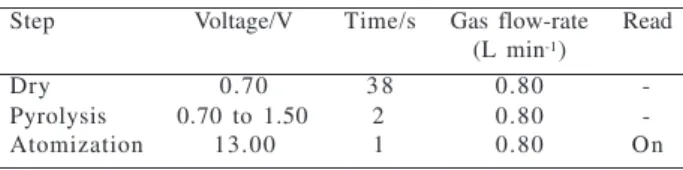
obtained by using the heating program showed in Table 1. The pyrolysis temperature curves were obtained with applied voltages varying from 0.70 (730 °C) to 1.5 V (1158 °C) dur-ing 2.0 s, the atomization step bedur-ing kept constant at 13.0 V (2763 °C) for 1.0 s. By using the same contidions, pyrolysis temperature curves with solutions prepared in 1.0% (w/v) ascorbic acid medium were obtained in the absence and pres-ence of 100 mg L-1 of Na+ in 0.014 mol L-1 HNO3.
Table 1. Heating program of tungsten coil atomizer
Step Voltage/V Time/s Gas flow-rate Read (L min-1)
Dry 0.70 3 8 0.80
-Pyrolysis 0.70 to 1.50 2 0.80
-Atomization 13.00 1 0.80 On
Effect of concomitants and observation heights
and Mg2+ on the absorbance signals of 100 µg Pb2+ L-1
was evaluated at 0.0, 1.0, 2.0, 3.0 and 4.0 mm observation heights with the filament positioned below the radiation beam. The tungsten coil was initially positioned in the cen-ter of the radiation beam and this observation height was established as the zero reference point. The observation heights were determined positioning the tungsten coil in 1.0 mm increments until 4.0 mm below the radiation beam.
Results and Discussion
Pyrolysis temperature curves
Preliminary investigations with atomization of lead in presence of Na+, K+, Ca2+ and Mg2+, using the heating
program (Table 1) with and without pyrolysis step, showed contrasting results. Either signal suppression or enhance-ment were observed depending on the heating program employed (Table 2). The heating program with pyrolysis produced negative interference, except in presence of 1 mg L-1 of Na+ and Mg2+, and 10 mg L-1 of Mg2+ when
interference was slightly positive. However, these effects were opposite with a heating program without pyrolysis, except for 1000 mg L-1 of Ca2+ and Mg2+. In general,
Na+ and K+ produced the largest effects on lead
atomiza-tion. Newton and Davis9 found similar effects when
work-ing with tungsten-rhenium loops, but they did not ex-plain them.
Table 2. Effect of concomitants on atomization of 200µg Pb2+ L-1
in 0.014 mol L-1 of HNO 3
∆ Peak height absorbance (%) with pyrolysis* without pyrolysis*
1 1 0 100 1000 1 1 0 100 1000 NaNO3 + 5 - 3 - 45 - 53 + 3 + 67 + 73 + 23
KNO3 - 10 - 10 - 56 - 57 + 20 + 5 + 47 + 6 Ca(NO3)2 - 6 - 17 - 5 - 41 + 11 + 11 + 11 - 35 Mg(NO3)2 + 3 + 9 - 8 - 34 + 11 + 47 + 48 - 7
* Concomitants Concentrations: 1, 10, 100 and 1000 mg L-1
The presence of Na+, K+, Ca2+ and Mg2+ (100 mg L-1
in 0.014 mol L-1 HNO3) affected the profile of the lead
pyrolysis curve (Figure 1). The pyrolysis temperature sup-ported by lead, without chemical modifier, was 920 oC.
Above 920 oC neither Ca2+ nor Mg2+ changed lead
at-omization, and below this temperature they caused posi-tive interference. However, interferences by Na+ and K+
were more severe for higher pyrolysis temperatures. The absorbance signals were drastically reduced for higher py-rolysis temperature whereas, for lower temperatures, they produced positive interferences (Figure 1).
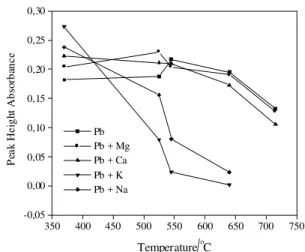
To verify the thermal stability of these elements in a tungsten coil atomizer, pyrolysis temperature curves for 5 mg L-1 of Na+, K+, Ca2+ and Mg2+ in 0.014 mol L-1 of
Figure 1. Pyrolysis temperature curves for 100 µg Pb2+ L-1 with
and without 100 mg L-1 of concomitants in 0.014 mol L-1 of HNO
3;
purge gas composition: 90% v/v Ar + 10% v/v H2; volume injected
10 µL and atomization temperature: 2763 oC
HNO3 were obtained. The pyrolysis temperature curves of
these concomitants showed thermal stability over 1100 oC
up to 1500 oC (Figure 2), making difficult the vaporization
of the concomitants without losses of lead, that presented maximum thermal stability at 920 oC. Moreover, the
at-omization of these concomitants showed a strong depen-dence of hydrogen (10% v/v) in the purge gas composi-tion. The absence of hydrogen during pyrolysis or atomi-zation steps reduced drastically the absorbance signals of these elements.
Recently, L’vov27 pointed out that the most probable
mechanism of atomization for alkali metals is governed by the reaction:
MOH(s/l) = M(g) + OH(g) (1)
350 400 450 500 550 600 650 700 750
-0,05 0,00 0,05 0,10 0,15 0,20 0,25 0,30
Pb Pb + Mg Pb + Ca Pb + K Pb + Na
P
ea
k
He
ig
ht
Ab
so
rb
an
ce
Temperature oC
Figure 2. Pyrolysis temperature curves for 100 µg Pb L-1 and for 5 mg L-1 of Na, K, Ca and Mg in 0.014 mol L-1 of HNO3; purge gas
composition: 90% v/v Ar + 10% v/v H2; volume injected 10 µL and
atomization temperature: 2763 oC
0 200 400 600 800 1000 1200 1400 1600
-0,20 -0,10 0,00 0,10 0,20 0,30 0,40 0,50 0,60 0,70
Pb Na K Ca Mg
Pe
ak He
igh
t
A
bso
rban
ce
The same author also pointed out that Ca2+ and Mg2+
are atomized through the direct reduction of their oxides:
MO(s,l) + H2(g) = M(g) + H2O(g) (2) Based on these proposed mechanism, it could be as-sumed that the formation of monohydroxides of sodium and potassium (reaction 1) and the reduction of calcium and magnesium oxides by hydrogen in the condensed phase (reaction 2) are occurring preferentially.
It could be thought that oxide species of lead, mono-hydroxides of alkaline elements and oxides of alkaline-earth elements are their prevalent atomic precursors. Mono-hydroxide species could be formed in the condensed phase by heterogeneous reaction with hydrogen, since this gas is also essential during the pyrolysis step.
In this case, one hypothesis to explain the negative interference caused by Na+ and K+ would be the
competi-tion for the hydrogen present in the purge gas, which was necessary for lead, sodium and potassium atomization. These processes could affect the dissociation of lead ox-ide in the condensed or vapor phase:
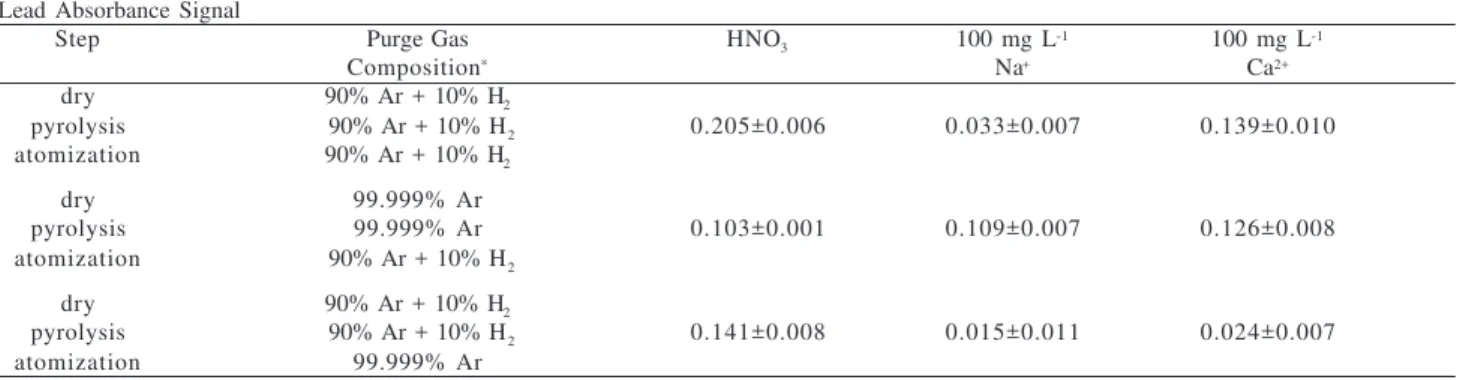
PbO(s,l,g) + ½ H2(g) = Pb(g) + H2O(g) (3) To show the competition of hydrogen during pyroly-sis step, an experiment was carried out without hydrogen in the purge gas composition during pyrolysis or atomiza-tion steps. The interference of Na+ and Ca2+ in lead
atomi-zation was suppressed when pure argon 99.999% (v/v) atmosphere was used during the dry and pyrolysis steps and a mixture of 90% (v/v) Ar plus 10% (v/v) H2 was used in the atomization step. Besides, using a mixture of 90% (v/v) Ar plus 10% (v/v) H2 during the dry and pyrolysis steps and pure argon 99.999% (v/v) in the atomization step, the interference persisted (Table 3).
To confirm the hypothesis that the interference pro-cesses were related to the formation of monohydroxides
species, an experiment was also carried out with Li+ and
ascorbic acid. This element was chosen considering that its monohydroxide is easily formed28 and thus the
inter-ference should manifest more critically.
The lead pyrolysis temperature curves in the pres-ence of Li+ (Figure 3) showed, as expected, that
atomiza-tion suppression was much more pronounced, confirm-ing the hypothesis that lead atomization is affected by a competition process for hydrogen, since monohydroxide species of Na+, K+ and Li+ are formed during dry and
pyrolysis steps. Lead pyrolysis temperature curves in presence of 10 fold less Li+ than Na+ or K+, presented
more severe interference even at low pyrolysis tempera-tures. Figure 3 shows that in presence of 10 mg Li+ L-1,
the lead analytical signal was strongly attenuated and disappeared with 100 mg Li+ L-1 for all applied voltages.
Monohydroxides of alkaline metals are more stable than oxides, and LiOH is the most stable28. The more stable
the monohydroxide species, the more pronounced is the interference of the alkaline element, which explains why 10-100 fold less Li+, affected more drastically the lead
pyrolysis temperature curve when compared to Na+ and
K+. According to these results, similar interference
ef-fects for those elements that depend on the presence of hydrogen in the purge gas composition for their atomi-zation are expected.
The influence of a reducing agent was also confirmed by adding ascorbic acid to solutions containing lead or lead and 100 mg Na+ L-1 (Figure 4). Interferences were not
observed for temperatures lower than 800oC. For higher
temperatures, the Na+ interference in a medium
contain-ing ascorbic acid was always lower than that without this compound, because the thermal decomposition of ascor-bic acid leads to the formation of CO and hydrogen29,
increasing the reducing characteristics of the medium. Consequently, more hydrogen was available.
Table 3. Effect of purge gas composition on atomization of 100 µg Pb L-1 in the presence and absence of 100 mg L-1 of Na+ or Ca2+ in
0.014 mol L-1 of HNO 3.
Lead Absorbance Signal
Step Purge Gas HNO3 100 mg L-1 100 mg L-1
Composition* Na+ Ca2+
dry 90% Ar + 10% H2
pyrolysis 90% Ar + 10% H2 0.205±0.006 0.033±0.007 0.139±0.010
atomization 90% Ar + 10% H2
dry 99.999% Ar
pyrolysis 99.999% Ar 0.103±0.001 0.109±0.007 0.126±0.008
atomization 90% Ar + 10% H2
dry 90% Ar + 10% H2
pyrolysis 90% Ar + 10% H2 0.141±0.008 0.015±0.011 0.024±0.007
atomization 99.999% Ar
Flow Rate: 1.0 L min-1
Figure 4. Pyrolysis temperature curves for 100 µg Pb mL-1 with 1% w/v of ascorbic acid and 100 mg Na+ L-1 in 0.014 mol L-1 HNO3; purge gas composition: 90% v/v Ar + 10% v/v H2; volume injected
10 µL and atomization temperature: 2763 oC.
Gilchrist et al.30 proposed the occurrence of reaction
(3) in a graphite tube, where the hydrogen in the purge gas would react with oxygen and other oxidant species, form-ing lead atoms in the gas phase. So, it can be suggested that the decrease of lead absorbance signal (Figure 1), in the presence of alkaline elements, was partially due to the lack of hydrogen during pyrolysis and atomization steps. In other words, it is supposed that lead atomization effi-ciency is related to hydrogen availability during the py-rolysis and atomization steps, and that this availability would depend on the presence of other species that also react with hydrogen, such as the alkaline elements, that may form stable monohydroxide species27, 30.
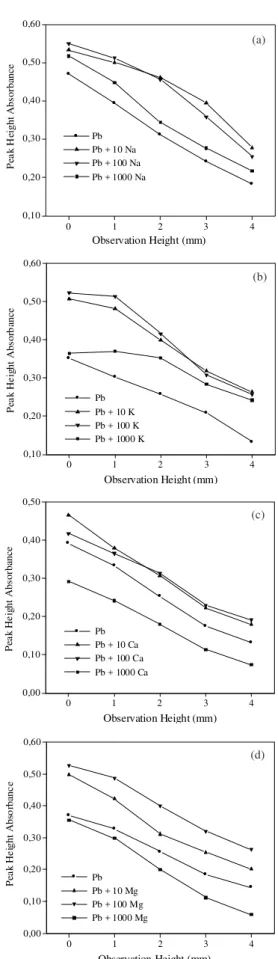
In spite of the non-isothermal environment around the coil, the interference effect was slightly affected by chang-ing the observation height (Figure 5). It can be supposed that the lower lead absorbance signal for higher
observa-Figure 5. Influence of observations heights on atomization of 100 µg Pb2+ L-1 with and without 10, 100 and 1000 mg L-1 of concomitants
in 0.014 mol L-1 HNO3: (a) Na, (b) K, (c) Ca and (d) Mg.
360 390 420 450 480 510 540 570
0,00 0,05 0,10 0,15 0,20 0,25 0,30 Pb Pb + Na Pb + Asc. Ac. Pb + Na + Asc. Ac.
P eaK H ei gh t A b so rb an ce
Temperature oC
0 1 2 3 4
0,10 0,20 0,30 0,40 0,50 0,60 (A) Pb Pb + 10 Na Pb + 100 Na Pb + 1000 Na
P ea k H ei g h t A b so rb an ce
Observation Height (mm)
0 1 2 3 4
0,10 0,20 0,30 0,40 0,50 0,60 (B) Pb Pb + 10 K Pb + 100 K Pb + 1000 K
P ea k He ig h t Ab so rb an ce
Observation Height (mm)
0 1 2 3 4
0,00 0,10 0,20 0,30 0,40 0,50 (C) Pb Pb + 10 Ca Pb + 100 Ca Pb + 1000 Ca
P ea k He ig h t Ab so rb an ce
Observation Height (mm)
0 1 2 3 4
0,00 0,10 0,20 0,30 0,40 0,50 0,60 (D) Pb Pb + 10 Mg Pb + 100 Mg Pb + 1000 Mg
P ea k He ig h t Ab so rb an c e
Observation Height (mm)
Figure 3. Pyrolysis temperature curves for 200 µg Pb L-1 with and without 10 or 100 mg L-1 of Li or Na in 0.014 mol L-1 of HNO3;
purge gas composition: 90% v/v Ar + 10% v/v H2; volume injected
10 µL and atomization temperature: 2763 oC
350 400 450 500 550 600 650 700 750
0,00 0,10 0,20 0,30 0,40 0,50 0,60 Pb Pb + 10 Na Pb + 100 Na Pb + 10 Li Pb + 100 Li
P ea k He ig h t Ab so rb an ce
Temperature oC
(a)
(b)
(c)
tions heights is due to the dilution of the vapor cloud into the flow-through cell. With the exception of K+ and Mg2+
(1000 mg L-1 and 0.0 observation height), lead curves
showed similar behavior in the presence and in absence of the concomitants. In general, lower concentration of concomitants (10 and 100 mg L-1) and higher
concentra-tion (1000 mg L-1) caused increase and decrease,
respec-tively, of the lead analytical signal (Figure 5). These ef-fects were always observed for lower pyrolysis tempera-tures. Probably, the presence of sodium, potassium, cal-cium and magnesium (10 and 100 mg L-1) change the
kinetics of the lead atomization, increasing the absorbance signal. For higher concentration of the concomitants (1000 mg L-1) lead occlusion can be occurring.
The processes occurring in the condensed phase seemed to be dominant. It can be verified from Figure 5 that interfer-ences were not critically affected by the gas phase tempera-ture, leading to the conclusion that the above mentioned processes occur predominantly in the condensed phase. This was also confirmed by experiments in which lead and the alkaline elements were introduced simultaneously, but physically separated in the tungsten coil. The results showed no occurrence of interferences in the gas phase, confirming the condensed phase hypothesis.
These results showed that the understanding of the atomization processes in the W coil atomizer needs new paradigms to better explaining them. The fast heating rate, the non-isothermal ambient and the use of hydro-gen in the purge gas exert a pronounced effect on the mechanism of atomization and these effects still require a full interpretation.
Acknowledgments
We thank Fundação de Amparo à Pesquisa do Estado de São Paulo (FAPESP Processo 1995/5782-7) and Financiadora de Estudos e Projetos (PRONEX) for finan-cial support. We are grateful to Fundação de Amparo à Pesquisa do Estado de São Paulo (FAPESP) for fellow-ship of P. V. Oliveira and F. R. P. Rocha and Conselho Nacional de Desenvolvimento Científico e Tecnológico (CNPq) for fellowships F. J. Krug, J. A. Nóbrega, M. M. Silva and Z. F. Queiroz.
References
1. Suzuki, M.; Ohta, K. Prog. Anal. At. Spectrosc. 1983,
6, 49.
2. Nóbrega, J. A.; Silva, M. M.; Oliveira, P. V.; Krug, F. J.; Baccan, N. Quím. Nova1995, 18, 555.
3. Chauvin, J. V.; Davies, D. G.; Hargis, L. C. Anal. Lett.
1992, 25, 137.
4. Berndt, H.; Schaldach, G. J. Anal. At. Spectrom. 1988,
3, 709.
5. Parsons, P. J.; Qiao, H.; Aldous, K. M.; Mills, E.; Slavin, W. Spectrochim. Acta 1995, 50B, 1475.
6. Sanford, C. L.; Thomas, S. E.; Jones, B. T. Appl. Spectrosc. 1996, 50, 174.
7. Batchelor, J. D.; Thomas, S. E.; Jones B. T. Appl. Spectrosc. 1998, 52, 1086.
8. Cantle, J. E.; West, T. S. Talanta1973, 20, 459. 9. Newton, J. A.; Davis, D. G. Anal. Chem. 1975,
47, 2003.
10. West, M. H.; Molina, J. F.; Yuan, C. L.; Davis, D. G.; Chauvin, J. V. Anal. Chem. 1979, 51, 2370.
11. Giné, M. F.; Krug, F. J.; Sass, V. A.; Reis, B. F.; Nóbrega, J. A.; Berndt, H. J. Anal. At. Spectrom. 1993, 8, 243. 12. Silva, M. M.; Silva, R. B.; Krug, F. J.; Nóbrega, J. A.;
Berndt, H. J. Anal. At. Spectrom. 1994, 9, 361. 13. Krug, F. J.; Silva, M. M.; Oliveira, P. V.; Nóbrega, J. A.
Spectrochim. Acta 1995, 50B, 1469.
14. Silva, M. M.; Krug, F. J.; Oliveira, P. V.; Nóbrega, J. A.; Reis, B. F.; Penteado, D. Spectrochim Acta 1996,
51B, 1925.
15. Silva, M. M.; Arruda, M. A. Z.; Krug, F. J.; Oliveira, P. V.; Queiróz, Z. F.; Gallego, M.; Valcárcel, M. Anal. Chim. Acta1998, 368, 255.
16. Lima, E. C.; Krug, F. J.; Nóbrega, J. A.; Nogueira, A. R. A. Talanta1998, 47, 613.
17. Luccas, P. O.; Nóbrega, J. A.; Oliveira, P. V.; Krug, F. J.
Talanta1999, 48, 695.
18. Lopes, G. S.; Nogueira, A. R. A.; Oliveira, P. V.; Nóbrega, J. A. Anal. Sci.1999, 15,165.
19. Bruhn, C. G.; Ambiado, F. E.; Cid, H. J.; Woerner, R.; Tapia, J.; Garcia, R. Anal. Chim. Acta 1995,
306, 183.
20. Bruhn, C. G.; Ambiado, F. E.; Cid, H. J.; Woerner, R.; Tapia, J.; Garcia, R. Quim.Anal.1996, 15, 191. 21. Bruhn, C. G.; Neira, J. Y.; Valenzuela, G. D.; Nóbrega,
J. A. J. Anal. At. Spectrom.1998, 13, 29.
22. Bruhn, C. G.; Neira, J. Y.; Valenzuela, G. D.; Nóbrega, J. A. Talanta1999, 48, 537.
23. Bruhn, C. G.; Neira, J. Y.; Guzmán, M. I.; Darder, M. M.; Nóbrega, J. A. Fresenius J. Anal. Chem in press. 24. Bruhn, C. G.; Nóbrega, J. A. Química & Indústria
1998, 37.
25. Neira, J. Y.; Bruhn, C. G.; Velenzuela, G. D.; Nóbrega, J. A. Quím. Nova1998, 21, 490.
26. Oliveira, P. V.; Queiroz, Z. F.; Krug, F. J.; Lima, E. C.; Nóbrega, J. A.; 5th Rio Symposium on Atomic
28. Alkemade, C. T. J.; Lollander, T.; Snelleman, W.; Zeegers, P. J. T. Metal Vapours in Flames; Pergamon Press; London, 1982.
29. Byrne, J. P.; Chakrabarti, C. L.; Gilchrist, G. F.;
Lamoureux, M. M.; Bertels, P. Anal Chem. 1993,
65, 1267.
30. Gilchrist, G. F. R.; Chakrabarti, C. L.; Cheng, J.; Hugles; D. M. J. Anal. At. Spectrom.1993, 8, 623.
Received: August, 5, 1999