0103 - 5053 $6.00+0.00
Article
* e-mail: [email protected]
Separation and Pre-concentration of Cadmium, Copper, Lead, Nickel and Zinc by Solid-Liquid
Extraction of their Cocrystallized Naphthalene Dithizone Chelate in Saline Matrices
Antônio C. Spínola Costa*,a, Leila Lopesa,b, Maria das Graças A. Korna and Jicarla G. Portelaa
a
Instituto de Química, Universidade Federal da Bahia, Campus Universitário de Ondina, 40170-290 Salvador - BA, Brazil
b
PETROBRAS, Salvador, Bahia 41856-900, Brazil
Um procedimento em batelada é proposto para separação e pré-concentração de cádmio, chumbo, níquel e zinco em amostras de salmoura. O método baseia-se na adsorção dos íons metálicos sobre a fase sólida composta de ditizona co-cristalizada com naftaleno microcristalino, na faixa de pH de 8,5 – 9,1. Ácido nítrico é utilizado para re-extrair os cátions da fase sólida, os quais são determinados por ICP-OES. Vários parâmetros, tais como efeito do pH, do tempo de agitação e da quantidade da fase sólida foram estudados sistematicamente visando otimizar as condições para a determinação de quantidades traço de Cd, Cu, Pb, Ni e Zn em amostras sintéticas de salmoura. Os limites de detecção obtidos, expressos em µg L-1, foram: 44 (Zn), 11 (Ni), 30 (Cd), 47 (Pb) e 11 (Cu). A precisão do
procedimento foi estabelecida pela medida de 10 replicatas com 250 µg L-1 de cada íon e os desvios
padrão relativos foram de 2,71 % (Cd), 2,15 % (Cu), 1,53 % (Pb), 2,47 % (Ni) e 2,78 % (Zn). A exatidão do procedimento foi confirmada pelo método de adição de analitos e os resultados obtidos indicaram recuperação quantitativa (≥ 95 %).
A procedure for separation and pre-concentration of trace amounts of cadmium, copper, lead, nickel, and zinc in brine samples has been proposed. It is based on the adsorption of metal ions onto dithizone co-crystallized with microcrystalline naphthalene, in the pH range 8.5-9.1. Nitric acid is used to back-extract the cations from the solid phase, which are measured by ICP-OES. Various parameters, such as the effect of pH, stirring time, and amounts of solid phase, have been studied in detail, to optimize the conditions for the determination of trace amounts of Cd, Cu, Pb, Ni and Zn in synthetic brine samples. The limits of detection values expressed in µg L-1 are 44 (Zn), 11 (Ni), 30
(Cd), 47 (Pb) and 11 (Cu). The precision of the procedure was determined by running 10 replicate samples, each one containing 250 µg L-1 of each element and the relative standard deviations were
2.71 % (Cd), 2.15 % (Cu), 1.53 % (Pb), 2.47 % (Ni), and 2.78 % (Zn). The accuracy of the procedure was confirmed by applying the analyte additions method and the results indicated that quantitative recoveries (≥ 95 %) were obtained.
Keywords: preconcentration, solid-liquid extraction, naphthalene, dithizone, highly saline matrices
Introduction
The direct determination of metals in highly saline matrices by atomic spectrometry is difficult because the aspiration of solutions with high salt concentrations into the plasma or flame can cause problems such as blockage of the nebulizer, considerable background emission, transport and chemical interferences, with consequent drop in sensitivity and precision. For industrial application of brine (NaCl 20-30% m/v), the usual concentration of trace metals require limits of detection quite difficult to be
reached by direct determination of samples using inductively coupled plasma optical flame emission spectrometry (ICP-OES) or flame atomic absorption spectrometry (FAAS) techniques. Therefore, separation and pre-concentration methods have played fundamental role in solving these problems.1,2
developed using 2-(5-bromo-2-piridylazo)-5-diethylaminophenol4 and 1-(2-pyridylazo)-2-naphthol5 supported on microcrystalline naphthalene. In other work, Taher6 used atomic absorption spectrometric method for determination of trace amounts of nickel in alloys and biological samples after pre-concentration with the ion pair of 2-(5-bromo-2-piridylazo)-5-diethylaminophenol and ammonium tetraphenylborate on microcrystalline naphthalene. Therefore, the referred works have a limited applicability once the analytical methods proposed for separation and pre-concentration are suitable for a single element.
Dithizone has two active hydrogen atoms that can be substituted by a cation. It is a S, N binder donor that reacts with “soft” cations like Mn, Fe, Co, Ni, Cu, Zn, Pd, Ag, Cd, In, Sn, Pt, Au, Hg, Ti, Pb, Bi, Se, Te and Po. The nonpolar dithizonates formed are slightly soluble in water and soluble in organic solvents. Liquid-liquid extraction and spectrophotometric determination of metals using dithizone are sensitive, but have low selectivity and both reagent and complexes are unstable.16-19
In the present paper we describe a pre-concentration method that allows in a single operation five metallic cations to be separated from brine samples. The separation and pre-concentration are performed using dithizone supported on naphthalene. The sorbed elements are subsequently eluted with nitric acid and determined by ICP-OES.
Experimental
Reagents
All reagents were of analytical reagent grade. Metals stock solutions were prepared from Merck standard solutions to a final concentration of 1.000 g L-1. Work solutions were daily prepared by diluting aliquots with pure water and acidified with nitric acid. Buffer solutions were glycine/hydrochloric acid adjusted at pH 3, acetate buffer at pH 4 to 6, tris-HCl buffer at pH 7 to 8, and ammonia buffer at pH 8.5 to 10. Acid solutions were nitric or hydrochloric acids (Merck) at different concentrations prepared by suitable dilution of the respective concentrated acids in deionized water. Solid phase was prepared with dithizone and acetone from Merck, and commercial grade naphthalene.
Synthetic brinewas prepared by dissolution of 300 g of commercial sodium chloride in 1 L of water. This brine was purified by treatment with NaOH and Na2CO3, followed by decantation of CaCO3 and Mg(OH)2 precipitates and acidified with hydrochloric acid.
Apparatus
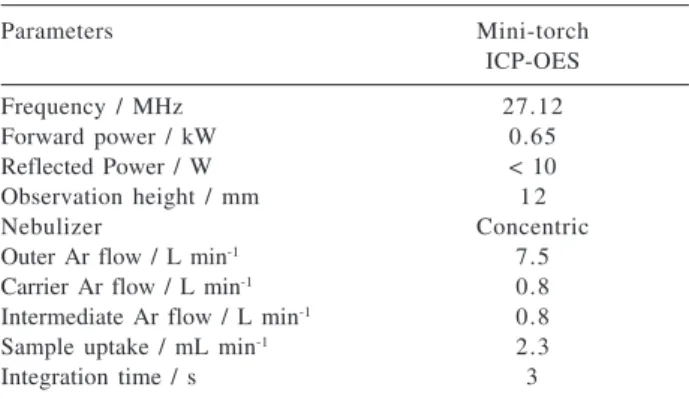
Atomic emission measurements were made in an ARL ICP OES model 3410 sequential with a mini-torch. The optimized operating parameters are listed in Table 1.
A PROCYON PHD-10 digital pH meter supplied with a combined glass-calomel electrode was used for pH measurements.
Dithizone-naphthalene solid phase preparation
It was weighed 40.0 g of naphthalene and 0.40 g of dithizone that were transferred to a 2 L vessel containing 850 mL of acetone. This mixture was stirred for 30 min with a magnetic stirrer.
Aliquots of this mixture were slowly transferred to a 2 L vessel with deionized water under stirring. The product from co-crystallization was vacuum filtered using a Bückner funnel and low retention paper. The obtained solid was put in a dessicator with silica gel. This solid phase was stable at least for two months, when kept in a dark well tighted vessel.
Cations extraction and pre-concentration procedure
Sample volumes from 50 to 200 µL containing up to 50 µg of each cation were transferred to plastic vessels. It was added 10 mL of pH 8.5 ammonium buffer solution and 1.5 g of the solid phase. The vessel was closed and kept under mechanical stirring for 15 min. The mixture was filtered through a filter paper and the liquid phase was discharged. Solid material retained onto filter paper was washed with 15 ml of 8 mol L-1 nitric acid. Metals ions extracted were then directly determined by ICP-OES. The same procedure was applied to blanks. An analytical curve prepared in 8 mol L-1 nitric acid was used in order to avoid matrix effects.
Table 1. Operating conditions for ICP-OES measurements
Parameters Mini-torch
ICP-OES
Frequency / MHz 27.12
Forward power / kW 0.65
Reflected Power / W < 10
Observation height / mm 1 2
Nebulizer Concentric
Outer Ar flow / L min-1 7.5
Carrier Ar flow / L min-1 0.8
Intermediate Ar flow / L min-1 0.8
Sample uptake / mL min-1 2.3
Results and Discussion
In order to obtain quantitative recoveries of metal ions on naphthalene-dithizone solid phase, the separation and pre-concentration procedure were optimized for various experimental parameters such as pH, stirring time, sample volume, amounts of solid phase, sorption capacity and cations desorption from solid phase, by using an univariate approach.
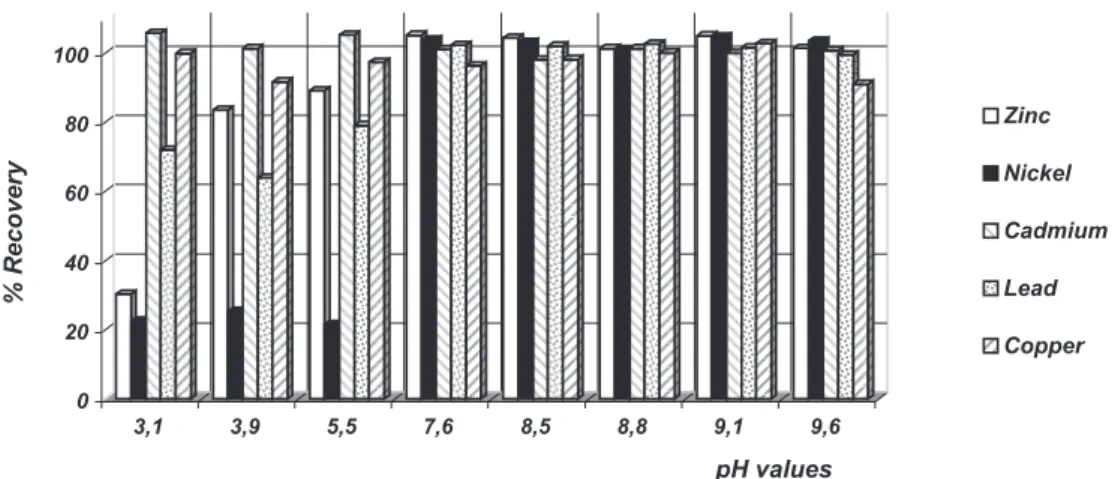
The effect of pH on simultaneous extraction of the five metal ions was evaluated. Results shown in Figure 1 demonstrated that maximum extraction (over 95% for all cations) is achieved for pH ranging from 7.6 to 9.1. In subsequent studies, the pH was maintained at 8.5 using an ammonium buffer.
In order to determine the best ratio between naphthalene and dithizone amounts for sorption in 100 mL volume solution, 25 µg of each metal ion was added. The proposed pre-concentration procedure was applied and dithizone concentration was tested within the range 0.5 to 3.0% using 1.0 g solid phase. Results showed that sorption was quantitative for solid phase using a minimum concentration of 1% m/v dithizone. After the determination of solid phase composition, 100 mL volume solution, 25 µg of each metal ion, and amounts of solid phase within the range from 0.5 to 2.0 g were tested keeping constant the concentration of 1% m/v dithizone. It was found that metal ions recoveries are quantitative over 0.5 g of 1 % m/v dithizone solid phase. It was recommended 1.0 g of 1% m/v dithizone solid phase to guarantee a maximum sorption of the metal ions.
The effect of the reaction time between solid phase and sample was studied by varying the shaking time from 5 to 30 min. All cations had an extraction percentage over 95%. The effect of sample volume was studied by varying it from 50 to 500 mL. Obtained results showed that maximum volume must be 200 mL for an efficiency extraction over
95%. This stands for a concentration factor up to 13-fold. Nitric and hydrochloric acid solutions were tested for back extraction of cadmium, copper, lead, nickel, and zinc from solid phase. Results demonstrated that 15 mL of 8 mol L-1 nitric acid can be used for quantitative (>95%) elution in a single step.
Retention capacity of the adsorbent
It was assessed the capacity of solid phase to retain each cation in a single element solution. Using different amounts of metal stock solution added to 1.00 g of solid phase, 10 mL of pH 8.5 buffer and 100 mL of deionized water, the efficiency was tested when the metal mass present in different solutions varied in the range 0 to 500 µg. It was observed that 1.00 g of solid phase was efficient to retain up to 500 µg of each cation when only a single element was present in solution.
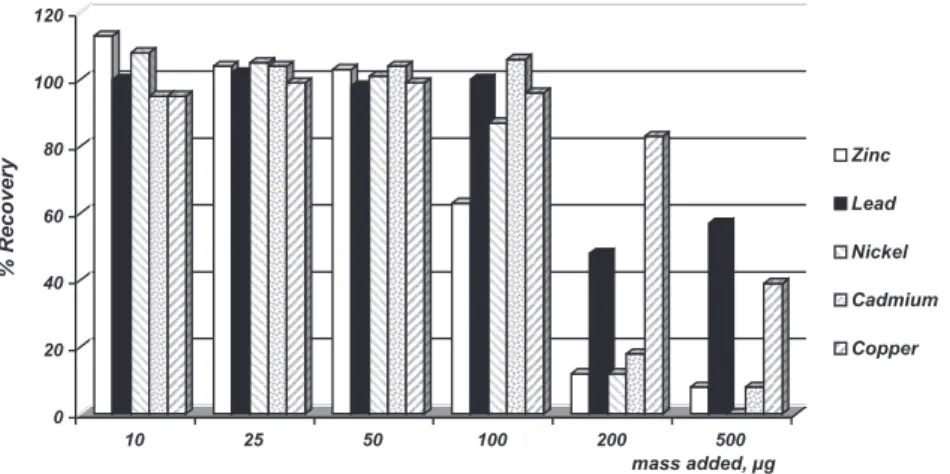
Solid phase sorption capacity was also assessed with a multielemental solution. Results showed that 1.00 g of solid phase was able to retain up to 50 µg of each cation adding up to 250 µg of total adsorbed cations. It was observed that when each cation is present in amount above 100 µg, some of them are preferentially retained affecting the retention of the other ones, as shown in Figure 2.
Effect of concomitants
The effect of Na (30% m/v) and Fe (500 µg) on the adsorption of all metal ions (1.0 µg mL-1 of each) on dithizone-naphthalene solid phase was studied only to usual concentrations in brine samples. The tolerance limit was set as the amount of ion required to cause ± 3% error in the determination of Cd, Cu, Pb, Ni, and Zn. Among the elements that could be present at significant levels in highly saline samples, such as Na and Fe, only Fe interfered.
Figure 1. pH effects on cations extraction by solid phase. Mass of each cation: 25.0 µg. Sample volume: 100 mL. Phase solid mass: 1 g with 1%
However, by using 300 mg of citric acid or 300 mg of sodium fluoride or just by increasing the amount of solid phase to 3 g, a mass of 500 µg of Fe can be completely masked.
Calibration, sensitivity and precision
Reference solutions of the elements containing 0.1, 0.5, 1.0, 2.0, and 3.0 µg mL-1 were prepared from the stock standard monoelement solutions of Cu, Pb, Ni, Cd and Zn by dilution with HNO3 8 mol L-1. The sensitivities found from the slopes of the calibration curves and the correlation coefficients obtained are shown in Table 2. Precision of the method, calculated as relative standard deviations (RSDs) from a set of 10 sample measurements of each cation in a sample with 250 µg L-1 of each one was 2.71 % (Zn), 2.15 % (Ni), 1.53 % (Cd), 2.47 % (Pb), 2.78 % (Cu). Table 3 shows BEC (background equivalent concentration) values, detection and quantification limits for Cu, Pb, Ni, Cd, and Zn ICP-OES determination.
Application
In order to validate the procedure, spiking was applied in two groups of 100 mL samples. To the first group was added 10 µg of each metal ion before pre-concentration
procedure. To the second group was added 5 µg of each metal ion after the pre-concentration procedure. Results in Table 4 showed that both steps, pre-concentration and determination, provided recoveries above 95% for all samples. The RSDs in all cases were less than 2.8%.
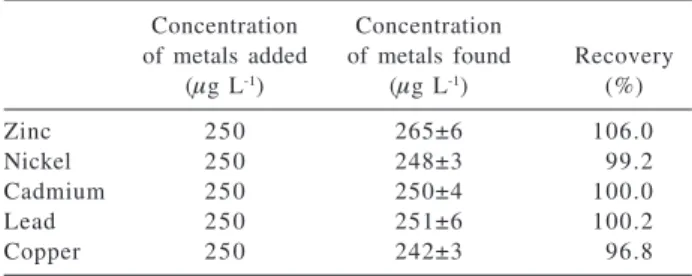
The proposed procedure was applied to determine copper, cadmium, zinc, nickel, and lead in synthetic brine sample that contained 300 g L-1 of sodium chloride and 250 µg L-1 of each cation. Results are shown in Table 5. Good agreement (t-test) was obtained between the added
Figure 2. Recoveries percentile of cations on 1.0 g solid phase with 1% dithizone.Mass of each metal: 10 to 500 mg. Sample volume: 100 mL.
Shaking time: 15 min. Back extraction: 25.0 mL HNO3 8 mol L-1. pH 8.5.
Table 4. Recoveries of Cd, Cu, Ni, Pb and Zn from spiked brine
samples
Mass of
metals added % Recovery
(µg) Zinc Nickel Cadmium Lead Copper
Group 1a 1 0 101.0 95.4 95.8 95.3 100.3
Group 2b 5 103.2 95.1 106.2 101.8 99.8
a Metals ions added before pre-concentration procedure; b Metals ions added after pre-concentration procedure.
Table 3. BEC values andlimits of detection and quantification of the
elements by ICP-OES
Limit of Limit of Metal Wavelength BEC detection quantification
(nm) (µg L-1) (a)
(µg L-1)(b)
(µg L-1)(c)
Z n 213.823 5 3 9 3 0
Pb 220.335 1144 4 2 140
Ni 221.633 254 1 0 3 4
Cd 228.791 131 5 1 8
Cu 324.744 487 1 2 4 2
(a) 30 measurements of blanks; (b) 3 times standard deviation of 30 measurements of blank expressed in µg L-1; (c) 10 times standard
deviation of 30 measurements of blank expressed in µg L-1.
Table 2. Sensitivities and correlation coefficients of calibration curves
Element Sensitivity Correlation
(Kcounts L mg-1) coefficient
Cu 5.818 0.9999
Ni 4.000 0.9999
Cd 10.273 0.9997
Pb 0.823 0.9999
and analyte recovered content using experimental procedure. The recovery values calculated for the standard additions were always higher than 95%, confirming the accuracy of the procedure and the absence of matrix effects.
Conclusions
An efficient adsorbent generated simply by mixing solutions of dithizone and naphthalene has been developed and used for separation and pre-concentration of cadmium, copper, lead, nickel, and zinc in saline matrices. The reagents were easily available and inexpensive. The procedure has the advantage of avoiding organic solvents during extraction step. The recovery of each cation was carried out in a single step by using 15 mL of nitric acid 8 mol L-1. All cations were quantitatively recovered for a sample volume up to 200 mL, which means for a concentration factor of up to 13-fold.
Acknowledgements
The authors are grateful to the CNPq (Conselho Nacional de Desenvolvimento Científico e Tecnológico) by financial support and schoolarships provided to M.G.A.K. and A.C.S.C. The authors also express their gratitude to FINEP (Financiadora de Estudos e Projetos), CAPES (Coordenação de Aperfeiçoamento de Pessoal de Nível Superior) and PETROBRAS (Petróleo Brasileiro) for
Table 5. Determination of Cd, Cu, Ni, Pb and Zn in synthetic brine.
Mean and standard deviations (n=3)
Concentration Concentration
of metals added of metals found Recovery (µg L-1) (µg L-1) (%)
Zinc 250 265±6 106.0
Nickel 250 248±3 99.2
Cadmium 250 250±4 100.0
Lead 250 251±6 100.2
Copper 250 242±3 96.8
Solid phase: 1.5 g; Extraction: 25.0 mL HNO3 8 mol L-1.
financially supporting this work and Dr. Cristina Coelho for reading of the English manuscript.
References
1. Boumans, P.W.J.M. In Inductively Coupled Plasma Emission Spectroscopy. Part 1: Methodology, Instrumentation and
Per-formance; Interscience: New York, 1987.
2. Welz, B.; Sperling, M.; Atomic Absorption Spectrometry; VCH: Weinheim, Germany, 1999.
3. Taher, M.A.; Puri, B.K.; Talanta 1996, 43, 247. 4. Taher, M.A.; Analyst2000, 125, 1865. 5. Taher, M.A.; Talanta2000, 52, 181.
6. Taher, M.A.; J. Anal. At. Spectrom. 2000, 15, 573. 7. Satake, M.; Ishida, K.; Anal. Chem. 1986, 58, 2502. 8. Satake, M.; Talanta1992, 39, 1349.
9. Satake, M.; Matsumura, Y.; Mehra, M.C.; Mikrochim. Acta
1980, 1, 455.
10. Ishida, K.; Puri, B.K.; Satake, M.; Talanta1985, 32, 1985. 11. Nagahiro, T.; Satake, M.; Lin, J.; Puri, B.K.; Analyst1994,
109, 163 .
12. Mehra, M.C.; Nagahiro, T.; Satake, M.; Mikrochim. J.1986, 33, 198.
13. Mehra, M.C.; Puri, B.K.; Satake, M.; Analyst1985, 110, 791. 14. Burns, D.T.; Tungkananuruk, N., Anal. Chim. Acta1986,
189, 383.
15. Puri, S.; Dubey, R.K.; Puri, B.K.; Hussain, M.F.; Anal. Letters
1998, 31, 283.
16. Ueno, K.; Imamura, T.; Cheng, K. L.; Handbook of Organic Analytical Reagents; CRC Press: London, 1992.
17. Irving, H.M.N.H.; The Analytical Application of Dithizone. Critical Reviews in Analytical Chemistry; CRC PRESS: Boca Raton, 1980, Vol. 8.
18. Sekizuka, Y.; Kojima,T.; Yano, T.; Ueno, K.; Talanta1973, 20, 979.
19. Chwastowska, J.; Kosiarska, M.; Talanta1998, 35, 439.
Received: July 18, 2001