0103 - 5053 $6.00+0.00
A
r
t
ic
le
* e-mail: [email protected]
Electronic Spectra of Chevreul’s Salts
Luciana A. da Silvaa, Jailson B. de Andrade*,a and Henrique E. Tomab
a
Instituto de Química, Universidade Federal da Bahia, Campus de Ondina, 40170-290 Salvador - BA, Brazil
b
Instituto de Química, Universidade de São Paulo, Cidade Universitária, 05508-900 São Paulo - SP, Brazil
A série isomórfica de sulfitos duplos com fórmula empírica Cu2SO3.MSO3.2H2O (onde M é Cu, Fe, Mn ou Cd) é preparada pela substituição do Cu(II) no sal de Chevreul, Cu2SO3.CuSO3.2H2O, por íons de metais de transição, tais como Fe(II), Mn(II) e Cd(II). Como conseqüência, as espécies isomórficas apresentam colorações distintas. Cálculos de modelagem molecular foram empregados neste trabalho para o centro dimérico [CuI
2(SO3)2(SO3)2]6-. O espectro eletrônico do sal de Chevreul
consiste de uma banda de transferência de carga em 425 nm associada ao cromóforo [CuI
2(SO3)2(SO3)2]6- e duas transições de campo ligante a 785 e 1000 nm envolvendo distorção de
Jahn-Teller dos níveis do Cu(II). Além disso, uma banda adicional de transferência de intervalência é observada em 500 nm, sendo responsável pela sua coloração vermelha característica. A substituição do íon Cu(II) pelos íons Fe(II), Mn(II) e Cd(II) não elimina a banda de absorção em 425 nm, associada à transição de transferência de carga centrada nos sítios Cu(I), porém a banda original em 500 nm desaparece, em concordância com a atribuição de transição intervalência.
The isomorphic series of double sulfites with empirical formula Cu2SO3.MSO3.2H2O (where M is Cu, Fe, Mn, or Cd) have been prepared from the Cu(II) replacement by transition metal ions such as Mn(II), Fe(II) and Cd(II) ions in Chevreul’s salt, Cu2SO3.CuSO3.2H2O. As a consequence, the isomorphic species present distinct colors. Molecular modeling calculations were carried out for the dimeric [CuI
2(SO3)2(SO3)2]6- center. The electronic spectra of the Chevreul’s salt consist of a
charge-transfer band around 425 nm associated with the [CuI
2(SO3)2(SO3)2]6- chromophore and two
ligand field transitions at 785 and 1000 nm involving the Jahn-Teller splitting of the Cu(II) levels. An additional intervalence-transfer band, responsible for its characteristic red color, can be found at 500 nm. The replacement of the Cu(II) ions for Fe(II), Mn(II) and Cd(II) does not eliminate the absorption band at 425 nm, supporting its assignment as a charge-transfer transition centered on the Cu(I) sites; while the original band at 500 nm disappears, in agreement with its intervalence transfer nature.
Keywords: electronic spectra, Chevreul’s salt, isomorphic salts
Introduction
The first known mixed valence sulfite complex, CuI
2SO3.CuIISO3.2H2O, was prepared by M. Chevreul,1 in
1812. Its crystalline structure was described in terms of
coordination polyhedra by Kierkegaard and Nyberg,2
consisting of [SO3] trigonal pyramids, [CuIO
3S] tetrahedra
and [CuIIO
4(H2O)2] octahedra linked together, giving a
three-dimensional network.
Chevreul’s salt derivatives have been prepared from the Cu(II) replacement by transition metal ions such as Mn(II), Fe(II) and Cd(II) ions.3-5 In such cases, the X-ray diffraction
data were similar to those of Chevreul’s salt, with minor
changes in “d” spacings,3-5 forming an isomorphic series, i.e., Cu2SO3.CuSO3.2H2O, Cu2SO3.MnSO3.2H2O, Cu2SO3.FeSO3.2H2O and Cu2SO3.CdSO3.2H2O. As a consequence, a gradual substitution of the Cu(II) ions by the transition metal ions is also possible, giving rise to a variety of mixed compositions.
Interestingly, the isomorphic species present distinct colors.4 The intense red color of the Chevreul’s salt changes
to yellowish-brown, after the substitution of Cu(II) by Fe(II). If the substitution is carried out with Mn(II) instead of Fe(II), a gradual transition to yellow color is observed. On the other hand, if Cu(II)is replaced by Cd(II), a faint yellow color is obtained.
spectroscopic properties of the Chevreul’s salt have been investigated by Inoue et al.6 based on EPR measurements and diffuse reflectance absorption spectra. Up to the present time, there is a complete lack of information about the electronic interactions between the constituents of Chevreul’s salt derivatives, especially concerning the types of electronic transitions responsible for their different colors. For this reason, this subject is focused in this paper, with emphasis on the theoretical evaluation of the charge-transfer bands in the Chevreul’s salt.
Experimental
Materials
All chemicals used in the synthesis of the double sulfites were of analytical reagent grade.
Copper, and mixtures of copper and manganese, copper and iron or copper and cadmium sulfate solutions (see compositions in Table 1) were saturated with sulfur dioxide gas at room temperature to give solutions with pH of approximately 1. These solutions were heated to 78 oC.
The pH of the solutions was raised to 3.0-3.5 by dropwise addition of a 20% sodium carbonate solution, under magnetic stirring. The precipitation of the complex sulfites starts at about pH 3.0. The crystalline materials were immediately collected on a filter, washed with deionized water and rinsed with ethanol, followed by air drying. A more detailed account on their syntheses can be found elsewere.4,5
Measurements
The electronic spectra were recorded on a Guided Wave spectrophotometer, model 260, equipped with a Wand bundle probe for in situ reflectance measurements. Total copper, manganese, iron, and cadmium contents were determined using an ICP/AES ARL, model 3410 instrument.
Theoretical Calculations
Molecular modeling calculations were carried out for the dimeric [CuI
2(SO3)2(SO3)2]6- center attached to two
[CuII(H
2O)2(SO3)2]2- fragments, starting from the
crystallographic bond lengths,2 in order to simulate the
{CuI
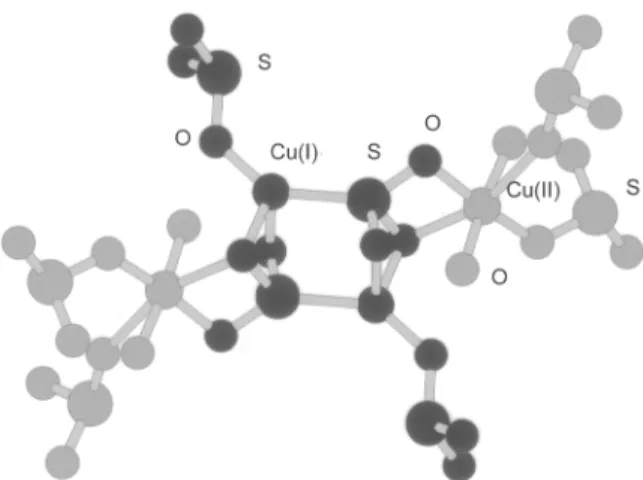
2(SO3)2[CuII(H2O)2(SO3)2]2}6- repetitive group (Figure
1) in the tridimensional structure of the Chevrel’s salt2
(SO32- = S bound sulfite, SO
32- = O bound sulfite). Geometry
optimization was carried out using the MM+ method within
the HyperChem 6.0 program (Hypercube Inc. Gainesville, USA), and a gradient of 1 x 10⁻⁶ kcal (1 cal = 4.1840 J) as a
convergence criterion in a conjugate gradient method. Spectral simulations were carried out in separate for the [CuI
2(SO3)2(SO3)2]6- center, but keeping the same previously
optimized geometry for the {CuI
2(SO3)2[CuII(H2O)2
(SO3)2]2}6- group (Figure 1). SCF molecular orbitals were
obtained at the RHF level for the closed-shell Cu(I) ground-state species, using the ZINDO/S method,7-10 and the default
parameters, for single CI excitations in an active space involving 20 frontier molecular orbitals (10 highest occupied and 10 lowest unoccupied MOs).
Results and Discussion
The diffuse reflectance electronic spectrum of the Chevreul’s salt reported by Inoue et al.6 in the 400-800 nm range, consists of two broad bands at 785 and 425 nm. The first one has been ascribed to a d-d transition of the octahedral Cu(II) ions.6 The second band (at 425 nm) has
been tentatively assigned to an intervalence transition between the tetrahedral Cu(I) sites and the octahedral Cu(II) ones. This transition is responsible by the intense dark red color of the Chevreul’s salt.
Table 1. Composition of the starting solutions in the mixed valence
sulfite preparations
Double sulfites MSO4.nH2Oa (g) Solution
Cu Fe Mn Cd volume (mL)
Cu2SO3.CuSO3.2H2O 2.0 - - - 5 0
Cu2SO3.FeSO3.2H2O 1.0 12.2 - - 5 0
Cu2SO3.MnSO3.2H2O 1.0 - 6.2 - 5 0
Cu2SO3.CdSO3.2H2O 1.0 - - 10.2 5 0 a Cu (n = 5); Fe (n = 7); Mn (n = 1); Cd (n = 8/3)
Figure 1. ZINDO/1 optimized molecular structure for the
{CuI
2(SO3)2[CuII(H2O)2(SO3)2]2}6- characteristic group in the
Chevreul’s salt, showing the [CuI
2(SO3)2(SO3)2]6- unity in the center
(dark) and the [CuII(H
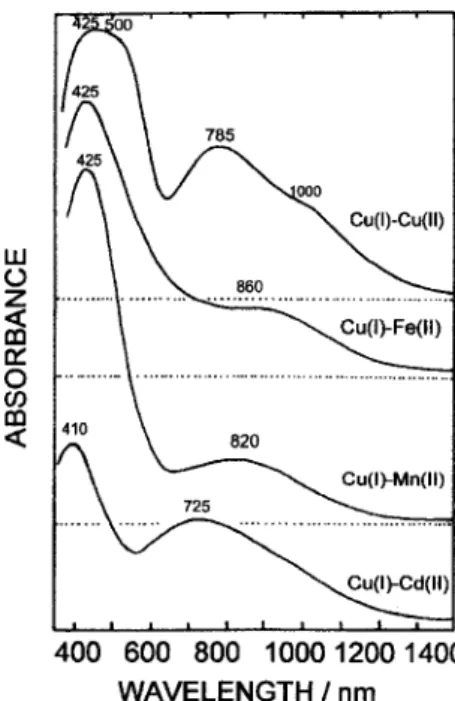
In this work, the electronic spectrum of the Chevreul’s salt has been extended to the near-infrared region, as illustrated in Figure 2. The spectra of the corresponding derivatives with Fe(II), Mn(II) and Cd(II) ions are also shown in Figure 2, for comparison purposes.
As can be seen in Figure 2, all the Chevreul’s salt derivatives exhibit an absorption band around 425 nm and a less intense band in the visible region. This feature has also been recently reproduced from photoacoustic
measurements.11 However, the absorption profile is
markedly distinct for the Chevreul’s salt, in which case the comparison with the series clearly reveals the composite nature of the absorption band in the 400-500 nm range. A new component can be observed at 500 nm, and another one at 1000 nm, in the near-infrared region not accessed by the previous work.6
The high energy band at 425 nm seems to be a common feature of the Chevreul’s salt derivatives (see Figure 2) and accordingly, it would be better ascribed to a transition in the Cu(I)-sulfite chromophore, rather than to an intervalence transfer transition. In the last case, the electronic transition would be strongly dependent on the nature of the M(II) ion. For this reason, semi-empirical theoretical calculations were carried out for the Cu(I)-sulfite chromophore, in order to elucidate the characteristic electronic transitions associated with this group.
Initially, molecular modeling calculations were carried out for the dimeric [CuI
2(SO3)2(SO3)2]6- center attached to
two [CuII(H
2O)2(SO3)2]2- fragments, reproducing very
closely the {CuI
2(SO3)2[CuII(H2O)2(SO3)2]2}6- characteristic
group in the tridimensional structure of the Chevrel’s salt.2
After the geometry optimization using the ZINDO/1 program, the two [CuII(H
2O)2(SO3)2]2- fragments were
removed, leaving the [CuI
2(SO3)2(SO3)2]6- center. In this
way one can simulate the electronic properties of the [CuI
2(SO3)2(SO3)2]6- moiety, in separate, but keeping the
same original structural arrangement found in Chevreul’s salt. This particular chromophore is rather unusual, since it contains a dimeric, tetrahedral Cu(I) complex attached to sulfur bound, bidentate oxygen bound and monodentate oxygen bound sulfite ions, as illustrated in Figure 1.
ZINDO/S calculations for the [CuI
2(SO3)2(SO3)2]6- center
led to the HOMOs and LUMOs involved in the electronic transitions. As shown in Table 2, the three highest occupied molecular orbitals (HOMO levels number 60, 61 and 62) exhibit predominantly Cu(I) character, but incorporate a substantial contribution from the S-bound sulfite ion. The lowest unoccupied molecular orbital (LUMO 63) has a strong S-bound sulfite ion character (83%), containing only a small contribution from the Cu(I) ion. The next level (LUMO 64) has also predominantly S-bound sulfite ion character (63%), while the succeeding level (LUMO 65) involves a nearly equivalent mixture of the Cu(I) and S-bound sulfite ions.
According to the ZINDO/S calculations, the lowest, moderately intense, spin-allowed electronic transitions occurs at 620 (oscillator strength f = 0.033) and 577 nm (f = 0.078), involving the excitation from HOMO 62 to LUMO 64, and from a combination of the HOMO 61 and 62 levels, to a combined level from LUMO 63 and 65, respectively. The next theoretically allowed transition occurs at 401 nm (f = 0.098), corresponding to the excitation from HOMO 60 to LUMO 63. Therefore the [CuI
2(SO3)2(SO3)2]6- chromophore is expected to exhibit
three absorption bands in the visible region, ascribed to
Table 2. HOMO and LUMO composition for the CuI
2(SO3)2(SO3)2
moiety in the Chevreul’s salts
Type MO Compositiona
Number
HOMO 6 0 0.625 (CuI) + 0.256 (SO
32-) + 0.119 (SO32-)
HOMO 6 1 0.586 (CuI) + 0.387 (SO
32-) + 0.027 (SO32-)
HOMO 6 2 0.544 (CuI) + 0.429 (SO
32-) + 0.027 (SO32-)
LUMO 6 3 0.135 (CuI) + 0.833 (SO
32-) + 0.012 (SO32-)
LUMO 6 4 0.320 (CuI) + 0.635 (SO
32-) + 0.045 (SO32-)
LUMO 6 5 0.547 (CuI) + 0.363 (SO
32-) + 0.090 (SO32-)
a) (SO32-) = S bound; (SO32-) = O bound
Figure 2. Diffuse reflectance spectra of the mixed valence
Cu(I)-Cu(II) and related Cu(I)-M(II) Chevreul’s salts, Cu2SO3.MSO3.2H2O
molecular orbital transitions displaying substantial CuI
-sulfite charge-transfer character, as deduced from the HOMO and LUMO compositions.
The octahedral Cu(II) sites exhibit the metal ion bound to six oxygen donor ligands, and the visible band around 785 nm has been associated with the characteristic ligand field transition in the copper(II) ions.12 Actually, the metal ion is
bound to two water molecules (d = 1.92 Å)2 and to two pairs
of non-equivalent, oxygen bound sulfite ions, at d = 2.03 and 2.46 Å. These bonding distances characterize a substantial distortion, as expected from the Jahn-Teller effect associated with the d9 ions.13 One of the consequences of the Jahn-Teller
effect is the splitting of the ligand field bands in the copper(II) ions. Although this aspect has not been previously reported6
for the Chevreul’s salt, the observed bands a 785 and 1000 nm are in good agreement the ligand field theory, reflecting the Jahn-Teller distortion in the copper(II) sites. The expected, weak charge-transfer bands in the [CuI
2(SO3)2(SO3)2]6 moiety
at 620 and 577 nm are probably superimposed to the ligands field bands in the visible.
Theoretically, neither the tetrahedral [CuI
2(SO3)2(SO3)2]
6-nor the octahedral [CuII(H
2O)2(SO3)4]6- sites are expected to
exhibit electronic bands around 500 nm. Therefore, the observed absorption at 500 nm in the Chevreul’s salt spectrum can only be ascribed to an intervalence transfer transition from the tetrahedral Cu(I) ions to the empty 3dx2
-y2
level of eg symmetry of the Cu(II) ions. In this case, the intervalence transfer energy can be expressed in terms of the following equation:12
EIT= 30,000 [X(CuI) - X(CuII)] + 10 Dq
where X(CuI) and X(CuII) are the optical electronegativities
of the Cu(I) and Cu(II) sites and 10 Dq represents the ligand field splitting in a octahedral Cu(II) ion. From the ligand field transition, 10 Dq is approximately 12,700 cm-1 .
Considering that EIT = 20,000 cm-1, and that the optical
electronegativity of the octahedral Cu(II) ions is 2.2,14 the
optical electronegativity of the tetrahedral Cu(I) sites in the Chevreul’s salt can be calculated as2.44.
Iron(II), and manganese(II)) ions exhibit 3d6 and 3d5 electronic configurations, respectively. In principle, these electronic configurations can also allow intervalence transitions, since the cations have empty 3d orbitals. However, both ions are not particularly good electron acceptors, and as far we know, intervalence-transfer transitions generating iron(I) or manganese(I) excited species are quite unusual in the literature.
The Mn(II) derivative exhibits an absorption bands at 820 nm, while the metal ion, in separate, do not display absorption bands in this particular region. The same
argument can be applied for the CdII case, which display
an absorption band at 725 nm. In the last case, it should be noticed that, from the optical electronegativity,14 X(CdII)
= 1.35, the intervalence band in the Chevrel’s salt derivative is expected around 300 nm, i.e., in the UV region. Therefore, by ruling out the ligand field and intervalence transfer transitions, the observed bands for the Mn(II) and Cd(II) derivatives at 820 and 725 nm can only be ascribed to the expected low energy transitions in the [CuI
2(SO3)2(SO3)2]6- chromophore, under the influence of
the specific interactions with the M(II) ions.
In the case of the Fe(II) derivative, the absorption band at 860 nm coincides with the expected ligand field transition for high spin octahetral iron(II) complexes.12 The
overall absorption profile in this case, as compared with the Mn(II) derivative, is rather broad (see Figure 1) and suggests the existence of additional bands around 600 nm, associated low energy transitions in the [CuI
2(SO3)2(SO3)2]6- chromophore.
Conclusions
The electronic spectrum of the Chevreul’s salt consists of a charge-transfer band around 425 nm associated with the [CuI
2(SO3)2(SO3)2]6- chromophore, and two ligand field
transitions at 785and 1000 nm involving the Jahn-Teller splitting of the Cu(II) levels. An additional intervalence-transfer band, responsible for its red color, can be found at 500 nm. The replacement of the Cu(II) ions for Fe(II), Mn(II) and Cd(II) does not eliminate the absorption band at 425 nm, supporting its assignment as a charge-transfer transition centered on the Cu(I) sites. The less intense band at 860 nm for the Fe(II) derivative is consistent with a Laporte forbidden ligand field transition, while the bands at 820 and 725 in the Mn(II) and Cd(II) cases were tentatively assigned to charge-transfer transitions in the [CuI
2(SO3)2(SO3)2]6- chromophore, respectively,
considering the lack of characteristic electronic transitions for these ions, in this region.
References
1. Chevreul, M. E.; Ann. Chim.1812, 83, 187.
2. Kierkegaard, P.; Nyberg, B.; Acta Chem. Scand. 1965, 19, 2189.
3. Sghyar, M.; Durand, J.; Miguel, A. H.; Cot, L.; Rev. Chim. Miner. 1984, 21, 710.
4. Silva, L. A.; Correia, S. J.; Martins, C. R.; de Andrade, J. B.; Quím. Nova, 1998, 21, 151.
5. Silva, L. A.; Matos J. R.; de Andrade, J. B.; Thermochim. Acta
6. Inoue, M.; Grijalva, H.; Inoue, M. B.; Fernando, Q.; Inorg. Chim. Acta1999, 295, 125.
7. Zerner, M. C.; Loew, G. H.; Kirchner, R. F.; Mueller-Westerhoff, U. T.; J. Am. Chem. Soc. 1980, 102, 589.
8. Bacon, A. D.; Zerner, M. C.; Theoret. Chim. Acta 1979, 53, 21.
9. Ridley, J. E.; Zerner, M. C.; Theoret. Chim. Acta1976, 42, 223.
10. Ridley, J. E.; Zerner, M. C.; Theoret. Chim. Acta 1973, 32, 111.
11. Silva, L. A.; de Andrade J. B.; Moysés Araújo, C.; Nakamura, O.; Ferreira da Silva, A.; Massunaga, M. S. O.; Vargas, H.; Phys. Chem. Chem. Phys.2001, 3, 4800.
12. Lever, A. B. P.; Inorganic Electronic Spectroscopy, Elsevier: Amsterdam, 1984.
13. Huheey, J. E.; Keiter, E. A.; Keiter, R.; Inorganic Chemistry: Principles of Struture and Reactivity, 4th ed., Harper Collins College Publishers: New York, 1993.
14. Duffy, J. A.; Bonding, Energy Levels and Bands in Inorganic Solids, John Wiley: New York, 1990.
Received: November 11, 2001 Published on the web: August 7, 2002