Article
J. Braz. Chem. Soc., Vol. 26, No. 10, 2125-2129, 2015. Printed in Brazil - ©2015 Sociedade Brasileira de Química 0103 - 5053 $6.00+0.00
A
*e-mail: [email protected]
†In memoriam
Transport Properties of Binary Solutions Containing the Ionic Liquid BMI.BF
4and
Ethylene Glycol
Fernanda T. Silva,a,* Demétrius W. Lima,b Márcia R. Becker,c Roberto F. Souzab,† and Emilse M. A. Martinib
aEscola de Química e Alimentos, Universidade Federal do Rio Grande - FURG,
Rua Barão do Caí, 125, Cidade Alta, 95500-000 Santo Antônio da Patrulha-RS, Brazil
bInstituto de Química, Universidade Federal do Rio Grande do Sul - UFRGS,
Av. Bento Gonçalves, 9500, P.O. Box 15003, 91501-970 Porto Alegre-RS, Brazil
cUniversidade Federal da Integração Latino-Americana - ILACVN,
Av. Tancredo Neves, 6731 - Bloco 6, 85866-000 Foz do Iguaçu-PR, Brazil
The ionic conductivity values of the ionic liquid (IL) 1-butyl-3-methylimidazolium tetrafluoroborate (BMI.BF4) and ethylene glycol (EG) electrolytes in different concentrations and
over a wide temperature range were determined. The results are discussed in terms of the interactions between the cations and anions of the ionic liquid and the organic solvent. The temperature-dependence of the ionic conductivity for BMI.BF4, as well as solutions containing BMI.BF4 and EG
as electrolytes, in the temperature range of 248-358 K, obeys the Vogel-Tammann-Fulcher equation.
The highest ionic conductivity was 42 mS cm-1 obtained with a solution of BMI.BF
4 in EG at a
molar fraction of 0.50 (358 K) due to the high ionic mobility. The critical micellar concentration (cmc) of 0.1 mol L-1 determined through the ionic conductivity indicates that BMI.BF
4 behaves
as a weak electrolyte above this value. The results obtained indicate that binary solutions based on BMI.BF4 and EG are appropriate for use in technological applications, such as capacitors.
Keywords: ionic liquid, ionic conductivity, 1-butyl-3-methylimidazolium tetrafluoroborate, ethylene glycol, critical micellar concentration
Introduction
Studies on the transport properties (e.g., ionic conductivity) of binary solutions of ionic liquid and organic solvents have been focused on their application in electrolytic or electrochemical capacitors or supercapacitors, since this is an initial step in the selection of a suitable electrolyte.1-3
These devices can be used in a wide temperature range and require electrolytes with high ionic conductivity, which facilitates the mass transport and the charge alignment at the electrode surface, resulting in the fast charge/discharge of these capacitors.4 Ionic liquids (ILs) are salts known to
exhibit chemical and thermal stability, negligible vapor pressure, nonflammability, a wide electrochemical window and high ionic conductivity.5-7 Their ionic conductivity
values, σ, at room temperature lie within a broad range
(0.1 to 18 mS cm-1).8 The dilution of ILs in solvents
decreases the medium viscosity and increases the ionic conductivity since the ions are separated by solvent molecules. However, at high ionic concentrations all solvent molecules may be involved in the solvation shell and the resulting system is characteristic of neat ILs rather than their solutions. In this case, ionic conductivity values reach a limit with increasing concentrations of ILs, after which they decrease.9
The water added to solubilize the ionic liquids may have a high vapor pressure and contribute to the rupture of the capacitor. Furthermore, because of its narrow electrochemical window, the water may undergo a reduction process with the consequent formation of H2, which can also contribute
to increasing the internal pressure of the capacitor.10
In this context, the organic solvents dimethylsulfoxide (DMSO), acetonitrile (AN), propylene carbonate (PC),
γ-butyrolactone (GBL) and ethylene glycol (EG) are attractive
dependent on the IL structures and the concentrations of both components. Data show that for AN-rich solutions with the IL N-methyl-N-pentylpyrrolidinium (PY15+) cation and
the bis(trifluoromethanesulfonyl)imide (TFSI−) anion the
conductivity reaches a maximum value of 63 mS cm-1 and
the viscosity decreases from 120 mPa s (neat PY15TFSI ) to
less than 5 mPa s, indicating an increase in the ionic mobility by solvation, decreasing the viscosity of the medium.13 In
this context, ethylene glycol is an important organic solvent with a wider electrochemical window, lower heat transfer efficiency, lower vapor pressure (0.06 mmHg at 293 K) and lower toxicity than acetonitrile, and it can be used with ILs in solution.14
The choice of solvent affects the electrolyte transport properties and this effect is not well understood, even though many studies have been focused on ILs and solvent mixtures. The aim of this study was to evaluate the transport properties of the IL 1-butyl-3-methylimidazolium tetrafluoroborate (BMI.BF4) and
its binary solutions with ethylene glycol (EG), within a wide range of temperatures and concentrations. From the ionic conductivity measurements it was possible to determine the critical micellar concentration (cmc) of these binary mixtures and gain a better understanding of the interactions involving the BMI+ cation, the BF
4− anion
and EG.
Experimental
The ionic liquid 1-butyl-3-methylimidazolium tetrafluoroborate (BMI.BF4) was prepared according to
a previously published procedure.15 It was synthesized
under argon atmosphere and dried under reduced pressure (0.1 bar) at 70 oC until constant weight. The water content
of the synthesized ionic liquid was determined using a coulometric Karl-Fischer titrator (Titrino 756 KF Metrohm) and was found to be 200 ppm. After drying, the BMI.BF4
was handled and stored in argon atmosphere. Proton nuclear magnetic resonance (1H NMR) analysis was performed
in order to verify the purity of the BMI.BF4 in CDCl3 at
room temperature using a Varian VXR 300 spectrometer (300 MHz). Impurities were not found in the BMI.BF4.
Ethylene glycol (EG) of extra pure grade (Reagen 99.7%, 0.30 wt.% H2O) was obtained from Merck and used as
received. BMI.BF4 and binary solutions containing BMI.BF4
and EG over a wide range of concentrations were used as electrolytes. The binary solutions were freshly prepared and maintained in an argon atmosphere before the measurements.
A Micronal model B330 conductivity meter with a microcell (cell constant of 10, Metler Toledo) calibrated with standard aqueous potassium chloride solutions
(491 ± 2.5 mg L-1 and 1000 ± 10 µS cm-1, 298 K) was
used to measure the ionic conductivity (σ). The solutions
were previously placed in a thermostated bath at temperatures between 248-358 K and maintained under argon atmosphere. The measurement uncertainty associated with the temperature and ionic conductivity were 1% and 3%, respectively.
Results and Discussion
The results obtained for the ionic conductivity (σ)
of the BMI.BF4 and binary solutions (BMI.BF4 and EG)
over a temperature range of 248-358 K are shown in Figure 1 and Table 1. The dependence of the conductivity on the temperature showed exponential behavior. At low temperatures (248-273 K) the ionic conductivity values are comparable with those of the organic solid electrolytes (in the order of 0.1 mS cm-1).4 The neat BMI.BF
4 behaves
as a quasi-molecular structure and the EG is a solid with a melting point of 260 K, which leads to lower ionic conductivity of the binary solutions. At higher temperatures (303-358 K) the BMI.BF4 is composed of imidazolium and
tetrafluoroborate ions in an extended hydrogen-bonded network.16 Each imidazolium cation is hydrogen-bonded
to three anions by the three protons of the aromatic ring. Its conductivity increase from 0.130 to 25 mS cm-1
with temperature and it is attributed to the decrease in viscosity as the degree of dissociation is not significantly influenced by temperature.17,18 Therefore, a temperature
increase leads to an improvement in the ionic mobility. In relation to the binary solutions (BMI.BF4 and EG), the
highest ionic conductivity value was 42 mS cm-1, obtained
with the solution of a molar fraction (xBMI.BF4) of 0.50 at
358 K. At these higher temperatures there was a reduction in the viscosity and an increase in the ionic mobility, with a consequent increase in the ionic conductivity.9,19
However, the ionic conductivity of xBMI.BF4 0.50 was more
temperature-dependent than that of the other solutions studied. At this concentration, there is a synergistic effect of the degree of dissociation and viscosity of the medium, leading to greater number of charge carrier species available for ionic conductivity but not yet dissociated at lower temperatures. The strong Coulomb interactions between the BMI+ cation and BF
4− anion are weakened upon
mixing with this polar organic compound, which leads to higher dissociated species. The viscosity of the mixture decreases considerably, within a wide temperature range, when EG is added to BMI.BF4. For example, at 303 K the
viscosity of neat BMI.BF4 is 81.40 mPa s while that of EG
is 14.33 mPa s.20 This decrease is particularly accentuated
The molar conductivity (Λ) of the BMI.BF4 and binary
solutions (BMI.BF4 and EG), which is dependent on the
number of charge carriers available, their mobility, the composition of the solutions and the degree of dissociation of the ionic species, can be calculated using the relation between ionic conductivity and molar concentration as follows (equation 1):
(1)
where Λ is the molar conductivity (S cm2 mol-1), σ is
the ionic conductivity (S cm-1) and C is the BMI.BF 4
concentration (mol cm-3). The molar conductivity values
obtained for the electrolytes were plotted as a function of the temperature according to the modified version of the Vogel-Tammann-Fulcher (VTF) model (Figure 2).21
According to this model, the molar conductivity and temperature are related by the following linear equation (equation 2) and the VTF fitting parameters (R2 = 0.99 and
99% confidence) are reported in Table 2.
(2)
where Λ∞ is the maximum molar conductivity at infinite
temperature, kB is the Boltzmann’s constant, Ea is the
activation energy for ionic conductivity and T0 the reference
temperature that may be ascribed to the ideal vitreous transition temperature, at which segments of the system start to move. For the purpose of comparison among the binary solutions T0 is arbitrated as the glass transition
temperature of BMI.BF4 (141 K) for all binary solutions
composition.8,21,22 The Ea values were obtained from the
slope of the fitted lines. The plot of ln Λ vs. 1/(T − T0)
had a negative slope, as expected for ionic liquid and ionic solutions. The Ea values for the BMI.BF4 and binary
solutions (BMI.BF4 and EG) were in the range of 85-97 meV.
The Ea value for BMI.BF4 (97 meV) is similar to that
reported in the literature (94 meV).21 The decrease in the Ea
values caused by the addition of EG to BMI.BF4 reflects the
differences in the nature of the temperature dependence of
Table 1. Ionic conductivity values for BMI.BF4 and binary solutions
(BMI.BF4 and EG) at different temperatures
BMI.BF4 molar
fraction / xBMI.BF4
Ionic conductivity / (mS cm-1)
248 K 273 K 303 K 338 K 358 K
BMI.BF4 0.130 0.96 5.2 18 25
0.80 0.160 1.94 6.8 21 30
0.65 0.205 2.90 9.3 26 36
0.50 0.251 3.00 12 30 42
0.35 0.194 2.10 11 24 37
0.20 0.185 1.89 8.4 17 27
0.10 0.161 1.24 4.5 12 18
Figure 1. Ionic conductivity values of the BMI.BF4 () and binary
solutions (BMI.BF4 and EG) with xBMI.BF4 of 0.80 (), 0.65 (), 0.50 (),
0.35 (), 0.20 () and 0.10 () at different temperatures.
Figure 1. Ionic conductivity values of the BMI.BF4 () and binary
solutions (BMI.BF4 and EG) with xBMI.BF4 of 0.80 (), 0.65 (), 0.50 (),
0.35 (), 0.20 () and 0.10 () at different temperatures.
Table 2. Activation energy (Ea) of the BMI.BF4 and binary solutions
(BMI.BF4 and EG)
BMI.BF4 molar fraction / xBMI.BF4 Ea / meV
BMI.BF4 97
0.80 94
0.65 95
0.50 86
0.35 95
0.20 89
0.10 85
Ea: activation energy.
Figure 2. Vogel-Tammann-Fulcher plots of molar conductivity values for the BMI.BF4 () and binary solutions (BMI.BF4 and EG) with xBMI.BF4
of 0.80 (), 0.65 (), 0.50 (), 0.35 (), 0.20 () and 0.10 ().
Figure 2. Vogel-Tammann-Fulcher plots of molar conductivity values for the BMI.BF4 () and binary solutions (BMI.BF4 and EG) with xBMI.BF4
of 0.80 (), 0.65 (), 0.50 (), 0.35 (), 0.20 () and 0.10 ().
Figure 1. Ionic conductivity values of the BMI.BF4 () and binary
solutions (BMI.BF4 and EG) with xBMI.BF4 of 0.80 (), 0.65 (), 0.50 (),
these binary solutions and the weaker interactions between the ions. The media xBMI.BF4 0.10 and 0.50 showed lower Ea
values, which is indicative of greater ion mobility. The lower Ea value of xBMI.BF4 0.50 can be attributed to the combination
of two effects: low viscosity and large number of species dissociated, while the lower Ea value of xBMI.BF4 0.10 can
be attributed to the lower viscosity of the medium. The Ea values are remarkably low when compared to that for the IL DMIm+M− (N,N'-dimethylimidazolium maleate) in
γ-butyrolactone (177 meV).23
Figure 3 shows the dependence of the ionic conductivity of the solutions studied on the BMI.BF4 molar fraction, at
different temperatures.
The ionic conductivity values for neat BMI.BF4 and
xBMI.BF40.10 were very similar at 303 K. The ionic
conductivity value is low for neat BMI.BF4 because the
interaction forces between the BMI+ and BF
4− ions are so
strong that they do not allow an effective dissociation of the ions. On the other hand, in the case of xBMI.BF4 0.10,
there were few ionic species in the medium, which is attributed to its low molar fraction, leading to the low ionic conductivity values. The maximum ionic conductivity values were observed for xBMI.BF4 0.50 at temperatures
of over to 303 K. This can be attributed to the EG being inserted in the BMI.BF4 network and breaking the strong
Coulombic interactions with the consequent solvation and an increase in the dissociation of the BMI+ and BF
4−
ions.14 This indicates that ionic conductivity is not only
related to the viscosity but also to the ion-ion, ion-solvent and solvent-solvent interactions.8 Thus, the solvation of
BMI.BF4 in EG can be described by the equilibrium
between the solvated ion pairs and the solvated unassociated ions, according to the following equation 3:
(3)
This state of aggregation is attributed to the ability of ILs form micelles in solution. In the micellar structure, the hydrophilic group (head) the imidazolium cation is directed toward contact with the EG, forming a polar surface, while the hydrophobic chain (tail) the nonpolar alkyl side chain lies in the opposite direction to EG forming a non-polar core. In the micellar structure, the BF4− anion
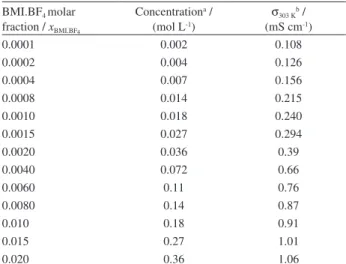
acts as a stabilizing counterion of the positively-charged imidazolium group. The formation of these micellar structures was evaluated considering the ionic conductivity of very dilute binary solutions (BMI.BF4 and EG). The
results are shown in Table 3 and Figure 4.
Micellization is not an abrupt transition occurring in the system but rather an association process that occurs
Figure 3. Ionic conductivity values for the BMI.BF4 and binary solutions
(BMI.BF4 and EG) at 248 (), 273 (), 303 (), 338 () and 358 K ().
Table 3. Ionic conductivity values at 303 K of very dilute binary solutions (BMI.BF4 and EG)
BMI.BF4 molar
fraction / xBMI.BF4
Concentrationa /
(mol L-1)
σ303 Kb /
(mS cm-1)
0.0001 0.002 0.108
0.0002 0.004 0.126
0.0004 0.007 0.156
0.0008 0.014 0.215
0.0010 0.018 0.240
0.0015 0.027 0.294
0.0020 0.036 0.39
0.0040 0.072 0.66
0.0060 0.11 0.76
0.0080 0.14 0.87
0.010 0.18 0.91
0.015 0.27 1.01
0.020 0.36 1.06
aConcentration of BMI.BF
4; bionic conductivity at 303 K.
Figure 4. Ionic conductivity for very dilutebinary solutions (BMI.BF4
and EG).
Figure 3. Ionic conductivity values for the BMI.BF4 and binary solutions
within a finite range of concentrations, and assigning a single value to it is somewhat arbitrary. However, for the binary solutions (BMI.BF4 and EG) it can be observed
that there are two lines intersecting at the critical micellar concentration (cmc). Below the cmc concentration, BMI.BF4
in EG behaves as a strong electrolyte with a high value being estimated for the dissociation. In concentrations above the cmc (around 0.1 mol L-1) a change in the slope of
the curve occurs due to micelle formation. The gentler slope is associated with the counterion on the micellar surface, resulting in an effective decrease in the number of ionic charge carriers, and the micelles, which contribute to the charge transport to a lesser extent than the free ions, owing to their lower mobility. As expected, the cmc of the binary solutions (BMI.BF4 and EG) appears to be much lower than
that of the aqueous BMI.BF4 solution (around 1.0 mol L-1).9
Conclusions
The temperature dependence of the ionic conductivity of BMI.BF4 and EG (electrolytes for capacitors) obeys
the Vogel-Tammann-Fulcher law. The activation energy of the electrolytes showed a tendency to decrease with an increasing amount of EG. The evaluation of the concentration-dependence of BMI.BF4 indicated that the
conductivity of the electrolyte xBMI.BF4 0.50 was the most
suitable for application in capacitors, this electrolyte showing a higher molar ionic conductivity value than the others. In very dilute binary solutions of BMI.BF4 and EG
at concentrations above 0.1 mol L-1 the ionic liquid BMI.
BF4 forms aggregate-type micelles in EG, indicating that
there is a decrease in the ion mobility.
Acknowledgments
The Brazilian governmental agencies CNPq and CAPES are gratefully acknowledged for their financial support.
References
1. Yuyama, K.; Masuda, G.; Yoshida, H.; Sato, T.; J. Power Sources 2006, 162, 1401.
2. Zhu, Q.; Song, Y.; Zhu, X.; Wang, X.; J. Electroanal. Chem. 2007, 601, 229.
3. Brandt, A.; Pohlmann, S.; Varzi, A.; Balducci, A.; Passerini, S.;
MRS Bull.2013, 38, 554.
4. Ue, M.; Curr. Top. Electrochem. 2000, 7, 49.
5. Kühnel, R.; Obeidi, S.; Lübke, M.; Lex-Balducci, A.; Balducci, A.; J. Appl. Electrochem. 2013, 43, 697.
6. Zhao, Y.; Liu, X.; Lu, X.; Zhang, S.; Wang, J.; Wang, H.; Gurau, G.; Rogers, R. D.; Su, L.; Li, H.; J. Phys. Chem. B2012,
116, 10876.
7. Fiegenbaum, F.; de Souza, M. O.; Becker, M. R.; Martini, E. M. A.; de Souza, R. F.; J. Power Sources 2013, 243, 822. 8. Galinski, M.; Lewandowski, A.; Stepniak, I.; Electrochim. Acta
2006, 51, 5567.
9. Ries, L. A. S.; Amaral, F. A.; Matos, K.; Martini, E. M. A.; de Souza, M. O.; de Souza, R. F.; Polyhedron2008, 27, 3287. 10. Trombetta, F.; de Souza, M. O.; de Souza, R. F.; Martini,
E. M. A.; J. Appl. Electrochem.2009, 39, 2315.
11. Laheäär, A.; Jänes, A.; Lust, E.; Electrochim. Acta2014, 125, 482.
12. Palm, R.; Kurig, H.; Tõnurist, K.; Jänes, A.; Lust, E.;
Electrochim. Acta2012, 85, 139.
13. Fox, E. T.; Paillard, E.; Borodin, O.; Henderson, W. A.; J. Phys. Chem.C2013, 117, 78.
14. Ramasamy, C.; del Val, J.; Anderson, M.; J. Power Sources 2014, 248, 370.
15. Dupont, J.; Consorti, C. S.; Suarez, P. A. Z.; de Souza, R. F.;
Org. Synth.2002, 79, 236.
16. Suarez, P. A. Z.; Einloft, S.; Dullius, J. E. L.; de Souza, R. F.; Dupont, J.; J. Chim. Phys. 1998, 95, 1626.
17. Li, W.; Zhang, Z.; Han, B.; Hu, S.; Xie, Y.; Yang, G.; J. Phys. Chem. B 2007, 111, 6452.
18. Tokuda, H.; Hayamizu, K.; Ishii, K.; Susan, M.; Watanabe, M.;
J. Phys. Chem. B2004, 108, 16593.
19. Xu, H.; Zhao, D.; Xu, P.; Liu, F.; Gao, G.; J. Chem. Eng. Data 2005, 50, 133.
20. Ciocirlan, O.; Iulian, O.; J. Chem. Data2011, 56, 1526. 21. Yu, Y-H.; Soriano, A. S.; Li, M-H.; Thermochim. Acta 2009,
482, 42.
22. Chong, A. L.; Forsyth, M.; MacFarlane, D. R.; Electrochim. Acta2015, 159, 219.
23. Song, Y.; Zhu, X.; Wang, X., Wang, M.; J. Power Sources2006,
157, 610.
Submitted: May 21, 2015
Published online: August 11, 2015