Artigo
*e-mail: [email protected]
THERMODYNAMIC STUDY OF THE SOLUBILITY OF SODIUM NAPROXEN IN SOME ETHANOL + WATER MIXTURES
Daniel R. Delgado, Miller A. Ruidiaz, Sandra M. Gómez, Mauricio Gantiva e Fleming Martínez*
Departamento de Farmacia, Universidad Nacional de Colombia, A.A. 14490, Bogotá D.C., Colombia
Recebido em 10/3/10; aceito em 16/6/10; publicado na web em 24/9/10
By using the van’t Hoff and Gibbs equations the apparent thermodynamic functions Gibbs energy, enthalpy, and entropy of solution for sodium naproxen in ethanol + water cosolvent mixtures, were evaluated from solubility data determined at temperatures from (278.15 to 308.15) K. The drug solubility was greatest in neat water and lowest in neat ethanol at all the temperatures studied. By means of non-linear enthalpy-entropy compensation analysis, it follows that the dissolution process of this drug in ethanol-rich mixtures is entropy-driven, whereas, in water-rich mixtures the process is enthalpy-driven.
Keywords: cosolvency; sodium naproxen; solubility.
INTRODUCTION
Sodium naproxen (Na-NAP, Figure 1) is a non-steroidal anti-inlammatory drug derived of propionic acid used widely as analgesic and antipyretic although it also is used for relief of symptoms of rheumatoid arthritis and osteoarthritis in addition to treatment of dysmenorrheal, among other indications.1 Although Na-NAP is
wi-dely used nowadays in therapeutics, the physicochemical information about their aqueous solutions is not complete at present, although several physicochemical studies have been done. Thus, the solution thermodynamics in neat aqueous media for this drug (as dissociate and non-dissociate compound) has been presented in the literature.2
In the same way, the solution thermodynamics as non-dissociate com-pound in some cosolvent mixtures has also been reported.3 Recently,
Chavez studied the solubility of Na-NAP in some methanol + water and ethanol + water mixtures at several temperatures.4 Moreover, the
physicochemical aspects of transfer of this drug (as non-dissociate compound) from aqueous media up to octanol and some phospholi-pidic vesicles have also been reported.5
On the other hand, it is well known that injectable homogeneous liquid formulations supply high doses of drug in small volumes, and thus, the solubility of drugs and other formulation components is very important, because it facilitate the design process of pharmaceutical dosage forms.6
As has been already described, the solubility behavior of drugs in cosolvent mixtures is very important because cosolvent blends are frequently used in puriication methods, preformulation studies, and pharmaceutical dosage forms design, among other applications.7 For
these reasons, it is important to determine systematically the solubi-lity of pharmaceutical compounds. Besides, temperature-solubisolubi-lity dependence allows us to carry out the respective thermodynamic
analysis, which, on the other hand, also permits inside the molecular mechanisms, involved toward the solution processes.6
The main objective of this study was to evaluate the effect of the cosolvent composition on the solubility and solution thermodynamics of Na-NAP in ethanol (EtOH) + water cosolvent mixtures based on the van’t Hoff method as has been done earlier with procaine hydro-chloride.8 Thus, this investigation amply the information reported by
Chavez about the solubility of this drug in the same cosolvent system.4 EXPERIMENTAL
Materials
Sodium naproxen (d-2-(6-methoxy-2-naphthyl)propionic acid sodium salt; CAS: [26159-34-2]; purity: 0.9990 in mass fraction) used is in agreement with the quality requirements indicated in the American Pharmacopeia, USP;9 on similar way, absolute ethanol A.
R. (Merck) (CAS: 64-17-5; purity: 0.9990 in mass fraction), distilled water (CAS: 7732-18-5; conductivity < 2 µS cm–1), molecular sieve
(Merck, numbers 3 and 4), and Millipore Corp. Swinnex®-13 ilter
units, were also used in this study.
Cosolvent mixtures preparation
All EtOH + water cosolvent mixtures were prepared in quantities of 10.00 g by mass using an Ohaus Pioneer TM PA214 analytical balance with sensitivity ± 0.1 mg, in mass fractions from 0.10 to 0.90 varying by 0.10, to study nine binary mixtures and the two pure solvents.
Solubility determinations
An excess of Na-NAP was added to 5 cm3 of each cosolvent
sampling. Drug concentrations were determined by mass balance by weighting a speciied quantity of the respective saturated solution and allowing the solvent evaporation up to constant mass. All the solubility experiments were run at least in triplicate. In order to make the equivalence between molarity and mole fraction concentration scales, the density of the saturated solutions was determined with a digital density meter (DMA 45 Anton Paar) connected to the same recirculating thermostatic baths.
RESULTS AND DISCUSSION
Before to show the solubility results, it is important to consider that this drug like procaine hydrochloride has electrolyte behavior,10
and thus, it dissociates in aqueous solution interacting with the co-solvent mixture by strong ion-dipole interactions, as well as by other weak non covalent interactions; on this way, it also could acts as a Lewis base (–OCH3, Figure 1), in order to establish hydrogen bonds
with proton-donor functional groups in the solvents (–OH groups).10 Experimental solubility
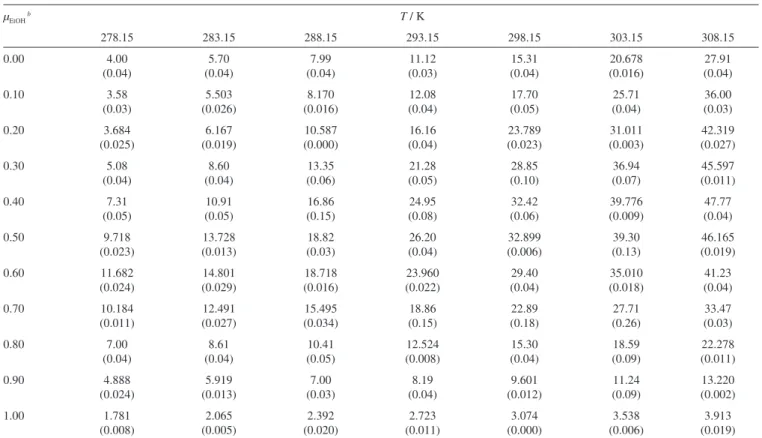
Tables 1 and 2 summarize the experimental solubility of Na-NAP, expressed in mol dm–3 and mole fraction, respectively, at all the
temperatures studied. In all cases the percent coeficients of variation were smaller than 1.0%.
It could be observed that the solubility expressed in both concentration scales was greatest in the mixture of 0.50 in mass fraction of EtOH at temperatures above 293.15 K. This behavior shows cosolvent effect for this electrolyte drug in this solvent system, and it is not in agreement with that expected according to the literature,7 since the Na-NAP solubility is not greatest in neat
water as could be expected because of its large dielectric constant
value (78.5 at 298.15 K).10 Our solubility values in neat water are
in good agreement with those reported by Mendez del Rio2 and
by Kim et al.,2 but they are so very different with respect to those
reported by Martino et al..2 In similar way, our solubility values in
neat EtOH and those on mixtures of 0.30 and 0.90 in mass fraction of EtOH are in good agreement with those reported by Chavez.4
Unfortunately, in the literature there are not reported quantitative solubility values for this drug in other EtOH + water mixtures, and therefore, none other direct comparison is possible.
Because Na-NAP is an electrolyte drug, it is important to keep in mind that in general terms, it could be stated that a strong electrolyte dissociates according to the expression, Cv+Av-→ v+C
z+ + v –A
z-, where v+ is the number of cations (C
z+) of valence z+ and v
– is the number
of anions (Az–) of valence z–. Because it is not possible to determine
experimentally the activity of ions separately, the concept of mean ionic activity (av
±) is used. Thus, the thermodynamic activity for an electrolyte can be deined as, a2= a+
v+a -v- = a
± v.11
Na-NAP is an electrolyte solute of type one-one, that is, it dissociates in aqueous solutions to generate two species, a mono-valent anion and a monomono-valent cation, respectively. If the inter-ionic interactions are not considered, in a irst approach the v value could be ideally assumed as 2 for this saline drug, and thus, this value could be used to calculate the apparent thermodynamic functions of solution.8,10
Thermodynamic functions of solution
According to van’t Hoff analysis, the apparent standard enthalpy change of solution (∆Hsoln
0-app) for electrolytes type one-one, such as
Na-NAP, if the inter-ionic interactions are not considered, is obtained by using the mean harmonic temperature (Thm is 292.8 K in the present
case) according to Equation 1.8
Table 1. Experimental solubility of sodium naproxen in ethanol + water cosolvent mixtures expressed in mol dm–3 at several temperaturesa
μEtOH
b T / K
278.15 283.15 288.15 293.15 298.15 303.15 308.15
0.00 0.2137 (0.0019) 0.2983 (0.0019) 0.4081 (0.0019) 0.5504 (0.0012) 0.7298 (0.0015) 0.9389 (0.0005) 1.1811 (0.0011) 0.10 0.1780 (0.0015) 0.2679 (0.0011) 0.3889 (0.0007) 0.5572 (0.0017) 0.7747 (0.0016) 1.0461 (0.0011) 1.3427 (0.0025) 0.20 0.1694 (0.0011) 0.2772 (0.0008) 0.4570 (0.0001) 0.6649 (0.0011) 0.9192 (0.0011) 1.1346 (0.0001) 1.4191 (0.0007) 0.30 0.2126 (0.0015) 0.3475 (0.0015) 0.5153 (0.0018) 0.7809 (0.0015) 0.9989 (0.0026) 1.2082 (0.0017) 1.4075 (0.0002) 0.40 0.2751 (0.0016) 0.3976 (0.0016) 0.578 (0.004) 0.8233 (0.0023) 1.0161 (0.0014) 1.1915 (0.0002) 1.3626 (0.0009) 0.50 0.3246 (0.0007) 0.4463 (0.0004) 0.5749 (0.0007) 0.7862 (0.0011) 0.9492 (0.0002) 1.0878 (0.0025) 1.2279 (0.0003) 0.60 0.3456 (0.0006) 0.4315 (0.0008) 0.5128 (0.0005) 0.6597 (0.0006) 0.7852 (0.0008) 0.9020 (0.0010) 1.0294 (0.0008) 0.70 0.2718 (0.0003) 0.3285 (0.0006) 0.3818 (0.0008) 0.4761 (0.0033) 0.5646 (0.0037) 0.6679 (0.0050) 0.7816 (0.0006) 0.80 0.1665 (0.0008) 0.2019 (0.0007) 0.3438 (0.0007) 0.2856 (0.0002) 0.3438 (0.0007) 0.4101 (0.0016) 0.4849 (0.0002) 0.90 0.1006 (0.0005) 0.1205 (0.0002) 0.1409 (0.0007) 0.1639 (0.0007) 0.1894 (0.0002) 0.2199 (0.0016) 0.2557 (0.0001) 1.00 3.089 (0.014)
× 10–2
3.560 (0.008) × 10–2
4.11 (0.04) × 10–2
4.653 (0.018) × 10–2
5.209 (0.001) × 10–2
5.950 (0.010) × 10–2
7.54 (0.03) × 10–2
a Values in parentheses are standard deviations. bμ
(1)
where, R is the universal gas constant (8.314 J mol–1 K–1). As an
example, Figure 2 shows the modiied van’t Hoff plot for Na-NAP in mixtures containing 0.40, 0.60, and 0.80 in mass fraction of EtOH. For mixtures from 0.20 to 0.60 in mass fraction of EtOH, parabolic models with good determination coeficients (r2) were obtained, while
in the other solvent systems, linear models were obtained with good r2 values as well.
The apparent standard Gibbs energy change for the solution process (∆Gsoln
0-app) of electrolytes type one-one, considering the
approach proposed by Krug et al.,12 is calculated at mean harmonic
temperature by means of,
(2) in which, the intercept used is the one obtained in the analysis by treatment of ln x2 as a function of 1/T – 1/Thm. Finally, the apparent
standard entropic change for solution process (∆Ssoln
0-app) is obtained
from the respective∆Hsoln
0-app and ∆G soln
0-app values by using:
(3)
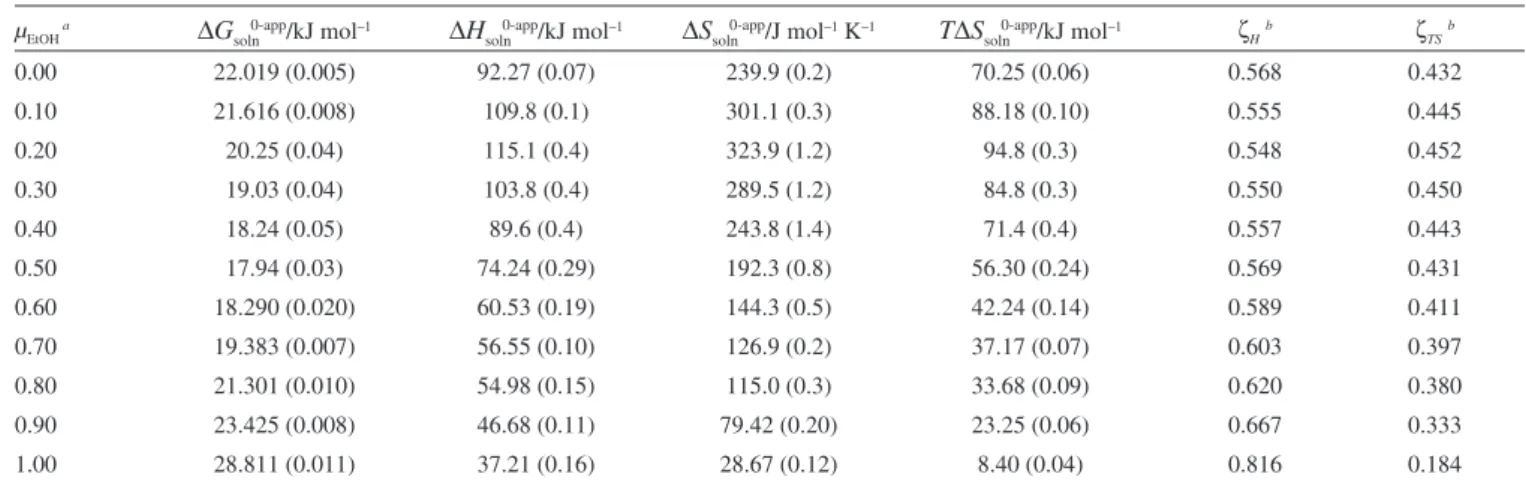
Table 3 summarizes the apparent standard thermodynamic functions for experimental solution process of Na-NAP in all EtOH + water cosolvent mixtures. In order to calculate the thermodynamic quantities for the experimental solution processes some propagation of uncertainties’ methods were used.13 It is found that the standard
Gibbs energy of solution is positive in all cases as expected because the mole fraction is always lower than the unit and thus, its logari-thmic term is negative, and therefore, standard Gibbs energy will be a positive quantity.
The apparent enthalpy of solution is positive in all cases, therefore the process is always endothermic. In the same way, the entropy of solution is also positive indicating entropy driving on overall the solution process for all the mixtures and neat solvents. The ∆Hsoln
0-app
and ∆Ssoln
0-app values increase from neat water up to the mixture of 0.20
in mass fraction of EtOH and decrease from this EtOH proportion up to neat EtOH.
With the aim to compare the relative contributions by enthalpy Figure 2. Modiied van’t Hoff plot for experimental solubility of sodium
naproxen in some ethanol + water mixtures expressed in mole fraction. ( ): 0.40 in mass fraction of ethanol; (): 0.60 in mass fraction of ethanol; (): 0.80 in mass fraction of ethanol. The lines interconnecting points are the respective polynomial regression models
Table 2. Experimental solubility of sodium naproxen in ethanol + water cosolvent mixtures expressed as 1000 × mole fraction at several temperaturesa
μEtOH
b T / K
278.15 283.15 288.15 293.15 298.15 303.15 308.15
0.00 4.00
(0.04)
5.70 (0.04)
7.99 (0.04)
11.12 (0.03)
15.31 (0.04)
20.678 (0.016)
27.91 (0.04)
0.10 3.58
(0.03)
5.503 (0.026)
8.170 (0.016)
12.08 (0.04)
17.70 (0.05)
25.71 (0.04)
36.00 (0.03)
0.20 3.684
(0.025)
6.167 (0.019)
10.587 (0.000)
16.16 (0.04)
23.789 (0.023)
31.011 (0.003)
42.319 (0.027)
0.30 5.08
(0.04)
8.60 (0.04)
13.35 (0.06)
21.28 (0.05)
28.85 (0.10)
36.94 (0.07)
45.597 (0.011)
0.40 7.31
(0.05)
10.91 (0.05)
16.86 (0.15)
24.95 (0.08)
32.42 (0.06)
39.776 (0.009)
47.77 (0.04)
0.50 9.718
(0.023)
13.728 (0.013)
18.82 (0.03)
26.20 (0.04)
32.899 (0.006)
39.30 (0.13)
46.165 (0.019)
0.60 11.682
(0.024)
14.801 (0.029)
18.718 (0.016)
23.960 (0.022)
29.40 (0.04)
35.010 (0.018)
41.23 (0.04)
0.70 10.184
(0.011)
12.491 (0.027)
15.495 (0.034)
18.86 (0.15)
22.89 (0.18)
27.71 (0.26)
33.47 (0.03)
0.80 7.00
(0.04)
8.61 (0.04)
10.41 (0.05)
12.524 (0.008)
15.30 (0.04)
18.59 (0.09)
22.278 (0.011)
0.90 4.888
(0.024)
5.919 (0.013)
7.00 (0.03)
8.19 (0.04)
9.601 (0.012)
11.24 (0.09)
13.220 (0.002)
1.00 1.781
(0.008)
2.065 (0.005)
2.392 (0.020)
2.723 (0.011)
3.074 (0.000)
3.538 (0.006)
3.913 (0.019) a Values in parentheses are standard deviations. bμ
Table 3. Apparent thermodynamic functions relative to solution process of sodium naproxen in ethanol + water cosolvent mixtures at 292.8 K
μEtOH
a ∆G
soln0-app/kJ mol–1 ∆Hsoln0-app/kJ mol–1 ∆Ssoln0-app/J mol–1 K–1 T∆Ssoln0-app/kJ mol–1 ζH
b ζ
TS b
0.00 22.019 (0.005) 92.27 (0.07) 239.9 (0.2) 70.25 (0.06) 0.568 0.432 0.10 21.616 (0.008) 109.8 (0.1) 301.1 (0.3) 88.18 (0.10) 0.555 0.445
0.20 20.25 (0.04) 115.1 (0.4) 323.9 (1.2) 94.8 (0.3) 0.548 0.452
0.30 19.03 (0.04) 103.8 (0.4) 289.5 (1.2) 84.8 (0.3) 0.550 0.450
0.40 18.24 (0.05) 89.6 (0.4) 243.8 (1.4) 71.4 (0.4) 0.557 0.443
0.50 17.94 (0.03) 74.24 (0.29) 192.3 (0.8) 56.30 (0.24) 0.569 0.431 0.60 18.290 (0.020) 60.53 (0.19) 144.3 (0.5) 42.24 (0.14) 0.589 0.411 0.70 19.383 (0.007) 56.55 (0.10) 126.9 (0.2) 37.17 (0.07) 0.603 0.397 0.80 21.301 (0.010) 54.98 (0.15) 115.0 (0.3) 33.68 (0.09) 0.620 0.380 0.90 23.425 (0.008) 46.68 (0.11) 79.42 (0.20) 23.25 (0.06) 0.667 0.333 1.00 28.811 (0.011) 37.21 (0.16) 28.67 (0.12) 8.40 (0.04) 0.816 0.184 aμ
EtOH is the mass fraction of ethanol in the cosolvent mixture free of solute.bζH and ζTS are the relative contributions by enthalpy and entropy toward Gibbs energy of solution. These values were calculated by means of Equations 4 and 5, respectively.
(ζH) and by entropy (ζTS) toward the solution process, Equations 4 and 5 were employed, respectively.14
(4)
(5)
From Table 3 it follows that enthalpy is the main contributor to standard Gibbs energy of solution process of Na-NAP in all the sys-tems studied, and thus the energetic factor predominate, in particular for neat EtOH.
Thermodynamic functions of transfer
In order to verify the effect of cosolvent composition on the thermodynamic function driving the solution process, Table 4 sum-marizes the thermodynamic functions of transfer of Na-NAP from the more polar solvents to the less polar ones. These new functions were calculated as the differences between the thermodynamic quantities of solution in the more polar mixtures and the less polar mixtures.
If the addition of EtOH to neat water is considered (being the cosolvent mixture less polar as the EtOH proportion increases), as has been done earlier,8 it happens the following, from pure water to 0.20
in mass fraction of EtOH (∆GA→B
0-app< 0, ∆H A→B
0-app > 0, and ∆S A→B
0-app > 0)
the solubility process is driven by the entropy; whereas, from this com-position up to 0.50 in mass fraction of EtOH (∆GA→B
0-app < 0, ∆H A→B
0-app < 0,
and ∆SA→B
0-app < 0) the dissolution process is enthalpy driven.
Ulti-mately, from this EtOH proportion up to neat EtOH (∆GA→B 0-app > 0,
∆GA→B
0-app < 0, and ∆S A→B
0-app < 0), the solution process is entropy driven,
again. Nevertheless, the molecular or ionic events involved on solution processes are unclear.
Enthalpy-entropy compensation of solution
According to the literature, the making of weighted graphs of ∆Gsoln
0-app as a function of ∆G soln
0-app at mean harmonic temperature allows
us to observe similar mechanisms for the solution process according to the tendencies obtained.15
In this context, Figure 3 shows fully that Na-NAP in the EtOH + water cosolvent system exhibits non-linear ∆Hsoln
0-app vs. ∆G soln
0-app
compensation with negative slope if an interval from pure water up to 0.20 in mass fraction of EtOH is considered, whereas from this EtOH proportion to 0.50 in mass fraction of EtOH neat water a positive slope is obtained. Accordingly to this graph it follows that the driving function for drug solubility is the entropy in the former case, while in the second case, the driving function is mainly the enthalpy. On the other hand, from 0.50 in mass fraction of EtOH to neat EtOH negative slope is found again indicating entropy driven again, as it was already said in terms of quantities
Figure 3. ∆H0 soln vs. ∆G
0
soln enthalpy-entropy compensation plot for solubility
of sodium naproxen in ethanol + water cosolvent mixtures at 292.8 K. The slopes of the lines interconnecting composition points (mass fractions of ethanol) deine the thermodynamic functions driving the sodium naproxen transfer processes
Table 4. Apparent thermodynamic functions of transfer of sodium naproxen from more polar solvents to less polar solvents in ethanol + water cosolvent mixtures at 292.8 K
µEtOH
a ∆G
A→B 0-app/
kJ mol–1
∆HA→B 0-app/
kJ mol–1
∆SA→B 0-app/
J mol–1 K–1
T∆SA→B 0-app/
kJ mol–1
A B
0.00 0.20 –1.77 (0.04) 22.8 (0.4) 84.0 (1.2) 24.6 (0.3) 0.20 0.50 –2.31 (0.05) –40.9 (0.5) –131.6 (1.4) –38.5 (0.4) 0.50 1.00 10.87 (0.03) –37.0 (0.3) –163.6 (0.8) –47.91 (0.25) aμ
EtOH is the mass fraction of ethanol in the cosolvent mixture free of solute;
of transfer. Nevertheless, the molecular and ionic events involved in the dissolution of this drug in this cosolvent system are unclear as was already said.
CONCLUSIONS
From all topics discussed previously it can be concluded that the solution process of Na-NAP in EtOH + water mixtures is variable depending on the cosolvent composition. Non linear enthalpy-entropy compensation was found for this electrolyte drug in this cosolvent system. In this context, entropy-driving was found for the solution processes in compositions from pure water to the mixture having 0.20 in mass fraction of EtOH; whereas, for cosolvent mixtures from this EtOH proportion to mixture of 0.50 in mass fraction of EtOH, enthalpy-driving was found; moreover, beyond this EtOH proportion up to neat EtOH entropy-driving is found again. Ultimately, it can be said that the data presented in this report expand the physicochemical information about electrolyte drugs in aqueous solutions.
ACKNOWLEDGMENTS
We thank the DIB of the Universidad Nacional de Colombia (UNC) for the inancial support. Additionally we thank the De-partment of Pharmacy of UNC for facilitating the equipment and laboratories used.
REFERENCES
1. Raffa, R. B. In Remington: The Science and Practice of Pharmacy, 21st
ed.; Gennaro, A. R., ed.; Lippincott Williams & Wilkins: Philadelphia, 2005, p. 1539.
2. Martino, P. D.; Barthelemy, C.; Palmieri, G. F.; Martelli, S.; Eur. J. Pharm. Sci. 2001, 14, 293; Perlovich, G. L.; Kurkov, S. V.; Kinchin, A. N.; Bauer-Brandl, A.; Eur. J. Pharm. Biopharm. 2004, 57, 411; Méndez del Río, J. R.; M.Sc. Thesis, Georgia Institute of Technology, Atlanta, 2004; Kim, Y. S.; Méndez del Río, J. R.; Rousseau, R. W.; J. Pharm. Sci. 2005, 94, 1941; Mora, C. P.; Martínez, F.; Phys. Chem. Liq. 2006,
44, 585; Mora, C. P.; Barbosa, H. J.; Martínez, F.; Vitae, Rev. Fac. Quím. Farm. 2007, 14, 38.
3. Bustamante, P.; Peña, M. A.; Barra, J.; J. Pharm. Pharmacol. 1998,
50, 975; Pacheco, D. P.; Martínez, F.; Phys. Chem. Liq. 2007, 45, 581; Manrique, Y. J.; Pacheco, D. P.; Martínez, F.; J. Solution Chem. 2008,
37, 165.
4. Chavez, K. J.; Ph.D. Thesis, Georgia Institute of Technology, Atlanta, 2009.
5. Mora, C. P.; Martínez, F.; J. Chem. Eng. Data2007, 52, 1933. 6. Jiménez, J. A.; Martínez, F.; J. Solution Chem. 2006, 35, 335. 7. Rubino, J. T. In Encyclopedia of Pharmaceutical Technology; Swarbrick,
J.; Boylan J. C., eds.; Marcel Dekker, Inc.: New York, 1988, vol 3, p. 375-398; Yalkowsky, S. H.; Solubility and Solubilization in Aqueous
Media, American Chemical Society and Oxford University Press: New
York, 1999, p. 91-134.
8. Delgado, D. R.; Vargas, E. F.; Martínez, F.; J. Chem. Eng. Data2010,
55, 2900.
9. US Pharmacopeia, 23rd ed., The United States Pharmacopeial
Convention: Rockville, MD, 1994, p. 1054-1055.
10. Martin, A.; Bustamante, P.; Chun, A. H. C.; Physical Pharmacy: Physical Chemical Principles in the Pharmaceutical Sciences, 4th
ed., Lea & Febiger: Philadelphia, 1993; Florence, A. T.; Atwood, D.;
Physicochemical Principles of Pharmacy, 3rd ed., MacMillan Press Ltd.:
London, 1998, p. 64-67.
11. Klotz, I. M.; Rosenberg, R. M.; Chemical Thermodynamics: Basic Theory and Methods, 6th ed.; John Wiley & Sons, Inc.: New York, 2000,
p. 438-448; Bevan, J.; Boerio-Goates, J.; Chemical Thermodynamics:
Principles and Applications, Academic Press: New York, 2000, p.
295-301; Connors, K. A.; Thermodynamics of Pharmaceutical Systems: An
Introduction for Students of Pharmacy, Wiley-Interscience: Hoboken,
2002, p. 96-105.
12. Krug, R. R.; Hunter, W. G.; Grieger, R. A.; J. Phys. Chem. 1976, 80, 2341.
13. Bevington, P. R.; Data Reduction and Error Analysis for the Physical
Sciences, McGraw-Hill Book Co.: New York, 1969, p. 56-91.
14. Perlovich, G. L.; Kurkov, S. V.; Kinchin, A. N.; Bauer-Brandl, A.; Eur. J. Pharm. Biopharm. 2004, 57, 411.