Article
Printed in Brazil - ©2017 Sociedade Brasileira de Química 0103 - 5053 $6.00+0.00
*e-mail: [email protected], [email protected]
Influence of the Transport of Sea Spray on the Salinization of the Semiarid Region
Waters (Bahia, Brazil)
Adriana M. Silva,a Vânia P. Campos,*,b Rafaela S. Domingues,b Lícia P. S. Cruzb and
Franciele O. Santanab
aColegiado Acadêmico de Engenharia Agrícola e Ambiental,
Universidade Federal do Vale do São Francisco, 48902-300 Juazeiro-BA, Brazil
bDepartamento de Química Analítica, Instituto de Química, Universidade Federal da Bahia,
40170-290 Salvador-BA, Brazil
The sea spray can be transported to long distances, reaching the semiarid regions. In this work, the rainwater and the atmospheric particulate matter were characterized by investigating the presence of sea spray in the atmosphere of the semiarid region of Bahia, Brazil, aiming to study the influence of its transport on the salinization of the waters of the region. Stable isotopes of deuterium and oxygen-18 were also determined in the rain as environmental tracers, evaluating the isotopic ratios 18O/16O and D/H. The atmosphere of the region suffers marine influence, as well as resuspended soil particles and anthropogenic sources. The results demonstrate that the amount of sea spray which reaches the region is insufficient to interfere at the groundwater composition and the cause of its salinization should be attributed to the local geology and the evaporation and salt concentration process due to the high temperatures found in the region.
Keywords:sea spray, rainwater, particulate matter, stable isotopes, semiarid region
Introduction
The contribution of chemical species to the atmosphere represents an important mechanism of the hydrogeochemical processes, very significant in semiarid regions, that continuously suffers with a high frequency of dry periods. The problem of the salinization of surface waters in these regions certainly points to factors such as the recharging of water bodies with salinated water due to leaching of salts from the soil and to the salt concentration in the reservoirs because of the high evaporation rate typical in the Brazilian Northeast region.1
Atmospheric deposition is one of the main stages of the cycling and redistribution of the various chemical elements on the earth’s surface. Therefore, their quantitative and qualitative knowledge is essentially important for the understanding of the biogeochemical cycles and anthropogenic influences on them. The wet deposition comprises the atmospheric particles and gases removal processes by the rain, fog or snow. The dry deposition
includes all the particles and gases transferring processes to all types of surfaces in the absence of moisture.2
The sea spray is a type of particulate matter produced naturally via the bubble-bursting process typically from whitecap generation. The bubbles scavenge organic matter as they rise to the surface. When they burst at the air-sea interface, they release a mixture of organic matter and inorganic sea salt, forming the sea spray aerosol, comprising the range of the submicrometre size and up to a few micrometres.3 It constitutes one of the most
important natural aerosol systems and contributes to the Earth’s radiative budget, biogeochemical cycling, impacts on ecosystems and even to regional air quality.4 Strongly
dependent on the intensity of local winds, as shown Masiol et al.,5 the sea spray can be transported to long
distances and deposited in a wet and/or dry way and it can reach the semiarid regions, distant from its emission source. Being these particles composed basically of seawater (NaCl in carbonate/borate buffer), having thus an alkaline pH, they are able to neutralize rain acidity by gas to particle interaction.6,7
the distribution of its size as the most important one. Chemically, its composition reflects its emission sources;8
their size is an important parameter for the evaluation of their impact on the global climate system.9
The environmental isotopic ratios δ deuterium and δ oxygen-18 (δD and δO18) act as excellent natural tracers
of air masses. They have been used very successfully as one of the unconventional tools in the study of the surface and underground water reserves.10 The natural isotopes appear
in the water in low concentrations that vary when they undergo processes of changing phase, such as evaporation. Thus, the environmental tracers are used to identify and separate the different salinity sources, as well as the effect of evapotranspiration in these processes11 and it can be
a useful tool in the study of the salinization processes,12
including salinization of the waters of the semiarid regions. The processes of water and soil salinization, low rainfall rate and high evaporation rate of the water stored in reservoirs, contribute to the degradation of the quality of the water in the semiarid region of Brazil.
As a consequence of the vulnerability of water resources in semiarid areas, especially considering their scarcity, the study of the surface and underground water quality becomes important, aiming to provide water with better quality for more noble uses such as household supplies. There is a reasonable amount of data with results of analysis of legislated parameters in Brazil, which determine the quality of water in some parts of semiarid regions.1,13
Some studies indicate differentiated causes to the salinization of water, among them are the high evaporation rates, that concentrate the salts in the surface waters and in the soils during the dry periods; this salt is transported to the aquifer in the wet period by the recharge waters.14 Kovda15
pointed as the main salinization source in the semiarid region, the aerosols coming from the marine atmosphere transported by the wind, which can be later leached from the soil and carried to the water bodies by runoff. On the other hand, according to Wetzel,16 the water conductivity
values in tropical regions are related to the geochemical and climatic characteristics of the region.
In this work, rain water and atmospheric particulate matter were characterized, investigating the presence of sea spray in the Semiarid of Bahia, Brazil, intending to study the influence of its transport in the salinization of waters in the region. The δD and δO18 were also evaluated in the
rain as environmental tracers. Additionally, there was a secondary data research on the geological characteristics of the semiarid region of the Bahia State, associated with the salinity of groundwater.
Experimental
Sampling
The Semiarid of Bahia occupies most of the northeastern Brazil and nearly 2/3 of the state’s territory. Among its main climatic characteristics, the high temperature average and extremely concentrated average annual rainfall of less than 800 mm stand out, creating long periods of drought (usually seven to nine months) and rainy periods restricted to few months of the year.17
For the proposed study, two areas in the Semiarid of Bahia (Figure 1) with different salinity characteristics of its natural waters were chosen: Juazeiro (9° 26’ 56’’ S, 40° 31’ 26’’ W), at 386 m of altitude, located in the north of the state, with groundwater that is often brackish, and
it is characterized by the lack of rain and great irregularity in its distribution from 250 to 750 mm per year, low cloud cover, strong sunlight, high levels of evaporation, high average temperatures (ca. 27 °C) and low relative humidity; and Morro do Chapéu (11° 30’ 27’’ S, 41° 08’ 08’’W) , at 1,003 m above sea level, located in the northwest of the state, a region with typically sweet groundwater.
All rainy events were sampled for periods of 24 h during one year, in both locations (55 rain samples from Juazeiro and 35 from Morro do Chapéu), for the determination of the major ions, using an automatic “wet only” deposition collector, set to about 1.5 m from the ground, consisting of a funnel (598 cm2) and a collector flask (6 L), both made
of polyethylene, protected in a metal box.
Sampling and storaging rain water samples for determination of hydrogen and oxygen isotopes were made according to the instructions of the International Atomic Energy Agency (IAEA).18 The main problems that should be
avoided are the fractionization by evaporation or diffusion of water vapor and/or isotopic exchange with the environment as well as with the storage bottle. Thus, a collector was mounted in a 20 L flask containing 100 mL of mineral oil to prevent evaporation and wrapped in aluminum foil to prevent sample degradation; there was a sieve on the top, disallowing the entry of other materials. Most rainy events that occurred during one year was collected. Immediately after sampling, aliquots of the samples were transferred in duplicate and stored in 100 mL amber glass bottles, fully completed and duly sealed, to avoid isotopic fractionation after collection. The samples were stored in a refrigerator and transported safely in thermal containers at low temperatures to the laboratory for measurement of stable isotopes.
The sampling of atmospheric particulate material was made in two intensive campaigns for 6 days, simultaneously, at the two sampling stations. The samplings were made for 24 h periods. The campaigns were scheduled for periods typically with predominant winds from the Atlantic and thus, based on the back trajectories study, it was observed that almost 100% of the sampling time of atmospheric particulate matter, the air masses arrived in both locations coming from the ocean.
Samples of suspended particles fractionated by size have been obtained with a Berner low-pressure impactor (BLPI)19
with six stages: 0.06, 0.18, 0.55, 1.7, 5.0, and > 14.5 µm. The particles were sampled on a Nucleopore membrane (47 mm, 0.2 µm) at air flow of 19.2 L min-1 during 24 h.
Analyses and quality control
The analytical methodology included ion chromatography for the determination of anions Cl-, NO
3- and SO42-, with
limits of detection (LOD): 1.97, 0.322 and 1.25 µmol L-1,
respectively, in the rainwater and particulate matter; molecular spectrophotometry using the indophenol method (λ = 630 nm) for the determination of NH4+
(LOD: 0.0944 µmol L-1); flame photometry for Na+ and
K+ (LOD: 2.61 and 0.246 µmol L-1, respectively); and
atomic absorption spectrometry with flame for Ca2+ and
Mg2+ (LOD: 1.70 and 0.251 µmol L-1, respectively). The
atmospheric particulate matter on the membranes was extracted with 1.5 mL of deionized water in ultrasound bath for 15 min, followed by centrifugation and analysis, using the same above cited analytical methods. The LOD for Cl-, NO
3-, SO42- and Na+ in atmospheric particulate matter
were: 0.107, 0.0174, 0.0678 and 3.91 nmol m-3, respectively.
Because it only had 1.5 mL of each sample of atmospheric particulate matter in different stages of the cascade impactor, it was not possible to analyze the other ions in this matrix. The pH measurements of the rain samples were made with a pHmeter MPA 210 (MLABOR) Model AF 405 (accuracy of 0.02 pH units), using a combinated glass electrode, calibrated with buffer solutions. Conductivity measurements were made with a conductivimeter Marconi Model MACA 150, provided with a platinum cell with a constant of 1.0 cm-1,
which allows thermostated measurements at 25 ± 0.1 °C. The isotopic analyzes were performed using Finnigan equipments: a mass spectrometer (MS, MAT Delta Plus), an automatic reactor (H Device, ThermoQuest) specific for analysis of the ratio D/H, and an online automatic sample preparation system (Gas Bench II) for the isotopic determination of the O18/O16 ratio. The standard water was
a SMOW sample (standard mean ocean water), provided by the IAEA.
The quality control analysis was done using a standard reference rain, produced by the Canadian environmental agency (RAIN-97, lots 1107 and 407) containing all species determined in the rain and in the particulate matter. The quality of the data series was controlled by mass balance (total sum of cation equivalents versus ion equivalents) and comparing the calculated and measured conductivity values.20
Statistical analysis
The evaluation of possible correlations between the ions measured in the rain and in the atmospheric particulate matter was made using the Pearson correlation coefficient.21
for the application of this statistical tool was Statistica, version 10.0.
Air mass trajectories
A study of the trajectories of air masses for the sampling period was done using the NOAA HYSPLIT model.22
The back trajectories were simulated for each period and sampling station, taking into accounts their respective altitudes and georeference, allowing the determination of the air masses trajectory that comes to each site.
Study of the geological characteristics of the water basins of the Semiarid of Bahia
Chemical secondary data on the groundwaters of the Bahia State were used. The major ions in groundwater were thus compiled, which could come from the sea spray. The data come from the registration of the wells, made available by the Company of Rural Engineering of Bahia (CERB) on the official website of the Geological Survey of Brazil23
through the Information System Groundwater (SIAGAS). Associations were made between the groundwater salinity of the region with the local geology, which will be discussed particularly in the two areas chosen for atmospheric studies of this work, that are part of the Salitre riverbasin, semiarid region of Bahia.
Results and Discussion
Inorganic characterization of the rain
In the two sampling sites (Juazeiro and Morro do Chapéu) the conductivity of the rain ranged from 21.5 to 70.8 µS cm-1 and 4.58 to 19.1 µS cm-1,respectively.
The molar concentrations and the percentage distribution
of the ionic species decreased in the following order: Cl- > Ca2+ > NO
3- > NH4+ > Na+ > K+ > Mg2+ > SO42- > H+ in
Juazeiro (Figure 2a) and Cl- > NH
4+ > Na+ > NO3- > Mg2+ >
H+ > SO
42- > K+ > Ca2+ in Morro do Chapéu (Figure 2b).
The presence of sea spray was detected by the ratio Cl-/Na+ in the rainwater, which also shows other sources of
Cl- in the atmosphere of the region, mainly in Juazeiro. As
found by Gioda et al.24 in Puerto Rican rainforest,despite
the altitude and distance from the sea, the atmosphere of the Semiarid of Bahia represented by wet precipitation, is strongly influenced by marine sources rather than local antropogenic sources. NH4+, one of the most abundant ions
in the rain of the two localities, probably has its origin in the use of fertilizers in the vicinity of the rain sampling sites, which is more intense in Morro do Chapéu.
The results showed pH values of the rain in Juazeiro between 5.98 and 7.33, with 6.80 as volume-weighted mean (VWM); in Morro do Chapéuthe pH values ranged from 6.40 to 7.24, with 6.75 as VWM. These values suggest a neutralization of the rain acidity by ammonia either by basic soil particles or by sea spray. The calculated average parcel of the rain acidity neutralization by sea spray, using Na+ as tracer, according to Campos et al.,7 was 26.3 and
27.6%, respectively, in those locations.7 The estimation
of the influence of the sea spray in rain from Juazeiro and Morro do Chapéu showed, respectively, the following contribution of constituents: Cl-, 56 and 92%; SO
42-, 38 and
81%; Mg2+, 14 and 26%; Ca2+, 25 and 57%; and K+, 2.2
and 0%. Thus, it is observed that in the locality of Morro do Chapéu, the contribution of marine aerosol is virtually the only source of chloride.
Inorganic characterization of the atmospheric particulate matter (PM)
Considering the two locations, the concentration level
of the major inorganic species in PM was in the range of 13.6-26.9 nmol m-3 Cl-, 3.23-6.17 nmol m-3 NO
3-,
2.87-11.0 nmol m-3 SO
42- and 11.5-37.0 nmol m-3 Na+.
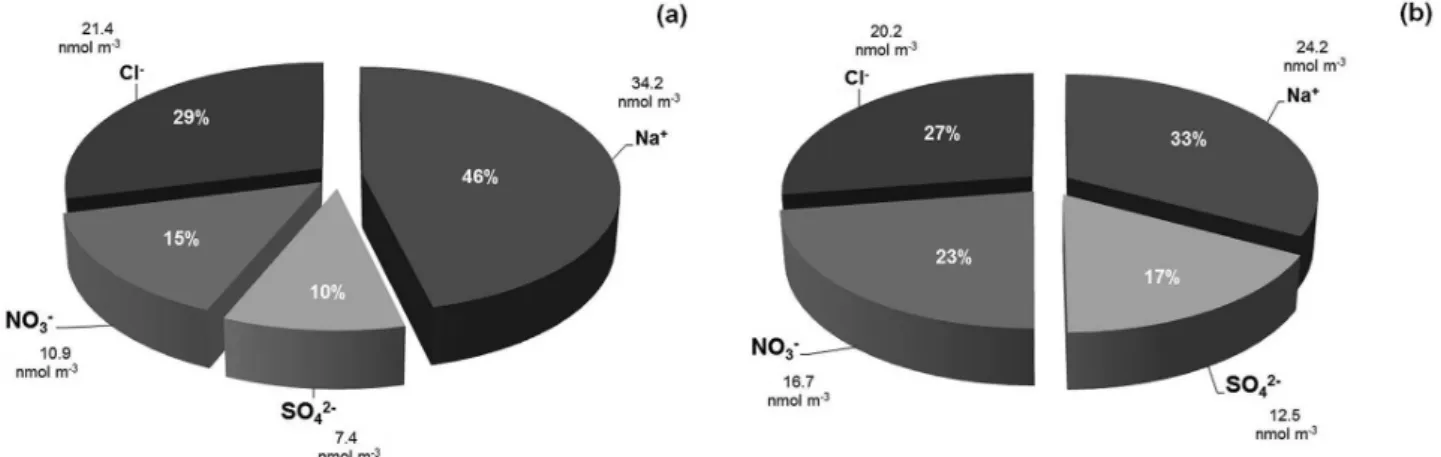
Figure 3 shows the average percentage distribution of these ions in the two locations, which characterizes the atmospheric particulate matter in that semiarid region. It can be seen in this figure that Na+ and Cl- are the most
abundant ions.
Figure 3 shows the distribution percentage and average concentration of the ions analyzed in the atmospheric particulate material. The apparent deficit in the chloride particle shown in this figure can be attributed to atmospheric reactions on the surface of sea spray, producing gaseous HCl.25 This does not happen in the rain, as previously
discussed with reference to other sources of Cl- in the
region, which should be gas, since they are not represented in the particulate material.
The SO42-nss percentual (nss: non sea salt), comparing
to total sulfate (SO42-T) in the atmosphere of both locations,
shows that the sea spray SO42- contribution to the particulate
material is only 3 and 2%, on average. Sievering et al.25
calculated the SO42-nss of the region as:
[SO42-]nss = [SO42-]T – 0.06 [Na+] (1)
where [SO42-]T and [Na+] are concentrations of the ions in
the particulate material; 0.06 is the molar ratio SO42-/Na+
in the sea water.
Figure 4 shows the distribution by size of these particles, where Na+ and Cl- can be observed predominantly as
particles > 1.7 µm. This is observed also in other works.3,4,26
Since Na+ and Cl- are mainly originated by sea spray, their
particles are mainly distributed in the micrometric fraction. However, as expected for long-range transport, the sea spray content in the sub-micrometric fraction is not negligible, as can be seen in this figure.
From Figure 4 the choride depletion seems to be high in both the stations, especially in the 0.55 µm fraction measured at Morro do Chapéu. Figure 4 also shows that the predominance of NO3- and SO42- as atmospheric
fine particles (≤ 1.7 µm) suggests a secondary source by gas-particle or particle-particle convertion, according to Allen et al.27 and Contini et al.28
Isotopic characterization of the rain
Stable isotopes of oxygen-18 and deuterium were determined in the rain as environmental tracers, evaluating the isotopic ratios 18O/16O and D/H, which can vary in the
rain according to the water source and the processes that occur during their displacement and its surface storage, such as climate of the local of the precipitation (rainfall and temperature), geographical features (distance from the coast, elevation) and evaporation degree. The quantitation of the isotope ratio is given in terms of its deviation (δ ‰)
Figure 3. Percentual distribution and average concentration of the major ions in the atmospheric particulate matter of (a) Juazeiro; (b) Morro do Chapéu (Semiarid of Bahia, Brazil).
Figure 4. Average concentrations of Cl-, Na+, SO
in the sample compared to a standard water (standard mean ocean water, IAEA), Rp, and the sample isotopic
ratio 18O/16O (R a):29
δ ‰ = [(Ra − Rp) / Rp] × 103 (2)
The deuterium excess (d) is a function of the source of the water vapor as well as of the hydrologic recycling degree in the basin. Increases in d result from the additional contribution of the recycled water vapor from the surface water evaporation and from the captured water by interception during the climatic event.30 According to
Armengaud et al.,31 d provides information on the distance
of the evaporative sources, which originated the rains, i.e., air masses subject to several consecutive episodes of condensation and evaporation produces precipitations with elevated values of the deuterium excess.
The excess of deuterium (d) is expressed by equation 3:
d = δD – 8 δO18 (‰) (3)
The parameter d is also dependent on the location; the average value found by Craig29 was 10‰.
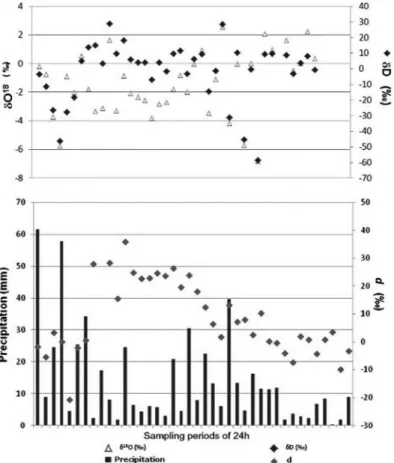
The data relating to the environmental isotopes oxygen-18 and deuterium in the precipitation characterized
the studied area, with maximum and minimum values of 28.8 and −58.5‰ for δD and 6.81 and −2.55‰ for δO18
in Juazeiro, and 23.3 and −48.6‰ for δD and −0.02 and 9.49‰ for δO18 in Morro do Chapéu, respectively. The
amounts of deuterium excess corroborating with the type of precipitation of air masses that represent the precipitation of the region maximum and minimum values were: 41.5 and −20.7‰ in Juazeiro, and 43.1 and −1.1‰ in Morro do Chapéu,respectively. The more positive values found for Morro do Chapéucharacterize waters from further afield. Figure 5 shows the daily variation of precipitation at this location as an example of the semiarid region of Bahia, with their isotopic ratios and the calculated deuterium excess, enabling the characterization of the temporal and spatial variability compared with the analysis of the origin of the deposited water in the region.
Air mass characterization
The study of the trajectories of air masses for each rain event and during the PM sampling period using the NOAA HYSPLIT mode21 showed that, in the most of the
atmospheric PM sampling days, the air mass that arrived in the region passed over the ocean: frequency of 83% for Juazeiro and 75% for Morro do Chapéu. In the case of the
sampled rainy events, the frequency of air masses coming from the ocean was relatively low for Juazeiro (29%) and it was maintained at 75% for the locality Morro do Chapéu. It was possible to know because for each sampling day has been generated a backward trajectory graph, from the beginning of the 24 h of sampling until the end. Figure S1 (Supplementary Information) shows examples of backward trajectories of air masses of sampling days.
Statistical analysis
The hierarchical cluster analysis (HCA) was applied to the data arrays of the rainwater samples for both seasons (Juazeiro and Morro do Chapéu) using the Statistica 10.0 program, aiming to complement the studies conducted to investigate the marine influence and other sources (natural continental and anthropogenic) in the waters salinization in the Semiarid of Bahia. Analyzing the dendrograms obtained (Figure S2, Supplementary Information), one can see that
for Juazeiro there is the division of five groups, showing strong similarities between (i) Cl- and K+, that could
indicate common origin from biomass burning; (ii) Na+
and pH; (iii) NO3- and NH4+; (iv) SO42-, SO42-nss; (v) Ca2+,
Mg2+ and conductivity, which seems that, in this station,
the crustal contribution is dominant with respect to sea spray. For Morro do Chapéu, there was the formation of three groups with great similarity: the first of them shows similarities between Cl-, Na+ and Mg2+, indicating the sea
spray contribution; the second group shows similarities between SO42-, SO42-nss and pH; the third group shows
similarities between NO3-, conductivity, NH4+, Ca2+ and K+.
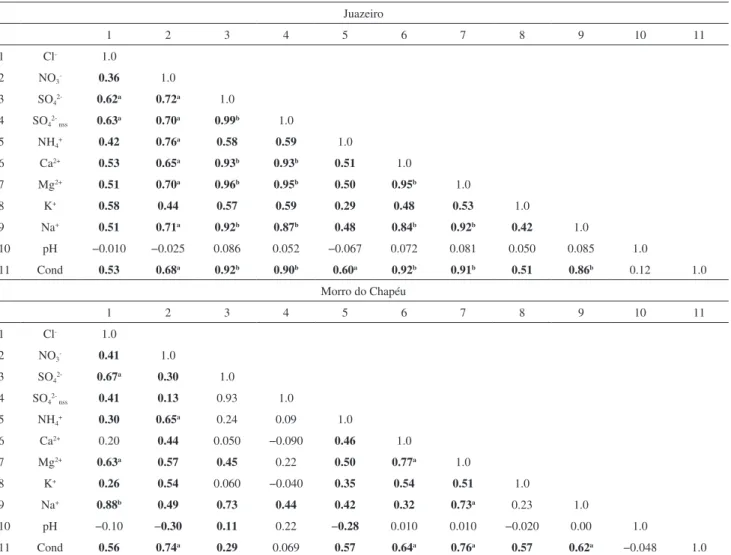
The correlation matrix (Table 1) constructed with the data of the rain samples of the region, showed the following strong positive correlations: (i) Cl-, Na+ and Mg2+ displayed
high positive correlation coefficient in Morro do Chapéu and high similarity according to the dendrogram, supporting the marine influence in this place; (ii) between nitrogen species (NH4+ and NO3-) in both locations, related to human activities
Table 1. Correlation matrix with the data of the rain samples of the Juazeiro and Morro do Chapéu regions
Juazeiro
1 2 3 4 5 6 7 8 9 10 11
1 Cl- 1.0
2 NO3- 0.36 1.0
3 SO42- 0.62a 0.72a 1.0
4 SO42- nss 0.63a 0.70a 0.99b 1.0
5 NH4+ 0.42 0.76a 0.58 0.59 1.0
6 Ca2+ 0.53 0.65a 0.93b 0.93b 0.51 1.0
7 Mg2+ 0.51 0.70a 0.96b 0.95b 0.50 0.95b 1.0
8 K+ 0.58 0.44 0.57 0.59 0.29 0.48 0.53 1.0
9 Na+ 0.51 0.71a 0.92b 0.87b 0.48 0.84b 0.92b 0.42 1.0
10 pH −0.010 −0.025 0.086 0.052 −0.067 0.072 0.081 0.050 0.085 1.0
11 Cond 0.53 0.68a 0.92b 0.90b 0.60a 0.92b 0.91b 0.51 0.86b 0.12 1.0
Morro do Chapéu
1 2 3 4 5 6 7 8 9 10 11
1 Cl- 1.0
2 NO3- 0.41 1.0
3 SO42- 0.67a 0.30 1.0
4 SO42- nss 0.41 0.13 0.93 1.0
5 NH4+ 0.30 0.65a 0.24 0.09 1.0
6 Ca2+ 0.20 0.44 0.050 −0.090 0.46 1.0
7 Mg2+ 0.63a 0.57 0.45 0.22 0.50 0.77a 1.0
8 K+ 0.26 0.54 0.060 −0.040 0.35 0.54 0.51 1.0
9 Na+ 0.88b 0.49 0.73 0.44 0.42 0.32 0.73a 0.23 1.0
10 pH −0.10 −0.30 0.11 0.22 −0.28 0.010 0.010 −0.020 0.00 1.0
11 Cond 0.56 0.74a 0.29 0.069 0.57 0.64a 0.76a 0.57 0.62a −0.048 1.0
with emission of precursors: NOx (NO + NO2), by more
intense emissions from biomass burning, NO3- ion being
the major oxidation products of these compounds; NH4+, by
management of animal waste, disposal of sewage, landfills and dumps; (iii) SO42- and SO42-nss correlates with NO3- in the
rain of Juazeiro, showing common origin of these species with ions derived from soil resuspension, such as Mg2+ and
Ca2+. Therefore, in this station, the main source of SO 42-nss
could be the continental dust. On the other hand, in Morro do Chapéu, the low correlation coefficient between SO42-nss
and NO3- and also the dissimilarity shown in the dendrogram
indicate no common origin and also corroborates with the low percentual (19%) of anthropogenic contribution found to SO42- in this location rain.
The principal component analysis technique (PCA) was applied to the data of atmospheric particulate matter in the two sampling locations used in this study. Samples were identified by a code that identifies the station (J: Juazeiro; M: Morro do Chapéu), the month of the collection (A: April; N: November), the initial date of sampling and identification of the particles (F: fine particles; C: coarse particles).
Figure S3 (Supplementary Information) shows the graphs of scores and loadings using two main components to explain the results that are associated with each variable (Cl-, NO
3-, SO42-, Na+) for fine and coarse particles. Looking
at this figure, the PCA showed that the first and second main components explain 81 and 14%, respectively, of the total variance.
The ions Na+ and Cl- were the most abundant in the
coarse fraction of the particles, suggesting a significant contribution by the sea spray in this size range of the particulate matter that comes to this region, especially in Morro do Chapéu.
The predominance of SO42- in fine mode in both
sampling stations, after a long period of drought, confirms its secondary source by particle-particle or gas-particle conversion through the SO2 oxidation, emitted from burning
local biomass. The main contribution of the ion NO3- in
fine particulate material supports the existence of gas phase reactions between NH3, Cl- from sea spray and nitric
acid, with the formation of NH4Cl and NH4NO3, partially
explaining the loss of chloride of the coarse particulate and, at the same time, nitrate gain for the fine particulate.
Contribution of sea spray to the groundwater of the study area
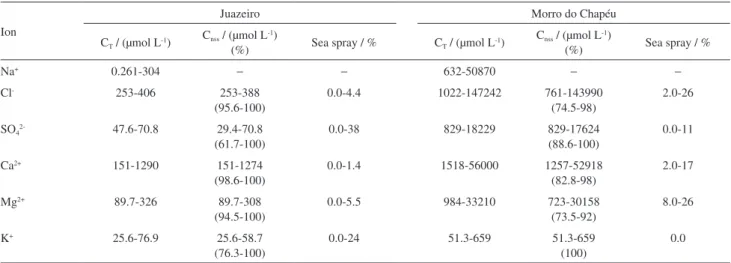
Table 2 presents the ranges of total concentration of the main ions in groundwater, which could originate from the sea spray, as well as nss (non sea salt) concentrations and the contribution of sea spray (ss) to those sampled waters from six wells in the region of Juazeiro and eight wells in the region of Morro do Chapéu.
The estimation of the sea spray in the groundwater from Juazeiro and Morro do Chapéu showed, respectively, the following maximal contribution of constituents (Table 2): 4.4 and 26% Cl-; 38 and 11% SO
42-; 1.4 and 17% Ca2+;
5.5 and 26% Mg2+; and 24 and 0.0% K+. These data show
that the amount of sea spray that reaches the region is not sufficient to salinize the groundwaters.
The municipalities of Juazeiro and Morro do Chapéu, areas considered to the atmospheric study in this work, are located in the Salitre river basin in semiarid region of Bahia. The research that was done in this work on the geological characteristics of these locations showed that this basin is under different hydrogeologic domains, which are entities resulting from the grouping of geologic units
Table 2. Ranges of total concentration, nss (non sea salt) and sea spray contribution in the groundwater of the studied areas. Water basin of the Salitre river, Semiarid of Bahia, Brazil
Ion
Juazeiro Morro do Chapéu
CT / (µmol L-1)
Cnss / (µmol L-1)
(%) Sea spray / % CT / (µmol L-1)
Cnss / (µmol L-1)
(%) Sea spray / %
Na+ 0.261-304 − − 632-50870 − −
Cl- 253-406 253-388
(95.6-100)
0.0-4.4 1022-147242 761-143990
(74.5-98)
2.0-26
SO42- 47.6-70.8 29.4-70.8
(61.7-100)
0.0-38 829-18229 829-17624
(88.6-100)
0.0-11
Ca2+ 151-1290 151-1274
(98.6-100)
0.0-1.4 1518-56000 1257-52918
(82.8-98)
2.0-17
Mg2+ 89.7-326 89.7-308
(94.5-100)
0.0-5.5 984-33210 723-30158
(73.5-92)
8.0-26
K+ 25.6-76.9 25.6-58.7
(76.3-100)
0.0-24 51.3-659 51.3-659
(100)
with hydrogeologic affinity, having the basis mainly the lithologic characteristics of the rocks.32 These domains,
in the case of the semiarid region of the Bahia State and its relation to the increasing salinity of the groundwater are: the coverage domain (freshwater), domain of the sediment and metasediments (freshwater and slightly brackish water), domain of the limestones (brackish water) and domain of the crystalline (very brackish water). The municipality of Morro do Chapéu prevails largely in the metasediments domain, with freshwater, with a small part in the domain of the limestones, and few points with slightly brackish water, represented in Figure 6 by the locality of Velame (0.72‰).
The municipality of Juazeiro, which also belongs to the domain of metasediments, in a small part, has waters with low salinity, for example in the locality of Paredão (0.41‰, Figure 6); it predominates in the limestones domain, imprinting a strong salinization of its groundwater (2.3 to 12‰, Figure 6), with the salinity varying according to local rainfall and reflecting the mineralogical composition of the rock. Figure 6 shows the salinity of the water in these and other cities of the Salitre river basin, highlighting the municipalities of Morro do Chapéu and Juazeiro.
Conclusions
The composition of rainwater in the two sampling stations, Juazeiro and Morro do Chapéu, in the Semiarid of Bahia, Brazil, showed that the atmosphere of both localities suffer marine influence, as well as resuspended soil particles and anthropogenic sources. The results demonstrate the
Figure 6. Salinity levels of groundwater in different municipalities/locations of the Salitre river basin in the Semiarid of Bahia, Brazil, highlighting the municipalities of Morro do Chapéu and Juazeiro.
potential of certain isotopic tracers in the rain, for the understanding of the hydrological cycle in the two localities in the semiarid region in the studied area: in Morro do Chapéu, precipitation waters are mostly coming from further afield sites, while in Juazeiro, they come from the region, although air masses often reach the coast, as shown by backward trajectories. The estimate of the contribution of sea spray in the rain in Juazeiro is much less (56%) than in Morro do Chapéu (92%), although the groundwater is sweet in this locality. The contribution of the sea spray for the groundwater at the study areas calculated using Na+ as tracer showed to be
small in relation to the main ions that could have this origin: Cl-, SO
42-, Ca2+, Mg2+ and K+. This allows to conclude that the
amount of sea spray which reaches the region is insufficient to interfere at the groundwater composition. As showed by the study, the salinity of the groundwater is associated with the geological characteristics of these locations. Thus, the cause of the salinization of the waters in the Semiarid of Bahia, Brazil, must be attributed to the local geology and processes of evaporation and concentration of salts, due to the high temperatures to which the region is subjected.
Supplementary Information
Supplementary data are available free of charge at http://jbcs.sbq.org.br as PDF file.
Acknowledgments
(Coordination for the Improvement of Higher Education Personnel) and Prof Dr Maria Zucchi from the Institute of Physics, Federal University of Bahia.
References
1. Brito, L. T. L.; Srinivasan, V. S.; Silva, A. S.; Gheyi, H. R.; Galvão, C. O.; Hermes, L. C.; Rev. Bras. Eng. Agríc. Ambient. 2005, 9, 596.
2. Finlayson-Pitts, B. J.; Pitts, J. N.; Chemistry of the Upper and
Lower Atmosphere: Theory, Experiments and Applications;
Academic Press: San Diego, USA, 2000.
3. Quinn, P. K.; Collins, D. B.; Grassian, V. H.; Prather, K. A.; Bates, T. S.; Chem. Rev. 2015, 115, 4383.
4. O’Dowd, C. D.; De Leeuw, G.; Philos. Trans. R. Soc., A2007,
365, 1753.
5. Masiol, M.; Squizzato, S.; Ceccato, D.; Rampazzo, G.; Pavoni, B.; Atmos. Environ.2012, 63, 117.
6. Bruynseels, F.; Storms, H.; Tavares, T. M.; Van Grieken, R.;
J. Environ. Anal. Chem.1985, 23, 1.
7. Campos, V. P.; Costa, A. C. A.; Tavares, T. M.; J. Environ. Manage.2007, 84, 204.
8. Seinfeld, J. H.; Pandis, S. N.; Atmospheric Chemistry and
Physics: From Air Pollution to Climate Change; John Wiley
and Sons: New York, USA, 1998.
9. Vignati, E.; Facchini, M. C.; Rinaldi, M.; Scannell, C.; Ceburnis, D.; Sciare, J.; Kanakidou, M.; Myriokefalitakis, S.; Dentener, F.; O’Dowd, C. D.; Atmos. Environ.2010, 44, 670.
10. Shamsi, A.; Kasemi, G. A.; J. Geope.2014, 4, 73. DOI: 10.22059/jgeope.2014.51193.
11. Clark, I.; Fritz, P.; Enviromental Isotopes in Hydrogeology, 2nd ed.; Lewis Publishers: New York, USA, 1997.
12. Ghosh, P.; Chakrabarti, R.; Bhattacharya, S. K.; Chem. Geol. 2013, 335, 118.
13. Oliveira, C. N.; Campos, V. P.; Medeiros, Y. D. P.; Quim. Nova 2010, 33, 1059.
14. Whipkey, C. E.; Capo, R. C.; Chadwick, O. A.; Stewart, B. W.;
Chem. Geol.2000,168, 37.
15. Kovda, D. A.; Irrigation, Drainage and Salinity: An
International Sourcebook; FAO/UNESCO: Paris, France, 1973.
16. Wetzel, R. G.; Limnology - Lake and River Ecosystems, 3rd ed.;
Elsevier Academic Press: California, USA, 2001.
17. Giulietti, A. M.; de Queiroz, L. P. In Towards Greater Knowledge of the Brazilian Semi-Arid Biodiversity; de Queiroz, L. P.; Rapini, A.; Giulietti, A. M., eds.; Ministério da Ciência e Tecnologia (MCT): Brasília, Brazil, 2006.
18. http://www.iup.uni-heidelberg.de/institut/studium/lehre/ AquaPhys/docPAS/IEHC_Vol3.pdf, accessed in May 2017. 19. Wang, H.-C.; John, W.; Aerosol Sci. Technol.1988, 8, 157. 20. World Meteorological Organization (WMO); Manual for the
GAW Precipitation Chemistry Programme, No. 160; GAW
Precipitation Chemistry Science Advisory Group: New York, USA, 2004.
21. Callegari, J.; Sidia, M.; Bioestatística: Princípios e Aplicações; Artemed: Porto Alegre, Brazil, 2003.
22. http://ready.arl.noaa.gov/HYSPLIT.php, accessed in May 2017. 23. http://siagasweb.cprm.gov.br/layout, accessed in May 2017. 24. Gioda, A.; Mayol-Bracero, O. L.; Scatena, F. N.; Weathers, K.
C.; Mateus, V. L.; McDowell, W. H.; Atmos. Environ. 2013, 68, 208.
25. Sievering, H.; Ennis, G.; Gorman, E.; Global Biogeochem. Cycles1990, 4, 395.
26. Andreas, E. L.; Edson, J. B.; Monahan, E. C.; Rouault, M. P.; Smith, S. D.; Boundary-Layer Meteorol.1995, 72, 3. 27. Allen, H. M.; Draper, D. C.; Ayres, B. R.; Ault, A.; Bondy, A.;
Takaham, S.; Modini, R. L.; Baumann, K.; Edgerton, E.; Knote, C.; Laskin, A.; Wang, B.; Fry, J. L.; Atmos. Chem. Phys.2015,
15, 10669.
28. Contini, D.;Cesari, D.; Genga, A.; Siciliano, M.; Ielpo,P.; Guascito, M. R.; Conte, M.; Sci. Total Environ. 2014, 472, 248. 29. Craig, H.; Science 1961, 133, 1702.
30. Rozanski, K.; Araguás-Araguás, L.; Gonfiantini, R.; Geophys. Monogr. Ser.1993, 78, 1.
31. Armengaud, A.; Kroster, R.; Jouzel, J.; Ciais, P.; Geophys. Res. 1998, 103, 8947.
32. Bomfim, L. F. C.; Jesus, J. D. A.; Mapa de Domínios/
Subdominíos Hidrogeológicos da Bahia; CPRM: Salvador, BA,
Brazil, 2004.
Submitted: November 26, 2016