Reni Aparecida Barsaglini
Universidade Federal de Mato Grosso. Instituto de Saúde Coletiva. Cuiabá, MT, Brazil.
E-mail: [email protected]
Ruth Terezinha Kehrig
Universidade Federal de Mato Grosso. Instituto de Saúde Coletiva. Cuiabá, MT, Brazil.
E-mail: [email protected]
Marcia Bomfim de Arruda
Universidade Federal de Mato Grosso. Instituto de Saúde Coletiva. Cuiabá, MT, Brazil.
E-mail: [email protected]
Analysis of the perception of managers on
management of Prison Health Policy in Mato
Grosso, Brazil
Análise da percepção de gestores sobre a gestão da política
de saúde penitenciária em Mato Grosso, Brasil
1Correspondence Reni Aparecida Barsaglini
Av. Fernando Correa da Costa, 2367, Campus Universitário, CCBS III, 1ººo andar. Boa Esperança. Cuiabá, MT, Brasil. CEP 78060-900.
Abstract
The health of prison population was differentiated in 2003 with the publication of the National Health Plan in the Prison System which, in 2014, was es-tablished as a National Policy on Comprehensive Healthcare for People Deprived of Liberty in the Prison System. Mato Grosso integrated the Plan in 2004 and currently has health teams in six closed regime prison units, with management shared by the State Justice and Human Rights and the State Health Secretariats. The present article analyzes the perception of managers on the management of health policy in the Prison System of Mato Grosso focusing on its characteristics, barriers, and strengths. Subjectivity in decision-making—in which the manager relies on technical, political, institutional, social, cultural references and the per-ception (permeated by experience) of the theme and interventions—is valued. It is a qualitative, descrip-tive and exploratory research using semi-structured interviews with managers of both secretariats and consultation of official documents of free access, treated by thematic analysis. The management of prison health actions encounters obstacles but also advancements. Inconsistencies are highlighted in the values that govern the justice and health sec-tors where legal security and discipline issues put a strain on the right to health and overcrowding cannot be ignored. The prison context provides peculiarities to the assistance, which are reflected in management, because sometimes adjustments
are made when facing differences, mobilizing the principle of equality, and sometimes they are com-promised and managers are left with the dilemma between necessary and possible care.
Keywords:Prison Health; Health Management;
Health Planning; Health Policies; Prison System.
Resumo
A saúde da população privada de liberdade diferen-ciou-se em 2003 pela divulgação do Plano Nacional de Saúde no Sistema Penitenciário o qual, em 2014, foi instituído como Política Nacional de Atenção Integral à Saúde das Pessoas Privadas de Liberda-de no Sistema Prisional. O estado Liberda-de Mato Grosso habilitou-se ao Plano em 2004 e conta com equipes de saúde em seis unidades prisionais de regime fe-chado, com gestão compartilhada pelas secretarias estaduais de Saúde e de Justiça e Direitos Humanos. Este artigo analisa a percepção de gestores sobre a gestão da política de saúde no Sistema Prisional de Mato Grosso, enfocando suas características, os en-traves e pontos positivos. Valoriza-se a subjetividade na tomada de decisão em que o gestor se vale de re-ferências técnicas, políticas, institucionais, sociais, culturais e a percepção (perpassada pela experiên-cia) que tem do tema e das intervenções. Trata-se de pesquisa qualitativa, descritiva e exploratória que faz uso de entrevistas semiestruturadas com gesto-res das duas secretarias e consulta a documentos ofi-ciais de livre acesso, tratados pela análise temática. A gestão das ações de saúde penitenciária encontra entraves, mas, também, avanços. Ressaltam-se as incongruências nos valores que regem o setor da justiça e o da saúde, em que questões jurídicas, de segurança e disciplina tensionam o direito à saúde e a superlotação não pode ser ignorada. O contexto prisional imprime peculiaridades à assistência que se refletem na gestão, pois ora empreendem-se ade-quações frente ao diferente mobilizando o princípio da equidade, ora o compromete colocando os gesto-res diante de dilemas entre o cuidado necessário e o possível.
Palavras-chave: Saúde Penitenciária; Gestão em Saúde; Planejamento em Saúde; Políticas de Saúde; Sistema Prisional.
Introduction
The Federal Constitution of 1988 took health as an obligation of the State and a right of all citizens, including those in prison settings. Before this legal apparatus, health care of the segment in question consisted of specific actions and counted with a differential from the Penal Execution Law No. 7.210, of 1984. After almost twenty years, new impetus stemmed from publications of the Interministe-rial Ordinance No. 1.777/2003, which instituted the National Health Plan in the Prison System (Plano Nacional de Saúde no Sistema Penitenciário, PNSSP) (Brazil, 2005) and, recently, the National Policy on Comprehensive Healthcare of People Deprived of Liberty in the Prison System (Política Nacional de Atenção Integral à Saúde das Pessoas Privadas de Liberdade no Sistema Prisional, PNAISP), in 2014 (Brazil, 2014).
The PNSSP foresees the implementation of health teams (doctor, nurse, dentist, psychologist, social worker, nursing technicians and dental hygiene professional) in prisons with more than a hundred inmates, in the ratio of one team for each five hundred inmates. Such services must meet “the needs of attention at the basic level, minimum of assistance in the medium complexity level [...] and components of urgency and emergency care in health, in line with the specifics of the National Penitentiary System” (Brazil, 2005, p. 24).
In 2004, the State of Mato Grosso integrated the PNSSP, whose management is shared between the State Justice and Human Rights Secretariat (Secretaria Estadual de Justiça e Direitos Humanos, Sejudh/MT) and the State Health Secretariat ( Sec-retaria de Estado da Saúde, SES/MT) (Mato Grosso, 2010a). We can, therefore, presuppose an institu-tional partnership not without tensions because it is made up of institutions with different backgrounds, values and missions and ones that start to become involved, to some degree, with the common commit-ment of “providing full health care for the confined prison population [...]” (Brazil. 2005, p. 1).
network, however, the peculiarities of the prison context impose particularities that, sometimes, generate ambiguities and barriers that are reflected both in the execution and management of assis-tance. Obstacles, however, do not preclude the imple-mentation of a policy, and they can, in fact, promote knowledge for improvements in decision making, if monitored throughout the process and understood as part of management in a broader sense (Silva; Melo, 2000), constituting an experience that has positive elements to the management practice.
In the field of Public Health, we situate this arti-cle in the Health Policy, Planning and Management, that “[...] discusses the policy-making processes (formulation), of the ways of organizing practices (programming), and the management (operation-alization) of plans, programs and action projects” (Teixeira et al., 2014, p. 589). However, it focuses on Health Management that, in the broad sense, refers to the actions of formulation and implementation of Health Policies with the perspective of the imple-ment of these actions being mediated by activities that manage the direction of health systems and services and, in the local spheres, refers to the co-ordination of work processes. Health Management considers also structure arrangements, coordina-tion and mobilizacoordina-tion of alliances and partnerships in addition to the political and strategic resources that provide conditions to achieve the objectives of the policies, plans and programs (Guimarães et al., 2004). Thus, decision-making is the responsibility and formal competence of the manager who relies on information to do so, including the existent personal knowledge (technical, political, institutional, social, cultural references among others) and the existing perception of the problem to form an opinion and act (Tanaka; Tamaki, 2012).
Consequently, based on and adapted to the idea of Uchimura and Bosi (2002), we can highlight the importance of the perceptions of subjects in the management process, which are conditioned by their experiences with this policy, program, system, service; and by their integration in a specific cul-tural, economic and social context (Guattari, apud Castiel, 1994). Subjectivity (in both individual and public spheres) in decision-making—in which the manager relies on technical, political, institutional,
social, cultural references and perception (perme-ated by the fluidity of experience) of the theme and interventions—is valued.
The present article analyzes the perception of managers on the management of health policy in the Prison System of Mato Grosso focusing on its current operation characteristics, barriers and strengths. It makes use of a qualitative method appropriate to address the meanings, motivations, beliefs, values, perceptions and enables the under-standing of social processes little known and stud-ied, such as the theme of Prison Health, which the review of Gois et al. (2012), pointed to the shortage of publications, characterizing it, also, as a descriptive and exploratory research (Gil, 2002).
Guided by a semi-structured script, two health managers of Prison Systems were interviewed in October 2013, one of the Sejudh/MT and other from the SES/MT, with background formation in admin-istration and nursing, respectively, both had experi-ence in Health Management and direct assistance. The data was supplemented with official documents of public access on Prison Health Management and treated by thematic analysis (Bardin, 2011), namely: policy and national and State level plans (Brazil, 2005; 2014; Mato Grosso, 2010a; 2010b; 2011a), min-utes and management reports (Mato Grosso, 2011b; 2012; 2013; 2014).
Research approved by the Hospital Univer-sitário Júlio Müller Research Ethics Committee (Opinion No. 344.952 of 31/7/13) and respondents were identified by the letter G (for Manager, or Ges-tor, in Portuguese) followed by random numbers, protecting their identity regardless of institutional placement.
The Health Management Policy in
the Prison Systems of Mato Grosso:
barriers and advancements
professionals (Mato Grosso, 2011a). As previously noted, when the state of Mato Grosso integrated the PNNSP in 2004,
[...] the constitution of the health team became an administrative responsibility of the Justice Secre-tariat – at the time Security SecreSecre-tariat [...]; and all the support and training was done by the State Health Secretariat [...].
Thus, health care human resources in prisons falls under the Sejudh/MT which seems to bring consequences to assistance and management, as will be discussed later.
Under the SES/MT, when Mato Grosso integrated the plan in 2004, health activities in the Prison System were under the area of Mental Health, and became a technical area in 2010, with the creation of the Management of Strategic Action. After con-sulting the last two State Health Plans, it is possible to note that from 2008 to 2011 health in the Prison System is, briefly and vaguely, one of the main health care guidelines (Mato Grosso, 2010b) and in the period from 2012 to 2015 fragility in the imple-mentation of health teams, is seen, in face of which
[...] a shared management between the Health Secretariat and the Justice and Human Rights Secretariat is necessary to overcome challenges, prioritizing infrastructure upgrade, considering the actions of multidisciplinary team, as well as this team’s coverage of the total prison population (Mato Grosso, 2013, p. 83).
In the SES/MT the management team currently consists of two professionals—the manager and a higher level technician working at the central level and that can rely on reference technicians for Prison Health issues in three districts (that house penitentiaries), connected to the respective Regional Health Offices (Escritórios Regionais de Saúde, ERS)—regionalized instances of SES/MT. Draws attention the initial insertion of the actions on the
area of Mental Health of the SES/MT, which seems to have a reason, given that the link of crimes with madness have been pointed by Foucault (2001), Re-belo and Caponi (2007), Carrara (1991; 1998) among others. We thus note:
[...] at the time it was created [the integration to PNSSP] was not yet a technical area: it was an action within the Mental Health Department. This is how it began in all States. Then, in 2009, more or less, it became a technical area within the State Health Secretariats. [...] Since 2010, it became a specific technical area within the Management of Strategic Action (G1).
It is appropriate to recall that, in face of enig-matic crimes, from the nineteenth century on, the elucidation of the relationship between crime and madness would result from efforts to under-stand and differentiate when human actions are promoted by free will, behavior, and therefore, the moral responsibility and the guilt of the criminal or, conversely, when they would be expressions of an illness or mental abnormality, affecting the offender, determining their actions, making them not responsible for these crimes (Carrara, 1991). With this in mind, Foucault (1978) distinguish two types of madness: one in which people recognize themselves in the actions motivated by moral choices (eg, jealousy and hate) being understand-able by reason, but a reason that would be foreign to the moral world giving rise, successively, to the notions of moral craziness, of degeneration, of the innate criminal, of wickedness. Who should be punished, corrected, protected, healed, and con-trolled? However, the problem of establishing limits of “normality” and “sanity” (of craze in this case), where the boundaries are blurred and confused, it is also well-known that such postulates influenced the fate of the criminally insane and, in a way, of the different criminal studies2.
The Prison System3 of Mato Grosso is composed of six penitentiaries (five male and one female),
2 For details on the relationship between crime and madness, based mainly on the writings of Michel Foucault, we suggest consulting Carrara (1998), and on the basis of distinct criminal studies refer to Bitencourt (2012).
forty-nine public jailhouses, five Support Homes (Three Harbor Houses, one Agricultural Colony, an Annex to the Central State Penitentiary ( Peni-tenciária Central do Estado, PCE), two Temporary Holding Centers, summing up to sixty-two prisons units (Mato Grosso, 2011a), apart from the Mental Health Unit4.
While there the criterion number of prisoners
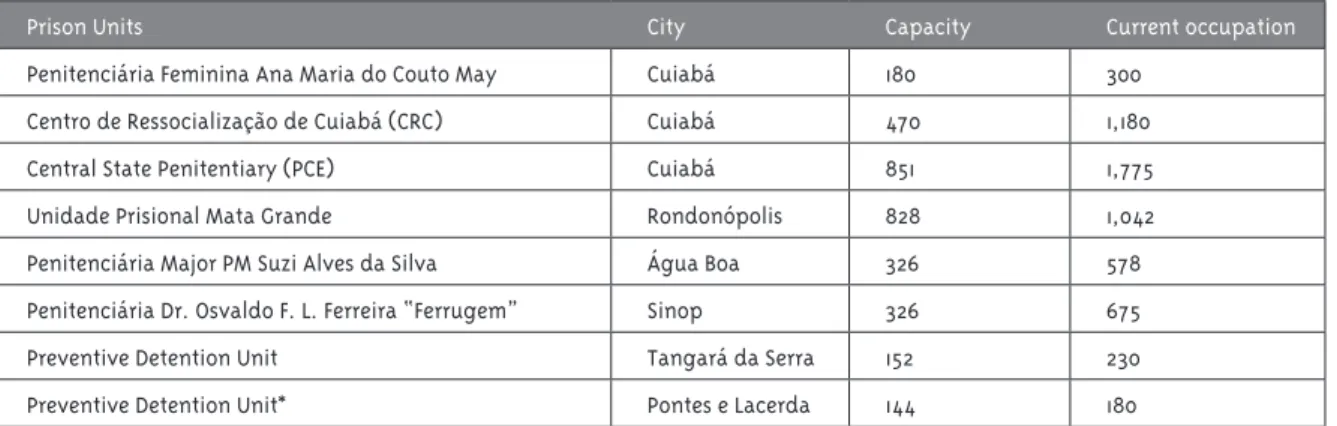
exists, the PNSSP does not address the prison units with AN open regime or those for pre-trial detainees (housed in jailhouses and police stations). In 2012, Mato Grosso had health teams implemented in seven units (Mato Grosso, 2012)—their location, capacity and quantity of prisoners are reported in Table 1 below.
Table 1 - Capacity and distribution of prisoners by Mato Grosso closed regime prison with health teams imple-mented, 2012
Prison Units City Capacity Current occupation
Penitenciária Feminina Ana Maria do Couto May Cuiabá 180 300
Centro de Ressocialização de Cuiabá (CRC) Cuiabá 470 1,180
Central State Penitentiary (PCE) Cuiabá 851 1,775
Unidade Prisional Mata Grande Rondonópolis 828 1,042
Penitenciária Major PM Suzi Alves da Silva Água Boa 326 578
Penitenciária Dr. Osvaldo F. L. Ferreira “Ferrugem” Sinop 326 675
Preventive Detention Unit Tangará da Serra 152 230
Preventive Detention Unit* Pontes e Lacerda 144 180
* Team was recently implemented and therefore not considered in the officially registered quantitative. Source: Mato Grosso (2012; 2014).
4 It is linked to the SES/MT and does not integrate the Prison System. It receives people under preventive detention and is located within the Central State Penitentiary (Mato Grosso, 2010a). It is so named to distinguish it from the “infirmary” where the health team works and, in a visit in October 2013, had eighteen its twenty-eight spots occupied.
The quantitative parameter, implementation of a health team for each five hundred prisoners (Brazil, 2005) is questioned by a manager because it is based on the parameter institutional capacity and not on current population. As a result of overcrowding, which is common, the team is overloaded and this reflects on the provision of inputs (with special at-tention to pharmaceutical inputs), creating tension between management levels with regards to the competencies and responsibilities of each entity.
The installed capacity was much lower than the number of inmates in that unit - overcrowding. So, in this case, some units managed to get two teams, but most of them only got one team. What does this mean? It means loss because the Ministry has established a kit for 500 inmates, right. It was by the total population in installed capacity. So the Ministry of Justice, of Health, sends a primary health care and medication kit for each prison
considering this capacity characteristic. [...] And the City Secretariats should supplement, but that does not take away the ability of the... Sejudh, to also do this supplementation (G1).
unique and differentiated management processes, always oriented to the achievement of the planned purposes.
It is inside the Prison System [the jailhouse]. But then they come up with some “fixes”... [to conform].
It is not at all set, right. Nothing is institutional-ized and we have been working like this with the city secretariats. Well: since it is considered in the city’s variable population, from the moment that their city is base to the jailhouse, whether you like it or not, it is your responsibility to provide health. You, as a secretary, have no way of saying: “No, this population does not exist” because you are creat-ing a serious problem with your population that is not detained, right. Because the inmate is not condemned, but he is restricted from freedom... (G1).
The operationalization of PNSSP/Mato Grosso is facing some non-isolated difficulties that hinder the management process. In the case of Health Manage-ment/Sejudh/MT, the absence of staff adds to the concentration of prisoners in the capital peniten-tiary units. With physical proximity to these units and given the shortage of human resources, man-agement finds itself overwhelmed by the technical demands, piling up and blurring with management
per se. One consequence is the difficulty of periodic visits to teams of prisons that are not in the capital, as expressed:
No, this periodicity does not exist. We define pe-riods, for example, we have to go to X [city base to the prison], because they are having problems. Last year the visits were structured. This year only one visit to one penitentiary unit outside the city was done. [...] What requires a lot of effort from man-agement itself are the units in the capital, we have to constantly be in the Central Penitentiary (PCE), we have to be in the Centro de Ressocialização de Cuiabá (CRC) or at the Woman’s Penitentiary. So Cuiabá consumes us to an extent that we don’t even have time to pay attention to the other units. It’s like if the Health Management ... was the manager of the PCE, and the management of the CRC and of the Woman’s, right. It is always calling... and very operational [...]: “because the medicine did not come” or “because someone’s car broke [and] they
didn’t come, had to do rotation with another unit ... “; “Oh! It is because someone is on vacation...” I blame this on the concentration of units [and], also, because the concentration of problems is here in the capital and since management is here in the capital, pressure is higher (G2).
Along with the concentration of the units are the physical structural issues of the state (which are beyond the power of Health Management, but that interferes with it), including with respect to the media, also making it difficult to work, because as a manager reported:
[...] at X [city] we can’t communicate, there is no tele-phone service; at Y [mentions another city] it is very difficult to communicate and our communication is practically through document and this makes it very difficult, right? (G2).
Problems of communication, visibility, and transparency in the decisions can also affect health management in the Prison System, for example, publicizing the State Operational Plan (POE). The POE is a management tool that contains the goals, forms of management and administration of health actions and services (Brazil, 2005). It must be submitted to the State Health Council (Conselho Estadual de Saúde, CES) and the Comissão Interg-estores Bipartite (CIB) for consideration, discussion, and approval, and the proposals are subsequently approved within each federal unit through the CIB and between state health and justice managers, and municipal health managers (Brazil, 2005).
There is a Municipal Operating Plan W [cites a city] and the Operating Plan Z [another city], but we do not have the operating plan in the other units, which complicates the reference issue, the flows, the protocol and therapeutic itinerary and professionals find themselves, often with many difficult to resolve problems and at the same time having to solve them almost immediately. [...] I have [the POE] but it was hard to find. [...] I tried to put it on our website because we have a 2012 management report that I managed to get, but I’m putting some things on the site little by little and I wanted to put the ordinance and the POE but it is very heavy, so, it was not possible. I have it on file and I have the publication of the statement in the Official Gazette, so there I saw that there is a POE [...], but is like a tale, it passes from father to son, everyone talks about it, but where is it?
[laugh] (G2).
The difficulty in financial execution is pointed to by a manager as what hinders the implementation of the POE, consisting of an aspect that deserves further study:
Cannot make an acquisition in that process at all... To give you an idea, I started here in 2011 as a technical area of health in the Prison System. All the processes of acquisition, the first Plan [POE], to supply the units with the inputs they need, was in 2011, but they were bought in 2013. [...] That is, the process has expired, then it was renewed, you remake it as if it was starting this year. It began
[In] 2011, returned in 2012 so you can remake it as if it started in 2013. And now... they told us to do it again... Then they already bought some, a part. And at one moment you have a budget, another no resources, another moment you have the resources, but no budget... (G1).
In this scenario, decentralization proves to be advantageous in the case of SES/MT which counts on a reference technician for Prison Health issues in their ERS in three cities that hold penitentiaries out of the capital, these offices can contemplate and expedite the integration of penitentiary health professionals acting there with other SUS profes-sionals. So it is reported:
One positive thing is that we have, -through the Regional Offices, managed to move the wheel. It is to guarantee that this health team is included in the CIES, in the Comissão de Educação Permanente em Saúde. So, we have managed to put them, insert them in the SUS trainings, and updates (G1).
Health teams from prisons outside the capital had a positive performance in some points (resolv-ability, proposals/initiatives, relationships to other reference units), as pointed out by both managers. They attribute the differential emphatically to the smaller amount of prisoners and external informal contacts, facilitated because they are smaller cities and because of others employment bonds, enabling agility, shortcuts to healthcare and joint initiatives with the community:
Yes, there are [differences]. [...] I believe that the population issue influences and knowing key people facilitate both the prisoner’s access [to service] and the resolution of some health problems. [...] We are aware that Prison Health professionals work in the city and I do not know if this is a gain, but it facilitates (G2).
About structure some things yes, because you have teams that are more purposeful [...] and it depends on the staff... There are some teams, like X [cites a city], we saw that they [...] brought the Community Council that existed, which would be the social control with them, they have active [...] (G1).
of equality” (Sposati, 1999, p. 128). The report of pos-sibilities shows viability, diminishing the absolute incompatibility:
What I do know is that there is a unit [for the treat-ment of chemical dependence], but it is not for inmates, only for the free population. Often has it been [forwarded] a court ruling that [the prisoner]
be received and they refuse because the work policy there is different. There’s no way the prisoner can go, there’s no way for the prisoner to be held there, even if for a while, but work [organization] there hinders the prisoners’ access, that is why this separation exists. [...] often the CAPS do not ac-cept [receiving the prisoner] because of this work philosophy, but we have a facilitation in other units outside the city... (G2).
The Prison Health units, formally driven by SUS principles and guidelines, when implemented, re-quire adjustments to comply to the specifics of the prison context. Because such units are classified as Basic Health Units (Unidades Básicas de Saúde, UBS) in the Prison System and, in fact, offer medical and dental consultations, inhalations, injections, patches, vaccines, laboratory exams, referrals to spe-cialty treatments, basic medication. With some local variations, they are also open during the weekend (restricted actions) and their routine resembles that of an Emergency room (Pronto Atendimento, PA), with spontaneous demand and non-programmatic attention, except to infectious diseases (tubercu-losis, leprosy, HIV/AIDS). It seems to be a distinct basic unit due to the peculiarities of the confinement institution and the prison population served.
So they act as an intermediate between UBS and PA, resolving a significant part of the events and avoiding the complicated escorted exits of the prisoners. However, it is distinct from the typical PA because they work during the day and do not have night shifts, and the emergencies are sent to the local reference units. In addition, we have to consider that the confined population circulates (between jailhouses/penitentiaries and between penitentiaries), floating (with prisoners entering and leaving daily), and demands security, and the
scheduled actions require handling of prisoners and depend on the intermediation of other professional categories (prison officer, military police). In this case, we arrive at an issue of availability and will-ingness of professionals working in environment guided by the discipline and security principles5 to the detriment of health (Thompson, 1993; Diuana et al., 2008), which can generate tensions, hampering the provision of treatment, preventive and health promotion actions. The interactions and the current standards inside and between cells can also filter access. We thus note:
Both promotion, and health, and [the prisoner] as a social person, [that] does not exist, right. Now the treatment, that depends. Depends on the custodial agent, is dependent on the partners that are within that radius [internal physical division] because, in this case, [depends on] what kind of crime was committed. It depends on each persons’ subjective view of what would be care to this subject that is arrested (G1).
These tensions will reflect (and strengthen) in points cited by managers, as in the case of linking health teams to the Sejudh/MT and not to the SES/ MT, affecting both the performance of the profes-sionals who find themselves in embarrassing situa-tions between guidelines and practices (sometimes contradictory to their formation), on the manage-ment of health in that context. Both managers rec-ognize the interference of institutional differences in their performances:
Although health is the responsibility of those who make health, I believe, even under the responsibil-ity of the Department of Justice, the problems that exist, and perhaps there may be more [others] with the administration of the Prison Secretariat and Administration... The manager’s priority is some-times more in custody, dedicated to the work of the prisoner and he forget this responsibility with health because it is a distinct area (G2).
I remember that at the time, I was coming here [...], I said: [...] “this is absurd, the health team is from the Justice...” Why doesn’t the Health Secretariat put...
[their own] employees? Because it will be easier. Imagine we get to a place that is the Justice’s [and]
and we want to do health? [...] How are we going to work [with health] with an institution in which we should be working as closely as possible, [but]
where Justice is a priority? (G1).
The last excerpt leads us to reflect on the appar-ent incompatibility between justice and the right to health in the context of the Prison System, given that health is based on the principle of social justice. Discussing a new social agenda in Latin America, Draibe (2011) refers to the increasing importance of social rights on the basis of social protection, guar-anteed in legislation and assuming the guarantee of the demands and results. Anchored in the values and principles of social justice, the concepts of solidarity and social cohesion put the right to health as part of justice and not incongruous to them as implied above. One gets the impression that justice, by being reduced to security, opposes health. Another point that differs in the orientation of health management in the Prison System of Mato Grosso regards the proposal of decentralization in the implementa-tion of the SUS. The Prison System, within public safety, is the responsibility of the State Government (thus, centralized), but in the health the movement was one of intensification of decentralization and, thus, the fact that the service is inserted directly into a state instance/Sejudh creates ambiguities in management:
In 2004, the state of Mato Grosso integrated the Plan [PNSSP] and the establishment of the health team became the administrative responsibility of the Justice Secretariat—at the time Security Secre-tariat [...]. It’s different in some states, for example, where the team ... is from that very city or the State [Health] Secretariat [...]. And that, by aligning SUS policy, assumed a differentiated form because the SUS preaches decentralization, that primary care should be responsibility of the cities [...] but within a penitentiary unit it is performed by a team which is under the administrative responsibility of a State Secretariat and also of ... prison administration. [...]
And we see some positive and somewhat negative effects, but either way, it’s different at the national level (G2).
[...] Because the SUS in a context of justice, it is quite the opposite. We work in the SUS [...] which has advanced—in spite of everything—, we have advanced in the management of decentralization, while Sejudh is still in the process of centralization, more every day. So, we [SES and Sejudh]... don’t dance to the same rhythm, right? [...] (G1).
The peculiarities of the prison context, the insti-tution, the population served and the interactions that go on there, influence the practice of health professionals which, in turn, is reflected in the ac-tions of managers, as discussed below.
The prison environment and the
impact on care and management
In his classic work Discipline and Punish: The Birth of The Prison, following the changes in punitive prac-tices throughout the eighteenth century, Foucault (1987) narrates how, in the context of a new “political economy of the body,” the public spectacles where a whole list of punishments and torture to the bodies of the condemned was inflicted with great violence; end up being replaced by the penalty of detention with more lenient punitive techniques to criminals. Incarceration becomes the penalty for excellence adopted by the legal system and promises to take care of the soul and body of the prisoner, improving their conduct, dominating their physical strength and correcting their spirit. Hence, the preference of the penitentiary body through disciplinary devices, constant surveillance, punishments and corrective measures. However, the author warns that the prison does not come down to the negative function of de-priving the criminal of his liberty, punishing him, monitoring him and breaking him in face of a system of docile-usefulness, but that serving the sentence should have deep corrective effects, promoting the transformation of individuals, enabling them to fol-low the prevailing social order.
of power, corruption, institutional violence far from teach respect for the law favoring the perpetuation of misconduct. However, if the prison is still used it is because its operation does not aim to meet its stated purposes, but its true function lies hidden, because the real role played is not to eradicate crime or illicit behavior, but, to manage it, organize it, dif-ferentiate it, in other words, it is a form of managing the transgressions, concludes Foucault (1987). Selec-tive actions and a dynamic that is not autonomous to the interests and game of social forces in the broader context, we can add.
Authors such as Thompson (1993), Silva (2008), Moraes (2013), Barcinski, Altenbernd and Campani (2014) also pointed out contradictions between the discourses and practices of prisons, because they propose to re-educate, re-socialize, regenerate, care and at the same time, historically, it serves to punish, watch, control and regulate other human beings. In face of this situation, how to operational-ize a policy guided by the principles of universality, equity, integrity, commitment and humanization such as the SUS? Let’s see:
[...] First, the view of Justice is: you are in pain, [and]
if the pain gets here, to tell me that there is a person there with pain and if they want to take me to her, then I provide health care, the health team exists to do this kind of attention, of this toothache [for example]. It is a one-off, fragmented action, on what the person is feeling. And the Plan [PNSSP] talks and writes of, it puts it clearly: promotion, preven-tion, treatment, rehabilitation actions. [...] And the humiliation that they go through... until the visit, it is very embarrassing... While we, the health team, are working on the issue of humanization. Human! Treat the human as a human! Then you see the Prison System... (G1).
Thus, there are implications to the duties of health professionals in the face of the demands, in view of the conflict and hierarchy of internal actions, in which legal issues of discipline and security, seem to outdo the health issues, as previously mentioned and expressed in the following excerpts, but that we interpret as typical of the prison context and, therefore, not restricted to a professional category or to the local context:
The manager’s [of the penitentiary] priority is sometimes more in custody, dedicated to the work of the prisoner and he forgets his responsibility with health, because they are distinct areas. So, although today it is not a nationwide trend, we think of tak-ing ownership of this health knowledge and more than that, linking it with the prison administration that is the custody issue, because what is perceived
[is that] the vision of the Prison Agent [on] health is different from the vision of health workers and this is true to the Brazilian level (G2).
The referred priority is reflected in the work of health professionals and hence the care of prisoners in various ways. They are not treated in their cells, but in the health unit, and therefore depend on other professionals moving them there, in the same way, they do when they need more complicated proce-dures to be done outside the prison and require an escorted transportation. However, the same profes-sional and vehicles are required for the displacement of inmates to legal services (forums), therefore, they have delicate choices to make and receive greater pressure for those that interfere in the prisoner’s legal situation and those that could mean changes in their destiny (sentence, regime, the license/ freedom), these changes influence the internal dy-namics. To understand the possible criterion that guides the choice, we can exercise our sociological imagination considering the difference in outcomes, for the inmate and the institution, when there is a failure to attend a hearing or a doctor’s appointment or other kinds of health care...
Can I have my point of view as a technician, a nurse and be respected—I will not share what is imposed. There [at the prison], we do not notice this, there is a whole movement: “It has to be done,” it will be, “Let it be done!” Even the instructions when they arrive for our professional colleagues who integrate the health teams they come like this: “[G1], there is no way of not doing it, because they already come like this: ‘you will do it, so do it’.” I said: Geez... [laugh]. While, in the health team, we do not have that. I, as a technician, can simply [say]: “I will not do it because my technical basis is this, this, this and this.” [...]
Because, there is no doctor, so the nurse is forced, by a situation, to medicate: even if it is a dipyrone, it’s a medication, which he has no capacity to do, it is not in their scope (G1).
[...] In the Penitentiary X [city], because there we do not have the medical professional and the team is a bit fallen apart, and also because the nurse is in leave because of health problems, and we had a confrontation between two health professionals and the security team, in the sense that the nursing technicians had to solve everything, and we know that this should not be done.... (G2).
We can think of demarcated territories of power in institutions, where access and performance in their spaces can be embarrassing, hampered as pointed out by a manager about the difficulty in entering the penitentiaries, and one of the strategies to get around that would be through other organiza-tions that act there such as the Pastoral, since the penitentiary is “the house of the Sejudh...”, as he said.
Therefore, access to information about the health status of the healthcare team professionals is also cited as difficult, the information is restricted to the Public Security Secretariat. Studies show that working in closed institutions makes professionals vulnerable (Rumin et al., 2011; Greco, 2011), and if there is a sector that deals with this issue, it appears to act in a closed way, with little visibility and com-munication with stakeholders. It is worthy of note that the additional hazard pay earned in 2013 was only granted after a long union struggle and a strike by the Prison System servers (Sindespen-MT, 2013a). The existence of a specific sector, along with the acquisition of the said benefit, is the recognition of
the exposure and risks to the health of the worker in that environment.
Because the type of work they do—because the healthcare professional ends up being confined too—he stays there, he goes there, and he is also in a situation of vulnerability, mainly psychological. We have observed this in the professionals... (G1).
[This service] is made by the Safety Division and within the human resources policy that serves both the Justice Secretariat and the Security Secretariat that is called Quality of Life Management. [...]There is a psychology work, from psychologists [...], where they receive people both from the health team, and other workers, and prison officers, but we do not have information about these data if there are statistics or a more strategic work about that. The Human Resources [sector] pointed out to us that the Sejudh made no budgetary provision for this and, therefore, they would be unable to do any work and made clear that the work that is done it happens
[...] so, with attention to the server being given when the server seeks it. But it is a concern as a server... that professionals fall ill, but we cannot [...] find an alternative to minimize this and I still believe that this work should be done in a workgroup in a study on how it would be possible to minimize
[risks]. What would be the alternative, right? And what we have of concrete is that there is nothing focused on the penitentiary staff, including health professionals (G2).
also adapt them to the health service reality in that context, as shown in the excerpt:
There is a health school—the Penitentiary School—it was set up recently and the bylaws say that the prison staff needs to pass, I think it was about 400 hours of course. This was a gain for the servers, but we have several realities. Recently we gave admitted various professionals and they did not take this course. Mostly because of a structure issue too, because we depend on professionals as well... [it is difficult] for professionals who are entering over time
[...], but what has been done is precisely periods of training [...] This training has an organization dedi-cated to safety and dedidedi-cated more to prison guards, more dedicated to who guards the inmates and we are gradually embracing also all other professionals be they doctors, attorneys or nurses. But it is very characteristic the professional who comes in and is not a penitentiary officer, he does not want to go through the work, workshops more focused on the agents, [...] and it is waived by the Secretariat. In a way, it is not even defined whether it is needed or not. It is more open-ended [...] and the professional thinks: “I will not do it because in nothing does it help me to learn self-defense, it is useless to learn things that are more focused on the Agent” (G2).
Cooperation between the State Secretariats (Sejudh/MT and SES/MT) and district Secretariats is relevant for the optimization of resources and integration of professionals to the public network and training processes, and which is even foreseen in the PNSSP as a competence shared by the entities involved (Brazil, 2005). However, while operational, the expected cooperation shows nuances of impro-visation, little articulated or little institutionally strengthened. We thus note:
[...] What about training focused on the health professionals, treatment update, we do not have a training protocol. What we have are spontaneous needs, according to the professionals’ own reports which say they are in need of training [...], and often we do work with the city, with the technical areas of the State Secretariat, such as with STDs, AIDS, leprosy, tuberculosis, right? And, most of the time, we end up in trainings directly created for city
professionals. So ... it [is] not a targeted training, but we take the opportunity there to be included. And we want to do this work of constant training, but we still do not have this strategy prepared. We recently asked all professionals to [say] that train-ing is important, and what traintrain-ings they wanted to do, but we did not get the proper return. I believe the daily workload leads them not to have time to even think about it, one social worker said: “No use, I won’t do it now. I’ll be honest with you: [...] I can’t, I don’t have time to breathe.” So, at the management level, we did not define anything yet, and the train-ings that occur, we agree with the technical area of State Prison Health, we plan early in the year and this plan is fulfilled (G2).
The initiative of specific protocols to profes-sional health categories, is positive and important to protect the autonomy of the professional within the legitimate and legal limits of the profession, such as the Nursing Manual of Standards and Rou-tines (Mato Grosso, 2012). We emphasize that the participation of unions and professional councils would be productive in this process, as well as the understanding of the Continuing Health Education linked to changes in professional practices.
[...] are creating an amendment on responsibilities, competencies and the health procedures of each professional. Then the servers will learn about the pharmacist’s, nurses’, dentist’s work especially because it will make the professional’s life there easier. Then, the pilot project will be Cuiabá [...]
Despite the drawbacks, and precisely because of the often unfavorable conditions, it is understood that health teams can work and make a difference in assistance to prisoners—including because it is a work with little outward visibility. Apparently, they can meet the needs in order to control the situation within what is sustainable in the midst of what we characterize, in another study, as performance that oscillates “between the necessary and possible care in the prison context” (Barsaglini et al., 2014). At times, for example, in the face of the increase in cases of tuberculosis6 in 2013 (Sindespen-MT, 2013b), the situation may get out of hand, express-ing the fragility of the health service, as cited by a manager. The fact is that in such cases, not only does the health sector gain visibility, because of the threat posed to both the free population, local workers and others that pass through (profession-als, visitors), in addition to the prisoners who every day receive their freedom and return to the open society; but also the reality of the prison which eventually comes up.
The professionals are going beyond their capacity. So, based on the National Plan, if you have to have a minimum team for up to five hundred prisoners and somewhere you have a minimum team for a thousand prisoners, it means that this team should meet and promote health for five hundred people, but it’s trying to do so for a thousand. The issue of promotion and prevention is weak and the assistance focuses more on the treatment side that tends to be prioritized. [...] Other than that, they work in a very stressful environment with a lot of pressure from penitentiary management and can care for the most critical and urgent health cases. [...] Does the team work? It works. Does it meet all the expectations and everything that is in the National Plan and what it needs to develop in primary care? Not yet. But [...], it avoids that a disease becomes an epidemic, providing faster service to the prisoner, the team ends up doing what is possible (G2).
Oh, I think it [the assistance] isn’t even a “drop in the ocean”, you know? Unfortunately, like, it ex-ists really to prevent all the health need they [the prisoners] have comes out. They are there to try to hide it..., but [with] a very incipient weakness, that doesn’t. So is the case of tuberculosis, that you are watching on TV, right? (G1).
Finally, and not least, we ask managers their view of the Prison System and the population served/ held, because we are in the perception plane, and we understand that this perception feeds on experience and is, in practice, is also guided by the dominant values of our society.
In this case, consideration about the prison population served by the health service, in the view of managers, brings the ambiguity with which the prisoners are seen different for disobeying the law, for disrupting the social order, but also equal to others regarding the right to health to be provided by the State.
The perception of the prisoner as a “client” suggests the use of a particular service provided and someone whom they must serve, in this case, even not being an ordinary person (but they should be “treat as if they were...”), which embeds their abnormality or slide—legal (and moral), for which they were already judged by the competent body (the justice system), not being the health sector competence to do it again. It is noteworthy that the penalty is deprivation of liberty, suggesting that upon entering the prison the person is sub-jected to other forms of punishment, material or symbolic (Silva, 2008), but also, that their situa-tion is temporary, for they will return to society as mentioned below.
The refraction that the prison creates does not seems to be only on SUS principles, as we have seen because the prisoner can go from defendant to victim in the intricacies of the institution. In fact, he will be subject both to the official standards and those governing intra and inter-cell relations imposing a new place (Smith, 2008; Coelho, 2005). Note, also, reference to treatment is as “humane”,
which implies that one should treat the prisoner as such, leading us to believe that that would be the usual treatment7.
As a health manager I see the prisoner as a cli-ent—there’s no way for us to have a view of their legal status: “Oh, because you killed because you stole,” right? [...] Because there is also victimiza-tion, because the prisoner does all the bad things outside [...], he is the evil outside, but when he arrives in the prison he is a victim and we realize this characteristic of victimization. But other than that, we have to give full access and work with the teams to precisely ensure that access to prison-ers and to treat them as you would treat anyone else. [...] Although a criminal, whether they redeem themselves or not, you have to do your work with this purpose, that he can get out of a penitentiary unit and follow on with his life and make amends, recover, re-socialize or whatever you want to call it, [...] this is a hypothesis, but you treat humanely even who has committed a crime (G2).
[...] Because the prisoner who is now there, is the citizen who is deprived of freedom and that will be released. He still has his rights as a person. He lost his right to freedom. But the right of the human person he still has. And this has to be guaranteed to him (G1).
The first report above on the goal of your work being to contribute to redeem, restore, re-socialize the prisoner and, accordingly, that he be treated “hu-manely” leads to the Corrective Penal School that, as stated by Vay and Silva (2012), although weakened in our legislation is kept alive in the thoughts of attor-neys, politicians, police and society in general. The idea that the prisoner can be cured/reformed, as if weak individual bearer of a social pathology, in need
of assistance measures which might remedy this weakness is strengthened in the practice of health care in penitentiaries, understood as a right to be re-spected as stated by managers. Thus, inflicting more suffering, in addition to the deprivation of liberty, not meeting their health needs would be a mistake. There is also information that the offender is a stranger, at least to the health sector. According to the current model of SUS guidelines, knowledge of an enrolled population allows to properly organize visits. However, it notes that the information pro-duced on the prisoners by the government (quantita-tive, numerical), does not effectively meet the needs of the health sector. Increasing their knowledge of individuals in institutions is critical for the disci-plinary power to be exercised and to regulate their conduct (Foucault, 1987). That’s what this author has designated practice exam establishing homogene-ity and does not allow to see the person, but only a contingent8.
This prisoner we do not know, he is a question mark in our State and in most Brazilian States. We know him as a number, we do not know him as a person.
[...] To give you an idea, the database of InfoPen
[this is the Integrated Penitentiary Information System of the Ministry of Justice] which has all the characteristics of age, name, where they came from, who they are; Now that it came to access within the health unit. [...] Because no state knew what was the characteristic of the inmate. We have some data there, in a database to which we do not have much access, which is the InfoPen, but it tells us nothing about health (G1).
As for the perception of the prison institution, reports suggest who would be the inmate and little confidence in the possibilities of recovery, or redemption, although it exists to witness a few
7 The situation of many penitentiaries and prisoners in Brazil is not known, they only comes up when “big” events happen such as the massacre of Carandiru, in 1992, coordinated rebellions in 2006 and recently the rebellion in Maranhão, in late 2013. In Mato Grosso, a local newspaper material provides clues as to how this situation might be in reporting the death of an inmate by overdose resulting from an allegedly forced ingestion of the “death drink” (alcoholic drink with cocaine) stating that “in the cell, there were more than forty prisoners and no one could explain what happened” (Rosa, 2014).
cases. When saying “redeem”, a term that alludes to salvation and liberation, the question is whether it would be the release from prison or from a life of crime, seeming like the prisoner had been arrested and would possibly continue there... Structural so-cial issues prior to incarceration, the unfavorable environment, coupled with high recurrence rates reported in other studies (Thompson, 1993; Toros-sian, 2012), support this perception:
We get very sad when we see this reality in prisons and make some comparisons. Then you say that it is a people-storage unit; that it [the penitentiary]
serves no purpose, only serves to separate the com-pletely marginalized people with characteristics of poverty, lack of education, and who live in the world of drugs. Secluded from the excluded and who will not see redemption, but from the moment we visit other units and sees positive work we realize that there is a possibility. Not that they will be totally redeemed, but we can offer something worthy or something that he can, while incarcerated, live I don’t know if with dignity, but as humanly as pos-sible, right? [...]. To me, being incarcerated is already a life sentence, but for many, they come out, come back, come out, come back, as if it had no impact on their life. So, [...] we have to understand that it is mostly a place to segregate those people who are in conflict with the law, from other people and in a few units [there are] projects that aim to treat with dignity a person who committed a crime, that is how I see it (G2).
The prison receives people who have committed some kind of crime. Places the individual there to serve a sentence, depending on what was done, depending on who is monitoring your process as a prisoner, the sentence has to be fulfilled more heav-ily [...], because of his guilt, the sentence, is the worst possible. There is a proposal for rehabilitation [...], because really there are some who can [...], which is to offer education [...] there are some that even finish middle school, as for income, they work on the issue of vocational training, learn a trade and
from there create a source of income. That exists within the prison. But it is very incipient [...], even the Fundação Nova Chance9[...] works with this approach. [...] It has all this done but, unfortunately, it is very incipient (G1).
In short, we can understand that human resourc-es are resourc-essential to the effectivenresourc-ess of programs and policies and it is assumed there is an interrelation-ship between the routine professionals practices of health and the economic, social and symbolic condi-tions of existence (Diuana et al., 2008).
Final remarks
The PNSSP and, recently, its proposal as policy, represented significant progress in attention to the prison population, however, its operation, although relevant, shows to be incipient in the State, in the perception of managers.
The concentration of management in Sejudh/ MT, including with health professionals tied to it, and not to the SES/MT, suggests that the estab-lished partnership fulfills more bureaucratic than operational functions. Indeed, there is a predomi-nance of autonomy in health management deci-sions by Sejudh/MT, and slight sharing with SES/ MT in specific moments, such as when involving common issues in this dimension or in situations requiring specific health expertise for which the in-stitution has legitimacy. It is understandable that the meeting of historically different institutions and individuals generates tension, but it can also promote institutional learning that supports the improvement of the process. Therefore, reflectiv-ity is important and is not natural and should be urged by those involved and reinforced the formally agreed responsibility.
Thus, the managers point out to us the obstacles to the operation of PNSSP, but also advances, show-ing the non-passivity and creativity before these ob-stacles that can bring innovations to management. A point worth mentioning refers to inconsistencies
in the values that govern one or the other sector where safety, discipline, and legal issues actually show tension with every citizen’s right to health care, regardless of their social status. It seems that the prison context provides peculiarities to the assis-tance, which are reflected in management, because sometimes adjustments are made when facing dif-ferences, mobilizing the principle of equality, and sometimes they are compromised.
The health needs of prisoners that are not sup-plied internally require reference and find institu-tional barriers not only because of the organization of the services, but because of the discrimination barriers to the population served/held sometimes shrouded in technical and bureaucratic nuances, af-fecting, thus, the right to health. So what integrality would be possible? What promotion of health? This lack of synchronism may affect the management that should beware so that lack of care does not become the punishment.
The prison deals with deprivation of liberty of its prisoners, but sometimes it seems to extend to profes-sionals (of both assistance and management), leaving to managers the dilemmas between the necessary care, possible care and the right to health of all citizens.
References
ARRUDA, M. B. As engrenagens da cidade: centralidade e poder em Cuiabá na segunda metade do século XX. Cuiabá: UFMT: Carlini & Caniato, 2010.
BARCINSKI, M. M. A.; ALTENBERND, B.; CAMPANI, C. C. Entre cuidar e vigiar:
ambiguidades e contradições no discurso de uma agente penitenciária. Ciência & Saúde Coletiva, Rio de Janeiro, v. 19, n. 7, p. 2245-2254, 2014.
BARDIN, L. Análise de conteúdo. Lisboa: Edições 70, 2011.
BARSAGLINI, R. A.; ARRUDA, M. B.; LOPES, V. A.
Saúde penitenciária: experiência de profissionais atuantes na atenção em unidades prisionais de Cuiabá/MT e na gestão das ações no nível central (SES-MT e SEJUDH-MT). Relatório de pesquisa/ Capes. Instituto de Saúde Coletiva – Universidade Federal de Mato Grosso, 2015.
BARSAGLINI, R. A. et al. Trabalhadores de saúde em penitenciárias em Cuiabá/MT: perfil dos profissionais e impressões sobre a instituição. In: CONGRESSO INTERNACIONAL REDE UNIDA, 11., Fortaleza, Anais eletrônicos... Fortaleza, 2014. Resumo. Disponível em: <http://conferencias. redeunida.org.br/ocs/index.php/redeunida/RU11/ paper/view/702>. Acesso em: 15 dez. 2014.
BITENCOURT, C. R. Tratado de direito penal: parte geral 1. 17. ed. São Paulo: Saraiva, 2012.
BRASIL, Ministério da Saúde. Plano Nacional de Saúde no Sistema Penitenciário. 2. ed. Brasília, DF, 2005.
BRASIL. Portaria Interministerial nº 1, de 2 de janeiro de 2014. Institui a Política Nacional de Atenção Integral à Saúde das Pessoas Privadas de Liberdade no Sistema Prisional (PNAISP) no âmbito do SUS. Diário Oficial da União, nº 2, Brasília, DF, 3 jan. 2014, p. 18-19.
CARRARA, S. Singularidade, igualdade e transcendência: um ensaio sobre o significado social do crime. Revista Brasileira de Ciências Sociais, Rio de Janeiro, v. 6, n. 16, p. 80-88, 1991.
CARRARA, S. Crime e loucura: o aparecimento do manicômio judiciário na passagem do século. Rio de Janeiro: EdUerj, 1998.
CASTIEL, L. D. O buraco e o avestruz: ensaios sobre a singularidade do adoecer humano. Campinas: Papirus, 1994.
COELHO, E. C. Oficina do diabo e outros estudos sobre criminalidade. Rio de Janeiro: Record, 2005.
DIUANA, V. et al. Saúde em prisões: representações e práticas dos agentes de segurança penitenciária no Rio de Janeiro.
Cadernos de Saúde Pública, Rio de Janeiro, v. 24, n. 8, p. 1887-1896, 2008.
DRAIBE, S. M. Uma nova agenda social na América Latina?: pontos de partida para análise comparada dos sistemas de proteção social e suas mudanças recentes. In: SOLA, L.; LOUREIRO, M. R. (Org.). Democracia, mercado e Estado: o B de Brics. Rio de Janeiro: FGV, 2011. p. 249-288.
FOUCAULT, M. Vigiar e punir: nascimento da prisão. 16. ed. Petrópolis: Vozes, 1987.
FOUCAULT, M. Os anormais. São Paulo: Martins Fontes, 2001.
GIL, A. C. Como elaborar projetos de pesquisa. 4. ed. São Paulo: Atlas, 2002.
GOIS, S. M. et al. Para além das grades e
punições: uma revisão sistemática sobre a saúde penitenciária. Ciência & Saúde Coletiva, Rio de Janeiro, v. 17, n. 5, p. 1235-1246, 2012.
GRECO, P. B. T. Distúrbios psíquicos menores em agentes socioeducadores dos Centros de Atendimento Socioeducativo do Rio Grande do Sul. 2011. Dissertação (Mestrado em Enfermagem) - Universidade Federal de Santa Maria, Centro de Ciências da Saúde, Santa Maria, 2011.
GUIMARÃES, M. C. L. et al. Avaliação da capacidade de gestão de organizações sociais: uma proposta metodológica em desenvolvimento.
Cadernos de Saúde Pública, Rio de Janeiro, v. 20, n. 6, p. 1642-1650, 2004.
LOPES, V. A. Experiência de profissionais de saúde em unidade prisionais em Cuiabá/MT. 2014. Dissertação (Mestrado em Saúde Coletiva) - Instituto de Saúde Coletiva da Universidade Federal de Mato Grosso, Cuiabá, 2014.
MATO GROSSO. Secretaria de Estado de Justiça e Direitos Humanos. Plano de Modernização do Sistema Penitenciário 2010-20. Cuiabá, 2010a. Disponível em: <http://www2.mp.pr.gov.br/cpcrime/ boletim82/cep_b82_n_11.doc>. Acesso em: 10 abr. 2014.
MATO GROSSO. Secretaria de Estado de Saúde de Mato Grosso. Superintendência de Políticas de Saúde. Plano Estadual de Saúde de MT 2008-2011. Cuiabá, 2010b. Disponível em: <http://www.saude. mt.gov.br/arquivo/2909>. Acesso em: 20 abr. 2014.
MATO GROSSO. Secretaria de Estado de Justiça e Direitos Humanos. Diagnóstico setorial e
avaliação dos programas da SEJUDH/MT:
insumos para o Plano Plurianual 2012-2015. Cuiabá, 2011a. Disponível em: <http://www. sejudh.mt.gov.br/UserFiles/File/SEJUDH/ DIAGNOSTICO%20SOCIAL%20-%20SEJUDH%20 OFICIAL.pdf>. Acesso em: 20 abr. 2014.
MATO GROSSO. Conselho Estadual de Saúde.
Ata da ducentésima sexagésima terceira reunião do CES-MT:9 de novembro de 2011. Cuiabá, 2011b. Disponível em: <www.saude.mt.gov.br/ arquivo/3454>. Acesso em: 10 jan. 2013.
MATO GROSSO. Secretaria de Estado de Saúde de Mato Grosso. Relatório de gestão: gerência de saúde do sistema penitenciário, Sejudh/MT. Cuiabá, 2012. Disponível em: <http://www.sejudh. mt.gov.br/saap2.php?IDCategoria=772>. Acesso em: 16 jul. 2014.
MATO GROSSO. Secretaria de Estado de Saúde de Mato Grosso. Plano Estadual de Saúde de MT 2012-2015 - Superintendência de Políticas de Saúde. Cuiabá, 2013. Disponível em: < http://www. saude.mt.gov.br/upload/documento/249/versao- final-da-oficina-pes-2012-2015_030511-[249-160511-SES-MT].pdf>. Acesso em: 12 abr. 2014.
MATO GROSSO. Secretaria de Estado de Justiça e Direitos Humanos. Secretaria Adjunta de Administração Penitenciária: nossas unidades. Cuiabá, 2014. Disponível em: <http://www.sejudh. mt.gov.br/saap2.php?IDCategoria=395>. Acesso em: 16 jul. 2014.
MORAES, P. R. B. A identidade e o papel dos agentes penitenciários. Tempo Social: Revista de Sociologia da USP, São Paulo, v. 25, n. 1, p. 131-147, 2013.
REBELO, F.; CAPONI, S. A medicalização do crime: a penitenciária de Florianópolis como espaço de saber e poder (1933-1945). Interface: Comunicação, Saúde, Educação, v. 11, n. 22, p. 193-206, 2007.
ROSA, A. Detento é encontrado morto em cela da PCE; suspeita é de overdose. Midianews, Cuiabá, 29 maio 2014. Disponível em:<http://www.midianews. com.br/conteudo.php?sid=25&cid=199099>. Acesso em: 30 maio 2014.
RUMIN, C. R. et al. O sofrimento psíquico no trabalho de vigilância em prisões. Psicologia: Ciência e Profissão, Brasília, DF, v. 31, n. 1, p. 188-199, 2011.
SILVA, A. M. C. Nos braços da lei: o uso da
SILVA, P. L. B.; MELO, M. A. B. O processo de implementação de políticas públicas no Brasil: características e determinantes da avaliação de programas e projetos. Núcleo de Estudos de Políticas Públicas, Campinas, Cad. 48, p. 01-16, 2000.
SINDESPEN-MT. Conquista: governo do Estado publica pagamento de insalubridade para servidores penitenciários. Sindicato dos Servidores Penitenciários do Estado de Mato Grosso. Cuiabá, 3 out. 2013a. Disponível em: <http://www.sindspenmt.com.br/noticia_ver. php?id=54>. Acesso em: 12 jul. 2014.
SINDESPEN-MT. Tuberculose: 10% dos pacientes em Mato Grosso são presos da Penitenciária Central do Estado. Sindicato dos Servidores Penitenciários do Estado de Mato Grosso. Cuiabá, 4 out. 2013b. Disponível em: <http://www. sindspenmt.com.br/noticia_ver.php?id=56>. Acesso em: 12 jul. 2014.
SPOSATI, A. Exclusão social abaixo da linha do Equador. In: VERAS, M. P. B. (Org.). Por uma sociologia da exclusão social:o debate com Serge Paugam. São Paulo: Educ, 1999. p. 128-133.
TANAKA, O. Y.; TAMAKI, E. M. O papel da avaliação para a tomada de decisão na gestão de serviços de
saúde. Ciência & Saúde Coletiva, Rio de Janeiro, v. 17, n. 4, p. 821-828, 2012.
TEIXEIRA, C. F. et al. Produção científica sobre política, planejamento e gestão em saúde no campo da saúde coletiva: visão panorâmica. In: PAIM, J. S.; ALMEIDA-FILHO, N. (Org.).
Saúde Coletiva: teoria e prática. Rio de Janeiro: MedBook, 2014. p. 585-594.
THOMPSON, A. A questão penitenciária. 4. ed. Rio de Janeiro: Forense, 1993.
TOROSSIAN, M. S. Análise sobre a reincidência criminal na abordagem comportamental.
Revista Eletrônica do CEAF, Porto Alegre, v. 1, n. 2, p. 01-07, 2012. Disponível em: <http://www. mprs.mp.br/areas/biblioteca/arquivos/revista/ edicao_02/vol1no2art1.pdf>. Acesso em: 6 maio 2014.
UCHIMURA, K. Y.; BOSI, M. L. M. Qualidade e subjetividade na avaliação de programas e serviços em saúde. Cadernos de Saúde Pública,
Rio de Janeiro, v. 18, n. 6, p. 1561-1569, 2002.
VAY, G. S.; SILVA, T. M. A escola correcionalista e o direito protetor dos criminosos. Revista Liberdades, São Paulo, n. 11, p. 69-89, set./dez. 2012.
Authors’ contribution
Barsaglini participated in all stages of preparation of the article. Kehrig and Arruda participated in the discussion of data and critical review.