Major Article
INTRODUCTION
Corresponding author: Dra. Liléia Diotaiuti. Laboratório de Referência em Triatomíneos e Epidemiologia da Doença de Chagas/CPqRR/FIOCRUZ. Av. Augusto de Lima 1715, Barro Preto, 29190-002 Belo Horizonte, Minas Gerais, Brasil.
Phone: 55 31 3349-7763; Fax: 55 31 3295-3115 e-mail:diotaiuti@cpqrr.fi ocruz.br
Received 19 March 2015 Accepted 9 July 2015
Susceptibility of
Triatoma sordida
Stal, 1859
(Hemiptera: Reduviidae) to alpha-cypermethrin
under natural climatic conditions
Grasielle Caldas DÁvila Pessoa
[1],
Aline Cristine Luiz Rosa
[1],
Letícia Cavalari
[1],
João Geraldo de Rezende
[2],
Bernardino Vaz de Mello
[3]and Liléia Diotaiuti
[1][1]. Laborató rio de Referência em Triatomí neos e Epidemiologia da Doença de Chagas, Centro de Pesquisas René Rachou, Fundação Oswaldo Cruz, Belo Horizonte, Minas Gerais, Brazil. [2]. Gerência Regional de Saúde de Montes Claros, Montes Claros, Minas Gerais, Brazil. [3]. Secretaria de Saúde do Estado de Minas Gerais, Governo do Estado de Minas Gerais, Belo Horizonte, Minas Gerais, Brazil.
ABSTRACT
Introduction: Despite the recommendations by interpretation of resistance ratios obtained in laboratory bioassays, little is known about the actual impact of these results in the effectiveness of vector control activities in the fi eld. In this context, our objective was to determine the mean value of different resistance ratios obtained by laboratory bioassays performed as part of the chemical control strategies of Triatoma sordida in the fi eld. Methods: Field bioassays were developed in Monte Azul and Coração de Jesus (Southeast, Brazil). In each location, samples were formed with three domestic units treated with alpha-cypermethrin 20.0% (Alfatek ® 200 SC). One day after spraying, 10 fi fth-instar nymphs remained in contact with the surfaces treated (adobe with plaster, adobe without plaster, or wood) with insecticide in plastic cones for 72h. Three cones were exposed inside the intradomicile and the peridomicile. The insects in the control group were exposed to an insecticide-free piece of cardboard. Mortality was measured 72h after removal of the insects from the treated surfaces. The tests were realized in triplicate. Results: Mortality was 100.0% in all locations, except for Monte Azul; Landinho (96.6%) and Coração de Jesus;
Barriguda (96.6%). Conclusions: Although the resistant populations in laboratory tests proved to be susceptible in the fi eld, this
observation is not suffi cient to suggest that the cut-off points used to justify the resistance ratio should be changed. In this sense, we recommend that laboratory and fi eld bioassays are carried out with a greater number of Triatominae populations to allow more in-depth consideration of the subject.
Keywords: Triatoma sordida. Field bioassays. Alpha-cypermethrin susceptibility.
Insecticide resistance results in a decrease in the mortality observed in a population subjected to continuous treatment. This characteristic is expressed by a greater number of specimens that tolerate lethal doses compared with specimens considered sensitive during the initial application of the product, leading to selection pressure in populations. This phenomenon is based on the genetic variability of natural populations. Consequently, this variabilility combined with insecticide pressure results in selection of certain phenotypes and the subsequent increase in resistance gene frequencies(1).
Until recently, insecticide resistance in triatomines was considered to be ad hoc and not very likely to occur, considering their long life cycle (i.e., even if there are resistant individuals, the selection process is expected to be very slow) and a low genetic variability in the population, which implies only very rare individuals will be genetically predisposed to insecticide sensitivity(2). Since then, however, studies of the response of
different species to several insecticides, suggest that such a phenomenon is distributed in an area larger than the one currently known, and therefore requires more characterization and delimitation. Most published studies refer to Triatoma infestans populations with high resistance ratios 50% (RR50 > 50), from Bolivia and Argentina, in areas where vector control is diffi cult. Research on the susceptibility of triatomines in Venezuela, Colombia, and Paraguay are still quite ad hoc, and address such problems with vector control of Rhodnius prolixus, Triatoma infestans, Triatoma maculata, Triatoma dimidiata,and Panstrongylus herreri. As for Brazilian triatomines, investigative studies on the susceptibility to insecticide are on the rise and have focused on Triatoma brasiliensis, Triatoma sordida, Panstrongylus megistus,and
METHODS
TABLE 1 -Deltamethrin toxicological profi le in peridomestic Triatoma sordida from North of Minas Gerais, Brazil.
Deltamethrin toxicological profi le
Municipality/location RR50
Zerba & Picollo(4) PAHO(5)
Monte Azul; Porteiras 1.30* Susceptible Susceptible
Monte Azul; Landinho 1.63* Susceptible Susceptible
Monte Azul; Canabrava 2.63* Resistant Susceptible
Monte Azul; Brejinho 3.59** Resistant Susceptible
Coração de Jesus; Barriguda 7.08** Resistant Resistant
RR50: resistanceratio 50%; PAHO: Pan American Health Organization. *Data from Pessoa et al.(6). ** Data from Pessoa et al.(7).
There are two recomendation to justify the resistance ratios (4) (5). According to Zerba & Picollo(4), populations with
an RR50 > 2 are considered resistant, while according to the Pan-American Health Organization (PAHO)(5), populations
with an RR50 ≥5 are considered resistant. The following recommendations have been proposed for these resistant populations: 1) investigate possible operational failures in the vector control strategies performed by the National Program of Chagas Disease Control (NPCDC); 2) replacement of the insecticide used by the NPCDC with another that has a distinct mode of action, and 3) further susceptibility monitoring studies on the timeline.
However, despite the recommendations by Zerba & Picollo(4)
and PAHO(5), little is known about the resistance ratios observed in laboratory bioassays on the effi cacy of vector control activities in the fi eld. This implies that bioassays should be conducted both at the laboratory and in the fi eld, in a simultaneous and complementary manner, to allow for assessments of point-to-point situations and, consequently, recommendations of rational and timely procedures for triatomine control strategies. In this context, the objective of this study was to determine the mean value of different resistance ratios obtained by laboratory bioassays in the chemical control strategies in the fi eld. We selected populations of T. sordida that had the deltamethrin susceptibility profi les described by Pessoa et al.(6) (7), presenting different RR
50 (1.30-7.01), (Table 1).
Insect sampling
The triatomines were manually collected in November 2013, without using a dislodging agent from peridomiciles, in endemic areas of Minas Gerais where the National Program of Chagas Disease Control had performed continuous and systematic applications of insecticides with residual action over the last 30 years: Monte Azul (15° 09' 18" S 42° 52' 30" O) and Coração de Jesus (16° 41' 06" S 44° 21' 54" O). This region has a semiarid climate with high temperatures (18-32ºC), dry (54-58% RH – relative humidity) and irregular rainfall concentrated in a few months of the year(3).
All insects collected were identifi ed using the taxonomic key of Lent and Wygodzinsky(8) and maintained under
controlled conditions of temperature and humidity (25°C ± 1°C; 60% ± 10% RH) in insectary of Laboratório de Referência em Triatomíneos e Epidemiologia da Doença de Chagas of the
Fundação Oswaldo Cruz (FIOCRUZ). They were fed weekly with mouse blood (Swiss Webster) for growth of the colonies so as to allow the tests in the fi eld.
Chemicals
Alfatek® 200 SC (alpha-cypermethrin, 20.0%) used for the bioassays was obtained from Rogama Indústria e Comércio Ltda, Brazil. This insecticide is currently used by the Ministry of Health of Brazil for the National Program of Chagas Disease Control in the Brazil.
Field bioassays
The fi eld bioassays were carried out in the locations of origin of the triatomines in September, 2014. In Monte Azul and Coração de Jesus, a sample was formed with three domestic units (DUs) as shown in Table 2, comparable in terms of type of surface (adobe with plaster) and environmental characteristics, treated with alpha-cypermethrin at a concentration of 25mg a.i./m2.
Spraying was carried out by agents of endemic diseases in the region, as recommended by the Ministry of Health(9). A Guarani
hand sprayer was used attached to a Tee-jet 8002 nozzle. Tests were conducted simultaneously, using the same methodology, on adobe surfaces without plaster or wood, in order to evaluate the infl uence of the substrate type on the availability of the sprayed insecticide in locations where populations with the highest RR50 were reported by Pessoa et al.(6) (7). One day after spraying the DUs, 10 fi fth-instar nymphs (second generation), 14 days after the imaginal moult and 7 days after feeding, were submitted to wall surface tests according to recommendations by the World Health Organization (WHO)(10). The insects remained in contact
RESULTS
DISCUSSION
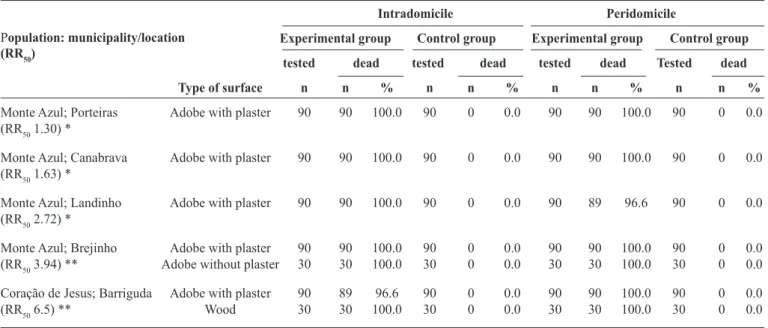
TABLE 2 - Mortality of fi fth-instar nymphs of Triatoma sordida with different deltamethrin toxicological profi les in response to exposure
on surfaces impregnated with alpha-cypermethrin 20.0%, 72h after contact with the treated surfaces; (p = 0.00062, experimental versus control group, Mann-Whitney test).
Population: municipality/location
Intradomicile Peridomicile
(RR50)
Experimental group Control group Experimental group Control group
tested dead tested dead tested dead Tested dead
Type of surface n n % n n % n n % n n %
Monte Azul; Porteiras Adobe with plaster 90 90 100.0 90 0 0.0 90 90 100.0 90 0 0.0
(RR501.30) *
Monte Azul; Canabrava Adobe with plaster 90 90 100.0 90 0 0.0 90 90 100.0 90 0 0.0
(RR501.63) *
Monte Azul; Landinho Adobe with plaster 90 90 100.0 90 0 0.0 90 89 96.6 90 0 0.0
(RR502.72) *
Monte Azul; Brejinho Adobe with plaster 90 90 100.0 90 0 0.0 90 90 100.0 90 0 0.0
(RR50 3.94) ** Adobe without plaster 30 30 100.0 30 0 0.0 30 30 100.0 30 0 0.0
Coração de Jesus; Barriguda Adobe with plaster 90 89 96.6 90 0 0.0 90 90 100.0 90 0 0.0
(RR50 6.5) ** Wood 30 30 100.0 30 0 0.0 30 30 100.0 30 0 0.0
RR50: resistance ratio 50%. *Data from Pessoa et al.
(6). **Data from Pessoa et al.(7).
The insects of the control group were exposed to an insecticide-free piece of cardboard attached to the wall in the same environments of the intradomicile and peridomicile of each DU, where the experimental groups were exposed. Mortality was measured 72h after removal of the insects from the treated surfaces. Triatomines were considered dead when they were placed on a fi lter paper and did not show locomotor activity, either spontaneously or when stimulated with forceps. Signs of paralysis and lack of coordination of the nymphs to move was considered as well.
Statistical analysis
Results from the experiments were analyzed through non-parametric hypothesis tests. Considering the nature of the data to be compared (2 independent samples), we used the Mann-Whitney test, and differences between groups were considered signifi cant when p-values were below or equal to α = 0.05.
Ethical considerations
This study was approved by the Animal Ethics Committee of Fundação Oswaldo Cruz (number 29/14-1).
The mortality rate, assessed 72h after the removal of the insects from the areas with insecticide, was 100% in all locations, except for Landinho (96.6%) and Barriguda (96.6%). Tests conducted in Brejinho and Barriguda, on adobe surfaces without plaster or on wood, both showed 100% mortality (Table 2). Thus, by using the criterion recommended by WHO(10), all populations
were considered susceptible to alpha-cypermethrin.
For every population and surface considered, in peridomicile and intradomicile, the Mann-Whitney test performed comparing the exposed and the control groups generated a p-value = 0.00061 (p < 0.05). Thus, mortality rates were signifi cantly different between the 2 groups compared.
Despite the growing number of studies that characterize the toxicological profi le of different triatomine populations to insecticides, there is only one study in the literature that has evaluated the actual impact of resistance ratios found in laboratory bioassays on triatomine control strategies in the fi eld. In a laboratory test, Obara(11) characterized the susceptibility of
three Brazilian populations of T. brasiliensis from Oieiras (Piauí) to deltamethrin (RR50 1.75-2.17) in the laboratory bioassays. Then exposed first-instar nymphs to different substrates (clay, adobe without plaster, and unpainted wood) impregnated with deltamethrin WG250 (a commercial product) at a concentration of 25 mg a.i./m2. Regardless of the RR
50 of each
population, each was susceptible to the insecticide, as evidenced by a 100% mortality rate. However, these results should be interpreted with caution, as fi fth-instar nymphs are known to be more resistant than fi rst-instar nymphs(12).
In this study, we evaluated the susceptibility of five populations of T. sordida collected in areas with persistent infestations and presenting different deltamethrin susceptibility profi les. According to Zerba & Picollo(4), three populations
(Monte Azul; Porteiras and Monte Azul; Landinho) are resistant to deltamethrin (RR50 > 2). In contrast, according to PAHO(5)
Regardless of the criteria adopted by Pessoa et al.(6) (7), our fi eld
bioassays showed that all study populations were susceptible to alpha-cypermethrin. The lack of correlation between the results of the laboratory and fi eld bioassays may be due to the use of different pyrethroids in these assays. Although both deltamethrin and alpha-cypermethrin are pyrethroids, and they therefore have the same site of action in the nervous system of triatomines (sodium channels), many studies (laboratory bioassays) with several triatomine species have demonstrated different toxicological profiles in response to different pyrethroids(13). The lack of correlation between the laboratory and fi eld bioassays may be due to the use of nymphs in different stages of development. In laboratory bioassays, fi rst-instar nymphs are used since it is diffi cult to obtain the high sample numbers needed to complete testing (e.g. 400 specimens). On the other hand, the fi eld bioassays are conducted with fi fth-instar nymphs considering that these are more resistant to insecticides(12). Because of these methodological differences, the World Health Organization(10) recommends that laboratory
bioassays are used as an initial test to indicate possibly resistant populations, being subjected to fi eld bioassays to confi rm or not the insecticide resistance.
Degradation of the insecticide in the peridomicile is faster than that in the intradomicile, because of exposure to sunlight (ultraviolet radiation) and other weather conditions (e.g., rain and ultraviolet radiation). This effect is clear in the timeline(14) (15) (16). As the fi eld bioassays were carried out one day
after spraying, we believe there is no difference in insecticide availability between the intradomicile and the peridomicile. Our hypothesis was confi rmed in all study DUs, where we observed 100% mortality in both environments, with the exception of one DU in Landino (96.6%) and one in Barriguda (96.6%). We believe that the survival of these two triatomines may be related to lower individual susceptibility(5).
The adobe surface with plaster was chosen because this surface is most commonly found in DUs in the region. However, we note that there is a distinct pH difference between the surfaces, depending on the material used in their manufacture; this could affect the rate of pesticide degradation(15) (16). This variable was excluded from our assays because exposure to treated surfaces was performed 24 h after spraying. Furthermore, we note that the porosity of sprayed surfaces is directly related to pesticide absorption and its consequent availability in the environment. For this reason, the insecticide effect of alpha-cypermethrin was assessed on adobe surface with plaster, adobe without plaster, and wood. There was 100.0% mortality with all three surfaces, which confi rms that the surface does not play a major role in sensitivity.
Considering that the study populations were highly susceptible to alpha-cypermethrin, an insecticide currently used by the Brazilian Ministry of Health for triatomine control in the fi eld, the diffi culties in controlling these populations can be related to the abundance and complexity of peridomiciles of the region studied. The peridomicile presents a wide variety
of ecotopes corresponding to an infi nite number of hidden loci associated with different sources of food for T. sordida, such as chickens, dogs, pigs, and cats. Spraying the peridomicile is exhausting work in which unshackling all of the material accrued is operationally impossible for the fi eld agent in charge. After insecticide application, eggs and triatomines (nymphs and adults) may either be completely free of contact with active chemicals, or could be in contact with sub-lethal doses, thus selecting for the specimens less susceptible to the chemicals and allowing for the survival of those insects in such ecotopes(17) (18). This underscores the fi nding that different pyrethroids exhibit ovicidal action when the insecticide is applied directly to the exochorial components of eggs(19). Furthermore, operational failures may contribute to the control diffi culties, revealing the urgent need for technical improvement of the fi eld team in charge. The control failures may be caused by lack of effi cacy of the insecticide, by operational failures and/or environmental conditions. The lack of insecticide effi cacy is related to poor quality of the active ingredient and/or inadequate formulation. Operational failures cover the insecticide dilution errors, failures in applications as well problems with spraying machines(5). One should also consider the discontinuity
of spraying cycles for administrative, budgetary, and logistical reasons(17) (18) (20). Finally, the presence of wild foci of T. sordida in the region should be considered, as it is associated with signifi cant mobility of this triatomine (mostly adults), which facilitates the process of dispersal and colonization of artifi cial ecotypes(20),
thereby hindering control.
Although in this study, the resistant populations in laboratory tests were actually susceptible in the fi eld, this observation in itself is insuffi cient to justify changing the cut-off points used for setting the RR50, how as conducted by the Ministry of Health of Brazil by the integrated management of the insecticide resistance of Aedes aegypti(9). Indeed, we recommend that laboratory and fi eld bioassays are carried out with a greater number of Triatominae populations to allow more thorough evaluation of the critical parameters. We recommend that these studies should be carried out on the timeline, once the triatominic populations is being pressed continuously by insecticides used by National Program of Chagas Disease Control in Brazil. This is particularly important in areas with overlap of endemics and/or agricultural areas, as these locations may intensify and even accelerate the selection of resistant genes that may exist in these populations.
ACKNOWLEDGMENTS
The authors declare that there is no confl ict of interest.
CONFLICT OF INTEREST
This study was supported by the Conselho Nacional
de Desenvolvimento Científi co e Tecnológico (CNPq), the
Fundação de Amparo a Pesquisa do Estado de Minas Gerais
(FAPEMIG), the Centro de Pesquisas René Rachou (CPqRR), the Fundação Oswaldo Cruz (FIOCRUZ), the Secretaria de Vigilância em Saúde (SVS), the Ministério da Saúde (MS), Brazil, and the World Health Organization (WHO).
FINANCIAL SUPPORT
REFERENCES
1. Brow AQ, Paul R. Insecticide resistance in arthopods. WHO
Monogr Geneva Ser 38. Geneva: World Health Organization; 1971.
2. Tabashink BE, Roush RT. Introduction. In: Roush RT, Tabashink BE, editors. Pesticide resistance in arthropods. New York: Chapman and Hall; 1990. p. 1-3.
3. Pessoa GCD. Perfi l da suscetibilidade a deltametrina em populações de Triatoma sordida (Hemiptera: Reduviidae) do Estado de Minas Gerais procedentes de áreas com infestação persistente. 2012. 179p. (Doctor´s Thesis). Universidade Federal de Minas Gerais; 2012 Belo Horizonte.
4. Zerba EN, Picollo MI. Resistencia a insecticidas piretroides
en Triatoma infestans. Centro de Investigaciones de Plagas e
Insecticidas (CIPEIN). Buenos Aires, Argentina: CITEFA-CONICET; 2002.
5. Pan American Health Organization (PAHO). II Reunion técnica latinoamericana de monitoreo de resistência a insecticidas em triatominos vectores de Chagas. Panamá: PAHO; 2005.
6. Pessoa GCD, Dias LS, Diotaiuti L. Deltamethrin pyrethroid susceptibility characterization of Triatoma sordida Stal, 1859 (Hemiptera: Reduviidae) populations in the Northern Region of Minas Gerais, Brazil. Rev Soc Bras Med Trop 2014; 47:426-429. 7. Pessoa GCD, Pinheiro LC, Ferraz ML, Mello BV, Diotaiuti L.
Standartization of laboratory bioassays for the study of Triatoma
sordida susceptibility to pyrethroid insecticides. Parasit Vectors
2015; 8:109-114.
8. Lent H, Wygodzinsky P. Revision of the Triatominae (Hemiptera,
Reduviidae), and their signifi cance as vectors of Chagas`disease.
Bull Amer Mus Nat Hist 1979;163.
9. Ministério da Saúde. II Seminário internacional sobre técnicas e ferramentas de controle de doenças transmitidas por vetores - recomendações. Brasília: Superintendência de Vigilância em Saúde; 2006.
10. World Health Organization (WHO). Taller sobre la evaluación de
efecto insecticida sobre triatominos. Workshop on the insecticide effect evaluation in triatominos. Acta Toxicol Argentina 1994; 2:29-33.
11. Obara TM. Caracterização da resistência a inseticidas em populações da subfamília Triatominae (Hemiptera: Reduviidae), vetores de Trypanosoma cruzi Chagas, 1909. 2010. 246p. (Doctoral Thesis). Universidade de São Paulo, 2010. São Paulo. 12. Dias JCP. Observações sobre o comportamento de triatomíneos
brasileiros frente ao jejum em laboratório. Rev Bras Malar 1965; 17:55-63.
13. Santo-Orihuela PL, Vassena CV, Zerba EM, Picollo MI. Reltive
contribution of monooxygenase and esterase to pyrethroid
resistance in Triatoma infestans (Hemiptera: Reduviidae) from Argentina and Bolivia. J Med Entomol 2008; 45:298-306.
14. Oliveira Filho AM, Melo MTV. Field trial of the pyrethroid bifenthrin (OMS 3024) against triatomines in an area of T. infestans colonization – Riachão das Neves, BA. Cienc Cult 1987; 39:817. 15. Marcondes CB, Pinto CT. Avaliação da deltametrina (K-Othrine
50 FW), em doses baixas, no controle de triatomíneos em São Paulo
do Umbuzeiro, Paraíba. Rev Soc Bras Med Trop 1989; 22:85-90. 16. Diotaiuti L, Pinto CT. Suscetibilidade biológica do Triatoma
sordida e Triatoma infestans a deltametrina e lambdacyalotrina
em condições de campo.Rev Soc Bras Med Trop 1991; 24:151-155. 17. Porcasi X, Catala SS, Hellac H, Scavuzzo MC, Gorla DE.
Infestation of rural houses by Triatoma infestans (Hemiptera: Reduviidae) in Southern área of Gran Chaco in Argentina. J Med Entomol 2006, 43:1060-1067.
18. Gurtler RE, Canale DM, Spillmann C, Striolo R, Salomón OD, Blanco S, et al. Effectiveness of residual spraying of peridomestic ecotopes with deltamethrin and permethrin on Triatoma infestans in rural western Argentina: a district wide randomized trial.
Bull World Health Organ 2004; 82:196-205.
19. Rodrigues VLC, Ferraz Filho NA, Rocha e Silva EO, Ishihata GK. Triatomíneos: ação ovicida de alguns piretróides. Rev Soc Bras Med Trop 2002; 35:237-241.
20. Forattini OP, Rocha e Silva EO, Ferreira AO, Rabello EX, Patolli DGB. Aspectos ecológicos da tripanossomíase Americana. III. Dispersão local de triatomíneos, com especial referência ao