Waldir Neme Felippe Filho
Professor
Universidade de Barra Mansa - UBM Departamento de Engenharia Civil Barra Mansa - Rio de Janeiro - Brasil [email protected]
Flávio de Souza Barbosa
Professor
Universidade Federal de Juiz de Fora - UFJF Departamento de Mecânica Computacional Aplicada Juiz de Fora - Minas Gerais - Brasil
Ney Roitman
Professor
Universidade Federal do Rio de Janeiro - UFRJ Programa de Engenharia Civil - COPPE Rio de Janeiro - Rio de Janeiro - Brasil [email protected]
Carlos Magluta
Professor
Universidade Federal do Rio de Janeiro – UFRJ Programa de Engenharia Civil - COPPE Rio de Janeiro - Rio de Janeiro – Brasil [email protected]
Flávia Carolina Borges
Professora
Universidade Veiga de Almeida – UVA Departamento de Engenharia Civil Rio de Janeiro - Rio de Janeiro - Brasil [email protected]
Experimental and
numerical evaluation of
viscoelastic sandwich beams
Abstract
Viscoelastic materials can dissipate a large amount of energy when subjected to cyclic shear deformations, but they have low bearing capacity. Therefore they are often employed as a damping layer in sandwich structures. These sandwich structures present a high damping ratio and simple application.
In order to design sandwich structures, many aspects ranging from computer mod-eling to laboratory testing should be considered. In this study, a test set of experiments were performed and results are compared with a numerical GHM (Golla, Hughes and Mc Tavish method) based model, in order to establish a method to support viscoelastic sandwich beam design.
In this way, starting from the dynamic properties of a viscoelastic material, a nu-merical model is used to evaluate the behavior of these structures. Comparisons with uncontrolled structures are also presented, showing the dissipative characteristics of this passive control.
Keywords: sandwich structure, viscoelasticity, GHM model.
http://dx.doi.org/10.1590/0370-44672013700015
Civil Engineering
Engenharia Civil
1. Introduction
Aiming for the reduction of struc-tural vibrations, several techniques were developed to increase structural damp-ing. Among these techniques, the passive control with viscoelastic materials has shown reasonable eficiency. These ma-terials have low bearing properties with a high dissipative capacity when subjected to cyclic deformations. That is the main reason to apply viscoelastic materials in sandwich layers with stiff elastic materi-als (Felippe et al. 2013).
In this way, in order to effectively reduce structural vibrations using vis-coelastic materials, it is important to understand the dynamic behavior of the structure and the viscoelastic material (VEM) used. This type of control system has experienced a growth in practical applications due to some beneits related to cost-effectiveness and a high level of dynamic damping (Battista et al. 2010,
Kim et al. 2006, Moliner et al. 2012,
Saidi et al. 2011).
the computational models, a viscoelastic inite element (CST) using the GHM
method (Golla, Hughes and Mc Tavish method) was developed.
2. The GHM method for viscoelastic materials modeling
The stress-strain relation on Laplace’s domain as mentioned by Golla, Hughes and Mc Tavish (1985) may be written as:
s
(
s
)
= [
E
0+
h
(
s
) ]
e
(
s
)
(1)(2) (3) (4) (5) (6) (7) (8a) (8b) where s is the Laplace operator, s(s) and e(s) are,
respectively, the stress and strain on Laplace’s
domain, E0 is the elastic fraction of complex modulus and h(s) is the relaxation function.
Function h(s) can be written using Biot's series with four terms (or two GHM terms):
( )
2 2 2 2 2 2 1 1 2 1 2 1δ
β
β
α
δ
β
β
α
+
+
+
+
+
+
+
=
s
s
s
s
s
s
s
s
s
h
where N is the number of terms, αi, βi and δi are materials constants and
(αi, βi, δi) ≥ 0.
Starting from the equation of
mo-tion in the Laplace domain:
{
Ms
2+
K
l} q (
s
) =
f
l(
s
)
K
l= [
E
0
+
h
(
s
)]
k
vwhere M, K l and f l(s) are respectively the mass, stiffness and external loading in the Laplace domain, where:
where: Kv is the rigidity fraction associ-ated with geometrical characteristics of
the model. The GHM model deines the equation of motion in the time domain as:
q
K
q
C
q
M
+
+
=
f,
1 1 2 2 0 0 0 0 0 0 v v M K K =
M
,
1 11
2 2 2
0 0 0
0 0 0 0 v v K K = C
,
0 1 2 1 2
1 2 ( ) 0 0 v v v v v v v
K E K K
K K
K K
+ +
=
K , =
2 1 ˆ ˆ z z q q , ( ) 0 0 f t = f , where:
and zi is the auxiliary variable introduced into the problem, called dissipation
vari-able.
Generalizing Eq. (5) for n degrees of
freedom, Eqs. (6-7) may be written as:
=
I
0
0
0
I
0
0
0
M
M
2 2 11
,
=
I
0
0
0
I
0
0
0
0
C
2 2 2 1 1 1,
+ + = I 0 R 0 I R R R K K v 2 2 1 1 2 1 2 1 0 ) ( T T E , = 2 1 ˆ ˆ z z qq , =
0 0 f(t)
where:
K
v= T
TΛ
T,
and
Λ
is a diagonal matrix consisting of the non-zero eigen-values of the stiffness matrix normalized with respect to the elastic modu-lus; T is the matrix of vectors corresponding to the non-zero eigen-values of the matrix(1/E)Kelastic; R = T
Λ
1/2 and zi = R zi.As shown in Eqs. (2-8) the number of dissipative degrees of freedom associated with viscoelastic elements depends on the number of terms used in the relaxation
func-tion and the number of rigid body mofunc-tions (Barbosa 2000). It should be noted that the greater the number of terms used to write the relaxation function, the more accurate the model will be.
(9)
3. Experimental program
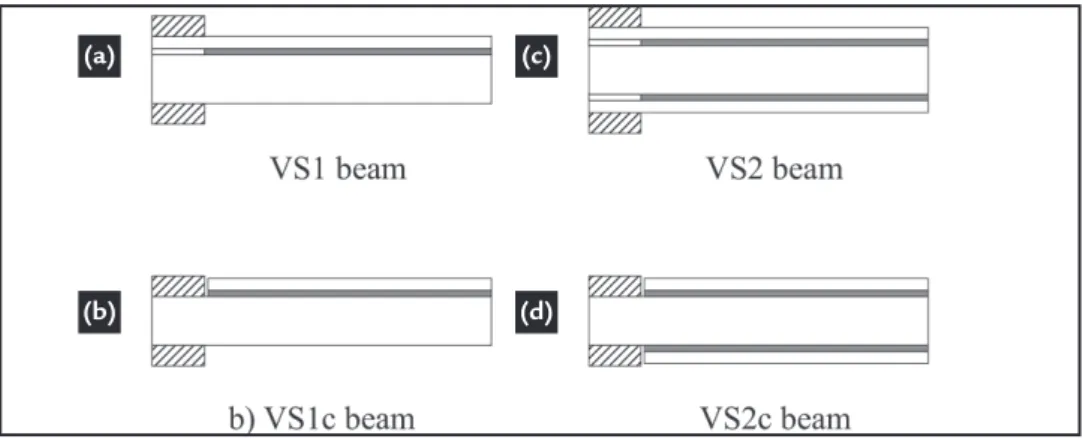
A set of tests was performed with viscoelastic sandwich cantilever beams. The beams were divided into four groups in accordance with their layer conigura-tion: a VS1 beam, with two elastic layers (base beam and restraining layer, both
clamped) and one viscoelastic layer; a VS1c beam, with two elastic layers (base beam clamped and free restraining layer) and one viscoelastic layer; a VS2 beam, with three elastic layers (one base beam and two restraining layers, all clamped)
and two viscoelastic layers; and a VS2c beam, with three elastic layers (one base beam clamped and two free restraining layers) and two viscoelastic layers. The layer coniguration of the beams can be seen in Fig. 1.
(a)
(b)
(c)
(d)
Figure 1 Longitudinal section of the analyzed beams.
These beams have a rectangular cross section and 1140 mm length, working as a base structure (with 16.1mm height) and onto this structure, viscoelastic layers (with 2.0mm height) and elastic constraining lay-ers (with 3,17mm height) were mounted, as
shown in Fig. 1. Aluminum was the mate-rial used for the elastic layers and VHB 4955 was used as the viscoelastic material.
These beams were stimulated under the action of a hammer impact at 15 cm from the cantilever and at 15, 20 and 25 cm
from the cantilever, transversal displace-ments were observed during the period. In Fig. 2, one can see how the beams were in-strumented with LVDT sensors fabricated by Balluff, which could register displace-ments without touching the structure.
Figure 2 Viscoelastic sandwich beam ready to be tested.
Two elastic beams, A and B, were tested and then the sandwich beam
conigu-ration was mounted on these elastic beams, making a total of two specimens. The natural
frequencies and damping ratios of the respec-tive beams A and B are shown in Table 1.
Vibration mode
Beam A Beam B
Natural frequency
(Hz) Damping ratio(%) Natural frequency (Hz) Damping ratio(%)
1 10.25±0.00 0.05±0.00 10.24±0.00 0.05±0.00
2 63.38±0.00 0.03±0.00 63.70±0.00 0.04±0.00
3 179.00±0.00 0.06±0.00 179.26±0.00 0.05±0.00 Table 1
For the specimens VS1, VS1c, VS2 and VS2c the natural frequencies and their
damping ratios are listed in Tables 2-5, respectively.
Vibration mode
Beam A Beam B
Natural frequency
(Hz) Damping ratio (%) Natural frequency (Hz) Damping ratio (%)
1 11.31±0.02 4.98±0.11 11.03±0.02 4.44±0.01
2 63.37±0.17 4.90±0.19 61.76±0.14 4.32±0.05
3 175.05±0.12 4.39±0.01 168.08±0.23 3.28±0.06
Table 2
Natural frequencies and
damping ratios of VS1 specimens.
Table 3
Natural frequencies and
damping ratios of VS1c specimens. Vibration mode
Beam A Beam B
Natural frequency (Hz)
Damping ratio (%)
Natural frequency (Hz)
Damping ratio (%)
1 9.82±0.00 2.74±0.01 8.41±0.01 2.23±0.02
2 63.70±0.04 4.80±0.10 55.09±0.06 3.48±0.06
3 174.05±0.35 4.44±0.04 145.48±0.16 3.86±0.07
Vibration mode Beam A Beam B
Natural frequency (Hz)
Damping ratio (%)
Natural frequency (Hz)
Damping ratio (%)
1 - - 12.34±0.05 7.92±0.11
2 - - 64.79±0.37 8.65±0.20
3 - - 173.29±0.90 6.17±0.49
Table 4
Natural frequencies and
damping ratios of VS2 specimens.
Table 5
Natural frequencies and
damping ratios of VS2c specimens. Vibration mode
Beam A Beam B
Natural frequency (Hz)
Damping ratio (%)
Natural frequency (Hz)
Damping ratio (%)
1 8.26±0.00 4.75±0.31 9.82±0.01 5.14±0.03
2 56.81±0.22 6.67±0.02 6.67±0.31 8.60±0.20
3 146.04±1.44 4.73±0.56 4.73±0.41 5.90±0.97
3.1 GHM Model’s parameters
There are several methodologies for characterizing the Complex Modu-lus of viscoelastic materials: ASTM Standard Method (ASTM 1993), Direct Method (Faisca 1998) and Indirect Method (Masterson and Miles 1995).
These methods basically register the temporal responses at a given tempera-ture, when a specimen is forced into shear or axial deformation.
After the values of Complex Mod-ulus are experimentally determined,
one can adjust the curves of the real part of the Complex Modulus and loss factor for the points obtained experi-mentally. In the case of the formulation GHM, the complex shear modulus is given by:
(
)
(
)
(
)
(
)
2 2 2 2 2 2
2 2 1
1
2 1
0 2 2 2 2 2 2 2 2
1 1 2 2
'( )
G
=
G
+
+
+
+
+
+
( )
(
1)
121(
2)
22 22 2 2 2 2 2
1 1 2 2
1
( )
'
G
+
=
+
+
(10)
(11)
and these functions are used to deter-mine the GHM parameters.
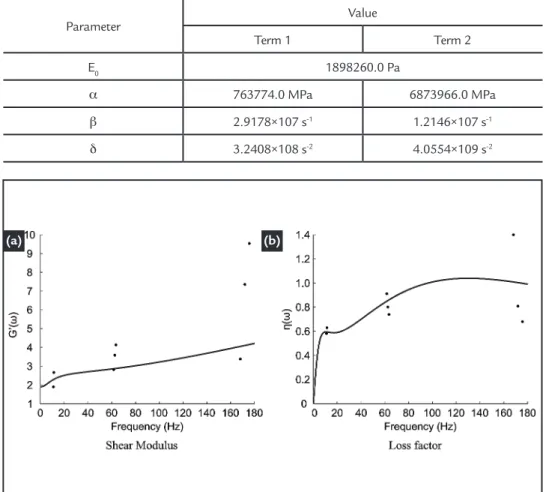
Here it was used the Direct Method, for frequencies between 0 and 200 Hz.
Us-ing data from the experiments, the GHM parameters could be determined using the Nonlinear Least Squares Method (Cole-man and Li 1994, Cole(Cole-man and Li 1996).
Parameter Value
Term 1 Term 2
E0 1898260.0 Pa
α 763774.0 MPa 6873966.0 MPa
β 2.9178×10⁷ s-1 1.2146×10⁷ s-1
δ 3.2408×10⁸ s-2 4.0554×10⁹ s-2 Table 7
GHM parameters adjusted to the viscoelastic material.
Figure 3 Experimental values and fitted curves of G′(ω) and η(ω).
(a) (b)
4. Numerical evaluation
Using equations 6-7, it is pos-sible to achieve viscoelastic elements matrices for the linear triangular Finite Element.
The beams were simulated under the action of a hammer impact at 15 cm from the cantilever and, at the same point, transversal displacement was
observed along the time. The domain of the structure was discretized with linear triangular element meshes like the one shown in Figure 4.
Figure 4 Structural Finite Element discretization.
In order to establish the models, considered were the mechanical properties listed in Table 8.
Mechanical property Elastic layer Viscoelastic layer
Density (kg/m ) 8794.0 795.0
Poisson’s coefficient 0.30 0.49
Elastic Modulus (GPa) 109.6
-Table 8 Mechanical properties adopted for sandwich structure.
With the model, meshes and me-chanical properties presented, the time response of beams could be obtained. In order to obtain the natural frequencies,
a spectral response was constructed and the time response signal iltered around the irst three natural frequencies identi-ied; then, to obtain the damping ratios,
Figure 5
Numerical and experimental frequencies and damping ratios identified for VS1 beam.
Figure 6
Numerical and experimental frequencies and damping ratios identified for VS1c beam.
Figure 7
Numerical and experimental frequencies and damping ratios identified for VS2 beam.
Figure 8
Numerical and experimental frequencies and damping ratios identified for VS2c beam.
As one can see, the natural frequen-cies predicted with the numerical model show good agreement with those
identi-ied experimentally and one can state that the GHM model used provided consistent results in terms of the damping ratio and
natural frequencies.
(a) (b)
(a) (b)
(a) (b)
(a) (b)
5. Conclusions
This study evaluated some beams with and without sandwich viscoelastic damping treatment. It has been shown
that this type of passive control signii-cantly improves the damping ratios of an elastic base beam, from 44.6× (for VS1c
restrain-ing layers presented a higher damprestrain-ing ratio than those where this layer was not restrained. This behavior was expected since, when these layers are constrained, larger shear deformations are imposed on VEM. Consequently, the material dissipates more energy.
Also evaluated was a computational model for viscoelastic materials acting as structural vibration dampers: the GHM Method. Analyzing the obtained responses for the cantilever beams, one can observe
that despite the good correlation between the itted curves and the experimental data, the damping factor obtained through the numerical model was, in general, underes-timated. Notwithstanding, there was good agreement between the natural frequencies obtained with the model and the experi-mental values. Obviously these differences cannot be attributed only to curve itting. Other factors such as: the methodology used on modal identiication; 2) Dispersion of experimental results; and 3) The Finite
Element discretization, also play a signii-cant inluence on the numerical results.
In previous studies, it was possible to observe the inluence of the curve it over the numerical results. Apparently, this model tends to underestimate the damping ratios.
Therefore it is considered that since the GHM model provided results close to the experimental data and in favor of safety, this model can be a useful tool to project or simulate sandwich beams.
Acknowledgements
Authors would like to thank: CNPq (Conselho Nacional de Desen-volvimento Cientíico e Tecnológico);
UFJF (Federal University of Juiz de Fora); FAPEMIG (Fundação de Am-paro à Pesquisa do Estado de Minas
Gerais) and CAPES (Coordenação de Aperfeiçoamento de Pessoal de Nível Superior) for inancial supports.
References
ASTM. Standard test method for measuring vibration-damping properties of materials. ASTM, 1993.
COLEMAN, T. F., LI, Y. On the convergence of relective newton methods for large--scale nonlinear minimization subject to bounds. Mathematical Programming, 67, 1994.
COLEMAN, T. F., LI, Y. An interior, trust region approach for nonlinear minimization subject to bounds. SIAM Journal on Optimization, 6, 1996.
BATTISTA, R. C. et alii. A viscoelastic sandwich solution for orthotropic decks of steel bridges. Proc. Stability and ductility of steel structures, 2010.
FAISCA, R. G. Caracterização de materiais viscoelásticos como amortecedores estru-turais. COPPE/UFRJ, 1998. Rio de Janeiro: (Dissertação de Mestrados).
GOLLA, D. F., HUGHES, P. C. Dynamics of viscoelastic structures - a time-domain, inite element formulation. Journal of Applied Mechanics, 52, p.897–906, 1985. KIM, J. et alii. Seismic performance of structures connected by viscoelastic dampers.
Engineering Structures, 28, 2006.
MASTERSON, P. A., MILES, R. N. Method for the determination of complex she-ar modulus of viscoelastic adhesives. Proc. 2nd Annu. International Symposium on Smart Structures and Materials, Society of Photo-optical Instrumentation Engineers (SPIE), 1995.
MOLINER, E. et alii. Retroit of existing railway bridges of short to medium spans for high-speed trafic using viscoelastic dampers. Engineering Structures, 40, 2012. SAIDI, I. et alii. Development of passive viscoelastic damper to attenuate excessive loor