*e-mail: [email protected]
Trabalho apresentado no 1º Congresso da Sociedade Brasileira em Materiais, Rio de Janeiro, Julho de 2002.
A New Route to Process Diamond Wires
Marcello Filgueiraa*, Guerold Bobrovnitchiia, Daltro Garcia Pinattib
a
Universidade Estadual do Norte Fluminense, Laboratório de Materiais Avançados, Av. Alberto Lamego, 2000, 28015-620 Campos dos Goytacazes - RJ, Brasil.
b
Departamento de Engenharia de Materiais DEMAR/FAENQUIL, Polo Urbo Industrial, Gleba AI6, 12600-000 Lorena - SP, Brazil
Received: October 7, 2002; Revised: December 8, 2002
We propose an original route to process diamond wires, denominated In Situ Technology, whose fabrication involves mechanical conformation processes, such as rotary forging, copper tubes restacking, and thermal treatments, such as sintering and recrystallisation of a bronze 4 wt.% diamond composite. Tensile tests were performed, reaching an ultimate tensile strength (UTS) of 230 MPa for the diameter of ∅ = 1.84 mm. Scanning electron microscopy showed the diamond crystals distribution along the composite rope during its manufacture, as well as the diamond adhesion to the bronze matrix. Cutting tests were carried out with the processed wire, showing a probable performance 4 times higher than the diamond sawing discs, however its prob-able performance was about 5 to 8 times less than the conventional diamond wires (pearl system) due to the low abrasion resistance of the bronze matrix, and low adhesion between the pair bronze-diamond due to the use of not metallised bronze-diamond single crystals.
Keywords:diamond wires, In Situ Technology, swaging, sintering.
matrix-diamond crystals7. Diamonds are impregnated in the metal matrix via two ways: electrodeposition or sintering. In the electrodeposited tools there are only a monolayer of monds on the tool surface, while the sintered ones show dia-mond crystals distributed into the bulk and on the surface of the tools, and is cheaper and easier to process. In this sense, sintered diamond cutting tools are more usual7,8.
The metal matrix selection is based on the abrasivity of the material to be cut or polished. For highly abrasive mate-rials such as concrete, SiC, Si3N4, Al2O3, tungsten bond is used. Cobalt bond is employed in the cutting of materials whose abrasivities are similar to the granites. Bronze, co-balt bonds and its alloys are used for marbles. Brass, bronze or copper bonds are employed in the cutting of ceramics, glasses, and nonferrous metals7.
The sintering is normally accomplished by hot pressing. In this case, the powder or green body (in the desired form) is submited to sintering at the same time in which it is pressed into a mold. A classical example is performed by Contardi9, explaining a method to process diamond pearls for cutting
1. Introduction
wires, where the metal matrix bond + diamond crystals mix is confined into holes of a graphite mold. This mold is put into a resistive vacuum furnace chamber coupled to a press. The press punches conduct the current for the green bodies sintering, at the same time that press them into the mold holes. The productivity is high, about 960 pearls per 8 h.
In this work we present an alternative route to process
diamond composites, denominated In Situ Technology,
which involves conventional sintering and swaging (rotary forging) of the metal matrix-diamond mix, instead of the conventional hot pressing route. It was produced wires of bronze 4 wt.% diamond for use as diamond wires and lin-ear saws in general. Table 1 gives the comparison of geo-metric data of diamond wires fabricated by pearls and in situ
techniques. Diamond volume and surface in the in situ wire are 20 to 30 times larger than pearls wire, and cutting sec-tion of rocks are decreased to 40%10.
2. Experimental
Table 2 shows the typical concentration vs. density of diamond in cutting tools. In the present work we used a con-centration 50 (2.2 carat/cm3; 0.44 g/cm3; 0.1264 cm3 of dia-mond/cm3 of tool) since this is the concentration used to cut dimension stones. Figure 1 shows the processing flow chart
of the bronze/diamond cap, starting with bronze 4 wt.% dia- Figure 1. Processing flow chart of the bronze / diamond external cap.
Table 2. Typical concentration versus density of diamonds in cutting tools.
Concentration of diamond Mass of diamond/cm3 of tool volume Volume of diamond
Carat Grams (cm3)/tools (cm3)
150 6.60 1.32 0.38
125 5.50 1.10 0.32
100* 4.40 0.88 0.25
75 3.30 0.66 0.19
50 2.20 0.44 0.13
42 1.85 0.37 0.11
30 1.32 0.26 0.07
25 1.10 0.22 0.06
* Concentration 100 refers to 25% in tool volume of diamond per cm3 of tool and has 4.4 carat of diamond/cm3 of tools; 1 carat = 0.2 g.
The fourth column is obtained by dividing the third column by the diamond density (ρdiam. = 3.48 g/cm3).
Table 1. Comparative geometric data between pearls and in situ diamond wire.
Data Pearls In Situ
φe (external diameter) 10 mm 8 mm 6 mm
φi (internal diameter) 7 mm 5 mm 3 mm
Width 5 mm (pearls) 1000 mm (length/m)
Spacing 25 mm Continuous
Diamond volume/m * 1000 mm3 30.630 mm3 21.206 mm3
Diamond surface/m + 785 mm3 25.133 mm3 18.850 mm3
Relation between in situ/pearls Volume 30 21
Surface 32 24
*Diamond volume/m: π/4 × (φe2 - φ i
2) × width × number of pearls/m; +Diamond surface/m: π × φ
mond. The materials used in this work are: De Beers SDA + 65 40/50 mesh diamonds, commercial atomised copper powder (75/60 mm), and OFHC copper tubes.
3. Results and Discussion
Microstructural and tensile behaviour
Figure 2a shows the longitudinal microstructure of the initial sintered bronze 4 wt.% diamond at ∅ = 8.00 mm. The diamond distribution is relatively spaced. Samples were cupped in backelite and ground by 80 mesh emery paper.
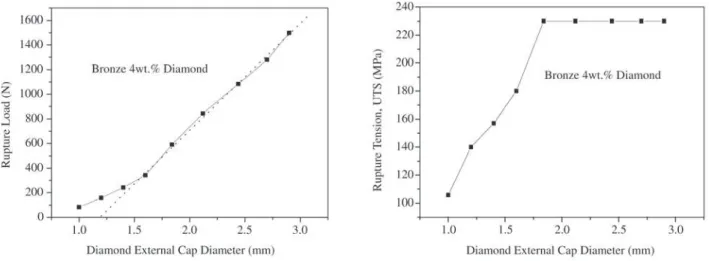
1H2O + 1HNO3 picking did not work because corrosion was not uniform and pitting tooke place in the bronze/diamond interface. Figure 2b shows the cross section of the diamond wire at ∅ = 1.84 mm (R = 18.90X). It can be observed that during the wire area reduction by swaging the diamond crys-tals keeps their physical integrity. This result is of great im-portance because it gives viability to the in situ processing route, never used before. For bronze 4 wt.% diamond, the rupture load is shown as a function of the external cap diam-eter along the various stages of the processing (Fig. 3a). The curve of Fig. 3a does not extrapolate to zero, but to
Figure 2. (a)Longitudinal section of the sintered bronze 4 wt.% diamond, ∅ = 8.00 mm, and (b) cross section of diamond composite,
∅ = 1.84 mm.
Figure 3. (a)Rupture load (N) as a function of diamond external cap diameter (mm), and (b) rupture tension (UTS) as a function of
∅ = 1.20 mm (extrapolation of the dashed line), and this di-ameter is the limit of the contact diamond to diamond. With it, the rupture load is 180 N, indicating an adherence between bronze and diamond of 160MPa (σ≈180 N/[π.∅2/4] ≈180 N/[(π/4).(1.20)2.10-6 m2] ≈160 MPa). In Fig. 3b the UTS re-mains constant at 230 MPa for diameters up to ∅ = 1.84 mm, after which it decreases. The data of Fig. 3b refers to the UTS values for the same material, indicating that ∅ =1.84 mm is the optimum diameter for this composition and mean crystal diamonds size of 350 µm.
Measurements are made in the annealed condition (650 °C/20 min) and data are an average over 5 to 7 sam-ples. The experimental average modulus of elasticity is E = 11.5 GPa, but for annealed commercial bronze, UTS = 260 MPa and E = 16 Gpa8,9. The presence of dia-mond up to ∅ = 1.84 mm has minor influence in UTS, but it decreases E (more flexible material) since it is now dis-tributed as a composite. Conventional diamond wire has a rupture load between 1200 and 3000 N (UTS = 60 and 150 MPa, considering ∅ = 5.00 mm for the AISI 316 core).
Figure 4. (a) View of a diamond crystal spyked in the bronze matrix. Sample as sintered. (b)Bronze-diamond interface. ∅ = 5.00 mm,
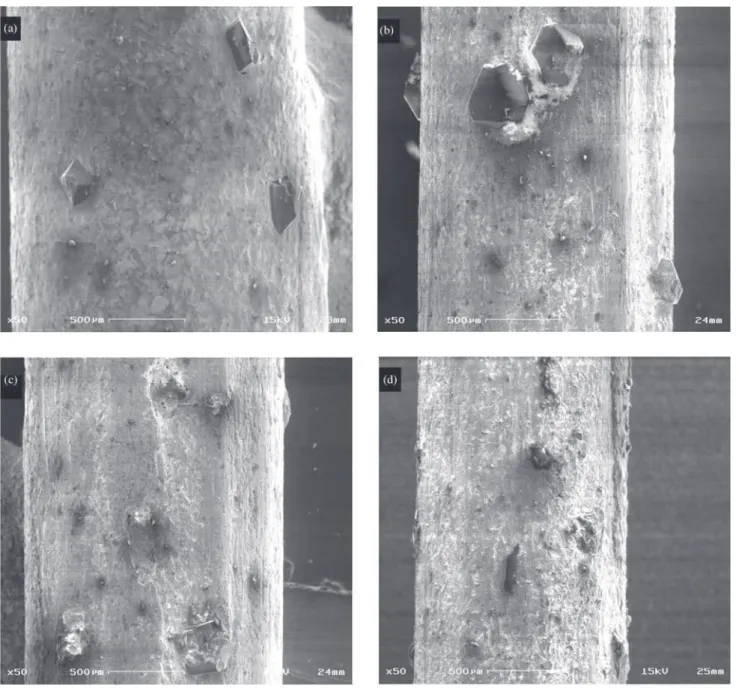
Figure 5. Marble cutting of in situ wire. (a)Before cutting operation, φ = 1.93 mm. (b)After cutting an area of A = 605 cm2 , φ = 1.61 mm.
(c) After cutting an area of A = 1180 cm2, φ = 1.23 mm. (d) Silver welded junction of in situ diamond wire.
The bronze 4 wt.% diamond at ∅ = 1.84 mm has a rupture load of 611 N (230 MPa), higher than the AISI 316 core. All the tensile tests are performed according to the Ref. 11.
Bronze – Diamond Adherence
Figure 4 show the interface bronze-diamond in the vari-ous stages of the processing (as sintered ∅ = 8.00 mm, ∅ = 5.00 mm, φ = 3.30 mm, and φ = 1.84 mm). The Cu
layer is removed with 1H2O + HNO3 in order to expose the diamond cutting faces. There are no gaps (faults) between bronze and diamond. There is no interdiffusion between them, and the adherence is smaller than the UTS = 230 MPa of the bronze 4 wt.% diamond.
Preliminary cutting of marble
monolithic bronze 4 wt.% diamond wire. Figures 5a, b and c show micrographs of the wire before, in the middle and in the end of the cutting trial, respectively, being made in a linear saw frame of 0.22 m in length, resulting in 1188 × 10-4 m3/0.22 m = 0.54 m2/m of cut area per meter of wire. In considering that, the braided wires will have 12 bronze 4 wt.% diamond wires, and we expect a cutting area capacity of 6.5 m2/m, it corresponds to 5 (30 m2/m) to 8 (50 m2/m) times less than the pearls-diamond wire. The reason for this poor performance is the low abrasion resistance of the bronze material shown in Fig. 5, where abrasion of the loose diamond powder is clearly seen. Another comparison can be done with results of reference12 for granite cutting with a circular saw of φ = 0.7 mm with a diamond volume of V = 1.7 × 10⁻⁵ m3 and a perimeter of λ = 1.7 mm (V = 10–5 m3/m,, effective diamond DAS 100,40/50 mesh and concentration 30). The measured cutting capacity of the circular saw was 0.62 m2 resulting in 0.62/1.7 = 0.35 m2/m. For marble, the cutting capacity is the double (0.73 m2/m). The cutting capacity of in situ linear saw frame (0.54 m2/m for diamond volume of v =1.7 × 10⁻⁶ m3) is 4.4 times higher than the Ref. 12 results [(0.54/1.7 × 10–6) : (0.73/10–5 )]. In the sequence of development, it will be used W, Co, W-Co alloy, Fe or Fe-Co alloy to improve abrasion resis-tance. It is recognized that the critical point is the adhesion be-tween the diamond and the matrix. Metal coated diamond will also improve the cutting area capacity of the in situ wire.
One of the new feature of the in situ diamond wire is its possibility to be welded after rupture. Fig. 5.d shows the
mi-crograph of a silver welded part of the in situ monolithic wire (φ = 1.69 mm). Mechanical resistance is maintained (UTS = 226 MPa) in the welded area and diamond of that region is not lost. This characteristic is a considerable improvement over the pearl-diamond wire that is completely lost after rupture.
4. Conclusions
A diamond wire was obtained by an alternative route called
in situ process by swaging and sintering with maintenance of diamond crystal integrity. By means of this route it is possible to decrease the diameter of the wire from 10 to 6 mm, decreas-ing then three times the section of the rock to be cut.
Abrasion of the bronze matrix was too high indicating the need of development into two directions: use of metal coated diamond in order to improve adhesion and use of another metal matrix, such as W-Co, or Fe-Co alloys.
For the bronze 4 wt.% diamond rope, with φ = 1.65 mm diameter, the UTS = 170 MPa fulfils the requirements of ten-sile strength to operate as a diamond wire cutting rope.
Adherence between the pair bronze-diamond was weak, due to the fact that the diamonds crystals used in this work were free of metallisation.
The function of silver welding was satisfactory after rup-ture, promoting the constant recycling of the external cutting rope.
When comparing the cutting data in marble using the in situ external rope, its probable performance was about 4 times higher than the conventional sawing discs, but 5 to 8 times less than the conventional pearl system diamond wires, due to the low abrasion resistance of the bronze matrix and weak adher-ence between bronze-diamond.
Acknowledgements
The authors thanks to DEMAR/FAENQUIL for the equip-ments used in the experiequip-ments.
References
1. Thoreau, B. Diamond Impregnated Wire for Sawing Hard Abrasive Stones. Industrial Diamond Review. v. 2, p. 94-95, 1984.
2. Daniel, P. More Granites Succumb to Diamond Wire. In-dustrial Diamond Review. n. 5, p. 187-194, 1986.
3. Daniel, P. Granite Quarrying – Cut Waste & Costs. Indus-trial Diamond Review. n. 1, p. 1–4, 1986.
4. Daniel, P. Slate Without Waste. Industrial Diamond Review. n. 4, p. 200-203, 1993.
5. Pinzari, M. Quarrying Stone by Diamond Wire in Italy. In-dustrial Diamond Review. v.5, p. 231-336, 1989.
6. Filgueira, M.; Pinatti, D.G. Production of Diamond Wire by Cu 15%v Nb in situ Process. Proceedings of the 15th Inter-national Plansee Seminar, Reutte/Austria, Plansee Hold-Table 3. Marble cutting data with the in situ diamond wire.
N φ (mm) σ (mm) ±ε (mm) A (cm2)
6 1.93 0.06 0.02 0.00
10 1.79 0.06 0.02 52.50
11 1.78 0.06 0.02 65.00
20 1.73 0.06 0.01 70.50
22 1.69 0.04 0.01 84.00
27 1.67 0.05 0.01 104.00
31 1.67 0.06 0.01 110.00
31 1.61 0.06 0.01 119.00
31 1.58 0.06 0.01 118.50
26 1.50 0.08 0.01 126.00
34 1.44 0.10 0.02 97.50
33 1.38 0.11 0.02 101.25
28 1.31 0.14 0.03 84.00
18 1.23 0.12 0.03 56.25
Number of measurements φ during cutting: N
Error: ε = __σ__ Average diameter:φ = (∑φi)/N
(N)1/2 Variance: σ = (∑[φ
i - φ] 2)1/2
ing AG, v. 1, p. 360-374, 2001.
7. Przyklenk, K. Diamond Impregnated tools – Uses and Pro-duction. Toolmaking, Industrial Diamond Review, v. 4, p. 192-195, 1993.
8. Filgueira, M. Production of in situ Diamond Wires. PhD. Thesis, State University of North Fluminense, p. 1-153, 2000. (in portuguese)
9. Contardi, G.L. Wire Beads – Economic Productions.
Tool-making, Industrial Diamond Review, v. 5, p. 256, 1993. 10. Filgueira, M.; Pinatti, D.G. In situ Diamond Wires – Part
II: The Bronze 4 Weight % Diamond Composite Cutting Rope. Journal of Material Processing Technology. In Press. 11. Anual Book of ASTM Standards. Section 3–Metals Test-ing Methods and Analytical Procedures v. 3, n. 1, 1985.