ABSTRACT
BACKGROUND AND OBJECTIVES:Pain is a major
mani-festation of patients in immediate postoperative period, being an individual and subjective complaint afecting patients’ quality of life. his study aimed at evaluating the use of analgesics in the immediate postoperative period of patients assisted in a post-anesthetic care unit.
METHODS: Data were collected in the period from March to April 2016. his is a cross-sectional, quantitative study, carried out in the post-anesthetic care unit of a Level IV Hospital of Rio Grande do Sul. Short-form McGill pain questionnaire was used for socio-demographic and clinical characterization of patients.
RESULTS: Participated in the study 336 patients, most (68.8%) female and elderly. Body mass index (BMI) was higher than 25, indicating overweight or obesity. Perioperative opioid analgesics were used by 266 patients. here has been statistical association between no postoperative pain and the use of any opioid. Most frequent class of drugs used in the perioperative period were opioid analgesics, especially fentanyl and remi-fentanil for surgeries with general anesthesia, and morphine (0.2mg) for spinal anesthesia.
CONCLUSION:his study aimed at bringing subsidies on the need for adequate drugs associated to the anesthetic technique to maintain patients in better physiological conditions, with longer painless periods and less adverse efects, thus promoting more adequate quality of life during this critical period.
Keywords:Analgesia, Hospitalized patients, Pain, Postoperative pain.
Pain evaluation at the post-anesthetic care unit of a tertiary hospital
Avaliação da dor na sala de recuperação pós-anestésica em hospital terciário
Priscila Schefler Panazzolo1, Fernanda Duarte Siqueira1, Monique Pereira Portella1, Eniva Miladi Fernandes Stumm1, Christiane de
Fátima Colet1
1. Universidade Regional do Noroeste do Estado do Rio Grande do Sul, Departamento de Ciências da Vida. Ijuí, RS, Brasil.
Submitted in August 23, 2016.
Accepted for publication in January 26, 2017. Conlict of interests: none – Sponsoring sources: none.
Correspondence to:
Departamento de Ciências da Vida Rua do Comércio, 3000 – Bairro Universitário 98700-000 Ijuí, RS, Brasil.
E-mail: [email protected]
© Sociedade Brasileira para o Estudo da Dor
RESUMO
JUSTIFICATIVA E OBJETIVOS: A dor ocorre como uma das principais manifestações nos pacientes em pós-operatório ime-diato, sendo uma queixa individual e subjetiva que impacta a qualidade de vida dos pacientes. O objetivo deste estudo foi aval-iar o uso de analgésicos no pós-operatório imediato de pacientes assistidos em uma sala de recuperação pós-anestésica.
MÉTODOS: Os dados foram coletados no período de março a abril de 2016. Trata-se de um estudo transversal, de abordagem quantitativa, realizado na sala de recuperação pós-anestésica de um Hospital de Nível IV do Rio Grande do Sul. Foi utilizado o formulário de caracterização sócio-demográica e clínica dos pacientes, questionário McGill - forma reduzida.
RESULTADOS: Foram entrevistados 336 pacientes, a maioria (68,8%) era do sexo feminino e idosos. O índice de massa corpo-ral para 69,6% foi superior a 25, indicativo de sobrepeso ou obe-sidade. Duzentos e sessenta e seis pacientes izeram uso de algum analgésico opioide no perioperatório. Veriicou-se a associação estatística entre não apresentar dor no pós-operatório e fazer uso de qualquer opioide. Entre os fármacos a classe mais utilizada durante o perioperatório foi analgésico opioides, destacando-se o uso de fentanil e remifentanil, para cirurgias com anestesia geral, e morina (0,2mg) para anestesias subaracnóideas.
CONCLUSÃO: Este estudo buscou trazer subsídios sobre a ne-cessidade de fármacos adequados associados à técnica anestésica, para que o paciente se mantenha com melhores condições isi-ológicas, com mais tempo sem dor e com menos efeitos adversos, proporcionando assim qualidade de vida mais apropriada para esse período crítico.
Descritores: Analgesia, Dor, Dor pós-operatória, Pacientes internados.
INTRODUCTION
Pain is a major manifestation in the immediate postoperative period, is diferent among individuals and inluences patients’ quality of life (QL), being considered the most common rea-son for human distress and incapacity. Pain is a multidimen-sional experience which involves sensory, afective, autonomic and behavioral aspects1.
Moreira et al.2 have reported that pain is frequent in
pa-tients submitted to surgical procedures and in the immedi-ate postoperative period. So, analgesia should start before surgery to favor fast patients’ response and early recovery of organic functions, since pain may induce postopera-tive complications. According to Miranda et al.3 pain may
cause functional and organic damages, which impair the recovery of vital signs, respiratory, thermal and circulatory capacity.
So, the anesthetic technique applied to patients interferes with postoperative pain4. According to Vaz & Vaz5, analgesia
should be adapted according to pain intensity, characteristics and nature, as well as to surgery type and size. In addition, other factors, such as anxiety, socio-cultural origin, psycho-behavioral factors and type of anesthesia might inluence an-algesia quality.
Barbosa et al.6 have indicated a technique which is being used
and has shown to be efective, which is the multimodal an-algesia which, according to the World Health Organization (WHO), is the association of diferent analgesics, thus favor-ing the use of lower doses, accordfavor-ing to patients’ need and proile, thus preventing adverse efects.
he adequate choice of the drug is critical to efectively man-age postoperative pain. Non-steroid anti-inlammatory drugs (NSAIDs) and opioid analgesics are the most widely used drugs for postoperative pain7.
here are studies which have proved pain evaluation by difer-ent methods such as Daminelli, Sakae & Bianchini’s8, which
has evaluated postoperative analgesia efectiveness.
his study aimed at evaluating the use of analgesics in the immediate postoperative period of patients assisted in a post-anesthetic care unit (PACU), according to the type of surgery.
METHODS
his is a cross-sectional and quantitative study carried out in a PACU of a Level IV Hospital of Rio Grande do Sul from March to April 2016. For sample calculation, the number of monthly surgeries carried out in the hospital the year before the study was used. Monthly mean was 463 surgeries with conidence level of 95% and sample error of 5%. Sample was made up of 302 patients with 10% for sample safety margin. Participated in the study 336 patients in the immediate post-operative period assisted in the PACU.
A form developed for patients’ socio-demographic and clini-cal characterization and brief McGill questionnaire were used9. his form encompasses socio-demographic variables:
gender, weight (kg), height and age. Clinical and surgical data involve the use of opioids, anesthetic drugs by diferent routes, muscle relaxant, other opioid and non-opioid analge-sics and adverse efects of these drugs.
McGill questionnaire is widely accepted as trustworthy, valid, sensitive and accurate. Pain is evaluated according to present pain intensity (PPI) at patients PACU admission and discharge, being this based on words selected by pa-tients to describe their own pain. Pain numeric scale (PNS) is where patients grade their pain in numeric intervals from zero to 10, being zero (no pain); 1 to 3 (mild pain); 4 to 6 (moderate pain); 7 to 9 (severe pain); and 10 (worst imagin-able pain).
Pain was evaluated in two moments, with McGill scale. First evaluated period was at PACU admission, by means of PPI
evaluation, and the second period was at PACU discharge, moment when they were referred to the ward. Questionnaire was applied by previously trained interviewers, during their PACU stay.
Drugs were classiied according to the third level of the Ana-tomical herapeutic Chemical (ATC)10.
his study was approved by the Research Ethics Committee, UNIJUÍ, Opinion 1.426.751 of 02/26/2016.
Statistical analysis
Analytic statistics, helped by statistical software SPSS version 18.0 were used for data analysis. Opioid analgesics, inhala-tional anesthetics, intravenous drugs, muscle relaxants and other analgesics were associated to admission PPI and dis-charge PPI.
ANOVA, followed by Student t test, was used for
indepen-dent samples. PPI was equal zero for patients reporting no pain and higher than zero for patients referring pain of dif-ferent intensities.
RESULTS
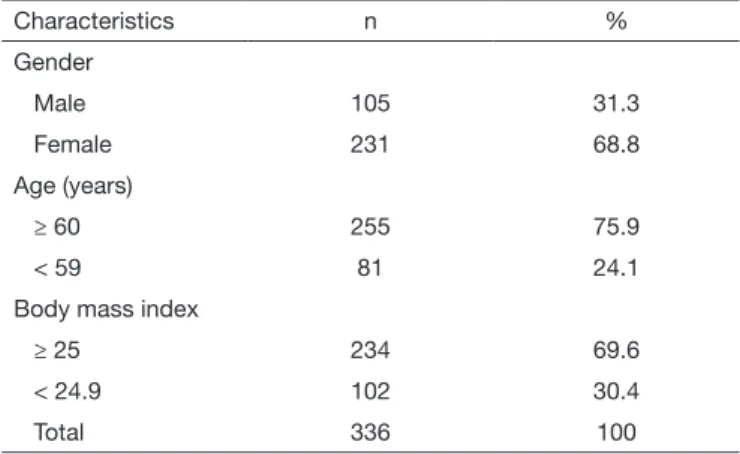
Participated in the study 336 patients, most (68.8%) females and 75.9% elderly. BMI was calculated and it was observed that 69.6% had score above 25, indicating overweight or obe-sity. Complete data are shown in table 1.
Table 1. Socio-demographic characterization of patients in immediate postoperative period collected from March to April 2016 (n=336)
Characteristics n %
Gender
Male 105 31.3
Female 231 68.8
Age (years)
≥ 60 255 75.9
< 59 81 24.1
Body mass index
≥ 25 234 69.6
< 24.9 102 30.4
Total 336 100
Most frequent surgeries were open surgeries (77.6%) with general anesthesia (45.2%), followed by spinal and/or spinal with lumbar block (40.4%). As to surgical specialties, most frequent were oncologic (26.5), traumatic (17.6%), general (15.8%), obstetric (17.3%), urologic, gynecologic and vas-cular surgeries (9.8%), presented in a previous study with a group of patients followed up in the PACU.
and atracurium was used by most patients (34.5%). Thio-pental was not used.
Table 2. Use of opioid analgesics, anesthetics and muscle relaxants during surgery (n=336)
Drug classes Yes No
n (%) n (%)
Opioid analgesics
Alfentanil 52 (15.3) 284 (84.7)
Fentanyl 230 (68.1) 106 (31.9)
Remifentanil 88 (26) 248 (74)
Sufentanil 6 (1.5) 330 (98.5)
Morphine (0.2mg) 121 (36.2) 215 (63.8)
Morphine (10 mg) 37 (11) 299 (89)
Nalbuphine 18 (5.6) 302 (94.4)
Non-opioid analgesics
Ketoprofen 214 (63.7) 122 (36.3)
Dipirone 232 (69) 104 (31)
Inhalational anesthetics
Isolurane 19 (5.7) 317 (94.3)
Sevolurane 23 (6) 313 (94)
Intravenous anesthetics
Ketamine 9 (2.7) 327 (97.3)
Propofol 232 (69) 104 (31)
Thiopental - 336 (100)
Muscle relaxant
Atracurium 116 (34.5) 220 (65.5)
Pancuronium - 336 (100)
Rocuronium 45 (13.2) 291 (86.8)
Suxamethion 2 (0.3) 334 (99.7)
Table 3 shows drugs used in the postoperative period in the PACU. It was observed that 8.9% of PACU patients used tramadol as opioid analgesic. With regard to analgesics, it was observed that 26.5% of patients have used dipirone. In some cases, drugs were prescribed in associations, such as tramadol and ketoprofen, dipirone and ketoprofen or even tramadol with dipirone. A total of 42.8% of patients have used some type of analgesic.
Table 3. Use of opioid and non-opioid analgesics in the immediate postoperative period of post-anesthetic care unit patients (n=336)
Use Yes No
n (%) n (%)
Opioid analgesics
Morphine* 5 (1.5) 331 (98.5)
Tramadol 30 (8.9) 306 (91.1)
Non-opioid analgesics
Ketoprofen 20 (5.9) 316 (94)
Dipirone 89 (26.5) 247 (73.5)
*10 mg morphine diluted in sterile distilled water.
Table 4 shows drugs used during surgery and in the PACU, comparing PACU admission and discharge PPI. It was ob-served that 266 patients have used some opioid analgesic dur-ing surgery and from these 144 patients have referred no pain and 122 patients have referred pain>zero. From patients us-ing some opioid durus-ing surgery, 135 remained painless until PACU discharge and results were statistically signiicant at patients admission (p=0.000) and discharge (p=0.000). With regard to fentanyl, it was observed that 122 patients have used it during surgery and had no pain at admission and 115 re-mained pain-free, being these results statistically signiicant. When comparing the types of morphine, it was observed that those using intravenous 0.2 mg morphine have referred less pain, being that 90 patients have reported pain zero at admis-sion and 75 have remained painless at PACU discharge, with statistical signiicance (p=0.000) in both moments. With regard to propofol, 117 patients were admitted with no pain, however during recovery 121 patients have developed pain>zero.
Table 4. Comparison of the use of drugs during surgery and in the post-anesthetic care unit and pain intensity at patients’ admission and discharge (n=336)
PPI Admission PPI Discharge
0 > 0 P 0 > 0 P
Opioid a
Yes 144 122 .000* 135 131 .001*
No 55 15 43 27
Alfentanil
Yes 24 25 .001* 23 30 .030
No 175 112 155 128
Fentanyl
Yes 122 106 .000* 115 113 .001*
No 76 32 63 45
Remifentanil
Yes 35 52 .000* 35 52 .000*
No 164 87 143 106
Sufentanil
Yes 3 2 .969 4 1 .015*
No 196 135 174 157
Morphine (10 mg)
Sim 13 21 .000* 10 24 .000*
Não 178 124 162 140
Morphine (0,2 mg)
Yes 90 28 .000* 75 43 .000*
No 104 114 100 118
Isolurane
Yes 6 9 .002* 5 11 .002*
No 191 130 0 149
Sevolurane
Yes 7 13 .000* 6 14 .000*
No 190 126 170 146
Table 4. Comparison of the use of drugs during surgery and in the post-anesthetic care unit and pain intensity at patients’ admission and discharge (n=336) – continuation
PPI Admission PPI Discharge
0 > 0 P 0 > 0 P
Propofol
Yes 117 113 .000* 109 121 .005*
No 81 25 68 38
Atracurium
Yes 53 62 .000* 48 67 .000*
No 145 77 129 92
Rocuronium
Yes 17 27 .000* 19 25 .005*
No 181 114 158 134
Suxamethion
Yes - 1 .015* - 1 .033
No 198 137 177 158
Dipirone
Yes 129 93 # 111 111 .007*
No 61 53 57 57
Ketoprofen
Yes 115 84 # 107 92 .252
No 75 62 61 76
Nalbuphine
Yes 10 8 # 8 10 .160
No 180 138 160 158
Ketamine
Yes - 2 # 1 1 .926
No 180 154 157 177
ause of any opioid during surgery; *statistically signiicant, t test for dependent
samples; # test not performed because patient has only used such drugs after post-anesthetic care unit admission; PPI = present pain intensity.
here has been statistical association between no postopera-tive pain in patients using: any opioid, among them: fentanyl (p=0.001), remifentanil (p=0.000), sufentanil (p=0.015), 0.2 mg morphine (p=0.000) and 10 mg morphine (p=0.000). here has been no association between variables and alfentanil (p=0.030) or muscle relaxant suxamethion (p=0.033) and an-algesics such as ketoprofen (p=0.252), nalbuphine (p=0.160) and ketamine (p=0.926). his study has not evaluated pain previous to surgery, being this a limitation.
DISCUSSION
In our study, most patients were females, aged above 60 years and BMI above 25. Similar data to a study carried out in surgical units between August and September 2006, with patients submitted to general anesthesia, where females (66.8%) and patients aged above 60 years have prevailed11.
Nora12 has also reported that gender, age, weight, height and
BMI are critically important for the choice of anesthetic type and technique.
Considering the type of surgery, it was observed that pa-tients submitted to oncologic, traumatic and vascular sur-geries have reported more pain, with statistically significant difference.
Most widely used class in this study was opioid analgesics, especially fentanyl and remifentanil for surgeries with general anesthesia, and 0.2 mg morphine for the association with spi-nal and/or lumbar block anesthesia. Vaz & Vaz5 have reported
that spinal opioids individually applied may promote optimal analgesia and, if combined to local anesthetics, dose decrease cause less adverse efects.
Daminelli, Sakae & Bianchini8 have evaluated the
efective-ness of postoperative analgesia in a hospital of Santa Catarina from July to October 2006 and have reported the predomi-nance of simple analgesics such as dipirone and NSAIDs such as ketoprofen, being superior to the prescription of opioids. hese data are similar to our study were dipirone and keto-profen consumption has predominated.
Palombo & Medeiros13 have reported that to minimize
post-operative pain it would be desirable the prescription of an-algesics with ixed time, which could prevent plasma level unbalance of administered drugs, also preventing patients of sufering pain peaks. However, this was not evaluated in our study. Custódio et al.14 have described that there is not just
one way or method to manage pain, because diferent pain types and intensities may appear in the postoperative period, depending on the type, size and drugs used during surgery. However, it would be important that hospitals kept a stan-dardization of drugs, anesthetic techniques and therapies, ac-cording to the types of surgeries, be them open or closed, because these variations result in diferent pain intensities due to damage caused during surgery. In these cases, clini-cal protocols would minimize postoperative pain. he lack of protocols in health institutions for pain control impairs the prescription of analgesics and the classiication of patients’ pain intensity15.
In our study, most reported symptoms by patients as adverse efects were nausea, vomiting and sleepiness, especially in sur-geries with general anesthesia or sedation. hese adverse ef-fects are in general attributed to opioids, being them the most widely used drugs in surgeries under general anesthesia. Ac-cording to Vaz & Vaz5, opioid-induced nausea and vomiting
are related to their central and peripheral action, stimulating chemoreceptor zone and provoking gastric stasis, respectively. Opioids may induce sleepiness and the author also reports that preventive analgesia contributes a lot for a better post-operative period, with less pain intensity and adverse efects. On the other hand, according to some authors, inhalation-al anesthetics and propofol in the intraoperative period do not seem to inluence postoperative pain intensity. here has been just one statistical diference between propofol and des-lurane (p=0.04) and remaining comparisons were not sig-niicant (p30.07). here have been no statistically signiicant
diferences between fentanyl and morphine in two evaluated groups (p=0.21 and 0.24)16. In our study, propofol, isolurane
his is justiied because these are anesthetic drugs more fre-quently used in our study, the use of which has always been associated to an opioid analgesic.
With regard to fear of professionals to administer opioid an-algesics, Nascimento et al.15 have evaluated diiculties in
ad-ministering them, reported by a nursing team. In 2008, in a large Teaching Hospital of Paraná, it was observed that 58.4% of professionals have administered the drug when patients re-ferred mild pain, followed by 39% when pain was moderate and 2.6% have started its administration after severe pain re-port. Among reported diiculties for is administration, 65% of professionals have reported lack of analgesic prescription, 76% fear of dependence and/or withdrawal syndrome, which occurs after abrupt opioid withdrawal.
CONCLUSION
Our results have shown that analgesics such as tramadol and dipirone were prescribed and the most frequently used to mini-mize pain reported by patients in the post-anesthetic care unit.
REFERENCES
1. Silva JA, Ribeiro Filho NP. A dor como um problema psicofísico. Rev Dor. 2011;12(2):138-51.
2. Moreira L, Truppel YM, Kozovits FG, Santos VA, Atet V. Analgesia no pós-cirúrgico: panorama do controle da dor. Rev Dor. 2013;14(2):106-10.
3. Miranda AF, Silva LF, Caetano JA, Sousa AC, Almeida PC. Avaliação da intensidade da dor e sinais vitais no pós-operatório de cirurgia cardíaca. Rev Esc Enferm USP. 2011;45(2):327-33.
4. Santos AC, Braga FS, Braga AF, Souza GA, Morais SS, Zeferino LC. Efeitos adver-sos no pós-operatório de cirurgias ginecológicas e mamárias. Rev Assoc Med Bras. 2006;52(4):203-7.
5. Vaz JL, Vaz MS. Fisiopatologia da dor pós-operatória. Educação Médica Continuada do Colégio Brasileiro de Cirurgiões. 2005;1(2):1-12. Disponível em: https://cbc.org. br/wp-content/uploads/2013/05/V.1_n.2_Dor _cirurgica_Fisiopatologia_II.pdf. 6. Barbosa MH, Correa TB, Araujo NF, Silva JAJ, Cardoso RJ, Cunha DF. Dor,
altera-ções isiológicas e analgesia nos pacientes submetidos a cirurgias de médio porte. Rev Eletr Enferm. 2014;16(1):1-9.
7. Bassanezi BS, Oliveira Filho AG. Analgesia pós-operatória. Rev Col Bras Cir. 2006;33(2):116-22.
8. Daminelli C, Sakae TM, Bianchini N. Avaliação da efetividade da analgesia pós-ope-ratória em hospital no sul de Santa Catarina de julho a outubro de 2006. ACM Arq. Catarin. 2008;37(1):18-24.
9. Melzack R. he short-form McGill pain questionnaire. Pain. 1987;30(2):191-7. 10. http://www.whocc.no/atc_ddd_index/.
11. Couceiro TC, Valença MM, Lima LC, Menezes TC, Raposo MC. Prevalência e in-luência do sexo, idade e tipo de operação na dor pós-operatória. Rev Bras Anestesiol. 2009;59(3):314-20.
12. Nora FS. Anestesia venosa total em regime de infusão alvo-controlada: uma análise evolutiva. Rev Bras Anestesiol. 2008;58(2):179-92.
13. Palombo PA, Medeiros VC. Controle da dor aguda no pós-operatório imediato. Rev Enferm Unisa. 2001;2(1):57-62.
14. Custódio G, Zappelini CE, Trevisol DJ, Trevisol FS. Uso de analgésicos no pós-ope-ratório para tratamento de dor em hospital do Sul do Brasil. Arq Catarinenses Med. 2008;27(4):75-9.
15. Nascimento LA, Santos MR, Aroni P, Martins MB, Kreling MC. Manejo da dor e diiculdades relatadas pela equipe de enfermagem na administração de opioides. Rev Eletr Enferm. 2013;13(4):714-720. Disponível em: https://www.fen.ufg.br/revista/ v13/n4/pdf/v13n4a16.pdf.