ORIGINAL ARTICLE
Pain-related evaluation and interventions in children in the anesthetic
care unit*
Avaliação e intervenções relacionadas à dor em crianças na sala de recuperação anestésica
Ana Carolina Corbanezi Mendes Sancho1, Rachel de Carvalho2
* Received from the School of Nursing, Israelite Hospital Albert Einstein (FEHIAE). São Paulo, SP. • End of Nursing Graduation Course Paper.
RESUMO
JUSTIFICATIVA E OBJETIVOS: No período pós-operatório de pacientes pediátricos, pode ocorrer dor aguda de intensidade variável, e cabe aos enfermeiros e médicos avaliar e tratar a dor, ajudando as crianças a vivenciarem esta situação da forma menos traumática possível. Os objetivos deste estudo foram avaliar a in-cidência de dor e alterações dos parâmetros vitais, em crianças pré-escolares no pós-operatório imediato de cirurgias gerais, identii-car os analgésicos prescritos e administrados no tratamento da dor, durante sua permanência na sala de recuperação anestésica (SRA).
MÉTODO: Pesquisa de campo, descritivo-exploratória, prospec-tiva e quantitaprospec-tiva, com 32 crianças submetidas a cirurgias gerais e internadas na SRA de um hospital particular de São Paulo.
RESULTADOS: A maioria dos pacientes era do gênero mascu-lino, com idade predominante de 4 anos. As cirurgias mais realiza-das foram adenoamigdalectomia, postectomia e adenoidectomia, sob anestesia geral e os analgésicos mais prescritos foram dipirona e paracetamol. Apenas duas crianças tiveram dor durante sua per-manência na SRA, sendo medicadas com paracetamol e nalbuina, com regressão total da dor.
CONCLUSÃO: A incidência de dor no pós-operatório imediato foi baixa, não havendo alterações signiicativas nos parâmetros vi-tais.
Descritores: Criança, Dor pós-operatória, Medição da dor, Perío-do de recuperação da anestesia, Sala de recuperação.
INTRODUCTION
Pediatric patients feel acute postoperative pain similarly to adult patients1. Health professionals have the responsibility of evaluating
and using adequate strategies for pain management, helping pedi-atric patients to live this situation in the least possible traumatic manner2,3.
Pain is truly subjective and personal, characterized as a multidi-mensional experience with diferent qualities and intensities, and is afected by afective-motivational variables4.
Acute pain evaluation involves its intensity, quality, duration and psycho-afective inluence, so that diagnosis is done and the most efective therapy for its control is chosen to prevent discomfort, agi-tation and hemodynamic changes and to decrease hospital stay1,5.
he understanding and the actions of the whole health team with 1. Nurse of the Medical-Surgical Clinic, Israelite Hospital Albert Einsten (HIAE). São
Paulo, SP, Brazil.
2. Nurse. Master and Doctor in Nursing by the Nursing School, University of São Paulo (USP). Professor of the Graduation and Post-Graduation Courses, School of Nursing, Is-raelite Hospital Albert Einstein (FEHIAE). Director of Publication and Divulgation of the Brazilian Association of Operating Center, Anesthetic Care and Material and Sterilization Center Nurses (SOBECC). São Paulo, SP, Brazil.
Submitted in September 11, 2012. Accepted for publication in January 04, 2013.
Correspondence to: Rachel de Carvalho
Av. Prof. Francisco Morato, 4293 - Butantã 01409-001 São Paulo, SP.
Phones (11) 2151-1001 - (11) 99545-9948
E-mails: [email protected] or [email protected]
Rev Dor. São Paulo, 2013 jan-mar;14(1):31-4
31
Sociedade Brasileira para o Estudo da Dorc
ABSTRACT
BACKGROUND AND OBJECTIVES: Children in the post-operative period may have acute pain of variable intensity, and it is up to nurses and physicians to evaluate and treat pain, helping children to live this situation in the least traumatic way. his study aimed at evaluating the incidence of pain and the change in vital parameters of preschoolers in the immediate postoperative period of general surgeries, in addition to identifying prescribed and ad-ministered analgesics to treat pain during their stay in the anes-thetic care unit (ACU).
METHOD: his was a ield, descriptive-exploratory, prospective and quantitative research carried out with 32 children submitted to general surgeries and admitted to the ACU of a private hospital in São Paulo.
RESULTS: Most patients were males, with predominant age of 4 years. Most common surgeries were adenotonsillectomy, postec-tomy and adenoidecpostec-tomy under general anesthesia and most com-monly prescribed analgesics were dipirone and paracetamol. Only two children had pain during their ACU stay, being medicated with paracetamol and nalbuphine, with total pain remission.
CONCLUSION: Postoperative pain incidence was low, without signiicant changes in vital parameters.
regard to pain evaluation and control are critical for children’s re-covery. Nurses know the tools available to evaluate pain in chil-dren6, however there is brittleness with regard to pain control,
which is limited to pharmacological methods7. Most popular
scales to evaluate pediatric pain are the behavioral scale, the faces scale, the visual analog scale and the numerical scale6,8.
Pain control involves pharmacological and non pharmacological techniques. Pharmacological techniques may involve the prescrip-tion of regular and rescue analgesics, as well as non pharmacological techniques, always directing treatment according to each patient’s needs, considering the speciicities of their developmental stage8,9.
Due to the importance of the nurse in detecting and managing postoperative pain, this study aimed at investigating nursing inter-ventions in children submitted to anesthetic-surgical procedures. he objectives were to check the incidence of pain and the changes in vital parameters, as well as prescribed and administered anal-gesics to pre-school children in the immediate postoperative pe-riod of general surgeries, during their stay in the anesthetic care unit (ACU).
METHOD
his was a ield, descriptive-exploratory and prospective research, with quantitative data analysis, in a ACU with 20 beds, which sup-ply 12 operating rooms and assist, in average, 150 pediatric patients per month, of a large general private hospital from the city of São Paulo.
Sample was made up of 32 pre-school children, that is, aged be-tween 3 and 6 years, submitted to general surgeries and admitted to the ACU, who were included ater the signature of the Free and Informed Consent Term (FICT) by their guardians.
Data were collected with regard to children, such as gender and age, type of surgery, induced anesthesia and duration of both, pain and vital signs evaluation every 15 minutes, identiication of prescribed analgesics and description of non pharmacological interventions used to relieve pain.
Data were submitted to statistical analysis, with calculation of mean, median and standard deviation for vital sign changes and pain scores, and are presented as tables.
his study was approved by the Research Ethics Committee (REC) of the institution (protocol CAAE - 0044.0.028.000-2011).
RESULTS
Most children were males (59.4%), with predominance of 4 years of age (43.8%).
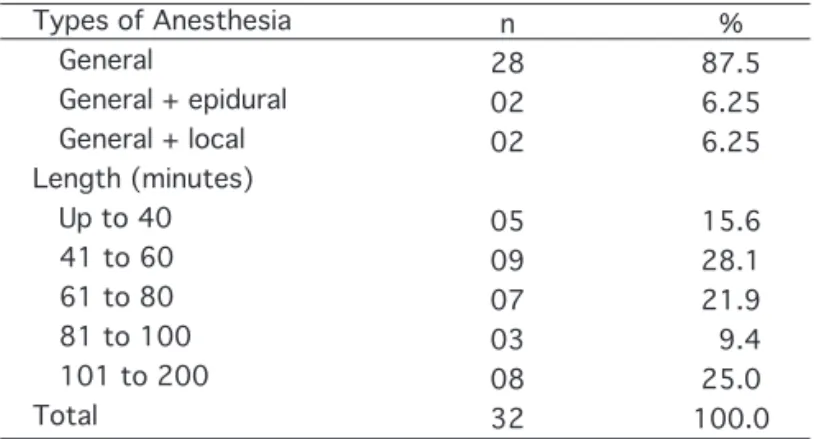
Most widely used anesthesia was general anesthesia, being also used general anesthesia associated to epidural and local blockade. Anesthesia duration has varied from 25 to 200 minutes with predominance of 45 to 60 minutes, followed by 65 to 80 min-utes (Table 1).
Most prevalent surgeries were simple adenoidectomy or associated to other surgery and postectomy (Table 2).
Surgery duration has varied from 10 to 170 minutes with preva-lence of surgeries lasting from 25 to 40 minutes, followed by suger-ies lasting from 45 to 60 minutes (Table 3).
ACU stay length was 45 minutes for 31% of children and 40 minutes for 16% of them.
here were no major vital sign changes. Mean heart rate (HR) was 103.4 ± 17.9 bpm and respiratory rate (RR) was 20.2 ± 0.4 breaths per minute; temperature (T) was 34.7 ± 0.6º C and mean oxygen saturation (SatO2) was 96.2 ± 2.3%.
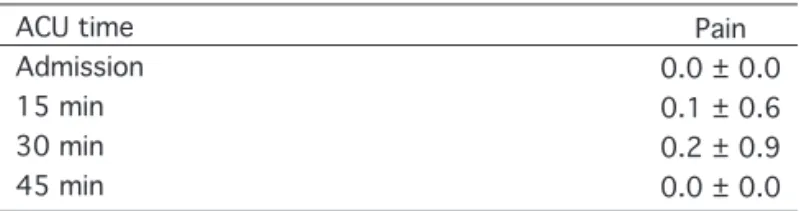
Vital signs were stable during 40 to 45 minutes of children’s stay in the ACU because pain intensity was mild (Table 4), since only two children had to be medicated for pain. In one of them, pain intensity was 4, 30 minutes ater admission to ACU. his child was medicated with oral 16 mg paracetamol and, at 45 minutes, the child was pain-free. he other patient had pain intensity of 3, 15 minutes ater admission to ACU and was medicated with in-travenous 1 mg nalbuphine; at 30 minutes, patient was pain-free. Six types of analgesics were prescribed, being dipirone the most prescribed (46.43%), followed by paracetamol (39.29%).
Most children (78.1%) had an escort, father or mother, during ACU stay, to decrease fear and possibly pain, being this considered a non pharmacological strategy. Another non pharmacological
32
Sancho and Carvalho
Types of Anesthesia General
General + epidural General + local Length (minutes) Up to 40 41 to 60 61 to 80 81 to 100 101 to 200 Total n 28 02 02 05 09 07 03 08 32 % 87.5 6.25 6.25 15.6 28.1 21.9 9.4 25.0 100.0 Table 1 – Types and length of anesthesia.
Table 2 – Types of surgeries.
Postectomy Adenotonsyllectomy
Adenotonsyllectomy + turbinoplasty Adenoidectomy
Adenoidectomy associated to other surgery Inguinal hernia repair
Umbilical hernia repair Strabismus correction Others Total n 05 05 01 03 07 03 01 02 05 32
Table 3 – Surgeries length.
Surgeries Length (min) 05 a 20
21 a 40 41 a 60 61 a 80 81 a 200 Total n 4 12 7 3 62 32 % 12.5 37.5 21.9 9.4 18.7 100.0
strategy is to allow children to take some toy that will make them feel safer, and 21.9% of them have taken a toy to the hospital.
DISCUSSION
When evaluating children’s pain, professionals have to take care with wrong beliefs, such as the idea that they do not feel the same pain as adults, or that they will not remember of their pain experi-ence. here are studies showing the use of analgesics in sub-thera-peutic doses in pediatric patients, especially in surgical cases, when pain may be severe because there is tissue injury and handling of structures and organs2,3.
At any age, surgery is a situation of anxiety and fear of the un-known, but when it comes to children going through a surgical procedure, very oten one neglects the need to explain, in a simple and clear way, what will happen to them to try to decrease their anxiety and fear. he eicient and quality assistance in the recovery process is also mandatory, always and in any situation10.
Most patients of this study were males, with predominance of 4 years of age, similar to other study including children submitted to surgeries classiied by the authors as “simple”, such as hernia correc-tion, appendicitis and urological surgeries, where most of patients were males2.
Most used anesthetics in children are inhalational anesthetics, fol-lowed by intravenous anesthetic induction. Most surgeries were performed under general anesthesia and one may consider that all children were submitted to this type of anesthesia; in some cases, however, the anesthesiologist has associated general to epidural or local anesthesia11.
Anesthesia duration varies according to surgery length, and the anesthetic level varies according to surgery complexity and length and, since each body reacts diferently to anesthetic drugs, anes-thesia duration may also vary, even in cases of surgeries of the same size3,12. Our study has shown broad variation on anesthesia time,
between 25 and 200 minutes, with prevalence of 45 to 60 minutes. Surgery time has varied from 5 to 180 minutes, with highest per-centage between 25 and 40 minutes, since surgeries were outpa-tient surgeries size I.
hese were elective, small procedures with decreased likelihood of luid and blood losses during the procedure, which was the expected result since the focus was children admitted to the ACU of an out-patient operating center of a general hospital.
During their ACU stay to control vital signs until total recovery from residual anesthetic efects, pain is in general the irst referred symptom, and there may also be psychomotor agitation due to re-sidual general anesthesia sedation.
In our study, pain intensity was mild, since only two children have
referred pain, which was totally controlled with drug therapy. A study evaluating children with postoperative pain1 has shown that drug treatment requires further attention, since some analge-sics may induce or worsen a possible respiratory depression in the immediate postoperative period.
he choice of analgesics to manage postoperative pain varies ac-cording to surgery complexity, to the choice of anesthesiologists and surgeons, as well as to patient’s pain level. Acute pain responds well to anti-inlammatory analgesics which have fewer side ef-fects. In our study, most prescribed analgesics were dipirone and paracetamol, which do not induce respiratory depression, fol-lowed by nalbuphine which, although being an opioid, has low po-tential to depress respiratory centers, although inducing a certain level of sedation13.
Other factors contributing to the low incidence of pain were that surgeries were less complex, patients received intravenous analge-sics before leaving the operating room, and the use of local or re-gional anesthesia associated to general anesthesia.
With regard to non pharmacological measures, our study has shown the presence of one parent and of children’s preferred toy, which is in line with a study4 which stresses the need to promote comfort and familiarity to children, since they are in an unknown place, in a diferent and stressing situation, such as the postopera-tive period. Calm and comfort provided to children by the presence of one parent and a toy have contributed for them to relax, because holding their preferred toy has brought some tranquility to that diicult moment.
CONCLUSION
he incidence of pain in pre-school children in the immediate postoperative period of general surgeries was low, vital sign changes were not signiicant and most prescribed analgesics were dipirone, paracetamol and nalbuphine.
REFERENCES
1. Ribeiro FA, Carvalho R. Ocorrência de dor no período pós-operatório imediato de crianças
submetidas à amigdalectomia. Rev Dor. 2010;11(1):50-4.
2. Tacla MTGM, Hayashida M, Lima AG. Registros sobre dor pós-operatória em
crian-ças: uma análise retrospectiva de hospitais de Londrina, PR, Brasil. Rev Bras Enferm.
2008;6(3):289-95.
3. Chaves LD, Pimenta CAM. Controle da dor pós-operatória: comparação entre métodos
analgésicos. Rev Latino-am Enferm. 2003;11(2):215-9.
4. Sousa FAEF. Dor: o quinto sinal vital. Rev Latino-am Enferm. 2002;10(3):446-7.
5. Queiroz FC. Manejo da dor pós-operatória na enfermagem pediátrica: em busca de subsí-dios para aprimorar o cuidado. Rev Bras Enferm. 2007;60(1):87-91.
6. Kanai KY, Fidelis WMZ. Conhecimento e percepção da equipe de enfermagem em relação
à dor na criança internada. Rev Dor. 2010;11(1):20-7.
7. Silva MS, Pinto MA, Gomes LMX, Barbosa TLA. Dor na criança internada: a percepção da equipe de enfermagem. Rev Dor. 2011;12(4):314-20.
8. Pereira LV, Souza FAEF. Mensuração e avaliação da dor pós-operatória: uma breve revisão.
Rev Latino-am Enferm. 1998;6(3):77-84.
9. Pimenta CAM. Controle da dor no pós-operatório. Rev Esc Enf USP. 2001;35(2):180-3. 10. Huerta Edel PN. Preparo da criança e família para procedimentos cirúrgicos: intervenção
33
Pain-related evaluation and interventions in children in the anesthetic care unit
Values in mean ± SD; ACU = anesthetic care unit.
Table 4 – Surgery duration.
ACU time Admission 15 min 30 min 45 min
Pain 0.0 ± 0.0 0.1 ± 0.6 0.2 ± 0.9 0.0 ± 0.0
de enfermagem. Rev Esc Enf USP. 1996;30(2):340-53.
11. Tardelli MA, Joaquim EHG, Iwata NM, et al. Anestesia com sevolurano e halotano em crianças. Estudo comparativo. Rev Bras Anestesiol. 1997;47(1):1-9.
12. Imbelloni LE, Vieira EM, Beato L, et al. Raquianestesia com a mistura enantiomérica de
bupivacaína a 0,5% isobárica (S75-R25) em crianças com idades de 1 a 5 anos para cirurgia ambulatorial. Rev Bras Anestesiol. 2002;52(5):652-7.
13. Imbeloni LE, Maia C P. Efeitos cardiorrespiratórios da nalbuina e morina como medica-ção pré-anestésica em pacientes hígidos. Rev Bras Anestesiol. 1986;36(3):203-6.
34
Sancho and Carvalho