STANDARD OPERATING PROCEDURE: USE IN NURSING CARE IN HOSPITAL SERVICES
Giselle Patrícia Guerrero1 Lúcia Marinilza Beccaria2 Maria Auxiliadora Trevizan3
Guerrero GP, Beccaria LM, Trevizan MA. Standard operating procedure: use in nursing care in hospital services. Rev Latino-am Enfermagem 2008 novembro-dezembro; 16(6):966-972.
This is a descriptive and quantitative study, carried out in three hospitals in the Northwest of São Paulo, Brazil. It aimed to verify the existence and use of Standard Operating Procedures (SOP) by nursing teams. SOPs describe each critical and sequential step of a task to ensure its expected result. A total of 261 nursing professionals participated in the study, randomly selected from different units and shifts between August and September 2006. Results indicate that 56.7% use SOPs only when they have doubts; 54.02% of the nursing technicians and auxiliaries and 62.86% of nurses do not believe the procedures are being complied with. These findings indicate the need for continuing training on SOP use and compliance by all professionals, with a view to improving nursing care.
DESCRIPTORS: techniques; nursing care; nursing
PROCEDIMIENTO OPERACIONAL ESTÁNDAR: UTILIZACIÓN EN LA ASISTENCIA DE
ENFERMERÍA EN SERVICIOS HOSPITALARIOS
Se trata de un estudio descriptivo con abordaje cuantitativa, realizado en 3 instituciones hospitalarias en el noroeste del estado de San Pablo, con los objetivos principales de verificar la existencia y la utilización, por el equipo de enfermería, de los Procedimientos Operacionales Estándar (POEs), desarrollados a fin de describir cada paso crítico y secuencial para garantizar el resultado esperado de una tarea. Participaron, de forma aleatoria, 261 profesionales de enfermería de diversas unidades de internación en los distintos turnos, entre los meses de agosto y septiembre de 2006. Se verificó que 56,7% acceden a los POE solamente cuando tienen dudas; 54,02% de los técnicos y auxiliares y 62,86% de los enfermeros no creen en el seguimiento de los POE. Esos valores llevan a reflexionar sobre la necesidad de ofrecer entrenamientos continuos en relación a la utilización y seguimiento de los POE por todos los profesionales, a fin de mejorar la asistencia de enfermería.
DESCRIPTORES: técnica; atención de enfermería; enfermería
PROCEDIMENTO OPERACIONAL PADRÃO: UTILIZAÇÃO NA ASSISTÊNCIA DE
ENFERMAGEM EM SERVIÇOS HOSPITALARES
Trata-se de estudo descritivo com abordagem quantitativa, realizado em 3 instituições hospitalares do noroeste paulista, com os objetivos principais de verificar a existência e a utilização pela equipe de enfermagem dos Procedimentos Operacionais Padrão (POPs), desenvolvido a fim de descrever cada passo crítico e seqüencial para garantir o resultado esperado de uma tarefa. Participaram, aleatoriamente, 261 profissionais de enfermagem em diversas unidades de internação nos distintos turnos, entre os meses agosto e setembro de 2006. Verificou-se que 56,7% acessam o POP somente quando têm dúvidas; 54,02% dos técnicos e auxiliares e 62,86% dos enfermeiros não acreditam no seguimento do POP. Esses valores levam à reflexão sobre a necessidade de treinamentos contínuos em relação à utilização e seguimento do POP por todos os profissionais, a fim de melhorar a assistência de enfermagem.
DESCRITORES: técnicas; cuidados de enfermagem; enfermagem
1 Nursing undergraduate student, at Faculdade de Medicina de São José do Rio Preto, Brazil, e-mail: [email protected]; 2 Ph.D., Faculty, Faculdade
INTRODUCTION
T
he concept and importance of the term standardization have been reported since theIndustrial Revolution with the process of replacement
of human labor by machines. Standardization of
production processes aimed to obtain more uniform
products with increased production and service
quality(1). The word standard means “what serves as
basis or norm for evaluation” and is related to the
results one wishes to achieve. In the health area, it
relates to care standards, which in turn are related to
clients’ rights of receiving nursing care according to
their needs(2).
Concern with the quality of healthcare service
is not new and, when clients seek hospital services,
they aim to reestablish their health, solve problems
and normalize dysfunctions. For clients to enjoy quality
services, a management system is needed which
acknowledges their needs, establishes standards and
attempts to keep up these standards with a view to
client satisfaction(3). Quality management can be
useful to nursing and contribute to the implementation
of new methods and changes necessary for the
improvement of care and both team and patient
satisfaction(4). The best way to begin standardization is to understand how the whole process occurs and,
in this case, a systematic representation is required.
An example is the Standard Operating Procedure
(SOP), which describes each critical and sequential
step one has to perform in a task in order to assure
its expected result. In addition to its relation to the
technique, standardization is a Greek word and refers
to the “disposition with which we do things with the
help of a true rule”(3,5).
Technical acts induce repetitive actions, which
sometimes are performed by many different hands,
with similar results being guaranteed to a certain
extent. Nonetheless, technical professionals are
different beings, with different talents, feelings and
knowledge and, although they act with regularity, due
to the work context(5), they do not always produce
results that satisfy different people, despite the use
of the same means. In the nursing area, SOPs are
contained in manuals aimed at clarifying doubts and
guiding the execution of actions and should be in
agreement with the institution’s guidelines and
standards, be updated whenever necessary, according
to scientific precepts that should be followed by all
(physicians, nurses and nursing auxiliaries) in a
standardized manner(6).
Well-qualified nurses favor the rationalization
of routines, standardization and safer procedures,
effective participation in care planning and liberation
of more time to interact with the patient. Therefore, it
is necessary to follow new trends and participate in
the construction of alternatives that meet the
challenges of improving the supply of quality care
services(3,7). In addition, nurses should exert the role
of producers, implementers and supervisors of nursing
care actions, contemplating a holistic view of the
patient and adopting their own reference framework(8). The lack of standardized procedures, norms
and routines, and the non-utilization of a nursing care
method indicate lack of organization of the nursing
service, due to different professional conducts. Thus,
standards are defined aiming to establish guidelines
for the control and continuing improvement of quality.
Standardized care refers to detailed guidelines that
represent predictable care delivery, prescribed for
specific situations, which promotes improvement of
organizations’ processes and results (8-10).
Additionally, the implementation of systems
for the development of nursing care, based on
standards and criteria, rests on the precept that care
should transcend compliance of medical and
administrative orders and specifically meet patients’
real needs through knowledge(8) and a holistic
perspective. Thus, nursing standards define nurses’
field of practice and provide guidance to their
performance, plan competences and educational
demands(11).
In view of the exposed, the objectives of this
study were: to define the profile of nursing
professionals, verify the existence of SOPs in hospital
units; verify whether they are used by nursing teams;
identify the review and updating of this material and
check whether there are standard committees at these
institutions.
METHOD
This is a descriptive and quantitative study,
where the researcher describes functional relations
between variables and identifies basic elements of
the collected data, showing the evolution of relations
between different elements(12). It was carried out in
three hospitals with 1,666 nursing workers in the
Northeast of São Paulo, Brazil. Four hundred
questionnaires were randomly delivered to nursing
professionals from different sectors and shifts, though
only 261 professionals participated in the study. Thus,
the sample was composed of 35 nurses, seven nursing
technicians and 219 nursing auxiliaries. Those who
did not agree to participate in the study or were either
on sick or maternity leave, vacation or had taken
time off during the data collection were excluded.
A structured questionnaire based on literature
was used, with the following script: identification data
(age, gender, marital status, state of origin),
professional data (professional category, unit of work,
time of work and workload) and data on
standardization of techniques (existence of manual
or standard operating procedure – SOP, difficulties
and benefits of its use, evaluation of frequency of
use and compliance by the teams, changes and review
of SOPs and communication with the board regarding
possible changes). Data collection was carried out
between August and September 2006 during the
morning, afternoon and night shifts.
The Research Ethics Committee approved the
study (Protocol nº 2932/2006 and Review nº 104/
2006) and the Free and Informed Consent Term was
signed with assurance of interviewees’ anonymity,
according to Resolution 196/96 by the National Health
Council (CNS), in addition to the hospitals’ permission,
named here A, B and C.
Hospital A is a general, large, private, teaching
facility with 773 beds and 187 nurses, 72 technicians
and 1,169 nursing auxiliaries. A total of 31 nurses,
three technicians and 184 nursing auxiliaries
participated in the study, who work in 22 inpatient
units and different shifts. Hospital B is a general,
private, medium size facility with 60 beds and nine
nurses, 23 technicians and 82 auxiliaries. Two nurses,
three technicians and 17 nursing auxiliaries from six
inpatient units and different shifts participated in the
study. Hospital C is also a general, private, medium
size facility with 86 beds and 13 nurses, one nursing
technician and 110 auxiliaries, of whom two nurses,
one technician and 18 nursing auxiliaries from seven
inpatient units and different shifts participated in the
study.
The different units and specialties of the
mentioned institutions are: medical and surgical clinic,
pediatric, geriatric, hemodialysis, obstetrical center,
surgical center, bone marrow transplantation unit,
intensive therapy unit (general, neonatal and
pediatric), coronary unit, nursery, infectious and
parasitic disease unit and emergency.
In the quantitative method(12), data are numerically synthesized and tabulated. In this study,
data were synthesized, tabulated and presented in
charts and figures.
RESULTS
The study sample presented 76.63% of female
and 23.37% of male individuals. The age range varied
from 20 to 62 years with prevalence of ages between
20 and 40 years (79.70%). In terms of marital status:
48.27% were married, 39.08% single, 11.88%
divorced and 0.77% widowed. The distribution of
subjects by professional category is as follows: 83.91%
are nursing auxiliaries, 41% nurses and 2.68% nursing
technicians.
The average time of work in nursing was 8
years, with a prevailing workload of 36 hours per week.
It was evidenced that the manual of techniques or
Standard Operating Procedure – SOP was available
in the three studied hospitals. All participants reported
knowledge of its existence in their work unit and
considered compliance important.
The majority of participants (95.40%)
reported no difficulties in understanding, but several
difficulties for using the manual, such as: lack of time,
absence of some procedures, difficult understanding,
not everyone complies with it, obsolete techniques,
poor dissemination, difficult access, lack of material
in the unit, disorganized manual, absence of indexes,
extensive content, lack of figures or pictures, long
time to review the manual, among others.
Nonetheless, several benefits were also mentioned:
allows correct performance of procedures, prevents
errors, provides more safety to clients and employees,
standardizes and updates techniques, clarifies doubts,
controls expenses, diminishes the level of infections,
saves nurses’ time, assures good nursing care, among
others.
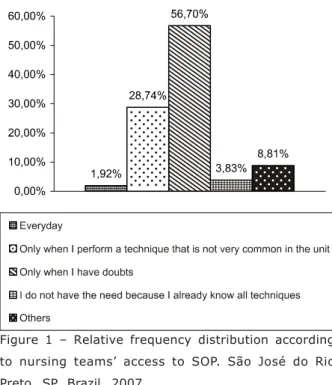
The frequency of access to SOP by the nursing
Figure 1 – Relative frequency distribution according
to nursing teams’ access to SOP. São José do Rio
Preto, SP, Brazil, 2007
In order to assure adequate standardization,
all professionals should be involved. Thus, we verified
how many believed the SOP was being complied with
and it was found that 54.02% of nursing auxiliaries
and technicians did not believe SOP was being followed
by the whole team. In the nurse category, 62.86%
reported they did not believe SOP was being followed
by all nursing professionals, as showed in Figure 2.
Figure 2 – Relative frequency distribution of the opinion
of nurses, nursing technicians and auxiliaries
regarding compliance with the SOP. São José do Rio
Preto, SP, Brazil, 2007
The reasons most mentioned by those
(44.44%) who believed SOP was being followed by
all nursing professionals were: need to clarify doubts,
because it is standardized, it is mandatory or is the
institution’s norm, it is instructed and demanded by
the nurse, because one depends on the manual to
perform the correct technique and also because they observe people using it.
The reasons presented by the remaining
55.56%, who did not believe the whole nursing team followed the manual, were: lack of time, the staff’s
reduced number and consequent work overload, lack
of employees’ interest, existence of habits of performing old and obsolete techniques, lack of
awareness or understanding of the importance of
standards, some “believe they know it all”, because it is easier to ask another professional or a nurse to
clarify doubts, due to lack of information or
dissemination of SOP among employees, many SOP manuals or techniques are outdated, lack of
encouragement or requirement by the service head,
laziness, many learn the wrong way and keep doing things the wrong way, difficult access to SOP, many
do what they consider easier and simpler and not
what is correct, lack of specific training, lack of necessary material described in the SOP.
According to the subjects’ observation
regarding changes of nursing techniques in their sector, 75.86% of the sample reported they perceived
some change and only 24.14% reported they did not notice any change. The average time of work in nursing
for the latter group was five years. The most
mentioned techniques that presented changes in their performance were: indwelling bladder catheterization
(asepsis, closed system, passage mode, fixation, aid
of other person), post-surgical bath, installation of central venous pressure, venous accesses
(heparinization, dwelling time), nurses’ private
techniques (installation of chemotherapy drugs, nasoenteral/nasogastric catheter passage, blood gas
collection), blood culture, installation of
intra-abdominal pressure, dressings (intracatheter- double lumen, used and humid product, use of gloves,
barrier), caring for the umbilical stump (cleansing,
open), medication administration and control of schedules, patient admission, evolution and discharge,
use of swab (catheter disinfection), parenteral diet,
use of equipment, material washing, hand washing, use of alcohol gel, mattress cleansing technique,
contact-isolation precaution, service system (integral
care), hemodialysis related procedures.
It was verified that the three studied hospitals
review and update the SOPs, one of them through a
specific committee, while the other two have it
Guerrero GP, Beccaria LM, Trevizan MA.
45,98%
37,14% 54,02%
62,86%
0,00% 10,00% 20,00% 30,00% 40,00% 50,00% 60,00% 70,00%
Nursing team Nurses
reviewed individually by nurses every six months,
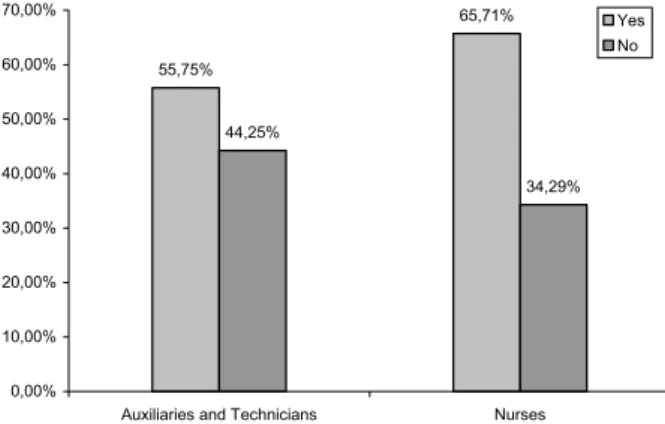
every year or when necessary. It was also verified that 55.75% of nursing auxiliaries and technicians
believe reviews are necessary and 65.71% of nurses
also report this need, as shown in Figure 3.
Figure 3 – Related frequency distribution of the opinion
of nurses, nursing technicians and auxiliaries
regarding the need to review the SOP. São José do Rio Preto, SP, Brazil, 2007
The main reasons appointed for reviewing
SOPs were: to update techniques because of constant changes; some SOPs differ from the sector’s reality,
they should be specific for each unit; absence of some techniques, especially newly adopted techniques in
the sector; to improve quality of care; due to outdated
techniques or techniques that are no longer performed. Also, it should be clearer, simpler, use pictures or
figures so as to encourage its use.
Regarding communication with the service
head on the need to changing SOPs, 87.74% reported they never talked to their superiors regarding this
need. It could be observed that most participants were somewhat afraid of proposing alterations and/or did
not see the need to communicate it because there are specific professionals to appoint this need and
they do not feel responsible for taking the initiative. The other 12.26% were asked how this communication
had occurred, that is, what had been the result, and
their answers were: changes are underway, SOP is under review, there was a meeting with no outcome,
awaiting answers, no changes so far, positive result after agreement among all nurses.
DISCUSSION
There is predominance of nursing auxiliaries
in this study, in line with the Brazilian reality. Estimates
from the Federal Nursing Council of Brazil (COFEN)
for the State of São Paulo until July 2007 indicate that
13.68% of nursing professionals were nurses, 9.94%
nursing technicians and 76.38% nursing auxiliaries(13). Many participants revealed a certain concern
and uncertainty when asked about compliance with
the SOP by the whole nursing team. It should be
stressed that the delivered care can be compromised
in case the team is not united. Teamwork requires
abilities to communicate, collaborate, understand each
other and think with others. Thus, if the team has
these abilities, it is possible to construct a common
care project, different team members can organize
their work, acknowledge the other’s work and
linkages(14).
It is important to highlight that several actions
mentioned by the nursing team can compromise
adequate care delivered to the client and,
consequently, the Nursing Code of Ethics, which states
in its article 21, regarding responsibilities and duties:
“Protect the person, family and community from harm
due to inexperience, neglect or imprudence of any
member of the Health Team”(15).
Thus, the real meaning of these concepts
should be clearly stated: inexperience refers to lack
of knowledge, technical training or ability to perform
a certain procedure, that is, lack of experience, which
can put patients at risk or cause them physical or
psychological harm. Neglect is the same as disregard,
carelessness, passiveness or omission, that is, one
who can or must act in a certain way and does not
due to idleness or laziness, either does not act or
behave in the opposite way one is expected to.
Imprudence stems from recklessness, lack of safety
and forethought, which exposes patients to
unnecessary risks and one does not attempt to
minimize such risks(16).
Therefore, it is essential that nursing
professionals expose inadequate work conditions and
are not collusive with professionals(16) who engage in
bad conduct. Also, as nurses are the leaders of nursing
teams and are responsible for putting care in practice,
they should be able to precisely and completely inform
patients regarding procedures performed for them
and with them(17). Individual behavior and performance can directly affect the quality of services. Thus, each
individual member of the team should clearly interpret
the characteristics and influence of his(er) work to
achieve quality(8).
55,75%
65,71%
44,25%
34,29%
0,00% 10,00% 20,00% 30,00% 40,00% 50,00% 60,00% 70,00%
Auxiliaries and Technicians Nurses
It is important to keep in mind that changes
in health organizations need evidence of effective
scientific results, besides a positive cost-benefit relation. Therefore, “every organization
simultaneously needs continuity and change, tradition
and innovation, of being and becoming.”(18).
Likewise, lack of knowledge is a component
of work alienation. Thus, one should never forget that
continuing education promotes personal and professional growth. It also supports change
processes, the adoption of participative management,
sharing of plans and decisions, the dissemination of knowledge and learning of new values(14), and
sensitizes people to their responsibility of
self-development.
There is little research on nursing
professionals’ quality of work, although it could be
observed in the analysis of changes in the quality of nursing care regarding some specific techniques that
the characteristics of health facilities, work conditions,
number of professionals, supervision and continuing education affect educational processes and,
consequently, the quality of care(19).
Additionally, no matter how technical a nursing activity may be, we can say that changes will
always happen if we take into account its reflexive character. Knowledge will never cease re-creation and
will indicate new alternatives of action, integrating
knowledge to action(5). One suggestion was to make SOP available on-line with free access for all health
professionals from any unit. Thus, it would be possible
to speed up its use and nursing care and also facilitate its update and review.
It should be reported that the “concept of
quality should be incorporated in the institution’s philosophy and also in the professionals’ political will”.
Moreover, every institution that aims to attend the
human being should be concerned with constant improvement of care, so that it can benefit from quality
care constructed through three dimensions: structure
(physical area, material resource, etc.), process (set of developed activities) and result (achievement of
desirable characteristics)(14).
The researchers also highlight that many
professionals seem not to feel at ease to express their ideas. However, freedom is an inseparable partner of
responsibility and implies that people have freedom to consider different situations they are presented
with, analyze favorable or non-favorable aspects and
make their own choice.
CONCLUSION
This study predominantly presented nursing
auxiliaries (83.91%), females (76.63%), between 20 and 40 years old (79.7%). It showed that SOP exists
at the three studied institutions; 100% know about its existence in their work unit and consider compliance
important; 95.4% have no difficulties understanding
it, but report difficulties in using it due to lack of time, absence of some procedures, difficulty understanding,
obsolete techniques, lack of required material. It was verified that 56.7% access the SOP
only when they have doubts; 54.02% of nursing technicians and auxiliaries and 62.86% of nurses do
not believe the whole team complies with the SOP;
75.86% report they perceived changes in its techniques; its review and update are performed
through a specific committee or individually by nurses and 55.75% of the nursing technicians and auxiliaries
and 65.71% of nurses highlight the need for revision. It is important to stress that, according to
the study results, the SOP aims to clarify doubts. However, neither this process nor continuing education
should be interrupted. Therefore, specific training on the SOP use is needed, with a view to a better
understanding of the reasons why not all professionals follow standardized techniques. Automated
performance of techniques is not desirable. On the
contrary, knowledge combined with action is essential, even in situations considered simple. Therefore,
professionals need to be engaged with care towards
common results, to be involved with the institution’s philosophy and to be able to cooperate and include
the whole team, so that they can participate in the
processes to improve care.
REFERENCES
1. Martins PG, Laugeni FP. Administração da produção. São Paulo: Saraiva; 1999.
2. Faraco MM, Albuquerque GL. Auditoria do método de assistência de enfermagem. Rev Bras Enferm. 2004;57(4):421-4.
3. Nogueira LCL. Gerenciando pela qualidade total na saúde. 4. ed. Belo Horizonte (MG): Editora de Desenvolvimento Gerencial; 2003.
4. Antunes AV, Trevizan MA. Gerenciamento da qualidade: utilização no serviço de enfermagem. Rev Latino-am Enfermagem 2000;8(1):35-44.
5. Schraiber LB, Peduzzi M, Sala A, Nemes MI, Castanhera ERL, Kon R. Planejamento, gestão e avaliação em saúde: identificando problemas. Ciênc Saúde Coletiva. 1999;4(2):221-42.
6. Silva VEF. Manuais de enfermagem. In: Kurcgant P, coordenadora. Administração em enfermagem. São Paulo: Editora Pedagógica e Universitária; 1991. p. 59-72. 7. Magalhães AMM, Duarte ERM. Tendências gerenciais que podem levar a enfermagem a percorrer novos caminhos. Rev Bras Enferm. 2004;57(4):408-11.
8. Silva SH. Controle da qualidade assistencial de enfermagem: implementação de um modelo [Tese]. São Paulo (SP): Escola de Enfermagem de Ribeirão Preto/USP; 1994. 9. Andrade JS, Vieira MJ. Prática assistencial de enfermagem: problemas, perspectivas e necessidade de sistematização. Rev Bras Enferm. 2005;58(3):261-5.
10. Carpenito LJ. Diagnóstico de Enfermagem e Planejamento do Cuidado. In: Carpenito LJ. Diagnóstico de Enfermagem: aplicação à prática clínica. 8. ed. Porto Alegre: Artmed; 2002. p. 68-91.
11. Monte ADAS, Adami NP, Barros ALBL. Métodos avaliativos da assistência de enfermagem em instituições hospitalares. Acta Paul Enferm. 2001;14(1):89-97.] 12. Marconi MA, Lakatos EM. Metodologia científica. 5. ed. São Paulo(SP): Atlas; 2008
13. Conselho Federal de Enfermagem [Página na internet]. Rio de Janeiro: Conselho Federal de Enfermagem; [Acesso em 2007 julho 17] Canal de informações portal COFEN: registro de profissionais com inscrição definitiva válida em 2007. Disponível em: http://www.portalcofen.com.br 14 . Kurcgant P, coordenadora. Gerenciamento em enfermagem. Rio de Janeiro: Guanabara Koogan; 2005. 15. Conselho Federal de Enfermagem [Página na internet]. Rio de Janeiro: Conselho Federal de Enfermagem; [Acesso em 2007 julho 05] Resolução Cofen nº 311/2007 - Código de Ética dos profissionais de Enfermagem; [1 tela] Disponível em: http://corensp.org.br/072005/legislacoes/anexos/ resolucao-cofen-311-2007-codigo-etica.pdf
16. Freitas GF, Oguisso T. Ocorrências éticas na enfermagem. Rev Bras Enferm. 2003;56(6):637-9.
17. Trevizan MA, Mendes IAC, Lourenço MR, Shinyashiki GT. Aspectos éticos na ação gerencial do enfermeiro. Rev Latino-am Enfermagem. 2002;10(1):85-9.
18. Erdmann AL, Mello ALSF, Meirelles BHS, Marino SRA. As organizações de saúde na perspectiva da complexidade dos sistemas de cuidado. Rev Bras Enferm. 2004;57(4):467-71.
19. Peduzzi M, Anselmi ML, França IJr, Santos CB. Qualidade no desempenho de técnicas dos trabalhadores de enfermagem de nível médio. Rev Saúde Pública. 2006;40(5):843-50.