The effect of educational interventions
on nursing team knowledge about
arterial hypertension
O EFEITO DE INTERVENÇÕES EDUCATIVAS NO CONHECIMENTO DA EQUIPE DE ENFERMAGEM SOBRE HIPERTENSÃO ARTERIAL
EL EFECTO DE INTERVENCIONES EDUCACIONALES EN EL CONOCIMIENTO DEL EQUIPO DE ENFERMERÍA SOBRE HIPERTENSIÓN ARTERIAL
* Excerpted from the Scientific Initiation Research Report “Caracterização do perfil e da ação profissional do Agente de Enfermagem de nível superior no Centro de Atenção Psicossocial”, Nursing School of the University of São Paulo, 2004. 1 Graduating in Nursing with the Nursing School of the University of São Paulo. Student under a Scholarship in the Scientific Initiation Program of CNPq. São Paulo, SP, Brazil. [email protected] Professor Doctor of the Maternal and Child
O
RIGINAL
A
R
TICLE
RESUMO
A hipertensão arterial é um dos principais fa-tores de risco para as doenças cardiovascula-res, sendo grande a responsabilidade da en-fermagem na atenção aos hipertensos. Obje-tivou-se, portanto, avaliar o conhecimento sobre hipertensão e seu tratamento com a equipe de enfermagem, antes e após onze intervenções educativas. Utilizou-se questio-nário abordando aspectos teóricos ligados ao conhecimento sobre hipertensão em enfer-meiros (5), técnicos (2), auxiliares (11) e agen-tes comunitários (37), de duas Unidades Bá-sicas de Saúde da cidade de São Paulo. Para análise estatística utilizou-se o teste T de Student, análise da variância e p<0,05. Verifi-cou-se aumento no conhecimento após as intervenções educativas para o grupo forma-do por enfermeiros, técnicos e auxiliares de enfermagem (84,6±12,0% vs 92,7±15,0%, p<0,05), enquanto que para agentes comu-nitários de saúde não houve mudança signi-ficante (80,8±12,2% vs 83,5±24,0%). Portan-to, conclui-se que as ações educativas foram efetivas e que devem ser implementadas jun-to à equipe de enfermagem, considerando que elas podem influenciar no aprimoramen-to da assistência às pessoas hipertensas.
DESCRITORES
Hipertensão. Enfermagem. Conhecimento.
Stael Silvana Bagno Eleutério da Silva1, Flávia Cortez Colósimo2, Angela Maria Geraldo Pierin3
ABSTRACT
Hypertension is one of the main risk fac-tors for cardiovascular diseases. Nursing carries a large responsibility in care deliv-ery to hypertensive individuals. Thus, the goal was to assess a nursing team’s knowl-edge on hypertension and its treatment before and after educational interventions. A questionnaire was used, addressing theo-retical aspects of hypertension knowledge among nurses (5), technicians (2), auxilia-ries (11) and community agents (37) at two Basic Health Units in São Paulo City, Brazil. For statistical analysis, Student’s T test was used, as well as variance analysis and p<0.05. A knowledge increase was verified after the educational interventions for the group constituted by nurses, technicians and nursing auxiliaries (84.6±12.0% vs. 92.7±15.0%, p <0.05), while no significant change occurred for community health agents (80.8±12.2% vs. 83.5±24.0%). Thus, it was concluded that the educational ac-tions were effective and must be put in practice in the nursing team, which they can influence the improvement of care deliv-ery for hypertensive patients.
KEY WORDS
Hypertension. Nursing. Knowledge.
RESUMEN
La hipertensión arterial es uno de los princi-pales factores de riesgo para las enfermeda-des cardiovasculares. Es grande la responsa-bilidad de la enfermería en la atención a los hipertensos. Se objetivó entonces evaluar los conocimientos sobre hipertensión y su trata-miento en el equipo de enfermería antes y después de once intervenciones educativas. Fue utilizado un cuestionario abordando as-pectos teóricos relativos al conocimiento so-bre hipertensión en enfermeros (5), técnicos (2), auxiliares (11) y agentes comunitarios de la salud (37) de dos Unidades Básicas de Sa-lud en la ciudad de São Paulo, Brasil. Para el análisis estadístico, fue aplicado el test T de Student, además de análisis de varianza y p<0,05. Se verificó un aumento en los cono-cimientos después de las intervenciones edu-cativas para el grupo formado por enferme-ros, técnicos y auxiliares (84,6±12,0% contra 92,7±15,0%, p<0,05), mientras que no se re-gistró cambio significativo para agentes co-munitarios de la salud (80,8±12,2% contra 83,5±24,0%). Por lo tanto, se concluyó en que las acciones educativas fueron efectivas y de-ben ser implementadas junto al equipo de en-fermería, considerando que ellas pueden in-fluir en el perfeccionamiento de la atención a las personas hipertensas.
DESCRIPTORES
INTRODUCTION
In primary care to arterial hypertension patients, health teams should pay special attention to the control problem, which in turn is closely related to the treatment adherence process. Particularly physicians, nurses, nursing technicians and auxiliaries should be properly advised about the par-ticularities of the disease and treatments to achieve better control of the disease.
In this context, a study(1 ) about physicians and nursing
teams’ knowledge showed that these categories did not fully master theoretical and practical knowledge about hyper-tension and blood pressure measurement. Another re-search in the same context(2 ) appointed that nurses and
nursing auxiliaries satisfactorily perform only 40% of steps in the blood pressure measurement. The health team’s lack of knowledge can interfere in primary care to hypertensive patients.
The nursing team plays an important role in working towards higher adherence rates to established health prac-tices for hypertensive patients. Nurses should work directly in health promotion, contributing to the early
diagnosis of the disease through routine blood pressure measurement and by advis-ing the team under their responsibility. After the installment of the disease, nurses should give advice on the benefits of medication and non-medication treatment, disease manage-ment and its complications when not con-trolled, as well as adherence to health lifestyles.
Unfortunately, the lack of control of hy-pertensive patients’ blood pressure levels has
been identified not only in Brazil(3 -4 ) but also
internation-ally(5 ). Therefore, all professionals working with these
pa-tients should work to change this reality. Another point that stands out is that nursing professionals should be techni-cally trained for blood pressure measurement and have sufficient knowledge about the theme.
When the multiprofessional team works together in care delivery to hypertensive patients, these actions favor their involvement in treatment, entailing greater control of blood pressure levels.
According to the V Brazilian Arterial Hypertension Guidelines(6 ), each multiprofessional team member plays a
defined role and performs specific actions. Nursing techni-cians and auxiliaries are subordinated to nursing supervi-sion. Thus, they need to be duly prepared and aware of the importance of working with hypertensive patients. The same document highlights that training and the motiva-tion that produces health professionals’ hypertension care actions are very important and cannot be neglected, but should be stimulated by health professionals, now playing the role of health educators in its full potential.
Primary care is considered hypertensive patients’ entry door into the health system, which can be facilitated by the Family Health Program’s actions. According to the Min-istry of Health(7 ), nurses play a fundamental role in the
Fam-ily Health Program, working in direct patient care delivery and supervising nursing professionals. In their work with nursing auxiliaries and community health agents, training and permanent supervision stand out.
The importance of nurses for hypertensive patients is re-lated to their role as educators, working in patient motivation for treatment adherence, self-care, proposing strategies that favor their involvement in the disease and treatment, besides training other nursing team professionals for activities that are within their competency area. Thus, considering the impor-tance of the nursing team’s work with hypertensive patients followed in primary care, this research aimed to compare the nursing team’s knowledge about arterial hypertension and its treatment before and after educative interventions.
METHOD
Data collection started after approval had been obtained from the São Paulo Municipal Research Eth-ics Committee under number 213/2003. This is a comparative, cross-sectional, exploratory and descriptive quantitative field research. Professionals who agreed to participate signed the Free and Informed Consent Term.
Cases
The study was presented to all nursing team members, totaling 103 professionals, at two Basic Health Units in the West of São Paulo City. The two units were chosen to put in practice a Public Health Policy project supported by the São Paulo State Research Foundation (Process No 03/06454-1). The units were homogeneous in terms of characteristics and number of nurs-ing team professionals. Study participants were 55 employ-ees: 5 nurses (9.1%), 2 technicians (3.6%), 11 auxiliaries (20%) and 37 community health agents (67.3%) who participated in the educative process and answered the pre-and post-educa-tive intervention assessment instrument. A large majority were women (90.9%); about half were up to 40 years old (50.9%); professionals who finished secondary education (67.3%) and with a personal revenue of less than three minimum wages (63.5%) predominated. Also, 41.9% mentioned they had never participated in courses about arterial hypertension.
The signing of the free and informed consent term and working at the basic health unit during the study period were set as inclusion criteria.
Data collection
For data collection, a questionnaire with 28 semistruc-tured questions was used, including closed and one open questions, addressing theoretical aspects related to
knowl-...[the] research aimed to compare the nursing
team’s knowledge about arterial hypertension and its treatment before and
edge about arterial hypertension, including the disease con-cept, normal blood pressure levels, treatment and patient orientations. The questionnaire was applied in the class-room available at the unit.
The first part of the questionnaire comprised general knowledge questions about hypertension, addressing con-cepts, chronicity of the disease and advice given to hyperten-sive patients, and was answered by all nursing team profes-sionals. Adaptations were made (use of less technical language and approach within the limits of professionals’ technical com-petency) to cover community health agents’ participation. The second part was for nurses, technicians and auxiliaries only, due to the specificity of their actions, and involved questions about blood pressure measurement, including the blood sure concept, sounds determining systolic and diastolic pres-sure (Korotkoff sounds), cuff size, manometer types, manom-eter calibration, patient and observer-related factors that can interfere in blood pressure measurement and care needed in the blood pressure measurement. Knowledge was assessed through the percentage of correct answers before and after the educative interventions, according to the participants’ cat-egories: category 1 for community health agents and category 2 for nurses, nursing technicians and auxiliaries.
Educative interventions took place every 15 days and took one hour and a half each (total hour load 16.5h), to-taling 11 meetings in six months. The employees partici-pated in the meetings after they had ended their work shift. At least two different times were available to cover all par-ticipants. The categories participated together and received the same contents, but the language was adapted so that
all could understand the subject equally. Each category’s competences were highlighted in accordance with the dis-cussion of the themes, detailing what was expected from each professional in work with hypertensive patients. The researchers prepared and presented the classes, using me-dia and practical classes when necessary. The first assess-ment took place after the first intervention and then sec-ond 15 days after the last educative interventions and, on the average, six months after the first assessment. The ad-ministered contents addressed concepts related to the dis-ease and treatment, besides epidemiological data to clarify the extent of the arterial hypertension problem. Interac-tive classes in simple language allowed the professionals to participate at any time. Statistical Package for Social Sci-ences (SPSS) software version 7.5 was used for statistical data analysis, for which the help of a statistics advisor was sought. Descriptive discriminating variables are presented in tables with absolute (n) and relative frequencies (%) and, for continuous data, averages and standard deviations were calculated. Significance was set at p<0.05.
RESULTS
Data in Table 1, 2 and 3 show the comparison between community health agents (category 1) and nurses, nursing technicians and auxiliaries’ (category 2) knowledge, shown by the percentage of correct answers to questions about arterial hypertension knowledge, treatment and blood pres-sure meapres-surement for each category before and after the educative process.
Table 1 - Knowledge about arterial hypertension and treatment, among community health agents (category 1), nurses, nursing technicians and auxiliaries (category 2), before and after educative interventions - São Paulo - 2008
Educative Interventions
Knowledge about the disease and treatment
Pre Post
Category 1 (n=37)
Category 2 (n=18)
Category 1 (n=37)
Category 2 (n=18)
N % N % N % N %
Arterial hypertension in adults is
>120x100 mmHg 4 10.8 1 5.5 0 0 0 0 > 140x90 mmHg 18 48.6 10 55.5 29 78.4* 15 83.3 > 130x90 mmHg 12 32.4 5 27.7 7 18.9 3 16.7 Depends on age 3 8.2 2 11.1 1 2.7 0 0
Arterial hypertension is a disease that is
Chronic. progressive-degenerative and affects the kidneys 1 2.7 0 0 0 0 0 0 Chronic. progressive-degenerative and affects the heart 8 21.6 1 5.5 2 5.4 0 0 Chronic. progressive-degenerative and affects the brain 1 2.7 0 0 1 2.7 0 0 All alternatives are correct 27 73.0 17 94.4 34 91.9 18 100
In hypertension treatment
Treatment can be interrupted when the pressure is controlled 5 13.5 1 5.5 1 2.7 0 0 Medication and/or non-medication measures can be used 30 81.1 17 94.4 33 89.2 18 100 Medication for blood pressure control show no unwanted effects 1 2.7 0 0 1 2.7 0 0 Not many drugs are available for blood pressure control 1 2.7 0 0 1 2.7 0 0
Guidance provided
Data in Table 1 show that, despite a percentage increase in all participants’ knowledge after the educative process, this increase was statistically significant on the question that as-sessed blood pressure levels that characterize the limit for ar-terial hypertension only. In this item, category 1 professionals stood out (48.6% vs78.4%, p<0.05). It should be highlighted that, on the questions that assessed the complications hyper-tensions can cause, including damage to target organs like the heart, brain and kidneys, besides questions related to medica-tion and non-medicamedica-tion treatment, even in the phase before
the educative process, correct answer percentages were al-ready high and all exceeded 70%. The same was not observed in the assessments that included different orientations about the disease and treatment, with hardly satisfactory and even below average levels, mainly in the community health agent category. On the question about the hypertension concept, although the increase in the correct answer percentage was not statistically relevant, it is noteworthy that community health agents increased from 48.6% to 78.4% and nurses, nurs-ing auxiliaries and technicians from 55.5% to 83.3%.
Table 2 - Percentage of correct answers by Nurses, Nursing Technicians and Auxiliaries (category 2) on specific questions about hypertension and pressure measurement, pre and post-educative interventions - São Paulo - 2008.
Appearance of loudest sound and thumping of sounds (Korotkoff Phases II and IV, respectively).
Does not change the blood pressure level.
The maintenance and evaluation frequency of blood pressure measurement devices should be Variables
Knowledge about blood pressure measurement
Maximum and minimum blood pressure are called, respectively
Systolic, when the blood is pumped out of the heart chambers, and Diastolic, when the heart chambers are filled with blood.
Diastolic, when the blood is pumped out of the heart chambers, and Systolic, when the heart chambers are filled with blood.
Systolic, when the heart chambers are filled with blood and Diastolic, when the blood is pumped out of the heart chambers.
Diastolic, when the heart chambers are filled with blood and Systolic, when the blood is pumped out of the heart chambers.
Systolic and diastolic blood pressure are defined, respectively, by
Appearance of loudest sound and muting of sounds (Korotkoff Phases II and V, respectively).
Appearance of first regular sound and thumping of sounds (IV de Korotkoff Phases I and IV, respectively). Appearance of first regular sound and muting of sounds (Korotkoff Phases I and V, respectively).
The width and length of the cuff's rubber bag should correspond, respectively, to the following dimensions of the patient's arm circumference
20%; encircle at least 70% of the patient's arm. 40%; encircle at least 80% of the patient's arm. Encircle at least 60% of the patient's arm. None of the alternatives is correct.
A very narrow cuff for the patient's arm can cause
False elevation of blood pressure levels. False decrease in blood pressure levels.
Elevation of systolic pressure and decrease of systolic pressure.
A very wide cuff for the patient's arm can cause
Decrease of systolic pressure and increase of diastolic pressure. False increase of blood pressure levels.
False decrease of blood pressure levels. Does not change the blood pressure level.
The blood pressure measurement manometer that is more difficult to get uncalibrated is
Aneroid Mercury column Electronic Does not matter 6 to 12 months 12 to 18 months 18 to 24 months 24 to 30 months
N % N %
Category 2
Pre-intervention
Post-intervention
2 11.1 14 77.8* 2 11.1 0 0 13 72.2 3 17.0
1 5.5 1 5.5
3 16.7 6 33.3 4 22.2 4 22.2 6 33.3 3 16.7 5 27.8 5 27.8 1 5.5 2 11.1 10 55.5 13 72.2 4 22.2 0 0 3 16.7 3 16.7 7 38.9 13 72.2 3 16.7 4 22.2 2 11.1 1 5.5 6 33.3 0 0 2 11.1 1 5.5 8 44.4 5 27.8 6 33.3 12 66.7 2 11.1 0 0 10 55.5 2 11.1
7 38.9 14 77.8 1 5.5 2 11.1
0 0 0 0
18 100 18 100
0 0 0 0
0 0 0 0
0 0 0 0
The results shown in Table 2 evidence a statistically sig-nificant increase in the percentage of correct answers for the question about maximum and minimum blood pressure only (11.1% vs77.8%, p<0.05). On the question about the sounds that identify systolic and diastolic pressure (appearance of first regular sound and muting of sounds, respectively), the percentage of correct answers remained unchanged (27.8% vs 27.8%). As for the fact that cuff width should correspond to 40% of the patient’s arm circumference and that the length should involve at least 80% of the arm, most participants gave the correct answer, even before the educative inter-ventions (55.5% pre vs 72.2% post). The same was not ob-served for answers about a narrow cuff causing a false rise in blood pressure (38.9% pre vs 72.2% post) and a wide cuff causing a decrease in blood pressure (33.3% pre vs66.7% post). In this respect, the majority gave the correct answer after the educative interventions only. This fact was repeated
on the item that assessed that the manometer with the low-est chance of getting uncalibrated is the mercury manom-eter (38.9% vs 77.8%). All participants correctly indicated that blood pressure measurement devices should be evaluated every six to 12 months (100% vs 100%).
In Table 3, the results show a statistically significant in-crease in nurses, nursing technicians and auxiliaries’ knowl-edge (category 2) about the item related to the need to measure the patient’s arm circumference before measur-ing blood pressure (38.9% vs77.8%, p<0.05). On the other items assessed in this question, a large majority gave more than 70% of correct answers about care before the blood pressure measurement. When assessing patient-related factors interfering in the pressure measurement before the educative process, the percentage of wrong answers, choos-ing the alternative all alternatives are correct stood out.
Table 3 - Percentage of correct answers by Nurses, Nursing Technicians and Auxiliaries (category 2) on specific questions about preparing the patient for blood pressure measurements and factors interfering in the measurement, pre and post-educative interventions - São Paulo - 2008
Patient-related factors that can interfere in the measurement
Observer-related factors that can interfere in the measurement
Position of observer's eyes towards the mercury column or aneroid manometer display.
Ask the patient not to talk during the blood pressure measurement.
Knowledge about preparation and factors interfering in blood pressure measurement
Previous rest Full bladder
Food or alcoholic beverage intake All answers are correct
Preference for figures ending in “0” or “5” to record blood pressure levels. Patient-observer interaction.
All answers are correct
Care before the measurement
Measure patient's arm circumference. Explain the procedure to the patient.
Ask the patient to rest for at least 5 minutes in a calm environment. Avoid that the patient has a full bladder.
Guarantee that the patient did not exercise between 60 and 90 minutes before the measurement. Guarantee that the patient did not consume alcoholic beverages, coffee or food and did not smoke 30 minutes earlier.
Keep the patient's legs uncrossed, feet on the floor, back against the chair and relaxed. Remove clothes from the arm where the cuff will be placed.
Place the arm at the height of the heart, support, with the hand palm upwards and the elbow slightly bent.
Place the cuff about 2 to 3 cm above the cubital fossa. Check if the manometer has been calibrated.
Estimate the systolic level by palpating the radial pulse and inflating the cuff until the pulse disappears and then rapidly deflate.
After the above procedure, wait for 1 minute and measure the blood pressure.
Variables
5 27.8 1 5.5 3 16.7 1 5.5 12 66.7 0 0
0 0 16 88.9 6 33.3 3 16.7 2 11.1 1 5.5 7 38.9 1 5.5 5 27.8 13 72.2 7 38.9 14 77.8* 10 55.5 17 94.4 15 83.3 15 83.3 12 66.7 15 83.3 12 66.7 17 94.4 11 61.1 16 88.9 15 83.3 17 94.4 16 88.9 17 94.4 16 88.9 15 83.3 17 94.4 16 88.9 17 94.4 17 94.4 16 88.9 17 94.4 13 72.2 16 88.9 9 50 13 72.2
N % N %
Category 2
Pre-Intervention
Post-Intervention
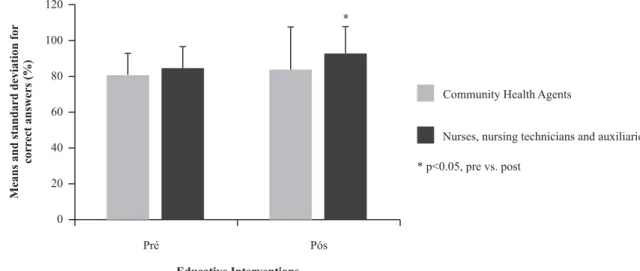
The comparison between the average number of cor-rect answers pre and post-educative interventions in each category, shown in Figure 1, evidenced a statistically sig-nificant increase in the nurses, nursing technicians and
aux-iliaries group (84.61±12.09 vs 92.73±15.03, p<0.05), but no modification for the community health agents (80.8±12.2 vs 83.5±24.0, p>0.05).
Pré Pós
Educative Interventions
Means
and
standard
deviation
for
corr
ect
answers
(%)
120
100
80
60
40
20
0
Community Health Agents
Nurses, nursing technicians and auxiliaries
*
* p<0.05, pre vs. post
Figure 1 - Comparison between mean correct answers by Community Health Agents (category 1) and Nurses, Nursing Technicians and Auxiliaries (category 2) in assessments pre and post-educative interventions - São Paulo - 2008
DISCUSSION
The main finding in this study evidenced that, after edu-cative interventions, a relevant knowledge increase oc-curred for nurses, nursing technicians and auxiliaries, but no modification for community health agents, which did remain above 80% though. This increase may be due to these professionals’ large participation and greater diligence during meetings. Nursing team professionals’ systematic training is important, as it allows them to transfer the knowl-edge they acquired to their actions involving patients. Ar-terial hypertension is a chronic disease that demands treat-ment during the lifetime. Therefore, continuous follow-up of hypertensive patients should be the target of nursing actions, with a view to maintaining the disease under con-trol and offering them conditions to achieve this.
Although the main result was favorable, weaknesses were identified in the nursing team’s knowledge involving care delivery to hypertensive patients. When assessing pressure levels that characterize the disease among community health agents, less than half had correct knowledge, which was no longer the case after the educative interventions. Among nurses, nursing technicians and auxiliaries, the correct an-swer level was slightly higher, but without any statistically relevant change. These findings support literature findings that show that hardly satisfactory knowledge is not a nov-elty in the context of care delivery to hypertensive patients. A Brazilian study involving physicians, nurses and nursing auxiliaries, about knowledge related to theoretical and prac-tical contents on blood pressure measurement showed that nursing auxiliaries possessed the lowest knowledge level(1).
In the same sense, another research among health profes-sionals revealed similar findings(1 ).
Another finding that stood out was that less than half of the community health agents indicated that they advised patients about lifestyle changes, the disease and adherence to antihypertensive treatment. As participants in the nurs-ing team who act under the nurse’s supervision, commu-nity health agents should be better prepared to advise hy-pertensive patients, as they have routine contact with them during their home visits. Research involving community health agents highlight that they lack the knowledge needed to perform everything they are expected to do(2 -3 ). Thus,
they end up working based on common sense and more rarely on knowledge. In the same sense, it is highlighted that, in professional education for family health, greater investments have been made in university education for physicians and nurses. In primary care, there is a large field for the development of educative actions and counseling, for which professionals need adequate skills. Moreover, when community health agents participate in thematic dis-cussions, these are conducted by physicians or nurses, who use traditional knowledge contents, with difficulties to cover the comprehensive goal of the Family Health Program, that is, each individual team member’s activities. In daily real-ity, it is expected that, during their visits, agents cease to act as mediators between the Basic Health Unit and the patient and start to give patients advice about subjects they are not properly trained for. In this sense, a study(4 ) has
pre-ponderant role in motivating hypertensive patients to get more involved in their treatment and, consequently, achieve better control of the disease.
In addition, there is the fact that hypertension is often diagnosed casually.
This attitude is related to the clients’ lack of adequate health promotion practices, that is, they habitually turn to health services for complaints, but rarely as a prevention measure. For clients to incorporate this conduct into their daily reality, the health team and particularly nurses needs to act in a comprehensive and interdisciplinary way, as nurses are trained to be health educators; through the development of health education actions, aiming to create awareness about the search for and maintenance of health(5).
As to the questions aimed for nurses, technicians and auxiliaries only, correct answer percentages increased af-ter the educative inaf-terventions, underlining the importance of the educative process. The understanding about systolic and diastolic blood pressure increased significantly after the educative process. Learning is a modification of acquired knowledge. A better comprehension of the arterial hyper-tension theme is expected to entail better care delivery to hypertensive patients and, thus, an increasingly substan-tial improvement in their pressure levels(7).
With regard to knowledge about care before the blood pressure measurement, it was noteworthy that, during the pre-intervention assessment, a minority marked an item as important as the patient’s arm circumference to select the adequate cuff size. After the educative process, the number of times this care was marked increased signifi-cantly, evidencing the importance of this step in the pro-cedure. The blood pressure measurement technique con-tains details that, if omitted, can lead to an underestima-tion or overestimaunderestima-tion of pressure levels, which can lead to a wrong hypertension diagnosis and, consequently, in-adequate treatment. These data reveal that most nursing
professionals still do not properly value the standardized performance of the blood pressure measurement proce-dure, in accordance with Brazilian(6) and international
rec-ommendations(6 ).
Assessing the nursing team’s basic knowledge on arte-rial hypertension is important for these professionals to know their theoretical and practical weaknesses and seek training so as to practice their profession more competently. With regard to care delivery to hypertensive patients, knowl-edge improvements can lead to better care, favoring pa-tients’ greater treatment adherence. Therefore, all nursing team categories need to get involved. All professionals should become educators. When patients acknowledge good care and concern with their disease, they tend to par-ticipate in the educative activities the unit proposes, which can lead to a better control of their pressure levels.
CONCLUSION
Arterial hypertension prevalence levels are high in Bra-zil and the disease constitutes one of the main risk factors for cardiovascular diseases, which in turn rank first in the morbidity and mortality profile. Particularly in primary care, nursing plays a Paramount role in all steps of the diagnosis and treatment, mainly with regard to patients’ treatment adherence, which remains a big challenge for all profes-sionals involved in primary care to hypertensive patients. Thus, nursing team members need tools that enable them to perform this care and retaining the knowledge permeat-ing the problem is a fundamental startpermeat-ing point in the pro-cess. This research is limited by its regional nature and by the fact that not all employees participated at the units in-volved. Nevertheless, it revealed the benefits for nurses, nursing technicians and auxiliaries and community health agents’ knowledge, indicating that a systematic educative process can improve these professionals’ knowledge, which can contribute to a change in the care panorama.
REFERENCES
1. Rabello CCP, Pierin AMG, Mion Junior D. O conhecimento de profissionais de saúde sobre a medida da pressão arterial. Rev Esc Enferm USP. 2004;38(2):127-34.
2. Veiga EV, Nogueira MS, Cárnio EC, Marques S, Lavrador MAS,
Moraes AS, et al.Avaliação de técnicas da medida da pressão
arte-rial pelos profissionais de saúde. Arq Bras Cardiol. 2003;80(1):83-8.
3. Pierin AMG, Strelec MAAM, Mion Júnior D. O desafio do con-trole da hipertensão arterial e a adesão ao tratamento. In: Pierin AMG, coordenadora. Hipertensão arterial: uma proposta para o cuidar. Barueri: Manole; 2004. p. 275-89.
4. Mano GMP, Pierin AMG. Avaliação de pacientes hipertensos acompanhados pelo Programa de Saúde da Família em um Centro de Saúde Escola. Acta Paul Enferm. 2005;18(3):269-75.
5. American Hearth Association Statistics Committee and Stroke Statistics Subcommittee. Heart Disease and Stroke Statistics – 2008 Update: a report. [cited 2008 Apr 20]. Available from: www.circ.ahajournals.org
6. Sociedade Brasileira de Cardiologia. V Diretrizes Brasileiras de Hipertensão Arterial [texto na Internet]. São Paulo; 2006. [ci-tado 2008 jul. 7]. Disponível em: http://www.sbn.org.br/Dire-trizes/V_Diretrizes_Brasileiras_de_Hipertensao_Arterial.pdf
8. Arcuri EM, Araújo TL, Veiga EV, Oliveira SMJ, Lamas JLT, Santos JLF. Medida da pressão arterial e a produção científica de en-fermeiros brasileiros. Rev Esc Enferm USP. 2007;41(2):292-8.
9. Silva JA. O Agente Comunitário de Saúde do Projeto QUALIS: agente institucional ou agente de comunidade? [tese na Internet]. São Paulo: Faculdade de Saúde Pública, Universida-de Universida-de São Paulo; 2001. [citado 2008 jul. 7]. Disponível em: http:/ /www.bvs-sp.fsp.usp.br/tecom/docs/2001/sil001.pdf
10. Silva JA, Dalmaso ASW. O agente comunitário de saúde e suas atribuições: os desafios para os processos de formação de recursos humanos em saúde. Interface Comum Saúde Educ. 2002;6(10):75-83.
11. Lima LPM, Gazetta CE. Análise do programa de controle da hipertensão arterial em uma unidade básica de saúde da fa-mília de São José do Rio Preto. Arq Ciênc Saúde. 2007;14(2): 88-94.
12. Santos ZMSA, Frota MA, Cruz DM, Holanda SDO. Adesão do cliente hipertenso ao tratamento: análise com abordagem interdisciplinar. Texto Contexto Enferm 2005;14(3):332-40.