SUMMARY
Objective: To study children and adolescents victims of domestic violence treated at the Referenced Pediatric Emergency Unit of the Hospital de Clínicas of the Universidade Estadual de Campinas and its specialized outpatient clinic between January 2003 and December 2007, emphasizing sexual abuse. Methods: he variables gender, age, origin, and classiication were studied. For victims of sexual abuse, the following variables were also studied: type of abuse (rape), location (domestic/urban), duration (acute/chronic), perpetrator (known, incestuous), alterations at medical examination, notiication to child protection agencies, and antiretroviral medication and serology (HIV, syphilis, hepatitis B and C). Patients were divided into two groups according to the type of abuse and type of perpertrator and they were associated with gender, age, and duration. For the comparison, chi-squared or Fisher’s exact test were performed (signiicance p < 0.05), as well as raw prevalence odds ratio. Results: Of the total cases of abuse (551), neglect (33.9%) and sexual abuse (31.9%) predominated; the victims were female in 55.9% of the cases, and 50% were up to 5 years of age. Of the sexual abuse cases (95), 80% were female, and 58.9% were between 5 and 10 years of age. Rape was observed in 39% and indecent assault in 59.6%; 72.6% occurred in the domestic area, 81.1% by known perpetrator; 31.6% were incestuous, 47.4% were chronic, and 76.5% had no clinical alterations. 81.1% were referred to child protection agencies. Antiretroviral medication was prescribed to 49.1% of patients, and serological tests (HIV in 46 [48.4%], syphilis in 42 [44.2%], hepa-titis B in 44 [46.3%] and hepahepa-titis C in 45 [47.4%]%), all of which were negative, were more frequent in rape victims (p = 0.00). here was an association between rape and age (10 and 15 years, p = 0.01) and between incestuous perpetrator and chronic duration (p = 0.01). Conclusion: Although this study does not relect reality, it can be used as a warning to pediatricians.
Keywords: Childhood maltreatment; child abuse; neglect; sexual violence.
©2012 Elsevier Editora Ltda. All rights reserved. Study conducted at Faculdade
de Ciências Médicas da Universidade Estadual de Campinas (FCM – UNICAMP), Departament of Pediatrics, Campinas, SP, Brazil
Submitted on: 02/13/2012
Approved on: 04/11/2012
Correspondence to: Mariana Porto Zambon Rua Botafogo, 151/491 Campinas – SP, Brazil CEP: 13104-064 Phone: +55 (19) 3788-7023 +55 (19) 3258-5150 [email protected]
Conflict of interest: None.
Domestic violence against children and adolescents: a challenge
MARIANA PORTO ZAMBON1, ANTONIO CARVALHODE ÁVILA JACINTHO2, MICHELLE MARCHIDE MEDEIROS3, RACHEL GUGLIELMINETTI3,
DENISE BARBIERI MARMO1
1PhD, Department of Pediatrics, Faculdade de Ciências Médicas da Universidade Estadual de Campinas (FCM – UNICAMP), Campinas, SP, Brazil 2ChildPsychiatrist, Department of Medical Psychology and Psychiatry, FCM – UNICAMP, Campinas, SP, Brazil
INTRODUCTION
For centuries, children and adolescents have been victims of violence around the world. However, only since 1962, when the “battered child syndrome” was described by American pediatrician C. Henry Kempe, has maltreatment of children and adolescents become a widely recognized fact1. Since
then, several national and international conventions have been proposed in order to protect this population.
Violence against children and adolescents, a current is-sue of extreme importance, has acquired alarming propor-tions, becoming a serious public health problem. In Bra-zil, it started to receive greater attention from authorities in the late 1980s, due to the promulgation of the Federal Constitution, in 1988, and of the Child and Adolescent Statute (ECA) in 1990. he law mandates the reporting of suspected or conirmed cases, establishing penalties for doctors, teachers, and those responsible for the health and education institutions that fail to notify the fact2,3.
Most deinitions of maltreatment incorporate two key elements: evidence of harmful behavior towards the child and presence of damage resulting from such conduct. he abuse may be committed by omission, suppression, or transgression of the rights of the child or adolescent, as deined by sociocultural norms and legal conventions4,5.
Experiences of violence occurring during childhood are likely to interfere signiicantly in the future develop-ment of the child, with results ranging from maladaptive behaviors and emotional deicits, to severe mental disor-ders such as impulsive behavior, hyperactivity disorder, learning problems at school, as well as behavior disorders and substance abuse in adolescence6-8.
Some factors have been associated with the occur-rence of child maltreatment, such as unfavorable social conditions (poverty, promiscuity, medical and social sup-port deicits, unemployment, bad housing conditions), families with economic hardship, dysfunctional family relationships, separated parents, low parental education level, families in which abusive or neglectful parents were abused or neglected in childhood, parents (or guardians) who are drug users or have other psychiatric disorders (personality disorders, depression, psychosis, etc.), besides the so-called childhood vulnerability factors, such prema-ture birth, mental retardation, male gender, adoption, and living in shelters or compulsory detention system6-9.
Notiication of cases of violence against children and adolescents is still scarce, which complicates their quan-tiication and, therefore, the knowledge of the true extent of the problem7. Several factors are associated with this
scarcity. Among these, the diiculty in diagnosis, which should be simpliied and standardized by screening meth-ods, and the “wall of silence”7, especially in cases
perpe-trated in the family environment, the most frequent site of violence must be highlighted.
In the city of Campinas, there was a progressive increase in reported cases of domestic violence afecting children and adolescents ater the creation of “Project Iluminar – caring for victims of sexual violence”, a network of service, training and reporting of cases for both genders and all age groups, and the implementation of the Violence Reporting System (Sistema de Notiicação de Violência – SISNOV) in 200510. he Referenced Pediatric Emergency Unit (Uni-
dade de Emergência Referenciada Pediátrica – UERP) of the Hospital de Clínicas of the Universidade Estadual de Campinas (HC – UNICAMP), is one of the services in the Campinas’ Iluminar network. his unit, in addition to providing emergency care to children and adolescents victimized by violence, became the starting point, and also stimulating agent, of better systematic notiication of these cases.
Ater the initial evaluation, the sexual abuse victims are referred to specialized outpatient care at the Violence Against Children and Adolescents Outpatient Clinic (Ambulatório de Violência Contra a Criança e o Adoles-cente – VCCA), focusing on pediatric and psychiatric care in addition to the support given by the unit’s social worker.
herefore, this study aimed to assess children and ado-lescents treated in this unit for domestic violence in the period of 2003 to 2007, with special attention to those who sufered sexual abuse, due to its greater impact.
METHODS
All children and adolescents with a diagnosis of domestic violence treated at UERP HC – UNICAMP, between Janu-ary 2003 and December 2007 and subsequently followed at the VCCA outpatient clinic, both linked to the Project Iluminar Campinas, were evaluated (opened in 2000).
he following epidemiological data were analyzed for all patients with a diagnosis of domestic violence: gender, age, origin, and classiication of violence, obtained from medical records. Violence was classiied according to the guidelines of the Brazilian Society of Pediatrics, 200111, as: physical
abuse, sexual abuse, psychological abuse, and neglect. Speciically for children and adolescents with a di-agnosis of sexual violence, the medical records were re-viewed, as well as SISNOV data. Data were recorded on a standardized form for clinical variables: type of sexual abuse (rape or not), location (domestic or urban), dura-tion (acute or chronic), perpetrator (known or not; in-cestuous or not), presence of alterations at physical ex-amination, child protection agency notiication, need for antiretroviral medication, and serological tests per-formed (HIV, syphilis, hepatitis B and C).
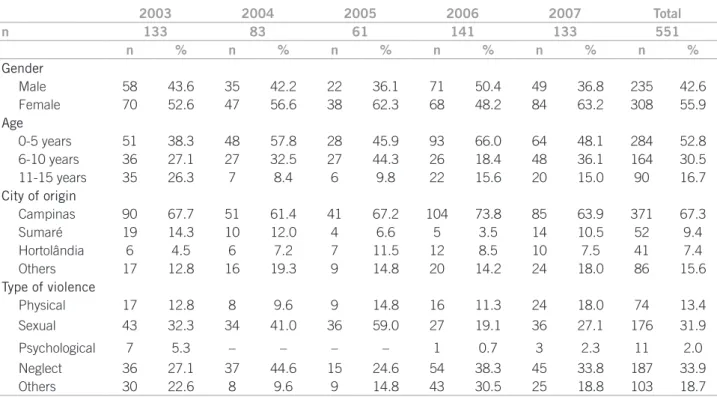
Table 1 – Distribution of cases of domestic violence between 2003 and 2007 treated at HC – UNICAMP divided according to: gender, age, origin and type of violence
from SISNOV, 64 from charts of HC – UNICAMP and 29 from both.
Regarding the type of sexual abuse, rape was con-sidered when vaginal or anal penetration or oral sex oc-curred, according to the legal modiications sanctioned by the President of Brazil in August 2009 and published in the Oicial Gazette on August 10 of that year. he new wording of article 213 of the Penal Code, which deines rape, became: “to constrain someone by violence or seri-ous threat, to have sexual intercourse or to practice or al-low the practice of other lewd acts with him/her”12.
With respect to the perpetrator, he/she was considered known if the victim or the family knew who the perpetra-tor was. If the perpetraperpetra-tor was related by blood, the act was considered incestuous.
Patients were divided in two groups with regard to the type of sexual abuse, rape or not; and according to the perpetrator, incestuous or not; and associated with gender, age, and acute or chronic duration.
he data were computed in a clinical ile and is pro-cessed using the SPSS-16.0 sotware (SPSS Inc. – Chica-go, IL, USA). For comparison between groups, the chi-squared or Fisher’s exact test were used, according to the variable studied. he crude prevalence odds ratio (POR) and its 95% conidence interval (95%CI) were also deter-mined, using Epi Info. Results were considered statistically signiicant when p <0.0513.
he study was approved by the Ethics Committee of Universidade Estadual de Campinas, under protocol No. 831/2009.
RESULTS
Between the years 2003 and 2007, 551 cases of vio-lence against children and adolescents were treated at HC – UNICAMP, including physical (13.4%), sex-ual (31.9%), and psychological (2.0%) abuse; neglect (33.9%); and undeined (18.7%). Of the total, 55.9% were females, with up to 17 years of age (mean = 5.75, SD = 4.18) 50% up to ive years of age, and most from the city of Campinas (67.3%) (Table 1).
Of the 95 assessed children and adolescents suspected of being victims of sexual abuse, 80% were females, aged up to 14 years (mean = 7.26, SD = 2.98), with 56.8% aged between 5 and 10 years, 23.2% younger than 5 years, and 20.0% older than 10 years. Most of them (58.9%) lived in Campinas and other cities of the region. According to the type of sexual violence, 39% of the cases were charac-terized as rape (22.1% vaginal, 13.7% anal, and 3.2% oral sex), 59.57% indecent exposure, and only two cases were deined as sexual harassment. Most cases (72.6%) occurred in the domestic area, 81.1% by a known perpetrator, and 31.6% by an incestuous perpetrator.
Regarding the duration of the sexual abuse, 47.4% of cases were considered chronic and the physical examina-tion descripexamina-tion of 51 patients was considered normal in 76.5%. Child Protection Services were called in most cases (81.1%). he use of antiretroviral medication was consid-ered for 55 patients, and the use of medication was indicat-ed for almost half of them (49.1%). Regarding serological tests, HIV testing was performed in 46 (48.4%) children and adolescents, syphilis in 42 (44.2%), hepatitis B in
2003 2004 2005 2006 2007 Total
n 133 83 61 141 133 551
n % n % n % n % n % n %
Gender
Male 58 43.6 35 42.2 22 36.1 71 50.4 49 36.8 235 42.6
Female 70 52.6 47 56.6 38 62.3 68 48.2 84 63.2 308 55.9
Age
0-5 years 51 38.3 48 57.8 28 45.9 93 66.0 64 48.1 284 52.8
6-10 years 36 27.1 27 32.5 27 44.3 26 18.4 48 36.1 164 30.5
11-15 years 35 26.3 7 8.4 6 9.8 22 15.6 20 15.0 90 16.7
City of origin
Campinas 90 67.7 51 61.4 41 67.2 104 73.8 85 63.9 371 67.3
Sumaré 19 14.3 10 12.0 4 6.6 5 3.5 14 10.5 52 9.4
Hortolândia 6 4.5 6 7.2 7 11.5 12 8.5 10 7.5 41 7.4
Others 17 12.8 16 19.3 9 14.8 20 14.2 24 18.0 86 15.6
Type of violence
Physical 17 12.8 8 9.6 9 14.8 16 11.3 24 18.0 74 13.4
Sexual 43 32.3 34 41.0 36 59.0 27 19.1 36 27.1 176 31.9
Psychological 7 5.3 – – – – 1 0.7 3 2.3 11 2.0
Neglect 36 27.1 37 44.6 15 24.6 54 38.3 45 33.8 187 33.9
Table 2 – Distribution of clinical characteristics (gender, age range, origin, type of abuse, location, perpetrator, alteration at physical examination, use of medication and serological tests) of 95 children and adolescents treated at HC – UNICAMP between 2003 and 2007, with a diagnosis of sexual abuse
44 (46.3%), and hepatitis C in 45 (47.4 %); all results were negative (Table 2). In patients who were victims of rape, the collection of serological tests and the start of antiretro-viral therapy was statistically signiicant (p = 0.00).
When comparing the groups, there was no associa-tion in relaassocia-tion to age group among those with suspected rape, being more frequent in adolescents aged between 10 and 15 years (p = 0.01) (Table 3).
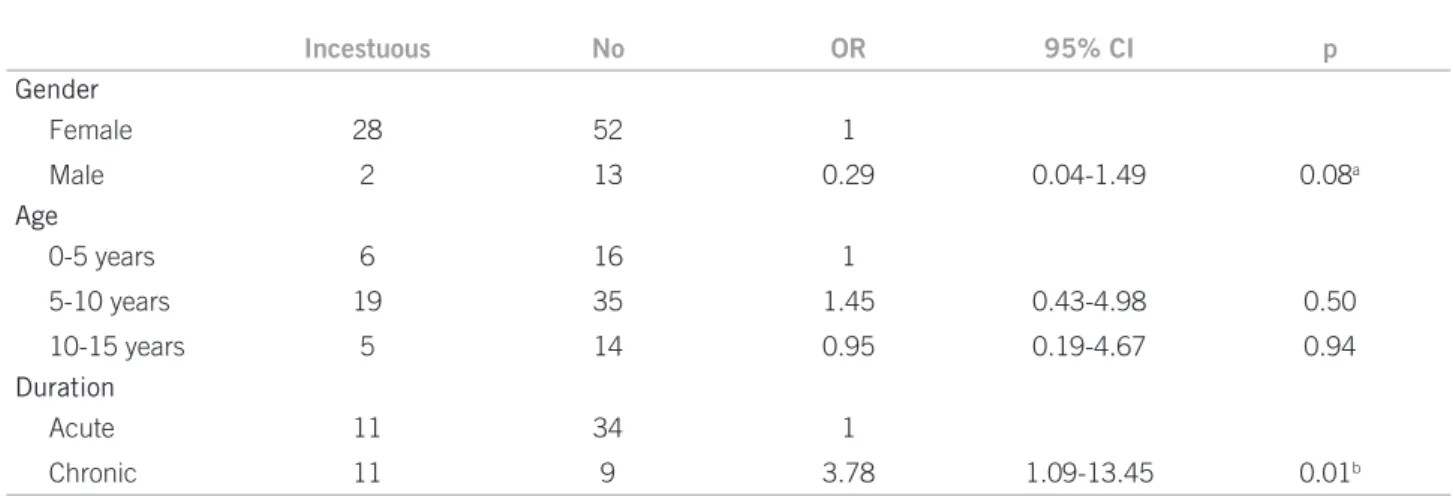
he type of perpetrator (incestuous or not) was as-sociated with the duration of sexual abuse, with chronic cases predominating in incestuous perpetrators (p = 0.01) (Table 4).
DISCUSSION
One of the most delicate issues, among many regarding the problem of child abuse, concerns the issue of notiication and the proper diagnosis of these cases, which also has im-plications in research on the subject.
Domestic violence against children, especially in the form of sexual abuse, constitutes a serious public health problem, resulting in an enormous challenge to society and service organizations6,9,14.
A huge wall of silence tends to be raised around the abuse, which results in serious psychological, emotional, and social damage for the victims8. he cover-up of the
abuse can occur for many reasons, from the family’s omis-sion to the child’s fear that the report of the incident will result in further punishment, as well as diiculties in di-agnosis and notiication, to the lack of standardized and efective tools for the proper handling of cases by the Bra-zilian health system.
Health professionals, especially pediatricians, due to their position in the provision of services to the juvenile population, are central to the identiication of individuals and population groups most vulnerable to violence, and also to the development of activities that can promote the most appropriate interventions in diagnosed cases. Moreover, they can develop preventive strategies for risk groups15,16.
he true prevalence of violence in children and ado-lescents is unknown, as many victims only disclose it in adulthood. Studies show that, worldwide, the prevalence of maltreatment in childhood and adolescence is very high, despite the diiculty in evaluating these data17-19.
In Brazil, the prevalence found was of approximately 15% of cases of abuse and neglect in children, lower than that in India (36%), Egypt (26%), and Philippines (37%), but much higher than that in Chile (4%) and the United States (4.9%)6.
In this study, considering the analysis of domestic vio-lence against children and adolescents as a whole, neglect and sexual abuse predominate. Neglect is the most common form of maltreatment, comprising up to 65% of all cases9,19.
Characteristics n (%)
Gender
Female 80 (84.2)
Male 15 (15.8)
Age range
0-5 years 22 (23.1)
5-10 years 54 (56.8)
10-15 years 19 (20.0)
City of origin
Campinas 56 (58.9)
Others 39 (41.1)
Type
Rape 37 (38.9)
Others 58 (61.0)
Location
Domestic 69 (74.2)
Urban 24 (25.8)
Perpetrator
Known 77 (81.9)
Unknown 17 (18.1)
Incestuous
Yes 30 (31.6)
No 65 (68.4)
Duration
Acute 45 (69.2)
Chronic 20 (30.8)
Physical examination
Normal 39 (76.5)
Altered 12 (23.5)
Medication
Yes 27 (49.1)
No 28 (50.9)
Serological tests
HIV
Negative 46 (48.4)
Syphilis
Negative 42 (44.2)
Hepatitis B
Negative 44 (46.3)
Hepatitis C
Table 3 – Evaluation of the type of sexual abuse, rape or not, in relation to sex, age, perpetrator, duration, performance of HIV test and treatment of 95 children and adolescents treated at HC – UNICAMP between 2003 and 2007, with a diagnosis of sexual abuse. p = chi-squared (< 0.05)
Table 4 – Evaluation of the perpetrator, if incestuous or not, in relation to gender, age, duration, performance of HIV test and treatment of 95 children and adolescents treated at HC – UNICAMP between 2003 and 2007, with a diagnosis of sexual abuse. p = chi-squared or Fisher exact test (< 0.05)
In this study, the predominant age group was younger than 5 years, with similar distribution between genders. Among adolescents, it is believed that there are diferences between the type of abuse experienced and gender, with physical abuse predominating in boys and emotional and sexual abuse in girls20,21.
In relation to sexual abuse, its negative efect on the self-esteem and psychological development of children is unquestionable, with serious repercussions in adult life22.
A recent study showed a strong association between men-tal disorders and a history of childhood sexual abuse, i.e., being a victim of childhood sexual abuse can cause a strik-ing impact on the emotional development of children and adolescents23.
he current study shows that, among victims of sexual abuse only, it predominates among girls between 5 and
10 years of age. he observation that sexual abuse is more common in girls has also been reported by other stud-ies21,22,24 and in other countries. Some reasons can help the
understanding of these diferences. In general, boys are more reluctant and are more discrepant when reporting the fact, underestimating the problem through mecha-nisms of denial, while society does not consider the abuse in male children and believes they are less afected than females24,25.
Regarding the age range, a study conducted in Rio de Janeiro also found higher prevalence in children up to 14 years of age, where the victim has less capacity for self-defense20. In this study, most cases of sexual abuse
oc-curred in the home environment by a known perpetrator, with 31% of these being incestuous. Another Brazilian study demonstrated that 84.5% of children were molested
Rape Others OR 95% CI p
Gender
Female 30 49 1
Male 7 8 0.70 0.20-2.43 0.52
Age
0-5 years 4 17 1
5-10 years 22 32 2.92 0.77-11.95 0.07
10-15 years 11 8 5.84 1.18-31.61 0.01*
Perpetrator
Incestuous 12 18 1.04 0.39-2.76 0.93
Non-incestuous 25 39 1
Duration
Acute 23 22 2.44 0.70-8.73 0.11
Chronic 6 14 1
*Significant; OR, odds ratio.
Incestuous No OR 95% CI p
Gender
Female 28 52 1
Male 2 13 0.29 0.04-1.49 0.08a
Age
0-5 years 6 16 1
5-10 years 19 35 1.45 0.43-4.98 0.50
10-15 years 5 14 0.95 0.19-4.67 0.94
Duration
Acute 11 34 1
Chronic 11 9 3.78 1.09-13.45 0.01b
by identiiable abusers, mostly family members, whereas the perpetrator was unknown in 72.3% of cases involving adolescents26.
Among those who seek treatment in this service, most were referred to Child Protection Services for evaluation of legal procedures. Brazilian law establishes that pediatri-cians and other professionals who treat children and ado-lescents must report suspected cases of domestic violence, even when they are not absolutely certain about them. his procedure is not easy and to do so, one must exercise a cautious, systematic and serious approach when evaluat-ing these children15,16,27.
Studies have shown that the growing need to provide appropriate care for victims of sexual violence, due to their increasing numbers especially at the pediatric emergency units, discloses a structural weakness of health profession-als, and reveals the structural weaknesses of the system itself, hindering early diagnosis, emergency conducts, no-tiication, and follow-up of victims15-17.
Approximately half of the cases of sexual abuse were already chronic at the moment of notiication. When medical care was inally sought, most patients had nor-mal physical examinations, which ultimately make it more diicult to establish the diagnosis. he absence of physi-cal alterations was also observed in other studies, which does not invalidate the diagnosis of abuse. he presence of alterations in the clinical examination, when suspected, must take into account the medical and social context, the history, and the explanation for the fact7,28,29.
he delay in the recognition of sexual abuse is inverse-ly proportional to the degree of relationship between the victim and the perpetrator: the closer the relationship, the longer the recognition time24,30. In this study, the chance
that the sexual violence was incestuous in chronic cases was 3.78 times higher.
he majority of cases of sexual abuse are characterized by indecent exposure, but over one-third consists of rape victims, which pose the largest concerns, requiring labora-tory investigation of sexually transmitted diseases and use of prophylactic medication30,31.
Although not very common (approximately 5%)24,
sexually transmitted diseases cannot be ignored in cases of sexual abuse in children and adolescents, including HIV. he transmission of HIV depends on the infection status of the perpetrator and on the characteristics and circum-stances of the abuse. Direct contact with semen or blood of the infected person is required for HIV transmission, and anal sex is more likely to infect than vaginal sex25.
his service indicates serological tests for HIV, syphilis, and hepatitis B and C for victims of rape. Of the tests per-formed, all were negative, although prophylaxis with met-ronidazole, benzathine penicillin, and antiretroviral medi-cation was indicated in 55% of the cases. he indimedi-cation
for post-exposure prophylaxis must take into account not only the time ater contact, but also the perpetrator’s char-acteristics, type of abuse, medication side efects, and ad-herence to treatment29-31.
When assessing the risk groups for rape, no associa-tion was found with gender, perpetrator and duraassocia-tion, but an association was found with age range, which is simi-lar to other studies. he group aged between 10 and 15 years was 5.84 times more likely to sufer this kind of abuse that children up to ive years, probably due to the pubertal development. Drezzet et al.26 found 90.8% of rape among
adolescent victims of sexual abuse and indecent assault in 46.5% of children.
In rape cases, there was no diference between genders, probably due to the fact that this is the type of sexual vio-lence most reported by males. As expected, the collection of serological tests and onset of medication therapy was statistically higher among rape victims.
Dubowitz et al.32, indicate the need to prevent child
maltreatment and highlight ive vulnerability aspects for the occurrence of this problem: poor performance on tests of everyday life, lower level of maternal schooling, use of drugs by the mother, maternal depression, and presence of more children in the family. Moreover, one cannot forget that ater the diagnosis and subsequent disclosure of the problem, the families start to face diiculties and require assistance from medical, psychological, legal and psycho-social institutions33,34.
Although it is acknowledged that the data obtained may not relect the full extent of the problem, this study can be seen as a warning to medical professionals, particularly in the pediatric area. Among the limitations of the data, the “wall of silence” that surrounds domestic violence needs to be highlighted, in addition to the loss of follow-up in these patients, failure to report cases and failure to recover data from medical records.
CONCLUSION
Even with the increasing concern among health profes-sionals on the problem of violence against children and adolescents, and the development of speciic programs for the correct approach to these cases, a deicit in the notii-cation and adequate characterization of cases, which may afect adequate treatment and research, is still observed.
It is necessary to break the wall of silence, removing these children and adolescents from the situation of aban-donment they face, when victimized by domestic violence, especially sexual violence.
REFERENCES
1. Messman-Moore T, Brown AL. Child maltreatment and perceived family en-vironment as risk for adult rape: is child abuse the most salient experiences? Child Abuse Negl. 2004;28:1019-34.
2. Marcondes de Moura ACA, Scodelario AS, Ferreira de Camargo CNM, Ferrari DCA, Mattos GO, Miyahara RP. Reconstrução de vidas: como prevenir e enfrentar a violência doméstica, o abuso e a exploração sexual de crianças e adolescentes. São Paulo: SMADS (Secretaria Municipal de Assistência e desen-volvimento Social), Instituto SEDES Sapientae; 2008. p. 96.
3. Gonçalves HS, Ferreira AL. A notiicação da violência intrafamiliar con-tra crianças e adolescentes por proissionais de saúde. Cad Saúde Pública. 2002;18:315-9.
4. Lopes Neto AA. Violência contra crianças e adolescentes. Rev Acervo. 2002. [cited 11 Jan 2012]. Available from: http://www.arquivonacional.gov.br/me-dia/Violencia%20-%2012.pdf http://revistas.an.gov.br/seer/index.php/info/ article/view/254/216.
5. Asnes AG, Leventhal JM. Managing child abuse: general principles. Pediatr Rev. 2010;31:47-55.
6. Reichenheim ME, Souza ER, Moraes CL, Mello Jorge MHP, Silva CMFP, Minayo MCS. Violence and injuries in Brazil: the efect, progress made, and challenges ahead. Lancet. 2011;377:1962-75.
7. Palusci VJ, Palusci JV. Screening tools for child sexual abuse. J Pediatr (Rio J). 2006;82:409-10.
8. Horonor H. Child sexual abuse: psychosocial risk factors. J Pediatr Health Care. 2002;16:187-92.
9. Hussey JM, Chang JJ, Kotch JB. Child maltreatment in the United States: prevalence, risk factors, and adolescent health consequences Pediatrics. 2006;118:933-42.
10. II Boletim do SISNOV: Sistema de Notiicação de Violência. Prefeitura Mu-nicipal de Campinas. Projeto Iluminar. Violência doméstica contra crianças e adolescentes e violência sexual em Campinas. Informativo – SISNOV; 2007. 11. Sociedade Brasileira de Pediatria. Guia de atuação frente a maus-tratos na
in-fância e na adolescência: orientações para pediatras e demais proissionais da saúde. Rio de Janeiro; 2001.
12. Artigo 213 do Código Penal. [cited 10 jun 2011]. Available from: http://www. dji.com.br/codigos/1940_dl_002848_cp/cp213a216.htm.
13. Montgomery DC. Design and analysis of experiments. 3rd ed. New York:
John Wiley & Sons; 1991.
14. Souza ER, Ribeiro AP, Penna LHG, Ferreira AL, Santos NC, Tavares CMM. O tema violência intrafamiliar na concepção dos formadores dos proissionais de saúde. Ciênc Saúde Coletiva. 2009;14:1709-19.
15. Minayo MCS, Souza ER, Malaquias JV, Reis AC, Santos NC, Veiga JPC, Silva CFR, Fonseca IG. Análise da morbidade hospitalar por lesões e enven-enamentos no Brasil em 2000. In: Minayo MCS, Souza ER, organizadoras. Vio-lência sob o olhar da saúde: a infrapolítica da contemporaneidade brasileira. Rio de Janeiro: Fiocruz; 2003. p.109-130.
16. Souza ER, Lima MLC. he panorama of urban violence in Brazil and its capi-tals. Ciênc Saúde Coletiva. 2006;11:363-74.
17. Marmo DB, Davoli A, Ogido R. Violência doméstica contra a criança (Parte I). J Pediatr (Rio J). 1995;71:313-6.
18. Pfeifer L, Salvagni EP. Visão atual do abuso sexual na infância e adolescência. J Pediatr (Rio J). 2005;81(5 Supl):S197-204.
19. Legano L, McHugh MT, Palusci VJ. Child abuse and neglect. Curr Probl Pedi-atr Adolesc Health Care. 2009;39:31.e1-26.
20. Aded NLO, Oliveira SF, Dalcin BLGS, Moraes TM, Cavalcanti MT. Children and adolescents victimized by sexual abuse in the city of Rio de Janeiro: an appraisal of cases. J Forensic Legal Med. 2007;14:216-20.
21. Danielsson I, Blom H, Nilses C, Heimer G, Högberg U. Gendered patterns of high violence exposure among Swedish youth. Acta Obstet Gynecol. 2009; 88:528-35.
22. Seraim A, Sai F, Achá MFF, Barros DM. Dados demográicos, psicológicos e comportamentais de crianças e adolescentes vítimas de abuso sexual. Rev Psiquiatria Clín. 2011;38:143-7.
23. Walker JL, Carey N, Stein DJ, Seedat S. Gender diferences in the prevalence of childhood sexual abuse and in the development of pediatric PTSD. Arch Womens Ment Health. 2004;7:111-21.
24. Fajman N, Wright R. Use of antiretroviral HIV post-exposure prophylaxis in sexually abused children and adolescents treated in an inner-city pediatric emergency department. Child Abuse Negl. 2006;30:919-27.
25. Stoltenborgh M, van IJzendoorn MH, Euser E, Bakermans-Kranenburg MJ. A global perspective on child sexual abuse: meta-analysis of prevalence around the world. Child Maltreat. 2011;16:79-101.
26. Drezzet J, Caballero M, Juliano Y, Prieto ET, Marques JA, Fernandes CE. Es-tudo de mecanismos e fatores relacionados com o abuso sexual em crianças e adolescentes do sexo feminino. J Pediatr (Rio J). 2001;77:413-9.
27. Gonçalves HS, Ferreira AL, Marques MJV. Avaliação de serviço de atenção a crianças vítimas doméstica. Rev Saúde Pública. 1999;33:547-53.
28. Day VP, Telles LEB, Zoratto PH, Azambuja MRF, Machado DA, Silveira MB, et al. Violência doméstica e suas diferentes manifestações. Rev Psiquiatr Rio Gd Sul. 2003; 25(Supl 1):9-21.
29. Maguire S, Mann MK, Sibert J, Kemp A. Are there patterns of bruising in childhood which are diagnostic or suggestive of abuse? A systematic review. Arch Dis Child. 2005;90:182-6.
30. Kellogg N, the Committee on Child Abuse and Neglect. he evaluation of sexual abuse in children. Pediatrics. 2005;116;506-12.
31. Shapiro RA, Makorof KL. Sexually transmitted diseases in sexually abused girls and adolescents. Curr Opin Obstet Gynecol. 2006;18:492-7.
32. Dubowitz H, Kim J, Black MM, Weisbart C, Semiatin J, Magder LS. Identify-ing children at high risk for a child maltreatment report. Child Abuse Negl. 2011;35:96-104.
33. Ferreira AL. Acompanhamento de crianças vítimas de violência: desaios para o pediatra. J Pediatr (Rio J). 2005;81(5 Supl):S173-80.