INFLUENCE OF GUIDANCE ABOUT BREASTFEEDING
IN THE BEHAVIOR OF A UNIVERSITY HOSPITAL USERS
Inluência da orientação sobre aleitamento materno
no comportamento das usuárias de um hospital universitário
Andrezza Gonzalez Escarce(1), Nicole Gomes de Araújo(2),
Amélia Augusta de Lima Friche(3),Andréa Rodrigues Motta(4)
(1) Universidade Federal de Minas Gerais – UFMG – Belo
Horizonte, MG, Brasil.
(2) Universidade Federal de Minas Gerais – UFMG – Belo
Horizonte, MG, Brasil.
(3) Speech Language Pathology Department of Universidade
Federal de Minas Gerais – UFMG, Belo Horizonte, MG, Brasil.
(4) Speech Language Pathology Department of Universidade
Federal de Minas Gerais – UFMG, Belo Horizonte, MG, Brasil.
Conlict of interest: non-existent
diarrhea, malnutrition, respiratory infections, miofunctional orofacial disorders and decreases the risk of allergies, hypertension, high cholesterol rate, diabetes and obesity1-3.
Breastfeeding is a perfect bound between a mother and her child, fulilling a function of an external “umbilical cord”. A breastfeeding woman sees comforted their ability to continue to generate life through the food that she offers1. In addition,
mothers who breastfeed have a lower chance of developing breast cancer in the future. Breastfeeding may also act as an adjunct in the prevention of a new pregnancy, it has low inancial cost, provides satisfaction, and, in advance, creates a mother-baby bound.
Currently is recommended exclusive breast -feeding for six months, and maintaining breast -feeding supplemented by two years or more5.
Despite abundant scientiic evidence regarding ABSTRACT
Purpose: to determine the inluence of received guidance about breastfeeding on the knowledge and practices of mothers attending a university hospital. Methods: descriptive observational study conducted with 250 mothers, aged between 18 and 45 years, who were in the Phonoaudiology Clinic for conducting newborn hearing screening and had their babies no later than six months ago. These mothers, who were previously oriented or not, answered a questionnaire about breastfeeding. Results: mothers who received previous guidance showed greater knowledge about: the appropriate age to offer other foods (p = 0.001), the utensils used for food (p = 0.031), the disadvantage of bottle-feeding (p = 0.037) and paciier (p = 0.019). Only mothers guided both on pre and post-natal reported using a syringe for feeding (p = 0.045). Moreover, the percentage of mothers who breastfeed on demand and new how to store milk was higher among those who had received guidance on the subject (p <0.001 and p = 0.027). The preparation of the breasts was best performed by mothers not previously guided (p = 0.002). Conclusion: this study showed that receiving guidance on breastfeeding did not determine greater knowledge on the subject, emphasizing the need of having a multidisciplinary team working in guidance of mothers as well as the importance of participation of the phonoaudiologist, who is the qualiied professional to address issues of prevention of orofacial disorders.
KEYWORDS: Orientation; Breast Feeding; Knowledge; Mothers
INTRODUCTION
Thus, the aim of this study was to investigate the inluence of the guidance received about breast -feeding knowledge and adopted by patient children of mothers at the Federal University of Minas Gerais Hospital ducts.
METHODS
This study consisted of a cross-sectional evalu-ation with 250 mothers between 18 and 45 years (mean 26.5, ±6.2 years) who were referred to the Speech-Language and Hearing Pathology Outpatient Clinic, Federal University of Minas Gerais Hospital (HC – UFMG) for the accomplishment of the Universal Newborn Hearing Screening (UNHS).
Mothers aged 18 years, who had child in a maximum period of six months, were included in this research and signed a consent form (ICF). Mothers of children who had conditions that prevented breast-feeding and/or were suffering from syndromes were excluded from this study.
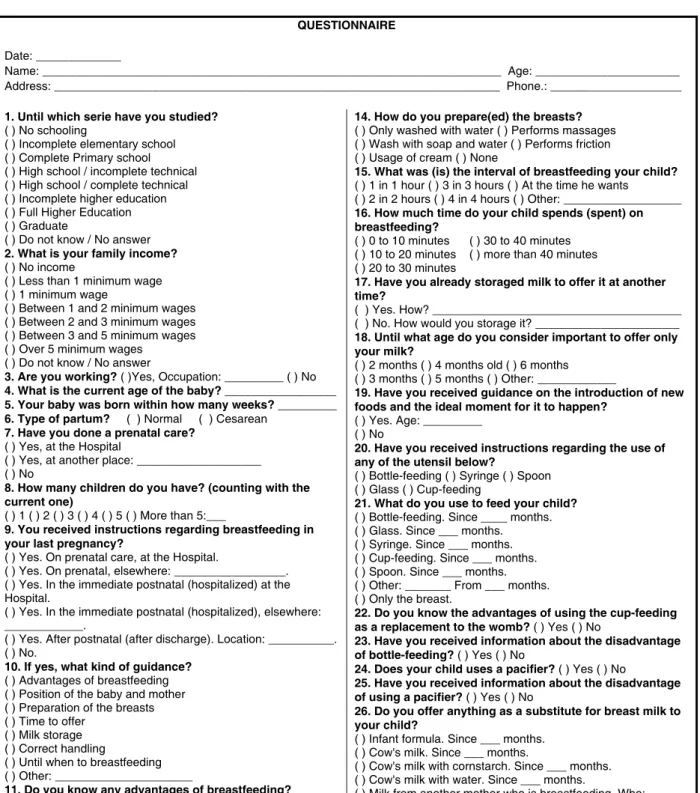
The research was done through the application of a semi-structured questionnaire containing 30 open and closed questions, developed by the researchers, aiming to investigate the knowledge and practices adopted by mothers about breastfeeding (Figure 1). the superiority of breast milk over the other types
of milk, the number of women who breastfeed their children in accordance with these recommendations still low2, since there is a large number of cases of
early weaning. Thus, the situation of breastfeeding in Brazil is still far from advocated by the World’s Health Organization6,7. In part, this fact may often
arise from ignorance on some part of the mothers, regarding the importance of breastfeeding for a longer period of time8-11.
Considering the importance of the subject to the child’s health, it becomes essential the promotion of campaigns aiming to inform mothers about the beneits of breastfeeding. However, other actions may also contribute signiicantly to increase the breastfeeding’s duration, such as the training of health professionals to encourage breastfeeding and directing actions to promote it, protect and support breastfeeding for primiparous mothers and adolescents with a lower educational degree than high school.
QUESTIONNAIRE
Date: _____________
Name: ______________________________________________________________________ Age: ______________________ Address: ____________________________________________________________________ Phone.: ____________________
1. Until which serie have you studied?
( ) No schooling
( ) Incomplete elementary school ( ) Complete Primary school ( ) High school / incomplete technical ( ) High school / complete technical ( ) Incomplete higher education ( ) Full Higher Education ( ) Graduate
( ) Do not know / No answer
2. What is your family income?
( ) No income
( ) Less than 1 minimum wage ( ) 1 minimum wage
( ) Between 1 and 2 minimum wages ( ) Between 2 and 3 minimum wages ( ) Between 3 and 5 minimum wages ( ) Over 5 minimum wages
( ) Do not know / No answer
3. Are you working? ( )Yes, Occupation: _________ ( ) No
4. What is the current age of the baby? _________________ 5. Your baby was born within how many weeks? _________ 6. Type of partum? ( ) Normal ( ) Cesarean
7. Have you done a prenatal care?
( ) Yes, at the Hospital
( ) Yes, at another place: ___________________ ( ) No
8. How many children do you have? (counting with the current one)
( ) 1 ( ) 2 ( ) 3 ( ) 4 ( ) 5 ( ) More than 5:___
9. You received instructions regarding breastfeeding in your last pregnancy?
( ) Yes. On prenatal care, at the Hospital.
( ) Yes. On prenatal, elsewhere: _________________. ( ) Yes. In the immediate postnatal (hospitalized) at the Hospital.
( ) Yes. In the immediate postnatal (hospitalized), elsewhere: ____________.
( ) Yes. After postnatal (after discharge). Location: __________. ( ) No.
10. If yes, what kind of guidance?
( ) Advantages of breastfeeding ( ) Position of the baby and mother ( ) Preparation of the breasts ( ) Time to offer
( ) Milk storage ( ) Correct handling
( ) Until when to breastfeeding ( ) Other: _____________________
11. Do you know any advantages of breastfeeding? Which one? _______________________________________
__________________________________________________
12. Are you still breastfeeding?
( ) Yes, I am giving only breast milk
( ) Yes, but I have already introduced other foods ( ) No, my milk dried
( ) No, I had to get back to work ( ) No, other reason ______________
13. How do you positioning your child during breastfeeding?
( ) Lying down ( ) Inclined ( ) Other: _______ ( ) Sitting ( ) Upstanding
14. How do you prepare(ed) the breasts?
( ) Only washed with water ( ) Performs massages ( ) Wash with soap and water ( ) Performs friction ( ) Usage of cream ( ) None
15. What was (is) the interval of breastfeeding your child?
( ) 1 in 1 hour ( ) 3 in 3 hours ( ) At the time he wants
( ) 2 in 2 hours ( ) 4 in 4 hours ( ) Other: __________________
16. How much time do your child spends (spent) on breastfeeding?
( ) 0 to 10 minutes ( ) 30 to 40 minutes ( ) 10 to 20 minutes ( ) more than 40 minutes ( ) 20 to 30 minutes
17. Have you already storaged milk to offer it at another time?
( ) Yes. How? ______________________________________ ( ) No. How would you storage it? ______________________
18. Until what age do you consider important to offer only your milk?
( ) 2 months ( ) 4 months old ( ) 6 months ( ) 3 months ( ) 5 months ( ) Other: ____________
19. Have you received guidance on the introduction of new foods and the ideal moment for it to happen?
( ) Yes. Age: _________ ( ) No
20. Have you received instructions regarding the use of any of the utensil below?
( ) Bottle-feeding ( ) Syringe ( ) Spoon ( ) Glass ( ) Cup-feeding
21. What do you use to feed your child?
( ) Bottle-feeding. Since ____ months. ( ) Glass. Since ___ months. ( ) Syringe. Since ___ months. ( ) Cup-feeding. Since ___ months. ( ) Spoon. Since ___ months. ( ) Other: _______ From ___ months. ( ) Only the breast.
22. Do you know the advantages of using the cup-feeding as a replacement to the womb? ( ) Yes ( ) No
23. Have you received information about the disadvantage of bottle-feeding? ( ) Yes ( ) No
24. Does your child uses a pacifier? ( ) Yes ( ) No
25. Have you received information about the disadvantage of using a pacifier? ( ) Yes ( ) No
26. Do you offer anything as a substitute for breast milk to your child?
( ) Infant formula. Since ___ months. ( ) Cow's milk. Since ___ months.
( ) Cow's milk with cornstarch. Since ___ months. ( ) Cow's milk with water. Since ___ months.
( ) Milk from another mother who is breastfeeding. Who: ______ __________________________________________________ 27. What have you offered to your child?
( ) Water ( ) Food sieved ( ) Juice fruit ( ) Porridge
( ) Scraped fruit ( ) Processed food ( ) Soup ( ) Other ____________
28. Since when do you offer these other foods?
( ) 2 months ( ) 4 months old ( ) 6 months ( ) 3 months ( ) 5 months ( ) Over 6 months
29. Have you ever had any difficulty in breastfeeding? What was it? ___________________________________________ __________________________________________________ 30. Have you looked for help from someone? Who?
__________________________________________________
First, a pilot study with 15 mothers was performed, which revealed the clarity of the questions.
The interviews were conducted in a waiting room of Outpatient Clinic. For the study, information about the voluntary nature of the research were transferred to the participating mothers, as well as its objectives and impact. Then was told that they would read and sign the consent form. The work approved by the Ethics Committee of the Federal University of Minas Gerais under ETIC 0332.0.203.000-10.
In the present study, the variables of interest have been received or not the guidance on breast-feeding, regardless of where the guidance has been received, the professional to which the held, and when this orientation occurred: only prenatal, only postpartum or both. The analysis of the issues related to the correct positioning of the baby during breast-feeding, the correct preparation of the breasts at the time of milk supply and milk storage was performed by categorizing the responses as “adequate” or “inadequate”. For both, it was considered appro -priate responses “inclinade position”13, “only water
hygiene”13, “feeding in free demand”2,13,14, and “milk
storage for up to 24 hours in the refrigerator and up to 15 days in freezer”15, respectively.
For input, processing and data analysis, we used the “EpiInfo” Version 6.04, program with the chi-square and Fisher’s exact test applied and adopted a signiicance level of 5%.
RESULTS
Demographic and socioeconomic characteristics of mothers interviewed are shown in Table 1, which observed that most of them had completed high school (44.4%), family income between one and two minimum wages (39.0%) and had never formally worked (54.4%).
Regarding the age of the baby, this range from 10 days to six months, with an average of 1.07 months (±0.8). Of all mothers interviewed, 36 (6.4%) had preterm, 160 (64.0%) normal childbirth and 123 (49.2%) were primiparous.
Regarding prenatal, 248 (99.2%) of the mothers held, of whom 171 (69.0%) at health centers, 44 (17.7%) in public hospitals, and 44 (17.7%) in private hospitals.
Characteristics n (%)
Education
Incomplete primary Complete primary Incomplete secondary Complete secondary Incomplete college Complete college Postgraduate
45 (18.0%) 29 (11.6%) 44 (17.6%) 111 (44.4%)
11 (4.4%) 9 (3.6%) 1 (0.4%)
Family income *
Without any income <1 minimum wage 1 minimum wage 1-2 minimum wages 2-3 minimum wages 3-5 minimum wages > 5 minimum wages
3 (1.3%) 7 (3.0%) 47 (19.9%) 92 (39.0%) 52 (22.0%) 21 (8.9%) 14 (5.9%)
Work
No formal work Saleswoman Domestic
Administrative assistant Clerk
Attendant Autonomous Merchant Other
136 (54.4%) 14 (5.6%)
9 (3.6%) 8 (3.2%) 7 (2.8%) 6 (2.4%) 4 (1.6%) 4 (1.6%) 62 (24.8%)
Table 1 – Demographic and socioeconomic characteristics of interviewed mothers
* n = 236
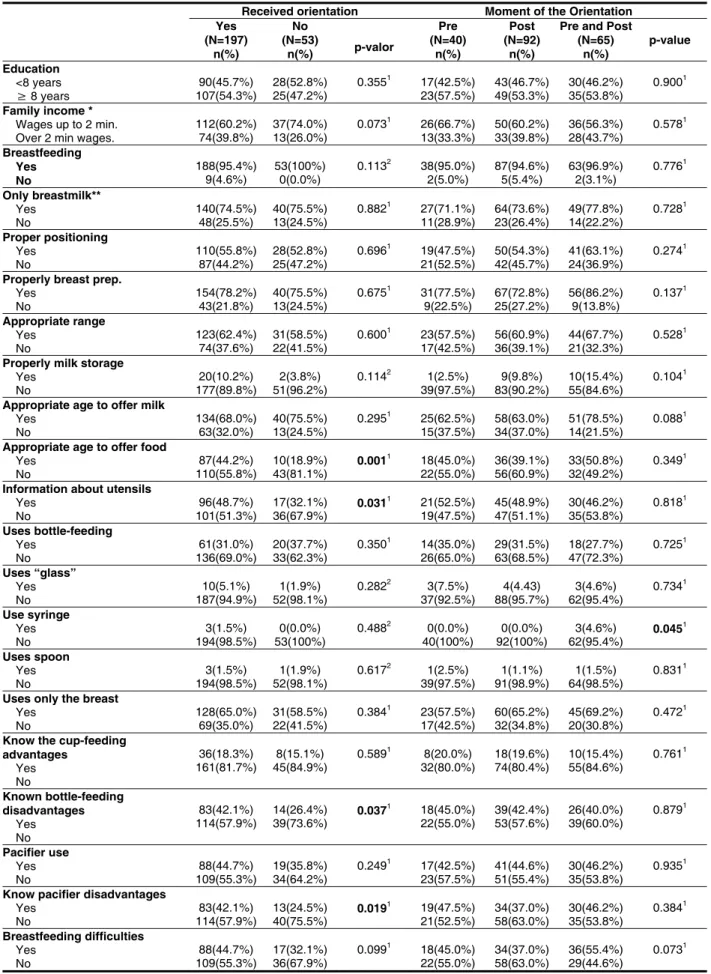
Received orientation Moment of the Orientation Yes (N=197) n(%) No (N=53) n(%) p-valor Pre (N=40) n(%) Post (N=92) n(%)
Pre and Post (N=65)
n(%)
p-value Education
<8 years
≥ 8 years 107(54.3%) 90(45.7%) 28(52.8%) 25(47.2%) 0.355
1 17(42.5%)
23(57.5%) 43(46.7%) 49(53.3%) 30(46.2%) 35(53.8%) 0.900
1
Family income *
Wages up to 2 min.
Over 2 min wages. 112(60.2%) 74(39.8%) 37(74.0%) 13(26.0%) 0.073
1 26(66.7%)
13(33.3%) 50(60.2%) 33(39.8%) 36(56.3%) 28(43.7%) 0.578
1
Breastfeeding Yes No
188(95.4%)
9(4.6%) 53(100%) 0(0.0%) 0.113
2 38(95.0%)
2(5.0%) 87(94.6%) 5(5.4%) 63(96.9%) 2(3.1%) 0.776
1
Only breastmilk**
Yes
No 140(74.5%) 48(25.5%) 40(75.5%) 13(24.5%) 0.882
1 27(71.1%)
11(28.9%) 64(73.6%) 23(26.4%) 49(77.8%) 14(22.2%) 0.728
1
Proper positioning
Yes
No 110(55.8%) 87(44.2%) 28(52.8%) 25(47.2%) 0.696
1 19(47.5%)
21(52.5%) 50(54.3%) 42(45.7%) 41(63.1%) 24(36.9%) 0.274
1
Properly breast prep.
Yes
No 154(78.2%) 43(21.8%) 40(75.5%) 13(24.5%) 0.675
1 31(77.5%)
9(22.5%) 67(72.8%) 25(27.2%) 56(86.2%) 9(13.8%) 0.137
1
Appropriate range
Yes
No 123(62.4%) 74(37.6%) 31(58.5%) 22(41.5%) 0.600
1 23(57.5%)
17(42.5%) 56(60.9%) 36(39.1%) 44(67.7%) 21(32.3%) 0.528
1
Properly milk storage
Yes
No 177(89.8%) 20(10.2%) 51(96.2%) 2(3.8%) 0.114
2 1(2.5%)
39(97.5%) 83(90.2%) 9(9.8%) 10(15.4%) 55(84.6%) 0.104
1
Appropriate age to offer milk
Yes
No 134(68.0%) 63(32.0%) 40(75.5%) 13(24.5%) 0.295
1 25(62.5%)
15(37.5%) 58(63.0%) 34(37.0%) 51(78.5%) 14(21.5%) 0.088
1
Appropriate age to offer food
Yes
No 110(55.8%) 87(44.2%) 10(18.9%) 43(81.1%) 0.001
1 18(45.0%)
22(55.0%) 36(39.1%) 56(60.9%) 33(50.8%) 32(49.2%) 0.349
1
Information about utensils
Yes
No 101(51.3%) 96(48.7%) 17(32.1%) 36(67.9%) 0.031
1 21(52.5%)
19(47.5%) 45(48.9%) 47(51.1%) 30(46.2%) 35(53.8%) 0.818
1
Uses bottle-feeding
Yes
No 136(69.0%) 61(31.0%) 20(37.7%) 33(62.3%) 0.350
1 14(35.0%)
26(65.0%) 29(31.5%) 63(68.5%) 18(27.7%) 47(72.3%) 0.725
1
Uses “glass”
Yes
No 187(94.9%) 10(5.1%) 52(98.1%) 1(1.9%) 0.282
2 3(7.5%)
37(92.5%) 88(95.7%) 4(4.43) 62(95.4%) 3(4.6%) 0.734
1
Use syringe
Yes
No 194(98.5%) 3(1.5%) 53(100%) 0(0.0%) 0.488
2 0(0.0%)
40(100%) 92(100%) 0(0.0%) 62(95.4%) 3(4.6%) 0.045
1
Uses spoon
Yes
No 194(98.5%) 3(1.5%) 52(98.1%) 1(1.9%) 0.617
2 1(2.5%)
39(97.5%) 91(98.9%) 1(1.1%) 64(98.5%) 1(1.5%) 0.831
1
Uses only the breast
Yes
No 128(65.0%) 69(35.0%) 31(58.5%) 22(41.5%) 0.384
1 23(57.5%)
17(42.5%) 60(65.2%) 32(34.8%) 45(69.2%) 20(30.8%) 0.472
1
Know the cup-feeding advantages
Yes No
36(18.3%)
161(81.7%) 45(84.9%) 8(15.1%) 0.589
1 8(20.0%)
32(80.0%) 18(19.6%) 74(80.4%) 10(15.4%) 55(84.6%) 0.761
1 Known bottle-feeding disadvantages Yes No 83(42.1%)
114(57.9%) 14(26.4%) 39(73.6%) 0.037
1 18(45.0%)
22(55.0%) 39(42.4%) 53(57.6%) 26(40.0%) 39(60.0%) 0.879
1
Pacifier use
Yes
No 109(55.3%) 88(44.7%) 19(35.8%) 34(64.2%) 0.249
1 17(42.5%)
23(57.5%) 41(44.6%) 51(55.4%) 30(46.2%) 35(53.8%) 0.935
1
Know pacifier disadvantages
Yes
No 114(57.9%) 83(42.1%) 13(24.5%) 40(75.5%) 0.019
1 19(47.5%)
21(52.5%) 34(37.0%) 58(63.0%) 30(46.2%) 35(53.8%) 0.384
1
Breastfeeding difficulties
Yes
No 109(55.3%) 88(44.7%) 17(32.1%) 36(67.9%) 0.099
1 18(45.0%)
22(55.0%) 34(37.0%) 58(63.0%) 36(55.4%) 29(44.6%) 0.073
1
Table 2 – Proile of the interviewed mothers and practices adopted by them
(82.4%) mothers who did not have such knowledge, 68 (33.0%) also use a bottle-feeding. Thus, it was observed that having received guidance on the using of the cup-feeding was not enough to educate mothers about the disadvantages of bottle-feeding and decrease the use of this tool (p=0.656).
When asked about the dificulties encountered during breastfeeding, 105 (42.0%) of mothers reported having some dificulty. Of these, 62 (56.2%) reported injuries and/or cracks, 27 (25.7%) reported baby dificulties in picking up the mama, 21 (20.0%), pain / burning, 20 (19.1%) no milk and / or “down” from the same eight (7.6%) adverse nipple, ive (4.8%) with dificulty positioning, two (1.9%) and two breast inlammation (1.9%) did not know what to do when the baby was choking. There was a signiicant association between dificulty in breastfeeding and the fact that primiparous (p=0.002).
Of all those interviewed, 77 (30.8%) reported that they had to seek help for breastfeeding, being 33 (42.9%) sought nurses, 14 (18.2%) own mother, 11 (14.3%) the physician, 11 (14.3%) the milk bank, six (7.8%) Health Center and three (3.9%) his sister. Other people were cited for six (7.8%) of these mothers.
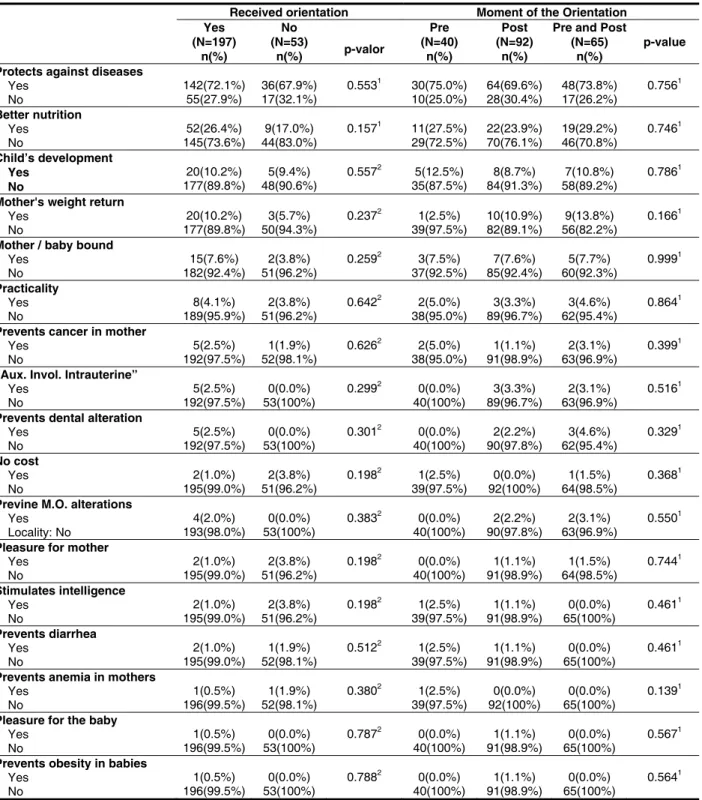
The fact of having received guidance did not inluenced the mothers’ knowledge about the advantages of breastfeeding, since the answers submitted by the targeted and non-targeted inter-viewed showed no signiicant difference (Table 3).
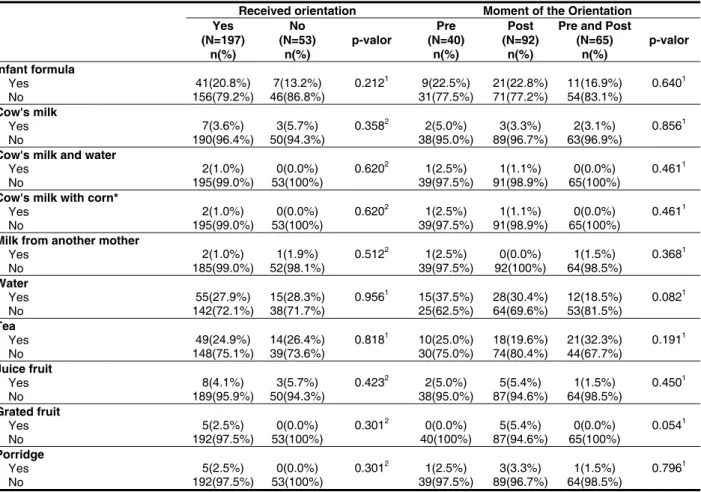
There was no association between the type of food offered by mothers to their children during the interview and the fact that they have received information about breastfeeding, and even when the orientation happened (Table 4).
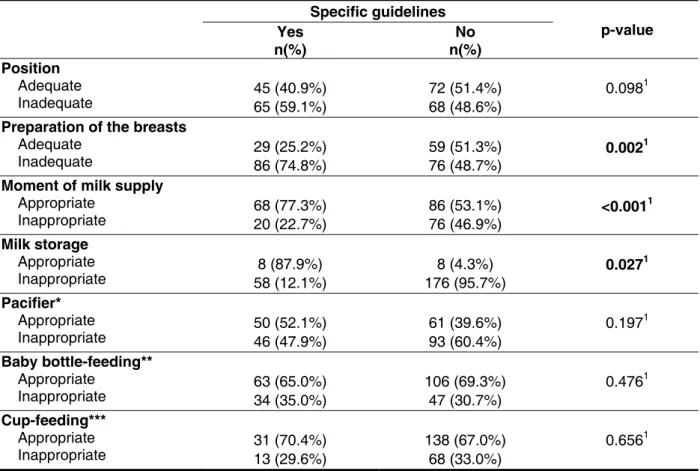
Comparing the guidance received by mothers regarding speciically on breastfeeding issues adopted by them (Table 5), was observed that having received guidance on the appropriate time to offer milk and on its storage determined a major knowledge of the subject (p<0.001 and p=0.027). Regarding to the preparation of the breasts, there was a higher proportion of the mothers who prepare it properly among those who were not oriented on the subject (p=0.002).
Received orientation Moment of the Orientation Yes
(N=197) n(%)
No (N=53)
n(%) p-valor
Pre (N=40)
n(%)
Post (N=92)
n(%)
Pre and Post (N=65)
n(%)
p-value
Protects against diseases Yes
No 142(72.1%) 55(27.9%) 36(67.9%) 17(32.1%) 0.553
1 30(75.0%)
10(25.0%) 64(69.6%) 28(30.4%) 48(73.8%) 17(26.2%) 0.756
1
Better nutrition Yes
No 145(73.6%) 52(26.4%) 44(83.0%) 9(17.0%) 0.157
1 11(27.5%)
29(72.5%) 22(23.9%) 70(76.1%) 19(29.2%) 46(70.8%) 0.746
1
Child’s development Yes
No
20(10.2%)
177(89.8%) 48(90.6%) 5(9.4%) 0.557
2 5(12.5%)
35(87.5%) 84(91.3%) 8(8.7%) 58(89.2%) 7(10.8%) 0.786
1
Mother's weight return Yes
No 177(89.8%) 20(10.2%) 50(94.3%) 3(5.7%) 0.237
2 1(2.5%)
39(97.5%) 10(10.9%) 82(89.1%) 56(82.2%) 9(13.8%) 0.166
1
Mother / baby bound Yes
No 182(92.4%) 15(7.6%) 51(96.2%) 2(3.8%) 0.259
2 3(7.5%)
37(92.5%) 85(92.4%) 7(7.6%) 60(92.3%) 5(7.7%) 0.999
1
Practicality Yes
No 189(95.9%) 8(4.1%) 51(96.2%) 2(3.8%) 0.642
2 2(5.0%)
38(95.0%) 89(96.7%) 3(3.3%) 62(95.4%) 3(4.6%) 0.864
1
Prevents cancer in mother Yes
No 192(97.5%) 5(2.5%) 52(98.1%) 1(1.9%) 0.626
2 2(5.0%)
38(95.0%) 91(98.9%) 1(1.1%) 63(96.9%) 2(3.1%) 0.399
1
“Aux. Invol. Intrauterine” Yes
No 192(97.5%) 5(2.5%) 53(100%) 0(0.0%) 0.299
2 0(0.0%)
40(100%) 89(96.7%) 3(3.3%) 63(96.9%) 2(3.1%) 0.516
1
Prevents dental alteration Yes
No 192(97.5%) 5(2.5%) 53(100%) 0(0.0%) 0.301
2 0(0.0%)
40(100%) 90(97.8%) 2(2.2%) 62(95.4%) 3(4.6%) 0.329
1
No cost Yes
No 195(99.0%) 2(1.0%) 51(96.2%) 2(3.8%) 0.198
2 1(2.5%)
39(97.5%) 92(100%) 0(0.0%) 64(98.5%) 1(1.5%) 0.368
1
Previne M.O. alterations Yes
Locality: No 193(98.0%) 4(2.0%) 53(100%) 0(0.0%) 0.383
2 0(0.0%)
40(100%) 90(97.8%) 2(2.2%) 63(96.9%) 2(3.1%) 0.550
1
Pleasure for mother Yes
No 195(99.0%) 2(1.0%) 51(96.2%) 2(3.8%) 0.198
2 0(0.0%)
40(100%) 91(98.9%) 1(1.1%) 64(98.5%) 1(1.5%) 0.744
1
Stimulates intelligence Yes
No 195(99.0%) 2(1.0%) 51(96.2%) 2(3.8%) 0.198
2 1(2.5%)
39(97.5%) 91(98.9%) 1(1.1%) 65(100%) 0(0.0%) 0.461
1
Prevents diarrhea Yes
No 195(99.0%) 2(1.0%) 52(98.1%) 1(1.9%) 0.512
2 1(2.5%)
39(97.5%) 91(98.9%) 1(1.1%) 65(100%) 0(0.0%) 0.461
1
Prevents anemia in mothers Yes
No 196(99.5%) 1(0.5%) 52(98.1%) 1(1.9%) 0.380
2 1(2.5%)
39(97.5%) 92(100%) 0(0.0%) 65(100%) 0(0.0%) 0.139
1
Pleasure for the baby Yes
No 196(99.5%) 1(0.5%) 53(100%) 0(0.0%) 0.787
2 0(0.0%)
40(100%) 91(98.9%) 1(1.1%) 65(100%) 0(0.0%) 0.567
1
Prevents obesity in babies Yes
No 196(99.5%) 1(0.5%) 53(100%) 0(0.0%) 0.788
2 0(0.0%)
40(100%) 91(98.9%) 1(1.1%) 65(100%) 0(0.0%) 0.564
1
Table 3 – Cited breastfeeding advantages by mothers
each region of the country has its own peculiarities, which turns dificult to realize a data comparison.
In the present work, the vast majority of mothers received prenatal as well as in other studies3,9,17,18. However, a minority of these guidelines received during this period, which was also identiied in the literature3, although other studies have found that
most of the investigated sample received guidance during the prenatal9,17-19. This result indicates that action is needed to improve these ratios, since the prenatal period is a good time to pass on important information for this population.
In this study, having received a proper knowledge determined a better understanding about the appro-priate age for introducing new types of foods in children’s diets, ie, after six months of life. However, this knowledge did not cause an approach’s change, since 25.5% of mothers reported already offering other foods to their children. This fact agrees with the literature, regarding to the low prevalence of breast-feeding and the early introduction of complementary foods8, suggesting ineficiency or inadequacy of the
guidelines, making these mothers do not recall the same or choose not to follow them. Professionals
DISCUSSION
Despite being recommended exclusive breast -feeding until six months of life and its maintenance complemented by two years or more, the number of mothers who breastfeed until the appropriate age is still low. Health care professionals can improve this situation through actions that seek to promote breastfeeding and help mothers overcome obstacles encountered during this period. These professionals should advise mothers on prenatal care, guide them and help them in the period of lactation, judiciously assess the breastfeeding technique and intervene appropriately when obstacles arise2.
In the present study, the mean age of mothers was 26 years, most did not work, had at least two children, had completed high school and family income between one and two minimum wages. In a previous study, pregnant women were on average 25 years and family income of three minimum wages, and half of these being primíparas16. In another
work, most of the mothers had not completed high school and also had more than one child3. Note that
Received orientation Moment of the Orientation Yes
(N=197) n(%)
No (N=53)
n(%) p-valor
Pre (N=40)
n(%)
Post (N=92)
n(%)
Pre and Post (N=65)
n(%) p-valor Infant formula
Yes
No 156(79.2%) 41(20.8%) 46(86.8%) 7(13.2%) 0.212
1 9(22.5%)
31(77.5%) 21(22.8%) 71(77.2%) 11(16.9%) 54(83.1%) 0.640
1
Cow's milk
Yes
No 190(96.4%) 7(3.6%) 50(94.3%) 3(5.7%) 0.358
2 2(5.0%)
38(95.0%) 89(96.7%) 3(3.3%) 63(96.9%) 2(3.1%) 0.856
1
Cow's milk and water
Yes
No 195(99.0%) 2(1.0%) 53(100%) 0(0.0%) 0.620
2 1(2.5%)
39(97.5%) 91(98.9%) 1(1.1%) 65(100%) 0(0.0%) 0.461
1
Cow's milk with corn*
Yes
No 195(99.0%) 2(1.0%) 53(100%) 0(0.0%) 0.620
2 1(2.5%)
39(97.5%) 91(98.9%) 1(1.1%) 65(100%) 0(0.0%) 0.461
1
Milk from another mother
Yes
No 185(99.0%) 2(1.0%) 52(98.1%) 1(1.9%) 0.512
2 1(2.5%)
39(97.5%) 92(100%) 0(0.0%) 64(98.5%) 1(1.5%) 0.368
1
Water
Yes
No 142(72.1%) 55(27.9%) 15(28.3%) 38(71.7%) 0.956
1 15(37.5%)
25(62.5%) 28(30.4%) 64(69.6%) 12(18.5%) 53(81.5%) 0.082
1
Tea
Yes
No 148(75.1%) 49(24.9%) 14(26.4%) 39(73.6%) 0.818
1 10(25.0%)
30(75.0%) 18(19.6%) 74(80.4%) 21(32.3%) 44(67.7%) 0.191
1
Juice fruit
Yes
No 189(95.9%) 8(4.1%) 50(94.3%) 3(5.7%) 0.423
2 2(5.0%)
38(95.0%) 87(94.6%) 5(5.4%) 64(98.5%) 1(1.5%) 0.450
1
Grated fruit
Yes
No 192(97.5%) 5(2.5%) 53(100%) 0(0.0%) 0.301
2 0(0.0%)
40(100%) 87(94.6%) 5(5.4%) 65(100%) 0(0.0%) 0.054
1
Porridge
Yes
No 192(97.5%) 5(2.5%) 53(100%) 0(0.0%) 0.301
2 1(2.5%)
39(97.5%) 89(96.7%) 3(3.3%) 64(98.5%) 1(1.5%) 0.796
1
Table 4 – Type of food offered to babies
Specific guidelines
p-value Yes
n(%) n(%)No
Position
Adequate Inadequate
45 (40.9%) 65 (59.1%)
72 (51.4%) 68 (48.6%)
0.0981
Preparation of the breasts
Adequate Inadequate
29 (25.2%) 86 (74.8%)
59 (51.3%) 76 (48.7%)
0.0021
Moment of milk supply
Appropriate Inappropriate
68 (77.3%) 20 (22.7%)
86 (53.1%) 76 (46.9%)
<0.0011
Milk storage
Appropriate Inappropriate
8 (87.9%) 58 (12.1%)
8 (4.3%) 176 (95.7%)
0.0271
Pacifier*
Appropriate Inappropriate
50 (52.1%) 46 (47.9%)
61 (39.6%) 93 (60.4%)
0.1971
Baby bottle-feeding**
Appropriate Inappropriate
63 (65.0%) 34 (35.0%)
106 (69.3%) 47 (30.7%)
0.4761
Cup-feeding***
Appropriate
Inappropriate 31 (70.4%) 13 (29.6%) 138 (67.0%) 68 (33.0%) 0.656
1
Table 5 – Association between the speciic guidelines received and behaviors of the interviewed
mothers
Legend: * Mothers who received information about the paciier’s downside. ** Mothers who received information about the disadvan -tage of the bottle-feeding. *** Mothers who know the advan-tages of using the cup-feeding as a substitute for breastfeeding. 1-chi--square test.
responsible for orientation must be prepared to deal with the ambiguity that presents the woman in the relationship that is established between the power and the desire to breastfeed, as a matter of taking risks or ensure beneits20.
Although mothers who received counseling regarding breastfeeding have higher knowledge about the disadvantages of bottle-feeding and paciier, ignorance on the subject is still high between these (57.9%). This fact highlights the need and importance of an audiologist participation in these guidelines, either in personally or through a health team training, since this is a qualiied professional to guide about possible orofacial miofunctional changes caused by the use of these tools.
About the advantages of breastfeeding, the most remembered by interviewees was that it protects the baby against diseases (63.6%), the same occurred in other realized studies9,16.19. However, this fact may be linked to the popular knowledge, since mothers without guidance also knew this advantage. The second most cited beneit was better nutrition
(24.4%). Noteworthy is the fact that this has been mentioned by a small number of mothers, since ignorance about this advantage will be an aggra-vating factor with regard to the possibility of early weaning. Now, the fact that breastfeeding prevent orofacial miofunctional change was cited by only 1.6% of mothers, indicating that probably there was not a speech-language pathologist in most of the orientation teams, or that the form of how the information was passed was not effective enough. Thus, it becomes evident the need for a multidis-ciplinary approach in order to motivate mothers to promote breastfeeding, since the lack of knowledge may be a barrier to breastfeeding, as well as the improper transmission or little consistency in the information16,21.
Previous studies3,16 indicate that although
mothers who reported have not received guidance on this aspect.
Studies show that the use of paciiers and nipples can lead to a lower frequency of breastfeeding, as well as affecting the oral motor function and cause orthodontic problems14,22,25,26. The nipples of any
kind, when used for a certain period, can cause the phenomenon called nipple confusion, leading to early weaning27. Nevertheless, increasingly
dummies have been introduced early, regardless of the damage that the use of these can lead to the child posteriorly22,25. This fact was evidenced
in the present study since, although mothers were informed about the downside of the paciier, they have not reduced their use, whereas 48.0% reported that the child uses a paciier, compared to 39,6% of mothers who were not targeted. This result was not statistically signiicant, but consistent according to the researched literature22,25, was high since the
use of paciiers (44.7%), and the same was offered early, with an average age of 1.07 (±0.8) months. In a previous study, 60.8% of irst-time mothers mentioned the intention to use the paciier to leave the maternity21.
Only 38.8 % of mothers received information about the disadvantage of bottle-feeding, of which, 35.0% reported that the child uses, compared to 30.7% of mothers who were not targeted. In another study, 77.6% of irst-time mothers mentioned the intention to use the bottle-feeding to leave the maternity21. Ignorance about the interference of
the bottle-feeding in breastfeeding success was a fact that also drew attention in another research9.
Moreover, is known that only 18.3% of mothers who received guidance knows about the cup-feeding, once again indicating the importance of the speech therapist on a health staff.
Among the dificulties encountered by mothers during breastfeeding, the most cited ones were wounds and / or cracks, dificulty in picking up the baby and breast pain / burning. In another study, the most frequently cited were “poor newborn latch” and pain28. Primiparous mothers showed more dificulties
in breastfeeding when compared to the others, a fact also observed in the study above28. Only 30.8% of
mothers reported dificulties looking for help, being nurses and doctors the most requested by mothers, ie, technicians and professionals with a relevant knowledge about breastfeeding. In another study, mothers sought help in the family environment16.
In the present study, mothers were unable to effectively absorb the information received or chose not to follow them, which may be associated with the quality of the instruction and the way it is being transmitted. The professional must be able to help the woman, must know how to listen and learn, As for breast milk substitutes, it was found that
19.2% and 4.0% of mothers provided infant formula and cow’s milk, respectively, to their children. Considering other types of food, it was observed that 28.0% of mothers have tendered water, tea 25.2% and 4.4% juice fruit. In this aspect, was noted that the guidelines were not suficient to promote exclusive breastfeeding up to six months, since 74.5% of mothers who received advice tendered milk and other foods, compared to 75.5 % of mothers who did not received guidance. In a conducted research in state capitals and the Federal District, the prevalence of breastfeeding in children under six months was 41.0%6. In the
same study, the early introduction of tea, water and other types of milk in the irst month of life and juice around the third month was also observed6. These
data reinforce the need to increase the number and quality of protective actions, promote and support exclusive breastfeeding until six months of life22,23,
since it contains all the necessary nutrients for a proper growth in this period11.
This research showed that mothers which received guidance on the positioning during breast-feeding did not perform better than those who did not. This, once more, brings us to the ineffectiveness of the guidance given to mothers and agrees with studies that emphasize the importance of improving the quality of orientations9.
In the present study, only 46.0% of mothers received information about the preparation of the breasts, compared to 78.4% of mothers of previous study16. The percentage of mothers who prepares
the breasts properly, ie, so wash only with water and not realize any intervention13 was higher in
the group of mothers who were not targeted. Most doctors, despite being supportive of breastfeeding, have not properly guided the pregnant women about the breasts care during pregnancy24, which
also demonstrates the importance of the speech-language therapist in prenatal care to complement the given guidelines24.
Most mothers supply breast milk at the appro-priate time, ie, breastfeeding her child on free demand, having it occurred in the same previous studies16,19 while in another study, the intervals of two to three hours were the most cited ones17.
Only 12.1% of mothers who receive guidance on how to storage milk usually do it correctly, ie, in the refrigerator or the freezer for up to 24 hours or 15 days, respectively15. Although the literature
about breastfeeding and its importance, which can lead to early weaning.
It is suggested that further studies be conducted on the subject, seeking to map both professionals responsible for guidance and the strategies employed by them.
CONCLUSION
The present study showed that the knowledge of the targeted mothers about breastfeeding was not signiicantly different of those not targeted. Furthermore, it was evident the need of a multidisci-plinary team working on guidance to these mothers, since several essential issues to successful breastfeeding were not absorbed properly. We also emphasize the importance of the presence of a speech-language pathologist on the staff, which can relay important information about the disadvantages of paciiers and bottle-feeding use, not only regarding to early weaning, but also to the prevention of orofacial motor changes as well, generally not addressed in interventions.
develop it’s conidence and give support29, besides making use of simple and appropriate language, considering the level of understanding of the mother, reinforcing the achieved result30. It is important that
mothers feel the interest of the health professional to gain conidence and feel supported2.
One limitation of the research points up the fact that mothers under 18 years of age were excluded. In addition, information was provided by mothers, and these may not have remembered to mention a previously received guidance or even missed a orientation as such, coniguring it as a memory bias.
Given the above research, it becomes clear the need to improve the quality of recommendations, as well as having a multidisciplinary team working on the orientation. Knowledge ensures a signiicant step towards awareness of mothers about the impor-tance of breastfeeding, aiming thereby decreasing the rate of early weaning9. Many mothers have the knowledge of the subject by seeking information in another medias, such as internet, conversation with other people, and so. However, this area is restricted, as they are unaware of simple questions
RESUMO
Objetivo: veriicar a inluência da orientação recebida acerca do aleitamento materno no conhecimento e condutas de mães usuárias de um hospital universitário. Métodos: estudo observacional descritivo realizado com 250 mães, previamente orientadas ou não, a respeito do aleitamento materno, com idade entre 18 e 45 anos, as quais se encontravam no Ambulatório de Fonoaudiologia do Hospital das Clínicas da UFMG para realização de triagem auditiva neonatal e haviam tido ilho há no máximo seis meses. Estas mães responderam um questionário a respeito do aleitamento materno. Resultados: as mães que receberam orientação demonstraram maior conhecimento acerca da idade adequada para se ofertar outros alimentos (p=0,001), dos utensílios utilizados para alimentação (p=0,031) da desvantagem da mamadeira (p=0,037) e da chupeta (p=0,019). Somente as mães orientadas tanto no pré quanto no pós-natal relataram utilizar a seringa para alimentação (p=0,045). Além disso, o percentual de mães que amamentam em livre demanda e que sabem como armazenar o leite foi maior entre aquelas que haviam recebido orientação acerca do assunto (p<0,001 e p=0,027). Já a preparação das mamas foi melhor realizada pelas mães não orientadas sobre o assunto (p=0,002). Conclusão: o presente estudo evidenciou que, dentre as mães entrevistadas, ter recebido orientação sobre o aleitamento materno não determinou maior conhecimento acerca do assunto, ressaltando, assim, a necessidade de se ter uma equipe multidisciplinar atuando nas orientações às mães, bem como a importância da participação do fonoaudiólogo, o qual é o proissional habilitado para abordar questões referentes à prevenção de alterações de motricidade orofacial.
16. Volpato SE, Braun A, Pegorim RM, Ferreira DC, Beduschi CS, Souza KM. Avaliação do conhecimento da mãe em relação ao aleitamento materno durante o período pré-natal em gestantes atendidas no Ambulatório Materno Infantil em Tubarão (SC). Arq Catarin Med. 2009;38(1):49-55. 17. Santos VLF, Soler ZASG, Azoubel R. Alimentação de crianças no primeiro semestre de vida: enfoque no aleitamento materno exclusivo. Rev Bras Saúde Mater Infant. 2005;5(3):283-91. 18. Alves CRL, Goulart EMA, Colosimo EA, Goulart LMHF. Fatores de risco para o desmame entre usuárias de uma unidade básica de saúde de Belo Horizonte, Minas Gerais, entre 1980 e 2004. Cad Saúde Pública. 2008;24(6):1355-67.
19. Sandre-Pereira G, Colares LGT, Carmo MGT, Soares EA. Conhecimentos maternos sobre amamentação entre puérperas inscritas em programa de pré-natal. Cad Saúde Pública. 2000;16(2):457-66.
20. Almeida JAG, Novak FR. Amamentação: um híbrido natureza-cultura. J Pediatr. 2004;80(5):119-25.
21. Melo AMCA, Cabral PC, Albino E, Moura LMD, Menezes AEB, Wanderley LG. Conhecimento e atitudes sobre aleitamento materno em primíparas da cidade do Recife, Pernambuco. Rev Bras Saúde Matern Infant. 2002;2(2):137-42.
22. Cotrim LC, Venancio SI, Escuder MML. Uso de chupeta e amamentação em crianças menores de quatro meses no estado de São Paulo. Rev Bras Saúde Mater Infant. 2002;2(3):245-52.
23. Ferreira FV, Marchionatti AM, Oliveira MDM, Praetzel JR. Associação entre a duração do aleitamento materno e sua inluência sobre o desenvolvimento de hábitos orais deletérios. Rev Sul-Bras Odontol. 2010;7(1):35-40.
24. Khalil SGM. A Fonoaudiologia orientando o aleitamento materno [monograia]. São Paulo: Centro de Especialização em Fonoaudiologia Clínica;1998.
25. Lamounier JA. O efeito de bicos e chupetas no aleitamento materno. J Pediatr. 2003;79(4):284-6. 26. Oliveira AB, Souza FP, Chiappetta ALML. Relação entre hábitos de sucção não-nutritiva, tipo de aleitamento e má oclusões em crianças com dentição decídua. Rev CEFAC. 2006;8(3):352-9. 27. Sanches MTC. Manejo clínico das disfunções orais. J Pediatr. 2004;80(5):155-62.
28. Souza MJN, Barnabé AS, Oliveira RS, Ferraz RRN. A importância da orientação à gestante sobre amamentação: fator para diminuição dos processos dolorosos mamários. ConScientiae Saúde. 2009;8(2):245-9.
REFERENCES
1. Antunes LS, Antunes LAA, Corvino MPF, Maia LC. Amamentação natural como fonte de prevenção em saúde. Ciênc Saúde Coletiva. 2008;13(1):103-9. 2. Giugliani ERJ. O aleitamento materno na prática clínica. J Pediatr. 2000;21:238-52.
3. Percegoni N, Araújo RMA, Silva MMS, Euclydes MP, Tinôco ALA. Conhecimento sobre aleitamento materno de puérperas atendidas em dois hospitais de Viçosa, Minas Gerais. Rev Nutr. 2002;15(1):29-35.
4. Rea MF. Os benefícios da amamentação para a saúde da mulher. J Pediatr. 2004;80(5):142-6. 5. Brasil, Ministério da Saúde. Pesquisa de prevalência do aleitamento materno nas capitais e no Distrito Federal. Brasília; 2009.
6. WHO (World Health Organization). Exclusive breastfeeding for six months best for babies everywhere. Genebra: The Organization: 2011. 7. Carvalhaes MABL, Corrêa CRH. Identiicação de diiculdades no início do aleitamento materno mediante aplicação de protocolo. J Pediatr. 2003;79(1):13-20.
8. Brasil, Ministério da Saúde. Guia alimentar para crianças brasileiras menores de dois anos: bases técnico-cientíicas, diagnóstico alimentar e nutricional e recomendações. Brasília; 2000. 9. Giugliani ERJ, Rocha VLL, Neves JM, Polanczyk CA, Seffrin CF, Susin LO. Conhecimentos maternos em amamentação e fatores associados. J Pediatr. 1995;71(2):77-81.
10. Escobar AMU, Ogawa AR, Hiratsoka M, Kawashita MY, Teruya PY, Grisi S. Aleitamento materno e condições sócio-econômico-culturais: fatores que levam ao desmame precoce. Rev Bras Saúde Mater Infant. 2002;2(2):253-61.
11. Marques RFSV, Lopez FA, Braga JAP. O crescimento de crianças alimentadas com leite materno exclusivo nos 6 primeiros meses de vida. Rev Chil Pediatr. 2006;77(5):529-30.
12. França GVA, Brunken GS, Silva SM, Escuder MM, Venancio SI. Determinantes da amamentação no primeiro ano de vida em Cuiabá, Mato Grosso. Rev Saúde Pública. 2007;41(5):711-8.
13. Rego, José Dias. Aleitamento materno: um guia para pais e familiares. 2.ed. São Paulo Atheneu. 2008.
14. Organização Mundial de Saúde. Evidências cientíicas dos dez passos para o sucesso do aleitamento materno. Brasília; 2001.
LSF. Aleitamento materno: uma abordagem sobre o papel do enfermeiro no preparo de mães adolescentes. Rev Inst Cienc Saúde. 2008;26(2):177-82.
29. Faleiros FTV, Trezza EMC, Carandina L. Aleitamento materno: fatores de inluência na sua decisão e duração. Rev Nutr. 2006;19(5):623-30. 30. Duarte AML, Costa AFF, Oliveira CT, Carvalho
Received on: March 30, 2012 Accepted on: August 07, 2013
Mailing address:
Andrezza Gonzalez Escarce
Av. Alfredo Balena, 190 – Santa Eigênia Belo Horizonte – Minas Gerais
CEP: 30130-100