Objective: To verify the type of milk consumed by children under one year of age and identify variables associated with non‑maternal milk consumption (formula or cow milk).
Methods: Cross‑sectional study developed during the 2012 National Vaccination Campaign against Poliomyelitis. The companions of 935 children under one year of age answered a structured questionnaire on the child’s diet in the last 24 hours. The estimates are presented by points, with 95%CI. F‑statistics were used to check for differences in the proportion of the types of milk consumption according to the children’s age range (<6 months and 6–11 months) and the association between non‑maternal milk consumption and the study variables.
Results: The consumption of maternal milk and child formula was higher for children under six months of age — corresponding to 82.8% (95%CI 78.5–86.3) and 70.4% (95%CI 61.4–78.0), respectively —, whereas the consumption of cow milk was higher among children between 6 and 11 months of age — 74.2% (95%CI 66.5–80.6) —, with diferences in the consumption proportions (p<0.0001). The variables associated with higher cow milk consumption were lower maternal education (p<0.0001), the fact that the mother does not have a paid occupation (p=0.0015), child doctor’s appointment in the public health network (p<0.0001) and participation in the Child’s Milk Program (p<0.0001).
Conclusions: The infants received cow’s milk early (before the irst year of life), especially children from families with lower socioeconomic levels and children who took part in a speciic social program for milk distribuition.
Keywords: Human milk substitutes; Infant; Nutrition programs and policies.
Objetivos: Veriicar o tipo de leite consumido por crianças menores de um ano de idade e identiicar variáveis associadas ao consumo de leite não materno (LNM) — fórmula infantil ou leite de vaca (LV).
Métodos: Estudo transversal realizado durante a Campanha Nacional de Vacinação contra Poliomielite 2012. Os acompanhantes de 935 crianças menores de um ano responderam a um questionário estruturado sobre a alimentação da criança nas últimas 24 horas. As estimativas são apresentadas por pontos e intervalo de coniança de 95% (IC95%). Adotou‑se a estatística F para veriicar diferenças na proporção de consumo dos tipos de leite segundo a faixa etária das crianças (<6 meses e 6–11 meses) e a associação entre o consumo de leite não materno e as variáveis estudadas.
Resultados: O consumo de leite materno e fórmula infantil foi maior entre as crianças menores de 6 meses — sendo 82,8% (IC95% 78,5–86,3) e 70,4% (IC95% 61,4–78,0), respectivamente —, enquanto o de leite de vaca foi maior entre as crianças de 6 a 11 meses — 74,2% (IC95% 66,5–80,6) —, com diferenças nas proporções de consumo (p<0,0001). As variáveis associadas ao maior consumo de leite de vaca foram: menor escolaridade materna (p<0,0001), o fato de a mãe não trabalhar fora (p=0,0015), a criança consultar na rede pública de saúde (p<0,0001) e participar do Programa Leite das Crianças – PLC (p<0,0001).
Conclusões: As crianças receberam leite de vaca precocemente (antes do primeiro ano de vida), em especial aquelas pertencentes às famílias de menor nível socioeconômico e inseridas em programa social especíico para recebimento de leite.
Palavras‑chave: Substitutos do leite humano; Lactente; Programas e políticas de nutrição e alimentação.
ABSTRACT
RESUMO
*Corresponding author. E‑mail: [email protected] (P.C. Saldan).
aUniversidade Estadual do Centro‑Oeste, Guarapuava, PR, Brazil.
bHealth Institute of the State Health Secretariat of São Paulo, São Paulo, SP, Brazil. cNursing School of Ribeirão Preto, Universidade de São Paulo, Ribeirão Preto, SP, Brazil.
Received on August 4, 2016; approved on December 23, 2016; available online on October 25, 2017.
MILK CONSUMPTION IN INFANTS UNDER ONE
YEAR OF AGE AND VARIABLES ASSOCIATED
WITH NON‑MATERNAL MILK CONSUMPTION
Consumo de leites em menores de um ano de idade
e variáveis associadas ao consumo de leite não materno
Paula Chuproski Saldan
a,*, Sonia Isoyama Venancio
b, Silvia Regina Dias Medici Saldiva
b,
INTRODUCTION
Dietary practices in childhood are extremely important and inluence the nutritional status of children, requiring their evaluation and monitoring.1 Exclusive maternal breastfeeding
(EBF) is recommended until the age of 6 months, and, from that moment on, an additional diet should be initiated, main‑ taining the breastfeeding until the age of two or mor.2‑4
If EBF is not possible, the indication is that the child receives modiied milk (formula). he use of whole cow’s milk (CM) until the age of 12 months is contraindicated due to its aller‑ genic potential, excessive protein content and for being con‑ sidered a risk factor for iron‑deiciency anemia.5‑7
Despite these recommendations, studies indicate that children aged less than 12 months receive non‑maternal milk (NMM), and some of these studies showed the consumption of CM.8‑14 One literature review pointed out that the deter‑
minants of unmodiied CM consumption are low maternal schooling and low socioeconomic status.15
he Child’s Milk Program (PLC) has been practiced in the state of Paraná since 2003, providing one liter of milk a day to children aged between 6 and 36 months of age, belonging to families with per capita income equal to or lower than half a regional minimum wage. he referred program aims at ight‑ ing infant malnutrition and encouraging family agriculture. he milk provided is luid, pasteurized, with minimum 3% fat content and enriched with iron and vitamins A and D.16,17
here are few studies about the consumption of types of NMM ofered to children aged less than one year, and the variables associated with the consumption of this milk. herefore, the objectives of this study were to assess the type of milk consumed by children aged less than one year and to identify the variables associated with the intake of NMM (formula or CM).
METHOD
Cross‑sectional study conducted during the 2012 National Vaccination Campaign against Poliomyelitis in Guarapuava, Paraná, Brazil. he study population was a group of children aged less than one year who attended the vaccination posts in the urban and rural areas of the city with their parents or guardians.
With information about the population of children aged less than 1 year, vaccinated in the irst stage of the 2011 cam‑ paign, the sample size was calculated using the prevalence of EBF in children aged less than 6 months, with an estimation of 40% being aged between 2 and 3 months, according to a local study,18 and sampling error of 9%. he sample size esti‑
mations were obtained by applying the algebraic expression by
Lwanga and Lemeshow19 and, afterwards, the 5% non‑response
adjustment and the design efect (def)20 of 1.4. he inal sam‑
ple size resulted in 1,005 children.
he study used the two‑stage cluster sampling.20 hat is,
considering that the children were not distributed evenly in the vaccination posts (clusters), the two‑stage selection was adopted, and the probability was proportional to the cluster size. he irst stage involved the selection of vaccination posts, and the second stage systematically selected the children wait‑ ing in line for the vaccination in each post. hirty‑two vaccina‑ tion posts were selected, and for each of them we estimated the selection fraction necessary to interview the people in charge of approximately 35 children.
Data collection was conducted between June 11 and 29, 2012, by 118 volunteer students in the courses of Nutrition and Nursing at the local university, who were trained for 4 hours. he data collection instrument was a questionnaire with 67 questions, based on that used in vaccination campaigns from the Breastfeeding and Cities project, from the Health Institute of the Health Secretariat of São Paulo,21 adopted by the Ministry
of Health to conduct the II Research of Breastfeeding Prevalence in Brazilian Capitals and the Federal District (II PPAM/Capitals and FD), in 2008.22 he questions about diet were based on
all probable foods — maternal milk (MM), water ,tea, NMM, types of NMM, number of times NMM was consumed, por‑ ridge, fruit juice, fruit, salty food (cooked, mush or soup) — that the child consumed the day before the interview (24‑hour recall) and were given to the guardians of children before vac‑ cination. he other questions referred to the child, the mother and the health service.
he variables used in this study were: NMM consumption (formula or CM), maternal age (≤19, 20–34 or ≥35 years), primiparity (yes or no), maternal schooling (<8, 8–11 or >11 schooling years), maternal occupation (yes or no), living with the child’s father (yes or no), area of residence (urban or rural), health service the child attends (public network or pri‑ vate/insurance) and participating (yes or nor) of the Children’s milk state program.
he descriptive analysis included the calculation of pro‑ portions and 95% conidence intervals (CI) for the types of milk consumed by the children. F‑statistics was used to iden‑ tify the variables associated with the intake of NMM and the diferences of proportions between the types of milk con‑ sumed, using a 5% signiicance level. To calculate the prob‑ ability of consumption of the types of milk (breastfeeding (BF), formula, CM and milk from PLC), the logit analysis was used and estimated, by statistical modelling, the proba‑ bility of the event in relation to the children’s age in days.22
he data analysis was processed in Stata, version 11.1 (Stata Corp., College Station, Texas, USA).
his study was approved by the Research Ethics Committee from the Nursing School in Ribeirão Preto, at Universidade de São Paulo (CEP‑EERP/USP), report nº 34.613, from June 11, 2012. his study did not require an informed consent form because it consisted of a fast questionnaire applied in the wait‑ ing line of the vaccination post. herefore, the parents or guard‑ ians were asked for a verbal consent, in order to not disrupt the vaccination campaign. his procedure was established in the research of the Breastfeeding and Cities project from the Health Institute of the Secretariat of Health in São Paulo and in the II PPAM/Capitals and FD.21,22
RESULTS
he participants eligible for the study accounted for 1,118, how‑ ever, 18 children were excluded for not living in Guarapuava. Sixteen questionnaires were excluded due to inconsistencies in the child’s age, and there were 149 refusals.
Of the 935 children who participated in the study, 459 (49.1%) were aged less than 6 months, and 476 (50.9%) were aged 6 months or more; 470 (50.3%) were female, 476 (50.9%) were born from vaginal delivery, and 853 (91.2%) presented with weight at birth ≥ 2,500 grams. Of the total number of children, 86.7% were accompanied by their mothers at the time of the interview. Of the mothers accompanying their chil‑ dren, 45.8% were primiparous; 57.8% were aged between 20 and 24 years; 50.4% had between 8 and 11 schooling years; 61.5% did not work outside the household; and 65.3% took their children to be cared for in the public health network, as described in Table 1.
Table 2 shows the proportions of milk consumption by the children. here were higher levels of consumption of BF and formula by children aged less than 6 months of age, and CM and PLC milk by children aged from 6 to 11 months, with diferent proportions in consumption for all types of milk analyzed. he frequency of daily consumption of NMM (for‑ mula and/or CM) was one for 13.7% (95%CI 10.6–17.6) of the children, two for 15.6% (95%CI 12.4–19.3) and three or more for 70.7% (95%CI 65.8–75.1).
Figure 1 shows that BF is high in the irst days of life (90%), decreasing to 70% at the age of 6 months and falling to 40% at the end of the irst year of life. he formula is also consumed by many children in the irst days of life (87%), however, its consumption reduces more expressively than BF. CM is consumed by 16% of the children in the irst month of life, increasing to 50% at the age of 6 months, and reach‑ ing approximately 90% of the consumption in the end of
the irst year of life. he consumption of PLC milk increases after the age of 6 months (13%), reaching 50% at the age of 12 months.
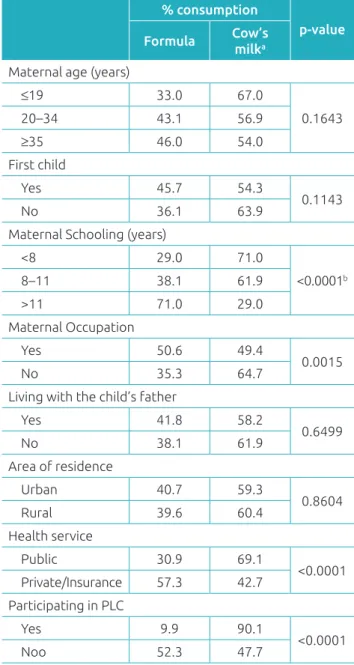
he variables associated with higher consumption of CM were: lower maternal schooling — with tendency to increase the consumption with the reduction of maternal schooling —, the fact that the mother did not work outside the household, the child being assisted in the public health network and par‑ ticipating in PLC (Table 3).
Table 1 Sociodemographic characteristics of mothers and children aged less than one year participating in
the study in Guarapuava (PR), Brazil, 2012.
n %
Maternal age (years)a
≤19 195 20.8
20–34 540 57.8
≥35 93 10.0
Not informedb 107 11.4
First childa
Yes 428 45.8
No 403 43.1
Not informedb 104 11.1
Maternal schooling (years)a
<8 234 25.0
8–11 471 50.4
>11 126 13.5
Not informedb 104 11.1
Maternal occupationa
Works outside the household 255 27.3
Does not work outside the household 575 61.5 Not informedb 105 11.2
Living with the child’s fathera
Yes 715 76.5
No 116 12.4
Not informedb 104 11.1
Area of residence
Urban 839 89.7
Rural 96 10.3
Health service
Public 611 65.3
Private/insurance 301 32.2
Not informedb 23 2.5
aData collected when the children were with their mothers. bData
DISCUSSION
Regarding the research design, it is important to mention that the conduction of surveys in vaccination campaigns has been used as a strategy to obtain data of populations in a short period of time, at low cost.21,23 he external validity of the study
can be assessed by the high coverage of the 2012 Vaccination Campaign against Poliomyelitis in the city, which reached 100% of the children aged less than one year, and by the similar pro‑ ile of the sample analyzed with the data from the Live Birth
Information System (SINASC) in 2011 for the city.24,25 Of
the children studied, 50.9% were born from vaginal delivery, and 91.2% weighed ≥ 2,500 grams versus 50.5% and 90.9%
of the population of reference (SINASC 2011), respectively.25
Regarding the maternal data, 63.9% of the mothers had 8 or more schooling years versus 60.2% of the population of refer‑ ence (SINASC 2011).25
his study showed that BF (82.8%) and the consump‑ tion of formula (70.4%) was higher among children aged
Table 2 Proportion of the consumption of milk by children aged less than one year in Guarapuava (PR), Brazil, 2012.
Types of milk % of consumption and 95%CI p‑value
Children <6 months Children aged 6 to 12 months
Maternal milk 82.8 (78.5–86.3) 54.5 (48.7–60.2) <0.0001
Non maternal milka 37.3 (31.8–43.3) 73.0 (68.0–77.5) <0.0001
Maternal milk + non maternal milka 55.0 (44.9–64.7) 39.9 (34.1–46.0) 0.0133
Formula 70.4 (61.4–78.0) 25.8 (19.4–33.4) <0.0001
Cow’s milkb 29.6 (22.0–38.6) 74.2 (66.5–80.6) <0.0001
Children’s Milk Programc 1.2 (0.3–5.1) 33.7 (25.8–42.7) <0.0001
aFormula and cow’s milk. bPasteurized milk, long‑life type, milk from the Children’s Milk Program and powdered milk. cMilk provided
by the government of the State of Paraná to families with per capita income lower than half a regional minimum wage. 95%CI: 95% confidence interval.
Child’s age (days)
%
%= probability of milk consumption
Milk from the Children’s Milk Program 100
90
80
70
60
50
40
30
20
10
0
0 30 60 90 120 150 180 210 240 270 300 330 360
Maternal milk Formula Cow’s milk
less than 6 months, whereas CM (74.2%) and PLC milk (33.7%) were more consumed by children aged between 6 and 11 months. he frequency of the daily consumption of NMM (formula and/or CM) was three times or more for 70.7% of the children analyzed. he intake of CM was high among the studied children, which is opposite to the recom‑ mendation of national and international institutions, which do not indicate the intake of this type of milk before the 12 months of life due to its allergenic potential, the protein overload and the high chances of the child developing iron deiciency anemia.6,7,26
Table 3 Proportion of consumption of milk according to
the variables analyzed in Guarapuava (PR), Brazil, 2012.
% consumption
p‑value
Formula Cow’s
milka
Maternal age (years)
≤19 33.0 67.0
0.1643
20–34 43.1 56.9
≥35 46.0 54.0 First child
Yes 45.7 54.3
0.1143
No 36.1 63.9
Maternal Schooling (years)
<8 29.0 71.0
<0.0001b
8–11 38.1 61.9
>11 71.0 29.0
Maternal Occupation
Yes 50.6 49.4
0.0015
No 35.3 64.7
Living with the child’s father
Yes 41.8 58.2
0.6499
No 38.1 61.9
Area of residence
Urban 40.7 59.3
0.8604
Rural 39.6 60.4
Health service
Public 30.9 69.1
<0.0001 Private/Insurance 57.3 42.7
Participating in PLC
Yes 9.9 90.1
<0.0001
Noo 52.3 47.7
aPasteurized, long life milk, in natura, milk from the Children’s Milk
Program and powdered milk. bStatistically signiciant liner tendency
test. PLC: Children’s Milk Program.
It is important to mention that the PLC milk ofered to children aged from 6 to 36 months, belonging to families with per capita income lower than half a minimum wage, is the whole CM enriched with iron and vitamins A and D.17
herefore, the government of the State of Paraná is going against the recommendations for the consumption of CM, so this state program could be revised and discussed with academic nutrition and pediatrics institutions regarding the provision of CM, which is recommended only after the child is 1 year old, given the implications to the children’s health. Such aspects suggest that this milk may be inluencing the non‑continuity of BF, since only 39% of the children breast fed at the end of their irst year of life.
he suggestion is to conduct a review in the age group of the infant audience to be impacted by PLC, from 6 to 36 months of age to 12 to 36 months of age, besides state and municipal actions defending BF, in order to continue this practice in the irst years of life of the children. he rel‑ evance of PLC for the rural development and for small and medium‑sized producers of the state is recognized and is not being discussed in this paper. However, it is important to think about the implications of CM consumption before the 12 months of life. Another aspect that should be fur‑ ther discussed in this program concerns one of the objec‑ tives that elucidates the ight against infant malnutrition, but nowadays the reality points to increasing excess weight among children.
A cross‑sectional study that analyzed the consumption of milk among Brazilian children aged less than 60 months found that 91.8% of the ones aged less than 6 months were breastfeeding, and 23% used formula; 74.6% of the children aged from 6 to 12 months received CM, and, in the South region, in this age group, 70% consumed more than two milky meals.8 hese indings are similar as to the intake of CM and
the frequency of milky meals, however, they are diferent regarding the formula. In a prospective study that assessed the dietary practices of children aged from 4 to 12 months in three Brazilian capitals, the intake of CM among children aged from 6 to 11 months was 77.7%,11 similar to that reported
in this study. he use of formula among those aged less than 6 months was 12%,11 which is below our inding. A cross‑sec‑
tional study conducted in Acrelândia (AC), Brazil, with chil‑ dren aged from 6 to 24 months, showed that the intake of CM was 70.4% and 77.4% for children aged 6 to 8 months and 9 to 11 months, respectively,10 and these values are simi‑
lar to the ones in this study.
end of the irst year of life, being more expressive for formula (12%). he chances of CM consumption is inverse, so 50% of the children consumed this milk at the age of 6 months. he consumption of PLC milk increased after the age of 6 months, since after this period the children enrolled in the program start receiving the beneit.17 his aspect sug‑
gests that the consumption of this type of milk before that age can be related to the fact that other children in the fam‑ ily received the beneit, so the mother uses the milk for all children, regardless of age.
A cross‑sectional study that analyzed the dietary prac‑ tices of children aged from 6 to 12 months from 136 cities in the State of São Paulo found that, at the age of 6 months, the probability of a child receiving other types of milk was 70%, and, at the age of 12 months, 83%. However, there is no diference between the types of milk consumed.27 Another
cross‑sectional study that analyzed the regional inluence on the early consumption of foods other than BF among chil‑ dren aged less than 6 months in Brazilian capitals and the Federal District emphasized the consumption of tea, mostly in the South region, and milk, in the Southeast and Northeast regions.9 his regional behavior can be distinguished after
the age of six months, when children from Paraná state are able to apply for PLC, showing the increasing consumption of this type of milk.
his study showed that the socioeconomic level inluenced the type of milk consumed by the children, since the variables associated with the higher consumption of CM were lower maternal schooling, the fact that the mother did not work outside the household and participating in PLC. here was also a tendency for the increasing consumption of CM with the reduced maternal schooling. he children who attended public health services also consumed more CM. he indings in this study corroborate those of a review article that points low maternal schooling and low socioeconomic status as deter‑ minants for the use of unmodiied CM.15 Even though the
children’s family income was not investigated in this study, maternal schooling was used as a proxy for the socioeconomic status of the families.9 A cohort study with children aged less
than six months accompanied in the irst, fourth and sixth months of life in Viçosa (MG), Brazil, showed that the low income was a risk factor for the consumption of CM in the sixth month of life.28
Another study observed that mother with less than eight schooling years, who worked outside the household, had more chances of ofering foods from the milk group, including for children aged less than six months.12 An investigation showed
that the consumption of milky meals (NMM and porridge) was associated with the fact that the mother worked outside the
household and had more than eight schooling years.27 Another
study veriied that the introduction of NMM was delayed for mothers who did not work outside the household.29 he main
indings in these investigations are opposite to those in this study, however, it is worth to mention that the type of NMM consumed was not investigated in the two last studies analyzed. In our study, the fact that the mother did not work outside the household could mean lower income, suggesting that the family with lower per capita income participates in the PLC.
Even though the literature does not show the role of the health service interfering in the type of milk consumed by the chil‑ dren, in this study, the children participating in the PLC should be accompanied every month (weight veriication) in the health united as a condition of the program. his suggests an explanation for the fact that the higher intake of CM took place among children who attended the public health network. However, it is worth to mention that despite the association found between the intake of CM and the public health service, this result should be interpreted carefully. A cross‑sectional study about the prevalence of breastfeeding in children aged less than two years in Campinas (SP), Brazil, showed that the public health service can have a positive impact on early wean‑ ing when compared to the private health system.30 A study that
accompanied children aged less than six months in the irst, fourth, and sixth months of life found that the lower number of prenatal appointments was a risk factor for the intake of CM in all months assessed. he authors conclude that this inding can be owed to the lower access of mothers to information about adequate dietary practices, usually approached in groups addressed to pregnant women in health units.28
he importance of BF is consensus in the literature, and children in families with lower socioeconomic status can bene‑ it more from BF, given the impossibility of acquiring formula due to its high cost. he Ministry of Health recommends that if the possibilities of relactation to maintain BF are inished, and at the inancial impossibility to acquire formula, professionals should advise mothers as to the adequate and safe use of CM.3
Some limitations of this study are the non‑investigation of how the types of milk consumed were prepared, that is, if they were ofered pure, diluted or with the addition of other foods; and the fact that the data were obtained in a single 24‑hour recall. he strong aspect of this study highlights the sampling technique used. Further studies are required to verify the impact of the milk ofered in the PLC on the nutritional status of the children who receive this beneit, and the inluence of the con‑ sumption of this milk in the continuity of BF.
REFERENCES
1. Brasil. Ministério da Saúde. Secretaria de Atenção à Saúde. Departamento de Atenção Básica. Orientações para avaliação de marcadores de consumo alimentar na atenção básica [homepage on the Internet]. Brasília: Ministério da Saúde; 2015 [cited 2015 May 27]. Available from: http://bvsms.saude. gov.br/bvs/publicacoes/marcadores_consumo_alimentar atencao_basica.pdf
2. Kramer MS, Kakuma R. The optimal duration of exclusive breastfeeding: a systematic review. Geneva: WHO; 2002. 3. Brasil. Ministério da Saúde. Secretaria de Atenção à Saúde.
Departamento de Atenção Básica. Saúde da criança: nutrição infantil: aleitamento materno e alimentação complementar. 2nd ed. Brasília: Ministério da Saúde; 2015.
4. Victora CG, Bahl R, Barros AJ, França GV, Horton S, Krasevec J, et al. Breastfeeding in the 21st century: epidemiology, mechanisms, and lifelong efect. Lancet. 2016;387:475‑90. 5. Oliveira MA, Osório MM, Raposo MC. Socioeconomic and dietary risk factors for anemia in children aged 6 to 59 months. J Pediatr (Rio J). 2007;83:39‑46.
6. Agostoni C, Decsi T, Fewtrell M, Goulet O, Kolacek S, Koletzko B, et al. Complementary feeding: a commentary by the ESPGHAN Committee on Nutrition. J Pediatr Gastroenterol Nutr. 2008;46:99‑110.
7. No‑referred authorship. Manual de orientação para a alimentação do lactente, do pré‑escolar, do escolar, do adolescente e na escola. 3rd ed. Rio de Janeiro: SBP; 2012.
8. Bortolini GA, Vitolo MR, Gubert MB, Santos LM. Early cow’s milk consumption among Brazilian children: results of a national survey. J Pediatr (Rio J). 2013;89:608‑13. 9. Saldiva SR, Venancio SI, Gouveia AG, Castro AL, Escuder MM,
Giugliani ER. Regional inluence on early consumption of foods other than breast milk in infants less than 6 months of age in Brazilian State capitals and the Federal District. Cad Saúde Pública. 2011;27:2253‑62.
10. Garcia MT, Granado FS, Cardoso MA. Complementary feeding and nutritional status of 6‑24‑month‑old children in Acrelândia, Acre State, Western Brazilian Amazon. Cad Saúde Pública. 2011;27:305‑16.
11. Caetano MC, Ortiz TT, Silva SG, Souza FI, Sarni RO. Complementary feeding: inappropriate practices in infants. J Pediatr (Rio J). 2010;86:196‑201.
12. Corrêa EN, Corso AC, Moreira EA, Kazapi IA. Complementary feeding and maternal characteristics of children younger than two years old in Florianópolis, Santa Catarina, Brazil. Rev Paul Pediatr. 2009;27:258‑64.
13. Bernardi JL, Jordão RE, Barros Filho AA. Supplementary feeding of infants in a developed city within the context of a developing country. Rev Panam Salud Publica. 2009;26:405‑11.
14. Oliveira LP, Assis AM, Pinheiro SM, Prado MS, Barreto ML. Complementary feeding in the irst two years of life. Rev Nutr. 2005;18:459‑69.
15. Wijndaele K, Lakshman R, Landsbaugh JR, Ong KK, Ogilvie D. Determinants of early weaning and use of unmodiied cow’s milk in infants: a systematic review. J Am Diet Assoc. 2009;109:2017‑28.
16. Bazotti A, Conti IL, Finokiet M. Programa Leite das Crianças: uma política pública de incentivo à produção local e à segurança alimentar e nutricional. Proceedings of the 2nd Jornada da Questão Agrária e Desenvolvimento; 2013 Nov 06‑07; Curitiba, PR, Brazil.
17. Governo do Estado do Paraná. Secretaria do Trabalho e Economia Solidária [homepage on the Internet]. Programa Leite das Crianças: apresentação [cited 2015 Feb 21]. Available from: http://www.leitedascriancas.pr.gov.br/ modules/conteudo/conteudo.php?conteudo=1
18. Brecailo MK, Corso AC, Almeida CC, Schmitz BA. Factors associated with exclusive breastfeeding in Guarapuava, Paraná, Brazil. Rev Nutr. 2010;23:553‑63.
19. Lwanga SK, Lemeshow S. Sample size determination in health studies: a practical manual. Geneva: WHO; 1991. 20. Silva NN. Amostragem probabilística: um curso introdutório.
São Paulo: EDUSP; 1998.
21. Venancio SI, Escuder MM, Kitoko P, Rea MF, Monteiro CA. Frequency and determinants of breastfeeding in the State of São Paulo, Brazil. Rev Saúde Pública. 2002;36:313‑8. 22. Brasil. Ministério da Saúde. Secretaria de Atenção à Saúde.
Departamento de Ações Programáticas e Estratégicas. II Pesquisa de Prevalência de Aleitamento Materno nas Capitais Brasileiras e Distrito Federal. Brasília: Ministério da Saúde; 2009.
23. Santos LM, Paes‑Sousa R, Silva Junior JB, Victora CG. National Immunization Day: a strategy to monitor health and nutrition indicators. Bull World Health Organ. 2008;86:474‑9. 24. Brasil. Ministério da Saúde. Sistema de Informação do
Programa Nacional de Imunizações. Campanha nacional de vacinação contra poliomielite 2012 [homepage on the Internet] [cited 2012 Aug 22]. Available from: http://pni. datasus.gov.br/consulta_polio_12_selecao.asp?enviar=ok&‑ sel=vacinometro&faixa=todos&grupo=todos&uf=PR&mu‑ nicipio=410940
Funding
Paula Chuproski Saldan had a scholarship from Conselho Nacional de Desenvolvimento Cientíico e Tecnológico (CNPq) for a Sandwich PhD program in the country (Process n. 300996/2013‑6). Fundação de Amparo à Pesquisa do Estado
de São Paulo (FAPESP), regular research support (Process n. 2014/11953‑1).
Conflict of interests
© 2017 Sociedade de Pediatria de São Paulo. Published by Zeppelini Publishers.
This is an open access article under the CC BY license (http://creativecommons.org/licenses/by/4.0/).
25. Brasil. Ministério da Saúde – DATASUS Informações de saúde. Nascidos vivos – Paraná [homepage on the Internet] [cited 2013 Nov 11]. Available from: http://tabnet.datasus.gov.br/ cgi/tabcgi.exe?sinasc/cnv/nvpr.def
26. Brasil. Ministério da Saúde. Secretaria de Atenção à Saúde. Departamento de Atenção Básica. Dez passos para uma alimentação saudável: Guia alimentar para crianças menores de dois anos: um guia para o proissional da saúde na atenção básica. 2nd ed. Brasília: Ministério da Saúde; 2013. 27. Saldiva SR, Escuder MM, Mondini L, Levy RB, Venancio
SI. Feeding habits of children aged 6 to 12 months and associated maternal factors. J Pediatr (Rio J). 2007;83:53‑8. 28. Carvalho CA, Fonsêca PC, Nobre LN, Silva MA, Pessoa MC, Ribeiro AQ, et al. Sociodemographic, perinatal and behavioral factors associated to types of milk consumed in six months
children under: Birth cohort. Ciênc Saúde Coletiva [serial on the Internet]. 2016 Abril. [cited 2012 Aug 22]. Available from: http://www.cienciaesaudecoletiva.com.br/artigos/ fatores‑sociodemografcos‑perinatais‑e‑comportamentais‑ associados‑aos‑tipos‑de‑leite‑consumidos‑por‑criancas‑ menores‑de‑seis‑meses‑coorte‑de‑nascimento/15586?id= 15586&id=15586&id=15586&id=15586&id=15586&id= 15586&id=15586
29. Simon VG, Souza JM, Souza SB. Introduction of complementary foods and its relation with demographic and socioeconomic variables during the irst year of life of children born in a University Hospital in the city of São Paulo. Rev Bras Epidemiol. 2003;6:29‑38. 30. Camilo DF, Carvalho RV, Oliveira EF, Moura EC. Breastfeeding