Journal of Evolution of Medical and Dental Sciences/Volume 2/Issue 52/ December 30, 2013 Page 10262
STUDY OF ANEMIA IN APPARENTLY HEALTHY CHILDREN AGED 6 TO 15
MONTHS
Fysal N1, P.M. Kutty2
HOW TO CITE THIS ARTICLE:
Fysal N, P.M. Kutty. Study of Anemia in apparently healthy children aged 6 to 15 months . Journal of Evolution of Medical and Dental Sciences 2013; Vol. 2, Issue 52, December 30; Page: 10262-10266.
ABSTRACT: Anemia due to lack of iron is the most important hematological disorder of infancy and
childhood. According to India’s third National Family Health Survey (NFHS- 3) of 2005- 6, 70 % of
children between 6 months and 59 months are anemic. So it is very important to screen children for anemia early. The first 2 years of life is a critical window of opportunity to intervene in children since anemia can impair psychomotor development. A cross sectional study involving 260 apparently healthy children between 6 months and 15 months of age, showed the prevalence of anemia to be 60.7%. Only 9.2% of them were having Protein Energy Malnutrition. Introduction of animal milk at an early age and the amount of animal milk consumed were found to be the two important risk factors significantly associated with anemia.
KEY WORDS: Hemoglobin, Protein Energy Malnutrition (PEM), Microcytic Hypochromic Anemia, Exclusive Breast Feeding (EBF).
INTRODUCTION: Nutritional anemia, particularly anemia due to lack of sufficient iron for synthesis of hemoglobin is the most common hematological disease of infancy and childhood. It can impair Physical growth and cognitive functions. The manifestations of iron deficiency are most severe in the growing child whose iron needs are high but whose capacity to adapt to deficiency is in many ways most restricted.
Iron deficiency anemia in infants and children go unnoticed and many infants and young children admitted to hospitals for other reasons have blood tests which indicate iron deficiency as an incidental finding 1.
So it is very important to screen infants and young children for early detection of anemia and to treat them before it produces an irreversible impact on their physical and mental growth.
Objectives:
1. To assess the prevalence and severity of anemia among apparently healthy children 6 to 15 months of age.
2. To study the important risk factors for anemia among this age group.
METHODS: Children in the age group of 6 to15 months coming for routine Immunization and Vitamin A supplementation to the immunization clinic at MES medical college Perinthalmanna were selected for a total Period of 2 years.
Study period: The study period was from 07. 08. 2009 to 07.08. 2011.
METHODS OF SELECTION
Journal of Evolution of Medical and Dental Sciences/Volume 2/Issue 52/ December 30, 2013 Page 10263
Exclusion criteria:
1.Children who were having obvious congenital anomalies.
2.Children who were hospitalized for any illness during or before the study. 3. Children who were getting long- term medications.
At the time of enrollment information regarding birth weight, birth order and number of siblings were obtained.
Stastical analysis used: Univariate analysis.
Information collected: The dietary parameters of the subjects including the period of Exclusive Breast Feeding (EBF), time and type of animal milk introduced, total amount of animal milk the subjects had received so far were collected. Also information was obtained regarding the consumption of green leafy vegetables, fruits and tea or coffee.
Diagnostic criteria: According to WHO from age group 6 months to 6 years, Hb<11gm% is the cut off value for anemia.
Hemoglobin Grade
10.00 – 10.99 g/dl Mild anemia 7.00 – 9.99 g/dl Moderate anemia
<7.00 g/dl Severe anemia Grading of anemia (2)
Observations: We enrolled 260 Subjects between 6 months and 15 months of age. Of this 50.4 % were males and 49.6%were females.
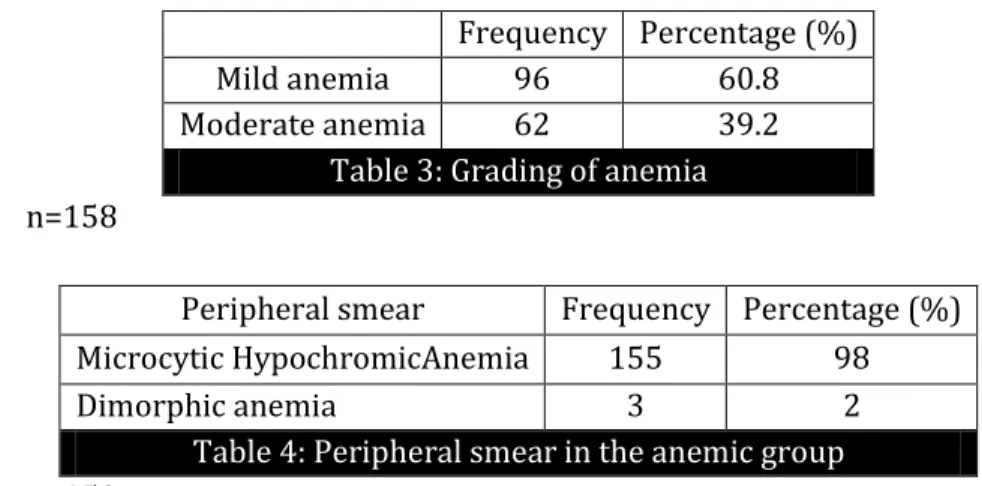
By WHO standards 60.7% were anemic. Mild anemia was noted in 60.8% and moderate anemia in 39.2% of the total anemic children. There were no cases of severe anemia. Most of the anemic children were having Microcytic Hypochromic anemia. In children who were not anemic the
average intake of cow’s milk was only 4 ml per day as against ml per day in the kids with
moderate anemia (P < 0.005). We also found a significant relationship between time of introduction of animal milk and development of anemia.
Frequency Percentage (%)
Present 158 60.7
Absent 102 39.3
Table 1: Prevalence of anemia n= 260
The prevalence of anemia in the study group was 60.7%.
Protein Energy Malnutrition (PEM)
Frequency Percentage
Grade I PEM 24 9.2
No PEM 236 90.8
Journal of Evolution of Medical and Dental Sciences/Volume 2/Issue 52/ December 30, 2013 Page 10264 Only 24 children (9.2%) had grade I PEM according to the Indian Academy of Pediatrics(IAP). There were no cases of grade II, III or IV PEM.
Frequency Percentage (%)
Mild anemia 96 60.8
Moderate anemia 62 39.2
Table 3: Grading of anemia n=158
Peripheral smear Frequency Percentage (%) Microcytic HypochromicAnemia 155 98
Dimorphic anemia 3 2
Table 4: Peripheral smear in the anemic group n=158
Most of the anemic children were having microcytic hypochromic anemia.
Number Animal milk
Mean(ml/day) S.D
Not anemic 88 47.324 23.719
Mild anemia 92 96.86 53.3279
Moderate anemia 60 118.96 65.0739
Table 5: Relation between consumption of animal milk and anemia n=240
In 88 children who were not anemic the average intake of cow’s milk was only 4 ml per day as against 118 ml per day in the 60 kids with moderate anemia.
DISCUSSION: A wide range in the prevalence of anemia among infants and children has been reported from developing and developed countries. This is mainly due to the differences in the age group studied, various criteria and methodologies adopted for diagnosing anemia and the different levels of socio-economic status.
Studies from developing countries show a high prevalence. The study from Delhi by Deekshi Kapur et al3 showed the prevalence of anemia among children 9-36 months of age to be 64% with no male/female preponderance. This corresponds to the present study where the prevalence was 60.7% and there was also no significant gender difference. But 7.8% cases had severe anemia in the study from Delhi as against no cases of severe anemia in the present study.
A study by Yip R, Keller W et al 4 observed the prevalence of anemia as 65.5% in 6 to 12 months old infants among the underprivileged.
Journal of Evolution of Medical and Dental Sciences/Volume 2/Issue 52/ December 30, 2013 Page 10265 Nutritional status of the child was not significantly associated with the development of anemia in the present study. But the study was conducted in apparently healthy children and there were only 24 cases of grade I PEM with no cases of grade II, III or grade IV PEM. A study by De Almeida et al6 did not find any influence by the anthropometric measurements on hemoglobin values, and the study population showed low prevalence of under nutrition. Another study by Mahu JL, Valteau et al7, also observed no correlation between anemia and anthropometric indicators. These studies are comparable with the present study.
There was a significant correlation between the amount of consumption of animal milk and the prevalence of anemia in the present study. The average consumption of animal milk in children without anemia is only 47ml per day as against 118 ml per day in children with anemia.
This observation was found in other studies also including those from Delhi3 and Montreal8. Most of the children with anemia were showing microcytic hypochromic picture in the peripheral smear. There were only 3 cases of dimorphic anemia. This is in contrast to the study by Deekshi Kapur et al where the dimorphic anemia was present in 1/3rd of cases. But then most of the children in the present study were having normal nutritional status as dimorphic anemia is commonly seen in malnutrition.
Among the various factors analyzed, two factors found to be influencing the development of anemia significantly in 6-15 months of age were,
1. The introduction of animal milk at an early age. 2. The amount of animal milk consumed.
CONCLUSIONS:
1. The prevalence of anemia in apparently healthy children aged 6 to 15 months were found to be 60.7%.
2. Mean birth weight of children with anemia was 2.97 kg and of those without anemia was 3.008 kg. There is no significant difference between the birth weight of anemic and non-anemic children.
3. 98% of the anemic children were having microcytic hypochromic anemia in the peripheral smear; 2% were showing a dimorphic picture.
4. The two factors which were found to be associated significantly with anemia are: a) Introduction of animal milk (cow’s milk being commonly used) at an early age. b) The amount of animal milk consumed.
5. The period of introduction of complementary feed was not significantly associated with
anemia in the present study. Our cultural practice is to add cow’s milk during this period and
since the study has shown the relation of anemia and introduction of Cow’s milk at an early age, it is advisable to delay the introduction of cow’s milk to the complementary food. Other dietary parameters like consumption of tea, green leafy vegetables and fruits were not significantly associated with the development of anemia.
Since it is a prevalence study the sample size may be too small to extrapolate to the population.
REFERENCES:
1. Forfar & Arneil’s Textbook of paediatrics, 6th Edn. 21:1060.
Journal of Evolution of Medical and Dental Sciences/Volume 2/Issue 52/ December 30, 2013 Page 10266 3. Deekshi Kapur, Kailash N. Agarwal, Sushama Sharma et al. Ind ped 2002;39:136 – 144.
4. Yip R, Keller W, Woodruff B et al. Report of the UNRWA nutrition survey. WHO East Medt Reg. Off. 1990.
5. Carlos A.N. A.N.de Almeilda, Rubens G. Ricco, Luiz A.Del Ciampo et al. J. pediatr (Rio de J) vol. 80 No.3 porto Alegre May/June 2004.
6. De Almeida CAN, Ricco RG, Del Ciampo LA, souza AM, Dutra de Oliveira JE. Growth and haematological studies on Brazilian children of low socioeconomic level. Arch Latinoam Nutr. 2001; 51:230 – 5.
7. Mahu JL, Valteau D, Suquet JP, Meskens C, Saly JC, Lebas J.Prevalence and etiology of anemia in Reunion: comparative study of hematological, biochemical and anthropometric parameters, parasitic and clinical status of anaemic and non – anaemic children. Nutr Res.1998; 8:733 – 44. 8. Lehmann F, Gray – Donald et al. CMAJ. 1992 May 1; 146(9): 1571-7.
AUTHORS: 1. Fysal N. 2. P.M. Kutty
PARTICULARS OF CONTRIBUTORS:
1. Associate Professor, Department of Pediatrics, MES Medical College, Perinthalmanna, Malappuram DT, Kerala.
2. Professor & HOD, Department of Pediatrics, MES Medical College, Perinthalmanna, Malappuram DT, Kerala.
NAME ADDRESS EMAIL ID OF THE CORRESPONDING AUTHOR: Dr.Fysal N.,
Associate Professor, Department of Pediatrics,
MES Medical College, Perinthalmanna, Malappuram DT, Kerala.