www.reumatologia.com.br
REVISTA BRASILEIRA DE
REUMATOLOGIA
Original article
Profi le of the use of disease modifying drugs in the Brazilian
Registry of Spondyloarthritides
Charles L. Kohem
a, Adriana B. Bortoluzzo
b, Célio R. Gonçalves
c,
José Antonio Braga da Silva
d, Antonio Carlos Ximenes
e, Manoel B. Bértolo
f,
Sandra L.E. Ribeiro
g, Mauro Keiserman
h, Rita Menin
i, Thelma L. Skare
j, Sueli Carneiro
k,
Valderílio F. Azevedo
l, Walber P. Vieira
m, Elisa N. Albuquerque
n,Washington A. Bianchi
o,
Rubens Bonfi glioli
p, Cristiano Campanholo
q, Hellen M. S. Carvalho
r,
Izaias Pereira da Costa
s, Angela L. B. Pinto Duarte
t, Nocy H. Leite
u, Sonia A. L. Lima
w,
Eduardo S. Meirelles
x, Ivânio A. Pereira
y, Marcelo M. Pinheiro
z, Elizandra Polito
A,
Gustavo G. Resende
B, Francisco Airton C. Rocha
C, Mittermayer B. Santiago
D,
Maria de Fátima L. C. Sauma
E, Valéria Valim
F, Percival D. Sampaio-Barros
c,*
a Universidade Federal do Rio Grande do Sul (UFRGS), Porto Alegre, RS, Brazil b Instituto Insper de Educação e Pesquisa, São Paulo, SP, Brazil
c Discipline of Rheumatology, Universidade de São Paulo (USP), SP, Brazil d Universidade de Brasília, Brasília (UnB), DF, Brazil
e Hospital Geral de Goiânia, Goiânia, GO, Brazil
f Universidade Estadual de Campinas (UNICAMP), SP, Brazil g Universidade Federal do Amazonas, Manaus (UFAM), AM, Brazil
h Pontifícia Universidade Católica do Rio Grande do SUL (PUCRS), Porto Alegre, RS, Brazil i Faculdade de Medicina de São José do Rio Preto, São José do Rio Preto, SP, Brazil j Hospital Evangélico de Curitiba, Curitiba, PR, Brazil
k Universidade Federal do Rio de Janeiro (UFRJ), Rio de Janeiro, RJ, Brazil l Universidade Federal do Paraná, Curitiba (UFPR), PR, Brazil
m Hospital Geral de Fortaleza, Fortaleza, CE, Brazil
n Universidade Estadual do Rio de Janeiro (UERJ), Rio de Janeiro, RJ, Brazil o Santa Casa do Rio de Janeiro, Rio de Janeiro, RJ, Brazil
p Pontifícia Universidade Católica de Campinas (PUC-Campinas), Campinas, SP, Brazil q Santa Casa de São Paulo, São Paulo, SP, Brazil
r Hospital de Base, Brasília, DF, Brazil
s Universidade Federal do Mato Grosso do Sul (UFMS), Campo Grande, MS, Brazil t Universidade Federal de Pernambuco (UFPE), Recife, PE, Brazil
u Faculdade de Medicina Souza Marques, Rio de Janeiro, RJ, Brazil w Hospital do Servidor Público Estadual, São Paulo, SP, Brazil
x Instituto de Ortopedia e Traumatologia, Universidade de São Paulo (USP), São Paulo, SP, Brazil y Universidade Federal de Santa Catarina (UFSC), Florianópolis, SC, Brazil
z Universidade Federal de São Paulo (UNIFESP), São Paulo, SP, Brazil A Santa Casa de Belo Horizonte, Belo Horizonte, MG, Brazil
* Corresponding author.
E-mail: [email protected] (P.D. Sampaio-Barros).
Perfi l do uso de drogas modifi cadoras de doença no registro brasileiro de
espondiloartrites
Palavras-chave:
Espondiloartrites Tratamento
Drogas modii cadoras de doença Metotrexato
Sulfasalazina
r e s u m o
Introdução: Poucos estudos avaliaram o peri l do uso de drogas modii cadoras de doença (DMD) em pacientes brasileiros com diagnóstico de espondiloartrite (EpA).
Métodos: Um protocolo comum de investigação foi prospectivamente aplicado em 1505 pacientes classii cados como EpA pelos critérios do Grupo Europeu de Estudo das Es-pondiloartrites (ESSG), acompanhados em 29 centros de referência em Reumatologia no Brasil. Variáveis clínicas e demográi cas foram obtidas e avaliadas, analisando-se suas correlações com o uso das DMD metotrexato (MTX) e sulfasalazina (SSZ).
Resultados: Pelo menos uma DMD foi utilizada por 73,6% dos pacientes, sendo MTX por 29,2% e SSZ por 21,7%, enquanto 22,7% utilizaram ambas as drogas. O uso do MTX foi sig-nii cativamente associado ao acometimento periférico, e a SSZ foi associada ao compro-metimento axial, sendo que as duas drogas foram mais utilizadas, isoladas ou combina-das, no comprometimento misto (p < 0,001). O uso de uma DMD esteve signii cativamente associado à etnia branca (MTX; p = 0,014), lombalgia inl amatória (SSZ; p = 0,002), dor em nádegas (SSZ; p = 0,030), cervicalgia (MTX; p = 0,042), artrite de membros inferiores (MTX; p < 0,001), artrite de membros superiores (MTX; p < 0,001), entesite (p = 0,007), dactilite (MTX; p < 0,001), doença inl amatória intestinal (SSZ; p < 0,001) e acometimento ungueal (MTX; p < 0,001).
Conclusão: O uso de pelo menos uma DMD foi referido por mais de 70% dos pacientes numa grande coorte brasileira de pacientes com EpA, sendo o uso do MTX mais associado ao acometimento periférico e o uso da SSZ mais associado ao acometimento axial.
© 2014 Elsevier Editora Ltda. Todos os direitos reservados.
a r t i c l e i n f o
Article history:
Received 28 January 2013 Accepted 23 June 2013
Keywords:
Sspondyloarthritides Treatment
Disease modifying drugs Methotrexate
Sulfasalazine
a b s t r a c t
Introduction: Few studies have evaluated the proi le of use of disease modifying drugs (DMD) in Brazilian patients with spondyloarthritis (SpA).
Methods: A common research protocol was applied prospectively in 1505 patients classii ed as SpA by criteria of the European Spondyloarthropathies Study Group (ESSG), followed at 29 referral centers in Rheumatology in Brazil. Demographic and clinical variables were obtained and evaluated, by analyzing their correlation with the use of DMDs methotrexate (MTX) and sulfasalazine (SSZ).
Results: At least one DMD was used by 73.6 % of patients: MTX by 29.2 % and SSZ by 21.7%, while 22.7 % used both drugs. The use of MTX was signii cantly associated with peripheral involvement, and SSZ was associated with axial involvement, and the two drugs were more administered, separately or in combination, in the mixed involvement (p < 0.001). The use of a DMD was signii cantly associated with Caucasian ethnicity (MTX , p = 0.014), inl am-matory back pain (SSZ, p = 0.002) , buttock pain (SSZ, p = 0.030), neck pain (MTX, p = 0.042), arthritis of the lower limbs (MTX, p < 0.001), arthritis of the upper limbs (MTX, p < 0.001), enthesitis (p = 0.007), dactylitis (MTX, p < 0.001), inl ammatory bowel disease (SSZ, p < 0.001) and nail involvement (MTX, p < 0.001).
Conclusion: The use of at least one DMD was reported by more than 70% of patients in a large cohort of Brazilian patients with SpA, with MTX use more associated with peripheral involvement and the use of SSZ more associated with axial involvement.
© 2014 Elsevier Editora Ltda. All rights reserved.
B Universidade Federal de Minas Gerais (UFMG), Belo Horizonte, MG, Brazil C Universidade Federal do Ceará (UFC), Fortaleza, CE, Brazil
D Escola de Medicina e Saúde Pública, Salvador, BA, Brazil E Universidade Federal do Pará (UFPa), Belém, PA, Brazil
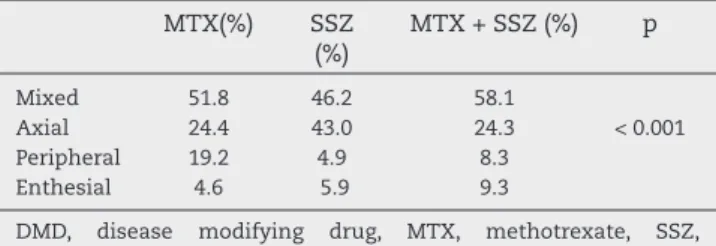
Table 1 – Results of using DMD, according to the clinical picture.
MTX(%) SSZ
(%)
MTX + SSZ (%) p
Mixed 51.8 46.2 58.1
Axial 24.4 43.0 24.3 < 0.001
Peripheral 19.2 4.9 8.3
Enthesial 4.6 5.9 9.3
DMD, disease modifying drug, MTX, methotrexate, SSZ, sulfasalazine.
Introduction
Spondyloarthritides are a group of chronic inl ammatory dis-eases with similar clinical and genetic characteristics, which allows their analysis within the same group. Ankylosing spondylitis (AS) is a disease with predominantly axial clini-cal impairment, while psoriatic arthritis (PA), reactive arthri-tis, arthritis associated with inl ammatory bowel disease and undifferentiated SpA often show an important peripheral in-volvement.1 Recognizing this extension of the concept itself,
SpAs were recently classii ed into axial2 and peripheral3. The
evaluation of Brazilian4 and Latin American5 patients with
SpA reveals that, besides the characteristic axial involve-ment, often a signii cant number of patients with peripheral involvement are detected.
Studies evaluating the treatment of SpA, especially AS6,7
and PA,8,9 show that the use of disease-modifying drugs
(DMD), such as methotrexate, sulfasalazine, and lel unomide,
is related more to the involvement of the peripheral versus
axial involvement.
This study analyzes the prescription of DMD for a large cohort of Brazilian patients with SpA.
Patients and methods
This is a prospective, observational, multicenter study with 1505 patients from 29 referral centers participating in the Reg-istro Brasileiro de Espondiloartrites (RBE). All patients fuli lled the criteria of the European Group for the Study of Spondylo-arthropathies (ESSG).10 Data were collected from June 2006 to
December 2009. The BRS participates in RESPONDIA (Regis-tro Iberoamericano de Espondiloartrites) group, consisting of nine Latin American countries (Argentina, Brazil, Costa Rica, Chile, Ecuador, Mexico, Peru, Uruguay and Venezuela) and the two countries of the Iberian Peninsula (Spain and Portugal) .
The joint investigation protocol included demographic (gender, race, family history, HLA-B27), osteoarticular clinical (inl ammatory back pain, buttock pain, neck pain, hip pain, lower extremity arthritis, arthritis of the lower limbs, en-thesitis, dactylitis), extra-articular clinical (uveitis, inl amma-tory bowel disease [IBD], psoriasis, urethritis), and laboraamma-tory (erythrocyte sedimentation rate - ESR and C-reactive protein - CRP) variables.
Patients were evaluated for treatment with nonsteroidal anti-inl ammatory drugs (NSAIDs), corticosteroids, DMD and biological agents. Regarding the use of DMD, metho-trexate (MTX), sulfasalazine (SSZ) and lel unomide (LFN) were evaluated.
For the diagnosis of AS, New York criteria were used;11
for psoriatic arthritis, the patients had to meet the criteria of Moll and Wright.12 The diagnosis of reactive arthritis was
considered if were present: asymmetric oligoarthritis of the lower limbs with enthesopathies and/or inl ammatory lum-bar pain arousing after enteric or urogenital infection,13 and
spondylitis/arthritis associated with inl ammatory bowel dis-ease, if the patient showed inl ammatory axial features and/ or peripheral joint involvement, associated with coni rmed Crohn's disease or ulcerative colitis.
Statistical analysis. Categorical variables were compared
us-ing χ2 and Fisher exact test, and continuous variables were
compared using ANOVA. A value of p <0.05 was considered signii cant, and 0.05> p> 0.10 was considered as statistical trend.
Results
Data analysis revealed that at least one DMD was used by 73.6% of patients; 51.9% reported the use of MTX - 29.2% as monotherapy and 22.7% with SSZ; and 44.4% used SSZ, of whom 21.7% as monotherapy. The use of lel unomide was re-ported by 0.2% of patients; for this reason, this agent was not included in the statistical analysis.
With respect to joint involvement, MTX was signii cantly associated with peripheral involvement and SSZ was asso-ciated with axial involvement, and the two drugs were used more often, as monotherapy or in combination, in the mixed involvement (p < 0.001) (Table 1).
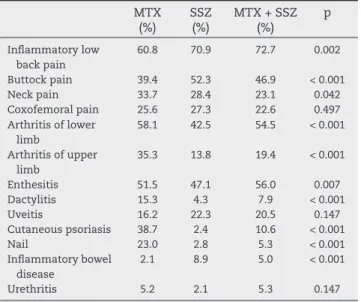
The demographic variables showed that MTX was associ-ated with Caucasian ethnicity (p = 0.014). Gender, family his-tory and HLA-B27 were not associated with the use of any DMD (Table 2).
With respect to the clinical picture, MTX was signii cantly associated with cervical involvement (p = 0.042), arthritis of the lower limbs (p < 0.001), arthritis of the upper limbs (p < 0.001), cutaneous psoriasis (p < 0.001), dactylitis (p < 0.001) and nail involvement (p < 0.001). By the other hand, SSZ was associated with inl ammatory back pain (p = 0.002), buttock pain (p = 0.030) and inl ammatory bowel disease (p < 0.001), while the use of both drugs was associated with enthesites (p = 0.007). Coxofemoral pain, anterior uveitis and urethritis showed no association with the use of DMD (Table 3).
Discussion
Tur-key revealed that 77.5% received SSZ and 15% MTX, and 9% received anti-TNF agents.14
The use of MTX has been studied in AS in the past two decades. Considering in general that its use is indicated for patients with predominantly axial involvement, the clinical response was not favorable;15-17 the only two studies that
dem-onstrated a better response to MTX were Latin American: one Brazilian18 and one Mexican.19 Also, the use of MTX for short
period of time (16 weeks) might not be enough for the desired effect of the medication. On the other hand, MTX has been
used for over 50 years in PA patients, with good results,21-23
being the basal drug of i rst choice.
The present study coni rmed this trend of MTX use in cases of peripheral involvement, associated or not with axial involve-ment. Statistical association with arthritis of the lower and up-per limbs was noted. The association with Caucasians seems to be related to the presence of psoriasis and its sequels (dacty-litis and nail involvement) as shown in the literature. 24,25
Sulfasalazine is the most commonly used conventional
DMD in AS.6 Its use in AS comes from the 1980s, and its main
action would be in cases of associated peripheral involve-ment.26,27 The same action proi le is observed in PA.28-30 SSZ is
also used in the case of reactive arthritis with gastrointestinal etiology31 and in the arthritides associated with inl ammatory
bowel disease.32.33 In contrast to what is traditionally observed
in the literature, the use of SSZ in the present study was asso-ciated with axial involvement, particularly inl ammatory low back pain and buttock pain, and with enteropathic arthritis.
However, although SSZ is signii cantly more used than MTX in patients with inl ammatory bowel disease, it is note-worthy that less than 9% of patients with this type of impair-ment were using SSZ. The explanation for this use in patients with axial involvement lies in the fact that many rheumatol-ogy services in Brazil use empirically at least one DMD, pref-erably SSZ, in patients with AS, before prescribing biological agents, since we have an impressive number of patients with mixed (axial and peripheral) joint involvement. Regarding the entheseal involvement, quite frequent in our series,34 is
com-mon practice the prescription of both MTX and SSZ, as com- mono-therapy or in combination, for its treatment.
Conl icts of interest
The authors declare no conl icts of interest.
The electronic form of the Brazilian Registry of Spondy-loarthritis is maintained by an unrestricted grant of Wyeth / Pi zer Brazil, who did not interfere in the data management and statistics. Dr. Sampaio-Barros received a research grant from Federico Foundation, Switzerland.
R E F E R E N C E S
1. Sieper J, Rudwaleit M, Baraliakos X, Brandt J, Braun J, Burgos-Vargas R, et al. The Assessment of SpondyloArthritis international Society (ASAS) handbook: A guide to assess spondyloarthritis. Ann Rheum Dis 2009; 68 (Suppl. II): ii1-ii44. 2. Rudwaleit M, van der Heijde D, Landewé R, Listing J,
Brandt J, Braun J, et al. The development of Assessment of SpondyloArthritis international Society classii cation criteria for axial spondyloarthritis (part II): validation and i nal selection. Ann Rheum Dis 2009; 68: 770-76.
3. Rudwaleit M, van der Heijde D, Landewé R, Akkoc N, Brandt J, Chou CT et al. The development of Assessment of SpondyloArthritis international Society classii cation criteria for peripheral spondyloarthritis. Ann Rheum Dis 2011; 70: 25-31.
4. Sampaio-BarrosPD, GonçalvesCR, Braga da Silva JA, Ximenes AC, Azevedo VC, Bianchi WA. Registro Iberoamericano de Espondiloartritis (RESPONDIA): Brasil. Reumatol. Clin. 2008; 4 (Supl. 4): 30-35.
5. Benegas M, Muñoz-Gomariz E, Font P, Burgos-Vargas R, Chaves J, Palleiro D, et al. Comparison of the clinical expression of patients with ankylosing spondylitis from Europe and Latin America. J Rheumatol 2012; 39: 2315-2320.
6. Braun J, van den Berg R, Baraliakos X, Boehm H, Burgos-Vargas R, Collantes-Estevez E, et al. 2010 Update of the ASAS / EULAR recommendations for the management of ankylosing spondyltis. Ann Rheum Dis 2011; 70: 896-904.
7. Sampaio-Barros PD, Pinheiro MM, Ximenes AC, Meirelles ES, Keiserman M, Azevedo VF et al. Recomendações sobre o tratamento da espondilite anquilosante. Rev Bras Reumatol 2013; 53: 242-57.
Table 2 – Results of using DMD, according to epidemiological data.
MTX (%)
SSZ (%)
MTX + SSZ (%)
p
Gender – Male 68.6 74.0 75.4 0.161 – Female 31.4 26.0 24.6
Race – Caucasian 70.2 65.1 61.0 0.014 – Non
Caucasian
29.8 34.9 39.0
Family history 83.6 81.7 82.1 0.734 HLA-B27 – Positive 66.3 70.1 75.4 0.115
– Negative 33.7 29.9 246
DMD, disease modifying drug; MTX, methotrexate; SSZ, sulfasalazine.
Table 3 – Results of using DMD, according to the clinical data.
MTX (%)
SSZ (%)
MTX + SSZ (%)
p
Inl ammatory low back pain
60.8 70.9 72.7 0.002
Buttock pain 39.4 52.3 46.9 < 0.001
Neck pain 33.7 28.4 23.1 0.042
Coxofemoral pain 25.6 27.3 22.6 0.497 Arthritis of lower
limb
58.1 42.5 54.5 < 0.001
Arthritis of upper limb
35.3 13.8 19.4 < 0.001
Enthesitis 51.5 47.1 56.0 0.007
Dactylitis 15.3 4.3 7.9 < 0.001
Uveitis 16.2 22.3 20.5 0.147
Cutaneous psoriasis 38.7 2.4 10.6 < 0.001
Nail 23.0 2.8 5.3 < 0.001
Inl ammatory bowel disease
2.1 8.9 5.0 < 0.001
Urethritis 5.2 2.1 5.3 0.147
8. Gossec L, Smolen JS, Gaujoux-Viala C, Ash Z, Marzo-Ortega H, van der Heijde D, et al. European League Against Rheumatism recommendations for the management of psoriatic arthritis with pharmacological therapies. Ann Rheum Dis 2012; 71: 4-12.
9. Carneiro S, Azevedo VF, Boni glioli R, Ranza R, Gonçalves CR, Keiserman CR et al. Recomendações sobre o tratamento da artrite psoriásica. Rev Bras Reumatol 2013; 53: 227-41. 10. Dougados M, van der Linden S, Julin R, Huitfeld B, Amor
B, Calin A et al. The European Spondyloarthropathy Study Group preliminary criteria for the classii cation of spondyloarthropathy. Arthritis Rheum 1991; 34: 1218-27. 11. van der Linden S, Valkenburg HA, Cats A. Evaluation of
diagnostic criteria for ankylosing spondylitis. A proposal for modii cation of the New York criteria. Arthritis Rheum 1984; 27: 361-8.
12. Moll JMH, Wright V. Psoriatic arthritis. Semin Arthritis Rheum 1973; 3: 55-78.
13. Kingsley G, Sieper J. Third International Workshop on Reactive Arthritis, 23-26 September 1995, Berlin, Germany. Ann Rheum Dis 1996; 55: 564-84.
14. Bodur H, Ataman S, Akbulut L, Evcik D, Kavuncu V, Kaya T, et al. Characteristics and medical management of patients with rheumatoid arthritis and ankylosing spondylitis. Clin Rheumatol 2008; 27: 1119-25.
15. Altan L, Bingöl U, Karakoç Y, Aydiner S, Yurtkuran M, Yurtkuran M. Clinical investigation of methotrexate in the treatment of ankylosing spondylitis. Scand J Rheumatol 2001; 30: 255-9.
16. Marshall RW, Kirwan JR. Methotrexate in the treatment of ankylosing spondylitis. Scand J Rheumatol 2001; 30: 313-4. 17. Roychowdhury B, Bintley-Bagot S, Bulgen DY, Thompson RN,
Tunn EJ, Moots RJ. Is methotrexate effective in ankylosing spondylitis? Rheumatology (Oxford) 2002; 41:1330-2. 18. Sampaio-Barros PD, Costallat LT, Bertolo MB, Marques-Neto
JF, Samara AM. Methotrexate in the treatment of ankylosing spondylitis. Scand J Rheumatol 2000; 29: 160-2.
19. Gonzalez-Lopez L, Garcia-Gonzalez A, Vazquez-Del-Mercado M, Muñoz-Valle JF, Gomez-Nava JI. Efi cacy of methotrexate in ankylosing spondylitis: a randomized, double blind, placebo controlled trial. J Rheumatol 2004; 31:1568-74.
20. Haibel H, Brandt HC, Song IH, Brandt A, Listing J, Rudwaleit M, Sieper J. No efi cacy of subcutaneous methotrexate in active ankylosing spondylitis: a 16-week open-label trial. Ann Rheum Dis. 2007; 66: 419-21.
21. Abu-Shakra M, Gladman DD, Thorne JC, Long J, Gough J, Farewell VT. Long-term methotrexate therapy in psoriatic arthritis: clinical and radiological outcome. J Rheumatol 1995; 22: 241-5.
22. Scarpa R, Peluso R, Atteno M, Manguso F, Spanò A, Iervolino S, et al. The effectiveness of a traditional therapeutical approach in early psoriatic arthritis: Results of a pilot
randomised 6-month trial with methotrexate. Clin Rheumatol 2008; 27: 823-6.
23. Lie E, van der Heijde D, Uhlig T, Heiberg MS, Koldingsnes W, Rødevand E, et al. Effectiveness and retention rates of methotrexate in psoriatic arthritis in comparison with methotrexate-treated patients with rheumatoid arthritis. Ann Rheum Dis 2010; 69: 671-6.
24. Chandran V, Raychaudhuri SP. Geoepidemiology and environmental factors of psoriasis and psoriatic arthritis. J Autoimm 2010;34:314-21.
25. Skare TL, Bortoluzzo AB, Gonçalves CR, Braga da Silva JA, Ximenes AC, Bértolo MB, et al. Ethnic inl uence in clinical and functional measures of Brazilian patients with spondyloarthritis. J. Rheumatol 2012; 39: 141-7.
26. Clegg DO, Reda DJ, Weisman MH, Blackburn WD, Cush JJ, Cannon GW, et al. Comparison of sulfasalazine and placebo in the treatment of ankylosing spondylitis. A Department of Veterans Affairs Cooperative Study. Arthritis Rheum 1996; 39: 2004-12.
27. Chen J, Liu C. Is sulfasalazine effective in ankylosing spondylitis? A systematic review of randomized controlled trials. J Rheumatol 2006; 33: 722-31.
28. Gupta AK, Grober JS, Hamilton TA, Ellis CN, Siegel MT, Voorhees JJ, et al. Sulfasalazine therapy for psoriatic arthritis: a double blind, placebo controlled trial. J Rheumatol 1995; 22: 894-8.
29. Combe B, Goupille P, Kuntz JL, Tebib J, Lioté F, Bregeon C. Sulphasalazine in psoriatic arthritis: a randomized, multicentre, placebo-controlled study. Br J Rheumatol 1996; 35: 664-8.
30. Clegg DO, Reda DJ, Mejias E, Cannon GW, Weisman MH, Taylor T, et al. Comparison of sulfasalazine and placebo in the treatment of psoriatic arthritis. A Department of Veterans Affairs Cooperative Study. Arthritis Rheum 1996; 39: 2004-12. 31. Clegg DO, Reda DJ, Weisman MH, Cush JJ, Vasey FB,
Schumacher HR Jr, et al. Comparison of sulfasalazine and placebo in the treatment of reactive arthritis (Reiter’s syndrome). A Department of Veterans Affairs Cooperative Study. Arthritis Rheum 1996; 39: 2021-7.
32. Brazilian Study Group of Inl ammatory Bowel Diseases. Consensus guidelines for the management of inl ammatory bowel disease. Arq Gastroenterol 2010; 47: 313-25.
33. D’Haens GR, Panaccione R, Higgins PD, Vermeire S, Gassull M, Chowers Y, et al. The London Position Statement of the World Congress of Gastroenterology on Biological Therapy for IBD with the European Crohn’s and Colitis Organization: When to start, when to stop, which drug to choose, and how to predict response? Am J Gastroenterol 2011; 106: 199-212.