http://www.uem.br/acta ISSN printed: 1679-9275 ISSN on-line: 1807-8621
Doi: 10.4025/actasciagron.v34i4.14551
Acta Scientiarum. Agronomy Maringá, v. 34, n. 4, p. 431-437, Oct.-Dec., 2012
Morphophysiological characterization in artichoke accessions
aimed at selecting materials for
in natura
consumption
Angélica Reolon da Costa1*, Magali Ferrari Grando1, Simone Meredith Scheffer-Basso1 and Vanina Pamela Cravero2
1
Universidade de Passo Fundo, Faculdade de Agronomia e Medicina Veterinária, Cx. Postal 611, 99001-070, Passo Fundo, Rio Grande do Sul, Brazil. 2
Universidade Nacional de Rosario, Faculdade de Ciências Agrarias, Zavalla, Santa Fe, Argentina. *Author for correspondence. E-mail: [email protected]
ABSTRACT. A morphophysiological characterization of 19 accessions within an artichoke germplasm
collection was conducted with the aim of determining genetic variability and to select materials suitable for in natura consumption to be used in genetic breeding. The collection was composed of commercial accessions, materials collected in South Brazil, and of foreign origin. Twenty quantitative, five multicategorical and two binary traits were evaluated. Quantitative data were submitted to a multivariate analysis. Genetic variability was observed for almost all characteristics. The traits with the greatest relative contribution to genetic divergence, which accounted for 79.54% of the variability, were as follows: the thickness and diameter bottom, bottom fresh mass/head fresh mass ratio, external bract length, bracts base, leaves and primary head height and plant diameter, primary head diameter and bracts base thickness. A cluster analysis revealed four groups. Group I aggregated the accessions with characteristics for fresh consumption. The best accessions were Romanesco 1, Green Globe, and Improved Green Globe, all of which exhibited plants with a greater fresh mass, larger primary head diameter, greater fresh mass and bottom diameter, circular head shape, no thorns, round head tip and desired color, that are important traits for selection of superior genotypes for in natura consumption.
Keywords:Cynara cardunculus var. scolymus (L.) Fiori, genetic variability, germplasm, multivariate analysis.
Caracterização morfofisiológica em acessos de alcachofra visando à seleção de materiais
para consumo
in natura
RESUMO. Foi caracterizada morfofisiologicamente uma coleção de germoplasma de 19 acessos de
alcachofra, visando acessar a variabilidade genética e selecionar materiais aptos ao consumo in natura para o melhoramento genético. A coleção foi constituída por acessos comerciais, materiais coletados no sul do Brasil e de origem internacional. Vinte caracteres quantitativos, cinco multicategóricos e dois binários foram avaliados. Os dados quantitativos foram submetidos à análise multivariada. Foi observada variabilidade genética para quase todas as características estudadas. Os caracteres com maior contribuição relativa para a divergência genética foram espessura e diâmetro do fundo; razão massa fresca do fundo/massa fresca do capítulo; comprimento da bráctea externa, base das brácteas, folhas e capítulo primário; altura e diâmetro da planta; diâmetro do capítulo primário e espessura da base das brácteas, representando 79,54% da variabilidade. Quatro grupos foram formados pela análise de agrupamento. O grupo I reuniu o maior número de acessos com características para o consumo in natura. Os melhores acessos foram Romanesca 1, Verde Redonda e Verde Redonda Melhorada, pois apresentaram plantas com maior massa fresca e diâmetro de capítulos primários, massa fresca e diâmetro do fundo, capítulo circular, sem espinhos e coloração desejada, características importantes na seleção de genótipos superiores ao consumo in natura.
Palavras-chave: Cynara cardunculus var. scolymus (L.) Fiori, variabilidade genética, germoplasma, análise multivariada.
Introduction
Theartichoke is a vegetable consumed in natura or industrialized. For in natura consumption, the fleshy bracts and the floral receptacle form the edible part of the artichoke. This crop also contains interesting medicinal properties, which benefit
as a forage plant in animal feed (IERNA; MAUROMICALE, 2010). Thus, the purpose of the artichoke can be considered in three areas: as a nutritional source, as a pharmaceutical and bioenergy source, and as an innovative crop for sustainable and economic development.
Italian immigrants first introduced the artichoke to Brazil. Currently, the State of São Paulo is Brazil’s largest producer of artichokes, and the most widely grown in this region is cv. Roxa de São Roque, destined for in natura consumption (FILHO et al., 2009). In Southern Brazil, the cv. Nobre is cultivated exclusively for industrial purposes, and the genotypes adapted to the environmental conditions and possessing favorable characteristics for in natura consumption are scarce.
The genetic variability in this culture allows for the selection of superior genotypes that can be used as progenitors in the creation of hybrids and the development of new varieties (COINTRY et al., 1999) as well as in cloning because this species might be sexually or asexually reproduced. Therefore, knowledge of the genetic variability in a population with regard to characters of agronomic interest is fundamental to use the characters as selective criteria (ASPRELLI et al., 2001; CRAVERO et al., 2002).
The characterization is based on morphological descriptors, which enable the characterization and differentiation of accessions. For the artichoke, 57 vegetative, phenologic, and yield traits were established as descriptors for the characterization of cultivars (UPOV, 2001).
To satisfy the demands of the consumer market, the selection of plants for genetic breeding demands an analysis of a large number of characteristics (CRAVERO et al., 2002). A multivariate statistical analysis fulfills this need because it allows for an estimation of the genetic divergence between the accessions and their division in groups according to the degree of similarity among them (CRUZ, 2006). The objective of this study was to conduct a characterization of the artichoke germplasm to determine the genetic variability and select accessions with the desirable traits for in natura consumption.
Material and methods
The evaluated germplasm collection was composed of accessions from the domestic gardens of rural properties in Rio Grande do Sul State, Brazil, and from commercial varieties and some foreign materials, which were established by seeds (sexually propagation) or buds (asexually
propagation). The treatments were composed of 19 artichoke accessions (Table 1), represented by individual plants with varied numbers of replications. The experimental design used was a completely randomized design, with 0.60 x 1.00 m spacing between plants.
The study was conducted in Passo Fundo, Rio Grande do Sul State – Brazil at 28°15’ S, 52º24’W, 687 m of altitude, between April and December, 2009.
The accessions were evaluated when the primary head (capitulum or inflorescence) reached commercial stage, D stage (FOURY, 1967), and they were characterized according to the artichoke descriptors established by Upov (2001). Twenty quantitative, five multicategorical, and two binary traits were used. The quantitative characteristics were the plant height, measured from the base to the top of the primary head; the plant diameter, measured from one end to the other of the lower leaf level; the floral peduncle length, measured from the plant base to the primary head insertion; the main stem diameter, measured 10 cm from the primary head insertion; the number of leaves at harvest; the length of the biggest leaf; leaf width, measured from the middle part of the blade; the number of lateral buds formed after harvest; the fresh mass, primary head length and diameter; the outer bract length; the length, width and thickness of the edible parts of the bracts (bract base selected from the fourth row of the main head); the thickness, fresh mass and diameter of the bottom; the number of secondary heads per plant; and the ratio of bottom fresh mass to primary head fresh mass.
Table 1. Identification, origin, establishment, color of head and the number of plants evaluated for each of the 19 accessions of the germplasm collection.
Identification Origin Establishment Color Nº of plants Violet de Sicilia Italy Seeds Purple 3 Romanesco 1 Argentina Buds Purple 10 Romanesco 2 Argentina Buds Purple 6 Purple of Romagna Commercial seed Seeds Purple 5 Purple Globe Commercial seed Seeds Purple 6 Roman Violet Commercial seed Seeds Purple 6
Espumoso 1 Espumoso Seeds Green 21
Espumoso 2 Espumoso Buds Green 16
Espumoso 3 Espumoso Buds Green 3
Espumoso 4 Espumoso Buds Green 4
Erechim Erechim Buds Green 21
Passo Fundo 1 Passo Fundo Buds Green 5
Colorado Colorado Buds Green 20
Passo Fundo 2 Passo Fundo Buds Green 6
Israel 3 Israel Seeds Purple 6
Israel 4 Israel Seeds Purple 3
Israel 20 Israel Seeds Purple 4
Green Globe (GG) Commercial seed Seeds Green 20 Improved GG Commercial seed Seeds Green 40
Acta Scientiarum. Agronomy Maringá, v. 34, n. 4, p. 431-437, Oct.-Dec., 2012
elliptical, oval, triangular and large transverse elliptical (Figure 1); (2) the head tip shape: acute, rounded, flat, and depressed; (3) the outer bract tip shape: acute, flat, and emarginated; (4) the external color of the bract: green, violet-striped green, green-striped violet, mainly violet and totally violet; and (5) the anthocyanic pigmentation of the petiole: absent, weak, moderate, strong, and very strong. The binary characteristics were (1) the presence and absence of a curvature of the bract tip and (2) the presence and absence of thorns on the bracts.
Figure 1. Frontal view of the primary head, assessed according to its shape: circular (1), elliptical (2), oval (3), triangular (4), and large transverse elliptical (5). Source: Upov (2001).
The quantitative data were submitted to a variance analysis and then followed by a multivariate analysis in which the Mahalanobis distance matrix, the relative contribution of different characters towards genetic divergence and, using Ward’s method, a dendrogram were obtained. The results of a grouping analysis were compared through an analysis of variance. The averages were then compared using Tukey’s test (which has a 5% error probability), in which the groups constituted the treatments and the accessions constituted the replication. The statistical analyses were performed with Genes (CRUZ, 2001) and COSTAT (COHORT SOFTWARE, 2003) statistical software. For the multicategorical and binary variables, no statistical analysis was applied; only the accession characterization was conducted.
Results and discussion
For 19 of the 20 quantitative traits evaluated, the variance analysis indicated differences between the accessions (p < 0.05 and p< 0.01). The leaf number was the only trait that did not differ between them (data not shown). These results indicated the existence of a genetic variability in this collection.
Besides this pioneering work in Brazil, other studies referring to morphophysiological and molecular diversity were performed in the Mediterranean regions (the center of artichoke diversity), showing intra- and inter-population variability (CRINO et al., 2008; MAURO et al., 2009;
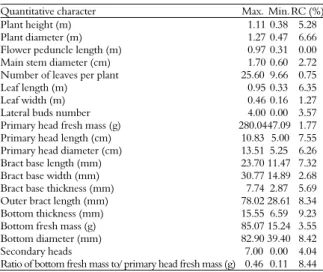
PORTIS et al., 2005). Genetic diversity has also been observed in countries where this crop has been introduced, such as in Argentina (ASPRELLI et al., 2001; COINTRY et al., 1999; CRAVERO et al., 2002). The morphological characters that contributed the most to genetic diversity in this study were bottom thickness, bottom fresh mass/head fresh mass ratio, bottom diameter, outer bract length, primary head length, bract base length, plant diameter, leaf length, primary head diameter, bract base thickness and plant height. These characters represented 79.54% of the variability present in the germplasm (Table 2).
Table 2. Width and relative contribution (RC) of quantitative characters for genetic diversity (SINGH, 1981) for 19 artichoke accessions (non-standardized data).
Quantitative character Max. Min. RC (%)
Plant height (m) 1.11 0.38 5.28
Plant diameter (m) 1.27 0.47 6.66
Flower peduncle length (m) 0.97 0.31 0.00 Main stem diameter (cm) 1.70 0.60 2.72 Number of leaves per plant 25.60 9.66 0.75
Leaf length (m) 0.95 0.33 6.35
Leaf width (m) 0.46 0.16 1.27
Lateral buds number 4.00 0.00 3.57
Primary head fresh mass (g) 280.0447.09 1.77 Primary head length (cm) 10.83 5.00 7.55 Primary head diameter (cm) 13.51 5.25 6.26 Bract base length (mm) 23.70 11.47 7.32
Bract base width (mm) 30.77 14.89 2.68
Bract base thickness (mm) 7.74 2.87 5.69 Outer bract length (mm) 78.02 28.61 8.34
Bottom thickness (mm) 15.55 6.59 9.23
Bottom fresh mass (g) 85.07 15.24 3.55
Bottom diameter (mm) 82.90 39.40 8.42
Secondary heads 7.00 0.00 4.04
Ratio of bottom fresh mass to/ primary head fresh mass (g) 0.46 0.11 8.44
Many of these traits, such as bottom diameter and thickness, bottom fresh mass/head fresh mass ratio, primary head length and diameter, bract base length and diameter, are involved in the head quality for in natura consumption.
However, Mauro et al. (2009) found that the major trait responsible for the morphological variation among the Sicilian ecotypes was primary head fresh mass. Asprelli et al. (2001) reported that the variables associated with head shape and fresh mass, bottom fresh mass and market yield were the main traits explaining the existing variability in one artichoke clone population in Argentina.
The greatest diverging accessions were Romanesco 1 and Israel 4, with a Mahalanobis distance (D2) = 131.68, and the most similar
accessions were Green Globe and Improved Green Globe (D2 = 1.40). Such similarity might be
10 20 30 40 50 60 70 80 90 100 39.73 79.47 119.21 158.95 198.69 238.43 278.17 317.91 357.64 397.38
Figure 2. Similarity dendrogram for the 19 artichoke accessions based on quantitative traits obtained through the Ward method, based on Mahalanobis distance matrix.
The cluster analysis is a suitable tool for evaluating inter-relationships among the variables, allowing identification of genotypes with high homogeneity and allowing their separation into different groups (AMARAL JUNIOR et al., 1996; ARIYO, 1993; SUGIYARTO et al., 1984). For the artichoke, this tool has been used in genetic variability studies in clone population, self-pollination families and hybrids (ASPRELLI et al., 2001; CRAVERO et al., 2002; MAURO et al., 2009).
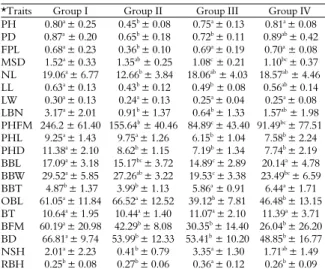
The variance analysis between groups showed the existence of diversity for the most quantitative characteristics (p < 0.01), with the exception of leaf breadth and bottom thickness (Table 3).
Table 3. Trait average and standard deviation for the four groups formed through a clustering analysis.
*Traits Group I Group II Group III Group IV PH 0.80a
± 0.25 0.45b
± 0.08 0.75a
± 0.13 0.81a
± 0.08 PD 0.87a ± 0.20 0.65b ± 0.18 0.72b ± 0.11 0.89ab ± 0.42
FPL 0.68a ± 0.23 0.36b ± 0.10 0.69a ± 0.19 0.70a ± 0.08
MSD 1.52a
± 0.33 1.35ab
± 0.25 1.08c
± 0.21 1.10bc
± 0.37 NL 19.06a ± 6.77 12.66b ± 3.84 18.06ab ± 4.03 18.57ab ± 4.46
LL 0.63a ± 0.13 0.43b ± 0.12 0.49b ± 0.08 0.56ab ± 0.14
LW 0.30a ± 0.13 0.24a ± 0.13 0.25a ± 0.04 0.25a ± 0.08
LBN 3.17a ± 2.01 0.91b ± 1.37 0.64b ± 1.33 1.57ab ± 1.98
PHFM 246.2 ± 61.40 155.64b
± 40.46 84.89c
± 43.40 91.49bc
± 77.51 PHL 9.25a ± 1.43 9.75a ± 1.26 6.15b ± 1.04 7.58b ± 2.24
PHD 11.38a ± 2.10 8.62b ± 1.15 7.19b ± 1.34 7.74b ± 2.19
BBL 17.09a ± 3.18 15.17bc ± 3.72 14.89c ± 2.89 20.14a ± 4.78
BBW 29.52a ± 5.85 27.26ab ± 3.22 19.53c ± 3.38 23.49bc ± 6.59
BBT 4.87b
± 1.37 3.99b
± 1.13 5.86a
± 0.91 6.44a
± 1.71 OBL 61.05a ± 11.84 66.52a ± 12.52 39.12b ± 7.81 46.48b ± 13.15
BT 10.64a ± 1.95 10.44a ± 1.40 11.07a ± 2.10 11.39a ± 3.71
BFM 60.19a ± 20.98 42.29b ± 8.08 30.35b ± 14.40 26.04b ± 26.20
BD 66.81a ± 9.74 53.99b ± 12.33 53.41b ± 10.20 48.85b ± 16.77
NSH 2.01a
± 2.23 0.41b
± 0.79 3.35a
± 1.30 1.71ab
± 1.49 RBH 0.25b ± 0.08 0.27b ± 0.06 0.36a ± 0.12 0.26b ± 0.09
In each row, the averages are followed by the same letter and do not differ from one another in Tukey’s test (with a 5% probability of error). *Plant height (PH), plant diameter (PD), flower peduncle length (FPL), main stem diameter (MSD), number of leaves per plant (NL), leaf length (LL), leaf width (LW), lateral buds number (LBN), primary head fresh mass (PHFM), primary head length (PHL), primary head diameter (PHD), bract base length (BBL), bract base width (BBW), bract base thickness (BBT), outer bract length (OBL), bottom thickness (BT), bottom fresh mass (BFM), bottom diameter (BD), number of secondary heads (NSH), ratio of bottom fresh mass to and primary head fresh mass (RBH).
Group I was composed of accessions with a higher fresh mass and primary head diameter as well as a higher fresh mass and bottom diameter compared to other groups. The fresh mass of the primary head is a good productivity indicator because if the fresh mass and the head diameter are higher, then the bottom is larger, which is an important feature for in natura consumption (Table 3). Thus, Green Globe, Improved Green Globe, Romanesco 1 and Violet de Sicilia could all be selected for in natura consumption. However, the other two accessions belonging to this group, although exhibiting features similar to the other accessions, should be discarded because they possessed thorns.
Group II differed from the other groups because it exhibited a higher primary head length and outer bracts length. The accessions from this group also exhibited an average lower plant height and floral peduncle length (Table 3).
Group III differed from the three other groups because it exhibited a greater bottom fresh mass and primary head fresh mass ratio. Group III also differed from Groups I and II because it demonstrated a greater bract base thickness. However, when compared to Groups I and II, Group III showed a smaller diameter of the main stem, primary head length, bracts base width, and outer bract length (Table 3). This group included only accessions of unknown identity (Espumoso 1, 2 and 3, Erechim, Colorado and Passo Fundo 2), which demonstrated lower values for the main characteristics of selective interest, and should be discarded.
Group IV contained accessions with average values lower than those of group I for main stem diameter, primary head fresh mass and diameter as well as bottom fresh mass and diameter. It also had lower values than those of groups I and II for primary head length, base width and outer bract length.
In a study performed by Cravero et al. (2002), the cluster analysis resulted in the formation of four groups of families evaluated in Argentina, and the best cluster joined together plants presenting a high number of secondary head, primary head fresh mass and diameter and market yield.
Acta Scientiarum. Agronomy Maringá, v. 34, n. 4, p. 431-437, Oct.-Dec., 2012
accessions belonging to Group III, due to exhibiting a greater bottom fresh mass and head fresh mass ratio, bract thickness and a higher number of secondary heads, could be included in crossing blocks aimed at the obtention of improved genotypes for these characteristics in the long term.
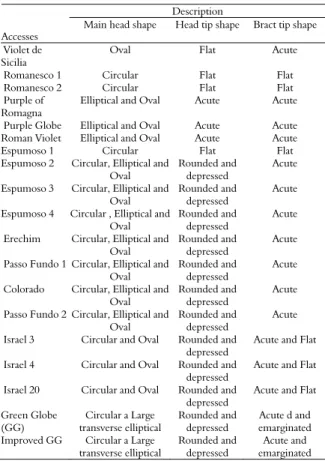
In addition to the quantitative characters, the qualitative, multicategorical, and binary characteristics are important traits to be considered in the selection of materials for in natura consumption because they also contribute to the product quality (BONASIA et al., 2010). With regard to the primary head shape (Figure 1), most accessions exhibited circular heads, which is a desirable characteristic for in natura consumption (Table 4). Heads of elliptical, oval and large transverse elliptical shape were also found. No triangular heads were observed in the collection. A greater variation was observed in relation to the primary head tip shape, with accessions having been found in the four classes described by the Upov (2001).
Table 4. Characterization of artichoke accessions based on multicategorical characters.
Description
Accesses
Main head shape Head tip shape Bract tip shape
Violet de Sicilia
Oval Flat Acute
Romanesco 1 Circular Flat Flat
Romanesco 2 Circular Flat Flat
Purple of Romagna
Elliptical and Oval Acute Acute
Purple Globe Elliptical and Oval Acute Acute Roman Violet Elliptical and Oval Acute Acute
Espumoso 1 Circular Flat Flat
Espumoso 2 Circular, Elliptical and Oval
Rounded and depressed
Acute
Espumoso 3 Circular, Elliptical and Oval
Rounded and depressed
Acute
Espumoso 4 Circular , Elliptical and Oval
Rounded and depressed
Acute
Erechim Circular, Elliptical and Oval
Rounded and depressed
Acute
Passo Fundo 1 Circular, Elliptical and Oval
Rounded and depressed
Acute
Colorado Circular, Elliptical and Oval
Rounded and depressed
Acute
Passo Fundo 2 Circular, Elliptical and Oval
Rounded and depressed
Acute
Israel 3 Circular and Oval Rounded and depressed
Acute and Flat
Israel 4 Circular and Oval Rounded and depressed
Acute and Flat
Israel 20 Circular and Oval Rounded and depressed
Acute and Flat
Green Globe (GG)
Circular a Large transverse elliptical
Rounded and depressed
Acute d and emarginated Improved GG Circular a Large
transverse elliptical
Rounded and depressed
Acute and emarginated
In the collection, 58.5% of the plants exhibited a depressed shape of the primary head tip, which is an undesirable feature in materials destined for in natura
consumption because it enables the infiltration of water and microorganisms, resulting in the compromise of the inner bracts and a consequent diminution of the head quality. The flat and rounded head tip shape are more suitable for commercial use. The accessions presenting these traits are listed in Table 4. Figures 3a and b present details of the head tip shape of flat and depressed types.
Figure 3. Multicategorical and binary traits observed among germplasm collection accessions. Head tip shape: (a) flat, (b) depressed; bract tip curvature: (c) presence, (d) absence; thorns on bracts tip: (e) presence, (f) absence.
In relation to the bract tip shape, the accessions demonstrated acute, flat and emarginated shapes (Table 4). Most accessions presenting a pointed bracts tip had thorns.
Table 5. Characterization of artichoke accessions based on multicategorical and binary characters.
Description Accesses
External color of the bract *PBAP *BTC *TBT Violet de Sicilia Green Weak Absence Absence Romanesco 1 Green-striped Violet Weak Absence Absence Romanesco 2 Violet-striped green or
Green-striped Violet
Weak Absence Absence
Purple of Romagna Mainly violet Strong Absence Presence Purple Globe Mainly violet Strong Absence Presence Violet Romagna Mainly violet Strong Absence Presence Espumoso 1 Green Weak Presence Absence Espumoso 2 Green Weak Presence Presence Espumoso 3 Green Weak Presence Presence Espumoso 4 Green Weak Presence Presence
Erechim Green Weak Presence Presence
Passo Fundo 1 Green Weak Presence Presence
Colorado Green Weak Presence Presence
Passo Fundo 2 Green Weak Presence Presence
Israel 3 Green Weak Presence Presence
Israel 4 Green Weak Presence Presence
Israel 20 Green Weak Presence Absence
Green Globe (GG) Green or Violet-striped green
Weak A or P *A or P
Improved GG Green to Green-striped Violet
Weak A or P *A or P
* PBAP = petiole basis anthocyanic pigmentation; BTC= bract tip curvature; TBT = thorns on bracts tip (P – presence, A – absence).
A primarily violet color was observed in the Purple of Romagna, Purple Globe, and Roman Violet accessions, which composed Group II. These materials could be part of crossing blocks aimed at the incorporation of purple colored genes. According to Cravero et al. (2005), the head color is determined by two pairs of alleles, with an existing complete dominance in each of the loci and a recessive epistatic relation between them.
Regarding the anthocyanic color in the petiole base, the majority of accessions demonstrated weak anthocyanic color, with only the commercial accessions Purple of Romagna, Purple Globe, and Violet Roman exhibiting a strong anthocyanic color in the petiole base (Table 5).
Additionally, regarding the binary characteristic bract tip curvature (Figure 3c and d), most accessions exhibited a normal curvature (no curvature) (Table 5). The presence of a curvature is an undesirable feature for in natura consumption because it can compromise the head quality
Of the plants in the collection, 39% did not have thorns on their bract tips (Figure 3e and f). The accessions with thorns were found in Group III (unknown identity accessions) and in Group II, which was formed by purple varieties. A variability of this characteristic was found among the plants of the Green Globe and Improved Green Globe accessions, which is possibly due to genetic segregation because these plants were established from seeds. In relation to the genetic determination of this trait, the presence and absence of thorns are determined by a dominant gene, with the presence
being determined by the recessive allele (PECAUT; FOURY, 1992). Therefore, the high frequency of accessions with thorns in this segregated population indicates that the frequency of the recessive allele is high. The variability in the bract tip and the presence or absence of thorns were also observed by Pignone and Sonnante (2004).
The results of this study allow for the identification of accessions with the quantitative and qualitative traits desirable for in natura consumption. The Group I accessions (Romanesco 1, Green Globe, and Improved Green Globe) stood out because the plants exhibited a greater fresh mass and diameter of the circular heads, a greater fresh mass and bottom diameter, a circular head, no thorns, a round head tip and a violet-striped or green-striped violet color.
Conclusion
There is genetic variability in the artichoke germplasm collection evaluated that can be useful for breeding program.
It is possible to cluster the accessions in four different groups. Group I brings together accessions with better quantitative traits for in natura consumption.
The most suitable accessions for in natura consumption are Romanesco 1, Green Globe and Improved Green Globe.
References
AMARAL JUNIOR, A. T.; CASALI, V. W. D.; CRUZ, C. D.; FINGER, F. L. Utilização de variáveis canônicas e de análise de agrupamentos na avaliação da divergência genética entre acessos de moranga. Horticultura
Brasileira, v. 2, n. 14, p. 182-184, 1996.
ARIYO, O. J. Genetic diversity in West African Okra (Abelmoschus caillei) multivariated analysis of morphological end agronomic characteristics. Genetic Resources and
Crop Evolution, v. 40, n. 1, p. 25-32, 1993.
ASPRELLI, P. D.; CRAVERO, V. P.; COINTRY, E. L. Evaluation of the variability present in a population of clones of artichoke (Cynara scolymus L.). Revista de
Investigação da Faculdade de Ciências Agrárias, v. 1,
n. 1, p. 27-38, 2001.
BONASIA, A.; CONVERSA, G.; LAZZIZERA, O.; GAMBACORTA, G.; ELIA, A. Morphological and qualitative characterization of globe artichoke head from new seed-propagated cultivars. Journal of the Science of Food
and Agriculture, v. 90, n. 15, p. 2689-2693, 2010.
CECCARELLI, N.; CURADI, M.; PICCIARELLI, P.; MARTELLONI, L.; SBRANA, C.; GIOVANNETTI, M. Globe artichoke as a functional food. Mediterranean
Journal of Nutrition and Metabolism, v. 3, n. 3,
Acta Scientiarum. Agronomy Maringá, v. 34, n. 4, p. 431-437, Oct.-Dec., 2012
COHORT SOFTWARE. Graphics and statistics
software for scientists and engineers. 2003. Available
from: <http://www.cohort.com>. Access on: Dec. 13, 2010. COINTRY, E. L.; LÓPEZ ANIDO, F. S. L; GARCÍA, S. M.; FIRPO, I. T. Genetic breeding of artichoke (Cynara scolymus L.). Avances en Horticultura, v. 4, n. 1, p. 51-60, 1999. CRAVERO, V. P.; ANIDO, F. S. L.; COINTRY, E. L. Characterization and selection of artichoke families through multivariate analysis techniques. Horticultura
Brasileira, v. 20, n. 4, p. 619-625, 2002.
CRAVERO, V. P.; PICARDI, L. A.; COINTRY, E. L. An approach for understanding the heredity of two quality traits (head color and tightness) in globe artichoke (Cynara scolymus L.). Genetic and Molecular Biology, v. 28, n. 3, p. 431-434, 2005.
CRINO, P.; TAVAZZA, R.; MUNOZ, N. R.; NISINI, P. T.; SACCARDO, F.; ANCORA, G.; PAGNOTTA, M. A. Recovery, morphological and molecular characterization of globe artichoke ‘Romanesco’ landraces. Genetic Resources
andCrop Evolution, v. 55, n. 6, p. 823-833, 2008.
CRUZ, C. D. Genes program - windows version. Viçosa: Universidade Federal de Viçosa, 2001.
CRUZ, C. D. Multivariate analysis and simulation. Viçosa: Universidade Federal de Viçosa, 2006.
FILHO, W. P. D.; CAMARGO, A. M. P. D.; CAMARGO, F. P. Artichoke market in São Paulo state and viability of economic production. Informações
Econômicas, v. 39, n. 1, p. 70-75, 2009.
FOURY, C. Study floral biology of artichoke (Cynara scolymus L.). Application in the selection. 1° partie: Donnés sur la biologie florale. Amélior Plantes, v. 17, n. 1, p. 357-373, 1967.
IERNA, A.; MAUROMICALE, G. Cynara cardunculus L. genotypes as a crop for energy purposes in a Mediterranean environment. Biomass and Bioenergy, v. 34, n. 5, p. 754-760, 2010.
LOMBARDO, S. A.; PANDINO, G. A.; MAUROMICALE, G.; KNÖDLER, M.; CARLE, R.; SCHIEBER, A. Influence of genotype, harvest time and plant part on polyphenolic composition of globe artichoke [Cynara cardunculus L. var. scolymus (L.) Fiori]. Food
Chemistry, v. 119, n. 1, p. 1175-1181, 2010.
MACUA GONZÁLES, J. I.; ARCE TUDANCA, P. Vegetative Multiplication. Clonal selection in artichoke.
Jornada Técnica de Alcachofra, v. 1, n. 1, p. 99-106, 1996.
MAURO, R.; PORTIS, E. E.; ACQUADRO, A.; LOMBARDO, S.; MAUROMICALE, G.; LANTERI, S. Genetic diversity of globe artichoke landraces from Sicilian sall-holdings: implications for evolution en domestication. Conservation Genetics, v. 10, n. 2, p. 431-440, 2009.
MAUROMICALE, G.; COPANE, V. Biological and production characteristics of different artichoke isolated clones from the Sicilian population “Violeto di Silicia”.
Técnica Agricola, v. 4, n. 1, p. 1-17, 1989.
MOGLIA, A.; COMINO, C.; LANTERI, S.; DE VOS, R.; WAARD, P.; BEEK, T. V.; GOITRE, L.; RETTA, S. F.; BEEKWILDER, J. Production of novel antioxidative phenolic amides through heterologous expression of the plant’s chlorogenic acid biosynthesis genes in yeast.
Metabolic Engineering, v. 12, n. 1, p. 223-232, 2010.
PECAUT, P.; FOURY, C. L. Artichoke. In: GALLAIS, A.; BANNERD, H. (Ed.). Breeding of crop plants. Paris, 1992. p. 460-470.
PIGNONE, D.; SONNANTE, G. Wild artichokes of south Italy: did the story begin here? Genetic Resources
and Crop Evolution, v. 51, n. 6, p. 577-580, 2004.
PORTIS, E.; MAUROMICALE, M.; BARCHI, L.; MAURO, R.; LANTERI, S. Population structure and genetic variation in autochthonous globe artichoke germplasm from Sicily Island. Plant Science, v. 168, n. 6, p. 1591-1598, 2005.
SINGH, D. The relative importance of characters affecting genetic divergence. The Indian Journal of
Genetics e Plant Breeding, v. 41, n. 2, p. 237-245, 1981.
SUGIYARTO, E.; SOERMATONO, D.; MANGOENDIDJOJO, W. Yield stability analysis in surgancane cultivar trial. Agriculture Science, v. 3, n. 1, p. 315-322, 1984.
UPOV. Guidelines for the conduct of tests for
distinctness, uniformity and stability. Globe Artichoke
(Cynara scolymus L.). TG/183/3. Geneva, 2001.
Received on August 22, 2011. Accepted on January 13, 2012.