The fresco paintings in the narthex of the St. Pan-teleimon church in Nerezi are only partly preserved, and
by their thematical character, they can be divided into 3 groups: the fi rst group consists of fragments of the Life cycle of St. Panteleimon, the second group consists of remnants of the Deesis composition painted over the entrance to the naos. The third group consists of fragments of the scenes in the fi rst zone on the north end of the east wall, as well as the fragment of the imperial scene, which can be linked with the donor composition which was painted in the second
zone on the north end of the east wall.
From the original painted program in the narthex of Nerezi, only a small part is preserved today, however, only in fragments. The fragments of the fresco painting are located on the eastern, southern, and the northern wall of the narthex, and can be classifi ed into three different groups according to their subjects.
The largest number of the fragments belongs to the cycle of scenes that were once representing the Life of St. Panteleimon depicted on the walls of the narthex.1
To the second group belong the fragments from the former compositional unit Deesis with the representations of Jesus Christ, the Mother of God, and St. John the Baptist, de-picted in whole length on the eastern wall, above the entrance into the naos.2
To the third group belong the fragments from the fi rst zone of the eastern wall, to the north of the entrance into the naos, where individual representations of saints in full length were depicted. Only the representation of St. Symeon the Stylite placed on the northern end of the wall can be posi-tively identifi ed, as well as the assumed representation of the Apostle Peter next to the entrance on the northern side.3
According to the existing fragments and their ar-rangement, it can be positively ascertained that the Cycle of St. Panteleimon stretched on the western wall as well, that was damaged the most and almost fully reconstructed in the 1950’s of the 20th century.4
The preserved fragments offer certain indications that on the northern side of the eastern wall in the fi rst zone, four representations were depicted, of which, as we already men-tioned, positively identifi ed is only the one of St. Symeon the Stylite and of one apostle (?). There is a great probability that between the apostle and the Stylite, three more representa-tions of full length saints were depicted, that is, two of them could have been parts of some other composition.
New Elements of the Painted Program in the Narthex
at Nerezi
Donka Bardžieva-Trajkovska
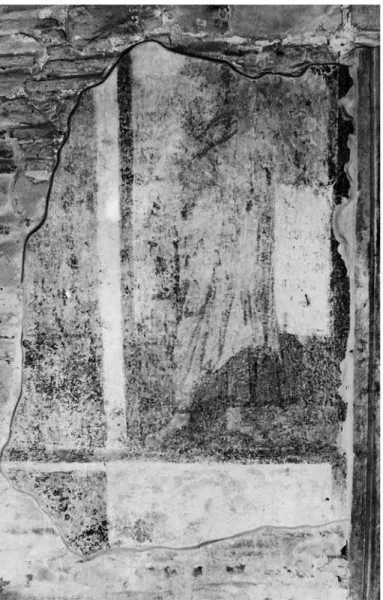
In the se cond zone of the northern part of the eastern wall, at its beginning, probably the most important fragment is preserved, where the lower part of a royal representation is clearly discernible – a purple pillow decorated with precious stones and pearls, as well as the legs of the fi gure, with the end of his robe decorated with precious stones. Some scholars as-sume that here, on this part of the eastern wall, the cycle dedi-cated to St. Panteleimon begins, and what is depicted is actually a fragment of a throne on which emperor Maximian may have been depicted before whom St. Panteleimon was summoned.5 As long as this assumption is considered as a probable one, it should be assumed that the Cycle of St. Panteleimon began in the second zone of the eastern wall, stretched only in that zone and was interrupted with the Deesis composition, to continue further on the whole surface of the southern part of the eastern wall. Such an assumption seems very unlikely because of the actual condition. Namely, the mentioned fragment indicates a frontally positioned royal fi gure, and not a royal fi gure in a composition with historical background.
On the other hand, the arrangement of the preserved scenes from the Cycle of St. Panteleimon depicted on the northern and southern walls, clearly show that they are placed across the whole surface of the walls, both in the fi rst and the second zone, which is another argument against the formerly presented thesis that the Cycle began on the northern end of the second zone of the eastern wall.
Particularly indicative facts that do not support this thesis are the remain of the representations depicted to the left and the right of the entrance.
In this sense, the preserved fragments of the Deesis above the entrance on the eastern wall, as well as the remains
1 N. Okunev, La découverte des anciennes fresques du monastère de Nérèz,
Slavia 6 (1927), 603–609; F. Mesesnel, Najstariji sloj fresaka u Nerezima. Stilska studija, Glasnik Skopskog naučnog društva 7/8 (1929–1930), 119– –132; S. Tomeković, Les répercussions du choix du saint patron sur le pro-gramme iconographique des églises du 12e siècle en Macédoine et dans le Péloponnèse, Zograf 12 (1981), 25–43; eadem, Les cycles hagiographiques de Saint’Angelo in Formis: recherche de leurs modèles, ZLU 34 (1988), 1–22; I. Sinkević, The Church of St. Panteleimon at Nerezi. Architecture, Programme, Patronage, Wiesbaden 2000, 66–71.
2 P. Miljković-Pepek, Prilozi proučavanju crkve manastira Nereza, ZLU 10
(1974), 311–321, especially 316, fi g. 2; Sinkević, op. cit., 67.
3 Mesesnel, op. cit., 120, records the representation of “some stylite saint”,
painted in a bust with raised arms, on a short column with a capital of strong vaults; Tomeković, op. cit., 4, fi g. 2; Sinkević, op. cit., 66–67.
4 Concerning the damages of the church incurred by the earthquake from 1555
and the repairs made afterwards, see: Miljković-Pepek, op. cit., 311–321.
5 Tomeković, Les répercussion du choix du patron, 30.
of the representations of the full length saints depicted in the fi rst zone to the north of the entrance, bespeak a different concept of this part of the wall, that was not connected with the cycle of the patron of the church. Some of the scholars studying this issue before presented a view that the Deesis could have been related to the composition of the Last Judge-ment that may have been painted on this part of the wall.6
Nevertheless, the assumption pertaining to the Last Judgement is invalid primarily because it is incompatible with the depictions of the saints in the fi rst zone of the north-ern half of the eastnorth-ern wall.7
Despite a lack of preserved representations in the second zone, on the north part of the eastern wall, based on the small fragment, we can set a rather certain thesis about the founder’s composition that once existed on the right side of the Deesis. This fragment displays very important elements: remains of a pillow and of a robe decorated with precious stones and pearls. We as-sume that the founder was depicted on this part of the wall, fol-lowing the example of certain preserved founders’ compositions from that period, such as the one in Kurbinovo. The launching of such a thesis can be considered soundly grounded despite the lack of more preserved fragments, primarily due to the fact that the painting of the founder’s composition in this space is a well established practice in the Orthodox tradition.8 From the past re-searches related to the portraits of the founders, long time ago, it was stated that in the time of the Comnenian dynasty (especially the time of Manuel I Comnenus), group royal portraits were fre-quently depicted.9 The founders’ portraits were most often painted in royal palaces, narthexes, exonarthexes, and monastic refecto-ries of the churches the founder of which was the emperor himself or some member of a royal family. There are also examples where the portraits of the founders were also painted on the facades of the churches, as in Kurbinovo,10 an example already mentioned.
To illustrate this point, we will list only a few ex a m-ples of founders’ portraits painted in the narthexes or exo-narthexes of the following churches: Daphne,11 Mileševa,12 Boyana,13 with a great probability also in the church of the Mother of God Pamacaristos in Constantinople,14 then in Staro Nagoričino,15 Gračanica,16 Lesnovo,17 etc.
Drawing 1. Fragments of the wall-paintings on the eastern wall of the narthex (drawing by V. Trajkovski)
6 Miljković-Pepek, op. cit., 316, n. 10, giving examples of illustrated
compositions of the Last Judgement in some contemporary but also earlier churches than Nerezi. Although the main argument for refusing such a thesis about the Last Judgement refers to the representations from the fi rst zone to the north and south of the entrance, we still reckon that it is note-worthy that if the representation of the Deisis was a part of the composition the Last Judgement than it should be expected Jesus Christ to be painted with mandorla. The older examples of this illustration speak in favour of that, which cannot be fi rmly confi rmed in the case of Nerezi (because of the damages of the representation, that is to say, with great certainty we consider that the mandorla was not painted. As for the Last Judgement scene: N. V. Pokrovskiǐ, Strashnyǐ sud v pamiatnikakh vizantiǐskogo i russkogo iskusstva, in: Trudy VI archeologicheskogo s’’ezda v Odessa III, Odessa 1887, 285–384; G. Millet, La dalmatique du Vatican. Les élus, im-ages et croyances, Paris 1945; D. Milošević, Das Jüngste Gericht, Reck-linghausen 1963; M. Garidis, Les punitions collectives et individuelles des damnes dans le Jugement dernier(du XIIe au XIVe siècle), ZLU 18 (1982), 1–17 (with earlier literature).
7 Concerning the Last Judgement see also: S. Tomeković, Le Jugement
dernier inédit de l’église d’Agètria (Magne), in: XVI Internationaler Byzantinistenkongress. AktenII/5, Wien 1982 (with earlier literature); E. Bakalova, Bachkovskata kostnitsa, Sofi a 1977, 55–67.
8 L. Hadermann-Misguich, Kurbinovo: les fresques de Saint-Georges et la
peinture byzantine du XIIe siècle, Bruxelles 1975, 268–275.
9 A. Grabar, L’Empereur dans l’art byzantin, Paris 1960.
10 L. Hadermann-Misguich, Une longe tradition byzantine. La décoration
exté-rieure des églises, Zograf 7 (1976), 7–8; C. Grozdanov – D. Bardžieva, Sur les portraits des personages historiques à Kurbinovo, ZRVI 33 (1994), 74–80.
11 Hadermann-Misguich, Kurbinovo, 268. 12 S. Radojčić, Mileševa, Belgrade 1963, 30.
13 A. Grabar, Boianskata tsurkva, Sofi a 19782, 3–15; I. Božilov, Portretite v
Boianskata crkva: Legendi i fakti, Problemi na iskustvoto I (1995), 3–9; B. Penkova, Za pominalnia harakter na stenopisite v paraklisa na gornia etaž na Boianskata crkva, Problemi na iskustvoto I (1995), 29–41.
14 A. Grabar, Portrait oubliés d’empereurs byzantins, in: idem, L’art de la
fi n de l’Antiquité et du Moyen Age I, Paris 1957, 192–193; idem, Zabraveni portreti na vizantijski imperatori, in: Izbrani sochinenija II, Sofi a 1983, 158–160: it is a mosaic portrait of the emperor Andronicus II Palaiologos and his wife Ana, that by 1580 was visible on the right side of the nar-thex the Mother of God Pamakaristos (Fetie Mosque). The description of this founder’s portrait based on the notes of a German travel writer H. J. Breüning von und zu Buochenbach, who recorded a few more portraits: T. Velmans, Le portrait dans l’art des Paléologues, in: Art et société à Byz-ance sous les Paléologues, Venise 1971, 99–100.
15 B. Todić, Staro Nagoričino, Belgrade 1992.
16 Idem, Gračanica. Slikarstvo, Belgrade–Priština 1988, 171, sl. 105. 17 S. Gabelić, Manastir Lesnovo, Belgrade 1998, 167–172 (with earlier
Known are the examples of the founders’ portraits painted on the facades on Panhagia Mavriotissa or St. Nicho-las Bolnički.18
The fragment of a fresco on the very end of the second zone of the eastern wall in the narthex of Nerezi indicates with great certainty that here a royal portrait was painted in full length, on a purple pillow decorated with precious stones and pearls (Figure1, drawing 1). From the royal fi gure, the lower decorated part of the divitision19 is visible, where only the lower right angle is preserved, and what has been left of the decoration elements are scarce remains. To the right side of the fi gurebeside the divitision, another part of a garment is noticeable; its hemp with brighter colour ends almost tri-angularly and in the upper part, it becomes wider and of pur-plish colour. The small remains of the garments that indicate royal representations with no doubt at the same time do open the issue of its character. Namely, here an upper part of the garment is presented; however, judging by its shape, it can hardly be connected with the end of the loros, that, according to the researchers, in older periods before the 14th century em-perors were wearing folded over the right hand,20 albeit the preserved examples of the emperors’ portraits bespeak that it was not a prevailing practice, that is, there were exceptions.21 Thus a signifi cantly prevalent number of preserved emper-ors’ portraits in which the loros is folded over the left hand,22 which is maybe the result of the development of iconography pertaining to this subject when the rulers are depicted with an akakhia or a model of the church in the right hand.
On the other hand, inadequate are the length and the shape of this part of the garment, that is completely stuck to the divitision and does not fall freely and sideways, as it is the case with the depicted ends of a loros, for it is a heavy strip of cloth decorated with precious stones and pearls.23
Therefore, we assume that the visible upper part of the garment belonged to a royal gown, maybe a chlamys – a festive gown that the emperor received on his coronation ceremony.24 If it is a royal gown, chlamys, combined with divitision and loros, then we can assume that on the very beginning of the eastern wall, the depiction of the contempo-rary Byzantine emperor Manuel I Comnenos was depicted, as the fi rst in the row, and next to him is his wife. Although under the given circumstances, this is rather guessing, still we would like to point out that the depiction of the wife of the emperor should be expected at the beginning of the wall, and she was usually depicted on his right hand side, which is indicated by another preserved portrait of the royal family, the one in Kurbinovo, that so far is considered the oldest of this type of Byzantine art.25 Also, it is to be expected that the iconography in Kurbinovo follows an older example of the donor’s composition of this type. Maybe it is the very one in Nerezi, since the program of this church not only in the naos but also in the side chapels and the narthex clearly shows a special conceptual solution related to the personality of the donor Alexios Angelos Comnenos I and the contemporary Ohrid archbishop Constantine I. It is reasonable to expect the donor’s composition to be painted in the narthex, especially if we bear in mind the fact that in this space above the entrance is placed the inscription carved into the marble emphasizing that “the donor is the son of the purple born Theodora”.26 Un-doubtedly, as a member of the dynasty lineage of the Com-nenos, he demanded a founder’s composition to be painted
on which were represented: the contemporary Byzantine emperor Manuel I Comnenos (1143–1180) with his wife,27
Fig. 1.Fragment of a royal fi gure on the eastern wall of the narthex
18 C. Grozdanov, Ohridskata slikarska škola od XIV vek, Skopje–Belgrade
1980, 50, and fi g. 54.
19 S. Marjanović-Dušanić, Vladarske insignije i državna simbolika u Srbiji
od XIII do XV veka, Belgrade 1994, 35.
20 S. Radojčić, Portreti srpskih vladara u srednjem veku, Skoplje 1934, 82;
Marjanović-Dušanić, op. cit., 128.
21 Radojčić, op. cit., 82; Marjanović-Dušanić, op. cit., 128. 22Ibid., 48–69.
23 It is interesting to mention that in the earlier examples of the preserved
portraits of Byzantine emperors in the church of St. Sofi a in Constantinople, the loros is thrown over the left arm; the fi gures of the emperors Justinian and Constantine, who are giving the church St. Sofi a and the city of Con-stantinople to the Mother of God (from the second half of the 10th century),
the portrait of Constantine IX Monomachos and the empress Zoe, from 1034–1042; the portrait of John II Comnenos and the empress Irene from the beginning of the 12th century, see: N. Lazarev, Istoriia vizantiǐskoǐ zhivopisi
II, Moscow 1986, fi gs. 135–142; V. J. Djurić, in: P. Ivić – V. J. Djurić – S. Ćirković, Esfi gmenska povelja despota Djurdja, Belgrade 1988, fi gs. 19 and 20; the portraits of Alexios I Comnenos and John Comnenos, miniature of the gospel in the Vatican Library (Cod. Urbin. gr. 2), where their coronation is represented, V. Pucko, Tema koronovania v miniatiureTrirskoǐ Psaltiri, in:
Bŭlgarsko srednovekovie. Bŭlgaro-s’vetski sbornik v chest na 70 godishni-nata na prof. I. Dujchev, Sofi a 1980, 300–307, 302–305, sl. 2.
24 G. Ostrogorski, Obredi krunisanja iz Knjige o ceremonijama, in: idem,
O verovanjima i shvatanjima Vizantinaca, Belgrade 1970, 278–318; the chlamys is one of the symbols of royal dignity, as an insignia that the God gives to the rulers as a “gift of meekness”: Marjanović-Dušanić, op. cit., 31; Ž. Dagron, Car i prvosveštenik. Studija o vizantijskom „cezaropapizmu“, Belgrade 2001, 72–102, especially 88; representation of Isac II Angelos in Kurbinovo: Grozdanov–Bardžieva, op. cit., drawing on pages 72–73.
25Ibid., 74–80; for other examples of royal portraits where the rule the wife
of the emperor to be painted on his right hand side was not followed, see: Grabar, L’Empereur dans l’art byzantin, 26–30; idem, Une pyxide en ivoire, DOP 14 (1960), 127–134; Velmans, op. cit., 123–132.
26 G. Ostrogorski, Vozvyshenie roda Angelov, in: Iubileinyĭ sbornik
Russk-ogo arkheologicheskRussk-ogo obshchestva v korolevstvie Iugoslavii, Belgrade 1936, 111–129, especially 116–119 (= idem, Uspon roda Andjela, in: Iz vizantijske istorije i prosopografi je, Belgrade 1970, 325–341); about the content of the inscription, see: P. Miljković-Pepek, Crkvata Sv. Pantelejmon vo seloto Nerezi, in: Spomenici za srednovekovnata i ponovata istorija na Makedonija I, Skopje 1975, 89–97, drawing of the inscription on pages 90–91.
27 The Byzantine emperor Manuel I Comnenos had two wives: the fi rst
then himself as a founder and, most probably, the archbishop of Ohrid Constantine I.28 The number of the assumed fi gures from the founder’s composition completely fi ts the dimen-sions of the given space and with regard to the dogmatic aspect, it can be directly linked to the representation of the Deesis, that has a symbolical meaning of ministry.29 The es-chatological dimension of the founders’ portraits in relation to the painted representation of the Deesis is not contentious, especially having in mind the Constantinopolitan tradition that is for sure followed by the founder of Nerezi. To further support this claim, of great importance is the example of the preserved mosaic of the founder’s composition of the Sebas-tokratoros Isaak Comnenos from 1120 in the monastery of Hora at Constantinople.
In the 12th century, the Sebastokratoros Isaak Comne-nos appears as one of the founders that renovated the Hora monastery with the initial intention to make the church his burial place;30 however, later on, he built another monastery dedicated to the Mother of God Cosmosoteria (1152).31
The Sebastocratoros Isaak Comnenos is the author of the well-known typicon of this monastery that contains the
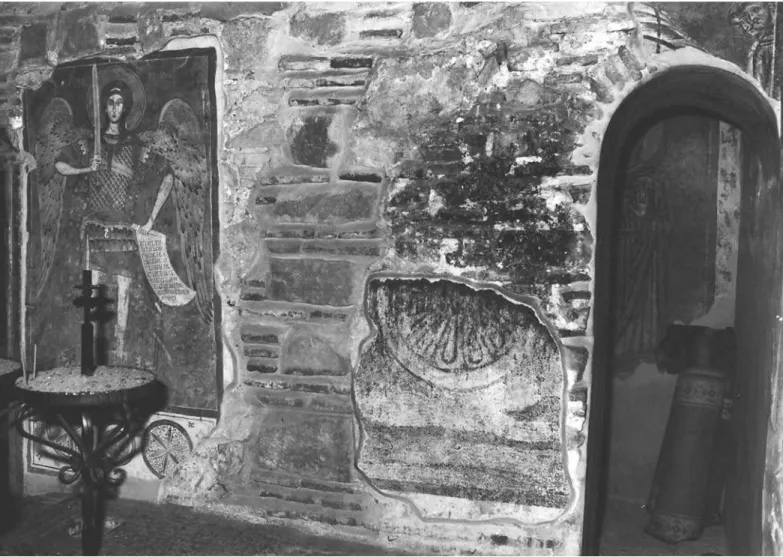
Fig. 2. Saint Peter the Apostle (?), the fragments
Fig. 3. Saint Simeon the Stylite
(formerly named Xenia). It is to be expected that in Nerezi, his second wife, Mary of Antioch, was painted, with whom he married on 25th of December,
1162: G. Ostrogorski, Istorija Vizantije, Belgrade 1969, 358, 370, 371, 373; idem, Uspon roda Andjela, 330–331.
28 It is assumed that some time around 1160, the Byzantine emperor
Manu-el I Comnenos appointed Constantine I for the archbishop of Ohrid. It is not
known to what year he stayed on the throne of the Ohrid seat, but already in 1183, one other anonymous archbishop is mentioned: I. Snegarov, Istoriia na Okhridskata arkhiepiskopiia, Sofi a 1924, 250.
29 About the Deisis, see: Ch. Walter, Two Notes on the Deisis, Revue des
études byzantines 26 (1968), 311–336; idem, Further Notes on the Deisis, Revue des études byzantines 28 (1970), 161–187; Hadermann-Misguich,
op. cit., 232–234;
30 P. A. Underwood, The Kariye Djami, New York 1966, vol. II, № 6 (pl.
41), 181 (pl. 316); vol. III: № 213 (424–425); R. Ousterhout, The Art of Kariye Djami, London 2002, 7, 12, 23. In this part of the church, Isaak Comnenos had also prepared a tomb that he later had removed to the mo-nastery Cosmosoteria.
31 The monastery is built on the locality Pherrai in Thrace, halfway between
the city of Alexandropolis and the present border with Turkey: D. Mouriki,
basic data concerning this representative of the Comnenian dynasty.32 As it is noted on the Deesis scene,33 in th exonar-thex of the Hora monastery, the Sebastokratoros Isaak Com-nenos was a son of the emperor Alexios I ComCom-nenos, that is, a brother of the emperor John II Comnenos. Regarding the fact that the founder of the church in Nerezi belongs to the Com-nenian dynasty on his mother’s side – the mother of Alexios is Theodora, the youngest daughter of Alexios I Comnenos and a sister of the Sebastokratoros Isaak Comnenos, who was the youngest prince34 – it should be assumed that in the process of the planning the founder’s composition in Nerezi, he was guided by the already established Constantinopolitan tradition of portraying founders.
Unlike the second zone, the preserved fragments of the fresco painting in the fi rst zone on the northern half of the eastern wall provide a more certain view of the assumed selection of saints.
In the fi rst zone of the eastern wall, to the left, that is, to the north of the entrance into the naos, a representation of a saint depicted in full length is preserved. There is an assump-tion that it represents one of the apostles (St. Peter?).35 What can be seen today from this depiction is his fi gurepreserved to the height of the neck, with a part of the nimbus, actually, the lower part of the nimbus above the neck. His is dressed in a yellowish robe – himation and a blue hiton, he is blessing with his right hand and holds an open scroll in the left hand. The text that was originally inscribed on the scroll has almost completely fallen off. The simplicity of the clothes and the blessing suggest the possibility that it could be a depiction of one of the saints, most probably St. Peter, who, according to the preserved examples, is usually depicted to the left of the entrance. As for the open scroll that he holds in his hand, it is noteworthy that the apostles are most often depicted with
gospels (the four evangelists) or with folded scrolls (the rest of the apostles).36 If this assumption is correct, then it should be considered that his counterpart to the south of the entrance was the depiction of St. Paul the Apostle. On this space, after the earthquake from 1555, the representation of the Archan-gel Michael was depicted in full length. It gives an important piece of information that even before, in the 12th century, a
Fig. 4. Deesis, the fragments
32 B. Ferjančić, Sevastokratori u Vizantiji, ZRVI 11 (1968), 141–191,
espe-cially 156–157.
33 The mosaic of the Deisis in the monastery Hora contains only the
re-presentations of Jesus Christ and the Mother of God in full length. The founder, Sebastokratoros Isaak Comnenos, is depicted crouching behind the representation of the Mother of God with outstretched arms in a gesture of prayer; Ousterhout, op. cit., ph. 7.
34 Ferjančić, op. cit., 156–157.
35 R. Hamann-MacLean, Grundlegung zu einer Geschichte der
mittelal-terlichen Monumentalmalerei in Serbien und Makedonien (Marburger Ab-handlungen zur Geschichte und Kultur Osteuropas 4), Giessen 1976, 270; Sinkević, op. cit., 67; The representations of the saints St. Peter and Paul are depicted on the eastern wall of the narthex in Bačkovo. Namely, on the eastern wall in the fi rst zone under the niche, with the representation of St. Mother of God, to the side of the entrance into the naos, the representations of St. Peter and Paul in full length are depicted. The two apostles are depicted in a nicely shaped space with arches and right next to the entrance, two archangels are depicted. The busts of these two apostles, together with the representations of two archangels, are depicted also in the narthex of the church in the Gelatian monastery from the 20’s of the 12th century: Bakalova, op. cit., 72, drawing
142 on p. 176. Among the later examples, painted more than century after in the narthex of the church St. Mother of God Perivleptos in Ohrid from 1295, on the eastern wall on both sides of the entrance in the naos, St. Peter and Paul are depicted with open gospels in their hands, and their counter-parts on the west wall are two other apostles, Philip and Thomas: P. Miljković-Pepek,
Deloto na zografi te Miahilo i Eutihij, Skopje 1967, 50. In the 14th century, the
apostles can be seen on the western wall of the naos in the fi rst zone, to the left and right of the entrance, such as in the case of Lesnovo: Gabelić, op. cit., 133, where St. Peter holds a closed scroll and St. Paul an open book.
full-length saint not related to the Cycle of St. Panteleimon (scenes that begin on the southern half of the eastern wall) was depicted there. This would mean that in the narthex of Nerezi, to the left and right of the entrance, Sts. Peter and Paul, the apostles were depicted like at Bačkovo,37 and in the monuments of the 14th century, where they almost regularly can be seen on the entrance of the western wall of the naos.38
The representation of St. Peter (?) is framed with red borders, which separates it from the next representation or composition painted in the continuation of the same wall to the north of the entrance. The existence of this border clearly indicates that the other saints depicted on this part of the wall were not aligned in a row, that is, they did not represent a single unit, as it is the case in the naos, but here we see several separated units, as emphasized meanings connected with the grouping of the saints. The border representation that should be taken into consideration while thinking about the possible selection of the depicted saints in this part is the representation of St. Symeon the Stylite. It is located at the end of the wall next to the entrance into the north-west chapel (Figure 3). The space on which this saint is depicted is completely in accordance with the established tradition of depicting the stylite saints in the Orthodox churches – beside the openings for entrances.39 It should be expected that to the right of the entrance, one other stylite was depicted, maybe Daniel the Stylite, who was his contemporary.40
Regarding the fi rst zone of the eastern wall, it seems that the question which saints, actually, which composition was depicted in the space between St. Peter the apostle (?) and the assumed stylite (?) to the right of the entrance into the north-west chapel, will remain open. On this part a con-siderable fragment of a fresco painting is preserved; unfor-tunately, its coloured layer has almost completely fallen off, with minimal traces of a dark background that hampers any assumptions or possible identifi cations.
On the grounds of everything previously stated, one can conclude that on the northern part of the eastern wall in the fi rst zone to the right of the entrance, were depicted
indi-vidual representations of saints in full length; altogether there were fi ve representations, of which positively identifi ed is the representation of St. Symeon the Stylite and another stylite saint (?), then the assumed representation of St. Peter the apostle, as well as one or two other representations of saints, that, unfortunately, will remain unidentifi ed.
However, in the circumstances of a partial identifi ca-tion, their presence on this part of the wall enables us to as-sume the possible concept of the decoration of the northern and southern part of the eastern wall, as separated units that are completely different. Namely, the northern end of the wall was reserved for individual representations of saints in the fi rst zone, while in the second zone, a founder’s composi-tion most probably was depicted. The border representacomposi-tion that separates the two units in terms of the concept of the program is the Deesis composition depicted in the lunette above the entrance.
The Deesis scene is depicted in the niche above the entrance into the naos, and it is in a very bad condition41 (Figure 4) at present. In the middle of the scene, a part of the head of Jesus Christ is visible, with long dark hair and a nimbus with an inscribed cross42 (Figure5). To the right of
Fig. 5. Christ from the Deesis, the fragments Fig. 6. Saint Panteleimon on the wheel, the fragments
37 Bakalova, op. cit., 172. 38 Gabelić, op. cit, 133.
39 I. M. Djordjević, Sveti stolpnici u srpskom zidnom slikarstvu srednjeg
veka, ZLU 18 (1982), 41–52, especially 44–45.
40Ibid., 46, crtež 1; S. Tomeković, Monaška tradicija u zadužbinama i
spisima arhiepiskopa Danila II, in: Arhiepiskop Danilo II i njegovo doba, Belgrade 1991, 425–438, especially 426, 436.
41 Miljković-Pepek, Prilozi proučavanju crkve manastira Nereza, 312–322,
316, ph. 2; idem, Crkvata Sv. Pantelejmon vo seloto Nerezi, 89–97, espe-cially 91.
42 The remains of a dark colour in the hair of Jesus Christ, clearly visible, do
Christ, there are small remains of the nimbus with the face of the Mother of God (still visible), and parts of the blue omo-phorion that covers her head and the upper part of her body. To the left of Christ, visible are remains of blue colour and hardly perceptible lines of a drapery, which was interpreted as belonging to the one of the archangels, Michael of Gabriel, though it is much more likely that it, in fact, is the representa-tion of St. John the Baptist.43
The rest of the painting program that is preserved in the narthex thematically belongs to the Cycle of scenes from the Life of St. Panteleimon.44 All the researchers working on this Cycle so far have managed to identify six scenes of this Cycle. S. Tomeković identifi es the basic fi ve: three scenes on the southern wall: St. Panteleimon Saved from the Sea (Miracle of the Sea), the Trial, the Beheading and the Funeral of the Teacher of St. Panteleimon, Hermolaos with his friends Hermipos and Hermokrates. On the north wall, she identifi es two more scenes: the Beheading (west) and the Funeral of St. Panteleimon (east).45
Ida Sinkević confi rms this identifi cation with an at-tempt to identify one more scene on the eastern wall, that, according to her, illustrates the moment immediately after the torturing of St. Panteleimon on the wheel.46
According to our own observations, the remains of the original fresco painting that belonged to the whole of the painted cycle of scenes from the Life of St. Paneteleimon make it possible to positively identify two more scenes on the eastern wall, that is, to give more precise identifi cation of the scene in the fi rst zone of the eastern wall on the basis of new, in-so-far unnoticed details, and to point out one more scene from the second zone of the northern wall.
The fi rst researchers of this Cycle noticed the remains of two fragments on the eastern wall, above the entrance into the southwest chapel (S. Tomeković and R. HamannMacLe --an),47 while the wheel from the fi rst zone of the eastern wall was noticed solely by Ida Sinkević.48 Namely, it is a large wheel, depicted in the fi rst zone, down on the eastern wall; a large part of the lower part is preserved, while the upper part is completely destroyed (Figure6). The wheel is rather large, painted with yellowish ochre and brown tones around the axis of the wheel, that has a shape similar to petals of open fl ow-ers. On the outer part of the wheel, faint traces of knives that are mentioned in the Life of St. Panteleimon. On the lower part of the wheel, a naked fi gureof a man with outstretched legs and arms is visible. The upper part of this fi gurewith a part of the neck is badly damaged and can only be seen as a silhouette. The preserved still visible fi gurepainted under the wheel refers to St. Paneleimon and the tortures he suffered on the wheel, described in his Life painted in the illustration of his Cycle in the church of St. Angelo in Formis, as well as on the famous icon from Sinai, where St. Panteleimon’s hagiography is represented (13th century).49 It means that this very fi gurethat was not noticed by the former research-ers belonged to the scene the Torturing of St. Panteleimon on the Wheel, and it covered a rather large surface on the eastern wall.50 According to the arrangement of the preserved elements and their dimension, it should be assumed that the scene of the Torturing of St. Panteleimon on the Wheel paint-ed in Nerezi coverpaint-ed almost one half of the surface of the eastern wall, in the space to the south of the entrance into the naos up to the preserved red border above the entrance into
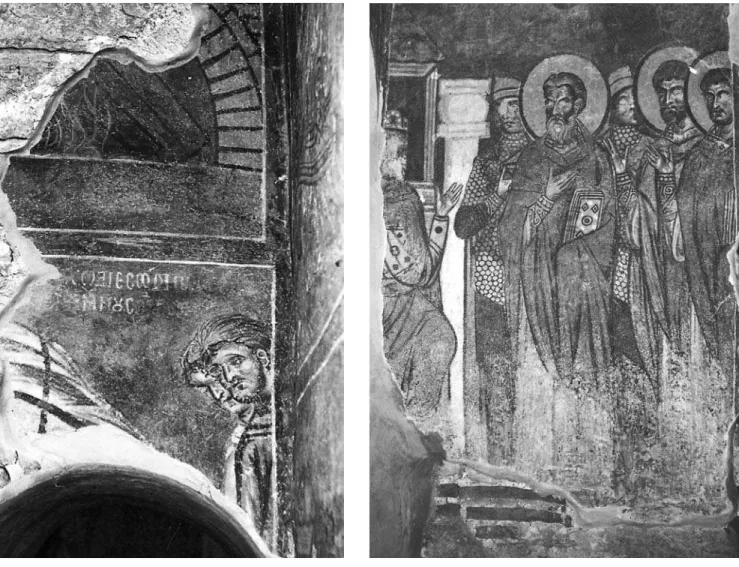
the south-west chapel, where the remain of one more wheel is present (judging from the remains of a part of a circle in yellow colour) and the fi gures of the two boys depicted in profi le, as a part of the group of people that were observing the torture of the saint that was performed in front of the mob
Drawing 2. Beheading of Hermolaos and his disciples Hermipos and Hermokrates, the damaged inscription
Drawing 3. Torturing of Saint Panteleimon on the Wheel, the damaged inscription
the Baptist, where a part of drapery and blue colour in the background can be noticed, but there can hardly be any word about a wing seen by I. Sinkević, op. cit., 67. We need to mention that to the right of the head of St. Virgine the blue colour dissapears and one can see traces of a brown and gray underpainting. These traces belong to an object, possibly to a throne on which Jesus sat. We dont treating this problem in the moment because it demands a more the rough elaboration.
43Ibid.
44 Tomeković, Les répercussion du choix du saint patron, 30–31; eadem,
Les cycles hagiographiques, 1–22, on Nerezi: 4–5; Penkova, op. cit., 35.
45 Tomeković, Les répercussion du choix du patron, 30–31; eadem, Les
cycles hagiographiques, 5, fi g. 2.
46 Sinkević, op. cit., 68–71.
47 Tomeković, loc. cit., gives a drawing of fi gures of two young boys with a
remain of the architecture with an arch made from brick over the border in the second zone, but cannot successfully identify them; Hamann-MacLean, about the remain of the architecture with the brick arch gives two possibili-ties: that this is a cave where the saint was hiding with his friends, or it is the place where he was caught; the two fi gures painted above the entrance in the chapel, I. Sinkević rightly relates to the wheel in the lower part, noticed only by her, but does not correctly identify the scene; Sinkević, op. cit., 68.
48Ibid.
49 K. Weitzmann, The Selection of Texts for Cyclic Illustration in Byzantine
Manuscripts, in: Byzantine Books and Bookmen, Washington 1975, 85, ph. 22; Tomeković, op. cit., 2, 7, fi gs. 1, 3; P. L. Vocotopoulos, Funcioni e tipo-logia delle icone, in: E. Bakalova – G. Pasarelli – S. Petković – A. Vasiliu – T. Velmans – P. L. Vocotopoulos, Il viaggio dell’icona dalle origini alla caduta di Byzancio, Milano 2002, 109–151, ph. 101.
50 On the Sinai icon, this scene is painted in the lower part of the frame, and
(Fi gu re 7).51 Actually, as this scene is described in the Life of St. Panteleimon, his fi gureshould be painted next to the wheel as on the preserved example from St. Angelo in Formis.52
In the Life of St. Panteleimon, the torturing on the wheel with knives chronologically follows after the scratch-ing of his body with sharp objects and his enclosure among wild beasts, that was at the beginning of his tortures.53 It should be expected that all the three scenes were depicted on this part of the wall. It can be assumed with great prob-ability that the upper part of the wall in the second zone, the torture with the scratching of his body and the burning of his wounds were depicted. From the scene of the torture of St. Pantleimon with the scratching of his body with sharp objects, that in Nerezi was depicted at the end of the second zone on the eastern wall, to the south in the space above the entrance into the chapel, at present only a small part is preserved – it depicts a furnace with a burning fi re (Figure8). Namely, what can be seen here is a painted architectural element of so far unidentifi ed building with a semi-circular red brick arch, that R. Hamann-MacLean interpreted as a cave in which the saint was hiding, or that it is a place where he was betrayed and captured.54 Svetlana Tomeković did not identify this frag-ment; however, although on her drawing she fairly registers the elements of the furnace, she did not succeed in noticing the fl ame painted with greyish-white lines.55 It is this very scene with the painted furnace with searing fl ames in this part of the space that clearly identifi es it as the scene of the Tortur-ing of St. Panteleimon with ScratchTortur-ing and BurnTortur-ing of His Wounds with Fire. Likewise, it should be assumed that the act of the scratching of the body of St. Panteleimon was painted
a little bit to the north of the painted furnace. On the famous Sinai icon from the 13th century,56 this scene was painted in the right section of the frame, chronologically following the Miraculous Healing of the Paralyzed, painted in the left corner of the frame, and under the Demolition of the Idols.
On this icon, too, the scratching of the naked body of St. Panteleimon is the initial scene that starts the illustration of his suffering, and on it, he is represented in full size, naked with hands and feet tied to a pillar. To the left and right of the fi gure, two fi gures scratching his naked body with rakes were painted. This scene does not contain traces of a furnace, as it is the case in Nerezi.
It is noteworthy, however, that the fi re is related to another scene from the Life of St. Panteleimon, and that is the Torturing of St. Panteleimon with Melted Iron, also painted on the Sinai icon. In this scene, St. Panteleimon is painted naked in a caul-dron placed above a heap of burning fi rewood; it is in the central part of the scene situated in front of an architectural decoration.
Fig. 7. Saint Panteleimon on the Wheel, the fragments
51 In the upper parts, above the heads of these boys preserved is the end
of the text, which was once inscribed in two rows. At the end of the second row, the signature of the name of St. Panteleimon can be read: in the fi rst row, one reads: ΟXΩ∆ΙΕC(ΩIΠΥΛ) in the second row reads: …ΕΗΜ(Ο)ΝΥCA ∆ΗΡΕΤΙ.
52 Tomeković, op. cit., fi g. 1.
53 J. Popović, Žitija svetih (za juli), Manastir Ćelije 1975, 655–670. 54 Hamann-MacLean, op. cit., 272; Sinkević, op. cit., 68, she only states the
view of Hamann-MacLean but does not question it.
55 Tomeković, op. cit., 4, fi g. 2a, paroi est; eadem, Les répercussion du choix
du patron, 30, fi g. 4.
The preserved fragments from the fresco painting pro-gram on the southern end of the northern wall suggest that the fi rst three scenes from his torture were painted there. It is to be expected that on the remaining part of the wall, that is to the south of the Deesis, were also painted scenes related to the be-ginning of the Cycle; in other words, they chronologically fol-low the events from his Life. Thus, in the second zone, the scene St. Panteleimon before Emperor Maximian could have been painted and below it St. Panteleimon Among Wild Beasts.
The conducted research pertaining to the preserved fragments of the fresco program on the southern part of the eastern wall leads to the assumption that the fi rst two scenes from the Sufferings of St. Panteleimon were depicted there, as follows: the Scratching and Burning of His Wounds with Fire in the second zone and the Torturing with the Wheel in the fi rst zone. The existence of these scenes indicates that the illustration of the Life of St. Pantleimon in Nerezi started from the second zone on the southern part of the eastern wall, and that while on it were depicted his sufferings, they do not represent his miracles, from which none has been preserved. It is noteworthy, too, that they chronologically follow the events comprising his life, as indicated by the subsequent three scenes in the fi rst and second zone of the southern wall.
The next scenes painted in the fi rst zone of the southern wall refer to the Summoning of St. Hermolaos, St. Panteleimon’s teacher, before emperor Maximian; time-wise, in the Life, it follows after the torturing of St. Panteleimon with the wheel (Figure9). The Life records that Hermolaos
appeared before emperor Maximian accompanied by his disciples Hermipos and Hermokratos, in the same manner as presented in the scene at Nerezi.
At the very beginning of the southern wall next to the entrance into the south-western chapel, on a beautifully adorned throne was painted the sitting fi gureof the emperor Maximian with his left hand raised as a sign of his addressing a group of people (altogether fi ve) led by St. Hermolaos.57
This scene is not contained in the up to now preserved cycles of the Life of St. Panteleimon.58
In Nerezi, a consistent follow up of the events from the Life of St. Panteleimon is marked in the next scene situ-ated to the west of the opening in the south wall; it features the beheading of Hermolaos and his disciples Hermipos and Hermokrates in the aftermath of their refusal to renounce Christ59 (Figure10). A very fi rm identifi cation of this scene
Fig. 8. A furnace with a burning fi re from the Scraping of Saint Panteleimon
Fig. 9. Summoning of Saint Hermolaos and his disciples before emperor Maximian
57 It is noteworthy that outside the menological cycle, the representation of
St. Hermolaos is painted in the church of St. Nicholas, the village of Ma-nastir from 1271. His representation is depicted on the north wall in the fi rst zone of the south nave, next to the representation of St. Andrew Stratilatis. He is depicted in a yellowish robe and a reddish cloak, with a face of an older man, grey, medium-long beard, and short grey hair. His face, with the exception of the damages on the left eye, is well preserved and fi ts the ty-pological characteristics of St. Hermolaos from Nerezi. He is in the gesture of blessing with his right hand and holds a closed gospel in his left hand: D. Koco – P. Miljković-Pepek, Manastir, Skopje 1958, 79, fi g. 96.
58 Tomeković, loc. cit.; eadem, Les cycles hagiographiques, loc. cit. 59 Eadem, Les répercussion du choix du saint patron, 30; eadem, Les cycles
is confi rmed by way of the still visible traces of the signa-tures, as well as of the remains of the scene depicting their execution.60
In the bottom part of the scene is presented the be-heading of St. Hermolaos in front of a grave, and above it a soldier (whose head is missing at the present) is painted, at the moment he is wielding the sword. Under the repre-sentation of St. Hermolaos there are remains of the fi gureof another halloed saint, probably one of his disciples awaiting the execution.
In the upper part of the scene, their dead bodies wrapped in white burial shrouds and disposed in a common marble grave are depicted.
In the second zone of the southern wall, the scene St. Panteleimon at the Bottom of the Sea was depicted; the lower parts of the fi gures of St. Panteleimon and St. Hermolaos are preserved61 (Figure11).
The scene the Beheading of St. Panteleimon is painted on the western part of the northern wall facing the scene of the beheading of his teacher.62 The positive identifi cation of this scene is possible based on the well-preserved representation of
Fig. 10. Beheading of Saint Hermolaos and his disciples Hermipos and Hermokrates
Drawing 4. Beheading of Saint Panteleimon, the damaged inscription
Fig. 11. Saint Panteleimon at the Bottom of the SeaI, the fragments
60 The remains of the signature of this scene are depicted on the eastern end
and can be followed in four rows: in the fi rst row, the name of Hermolaos was inscribed and the last two letters are now visible: ..M〈Ο〉ΛΑ; in the second row, was inscribed the signature of Hermipos of which are read-able the last: …ΙΠΟΣ. The name of Hermokrates was inscribed in the third row and most of its letters are preserved 〈ХΕ〉ΡΜΟΚΡΑΤ〈ΕΣ〉. In the last, fourth row preserved are the remains of the word: ΤΕΛΕ 〈Ι ΟΥ〉 ΝΤΑΙ… In translation, this word means ‘died’ (by sword). This word that means died in the menological scenes is regularly written or inscribed beside the event in which the death of some saint cut by sword is depicted. It is very likely that in Nerezi was also inscribed the word – sword, ξίφος, in one of the forms often used by the scenes connected with someone’s beheading: P. Mijović,
Menolog. Istorijsko-umetnička istraživanja, Belgrade 1973, 259–284; the reading of this word by I. Sinkević as – ΤΕΛΕ〈ΙΟΥ〉ΤΑΙ in the sense of
τελειόω, translated as “to become a perfect Christian”, is completely wrong: Sinkević, op. cit., 69, n. 281. It is necessary to note that on the basis of the Orthodox practice, present on the preserved scene of menological character, the inscribed signatures by the scenes always refer to the event depicted, and do not have some indirect meaning as an epithet, that will emerge as a consequence of that event. This note of ours can be checked by reviewing the scenes of menological character, in his case connected related to the death of a saint, where beside the image with the signature, once more is assigned the mode in which he was executed. For more examples of this kind, see in: Mijović, op. cit., 255–390.
61 Tomeković, op. cit., 5, fi g. 4b.
62 Eadem, Les répercussion du choix du saint patron, 31; eadem, Les cycles
Fig. 12. Beheading of Saint Panteleimon
Fig. 13. Funeral of Saint Panteleimon
St. Panteleimon. From the remains of this scene, the representa-tions of three fi gures are still discernible; on the very end of the wall to the west, a fi gurewith hands raised to the sky is painted. Most probably, it represents one of the observers of the event. In the central part of the composition in its middle, the fi gureof the soldier with unsheathed sword is visible, immediately after he had beheaded St. Panteleimon63 (Figure12).
The scene of the funeral of St. Panteleimon is painted on the eastern part of the northern wall.64 The saint is de-picted wrapped in a white burial shroud, with a nimbus, at the moment while two fi gures are laying down his dead body into the grave (Figure13). In the upper part of the scene above the head of St. Panteleimon, a fi gureof a priest is depicted. He is holding a censer in his right hand at the moment he is per-forming the funerary rite. The same scene is painted on the Sinai icon. Unlike this one here, there is only one fi gureof a young man that is lying the body of St. Panteleimon into the grave, and in the upper part, above the head, there is a priest at the moment he is administering the service.
In the second zone above the funeral of St. Pan-teleimon on the northern wall, visible are remains of another scene that could hardly be identifi ed so far. This fresco is badly damaged – everything that can be seen is one fi gure with outstretched arms. Judging from the posture of the fi g-ure, it can only be assumed that this is someone’s torture or execution. The traces of nimbus in this scene are visible. One can still see clearly the fi gureof a man with blood coming out of his cut throat. In the upper part above the neck the nimbus with the head and the upper part of the neck with blood com-ing out of it can be seen too. The presence of the nimbus and the scene of the beheading itself could reference to the
Be-heading of St. Panteleimon, which was perhaps painted two times, in accordance to the hagiography.
The fresco paintings on the western wall are not pre-served, and it is hard to speculate which scenes of the cycle were depicted there. It could have been his miracles or a spe-cial program that was not related to the cycle of scenes from the life of St. Panteleimon. The question about the painting program of the ceiling remains to be unsolved as well. It could have been designed like in the church St. Sofi a in Ohrid.65
As it is widely known, the preserved cycle of scenes from the life of St. Panteleimon in Nerezi represents the
old-63 Tomeković, op. cit., 5–6; Some signatures are preserved in the right corner
above the head of St. Panteleimon: …ΗΜΟ〈Ν〉ΖΙΦΕΙ ΤΕ〈ΛΕ〉ΙΟΥ〈Ν〉ΤΑΙ.
It is possible that the scene of the fi rst failed attempt of the Beheading of St. Panteleimon is painted here, mostly because of another scene located above his burial, in which traces of blood dripping out of his cut neck. There is basis for such a hypothesis in the hagiography; Popović, op. cit.
64 Tomeković, op. cit, 5, fi g. 2b; Sinkević, op. cit., 71.
65 S. Radojčić, Prilozi za istoriju najstarijeg ohridskog slikarstva, ZRVI
est known preserved cycle fresco painted in a Byzatine church depicted ever.66 With regard to this, it is impossible to make comparisons of the choice, iconography, and the features of the cycle at Nerezi because examples for comparisons are missing. An exception from this could be the Sinai icon, previ-ously mentioned, but this is an object of special character and function, different from the one of the narthex at Nerezi. The Sinai icon features a special concept of the selection of scenes related to his life, miracles, and sufferings, that is, it contains scenes with a character of a saint’s Life.67
It seems that in Nerezi the selected choice from the Life of St. Panteleimon was quite different. Although frag-mentarily preserved, starting from the southern half of the eastern wall through the southern wall to its counterpart, the north wall, the thematic idea related to St. Panteleimon’s passions can be clearly followed. With regard to this, there is a possibility that his miracles were not painted with the intention of emphasizing his martyrdom. This conclusion is reasonable as long as the whole concept of the program of the narthex is kept in mind seen in a wider context with the program and the character of the side chapels. The function of the side chapels, especially the north-west one, points to their function to serve as a solitary prayer space for monks.68 This is further supported by the selection of saints around the entrance into the chapel with the representation of St. Symeon the Stylite as an example of greatest monastic dis-cipline and since from the sufferings of the patron saint, the Great Martyr Panteleimon.69 In accordance with the Ortho-dox tradition, in this space at Nerezi are presented the main venues for earning the Kingdom of Heaven through three different sorts of exploits and sacrifi ce: martyr’s sufferings
66 The painted cycle of scenes in Nerezi from the Life of St. Panteleimon in
Nerezi, represents the oldest so far known example of the fresco program painted in the programs of Byzantine churches. The second, fully preserved extensive cycle of scenes from the Life of St. Panteleimon is painted on the Sinai icon, dated at the beginning of the 13th century, where 16 scenes
are depicted and can be chronologically followed, beginning on the upper part of the icon: The Meeting of St. Painteleimon and St. Hermolaos; St. Hermolaos Teaches St. Panteleimon; St. Panteleimon Finds the Dead Child Bitten By a Snake; Resurrection of the Dead Child; St. Panteleimon Shows the Dead Snake to St. Hermolaos; St. Panteleimon Baptized by St. Hermo-laos; The Healing of the Blind; the Demolition of the Idols; the Healing of the Paralyzed; Scratching of the Saint; the Torturing with Melted Iron; The Saint Thrown to Wild Animals; St. Panteleimon at the Bottom of the Sea; the Torture of St. Panteleimon on the Wheel; The Beaheading of St. Panteleimon; the Funeral of St. Panteleimon. Two scenes from the cycle of St. Panteleimon are also depicted on the Moscow Menologue (cod. 382, fol. 101r): Tomeković, Les répercussion du choix du saint patron, 31; Sinkević,
op. cit., 70–71.
67 K. Weitzmann, The Icon Program of the 12 and 13 Centuries at Sinai,
12 (1984), 63–116; Vocotopoulos, op. cit., 101.
68 D. Bardžieva-Trajkovska, Za programata na zapadnite kapeli vo Nerezi,
Kulturno nasledstvo 22–23 (1995/1996), 7–37.
69 On the north wall, right next to the entrance into the north-western chapel,
the scene of funeral of St. Panteleimon is depicted.
70 Bardžieva-Trajkovska, op. cit., 15–17, especially 17.
and sacrifi ce of St. Panteleimon at the time of the persecution of Christians, the greatest monastic exploit of the stylites, and the exploit of the Nerezian monks that took place in the north-west chapel, where the open tomb is preserved, as a permanent reminder of death.70 Such a didactic conception incorporated also the founder’s composition with the Deesis, that by way of his example of mercy and just power before the ministry shows the path for gaining a place in the King-dom of Heaven.
Од не ка да шње це ли не сли ка ног про гра ма нар тек са у Не ре зи ма да нас је са чу ван са мо ма ли део, и он у фраг-мен тар ном ста њу. И по ред то га, са чу ва ни фраг фраг-мен ти под сти цај ни су за ис тра жи ва ње и пру жа ју мо гућ ност за от кри ва ње пр во бит не те ма ти ке и идеј не осно ве жи во пи са. До са да оба вље на ис тра жи ва ња омо гу ћу ју кла си фи ка ци ју фраг ме на та у три по себ не це ли не или гру пе. То су: ци клус сце на из жи во та све тог Пан те леј мо на, за тим ком по зи ци ја Де и зи са, на сли ка на из над ула за у на ос, и пред ста ве у пр вој и дру гој зо ни на се вер ном де лу ис точ ног зи да. Мо же се за кљу чи ти да је ци клус Све тог Пан те леј мо на за по чи њао ју-жно од ула за у на ос, то јест ју ју-жно од ком по зи ци је Де и зи са, про ду жа вао се по це лој по вр ши ни ју жног зи да, пре ла зио на се вер ни зид и ту се, на ње го вом ис точ ном де лу, за вр ша-вао. Ис тра жи ва њи ма ју жног де ла ис точ ног зи да по твр ђе но је да је у пр вој зо ни би ла на сли ка на сце на Му че ња све тог