Eugenia Manda, dagna Kocur: Department of Social and En-vironmental Psychology, University of Silesia, Katowice, Poland. Correspondence address: Eugenia Mandal, Department of Social and Environmental Psychology, Institute of Psychology, Univer-sity of Silesia, 53 M.Grażyńskiego Str., 40-126 Katowice, Poland. E-mail: [email protected]
This study has not been aided by any grant.
Psychological masculinity, femininity
and tactics of manipulation in patients
with borderline personality disorder
Eugenia Mandal, Dagna Kocur
Summary
Aim. The aim of the study was a relation between the borderline personality disorder and psychological gender, and tendency to use various manipulation tactics in everyday life and therapeutic context. Methods. The study used the Psychological Gender Inventory (A. Kuczyńska, 1992), and self-developed questionnaire for evaluating the tendency to use manipulation tactics and a survey evaluating manipu-lation in therapeutic contact. The studied group included: 30 patients with diagnosed BPD, 30 people a control group and 125 therapists.
results. The study of psychological gender showed that in the patient group the level of masculinity was significantly lower. Results showed that 88% of the therapists participating in the study confirmed that they have experienced manipulation attempts from patients. The therapists assessed the tendency of pa-tients to use manipulation tactics as greater than it was declared by the papa-tients themselves. When com-pared to the control group, the patients indeed demonstrated a greater tendency to use the tactics of beg-ging, threatening and threatening to break a close relationship and a lesser tendency to use the tactic of seduction. In the view of the therapists, during therapy patients most often used the tactics of lying and guilt induction.
Conclusions. Manipulation is frequently used by BPD patients both in everyday life and in therapeu-tic contact. The most common reasons for using manipulation is to obtain benefits and to avoid negative consequences. It is necessary to conduct further research in this field and educate those who work with psychiatric patients in order to make them develop the ability to detect manipulation attempts and cope with such tactics.
borderline personality disorder / manipulation / gender
INTrOdUCTION
One of the most accurate definitions of ma-nipulation during therapeutic contact was giv-en by Hamilton and collaborators [1].
in-fluence their behaviour using the techniques of persuasion. However, these exceptionally effec-tive tools may prove dangerous if used in an in-adequate manner [3].
Murphy and Guze [4] have identified a number of forms of manipulation most often used by BPD patients: irrational behaviour, taking con-trol over the therapy and imposing own condi-tions, extorting promises, demanding special considerations, showing discontent and threat-ening with self-destructive behaviour. Manipu-lation used by BPD patients may also be a result of a number of misunderstandings in commu-nication. Firstly, the patient may fear being as-sessed by the therapist; they may therefore dis-tort some facts and omit information they are less comfortable with, trying to make a positive impression. Secondly, misunderstandings may be a result of differences in the evaluation of the importance of some facts by the patient and the therapist [5].
The relation between borderline personality disorder and the use of manipulation is rare-ly discussed in the literature of the subject, and when it is the opinions expressed are often con-tradictory [6]. Some authors claim that the BPD type of personality is particularly oriented at manipulating others and is characterised by the readiness to deliberately exert influence on other people while cleverly pursuing one’s own goals, and skilfulness in doing so [6, 7, 8]. According to other publications, some types of behaviour of BPD patients only appear as manipulation, but in fact do not originate in malice or premed-itation and are not pre-planned actions, their source being rather impulsiveness, fear, desper-ation and helplessness [9]. However, it is a com-mon view acom-mong therapists that patients with BPD often use manipulation in order to achieve their own goals. This is confirmed by the study of Gallop & Lancee [10], which demonstrated that as many as 90% of nurses stated that they associated BPD patients with manipulation. Oth-er research has also confirmed the conviction of specialists that there is a strong link between the BPD personality and manipulation [11].
Despite over 80 years of research on the sub-ject, borderline personality disorder still remains controversial and raises many questions [12]. What is characteristic for this condition is deeply rooted and consolidated patterns of maladaptive
features. A person suffering from this disorder has an unclear or distorted image of himself or herself and his or her goals and preferences. As a result this person is incapable of establishing more profound emotional relationships. Such a person has a sense of loneliness and searches for intimacy, but at the same time cannot withstand intimacy for fear of abandonment [13, 14, 15, 16]. Borderline patients experience intensive and un-stable emotions resulting in crises, which mean that their life is exceptionally dramatic and often involves the risk of self-inflicted injuries, suicid-al attempts, sometimes of a manipulative nature. Among people suffering from borderline disor-der the ratio of suicides and suicidal attempts is high (approx. 10%). It is estimated that 41% of patients staying in hospital emergency depart-ments due to repeated suicidal attempts fulfill the criteria sufficient for diagnosing borderline disorder [12, 17, 18, 19, 20, 21, 22].
Symptomatically, most authors emphasise the fact that the borderline personality is more fre-quently found in women — 3-4 times more of-ten than in men [23]. These authors suggest that there might be a link between BPD and gender, but this may also be a result of social and cul-tural patterns of behaviour which allow wom-en to display weakness, mood swings and nerv-ous breakdowns and prevent men from doing so. According to estimates, borderline person-ality disorder is most intense around the age of 25 while only 25% of those who suffer from this condition are over 40 years old. Probably mood swings and some patterns of behaviour tend to tone down with age [24, 25].
unre-alistic expectations towards therapists. They of-ten cause conflicts, also among the medical staff [26, 27, 28, 29].
The literature of the subject rarely discusses the relation between the BPD personality and the tendency to manipulate in the context of the Machiavellian personality. However, the re-search of John McHoskey of 2001 shows that the best predicator of Machiavellianism proves to be the traits of the borderline personality such as: emotional imbalance, inadequate and un-controlled outbursts of anger, impulsive self-de-structive behaviour and strong but unstable re-lationships with other people [30].
AIM OF THE STUdy
The aim of this study was to identify issues re-lated to manipulation and exertion of influence in therapeutic contact of borderline patients. The study was an attempt to research the relation between the BPD personality and psychological gender and the use of manipulation tactics both in everyday life and during therapy. The aim of the study was also to compare the opinions of patients and therapists on the subject of manip-ulation tactics used by BDP patients.
SUBJECTS ANd METHOd
The studied groups was composed of 30 adult patients with borderline personality disorder. The qualification of patients to the treatment group was based on the diagnostic criteria in-cluded in ICD-10 (F.60.32). The average age of the patients was M=30.87 years (SD=11.23 years). Half of the treatment group (15 people, 50%) was between 21 and 30 years. The control group was composed of 30 people who have under-gone no psychiatric treatment. The members of the control group were deliberately selected on the basis of their similarity of gender and age to the patient group. In both groups the majori-ty was women, who constituted 93% of the par-ticipants.
The studied group included 125 therapists with a background in psychiatry, psychother-apy, psychology and nursing. Therapists were divided into two groups. Study 1 involved 37
therapists specialising in BPD therapy. Study 2 involved 88 therapists specialising in treating various personality disorders, neuroses and de-pendencies. Also this group was dominated by women (78%). The therapists represented vari-ous schools of therapy, mostly cognitive behav-ioural, psychoanalytic and Gestalt. The average age of the therapists taking part in the study was M = 38.61 years (SD = 9.87 years).
The following research methods were used in the study:
Psychological Gender Inventory (IPP) of A.
Kuczyńska (1992). This tool is composed of thir -ty five features. Fifteen of them form the Femi-ninity scale (á = 0.78) related to the cultural ster-eotype of femininity, while another fifteen — the Masculinity scale (á = 0.78) which characterises the cultural stereotype of masculinity. The re-maining five features are neutral buffer items placed in randomly selected parts of the invento-ry. Using a five-point scale, a participant declares the extent to which he is characterised by a giv-en trait. On the basis of the number of points ob-tained in both scales the intensity of psycholog-ical masculinity and femininity is determined; the participant is then categorised within one of the four psychological gender types, i.e.: the sexually undefined, the feminine, the masculine and the androgynous [31].
wound myself to attract the attention of others, 8. I sometimes lie or choose not to tell the whole truth, 9. I sometimes make others feel guilty even though they have done nothing wrong, 10. I sometimes threaten a close relative or friend to break up the relationship between us.). A partic-ipant declares how often he or she uses a given tactic using a 7-point scale where 1 means never and 7 — very often. The reliability coefficient for the questionnaire on manipulation in everyday life was á=0.756, while for the questionnaire on manipulation in therapy — á=0.768. This method was used in the study involving BPD patients.
Manipulation tactics used by patients according to therapists — author’s method. The first part of the tool contained the following open question: “What methods of exerting influence and manip-ulation have you observed in persons with bor-derline personality disorder during therapy?” The other part contained 10 closed-ended ques-tions indicating various tactics which may be used for exerting influence, analogous to those listed in the questionnaire intended for patients (1. Seduction, charming, 2. Begging, 3. Refusing to speak, 4. Coercion, 5. Sulkiness, getting of-fended, 6. Threatening, 7. Self-inflicted injuries, 8. Lying, misleading, concealing information, 9.
Guilt induction, 10. Threatening to discontinue the therapy, mentioning it). The therapists eval-uated the behaviour of patients observed dur-ing therapy usdur-ing the same 7-point Likert scale. The reliability coefficient for the questionnaire for therapists was á = 0.778. This method was used in study 1 involving therapists.
Manipulation in the Therapeutic Context — studied using a survey with five open questions 1. Have you ever been manipulated by a patient? 2. What in your view was the reason why the patient nipulated? 3. In what way did the patient ma-nipulate? This method was used in study 2 in-volving therapists.
rESUlTS
In the patient group (M=39.03) the intensity of psychological masculinity was significantly low-er than in the control group (M=48.00) (p<0.001) (see Tab. 2). Most people (50%) had a feminine identity, followed by androgynous individuals (30%) and the sexually undefined (20%). None of the patients had the masculine psychological gender (see Tab. 1).
Table 1. Psychological gender of women and men in the BPD patient group and the control group
Table 2. Femininity and masculinity in the BPD patient group and the control group
IPP score BPD patients Control group Total
women men women men
n Feminine individuals 14 1 14 1 30
% 46.67 3.33 46.67 3.33
n Masculine individuals 0 0 2 1 3
% 0.00 0.00 6.67 3.33
n Androgynous individuals 8 1 8 0 17
% 26.67 3.33 26.67 0.00
n Individuals with undifferentiated gender 6 0 4 0 10
% 20.00 0.00 13.33 0.00
n Total 28 2 28 2 60
Psychological gender Group of BPD patients Control group t p
M SD M SD
Masculinity 39.03 12.06 48 7.48 -3.46 0.001
The results of research showed that BDP pa-tients most often admitted using the tactic of taking offence (M=4.73), the tactic of lying (M= 4.10), begging (M = 4.07), refusing to speak (M=3.97), guilt induction (M = 3.03), coercion (M=3.00), seduction (M=2.93), threatening to break up the relationship (M=2.83), threaten-ing (M=2.50), and least often — the tactic of self-inflicted injuries (M=2.20). The members of the control group, on the other hand, most often ad-mitted using the tactic of seduction (M=4.37), fol-lowed by the tactic of lying (M=4.10), taking of-fence (M=3.90), refusing to speak (M=3.57), coer-cion (M=3.13), begging (M=3.03), guilt induction (M=2.80), threatening to break up the relation-ship (M=1.87), and least often — the tactic of threatening (M=1.53) and self-inflicted injuries (M=1.53) (see graph 1).
Statistically significant differences related to the tactic of seduction were noted (p=0.002) more rarely used by the patients than the per-sons from the control group, and the tactic of threatening (p=0.002), threatening to break up the relationship (p=0.043) and begging (p=0.05) more often used by patients. A statistical tenden-cy was also noted with regard to the tactic of tak-ing offence (p=0.06), which was more often used by the patients. The study revealed a statistically significant negative correlation between the age of the patients and the tendency to self-inflict-ed injuries (=-0.58, p<0.05) and a positive corre-lation between the use of manipucorre-lation in eve-ryday life and the use of manipulation during therapy (r=0.375, p<0.04).
An analysis of the data of study 1 received from the therapists (N=37) indicates that in the
Graph 1 — Manipulation in everyday life in the BPD patient group and the control group
view of the therapists patients undergoing ther-apy most often use the tactics of lying (M = 5.51), guilt induction (M = 5.43), seduction (M = 4.97), followed by coercion (M = 4.86), threatening to discontinue the therapy (M = 4.70) and self-in-flicted injuries (M = 4.38). Least frequently the
therapists pointed to the tactics of: threatening (M = 3.95), refusing to speak (M = 3.86) and begging (M = 3.49). An analysis revealed that the therapists (M = 46.8) pointed to the patients’ use of manip-ulation tactics during therapy significantly more often than the patients themselves (M= 24.93).
Tactic of seduction Tactic of begging Tactic of refusing to speak Tactic of coercion Tactic of taking offence Tactic of threatening Self-inflicted injuries Lying Guilt induction Threatening to break up the relationship
0 0,5 1 1,5 2 2,5 3 3,5 4 4,5 5
2,93
4,07 3,97 3
4,73 2,5
2,2
4,1 3,03
2,83
4,37 3,03
3,57 3,13
3,9 1,53
1,53
4,1 2,8
1,87
Average, patient group Average, control group
4 4.5 5
3.5 3 2.5 2 1.5 1 0.5 0
1.87
2.83 2.8
3.03
4.1 4.1 1.53
2.2 1.53
2.5
3.9
4.73 3.13
3.57
4.07 4.37 3.97
The views of the patients regarding the most readily used manipulation tactics during therapy were different than the views of the therapists. The patients pointed to the following manipu-lation tactics as the most commonly used: refus-ing to speak (M=3.70), takrefus-ing offence (M=3.33) and lying (M=2.43). These tactics were followed by the tactics of: begging (M = 2.37) and coercion (M=2.37), guilt induction (M=2.33) and threat-ening to discontinue the therapy (M=2.33). The least frequently mentioned tactics included self-inflicted injuries (M=2.20), seduction (M=2.00) and threatening (M=1.87).
An analysis of the scores obtained by the ther-apists indicated a positive correlation between the therapists’ years in practice and their be-lief in the frequency of using manipulation tac-tics by patients with BPD (r=0.518, p<0.001). The number of patients with BPD treated by a given therapist was in a positive correlation with the assessment of how frequently the patients used
the tactic of begging (r=0.372, p<0.02) and the tactic of coercion (r=0.340, p<0.03).
The majority of the therapists in study 2 (N=88) admitted having experienced manipulation by a patient during therapeutic contact. Affirmative answers were given by 88% of participants, neg-ative ones — by 11%, and the answer “I don’t know” was selected by only 1% of the partici-pants.
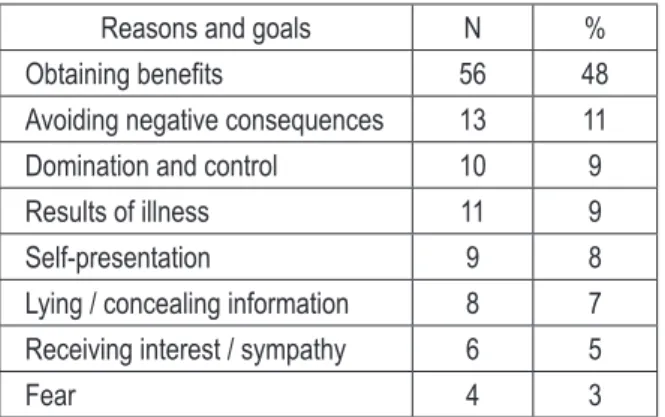
The reasons and goals of manipulation most frequently indicated included: obtaining benefits (48%), avoiding consequences (11%) and taking control (9%). Some therapists underlined that manipulation used by patients is a consequence of their disorder (9%). The therapists described in detail various kinds of benefits obtained by patients due to their use of various manipulation methods. The most common included: finan-cial benefits (38%), certificates of various kinds (25%), prescriptions / medicines (16%), passes / sick notes (16%) and others (5%) (see Tab. 3).
The most common manipulation tactics used by patients include: lying or concealing infor-mation (23%), compliments (16%) and broadly understood verbal manipulation (puns) (11%). Examples were also given of patients describ-ing symptoms which they were not experienc-ing, using the vocabulary learned from the liter-ature of the subject (9%) (see Tab. 4).
In the examples given by the therapists con-cerning the use of manipulation during therapy, the following types of behaviour were mentioned most often: strategy “yes, but...”, cancelling the session at the last moment or leaving before the end, being late, prolonging the session, attempts to induce the feeling of guilt in the therapist, emo-tional blackmail, harassing phone calls, gifts, shortening the distance, creating the appearanc-es of a significant improvement, attacks, aggrappearanc-es- aggres-sive undermining of the therapist’s competences, criticising the therapeutic setting and therapeu-tic contract, especially if it included a provision preventing the patient from committing suicide in the course of the therapy. Other examples in-cluded: idealisation of the therapist and crossing borders, e.g. the patient emulates the therapist or identifies with him of her, obtains information on his or her private life. In the view of the par-ticipants, the mechanism of projective identifica-tion used by the patients was meant to control the therapy process and the therapist.
Table 4. Manipulation methods used by patients in the opinions of the therapists (N=88)
Table 3. Reasons and goals of manipulation used by patients in the opinions of the therapists (N=88)
Reasons and goals n %
Obtaining benefits 56 48
Avoiding negative consequences 13 11 Domination and control 10 9
Results of illness 11 9
Self-presentation 9 8
Lying / concealing information 8 7 Receiving interest / sympathy 6 5
Fear 4 3
Manipulation method n %
Lying / concealing information 34 23 Compliments / coaxing 24 16
Puns 17 11
Inspiring pity 15 10
Simulation of symptoms of illness 13 9
Actor’s behaviour 13 8
Breaking / bending rules / setting 11 7
Promising improvement 8 5
An important problem revealed by the study is manipulation used by patients who wish to ob-tain certificates, disability allowances and sick notes of various types. Answers to the question concerning the aims of manipulation revealed that in the view of the participants the common motive is the wish to obtain certificates of vari-ous types (25%) or passes and sick notes (16%). One of the participants answered the question about the type of patients who are particularly prone to manipulation by saying: “Patients re-ferred by the court or the Social Insurance Insti-tution (ZUS)”.
rESUlTS ANd CONClUSIONS
Results of the presented research showed that in the BDP patients group the overall level of psychological masculinity was significantly low-er than in the control group. Most patients had the feminine psychological gender and none of the patients had the masculine psychologi-cal gender. This result may be linked to the fea-tures of the feminine psychological gender, such as: weakness, dependence, helplessness. The fea-tures linked with masculinity, such as instru-mentality, activity, resourcefulness, may be more rarely found in BPD patients, especially those who are currently staying in psychiatric hospi-tals [32, 33, 34]. In the literature of the subject, it is accepted that people with BPD are charac-terised by a distorted sense of identity, instabili-ty of relationships with others, emotional insta-bility, distorted image of own goals and prefer-ences, and even frequent and chaotic perverse behaviour [35]. The above is confirmed by the differences between both groups revealed in the study: in the patient group there were more peo-ple with undifferentiated psychological gender. In such people the feminine and masculine fea-tures are developed to a small extent, irrespec-tive of their biological sex.
The results of the study showed a statistical-ly significant correlation between the use of ma-nipulation in everyday life and its use in thera-py in BPD patients. This confirms of the tenden-cy of manipulation of their behaviour. Patients with BPD obtained significantly higher scores with regard to the use of manipulation tactics in everyday life than the control group; this
re-fers to the following tactics: taking offence, beg-ging, threatening and threatening to break up the relationship. Patients are less tendency to use the tactic of seduction than people from the con-trol group. The use of numerous manipulation tactics confirms the data suggesting that people with BPD have difficulties in controlling their emotions, are incapable of establishing more profound emotional bonds and prone to enter into unstable and intensive relationships with others [36]. The manipulation tactics they use are at the same time offensive (e.g. taking of-fence, threatening) and defensive (e.g. begging). This shows the great determination of patients in achieving their interests. BPD patients are less prone to use the tactic of seduction than people from the control group, because the groups of patients and therapists were composed mostly of people of the same sex (women). Seduction is a tactic of manipulation used in contacts with the other sex [37].
In the course of the study it was also noted that among the patients the tendency to use the tac-tic of self-inflicted injuries decreased with age. This may be explained by the fact that older peo-ple care more about their health and life than younger ones and probably believe that this type of manipulative behaviour is not socially accept-able.
A comparison of the scores obtained by the pa-tients and therapists suggests that there are dif-ferences between the assessment of the behav-iour of patients in the eyes of the therapists and the self-assessment of the patients. The thera-pists believe that patients use manipulation tac-tics more often than declared by the patients. This may mean that patients do not realise they use manipulation tactics in everyday life and during therapy or are not ready to admit it. The participants may also want to conceal their use of manipulation tactics in order to present them-selves in a better light, i.e. in order to deliber-ately lower the scores or hold back their own proneness to manipulation. Almost all the ther-apists participating in the study viewed their in-terpersonal contacts with BDP patients as partic-ularly difficult, inspiring negative emotions and constituting a big challenge from the therapeu-tic point of view.
experienced manipulation attempts from their patients. In the view of the therapists, the most common reason for manipulation among pa-tients was: striving to obtain benefits or avoid negative consequences, and more rarely – fear. The most frequent methods of manipulation were: lying, concealing information and coax-ing. These results demonstrate that manipula-tion is a frequent phenomenon in the therapeu-tic process of BPD patients. The results concern-ing the frequency of manipulation in BPD pa-tients may also be connected to knowledge on BPD and approach to this disorder among the therapists [38]. It is possible that some therapists treat certain types of behaviour as manipulation although they are only symptoms of the illness; such behaviour may also be linked to the diffi-cult economic situation of the patients.
The problem of manipulation used by patients with BPD in therapeutic contact may be viewed from the perspective of the phenomena of trans-ference and countertranstrans-ference. In psychother-apy, transference consists in the redirection of emotional reactions and past experiences of the patient onto the therapist during the therapeu-tic process. The patient repeats their experienc-es from early childhood in the relationship with a new object [38, 39, 40]. Manipulation attempts used by a patient may be explained in the con-text of transference: The patient is capable of only those behaviours which they have learned in the relationship with an important object. The therapists’ views regarding manipulation attempts used by patients may be seen in the context of countertransference. According to the classical definition of Freud, countertransference is an influence of the transferential reactions of a patient on the unconscious internal conflicts of the psychotherapist [38, 41]. In this context, the therapist’s perception of some situations as manipulation may be a result of the therapist’s projection of their own unworked-through con-flicts and problems onto the relationship with the patient.
In the patient–therapist relationship, the meth-ods of communication may also be of signifi-cance, e.g. asking too complex questions, ambig-uous comments, misunderstandings and diffi-culties in detecting the so-called communication traps, such as confabulation, distortion of
con-tent, silence. As a result, manipulative intentions may be ascribed to patients [38].
The present study demonstrates the impor-tance of manipulation in therapeutic contact and the need to deepen the knowledge of the subject in order to improve the broadly understood con-tact between the patient and the therapist.
rEFErENCES
1. hamilton J, Decker N, Rumbaut RD. The manipulative pa-tient. Am J Psychother. 1986; 40(2): 189–200.
2. Kottler JA. Opór w psychoterapii: jak pracować z trudnym klientem? Gdańsk: Gdańskie Wydawnictwo Psychologiczne; 2004.
3. harguindeguy LC. Władza leczącego - refleksje o manipu-lowaniu władzą przez uzdrawiaczy. Sztuka Leczenia. 2002; 8(4): 75–89.
4. Murphy GE, Guze SB. Setting limits: The management of the manipulative patient. Am J Psychother. 1960; 14: 30–47. 5. Knapp h. Komunikacja w terapii. Warszawa: Wydawnictwo
Naukowe PWN; 2009.
6. Aleksandrowicz J. Nerwice: psychopatologia i psychotera-pia. Warszawa: PZWL; 1998.
7. Czernikiewicz A. Pogranicze zaburzenia osobowości - współczesny rozwój koncepcji. Psychiatr Pol. 1986; 20(3): 225–231.
8. Tomb DA. Osobowość z pogranicza – borderline. In: Sidor-: Sidor-owicz S, editor. Psychiatria. Wrocław: Urban and Partner; 1998. p. 181.
9. Kernberg OF. Psychodynamiczna terapia pacjentów border-line. Gdańsk: GWP; 2007.
10. Gallop R, Lancee W. Escaping borderline stereotypes: wor-king through the maze of staff– patient interactions. J Psy-chosoc Nurs Ment health Serv. 1986; 26(2): 16–20. 11. Woollaston K, hixenbaugh P. „Destructive Whirlwind”:
nur-ses perceptions of patients diagnosed with borderline per-sonality disorder. J Psychiatr Ment health Nurs. 2008; 15 (9): 703–709.
12. Linehan MM. Zaburzenia osobowości z pogranicza: terapia poznawczo-behawioralna. Kraków: Wydawnictwo Uniwer-Kraków: Wydawnictwo Uniwer-sytetu Jagiellońskiego; 2007.
13. Wrońska A. Zaburzenia osobowości typu borderline (zabu-rzenia z pogranicza): epidemiologia, etiologia, leczenie. Psy- Psy-chiatria w Praktyce Ogólnolekarskiej 2007; 7(4): 161–169. 14. Bateman AW, halliwick U, Barnet E. Borderline personality
15. Jakubik A. Zaburzenia osobowości. Warszawa: Wydawni-ctwo Lekarskie PZWL; 2003. p. 83–88.
16. Kuczyńska A. Opis zaburzeń osobowości typu borderline według DSM-IV. Czas Psychol. 2002; 2: 177–185. 17. Murawiec S. Pograniczne zaburzenia osobowości a
depre-sja. Lek Depres. 1998; 3(4): 189–198.
18. Popiel A. Zaburzenie osobowości z pogranicza – wyzwanie terapeutyczne. Psychiatria. 2011; 8(2): 64–68.
19. Tyra TL. Niektóre metody diagnozy różnicowej zaburzenia osobowości typu borderline. Psychiatr Pol. 1989; 23(5/6): 396–402.
20. Gunderson JG, Davis T, Youngren VR. Dealing with self-de-structiveness in borderline patients. In: Rosenbluth M, Yalom ID, editors. Treating difficult personality disorders. San Fran-cisco: Jossey-Bass; 1997. p. 25–50.
21. Cierpiałkowska L, Marszał M, Pieniążek M. Defensive func-tioning in individuals with borderline personality organiza-tion in the light of empirical research. Pol J Appl Psychol. 2012; 10(1): 7–19.
22. Pastuszak A. Strategie regulacji emocji a inteligencja emo-cjonalna u pacjentów z zaburzeniami osobowości borderli-ne. Psychiatr Pol. 2012; 46(3): 409–420.
23. Kaplan hJ, Sadock BJ. Osobowość „z pogranicza” borderli-ne. In: Sidorowicz S, editor. Psychiatria kliniczna. Wrocław: Urban and Partner; 2004. p. 175–177.
24. Wrońska A. Zaburzenia osobowości typu borderline (za-burzenia z pogranicza) – epidemiologia, etiologia, lecze-nie. Psychiatria w Praktyce Ogólnolekarskiej. 2007; 7(4): 161–169.
25. De Moor MhM, Distel MA, Trull TJ, Boomsma DJ. Assess-ment of borderline personality features in population sam-ples: is the personality assessment inventory–borderline fea-tures scale measurement invariant across sex and age? Psy-chological Assessment. 2009; 21(1): 125–130.
26. Gmitrowicz A, Kucharska A. Pograniczne zaburzenia osobo-wości. Przegl Lek. 1993; 50(5/6): 159–162.
27. Bourke ME, Grenyer BF. Psychotherapists response to bor-derline personality disorder: a core conflictual relationship theme analysis. Psychotherapy Research. 2010; 20(6): 680–691.
28. Goldstein EG. Zaburzenia z pogranicza: modele kliniczne i techniki terapeutyczne. Gdańsk: GWP; 2003.
29. Pastuszak A. Regulacja emocji u pacjentów z zaburzeniami osobowości borderline – aktualne kierunki badań. Psychiatr Pol. 2012; 46(3): 401–408.
30. Mchoskey JW. Machiavellianism and personality dysfunc-tion. Pers Individ Dif. 2001; 31(5):791–798.
31. Kuczyńska A. Inwentarz do Oceny Płci Psychologicznej. Pod-ręcznik. Warszawa: Pracownia Testów Psychologicznych PTP; 1992.
32. Mandal E. Podmiotowe i interpersonalne konsekwencje ste-reotypów związanych z płcią. Katowice: Wydawnictwo Uni-Katowice: Wydawnictwo Uni-wersytetu Śląskiego; 2004.
33. Mandal E. Kobiecość i męskość. Popularne opinie a bada-nia naukowe. Warszawa: Wydawnictwo Akademickie Żak; 2003.
34. Brannon L. Psychologia rodzaju. Gdańsk: Gdańskie Wydaw-nictwo Psychologiczne; 2002.
35. Kuczyńska A. Opis zaburzeń osobowości typu borderline we-dług DSM-IV. Czas Psychol. 2002; 8(2): 177–185. 36. Seligman MEP, Walker EF, Rosenhan DL. Zaburzenia
oso-bowości borderline. In: Seligman MEP, editor. Psycho-: Seligman MEP, editor. Psycho-Seligman MEP, editor. Psycho- Psycho-patologia. Warszawa: Wydawnictwo Zysk i S-ka; 2003. p. 431–436.
37. Mandal E. Miłość, władza i manipulacja w bliskich związkach. Warszawa: Wydawnictwo Naukowe PWN; 2008.
38. Grzesiuk L. Psychoterapia: podręcznik akademicki. T.1. Te-oria. Warszawa: Eneteia Wydawnictwo Psychologii i Kultu-ry; 2005.
39. Dollard J, Miller NE. Osobowość i psychoterapia: anali-za w terminach uczenia się myślenia i kultury. Warsanali-zawa: Państwowe Wydawnictwo Naukowe; 1969.
40. Kokoszka A, Motyka M, Golec S, Nieniewska M, Drozdowski P, Winid B, Franczyk J, Kwiatkowski R, Fortuna D, Żuchowicz T. Wprowadzenie do psychoterapii. Kraków: Akademia Medy-czna im. Mikołaja Kopernika w Krakowie; 1993. p. 80–90. 41. Gabbard GO, Wilkinson SM. Przeciwprzeniesienie w