© V. V. Kyurova, D. E. Yaneva, 2015
Kyurova V. V. Analysis of the customer satisfaction of the hotel products in Bulgaria [Internet source] / V. V. Kyurova, D. E. Yaneva // Economic Processes Management: International Scientific E-Journal.
– 2015. – № 2. – Access mode:
http://epm.fem.sumdu.edu.ua/download/2015_2/2015_2_5.pdf
Received 10.03.2015
JEL Сlassification: M31
ANALYSIS OF THE CUSTOMER SATISFACTION OF THE HOTEL PRODUCTS IN BULGARIA
Kyurova Vyara Vasileva
PhD, Associate Professor,
Associate Professor of Management and Marketing Department South-West University, Blagoevgrad, Bulgaria
Yaneva Dilyana Emcheva
PhD, Assistant Professor,
Assistant Professor of Management and Marketing Department South-West University, Blagoevgrad, Bulgaria
One of the most important conditions for the right choice of a marketing policy of the hotel businesses is the availability of accurate studies, analyzes and forecasts about the changes of consumer demands, the competitive environment and the situation on the market of hotel products. Moreover, research on tourist motivation about the choice of hotel products and the factors shaping consumer preferences are important criteria to achieve a balance between supply and demand of these products. In this context, the objective of the study is to reveal the peculiarities of consumer behavior in the field of hotel business by setting a consumer profile, determine the motives for the choice of hotel products and the level of consumer satisfaction when using these products.
Keywords: hotel business,hotel product, consumer behavior, level of consumer satisfaction.
for the same period of time increased by 18.16%, as the nights spent by foreigners increased by 21.76%.
The main objective of entrepreneurs in the hotel industry when organizing their business, particularly in times of crisis, is to make the existing business efficient, to find its potential and to create its future [2, p. 24]. The growth of the market demands calls for the search of new opportunities for better satisfying consumer needs [10, p. 58]. Thus, the consumer behavior becomes a main driving force of the modern market [8, p. 5]. Ignoring it, can lead to serious problems in the realization of the marketing policy of the enterprise. We should have in mind that the efficient management of the hotel industry is unthinkable without knowing what is the actual perception of current and potential tourist for the product. For this purpose the hotel enterprises should closely observe the consumers and should analyze their needs. In this sense, a mandatory condition for the right choice of marketing policy of the hotel industry is the availability of accurate researches, analyses and forecasts about the demands, competitive environment and the market situation of hotel industry.
It is obvious that the consumers’ reaction is a key indicator for the success of the marketing strategy of the enterprises. This in turn will allow the hotel management to make optimal marketing decisions in the field of marketing mix.
Analysis of researches and publications. According to the classical understanding marketing is an entrepreneurial activity, through which the formation and development of the needs and demands of products and services is managed. This process involves learning, prognosticating and satisfaction of needs through the development, production, transportation and sale of the product and service [11, p. 24]. In other words – the core concept of marketing is matching the customers’ needs to the capabilities of the organization, related or not with profit [11, p. 8]. Therefore, some authors believe that consumer behavior is a major factor motivating the marketing activities of producers [7, p. 81]. This view has been supported in the work of Anastasova [1]. In addition she claims that one of the most important sub-fields of the market research is the study of consumers profiles, as without it market research would not be complete.
The actual customer needs are crucial for deciding which product or service to be produced, how and when to offer it to the market. On the other hand the study of consumer behavior will answer some basic questions such as: who; how; when; where and why they purchase it [9, p. 6]. It is obvious that the study of the motives of consumer behavior is one of the most important aspects of marketing research [14, p. 11].
personal factors make an impact. At the same time it may be defined as the process of eligibility of activity and the form of manifestation of the many personal elements as consumer interests, motives for behavior, consumer needs and more [16, p. 88]. Oliver presents the satisfaction as a general psychological condition occurring when the emotions accompanying higher expectations combine with the attitudes of the client regarding the acquisition or the use of this product [12, p. 57].
In light of the above we can say that increasing the requirements and preferences of tourists to the specifics of the tourism product necessitates a study of consumer attitudes and motivations in order to fully satisfy their real needs [17, р. 41]. In this regard, one of the main objectives of the consumer investigation of hotel products is an analysis of the motivation for choosing products or services, and the factors shaping consumer preferences [14, р. 94]. To support this opinion Madgerova believes that the motive of the decision to purchase travel products is the reasons that affect the choice which forms the consumer behavior on the market. It is clear that knowledge of the motives is essential for effective decision-making in tourism and appeasing customers’ needs [5, p. 16].
Classification of the main reasons for the consumption of tourism products were offered by Madgerova [5], Bogolyubov and Orlovskaya [2], according to which they are divided into: motives according to the purpose of the journey; motives according to the type of recreation; natural and climatic reasons; socio-cultural reasons; economic motives; psychological motives.
On the other hand the implementation of the tourism product is related to the simultaneous operation of multiple factors which lead to fluctuations in the demand, production and its supply [4, p. 13]. The study of the factors that affect the tourism motivation is essential in determining the demand for tourism products, the creation of tourist programs and to study the tourism consumption and its structure [5, p. 169-170]. In addition, we can mention that the study of the preferences of tourists' choice of hotel products and affecting their motivation factors is the basis of the use and combination of resources, diversification of the offered hospitality products and services, creating new products.
purpose and nature of the trip. The third group of factors forms the choice of place and time for the journey.
Some authors offer the following factors for consumer satisfaction: quality of service; range of services; competence of personnel working directly with clients; commitment to customer problems; courtesy of staff; communication skills of staff; prices of services [15, p. 21].
The most comprehensive and accurate classification of factors for establishing consumer preferences is proposed by A. Sak and B. Juravlev Segment: incomes, age, location, product and assessment of its featuresn [13, p. 284].
In our view, it is necessary to distinguish three groups of factors – relating to determination of the profile; reasons for choice of hotel products and the degree of consumer satisfaction regarding the use of these products. The first group includes factors: gender, age, education, social, family status and incomes. The second group of factors includes: purpose of the trip, number of nights spent, length of stay, cost package design and services, type and category of the type of accommodation. The third group of factors is linked with the actual hotel product, its characteristics and consumer features. Therefore, priority should be given to indicators such as: quality, uniqueness, comfort, image of the product, quality of service, competence of staff, etc.
Previously unsettled problem constituent. Despite the numerous works devoted to the consumer satisfaction the issue of that problem for the hotel business remains unresolved.
Main purpose of the article. The aim of the study is to reveal the peculiarities of consumer behavior in the field of hotel industry by setting profile, setting the reasons for the choice of hotel products and the degree of consumer satisfaction regarding the use of these products.
Results and discussions. To reveal the peculiarities of consumer behavior in the field of hotel business a survey was conducted among 842 users of hotel products on the territory of Bulgaria in the period of September – November 2014. The questionnaire consists of three blocks issues – for determining the profile; reasons for choice of hotel products and the degree of consumer satisfaction regarding the use of these products.
Fig. 1. Distribution of respondents by age
(own calculation based on surveys’ results)
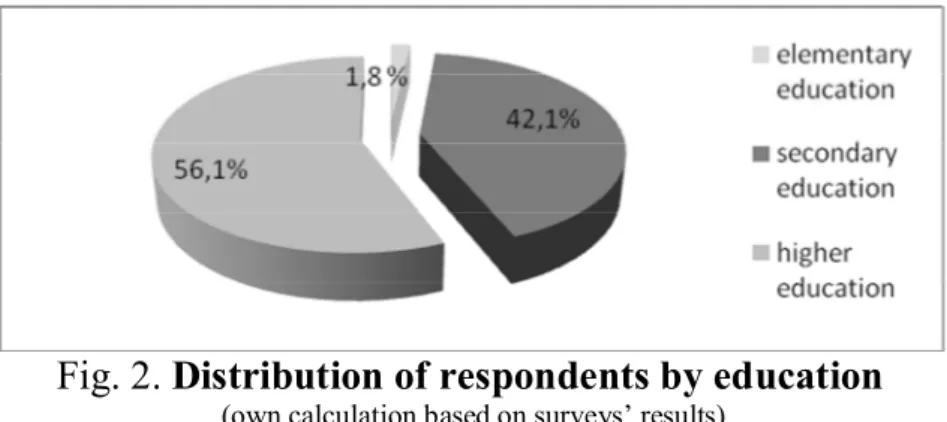
The educational structure of the respondents shown in Figure 2 represents an interest too. More than half of them (56.1%) say that they have graduated higher education, while 42.1% – secondary education. Only 1.8% indicated that they have completed primary education.
Fig. 2.Distribution of respondents by education
(own calculation based on surveys’ results)
In order to review more closely given problem, we examine the users profile of hotel products in terms of its socio-professional status in Table 1.
Table 1. Distribution of respondents by socio-professional status Socio-professional status Share, %
Owner/manager of the company 12,8 Working on a managerial position 16,3 Worker, contractor, employee 43,3
Unemployed 2,4
Student 12,6
Retired 4,6
Housewife 8,0
Total 100,0
The results show that the majority of respondents are employees. Over a quarter of the users of this type of products are owners, directors and managers (29.1%). While young people are also a significant number – 12.6%.
Based on the fact that the motivation is in the core a tourist trip, the study of the reasons for the choice of hotel products plays a major importance.
The decision to take a tourist trip is related to the disposable monthly income and household savings. It turns out that consumer of hotel products are persons with average and above average purchasing power options. To confirm this we have the results, which show that 59.5% of respondents spend from 4 to 7 nights in the hotels. On the other hand the use of hospitality products involves weekends, paid annual vacations and school holidays. Therefore, every fifth of the users of this type of service (20.3%) used the weekends, i.e. the duration of his stay was three days.
Another important aspect in shaping consumer behavior is the impact of the package price of hotel product. This corresponds to the category of accommodation, which is often a major motive in choosing such. The analysis results show that nearly half of consumers (48.3%) have selected a four-star hotel, and 20.5% of them – a three-star hotel as an option for accommodation.
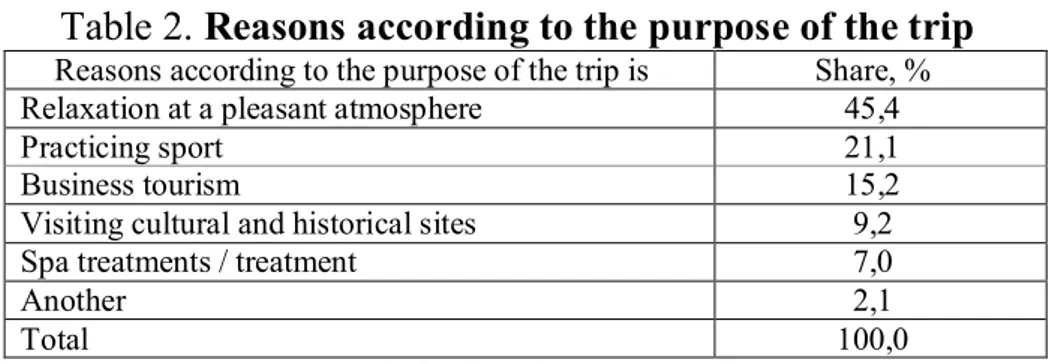
In the core of consumer behavior of tourists lies the objective of tourist travel. The distribution of respondents shows that the highest share falls on those who are driven by the motive for a holiday in a warm and relaxed atmosphere – 45.4%, followed by those who practice various sports (e.g. skiing, mountaineering) – 21.1%. They are followed by business travelers and those wishing to visit cultural and historical sites, respectively with 15.2% and 9.2%.
Table 2. Reasons according to the purpose of the trip Reasons according to the purpose of the trip is Share, % Relaxation at a pleasant atmosphere 45,4
Practicing sport 21,1
Business tourism 15,2
Visiting cultural and historical sites 9,2 Spa treatments / treatment 7,0
Another 2,1
Total 100,0
(own calculation based on surveys’ results)
Important aspects of the hotel product that determine consumer behavior and contribute to a more complete satisfaction of the diverse travel needs and desires are provided multiple services. During the study it was found that consumers prefer organizing various entertainment (81.4%), additional trips, tours or trips (47.1%).
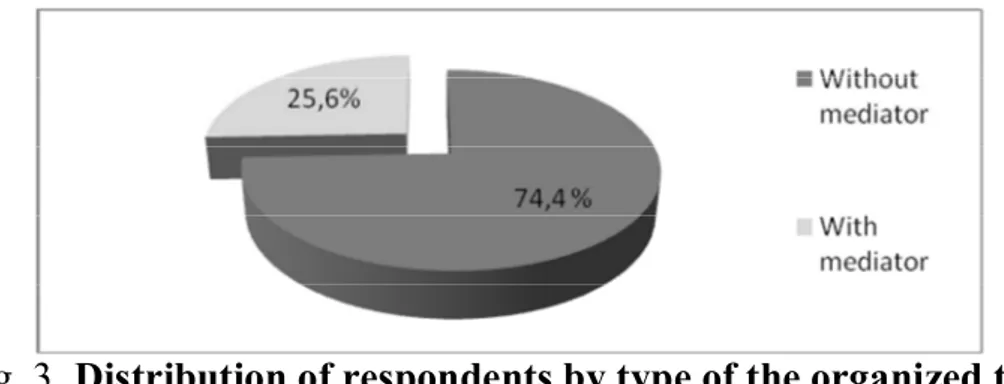
A key role in shaping consumer behavior and choice are the sources of information. The results presented in Figure 3 and Table 4 show that the majority of tourists (74.4%) arrange the travels themselves, i.e. without a mediator (tour operator, travel agency), using the Internet (68.4%) rely on friends and relatives (16.5%) or use their own past experience (10.9%). Only 4.2% trust advertising means like television, radio, newspapers, brochures, etc.
Fig. 3. Distribution of respondents by type of the organized trip
(own calculation based on surveys’ results)
Table 3. Distribution of respondents according to the sources of information Sources of information Share, %
Internet 68,4
Relatives and friends 16,5
Past experience 10,9
Рromotional tools 4,2
Total 100,0
(own calculation based on surveys’ results)
A question of interest is the establishment of the degree of consumer satisfaction when using hotel products. The survey results show that respondents are rather satisfied with the quality of the product offered (64.8%). It was observed that a significant proportion of the respondents are significantly not satisfied with the package price compared to the quality of service (12.2%); quality of products (14.6%); image of the product (5.1%). Only 0.9% of respondents could not determine the extent to which they are satisfied with their use of hotel products.
1. Marketing research on consumer motivation and factors influencing upon it stands in the basis of the formation of an effective marketing policy of the hotel enterprises. Knowing the characteristics of consumer behavior allows the hospitality industry to take appropriate action on the market situation.
2. It can be stated that consumers are mainly navigated to tourist sites corresponding to a higher category, namely hotels. It is also observed that the prevailing market segments are those of the middle class, average income, younger age groups and individual tourists.
3. Respondents mainly opt for short family vacation in a warm and relaxed atmosphere. While a significant proportion of them have specific requirements in terms of organizing the entertainment the hotel business should provide for the tourists. This will satisfy the diverse needs and desires of consumers, will provide the complex nature of the product and on this basis will keep its market positions.
4. Lack of high level of motivation to use the products of alternative tourism was found in consumers. Obviously, the tourism market segments of various forms of alternative tourism do not occupy a significant share of the market of tourism products offered yet. An important condition for the development of the hotel business is the development and supply of hotel products that integrate elements of other types of tourism.
5. It is imperative that developing an adequate advertising policy in order to significantly improve the overall advertising of hotel business at national and regional level. The choice of advertising resources and determining the channels for advertising are essential for this business.
Further area of scientific research in the problems of the forming an effective marketing policy in the hotel business should be the study of branding and its relation to the customer satisfaction.
References
1. Anastasova, L. (1998). Мarketing researches in tourism. Burgas: Selekta.
2. Bogolyubov, V.S., Orlovskaya, V. P. (2002). Economics of tourism. Мoscow: Akademia. 3. Drucker, P. (2002). Effective management. Economic tasks and optimal solutions. Моscow: Fair Press.
4. Filipova, M. (2010). Consumer choice in the Bulgarian tourism. Blagoevgrad: South-West University “Neofit Rilski”.
5. Georgiev, G., Madgerova, R. (2010). Introduction to tourism. Blagoevgrad: South-West University “Neofit Rilski”
6. Hawkins, D., Best, R., Coney, K. (1992). Consumer Behavior. IRWIN, INC. 7. Karakasheva, L., Menchevа, L., Маrкоvа, B. (1997). Marketing. Sofia: Prizma.
services. Моscow: Omera-L.
9. Kotler, Ph. (1993). Basics of marketing. Sofia.
10. Kyurova, V., Yaneva, D. (2012). Human resources – a tool for effective marketing policy of tourist enterprises. Economics & Management. Vol. VIII. No 4.
11. Melikyan, О.М. (2011). Consumer behavior. Моscow: Dashkov & K.
12. Oliver, R. (1981). Measurement and Evaluation of Satisfaction Process in Retail Settings. Journal of Retailing.
13. Sак, А. V., Juravlev, V. А. (2010). Optimization of marketing decisions. Мinsk: Grevtsova 14. Sarafinova, Е., Yatsuk, А. (2011). Marketing in tourism. Моscow: Аlfа-М: Infrа-М.
15. Stanimirov, Е., Cherkezova, V. (2012). Customer and personnel satisfaction.Varna: Izvestia 16. Uzunova, Y. et al. (1992). Маrкеting for everybody. Sofia.
17. Yaneva, D. (2013). A model reducing the impact of seasonality on the employment in the hotel business: Management, quality and competitiveness for sustainable development. Blagoevgrad: South-West University «Neofit Rilski».
18. Yaneva, D. (2013). Assessment of the factors forming the consumer behaviour in cultural tourism. International Scientific Conference «Cultural corridor Via Diagonalis – cultural tourism without boundaries». Sofia: Gea Lib.Ris.
19. Republic of Bulgaria National Statistical Institute (2014). Main economic indicators.
Available at:
http://www.nsi.bg/bg/content/1992/%D0%B3%D0%BE%D0%B4%D0%B8%D1%88%D0%BD%D0 %B8-%D0%B4%D0%B0%D0%BD%D0%BD%D0%B8 [Accessed 26 December 2014]
АНАЛИЗ УДОВЛЕТВОРЕННОСТИ ПОТРЕБИТЕЛЕЙ ГОСТИНИЧНЫХ ПРОДУКТОВ В БОЛГАРИИ
Кюрова Вяра Василева
доктор, доцент кафедры менеджмента и маркетинга, PhD
Янева Диляна Емчева
доктор, ассистент кафедры менеджмента и маркетинга, PhD Юго-западный университет "Неофит Рыльский", Болгария
Необходимым условием для правильного выбора маркетинговой политики гостиничных компаний является наличие точных исследований, анализов и прогнозов изменении потребительского спроса, конкурентной среды и конъюнктуры на рынках продуктов гостиничного бизнеса. Наряду с этим, изучение мотивов туристов в выборе гостиничных продуктов и факторов, формирующих потребительских предпочтении, – важное условиe для достижения баланса между спросом и предложении этих продуктов. В этом контексте, цель данного исследования – выявление особенностей потребительского поведения в сфере гостиничного бизнеса, ввиду чего сделана попытка определения потребительского профиля, мотивов выбора гостиничных продуктов и степень удовлетворенности потребителейи использовавших этих продуктов.