261 261261 261261 Mem Inst Oswaldo Cruz, Rio de Janeiro, Vol. 94(2): 261-268, Mar./Apr. 1999
Characterization of
Endotrypanum
(Kinetoplastida:
Trypanosomatidae), a Unique Parasite Infecting the
Neotropical Tree Sloths (Edentata)
Antonia M Ramos Franco
+, Gabriel Grimaldi Jr
Laboratório de Leishmaniose, Departamento de Imunologia, Instituto Oswaldo Cruz, Av. Brasil 4365, 21045-900 Rio de Janeiro, RJ, Brasil
This article reviews current concepts of the biology of Endotrypanum spp. Data summarized here on parasite classification and taxonomic divergence found among these haemoflagellates come from our studies of molecular characterization of Endotrypanum stocks (representing an heterogenous popu-lation of reference strains and isolates from the Brazilian Amazon region) and from scientific literature. Using numerical zymotaxonomy we have demonstrated genetic diversity among these parasites. The molecular trees obtained revealed that there are, at least, three groups (distinct species?) of
Endotrypanum, which are distributed in Central and South America. In concordance with this classifi-cation of the parasites there are further newer molecular data obtained using distinct markers. More-over, comparative studies (based on the molecular genetics of the organisms) have shown the phyloge-netic relationships between some Endotrypanum and related kinetoplastid lineages.
Key words: Endotrypanum - Protozoa - Kinetoplastida - Trypanosomatidae - molecular taxonomy - enzyme activities monoclonal antibodies enzyme electrophoresis DNA analyses mammalian reservoirs
sandflies vectors
Biological characteristics of Endotrypanum
spp. - Parasitic protozoa of the genus
Endotrypanum are unique among the Kinetoplastida in that they infect erythrocytes of their mammalian host. Infection with Endo-trypanum appears to be restricted to edentates, prin-cipally of forest-dwelling two-toed sloths of the genus Choloepus, but rarer infections with these flagellates seems to occur in three-toed sloths (ge-nus Bradypus) (Fig. 1). As shown in Fig. 2, in-side the erythocyte the Endotrypanum assumes an epimastigote or trypomastigote form, while in the sandfly or during in vitro culture the parasite as-sumes promastigote morphology (Shaw 1992). However, the complete life cycle of Endotrypanum
spp. has not been reproduced in experimental stud-ies. Other developmental stages of the parasite may occur within the mammalian host (Deane 1961).
In nature, Endotrypanum parasites are probably transmitted by the bite of infected phlebotomine sandflies (Diptera: Psychodidae). Arias et al.
This work was supported in part by the CNPq and Faperj (Brazil).
+Corresponding author. Fax: +55-21-280.1589. E-mail:
[email protected] Received 12 November 1998 Accepted 19 January 1999
(1985) identified E. schaudinni and other
Endotrypanum sp. infections in sandflies and sloths captured in the Amazon Region of Brazil. Studies using kinetoplast DNA probe for detecting para-sites in sandflies also demonstrated Endotrypanum
infections in Lutzomyia shannoni, Lu. umbratilis
and Lu. anduzei (Rogers et al. 1988). Further evi-dence for the development of Endotrypanum in phlebotomines was obtained by feeding several laboratory-reared sandfly species on infected sloths (Shaw 1964, 1969, 1981, Christensen & Herrer 1977, 1979). In these studies, infections develop-ing within the insect gut (Shaw 1964, 1969) were similar to those found in wild caught sandflies (Johnson et al. 1963, Arias et al. 1985). More-over, we have reported (Franco et al. 1997b) the developmental biology of Brazilian strains of
262 262 262 262
262 Genetic Polymorphism in Endotrypanum AMR Franco, G Grimaldi Jr
There were also individual variation in the distri-bution and survival of parasites within the guts of flies in each group. These data indicate that there is variation in the susceptibility to infection with
Endotrypanum among and within sandfly species.
Laboratory diagnosis - The finding that
Endotrypanum and Leishmania, as well as other distinct groups of Trypanosoma are commonly found in the same vertebrate and insect hosts in Neotropical forests (Table) has led to an increased interest in developing simple methods to distin-guish these parasites for epidemiological purposes. Several methods based on parasite-specific mark-ers have been proposed to discriminate these or-ganisms. Endotrypanum can be distinguished from
Leishmania species and other trypanosomatids by enzymatic profiles (Arias et al. 1985, Shaw et al. 1991, Franco et al. 1996b), monoclonal antibodies (Lopes & McMahon-Pratt 1989, Franco et al. 1997a), total DNA probes (Greig et al. 1989), hy-bridization probes based on kDNA (Pacheco et al. Fig.1: inhabitants of Neotropics: a two-toed sloth, Choloepus didactylus, the major host of Endotrypanum (A) and a three-toed sloth, Bradypus variegatus (B), reservoir-hosts of
Endotrypanum in Central and South American Countries.
Fig. 2: promastigotes from culture of Endotrypanum (A) and haemoflagellates found in the blood of two-toed sloth,
Choloepus juruanus from Rondônia State, BR (B).
1990), mini-exon gene repeats (Fernandes et al. 1993a), lectin reactivity (Lopes et al. 1987) and sialidase/trans-sialidase activities (Medina-Acosta et al. 1994). However, the classical methods used for direct demonstration of the parasite in tissues is difficult because of the paucity of organisms in infected hosts. Work is now in progress to evalu-ate (employing PCR and serological assays) the prevalence of Endotrypanum and Leishmania in-fections in sloths captured in distinct sylvan areas of the Neotropics (Pirmez et al. 1997, Mayrink et al. 1998).
Molecular characterization of the genus - The taxonomy of Endotrypanum spp. is still controver-sial. Since the original description of this parasite, by Mesnil and Brimont in 1908, only two species have been named as E. schaudinni Mesnil and Brimont, 1908 and E.monterogeii, Shaw, 1969. Croft et al. (1980) observed that the mobilities of the enzymes MDH, IDH and ME, in seven stocks of this parasite were different for the strains that had virus-like particles from those that did not. The two groups did not agree with the original identification of E. schaudinni and E. monterogeii since, ultra-structural and biochemical parameters were simi-lar, in contrast to the description by Shaw (1969), who reported serological differences between these species. Lopes et al. (1990), also grouped both spe-cies in the same cluster by comparison of nuclear DNA restriction fragment patterns.
The main goal of our studies is to apply an in-tegrated set of approaches towards the character-ization of parasites within the genus Endotrypanum
263 263263 263263 Mem Inst Oswaldo Cruz, Rio de Janeiro, Vol. 94(2), Mar./Apr. 1999
TABLE
Trypanosomatid parasites commonly found infecting sloths (Edentata: Xenarthra)
Trypanosomatids/ Geographical distributiona
Reference Sloths’ speciesb BR CO PA GF EC CR
E. schaudinni
C.didactylus + + Mesnil & Brimont 1908, Deane 1961, Herrer & Telford 1969
C. hoffmanni + Shaw 1985, Herrer & Christensen 1980
B. variegatus + + Shaw 1985
B.tridactylus + Shaw 1985
E. monterogeii
C. hoffmanni + Shaw 1969
Endotrypanum sp.
Choloepus sp. + ATCC 1991
Choloepus sp + ATCC 1991
C.hoffmanni + Zeledón et al. 1975c
C. juruanus + Franco et al. 1996b
L. panamensis
C.didactylus + Shaw 1985
C.hoffmanni + + Zeledón et al. 1975a
B. variegatus + + Zeledón et al. 1975a
L. guyanensis
C. didactylus + + Gentileet al. 1981, Lainson et al. 1981, Shaw 1985, Dedet et al. 1989
L. herreri
C. hoffmanni + Zeledón et al. 1979
B. griseus + Zeledón et al. 1979
L.equatorensis
C. hoffmanni + Grimaldi et al, 1992
L.colombiensis
C.hoffmanni + Kreutzer et al. 1991
L.shawi
C. didactylus + Lainson et al. 1989 B. tridactylus + Lainson et al. 1989
L. braziliensis sp.
B. infuscatus + Herrer & Telford 1969, Herrer et al 1973 B.griseus + Zeledón et al.1975c
C. hoffmanni + + Herrer & Telford 1969, Herrer et al. 1973, Zeledón et al. 1975c, Herrer & Christensen 1980, Christensen & de Vasquez 1982
T. leeuwenhoeki
C. hoffmanni + + + Shaw 1969, Zeledón et al.1975b, Travi et al.1989 B.variegatus + + Shaw 1969, Zeledón et al. 1975b
T. mesnil-brimonti
C.didactylus + + Deane 1961, Shaw 1985
T.preguici
C. hoffmanni + + Shaw 1969, 1985
B. griseus + Shaw 1969
T. cruzi
C.hoffmanni + Christensen & Herrer 1979, Herrer & Christensen 1980
B.infuscatus + Pipkin 1968
T.rangeli
C. hoffmanni + Herrer & Christensen 1980
B. tridactylus + Miles et al. 1983
T. legeri
B. g. griseus + Montero-Gei 1956, Trejos & Montero-Gei 1953
264 264 264 264
264 Genetic Polymorphism in Endotrypanum AMR Franco, G Grimaldi Jr
to address problems of parasite identification and taxonomy, diagnosis and developmental biology. Our results confirm previous studies reporting population diversity within this genus (Lopes et al. 1990).
Trans-sialidase and sialidase activities - By vir-tue of the differences observed in the rations of these enzyme activities, a large collection of trypanosomatids (comprising the major taxa of these parasites) could be separated into four ex-pression types. Endotrypanum could be clustered into a group which could be easily differentiate from other trypanosomatids by their capacity of expressing comparable levels of both trans-sialidase and trans-sialidase activities (Medina-Acosta et al. 1994). In general, the measurement of trans-sialidase and trans-sialidase activities permits the differ-entiation of parasites frequently found in the same sylvatic vertebrate and invertebrate hosts that are difficult to distinguish, such as Leishmania and
Endotrypanum.
Reactivities with monoclonal antibodies -Among the new approaches for identifying
Endotrypanum is serodeme analysis using specific monoclonal antibodies, Mabs (Lopes & McMahon-Pratt 1989). In a recent study (Franco et al. 1997a), an heterogenous population of Endotrypanum
strains have been screened against a panel of Mabs derived for selected species of Endotrypanum or
Leishmania, to see whether this approach could be used to differentiate/group further among these parasites. Using different immunological assay systems, Mabs considered specific for the genus
Endotrypanum [E-24, CXXX-3G5-F12] or strain M6159 of E. schaudinni [E-2, CXIV-3C7-F5] (Lopes & McMahon-Pratt 1989) reacted variably according to the test used but in the ELISA or im-munofluorescence assay both reacted with all the strains tested. Analyses using these Mabs showed antigenic diversity occurring among the
Endotrypanum strains, but no qualitative or quan-titative reactivity pattern could be consistently re-lated to parasite origin (i.e., host species involved) or geographic area of isolation. Western blot analy-ses of the parasites showed that these Mabs recog-nized multiple components and differences existed either in the epitope density or molecular forms associated with the antigenic determinants, which allowed the assignment of the strains to specific antigenic groups.
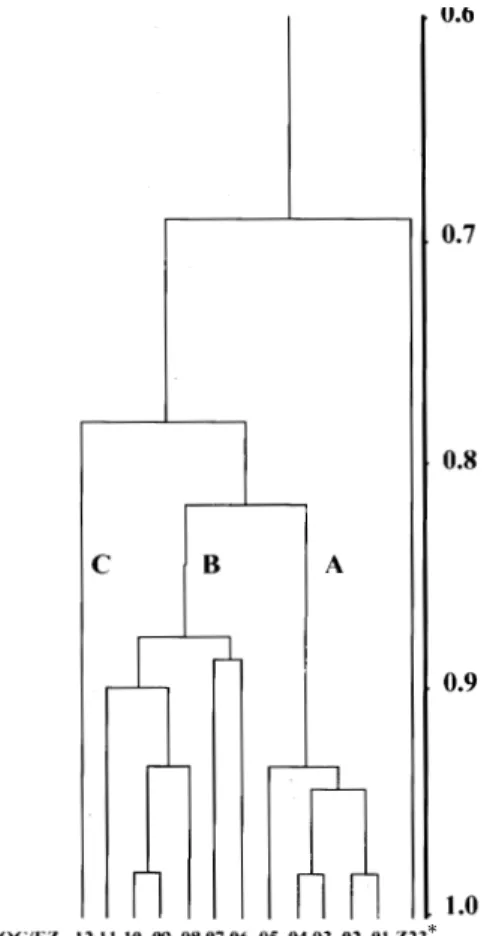
Multilocus enzyme electrophoresis (MLEE) -As a result of using numerical zymotaxonomy for classifying these organisms (Franco et al. 1996b), the taxonomic horizon of Endotrypanum spp. has been widened. We have analyzed enzyme polymor-phism among a group of Endotrypanum parasites (17 stocks isolated from sloths in the Amazon
Re-gion in Brazil and 6 reference strains). The 16 enzymic loci were analyzed, and the strains were classified into zymodemes, each representing para-sites with unique enzyme profiles. Using numeri-cal analyses the genus was shown to be mono-phyletic and the 12 zymodemes characterized could be divided into three groups (A, B, C) (Fig. 3). The data indicate that E. schaudinni is a species complex. The heterogeneous population of para-sites showed, however, no correlation with the origin of Endotrypanum stocks. Eight isolates from the State of Rondônia (Brazil) and a parasite strain from Panama were clustered together into a zymodeme (IOC/EZ01), which was phenetically closely related to the E. monterogeii from Costa Rica. All these data reinforce the discussion about the existence of the later parasite species.
Minicircle kDNA heterogeneity and molecular karyotypes - Comparisons of kDNA restriction enzyme fragments profiles from strains represent-ing selected Endotrypanum zymodemes were car-ried out by polyacrylamide gradient gel electro-phoresis. As the degree of heterogeneity within minicircles varied among species or strains of
Endotrypanum, the stocks could be clustered into distinct groups of parasites, according to the ma-jor sequence classes (minicircle fragments or di-gests) released by the restriction endonucleases tested (Franco et al. 1996a). In parallel study us-ing PFGE and appropriate gel runnus-ing conditions, chromosomes were polymorphic in number (10-25) and size (290-2,200 kb) of bands among para-sites of this genus. Distinct karyotypes were con-structed among E. schaudinni, E. monterogeii and
Endotrypanum sp. strains. All of the isolates (5) of
Endotrypanum sp. from the same species of sloth (C. juruanus) and geographical origin (Rondônia, Brazil) had the same karyotype (Franco et al. 1992). Interesting, these parasites were grouped in the same zymodeme (EZ01) with two other stocks originating from Central America (Franco et al. 1996b). However, RAPD analysis using selected primer was able to differentiate the EZ01 parasites, but the strains did not group on the basis of their geographic origin (Franco et al. 1998a).
Evolutionary links among parasites and taxo-nomic problems - The difficult taxonomy of
Endotrypanum spp. is mainly because the parasite life cycle is unknown. Although this genus is unique among the Trypanosomatidae in that the parasites are found inside the erythrocyte of the mammalian host, both forms (epimastigotes of E. schaudinni and trypomastigotes of E. monterogeii) are found rarely in infected sloths. Endotrypanum
265 265265 265265 Mem Inst Oswaldo Cruz, Rio de Janeiro, Vol. 94(2), Mar./Apr. 1999
vector, at least in experimentally infected phlebotomine sandfly (Franco et al. 1997b).
The Endotrypanum shares many characters with other trypanosomatids, particularly those of the genus Leishmania (Shaw 1992). Phylogenetic reconstruction studies of the various kinetoplastid lineages (Fernandes et al. 1993b, Maslov & Simpson 1995) have shown that Leishmania and
Endotrypanum are more closely related organisms to each other than either is to T. cruzi. The genetic similarity between Endotrypanum and leishma-nial parasites, such as L. (L.) herreri, L. (L). hertigi/
L. (L). deanei, L. (V.) colombiensis or L. (V.)
equatorensis was demonstrated by (i) sequencing comparisons of the small subunit of ribosomal RNA and RNA Polymerase II genes (Croan & Ellis 1996, Noyes et al. 1996, 1997, Croan et al. 1997), (ii) numerical zymotaxonomy, (iii) intergenic region typing of the internal transcribed spacers of the rRNA genes, (iv) minicircle kDNA heterogeneity analysis, and (v) measurement of the sialidase activites of the parasites (Cupolillo et al. 1998). The data show that L. (L.) hertigi/L. (L.)
deanei (Herrer 1971, Lainson & Shaw 1977) are genetically closest to the Endotrypanum/L. (L.)
herreri group. Interesting, L. (L.) herreri was ge-netically closer to Endotrypanum than to the patho-genic Leishmania species (Croan et al. 1997, Noyes et al. 1997). The former parasite was originally isolated from two (C. hoffmanni) and three-toed (B. griseus) sloths, and sandflies (Lu. trapidoi, Lu. ylephiletor and Lu. shannoni) in Costa Rica (Zeledón et al. 1979). Studies employing mono-clonal antibodies have also shown antigenic simi-larities among these parasites (Grimaldi et al. 1992, Shaw 1992, Franco et al. 1997a).
Moreover, studies by Touch-down PCR with primers from kinetoplastid housekeeping genes (ribosomal P proteins and repetitive sequences, SIRE) examine the relationships among
Endotrypanum (N= 22 strains, comprising the major taxa of this genus) and L. (L.) herreri (ISHA/ CR/74/LV341 and IYLE/CR/74/LV342 strains, both isolated from sandflies, and MCHO/CR/74/ LV344 strain, isolated from sloth). The data reveal differences among the leishmanial strains, but showing closed genetic similarity between LV342 and Endotrypanum strains clustered within the same group (group A) by zymodeme analysis (Franco et al. 1996b). However, both strains LV341 and LV344 were distinct from all Endotrypanum
stocks analyzed (Franco et al. 1998b). Compara-tive phylogenetic reconstruction studies are in progress to address the evolutionary links among these related kinetoplastid lineages.
The known vertebrate hosts of Endotrypanum
spp., two and three-toed sloths, are considered as
unique examples of South American fauna and they evolved some 60-70 million years ago during the Palaeocene period. The separation between these two genera of sloths occurred later during the Mi-ocene period and their presence in Central America, is thought to be a result of migration from South America (Webb 1985, Sarich 1985). In
Choloepus the body temperature ranges from 24º to 33º C. This variation results in a geographical barrier to these mammals (Nowak 1991) and con-sequently to the parasites. Lopes et al. (1990) based on results of restriction fragment hybridization conclude that Endotrypanum originated in South America. Considering these observations, zymodeme EZ01 (Fig. 3) has migrated towards Central America and the parasites isolated in this area are representative of the most recent group (group A). Moreover, the results suggest that the dispersal of the genus Endotrypanum has arisen from group C, which is probably the most ancient organism (Franco et al. 1996b).
Fig. 3: phenetic analysis of enzyme data from Endotrypanum
stoks. The Simple Matching Coefficient of Similarity was cal-culated between all combinations of pairs of strains and the similarity matrix transformed into a dendogram by the UPGMA algorithm.
(* Corresponds to Leishmania zymodeme - IOC/Z23).
266 266 266 266
266 Genetic Polymorphism in Endotrypanum AMR Franco, G Grimaldi Jr
REFERENCES
Arias JR, Miles MA, Naiff RD, Póvoa MM, De Freitas RA, Biancardi CB, Castellon EG 1985. Flagellate infection of Brazilian sandflies (Diptera: Psychod-idae): isolation invitro and biochemical identifica-tion of Endotrypanum and Leishmania. Am J Trop Med Hyg 34: 1098-1108.
ATCC - American Type Culture Collection 1991. Cata-logue of Protists. 17th ed., 20 pp.
Christensen HA, Herrer A 1977. The use of phlebo-tomine sand flies in xenodiagnosis. Coll Inter Cen-tre Nat Rec Sci 239: 129-130.
Christensen HA, Herrer A l979. Susceptibility of sandflies (Diptera: Psychodidae) to Trypanoso-matidae from two-toed sloths (Edentata: Bradypodidae). J Med Entomol l6: 424-427. Christensen HA, Vasquez AMD 1982. The tree-buttress
biotope: a pathobiocenose of Leishmania braziliensis. Am J Trop Med Hyg 31: 243-251. Croan D, Ellis J 1996. Phylogenetic relationships
be-tween Leishmania, Viannia and Sauroleishmania
inferred from comparison of a variable domain within the RNA polymerase II largest subunit gene. Mol Biochem Parasitol 79: 97-102.
Croan DG, Morrison DA, Ellis JT 1997. Evolution of the genus Leishmania revealed by comparison of DNA and RNA polymerase gene sequences. Mol Biochem Parasitol 89: 149-159.
Croft SL, Chance ML, Gardener PJ l980. Ultrastructural and biochemical characterization of stocks of
Endotrypanum. Ann Trop Med Parasitol 74: 585-589.
Cupolillo E, Pereira LOR, Fernandes O, Catanho MP, Pereira JC, Medina-Acosta E, Grimaldi Jr G 1998. Genetic data showing evolutionary links between
Leishmania and Endotrypanum. Mem Inst Oswaldo Cruz 93: 677-683.
Deane LM l96l. Tripanosomatídeos de mamíferos da região Amazônica. I. Alguns flagelados encontrados no sangue de mamíferos silvestres do Estado do Pará.
Rev Inst Med Trop São Paulo 3: 15-28.
Dedet JP, Gay F, Chatenay G 1989. Isolation of Leish-mania species from wild mammals in French Guiana.
Trans R Soc Trop Med Hyg 83: 613-615.
Fernandes O, Degrave W, Campbell DA 1993a. The mini-exon gene: a molecular marker for Endo-trypanum schaudinni. Parasitology 107: 219-224. Fernandes AP, Nelson K, Beverley SM 1993b.
Evolu-tion of nuclear ribosomal RNAs in kinetoplastid pro-tozoa: perspectives on the age and origins of para-sitism. Proc Natl Acad Sci USA 90: 11608-11612. Franco AMR, Andrade LO, Moreira CFS, Machado
GMC, Macedo AM, Grimaldi Jr G 1998a. Ran-dom amplified polymorphic DNA fingerprinting (RAPD) analysis reveals the genetic heterogeneous population structure of Endotrypanum parasites.
Mem Inst Oswaldo Cruz 93: 198.
Franco AMR, Machado GMC, Moreira CFS, Mayrink NA, Grimaldi Jr G 1996a. Analysis of minicircle kDNA heterogeneity in Endotrypanum indicate di-versity within this genus. Mem Inst Oswaldo Cruz 91: 96.
Franco AMR, Machado GMC, Naiff RD, Moreira CFS, McMahon-Pratt D, Grimaldi Jr G 1997a. Charac-terization of Endotrypanum parasites using specific monoclonal antibodies. Mem Inst Oswaldo Cruz 92:
63-68.
Franco AMR, Momen H, Naiff RD, Moreira CFS, Deane MP, Grimaldi Jr G 1996b. Enzyme polymor-phism in Endotrypanum and numerical analysis of isoenzyme data. Parasitology 113: 39-48.
Franco AMR, Moreira CFS, Santamgelo A, Medina-Acosta E, Schijman A, Grimaldi Jr G 1998b. On the identity of Leishmania herreri and enigmatic
Endotrypanum parasites infecting sloths and Phlebotomine sandflies from sylvan areas of the Neotropics. Mem Inst Oswaldo Cruz 93: 341.
Franco AMR, Tavares CC, Moreira CFS, Carrera CC, Deane MP, Grimaldi Jr G 1992. Molecular karyo-type analysis of reference strains and isolates of
Endotrypanum from sloths in the Amazon Region of Brazil. Mem Inst Oswaldo Cruz 87: 246. Franco AMR, Tesh RB, Guzman H, Deane MP, Grimaldi
Jr G 1997b. Development of Endotrypanum
(Kinetoplastida: Trypanosomatidae) in experimen-tally infected Phlebotomine sand flies. J Med Entomol 34: 198-192.
Gentile B, Le Pont F, Pajot FX, Besnard R 1981. Der-mal leishmaniasis in French Guiana: the sloth (Choloepus didactylus) as a reservoir host. Trans R Soc Trop Med Hyg 75: 612-613.
Greig SR, Akinsehinwa FA, Ashall F, Lainson R, Shaw JJ, Miles MA, Barker DC 1989. The feasibility of discrimination between Leishmania and
Endotrypanum using total DNA probes. Trans R Soc Trop Med Hyg 83: 196-197.
Grimaldi Jr G, Kreutzer RD, Hashiguchi Y, Gomez EA, Mimory T, Tesh RB 1992. Description of Leish-mania equatorensis sp. n. (Kinetoplastida: Trypanosomatidae), a new parasite infecting arbo-real mammals in Ecuador. Mem Inst Oswaldo Cruz 87: 221-228.
Herrer A 1971. Leishmania hertigi sp.n. from the tropi-cal porcupine, Coendou rothschildi Thomas. J Parasitol 57: 626-629.
Herrer A, Christensen HA 1980. Leishmania braziliensis
in the Panamanian two-toed sloth, Choloepus hoffmanni. Am J Trop Med Hyg 29: 1196-1200. Herrer A, Telford SR 1969. Leishmania braziliensis
iso-lated from sloths in Panama. Science 164: 1419-1420.
Herrer A, Christensen HA, Beumer RJ 1973. Reservoir hosts of cutaneous leishmaniasis among Panamanian forest mammals. Am J Trop Med Hyg 22: 585-591. Johnson PT, McConnell E, Hertig M 1963. Natural infections of leptomonad flagellates in Panamanian
267 267267 267267 Mem Inst Oswaldo Cruz, Rio de Janeiro, Vol. 94(2), Mar./Apr. 1999
Lainson R, Shaw JJ 1977. Leishmania of neotropical porcupines: Leishmania hertigi deanei nov. subsp.
Acta Amazonica 7: 51-57.
Lainson R, Braga RR, De Souza AAA, Póvoa MM, Ishikawa EAY, Silveira FT 1989. Leishmania
(Viannia) shawi sp. n., a parasite of monkeys, sloths and procyonids in Amazonian Brazil. Ann Parasit Hum Comp 64: 200-207.
Lainson R, Shaw JJ, Ready PD, Miles MA, Póvoa MM 1981. Leishmaniasis in Brazil. XVI. Isolation and identification of Leishmania species from sandflies, wild mammals and man in North Pará state, with particular reference to Leishmania braziliensis guyanensis, causative agent of “pian-bois”. Trans R S Trop Med Hyg 75: 530-536.
Lopes AHCS, McMahon-Pratt D 1989. Monoclonal antibodies specific for members of the genus
Endotrypanum. J Protozool 36: 354-361.
Lopes AHCS, Esteves MJG, Angluster J, Andrade AFB 1987. Lectin binding to surface saccharides on
Endotrypanum strains. Mem Inst Oswaldo Cruz 82: 42.
Lopes AHCS, Iovannisci D, Petrillo-Peixoto M, McMahon-Pratt D, Beverley SM 1990. Evolution of nuclear DNA and the occurrence of sequences related to new small chromosomal DNAs in the trypanosomatid genus Endotrypanum. Mol Biochem Parasitol 40: 151-162.
Maslov DA, Simpson L 1995. Evolution of Parasitism in Kinetoplastid Protozoa. Parasitol Today 11: 30-32.
Mayrink AN, Franco AMR, Grimaldi Jr G 1998. Se-rodiagnostic survey of Endotrypanum and Leishma-nia infections in two and three-toed sloths using a micro-Elisa assay as a screening test. Mem Inst Oswaldo Cruz 93: 274.
Medina-Acosta E, Franco AMR, Jansen AM, Sampol M, Nevés N, Pontes-de-Carvalho L, Grimaldi Jr G, Nussenzweig V 1994. Trans-sialidase and sialidase activities discriminate between morphologically in-distinguishable trypanosomatids. Eur J Biochem 225: 333-339.
Mesnil F, Brimont E 1908. Sur un hematozoaire nouveau (Endotrypanum n.gen.) d’un edente de la Guyane. C R Soc Biol 65: 581.
Miles MA, Arias JR, Valente AS, Naiff RD, De Souza AA, Póvoa MM, Lima JA, Cedillos RA 1983. Vertebrate hosts and vectors of Trypanosoma rangeli in the Amazon Basin of Brazil. Am J Trop Med Hyg 32: 1251-1259.
Montero-Gei F 1956. Contribución al estudio de
Endotrypanum schaudinni (Trypanosomatidae). Rev Biol Trop 4: 41-68.
Noyes HA, Camps AP, Chance ML 1996. Leishmania herreri (Kinetoplastida: Trypanosomatidae) is more closely related to Endotrypanum (Kinetoplastida: Trypanosomatidae) than to Leishmania. Mol Biochem Parasitol 80: 119-123.
Noyes HA, Arana BA, Chance ML, Maingon R 1997. The Leishmania hertigi (Kinetoplastida: Trypanosomatidae) complex and the lizard Leish-mania: their classification and evidence for a
neotropical origin of the Leishmania-Endotrypanum
clade. J Euk Microbiol 44: 511-517.
Nowak RM 1991. Order Xenarthra. Walker’s Mammals of the World, p. 515-527, Vol. I, Fifth edition. The Johns Hopkins University press Ltd., Baltimore and London.
Pacheco RS, Thomaz N, Momen H 1990. kDNA cross-hybridization between Endotrypanum and peripylarian Leishmania. Trans R Soc Trop Med Hyg 84: 531.
Pipkin AC 1968. Domicillary reduviid bugs and the epi-demiology of Chaga’s disease in Panama (Hemi-ptera: Reduviidae: Triatominae). J Med Entomol 5:
107-124.
Pirmez C, Oliveira-Neto MP, Franco AMR, Meneses C, Rangel E, Mayrink A, Silva-Gonçalves AJ, Fernandes O, Grimaldi G 1997. Edentates as a pos-sible reservoir of L. (V.) braziliensis in an endemic area of Rio de Janeiro. Mem Inst Oswaldo Cruz 92:
119.
Rogers WO, Burnheim PF, Wirth DF 1988. Detection of Leishmania within sand flies by kinetoplast DNA hybridization. Am J Trop Med Hyg 39: 434-439. Sarich VM 1985. Xenarthran systematics: albumin
im-munological evidence, p. 77-81. In The Evolution and Ecology of Armadillos, Sloths and Vermilingues, GG Montegomery, Smithsonian Institution Press, Washington, D.C., London.
Shaw JJ 1964. A possible vector of Endotrypanum schaudinni of the sloth Choloepus hoffmanni in Panama. Nature Lond 201: 417- 418.
Shaw JJ 1969. The Haemoflagellates of Sloths. London School of Hygiene and Tropical Medicine Memoir,
No. 13, H.K. Lewis and Co. Ltd., London, 132 pp. Shaw JJ 1981. The behaviour of Endotrypanum schaudinni (Kinetoplastida: Trypanosomatidae) in three species of laboratory-bred Neotropical sandflies (Diptera: Psychodidae) and its influence on the classification of the genus Leishmania, p. 232-241. In Parasitological Topics, Soc Protozool Special Publ. No. 1, Canning, E.U.
Shaw JJ 1985. The haemoflagellates of sloths, vermilinguas (anteaters), and armadillos, p. 279-292. In The Evolution and Ecology of Armadillos, Sloths and Vermilingues, GG Montgomery, Smithsonian Institution Press, Washington DC. Shaw JJ 1992. Endotrypanum, a unique intraerythrocytic
flagellate of New World tree sloths. An evolution-ary link or an evolutionevolution-ary backwater? Ciên Cult 44:107-116.
Shaw JJ, Braga RR, Lainson R, Ishikawa EAY 1991. Aconitate hydratase (ACON), na enzyme that dis-tinguishes Leishmania of the subgenus Viannia from other trypanosomatids. Trans R Soc Trop Med Hyg 85: 597-589.
Travi BL, Zea A, D’Alessandro A 1989. Trypanosoma
(Herpetosoma) leeuwenhoeki in Choloepus hoffmanni and Didelphis marsupialis of the pacific coast of Colombia. J Parasitol 75:218-224. Trejos A, Montero-Gei F l953. Estudios sobre
268 268 268 268
268 Genetic Polymorphism in Endotrypanum AMR Franco, G Grimaldi Jr
1: 21-27.
Webb SD 1985. The interrelationships of the tree sloths and ground sloths, p. 105-112, In The Evolution and Ecology of Armadillos, Sloths and Vermilinguas, GG Montgomery, Smithsonian Institution Press, Wash-ington, London.
Zeledón R, Ponce C, Murillo J 1979. Leishmania herreri
sp. n. from sloths and sandflies of Costa Rica. J Parasitol 65: 273- 279.
Zeledón R, Ponce C, Ponce E De 1975a. The isolation of Leishmania herreri sp.n. from sloths in Costa Rica.
Am J Trop Med Hyg 24: 706-707.
Zeledón R, Ponce C, Ponce E De 1975b. Isolation of
Trypanosoma rangeli from Costa Rican sloths. Am Soc Parasit, Program and Abstracts 60.