New evidence for balancing selection at the HLA-G locus
in South Amerindians
Tiago Degani Veit
1,2, Juciana Cazarolli
1, Francisco Mauro Salzano
1,2, Marion Schiengold
1and José Artur Bogo Chies
1,21
Departamento de Genética, Universidade Federal do Rio Grande do Sul, Porto Alegre, RS, Brazil.
2Programa de Pós-Graduação em Genética e Biologia Molecular,
Universidade Federal do Rio Grande do Sul, Porto Alegre, RS, Brazil.
Abstract
HLA-G is a non-classical HLA (Human Leukocyte Antigen) molecule characterized by limited tissue distribution un-der normal physiological conditions and low variability at both DNA and protein levels. Several studies suggest that HLA-G could play a role, as an immunoregulatory molecule, in situations as diverse as transplantation, cancer, viral infections and inflammatory diseases. A total of 237 individuals from 21 South American tribes speaking nine differ-ent linguistic families were studied in relation to the 14 bp insertion/deletion polymorphism at theHLA-G gene. A con-sistent (seven in nine) excess of heterozygosity in samples classified by language was obtained. Our data supply evidences for balancing selection acting at the HLA-G 14 bp INDEL region. Enhanced fetal survival in a patho-gen-rich environment may account for these findings.
Keywords: HLA-G 14 bp INDEL, balancing selection, Amerindians, pathogen resistance.
Introduction
HLA-G is a non-classical HLA (Human Leukocyte Antigen) molecule characterized by limited tissue distribu-tion under normal physiological condidistribu-tions and low poly-morphism at both DNA and protein levels. HLA-G presents unique characteristics as compared to its classical HLA counterparts, such as the expression of multiple isoforms generated by alternative splicing, which can be mem-brane-bound (G1-G4) or secreted (G5-G7). Moreover, it is the only HLA molecule capable to form dimers. Unlike the classical HLA-I A, B and C molecules, HLA-G seems to be involved in immune modulation rather than in antigen pre-sentation. It has been shown that HLA-G plays a major role in immunosuppression, interacting with cells of the im-mune system and suppressing the imim-mune response by dif-ferent mechanisms. These mechanisms include the inhibition of T lymphocytes (CTL) and NK cells cytotoxic activity, protection of class I-negative or allogeneic tumors from NK-mediated anti-tumor immunity (Riteau et al., 2001) and even tumor cells that express ligands for NK ac-tivator receptors such as MICA (Menier et al., 2002; Rouas-Freiss et al., 2003). Also, it was shown that the
HLA-G molecule can inhibit CD4+ T cell alloproliferative responses (Riteauet al., 1999), the proliferation of T and peripheral blood NK cells (Bahriet al., 2006; Caumartinet al., 2007; LeMaoultet al., 2007), and can also act on anti-gen presenting cells (APC) by inhibiting their maturation and function (Horuzskoet al., 2001). Additionaly, HLA-G may exert long-term immunotolerogenic effects through the generation of suppressor cells (reviewed by Carosellaet al., 2008) and even cells which do not transcribe HLA-G may temporarily become HLA-G+ and suppressive through intercellular uptake of HLA-G-containing mem-brane patches, a mechanism called trogocytosis (LeMaoult et al., 2007). On the other hand, it was postulated that HLA-G can activate uterine NK cells, leading to the pro-duction of pro-inflammatory and pro-angiogenic factors, which would be important for placental development (Rajagopalanet al., 2006).
HLA-G expression was first described in the cyto-trophoblast, and therefore the first studies on this molecule concentrated in its role during pregnancy. However, as soon as the first immunotolerogenic features of this mole-cule became known, the scientific community began to turn its attention to other immunological situations in which HLA-G could play a role, such as transplantation, cancer, viral infections, and inflammatory diseases (reviewed By Veitet al., 2010). Scientific interest on HLA-G has contin-uously increased since the description of the molecule in www.sbg.org.br
Send correspondance to José Artur Bogo Chies. Departamento de Genética, Universidade Federal do Rio Grande do Sul, Caixa Postal 15053, 91501-970 Porto Alegre, RS, Brazil. E-mail: [email protected].
1987, as evidenced by the fact that half of the 1352 entries for the term “HLA-G” in Pubmed (until July 2011) were generated in the last six years. At the Universidade Federal do Rio Grande do Sul, the Immunogenetics Laboratory of the Genetics Department is developing research on the variability of the gene HLA-G, with special focus on auto-immune diseases but also approaching infectious diseases and materno-foetal tolerance (Viannaet al., 2007; Veitet al., 2008, 2009; Cordero et al., 2009; Consiglio et al., 2011).
TheHLA-Ggene is located at the Major Histocom-patibility Complex (MHC) region, which comprises a col-lection of genes at the short arm of chromosome 6 (6p21.3). As previously mentioned, HLA-G presents limited poly-morphism as compared to classic HLA molecules: only 47 alleles have been described to date, as compared to 1698, 2271 and 1213 alleles found at the A, B and C loci, respec-tively (IMGT/HLA Database), and it codifies 15 different proteins. Moreover, this limited variability is distributed along the three alpha domains, while in classic HLA mole-cules it is concentrated around the peptide binding groove.
Another striking difference between HLA-G and other HLA genes is its unique promoter region. While in classic HLA genes the promoter elements are located within 220 bp upstream the ATG start codon, theHLA-G regulatory elements are located on a region that spans ~1.5 kb upstream from its start codon. Many typical HLA promoter elements are deleted or modified in theHLA-G promoter region, rendering HLA-G expression unrespon-sive to classical HLA stimulator factors such as nf-kB, IRF1 and CIITA. Another remarkable HLA-G promoter characteristic is its relatively high variability. To date, more than 29 SNPs have been identified in this region, many present near known regulatory elements (Donadi et al., 2011). These polymorphisms may have an important im-pact onHLA-Gexpression, as reported by previous studies (Oberet al., 2003; 2006). Moreover, haplotype analyses pointed to the existence of two lineages which may be un-der balancing selection. These lineages probably present different promoter activity patterns (Tanet al., 2005).
The 3’ untranslated region (3’UTR) also seems to play an important role in HLA-G expression, mainly through post-transcriptional regulatory mechanisms. Cas-telliet al.(2010) described eight different haplotypes in a Brazilian population.In silico analysis of this region has identified numerous putative microRNA binding sites, which may influence HLA-G expression depending on the allele and/or biological context. Also, according to the lat-est information, eleven polymorphic positions have been identified at theHLA-G3’UTR, many of which overlap-ping putative microRNA binding sites (Donadi et al., 2011). Among the 3’UTR polymorphisms, a 14 bp inser-tion/deletion (INDEL) (rs1704) has been extensively stud-ied due to its potential involvement in alternative splicing processes and post-transcriptional regulation. Transcripts
with the 14 nucleotide sequence (ins) can undergo an addi-tional splicing step which removes 92 bases from the region in which this sequence is located. This deletion is thought to influence mRNA stability since, following actinomycin treatment, the HLA-G transcripts lacking these 92 bases were shown to be more stable than the “complete” mRNAs in placental cells, (Rousseau et al., 2003). On the other hand, several studies have repeatedly reported the associa-tion of the ins allele with lower soluble HLA-G levels, and even the lack of detectable HLA-G expression in the plas-ma of homozygotes for the ins allele (Hviidet al., 2004; Rizzoet al., 2005, 2006, 2008). Interestingly, it was also described that the 14 bp INDEL lies in a region which is a putative binding site for many microRNAs (Castelliet al., 2009), and regulation through microRNA binding was also postulated to contribute toHLA-Gexpression control (Veit and Chies, 2009). Nevertheless, it is evident that the net ef-fect of microRNAs in HLA-G expression will be very diffi-cult to access, as microRNA profiles may substantially vary among tissues and biological states.
Mendes-Junioret al.(2007) hypothesized that since the insertion allele is associated to recurrent miscarriages and other pregnancy complications, its frequency might be rather low in isolated populations such as the Amazonian Indians, and this was indeed observed in their study. How-ever, their data did not support that, in the studied popula-tions, the 14 bp variant frequencies would depart from neutrality. Here we present new data on Amerindian popu-lations that provide evidence for balancing selection acting at the HLA-G 14 bp INDEL region.
Materials and Methods
Subjects
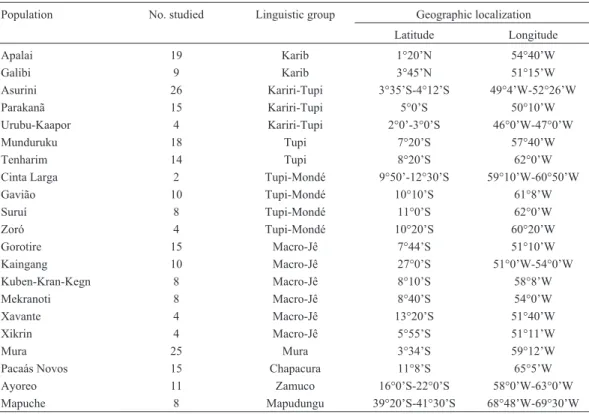
We obtained the frequencies of the allelic variants of the14 bp polymorphism in 237 South Amerindians from 21 different tribes and nine different linguistic families, classi-fied according to Campbell, 1997 (Table 1). They live all the way from 3°45’ N to 39°20’ S, and from 50°10’ W to 69°30’ W. These samples have been collected along five decades by members of our group and were conveniently stored for different types of testing. Informed oral consent was obtained from all participants, since they were illiter-ate. Consent was obtained according to the Helsinki Decla-ration, and this procedure was approved by the Brazilian National Ethics Commission (CONEP Resolution 123/98).
Polymerase chain reaction (PCR) amplification of exon 8 of the HLA-G gene and genotyping
Genotyping was performed by PCR as previously de-scribed (Hviid et al., 2002). Briefly, 100 ng of genomic DNA was amplified in a 25mL reaction, with final
concen-trations as follows: PCR buffer 1X, dNTP 0.2 mM, MgCl2
1.5 mM,TaqDNA polymerase 0.75 U, and 10 pmol of each
5’-GTGATGGGCTGTTTAAAGTGTCACC, RHG4: 5’-GGAAGGAATGCAGTTCA GCATGA). Thermocycling conditions were 94 °C for 2 min, 35 cycles of 94 °C for 30 s, 64 °C for 60 s and 72 °C for 60 s, and a final extension step of 72 °C for 10 min. The amplified PCR products were vi-sualized in 6% polyacrylamide gels stained with ethydium bromide. The amplicon sizes for the 14 bp polymorphism were: 224 bp for the +14 bp allele and 210 bp for the -14 bp allele.
Statistical analysis
Allele frequencies and observed heterozygosity (Ho) were computed by the direct counting method, and adher-ence of phenotypical proportions to expectations under Hardy-Weinberg equilibrium were tested by the complete enumeration method using the GENEPOP 3.4 software (Rousset, 2008). Expected heterozygosity values (He) were estimated by the ARLEQUIN 3.0 software (Excoffieret al., 2007). Departure from selective neutrality was tested by Slatkin’s implementation of the Ewens-Watterson homo-zygosity neutrality test (Slatkin, 1994); and the calculations were carried out using the PyPop software (Lancasteret al., 2003).
Results and Discussion
Due to the relatively low number of individuals stud-ied per tribe, we opted for grouping tribes according to their linguistic group, since it has previously been suggested that, among South American Indians, populations whose
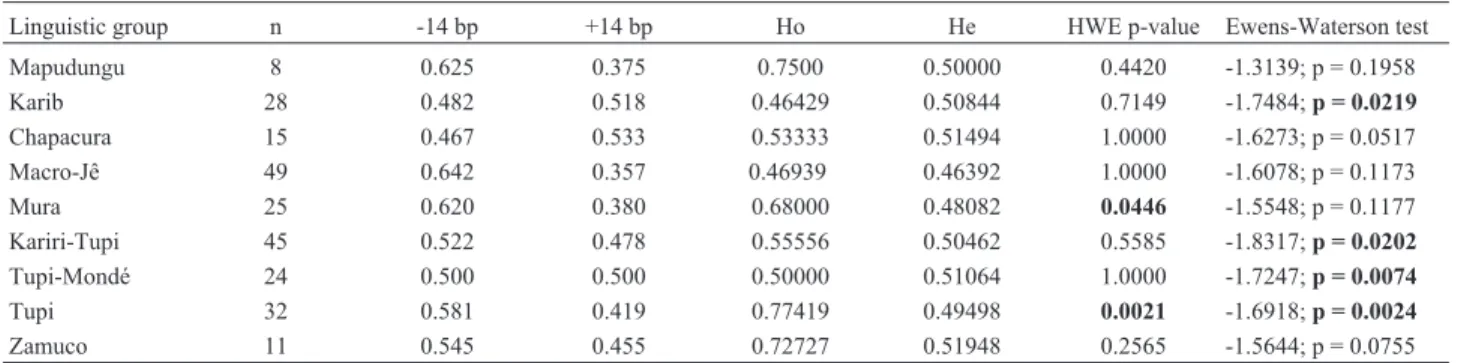
members speak the same language are genetically homoge-neous and may be viewed as the ultimate evolutionary unit (Fagundeset al., 2002). The 14 bp deletion allele was the most common one in seven of nine linguistic groups, while in two others (Karib and Chapacura) the 14 bp insertion prevailed. Two Amazonian linguistic samples deviated sig-nificantly from Hardy-Weinberg expectations (Tupi and Mura), both with an excess of heterozygotes (Table 2). Seven of the nine linguistic group samples also presented higher observed heterozygote frequencies (Ho) as com-pared to those expected (He), and four of these groups (Mapugungu, Mura, Tupi and Zamuco) presented Ho fre-quencies above 0.6. To investigate whether natural selec-tion could be reflected in these values, the Ewens-Wat-terson’s test of neutrality was performed. All linguistic groups presented negative normalized F values (Ho lower than He), with P-values ranging from 0.0024 to 0.1958 (Ta-ble 2). Among them, four reached statistical significance, significantly deviating from the neutral evolution hypothe-sis; curiously, three were members of the Macro-Tupi lin-guistic family (Kariri Tupi, Tupi Mondé and Tupi) and the Karib (Table 2). This finding is remarkable, considering that Macro-Tupi encompasses a wide group of languages spoken by tribes which have a widespread distribution in the Brazilian Amazon. Mendes-Junioret al.(2007), studied seven different Amazonian tribes and none presented a ge-notype distribution that departed from neutrality, in spite of the fact that 14 out of the 16 villages (87%) presented nega-tive F values. It is worthy of note that there is no overlap be-tween the tribes or linguistic groups of the two studies. Our Table 1- List of the populations sampled arranged by linguistic group.
Population No. studied Linguistic group Geographic localization
Latitude Longitude
Apalai 19 Karib 1°20’N 54°40’W
Galibi 9 Karib 3°45’N 51°15’W
Asurini 26 Kariri-Tupi 3°35’S-4°12’S 49°4’W-52°26’W
Parakanã 15 Kariri-Tupi 5°0’S 50°10’W
Urubu-Kaapor 4 Kariri-Tupi 2°0’-3°0’S 46°0’W-47°0’W
Munduruku 18 Tupi 7°20’S 57°40’W
Tenharim 14 Tupi 8°20’S 62°0’W
Cinta Larga 2 Tupi-Mondé 9°50’-12°30’S 59°10’W-60°50’W
Gavião 10 Tupi-Mondé 10°10’S 61°8’W
Suruí 8 Tupi-Mondé 11°0’S 62°0’W
Zoró 4 Tupi-Mondé 10°20’S 60°20’W
Gorotire 15 Macro-Jê 7°44’S 51°10’W
Kaingang 10 Macro-Jê 27°0’S 51°0’W-54°0’W
Kuben-Kran-Kegn 8 Macro-Jê 8°10’S 58°8’W
Mekranoti 8 Macro-Jê 8°40’S 54°0’W
Xavante 4 Macro-Jê 13°20’S 51°40’W
Xikrin 4 Macro-Jê 5°55’S 51°11’W
Mura 25 Mura 3°34’S 59°12’W
Pacaás Novos 15 Chapacura 11°8’S 65°5’W
Ayoreo 11 Zamuco 16°0’S-22°0’S 58°0’W-63°0’W
investigation is the first to report a significant deviation from the neutral hypothesis at the 14 bp locus in Ame-rindians, but both works point in the same direction. In or-der to check whether the significant deviations observed for theHLA-Gpolymorphism were in any way biased due to a limited number of individuals representing each linguistic group, the same analyses were performed on data already available for two apparently neutral markers (haptoglobin and acid phosphatase) in a subset of the individuals tested for HLA-G polymorphisms. These two biallelic markers were chosen due to the availability of data on a representa-tive number of individuals (188 and 171 individuals, re-spectively). As expected, no significant deviation was ob-served for acid phosphatase, and only among the Zamuco a deviation was observed for haptoglobin (data not shown, available on request).
The occurrence of balancing selection at theHLA-G promoter region has previously been described (Tanet al., 2005). Considering that HLA-G expression and levels were already related to different situations (either in physiologi-cal or pathologiphysiologi-cal conditions) and that this molecule, depending on the context, may be deleterious or advanta-geous, balancing selection at this locus seems to be a plausi-ble possibility. Recently, Castelli et al. (2011) made a comprehensive review of theHLA-Ggene polymorphism and haplotypes in a Brazilian urban cohort, evidencing a high linkage disequilibrium along the whole length of the gene. In this same work, the authors revealed evidence for balancing selection acting on the regulatory regions only (5’ and 3’ UTRs) and on the HLA-G locus as a whole. We cannot rule out that the evidence of balancing selection ob-served in our data could be due to a hitchhiking effect caused by a linkage disequilibrium between the 14 bp locus and theHLA-Gpromoter region. Nevertheless, the compel-ling evidence for the functionality of the 14 bp insertion in alternative splicing and its potential role in post-transcrip-tional regulation by microRNA binding make us believe that the 14 bp INDEL might also be an adaptive factor, in-fluencing HLA-G expression patterns and probably is re-lated to survival of heterozygous fetuses due to resistance to pathogens (Mendes-Junioret al., 2007). In conclusion,
our data corroborate the evidence of balancing selection at theHLA-Ggene, highlighting important regulatory roles of this molecule in the immune system.
Acknowledgments
We would like to thank Dr. Sidia Maria Callegari-Jacques for her help with the statistical analysis. This work was supported by Conselho Nacional de Desenvolvimento Científico e Tecnológico (CNPq) 135450/2009-8, 479438/2009-9 and 160530/2011-3; Coordenação de Aper-feiçoamento de Pessoal de Nível Superior (CAPES) and Fundação de Amparo à Pesquisa do Estado do Rio Grande do Sul (FAPERGS) 10/1516-6.
References
Bahri R, Hirsch F, Josse A, Rouas-Freiss N, Bidere N, Vasquez A, Carosella ED, Charpentier B and Durrbach A (2006) Solu-ble HLA-G inhibits cell cycle progression in human allo-reactive T lymphocytes. J Immunol 176:1331-1339. Campbell L (1997) American Indian Languages. The Historical
Linguistics of Native America. Oxford University Press, Oxford, 512 pp.
Carosella ED, HoWangYin K-Y, Favier B and LeMaoult J (2008) HLA-G-dependent suppressor cells: Diverse by nature, fun-ction, and significance. Hum Immunol 69:700-707. Castelli EC, Moreau P, Oya e Chiromatzo A, Mendes-Junior CT,
Veiga-Castelli LC, Yaghi L, Giuliatti S, Carosella ED and Donadi EA (2009)In silicoanalysis of microRNAS target-ing the HLA-G 3’ untranslated region alleles and haploty-pes. Hum Immunol 70:1020-1025.
Castelli EC, Mendes-Junior CT, Deghaide NH, de Albuquerque RS, Muniz YC, Simões RT, Carosella ED, Moreau P and Donadi EA (2010) The genetic structure of 3’untranslated region of the HLA-G gene: Polymorphisms and haplotypes. Genes Immun 11:134-141.
Castelli EC, Mendes-Junior CT, Veiga-Castelli LC, Roger M, Moreau P and Donadi EA (2011) A comprehensive study of polymorphic sites along the HLA-G gene: Implication for gene regulation and evolution. Mol Biol Evol 28:3069-3086. Caumartin J, Favier B, Daouya M, Guillard C, Moreau P, Carosel-la ED and LeMaoult J (2007) Trogocytosis-based generation of suppressive NK cells. EMBO J 26:1423-1433.
Table 2- Sample sizes (n), 14-bp polymorphism allele frequencies, observed (Ho) and expected (He) heterozygosities, Hardy-Weinberg Equilibrium (HWE) probability values (significant values in boldface), and Ewens-Watterson’s neutrality test results on Amerindians samples classified in nine lin-guistic groups.
Linguistic group n -14 bp +14 bp Ho He HWE p-value Ewens-Waterson test
Mapudungu 8 0.625 0.375 0.7500 0.50000 0.4420 -1.3139; p = 0.1958
Karib 28 0.482 0.518 0.46429 0.50844 0.7149 -1.7484;p = 0.0219
Chapacura 15 0.467 0.533 0.53333 0.51494 1.0000 -1.6273; p = 0.0517
Macro-Jê 49 0.642 0.357 0.46939 0.46392 1.0000 -1.6078; p = 0.1173
Mura 25 0.620 0.380 0.68000 0.48082 0.0446 -1.5548; p = 0.1177
Kariri-Tupi 45 0.522 0.478 0.55556 0.50462 0.5585 -1.8317;p = 0.0202
Tupi-Mondé 24 0.500 0.500 0.50000 0.51064 1.0000 -1.7247;p = 0.0074
Tupi 32 0.581 0.419 0.77419 0.49498 0.0021 -1.6918;p = 0.0024
Consiglio CR, Veit TD, Monticielo OA, Mucenic T, Xavier RM, Brenol JC and Chies JA (2011) Association of the HLA-G gene +3142C > G polymorphism with systemic lupus erythematosus. Tissue Antigens 77:540-545.
Cordero EA, Veit TD, Silva MA, Jacques SM, Silla LM and Chies JA (2009) HLA-G polymorphism influences the susceptibil-ity to HCV infection in sickle cell disease patients. Tissue Antigens 74:308-313.
Donadi EA, Castelli EC, Arnaiz-Villena A, Roger M, Rey D and Moreau P (2011) Implications of the polymorphism of HLA-G on its function, regulation, evolution and disease as-sociation. Cell Mol Life Sci 68:369-395.
Excoffier L, Laval G and Schneider S (2007) Arlequin ve. 3.0: An integrated software package for population genetics data analysis. Evol Bioinform Online 1:47-50.
Fagundes NJ, Bonatto SL, Callegari-Jacques SM and Salzano FM (2002) Genetic, geographic, and linguistic variation among South American Indians: Possible sex influence. Am J Phys Anthropol 117:68-78.
Horuzsko A, Lenfant F, Munn DH and Mellor AL (2001) Matura-tion of antigen-presenting cells is compromised in HLA-G transgenic mice. Int Immunol 13:385-394.
Hviid TV, Hylenius S, Hoegh AM, Kruse C and Christiansen OB (2002) HLA-G polymorphisms in couples with recurrent spontaneous abortions. Tissue Antigens 60:122-132. Hviid TV, Rizzo R, Christiansen OB, Melchiorri L, Lindhard A
and Baricordi OR (2004) HLA-G and IL-10 in serum in rela-tion to HLA-G genotype and polymorphisms. Immunoge-netics 56:135-141.
Lancaster A, Nelson MP, Meyer D, Thomson G and Single RM (2003) PyPop: A software framework for population geno-mics: Analyzing large-scale multi-locus genotype data. Pac Symp Biocomput 2003:514-525.
LeMaoult J, Caumartin J, Daouya M, Favier B, Le Rond S, Gon-zalez A and Carosella ED (2007) Immune regulation by pre-tenders: Cell-to-cell transfers of HLA-G make effector T cells act as regulatory cells. Blood 109:2040-2048. Mendes-Junior CT, Castelli EC, Simoes RT, Simoes AL and
Donadi EA (2007) HLA-G 14-bp polymorphism at exon 8 in Amerindian populations from the Brazilian Amazon. Tissue Antigens 69:255-260.
Menier C, Riteau B, Carosella ED and Rouas-Freiss N (2002) MICA triggering signal for NK cell tumor lysis is counter-acted by HLA-G1-mediated inhibitory signal. Int J Cancer 100:63-70.
Ober C, Aldrich CL, Chervoneva I, Billstrand C, Rahimov F, Gray HL and Hyslop T (2003) Variation in the HLA-G pro-moter region influences miscarriage rates. Am J Hum Genet 72:1425-1435.
Ober C, Billstrand C, Kuldanek S and Tan Z (2006) The miscar-riage-associated HLA-G -725G allele influences transcrip-tion rates in JEG-3 cells. Hum Reprod 21:1743-1748. Rajagopalan S, Bryceson YT, Kuppusamy SP, Geraghty DE, van
der Meer A, Joosten I and Long EO (2006) Activation of NK cells by an endocytosed receptor for soluble HLA-G. PLoS Biology 4:e9.
Riteau B, Menier C, Khalil-Daher I, Sedlik C, Dausset J, Rouas-Freiss N and Carosella ED (1999) HLA-G inhibits the allo-geneic proliferative response. J Reprod Immunol 43:203-11. Riteau B, Menier C, Khalil-Daher I, Martinozzi S, Pla M, Dausset J, Carosella ED and Rouas-Freiss N (2001) HLA-G1
co-expression boosts the HLA class I-mediated NK lysis inhibi-tion. Int Immunol 13:193-201.
Rizzo R, Hviid TV, Stignani M, Balboni A, Grappa MT, Mel-chiorri L and Baricordi OR (2005) The HLA-G genotype is associated with IL-10 levels in activated PBMCs. Immu-nogenetics 57:172-181.
Rizzo R, Rubini M, Govoni M, Padovan M, Melchiorri L, Stig-nani M, Carturan S, Ferretti S, Trotta F and Baricordi OR (2006) HLA-G 14-bp polymorphism regulates the metho-trexate response in rheumatoid arthritis. Pharmacogenet Genomics 16:615-623.
Rizzo R, Hviid TV, Govoni M, Padovan M, Rubini M, Melchiorri L, Stignani M, Carturan S, Grappa MT, Fotinidi M,et al.
(2008) HLA-G genotype and HLA-G expression in systemic lupus erythematosus: HLA-G as a putative susceptibility gene in systemic lupus erythematosus. Tissue Antigens 71:520-529.
Rouas-Freiss N, Moreau P, Menier C and Carosella ED (2003) HLA-G in cancer: A way to turn off the immune system. Semin Cancer Biol 13:325-336.
Rousseau P, Le Discorde M, Mouillot G, Marcou C, Carosella ED and Moreau P (2003) The 14 bp Deletion-Insertion poly-morphism in the 3’ UT region of the HLA-G gene influences HLA-G mRNA stability. Hum Immunol 64:1005-1010. Rousset F (2008) genepop’007: A complete re-implementation of
the genepop software for Windows and Linux. Mol Ecol Resour 8:103-106.
Slatkin M (1994) An exact test for neutrality based on the Ewens sampling distribution. Genet Res 64:71-74.
Tan Z, Shon AM and Ober C (2005) Evidence of balancing selec-tion at the HLA-G promoter region. Hum Mol Genet 14:3619-3628.
Veit TD and Chies JA (2009) Tolerancevs.immune response — microRNAs as important elements in the regulation of the HLA-G gene expression. Transpl Immunol 20:229-231. Veit TD, Vianna P, Scheibel I, Brenol CV, Brenol JC, Xavier RM,
Delgado-Cañedo A, Gutierrez JE, Brandalize AP, Schuler-Faccini L,et al.(2008) Association of the HLA-G 14-bp in-sertion/deletion polymorphism with juvenile idiopathic ar-thritis and rheumatoid arar-thritis. Tissue Antigens 71:440-446.
Veit TD, Cordero EA, Mucenic T, Monticielo OA, Brenol JC, Xa-vier RM, Delgado-Cañedo A and Chies JA (2009) Associa-tion of the HLA-G 14 bp polymorphism with systemic lupus erythematosus. Lupus 18:424-430.
Veit TD, Vianna P and Chies JA (2010) HLA-G - From fetal toler-ance to a regulatory molecule in inflammatory diseases. Curr Immunol Rev 6:1-15.
Vianna P, Dalmáz CA, Veit TD, Tedoldi C, Roisenberg I and Chies JA (2007) Immunogenetics of pregnancy: Role of a 14-bp deletion in the maternal HLA-G gene in primiparous pre-eclamptic Brazilian women. Hum Immunol 68:668-674.
Internet Resources
IMGT/HLA Database, June 2011,
http://www.ebi.ac.uk/imgt/hla/stats.html (June 2011).