Identification of SNPs in RNA-seq data of two cultivars of
Glycine max
(soybean) differing in drought resistance
Ramon Oliveira Vidal1,2, Leandro Costa do Nascimento1, Jorge Maurício Costa Mondego3, Gonçalo Amarante Guimarães Pereira1and Marcelo Falsarella Carazzolle1,4
1Laboratório de Genômica e Expressão, Universidade Estadual de Campinas, Campinas, SP, Brazil. 2Laboratório Nacional de Biociências/Associação Brasileira de Tecnologia de Luz Síncrotron,
Campinas, SP, Brazil.
3
Centro de Pesquisa e Desenvolvimento em Recursos Genéticos Vegetais, Instituto Agronômico de Campinas, Campinas, SP, Brazil.
4Centro Nacional de Processamento de Alto Desempenho, Universidade Estadual de Campinas,
Campinas, SP, Brazil.
Abstract
The legumeGlycine max (soybean) plays an important economic role in the international commodities market, with a world production of almost 260 million tons for the 2009/2010 harvest. The increase in drought events in the last de-cade has caused production losses in recent harvests. This fact compels us to understand the drought tolerance mechanisms in soybean, taking into account its variability among commercial and developing cultivars. In order to identify single nucleotide polymorphisms (SNPs) in genes up-regulated during drought stress, we evaluated sup-pression subtractive libraries (SSH) from two contrasting cultivars upon water deprivation: sensitive (BR 16) and tol-erant (Embrapa 48). A total of 2,222 soybean genes were up-regulated in both cultivars. Our method identified more than 6,000 SNPs in tolerant and sensitive Brazilian cultivars in those drought stress related genes. Among these SNPs, 165 (in 127 genes) are positioned at soybean chromosome ends, including transcription factors (MYB, WRKY) related to tolerance to abiotic stress.
Key words:single nucleotide polymorphisms, deep sequencing, drought resistance.
Introduction
Soybean (Glycine max) is a legume crop that plays an important economic role in the international market, with a world production of almost 260 million tons for the 2009/2010 harvest. Brazil ranks as the world’s second larg-est producer and exporter, with about 25% of the production. Soybean production is influenced by weather oscilla-tions, especially long periods of drought. In the Brazilian soybean culture, the frequency of drought events has in-creased in recent decades, probably associated with the weather changes in the world (Stokstad, 2004; Schiermeier, 2006). For example, in the states of the south of Brazil, re-sponsible for 40% of domestic production, losses have been as much as 25% of production in recent harvests. During this time some drought tolerant and sensitive cultivars were isolated from these regions. An understanding of the mo-lecular mechanisms governing such contrasting
pheno-types upon water deprivation could provide insights for the creation of new cultivars and help in assisted selection.
Single nucleotide polymorphisms (SNPs) are single base differences between DNA sequences of individuals or lines. They can be assayed and exploited as high-throughput molecular markers. SNP markers have the po-tential for use in association genetics approaches (Cardon and Bell, 2001; Flint-Garciaet al., 2003). The recent avail-ability of high-throughput DNA sequencing data has enabled studies based on highly informative SNPs. The evaluation of SNPs in large EST sequence data sets from agricultural crops has been employed to generate high-density genetic maps and identify variable genomic regions (Duet al., 2003; Choi et al., 2007; Novaeset al., 2009; Pindoet al., 2008; Duranet al., 2009). The scalability and availability of SNPs in highly automated genotyping assays has made this molecular marker the first choice in genetic linkage and association studies in a variety of species.
High quality reference genome sequences and re-sources used to perform low coverage resequencing by novel sequencing technologies such as 454 Life Sciences Genetics and Molecular Biology, 35, 1 (suppl), 331-334 (2012)
Copyright © 2012, Sociedade Brasileira de Genética. Printed in Brazil www.sbg.org.br
Send correspondence to Marcelo Falsarella Carazzolle. Laborató-rio de Genômica e Expressão, Universidade Estadual de Campi-nas, Cidade Universitária Zeferino Vaz, 13083-970 CampiCampi-nas, SP, Brazil. E-mail: [email protected].
(Barbazuket al., 2007), Illumina Solexa (Van Tassellet al., 2008), and SOLiD (Melumet al., 2010) on different indi-viduals, cultivars or even species are prerequisites for the traditional method of whole genome SNP discovery. In this context, genomic sequences of different individuals are aligned to a reference genome and nucleotide variation is detected.
This study used high-throughput mRNA sequencing (RNA-seq) reads derived from suppression subtractive li-braries (SSH) to identify SNPs in up-regulated genes from tolerant (Embrapa 48) and sensitive (BR 16) cultivars sub-mitted to drought stress. Such SNPs can be useful for as-sisted selection of soybean varieties with higher drought tolerance.
Material and Methods
Construction of cDNA libraries and sequencing
Soybean genotype Embrapa 48 (tolerant) and BR 16 (sensitive) were analyzed under two experimental condi-tions: drought stress and normal irrigation (for further de-tails see Rodrigueset al., 2012, this issue). Leaves and roots from stressed and control plants were collected at three dif-ferent times (25-50, 75-100, 125-150 min). RNA was iso-lated from tissue samples and used to construct suppression subtractive hybridization (SSH) cDNA libraries (Rodri-gueset al., 2012). These three libraries, enriched in genes up-regulated during drought stress, were sequenced using Illumina/Solexa technology. The reads corresponding to genes enriched in such libraries were used in SNP mapping (see below).
Gene identification from RNA-seq data
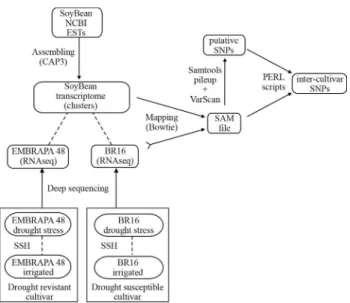
The reference transcriptome assembly was con-structed using 1,276,813 soybean ESTs available at NCBI. The bdtrimmer software (Baudet and Dias, 2007) was used to exclude ribosomal, vector, low quality and short (less than 100 bp) sequences (using default parameters). The re-maining sequences were assembled with the CAP3 pro-gram (Huang and Madan, 1999) using default parameters, generating 60,747 unigenes (30,809 contigs and 29,938 singlets) (Nascimentoet al., 2012, this issue).
The RNA-seq reads from SSH libraries from tolerant and sensitive cultivars were submitted to quality filtration considering bases greater than Q20 and merged in one sin-gle file. The information about the cultivars was included on the read ID to facilitate SNP genotyping. Bowtie soft-ware (Langmeadet al., 2009), considering default parame-ters (maximum of 2 mismatches), was used to map the reads against the reference transcriptome and the output file was saved in SAM format (Figure 1).
SNP detection
SNP detection was performed with the SAMtools pileup program (Liet al., 2009), which found the variations
in the SAM file, followed by VarScan (Koboldt et al., 2009), which identifies and filters variants based on read counts, base quality and allele frequency (Figure 1).
We developed a Perl script to compare the filtered SNP lists generated by the pipeline described above for the two datasets. Putative SNPs were tagged if the reads in-volved were mapped unambiguously on the reference transcriptome and the minor allele appeared at least 10 times. The SNPs were discarded if the depth was less than 20 and the frequency of one allele was more than 80%. For each candidate SNP, the algorithm accessed the reads over that position in the SAM file, and observed if all variations occurred only between the two cultivars.
The unigenes identified through mapping of RNA-seq reads that presented polymorphic sites between both cultivars were annotated and grouped into Gene Ontology classification (GO terms) using blast2go software (Conesa and Götz, 2008). In order to identify the chromosome posi-tion of polymorphic genes, the unigenes were mapped to the soybean genome assembly (Schmutzet al., 2010) using Exonerate software (Slater and Birney, 2005).
Results and Discussion
Alignment of RNA-seq reads to reference transcriptome
The soybean data available for bioinformatics analy-sis comprise the reference genome (Willians 82 cultivar; Schmutzet al., 2010), gene models and the EST assembly described in Material and Methods. We chose this assem-bly as reference to the mapping in order to avoid (1) splic-ing alignment problems and (2) the absence of the untranslated regions.
332 Vidalet al.
After evaluating the SSH libraries, a total of 12,285,871 reads of 45 bp and 30,326,963 reads of 76 bp were obtained for sensitive and tolerant cultivars, respec-tively. For the sensitive cultivar, 6,317,010 reads were aligned to 7,039 contigs and 2,659 singlets, providing an average depth of coverage of 651 reads by reference se-quence. For the tolerant cultivar, 6,120,258 reads were aligned to 15,667 contigs and 6,284 singlets, providing an average depth of coverage of 279 reads by reference se-quence. We searched for SNPs in contigs that mapped into both cultivars. After mapping, 7,897 contigs have reads as-signed to both cultivars, and were used in SNP identifica-tion.
Polymorphism detection
The identification of sequence polymorphisms was performed using SAMtools pileup and VarScan software. We identified a total of 44,510 variations (in 11,000 uni-genes) that come from SNPs within each cultivar, SNPs be-tween the cultivars and reference assembly, and SNPs between the cultivars.
To identify inter-cultivar SNPs in the soybean refer-ence sequrefer-ences and to identify the SNPs between both cultivars (i.e. non-allelic SNPs), we used an in-house SNP filter developed to identify the positions of robust candidate sequence polymorphisms relative to the aligned Solexa reads from each cultivar. We applied another filter requir-ing at least 10 reads on each cultivar and a maximum of 80% difference between the major and minor allele.
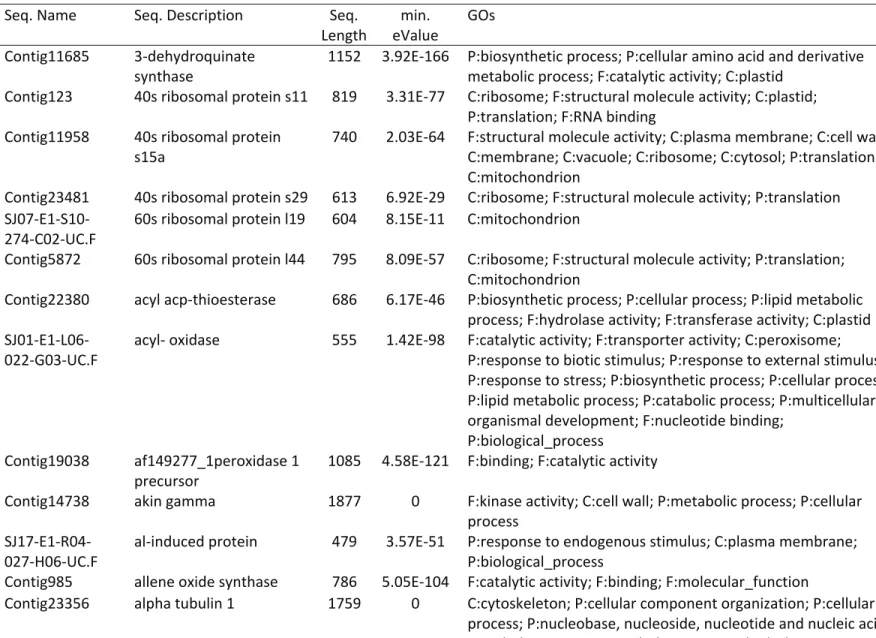
The 6,698 putative polymorphisms were identified in over 2,222 transcripts in tolerant and sensitive cultivars (~3 SNPs/gene). The majority of these polymorphisms repre-sent allelic SNPs (intra-cultivar SNPs) and are not useful as molecular markers for soybean breeding. Nevertheless, we found 165 putative SNPs between tolerant and sensitive cultivars in a total of 127 unigenes (Supplementary Mate-rial Table S1). Figure 2 summarizes the GO annotation. As expected, the GO analysis of these 127 genes revealed that many are related to stress response and other ontologies possibly related to stress. Among such genes are a series of
signal transducers (calmodulin, ankyrin, GTP binding pro-teins) and transcription factors (i.e., WRKY, MYB, Zinc Finger, Homeodomain-ZIP), all of which were cataloged in a set of soybean transcription factors (TFs) database focus-ing on abiotic stress responsive transcription factors (Mo-chidaet al., 2009). Among these soybean TFs, the WRKY and MYB genes were experimentally evaluated. Zhouet al. (2008) verified that soybean WRKY genes provide toler-ance to abiotic stresses in transgenic Arabidopsisplants. Soybean MYB genes were considered part of the stress tol-erance apparatus based on salt and freezing stress assays in transgenic plants (Liaoet al., 2008). The presence of vari-ability in genes that likely coordinate the first steps of stress signaling, thus controlling a series of protective proteins against drought effects, denote such genes as possible markers for assisted selection. We consider all of these polymorphisms as strong candidates for molecular markers for selective breeding.
Mapping SNPs in soybean chromosomes
Putative SNPs detected in uniquely mapped reference sequence unigenes were plotted along the soybean chromo-somes. Alignment with the soybean genome showed that the genes with these identified putative SNPs were not dis-tributed uniformly across the genome. Instead, they are more prominent at the chromosome ends (Figure 3). Wuet al. (2010) detected that many SNPs were clustered in gene-rich, high-recombination euchromatic regions in soy-bean chromosomes. This positional trait of SNPs may be a consequence of intense recombination/mutation events that are crucial for increased variability in autogamous species such as soybean.
Conclusion
The identification of SNPs in contrasting cultivars for drought stress may be useful to breeders in Marker Assisted Selection (MAS) or even in Genome Wide Selection
SNPs contrasting drought resistant cultivars 333
Figure 2- GO terms of the 127 genes with intra-cultivar SNPs.
(GWS). They can be added to the upcoming markers de-rived from high-throughput gene sequencing. We believe that the presence of SNPS in transcription factors is out-standing. Such proteins could be controlling a series of genes responsive to stress, making them good candidates for transgenesis and as starting points to understand drought tolerance mechanisms in soybean.
Acknowledgments
The authors would like to thank all researchers of the Brazilian Soybean Genome Consortium (GENOSOJA) in-volved in the generation of data used in this paper, and CNPq (Conselho Nacional de Desenvolvimento Científico e Tecnológico – Brazil) for financial support.
References
Barbazuk WB, Emrich SJ, Chen HD, Li L and Schnable PS (2007) SNP discovery via 454 transcriptome sequencing. Plant J 51:910-918.
Baudet C and Dias Z (2007) New EST trimming procedure ap-plied to SUCEST sequences. In: Proceedings of the Second Brazilian Conference on Advances in Bioinformatics and Computational Biology. Springer-Verlag, Berlin, pp 57-68. Cardon LR and Bell JI (2001) Association study designs for
com-plex diseases. Nat Rev Genet 2:91-99.
Choi IY, Hyten DL, Matukumalli LK, Song Q, Chaky JM, Quigley CV, Chase K, Lark KG, Reiter RS, Yoon MSet al. (2007) A soybean transcript map: Gene distribution, haplo-type and single-nucleotide polymorphism analysis. Genetics 176:685-96.
Conesa A and Götz S. (2008) Blast2GO: A comprehensive suite for functional analysis in plant genomics. Int J Plant Ge-nomics 2008:e619832.
Du CF, Liu HM, Li RZ, Li PB and Ren ZQ (2003) Application of single nucleotide polymorphism in crop genetics and im-provement. Yi Chuan 25:735-739.
Duran C, Appleby N, Clark T, Wood D, Imelfort M, Batley J and Edwards D (2009) AutoSNPdb: An annotated single nucleo-tide polymorphism database for crop plants. Nucleic Acids Res 37:D951-D953.
Flint-Garcia SA, Thornsberry JM and Buckler ES (2003) Struc-ture of linkage disequilibria in plants. Annu Rev Plant Biol 54:357-374.
Huang X and Madan A (1999) CAP3: A DNA sequence assembly program. Genome Res 9:868-877.
Koboldt DC, Chen K, Wylie T, Larson DE, McLellan MD, Mar-dis ER, Weinstock GM, Wilson RK and Ding L (2009) VarScan: Variant detection in massively parallel sequencing of individual and pooled samples. Bioinformatics 25:2283-2285.
Langmead B, Trapnel C, Pop M and Salzberg S (2009) Ultrafast and memory-efficient alignment of short DNA sequences to the human genome. Genome Biol 10:R25.
Li H, Handsaker B, Wysoker A, Fennell T, Ruan J, Homer N, Marth G, Abecasis G, Durbin R and 1000 Genome Project Data Processing Subgroup (2009) The Sequence align-ment/map (SAM) format and SAMtools. Bioinformatics 25:2078-2079.
Liao Y, Zou HF, Wang HW, Zhang WK, Ma B, Zhang JS and Chen SY (2008) Soybean GmMYB76, GmMYB92, and
GmMYB177 genes confer stress tolerance in transgenic Arabidopsis plants. Cell Res 18:1047-1060.
Melum E, May S, Schilhabel MB, Thomsen I, Karlsen TH, Ro-senstiel P, Schreiber S and Franke A (2010) SNP discovery performance of two second-generation sequencing plat-forms in the NOD2 gene region. Hum Mutat 31:875-885. Mochida K, Yoshida T, Sakurai T, Yamaguchi-Shinozaki K,
Shinozaki K and Tran LS (2009)In silicoanalysis of tran-scription factor repertoire and prediction of stress responsive transcription factors in soybean. DNA Res 16:353-369. Nascimento LC, Costa GGL, Binneck E, Pereira GAG and
Caraz-zolle MF (2012) A web-based bioinformatics interface ap-plied to Genosoja Project: Databases and pipelines. Genet Mol Biol 35(suppl 1):203-211.
Novaes E, Drost DR, Farmerie WG, Pappas Jr GJ, Grattapaglia D, Sederoff RR and Kirst M (2009) High-throughput gene and SNP discovery inEucalyptus grandis, an uncharacterized genome. BMC Genomics 9:e312.
Pindo M, Vezzulli S, Coppola G, Cartwright DA, Zharkikh A, Velasco R and Troggio M (2008) SNP high-throughput screening in grapevine using the SNPlex genotyping system. BMC Plant Biol 8:e12.
Schiermeier Q (2006) The costs of global warming. Nature 439:374-375.
Schmutz J, Cannon SB, Schlueter J, Ma J, Mitros T, Nelson W, Hyten DL, Song Q, Thelen JJ, Cheng Jet al.(2010) Genome sequence of the palaeopolyploid soybean. Nature 463:178-183. Slater G and Birney E (2005) Automated generation of heuristics for biological sequence comparison. BMC Bioinformatics 6:e31.
Stokstad E (2004) Global survey documents puzzling decline of amphibians. Science 306:391.
Van Tassell CP, Smith TP, Matukumalli LK, Taylor JF, Schnabel RD, Lawley CT, Haudenschild CD, Moore SS, Warren WC and Sonstegard TS (2008) SNP discovery and allele fre-quency estimation by deep sequencing of reduced represen-tation libraries. Nat Meth 5:247-252.
Wu X, Ren C, Joshi T, Vuong T, Xu D and Nguyen HT (2010) SNP discovery by high-throughput sequencing in soybean. BMC Genomics 11:469.
Zhou QY, Tian AG, Zou HF, Xie ZM, Lei G, Huang J, Wang CM, Wang HW, Zhang JS and Chen SY (2008) Soybean WRKY-type transcription factor genes, GmWRKY13, GmWRKY21, and GmWRKY54 confer differential toler-ance to abiotic stresses in transgenic Arabidopsis plants. Plant Biotechnol J 6:486-503.
Internet Resources
Soybean transcription factors database,
http://soybeantfdb.psc.riken.jp (October 10, 2011).
Supplementary Material
The following online material is available for this article: Table S1 - All genes with intra-cultivar SNP annota-tions.
This material is available as part of the online article from http://www.scielo.br/gmb.
License information: This is an open-access article distributed under the terms of the Creative Commons Attribution License, which permits unrestricted use, distribution, and reproduction in any medium, provided the original work is properly cited.
Table S1. All genes with SNPs intra-cultivars annotations.
Seq. Name Seq. Description Seq.
Length
min. eValue
GOs Enzyme
Codes
Contig11685 3-dehydroquinate
synthase
1152 3.92E-166 P:biosynthetic process; P:cellular amino acid and derivative metabolic process; F:catalytic activity; C:plastid
EC:4.2.3.4
Contig123 40s ribosomal protein s11 819 3.31E-77 C:ribosome; F:structural molecule activity; C:plastid;
P:translation; F:RNA binding
EC:3.6.5.3
Contig11958 40s ribosomal protein
s15a
740 2.03E-64 F:structural molecule activity; C:plasma membrane; C:cell wall; C:membrane; C:vacuole; C:ribosome; C:cytosol; P:translation; C:mitochondrion
EC:3.6.5.3
Contig23481 40s ribosomal protein s29 613 6.92E-29 C:ribosome; F:structural molecule activity; P:translation EC:3.6.5.3
SJ07-E1-S10-274-C02-UC.F
60s ribosomal protein l19 604 8.15E-11 C:mitochondrion
Contig5872 60s ribosomal protein l44 795 8.09E-57 C:ribosome; F:structural molecule activity; P:translation;
C:mitochondrion
EC:3.6.5.3
Contig22380 acyl acp-thioesterase 686 6.17E-46 P:biosynthetic process; P:cellular process; P:lipid metabolic
process; F:hydrolase activity; F:transferase activity; C:plastid
EC:3.1.2.14
SJ01-E1-L06-022-G03-UC.F
acyl- oxidase 555 1.42E-98 F:catalytic activity; F:transporter activity; C:peroxisome;
P:response to biotic stimulus; P:response to external stimulus; P:response to stress; P:biosynthetic process; P:cellular process; P:lipid metabolic process; P:catabolic process; P:multicellular organismal development; F:nucleotide binding;
P:biological_process
EC:1.3.99.3; EC:1.9.3.1; EC:1.3.3.6
Contig19038 af149277_1peroxidase 1
precursor
1085 4.58E-121 F:binding; F:catalytic activity
-Contig14738 akin gamma 1877 0 F:kinase activity; C:cell wall; P:metabolic process; P:cellular
process
- SJ17-E1-R04-027-H06-UC.F
al-induced protein 479 3.57E-51 P:response to endogenous stimulus; C:plasma membrane;
P:biological_process
-Contig985 allene oxide synthase 786 5.05E-104 F:catalytic activity; F:binding; F:molecular_function EC:4.2.1.92
Contig23356 alpha tubulin 1 1759 0 C:cytoskeleton; P:cellular component organization; P:cellular
process; P:nucleobase, nucleoside, nucleotide and nucleic acid metabolic process; P:catabolic process; F:hydrolase activity;
F:structural molecule activity; C:cytoplasm; F:carbohydrate binding; F:nucleotide binding
EC:3.6.5.4
Contig27771 alpha tubulin 1 1661 0 C:cytoskeleton; P:cellular component organization; P:cellular
process; P:nucleobase, nucleoside, nucleotide and nucleic acid metabolic process; P:catabolic process; F:hydrolase activity; F:structural molecule activity; C:cytoplasm; F:carbohydrate binding; F:nucleotide binding
EC:3.6.5.1; EC:3.6.5.2; EC:3.6.5.3; EC:3.6.5.4
Contig1153 aluminum-induced
protein
980 1.64E-111 P:response to endogenous stimulus; C:plasma membrane;
P:biological_process
-Contig25238 ankyrin repeat-containing 1060 4.81E-59 C:membrane; P:response to stress; P:response to abiotic
stimulus; C:plastid
-Contig22377 annexin 2 875 7.41E-110 P:response to stress; P:response to abiotic stimulus; C:cell;
P:transport; F:binding; C:thylakoid; C:nucleus; C:cytosol; F:lipid binding
-Contig3332 aquaporin-like
transmembrane channel protein
1335 1.79E-152 C:membrane; P:response to stress; C:plasma membrane;
P:transport; P:cellular process; F:transporter activity
-Contig1476 at1g19180 t29m8_5 846 2.06E-132 P:response to stress; P:response to biotic stimulus;
P:multicellular organismal development; P:response to external stimulus; P:response to endogenous stimulus; P:signal
transduction; F:protein binding; P:flower development; C:nucleus
-Contig7639 at1g47330 t3f24_2 763 5.05E-106 C:cytoplasm; C:plasma membrane
-Contig4713 at5g18670 t1a4_50 2035 0 P:carbohydrate metabolic process; P:catabolic process;
F:hydrolase activity; F:binding
EC:3.2.1.2
Contig19095 auxin efflux carrier
component
1844 0 P:transport; P:cellular process; P:anatomical structure
morphogenesis; P:multicellular organismal development; C:plasma membrane; C:membrane; P:post-embryonic development; P:response to abiotic stimulus; P:flower
development; P:reproduction; F:protein binding; F:transporter activity; P:tropism; P:embryonic development; C:cytoplasm; C:cell
-Contig13059 auxin response factor 9 1160 5.28E-86 F:binding; P:response to endogenous stimulus; P:transcription
precursor F:protein binding; F:hydrolase activity; F:carbohydrate binding; F:binding
Contig16059 calcium-dependent
protein
1079 1.16E-100 P:protein modification process; F:binding; F:nucleotide binding; F:protein binding; P:response to endogenous stimulus; P:signal transduction; C:plastid; F:kinase activity; C:plasma membrane
EC:2.7.11.17
SJ10-E1-R05-029-D10-UC.F
calcium-dependent protein kinase
578 1.74E-89 P:protein modification process; F:binding; F:nucleotide binding; F:protein binding; P:response to endogenous stimulus; P:signal transduction; C:plastid; F:kinase activity; C:plasma membrane
EC:2.7.11.17
Contig6964 callose synthase 10 1067 5.93E-174 F:transferase activity; P:biosynthetic process; P:carbohydrate
metabolic process; P:cellular process; C:plasma membrane
EC:2.4.1.34
Contig2415 calmodulin 899 1.21E-78 P:metabolic process; F:binding; P:post-embryonic development;
P:response to abiotic stimulus; F:catalytic activity;
P:biological_process; C:membrane; C:vacuole; F:protein binding; P:pollination; P:cellular process; P:protein metabolic process; P:catabolic process; P:signal transduction; C:plasma membrane
EC:1.3.1.74
Contig22225 calmodulin-binding
transcription activator
764 1.18E-70
-Contig23083 carbonic anhydrase 873 3.59E-72 F:binding; C:plastid; F:catalytic activity; P:metabolic process EC:4.2.1.1
Contig2904 catalase 1811 0 P:response to stress; P:catabolic process; P:cellular process;
F:binding; C:peroxisome; F:catalytic activity; P:metabolic process
EC:1.11.1.6
Contig15505 chloroplast protease 1222 3.38E-179 F:protein binding; F:hydrolase activity; C:thylakoid; P:cellular
process; C:membrane; F:binding; P:protein metabolic process; P:catabolic process; P:generation of precursor metabolites and energy; P:photosynthesis; C:plastid; P:nucleobase, nucleoside, nucleotide and nucleic acid metabolic process; F:nucleotide binding; P:cell cycle; P:response to abiotic stimulus
EC:3.4.24.0
Contig22316 chromatin remodeling
complex subunit
1092 3.29E-42 F:binding; P:cellular component organization; P:cellular process; F:DNA binding; F:nucleotide binding; F:transferase activity; C:intracellular; F:hydrolase activity; F:chromatin binding; C:nucleus
-Contig7885 coatomer gamma 994 2.35E-131 F:protein binding; P:transport; P:cellular process; C:plastid;
C:membrane; C:Golgi apparatus; F:structural molecule activity
-Contig3263 cysteine proteinase
inhibitor
-Contig10810 cysteine synthase 668 4.42E-46 P:pollination; P:multicellular organismal development; F:binding; C:mitochondrion; C:plastid; F:nucleotide binding; F:transferase activity; F:protein binding; P:biosynthetic process; P:cellular amino acid and derivative metabolic process; F:catalytic activity
EC:2.5.1.47
Contig3637 double wrky type
transfactor
1556 4.24E-180 P:transcription; F:transcription factor activity; F:DNA binding
-Contig13855 ferredoxin-nadp+
reductase
1492 0 P:transport; C:thylakoid; F:RNA binding; P:generation of
precursor metabolites and energy; P:photosynthesis; F:catalytic activity; F:molecular_function; P:response to stress; P:response to biotic stimulus; C:plastid; F:protein binding; C:membrane; F:nucleotide binding; C:extracellular region
EC:1.6.99.1; EC:1.18.1.2
Contig29868 gcpe protein 2290 0 P:metabolic process; P:signal transduction; P:response to stress;
P:response to biotic stimulus; P:biosynthetic process; P:carbohydrate metabolic process; P:cellular process; P:lipid metabolic process; C:plastid; F:binding; P:secondary metabolic process; F:catalytic activity
EC:1.17.4.3
Contig22053 gdp dissociation inhibitor 249 1.83E-31 P:biological_process; P:transport; F:enzyme regulator activity
-Contig14301 germin-like protein 688 1.97E-116
-Contig4559 global transcription factor
group
1876 1.51E-89 F:protein binding; P:biological_process; F:DNA binding; F:transferase activity
-Contig19241 glycerol 3-phosphate
permease
988 4.64E-154 F:transporter activity; P:transport; P:cellular process
-Contig28897 gtp-binding protein 962 6.66E-118 F:nucleotide binding; C:plasma membrane; F:hydrolase activity;
P:signal transduction; P:transport
-Contig12976 high affinity potassium
transporter
537 3.85E-71 F:transporter activity; C:plasma membrane
-Contig11277 isoflavone synthase 1 1773 0 F:binding; F:catalytic activity; F:molecular_function; P:metabolic
process
-Contig29114 light-harvesting complex
ii protein lhcb3
1157 2.40E-147 P:generation of precursor metabolites and energy; P:photosynthesis; C:intracellular; C:membrane; C:plastid; C:thylakoid; F:structural molecule activity
-Contig10765 lipoxygenase 2939 0 C:cytoplasm; P:biosynthetic process; P:cellular process; P:lipid
metabolic process; F:binding; F:catalytic activity; P:metabolic process
Contig11027 lipoxygenase 1103 6.35E-126 C:cytoplasm; P:biosynthetic process; P:cellular process; P:lipid metabolic process; F:binding; F:catalytic activity; P:metabolic process
EC:1.13.11.1 2
Contig5611 lipoxygenase l-5 2187 0 C:cytoplasm; P:biosynthetic process; P:cellular process; P:lipid
metabolic process; F:binding; F:catalytic activity; P:metabolic process
EC:1.13.11.1 2
Contig1867 lrr receptor protein 1027 1.26E-117 F:receptor activity; C:cell wall; C:plasma membrane; P:protein
modification process; F:nucleotide binding; C:membrane; F:kinase activity; P:signal transduction; P:metabolic process; F:catalytic activity
EC:2.7.11.0; EC:1.3.1.74
Contig10747 mee14 (maternal effect
embryo arrest 14)
1209 3.18E-113 P:reproduction; P:post-embryonic development; P:embryonic development; P:response to stress; P:response to biotic stimulus; C:plastid
-Contig11066 myo-inisitol oxygenase 1308 5.41E-154 C:cytoplasm; F:binding; P:carbohydrate metabolic process;
P:cellular process; P:catabolic process; P:anatomical structure morphogenesis; F:catalytic activity; P:metabolic process
EC:1.13.99.1
Contig7836 n chain improved model
of plant photosystem i
965 1.67E-76 C:plastid; C:thylakoid; P:generation of precursor metabolites and energy; P:photosynthesis; C:membrane; F:protein binding
-Contig26849 na+ h+ antiporter 541 1.64E-85 F:transporter activity; P:transport; P:cellular process;
P:biological_process; C:membrane
-Contig22303 nucleobase ascorbate
transporter
1980 0 C:membrane; C:vacuole; C:cell wall; P:transport; P:cellular
process; F:transporter activity
-Contig21879 nucleosome chromatin
assembly factor group
1839 0 C:intracellular; P:anatomical structure morphogenesis; P:cell
differentiation; P:multicellular organismal development; P:cell cycle; P:flower development; P:regulation of gene expression, epigenetic; P:nucleobase, nucleoside, nucleotide and nucleic acid metabolic process; C:nucleus; P:reproduction; P:post-embryonic development; P:cellular component organization; P:cellular process; F:protein binding; F:transferase activity; C:plastid; P:embryonic development
EC:2.3.1.48
Contig20668 omega-3 fatty acid
desaturase
1766 0 P:biosynthetic process; P:cellular process; P:lipid metabolic
process; F:catalytic activity; C:membrane; C:plastid; P:metabolic process
-Contig8110 peptide methionine sulfoxide reductase
857 1.11E-102 C:cytosol; F:catalytic activity; P:metabolic process; P:protein modification process; P:response to stress
EC:1.8.4.11
Contig26213 phosphate transporter 755 2.46E-81 P:transport; C:plasma membrane; P:cellular process;
F:transporter activity; C:membrane
-Contig11742 phosphoribulokinase
precursor
1871 0 P:biosynthetic process; P:carbohydrate metabolic process;
P:photosynthesis; P:response to stress; P:response to biotic stimulus; P:response to abiotic stimulus; C:plastid; F:nucleotide binding; F:protein binding; F:kinase activity; C:membrane; C:thylakoid; P:metabolic process; P:cellular process; C:extracellular region
EC:2.7.1.19
Contig27945 plasma membrane
intrinsic protein
1146 2.45E-144 C:membrane; C:plasma membrane; P:transport; P:cellular process; F:transporter activity
- SJ18-P1-S12-007-U51-UC.F
PREDICTED: hypothetical protein [Vitis vinifera]
243 2.59E-09
-Contig1857 Ubiquinone biosynthesis 1271 7.11E-95 C:plasma membrane; C:endoplasmic reticulum
-Contig3159 WD-repeat protein 803 6.40E-110 F:nucleotide binding; F:protein binding
-Contig3879 putative phi-1-like
phosphate-induced protein
1211 1.07E-177 C:cell wall; P:response to endogenous stimulus
-Contig5355 NADH-ubiquinone
oxidoreductase 24 kD subunit
1092 9.30E-146 P:response to stress; F:nucleotide binding; F:binding; F:catalytic activity; C:membrane; C:mitochondrion; P:generation of precursor metabolites and energy
EC:1.6.5.3
Contig5389 kelch repeat-containing
F-box family protein
761 9.51E-81 F:molecular_function; P:biological_process
Contig6081 - 1027 4.22E-97
-Contig6275 class III HD-Zip protein 8 2215 0 P:multicellular organismal development; P:growth;
P:transcription; P:anatomical structure morphogenesis; F:DNA binding; F:transcription factor activity; P:flower development; C:nucleus
-Contig7590 heat shock protein
binding protein
692 1.34E-88 F:binding; P:cellular homeostasis; P:response to stress; P:response to abiotic stimulus; P:response to endogenous stimulus; P:signal transduction
-Contig8634 Clp protease 2 proteolytic
subunit
369 1.11E-15 C:plastid; F:hydrolase activity; C:thylakoid; P:protein metabolic process; P:catabolic process
Contig9422 - 945 1.62E-68 F:molecular_function; P:biological_process
Contig9779 ubiquitin-protein ligase 756 8.57E-66 P:response to stress; P:response to abiotic stimulus; P:protein
modification process; P:biological_process; P:metabolic process; F:catalytic activity; C:cytosol
EC:6.3.2.19
Contig10455 - 621 9.79E-63 P:protein metabolic process; P:cellular process; F:protein
binding; C:membrane; C:plastid; C:thylakoid
-Contig10755 aluminum induced
protein with YGL and LRDR motifs
832 5.78E-101 C:cytosol; C:nucleus; C:plasma membrane
-Contig11725 epsilon-adaptin 1079 1.07E-170 F:protein binding; P:transport; P:cellular process; C:membrane;
C:cytoplasm
-Contig12204 Phosphatidic acid
phosphatase (PAP2) family protein
821 7.59E-98 P:metabolic process; F:catalytic activity; C:membrane; P:biological_process; C:chloroplast
Contig12307 aldehyde dehydrogenase 1434 5.19E-153 F:catalytic activity; C:cytoplasm; P:metabolic process; P:cellular process
EC:1.2.1.3
Contig14052 - 712 4.18E-48 C:mitochondrion; F:binding
-Contig17122 protein kinase 829 1.68E-84 F:kinase activity; P:protein modification process; F:nucleotide
binding; C:plastid
-Contig19813 - 924 9.04E-133
-Contig20875 phosphoribosylanthranila
te transferase
1370 2.40E-160 F:molecular_function; P:biological_process; C:cellular_component
Contig21517 - 574 2.69E-34 C:membrane; C:vacuole; C:mitochondrion
-Contig26353 SWAP
(Suppressor-of-White-APricot)/surp domain-containing protein / ubiquitin family protein
932 7.21E-94 F:RNA binding; P:nucleobase, nucleoside, nucleotide and nucleic acid metabolic process
-Contig28841 MYB transcription factor
MYB122
590 1.65E-82 F:DNA binding; P:transcription; C:nucleus
-Contig29674 Avr9/Cf-9 rapidly elicited
protein 20
465 2.52E-52 P:protein metabolic process; P:cellular process; F:binding; F:protein binding; P:response to endogenous stimulus; C:nucleus; C:cytosol
-active 16 C:membrane; C:thylakoid
SJ18-P1-S12-232-U15-UC.F
aconitate hydratase, cytoplasmic / citrate hydro-lyase/
247 5.73E-25 P:response to stress; C:cytosol; F:binding; C:cell wall;
C:mitochondrion; P:response to abiotic stimulus; C:membrane; C:vacuole; F:nucleotide binding; P:response to endogenous stimulus; F:catalytic activity; P:metabolic process; P:cellular process; C:plastid; P:biological_process
EC:4.2.1.3
SJ18-P1-S12-286-X20-UC.F
coatomer gamma subunit 245 7.49E-33 F:protein binding; P:transport; P:cellular process; C:plastid; C:membrane; C:Golgi apparatus; F:structural molecule activity
- SJ01-E1-F05-036-F07-UC.F
Cell division protein kinase
544 4.75E-56 C:plasma membrane; P:cellular process; F:kinase activity EC:2.7.11.0
SJ07-E1-S10-199-A01-UC.F
- 311 9.81E-09
-Contig27355 protein binding 1401 0 F:zinc ion binding
Contig832 protein kinase 924 2.72E-12 F:protein kinase activity; F:ATP binding; F:transferase activity; P:protein amino
acid phosphorylation; F:RNA polymerase II carboxy-terminal domain kinase activity; F:protein serine/threonine kinase activity; F:kinase activity; C:cytosol; F:protein binding
SJ08-E1-S11-008-F11-UC.F
protein phosphatase 2c 417 8.79E-21 P:protein modification process; F:binding; F:hydrolase activity; C:cell
-Contig3754 psbp2_tobac ame:
full=oxygen-evolving enhancer protein 2-chloroplastic short=oee2 ame: full=23 kda subunit of oxygen evolving system of photosystem ii ame: full=23 kda
thylakoid membrane protein ame: full=oec 23 kda subunit flags: precursor
817 3.93E-38 C:membrane; F:binding; P:photosynthesis; C:plastid; C:thylakoid
-Contig1650 receptor serine threonine 1209 5.86E-86 F:receptor activity; F:kinase activity; P:protein modification process; F:nucleotide binding
EC:2.7.10.2; EC:2.7.11.0
kinase F:kinase activity; P:signal transduction
Contig14231 ribosomal protein 1178 5.87E-149 P:translation; P:multicellular organismal development; F:binding;
C:nucleolus; F:structural molecule activity; P:anatomical structure morphogenesis; P:transport; P:cellular process; P:cellular component organization; C:plastid; C:vacuole; C:ribosome; C:cytosol; C:plasma membrane; F:RNA binding
EC:3.6.5.3
Contig4137 ribosomal protein s14 842 5.06E-60 C:ribosome; F:structural molecule activity; P:translation EC:3.6.5.3
Contig3398 rubisco activase 1844 0 F:nucleotide binding; C:plastid
-Contig11808 s-adenosylmethionine
decarboxylase
1953 0 P:biosynthetic process; P:cellular amino acid and derivative
metabolic process; F:catalytic activity
EC:4.1.1.50; EC:4.1.1.19
Contig24388 serine threonine protein
phosphatase 2a regulatory subunit
846 1.41E-134 F:enzyme regulator activity; F:binding; C:plasma membrane; C:intracellular; C:cell wall; P:metabolic process; P:cellular process
-Contig24411 serine-threonine protein
plant-1761 2.90E-95 C:plastid
-Contig8686 sin3 histone deacetylase
complex
1236 2.85E-109 C:nucleus; P:transcription
-Contig24008 small gtp-binding protein 1132 1.06E-99 F:nucleotide binding; C:plasma membrane; F:hydrolase activity;
P:signal transduction; P:transport
-Contig5904 stem-specific protein 655 1.11E-50 C:cytosol; C:nucleus; C:plasma membrane
-Contig12813 succinate dehydrogenase 2287 0 C:cell wall; C:membrane; C:mitochondrion; F:binding;
F:molecular_function; P:generation of precursor metabolites and energy; P:catabolic process; F:nucleotide binding; F:catalytic activity
EC:1.3.5.1
Contig14015 sucrose transport protein
suc2
2027 0 P:pollination; P:cellular process; P:transport; P:response to biotic stimulus; C:vacuole; C:plasma membrane; F:transporter activity; C:membrane; P:reproduction; P:post-embryonic development
-Contig27892 transcription initiation
factor iib
1279 4.12E-167 C:cytoplasm; P:translation; F:transcription regulator activity; P:cellular component organization; P:transcription; F:protein binding; F:translation factor activity, nucleic acid binding; C:nucleus; F:binding
-Contig25975 transitional endoplasmic
reticulum
259 6.70E-29 P:cell cycle; F:hydrolase activity; F:nucleotide binding; C:plasma membrane
EC:3.6.4.3
isomerase metabolic process; P:photosynthesis; P:multicellular organismal development; C:mitochondrion; P:cellular process; P:lipid metabolic process; C:plastid; P:catabolic process; P:cellular component organization; C:thylakoid; F:catalytic activity; F:protein binding; C:extracellular region
Contig14497 tubulin alpha-3 949 3.69E-121 C:cytosol; C:cell wall; C:cytoskeleton; P:cellular component
organization; P:cellular process; P:nucleobase, nucleoside, nucleotide and nucleic acid metabolic process; P:catabolic process; P:response to abiotic stimulus; F:hydrolase activity; F:structural molecule activity; P:biological_process; F:nucleotide binding; C:plasma membrane
EC:3.6.5.1; EC:3.6.5.2; EC:3.6.5.3; EC:3.6.5.4
Contig416 ubiquitin-conjugating
enzyme e2 i
930 1.09E-93 P:protein modification process; F:catalytic activity EC:6.3.2.19
Contig28259 apiose
udp-d-xylose synthase 1
1769 0 F:nucleotide binding; C:cytoplasm; C:extracellular region;
F:catalytic activity; P:biosynthetic process; P:nucleobase, nucleoside, nucleotide and nucleic acid metabolic process
EC:4.1.1.35
SJ06-E1-SO1-008-D01-UC.F
udp-glucuronic acid decarboxylase 2
502 4.91E-85 C:membrane; C:Golgi apparatus; P:biosynthetic process; P:carbohydrate metabolic process; P:nucleobase, nucleoside, nucleotide and nucleic acid metabolic process; F:catalytic activity; P:cellular process; C:plasma membrane; C:vacuole; F:binding
EC:4.1.1.35; EC:4.2.1.46
Contig22609 uncharacterized protein 635 1.12E-24 F:molecular_function; P:biological_process; C:cellular_component
Contig21502 vacuolar atp synthase
subunit
1215 1.06E-124 P:transport; P:biosynthetic process; P:generation of precursor metabolites and energy; P:nucleobase, nucleoside, nucleotide and nucleic acid metabolic process; F:transporter activity; F:nucleotide binding; F:hydrolase activity; C:membrane
EC:3.6.3.14
Contig28734 vacuolar sorting protein
4b
636 1.49E-101 C:endosome; P:anatomical structure morphogenesis; P:cellular component organization; P:cell differentiation; P:multicellular organismal development; P:cellular process; P:transport; F:nucleotide binding; F:hydrolase activity; C:nucleus
EC:3.6.4.3
Contig21850 virion binding 719 1.62E-47 F:binding
-Contig23300 wd40-repeat protein 1309 8.76E-104 C:intracellular; F:nucleotide binding
-Contig5209 wrky transcription 870 1.77E-77 P:transcription, DNA-dependent; F:sequence-specific DNA binding; P:regulation
Contig18831 wrky transcription 1909 0 F:DNA binding; P:biological_process; F:protein binding; F:transcription factor activity; P:transcription; P:response to extracellular stimulus; P:cell communication; P:response to stress
-Contig21742 yth domain-containing 3028 0 C:cytoplasm; C:nucleus; F:protein binding
-Contig23318 zinc finger protein 1360 4.58E-119 P:flower development; P:transcription; F:DNA binding; F:protein
binding; C:nucleus