Voiding Dysfunction due to Multiple Sclerosis: a Large Scale
Retrospective Analysis
Bulent Onal, Aksel Siva, Ibrahim Buldu, Oktay Demirkesen, Bulent Cetinel
Departments of Urology (BO, IB, OD, BC) and Neurology (AS), Cerrahpasa School of Medicine, University of Istanbul, Istanbul, Turkey
ABSTRACT
Purpose:To assess the outcome of urologic evaluation in patients with voiding dysfunction due to multiple sclerosis (MS) and to determine the relationship between urological and neurological parameters of these patients.
Materials and Methods: We retrospectively reviewed the medical records of 249 consecutive patients (162 female and 87 male) with MS who were referred to our clinic between 1991 and 2006, with a median time of 4 years (range 3 months to
\HDUVRI06RQVHW'DWDZDVDQDO\]HGZLWKUHVSHFWWRSDWLHQWGHPRJUDSKLFVDQG¿QGLQJVRILQLWLDOHYDOXDWLRQ/RZHU
urinary tract symptoms were evaluated by Boyarsky symptom index.
Results:All patients except 13 had lower urinary tract symptoms and 70% manifested mixed symptoms. Total, storage and voiding symptom scores correlated with expanded disability status scale scores (p < 0.05). Twelve patients (5%) had
DEQRUPDOXSSHUXULQDU\WUDFW8OWUDVRXQG¿QGLQJVRIORZHUXULQDU\WUDFWZHUHDEQRUPDOLQSDWLHQWV1RGHPRJUDSKLF SDUDPHWHUVZHUHDVVRFLDWHGZLWKDEQRUPDO¿QGLQJVRIXSSHUXULQDU\WUDFWRQXQLYDULDWHDQDO\VLV8URG\QDPLFHYDOXDWLRQ RISDWLHQWVUHYHDOHGGHWUXVRURYHUDFWLYLW\ZLWKRUZLWKRXWGHWUXVRUVSKLQFWHUG\VV\QHUJLDLQ1RFRU -relation was found between urodynamic diagnosis and upper tract deterioration and urinary symptom scores (p > 0.05). Conclusions:The prevalence of mixed symptoms in patients with MS is higher than storage or voiding symptoms alone. Although detrusor overactivity and detrusor-sphincter dyssynergia were the most common urodynamic diagnoses, upper urinary tract deterioration was rare in our series.
Key words: multiple sclerosis; urodynamics; urination disorders; ultrasound
Int Braz J Urol. 2009; 35: 326-33
INTRODUCTION
Multiple sclerosis (MS) is a common neu-rological disease affecting mostly young adults with a prevalence of 50 to 100/100,000 individuals (1). Regionally, the median estimated prevalence of MS is the highest in Europe (80 per 100 000), followed by the Eastern Mediterranean (14.9), the Americas (8.3),
WKH:HVWHUQ3DFL¿F6RXWK(DVW$VLDDQG$I
-ULFD/RZHUXULQDU\WUDFWV\PSWRPV/876
are common and severely disturb patient quality of life
Voiding Dysfunction in Multiple Sclerosis
WKDWDVLPSOHDOJRULWKPZDVVXI¿FLHQWIRUWKHLQLWLDO
management of the voiding dysfunction in MS, since upper tract deterioration was rare (10-12).
The available data indicate that the high proportion of the detrusor overactivity with detrusor-sphincter dyssynergia (DSD) is not associated with an increased risk for severe upper urinary tract deteriora-tion (5,13-15). Hence, the evaluadeteriora-tion and follow-up strategy in MS regarding the voiding dysfunction is still controversial. Furthermore, it was our clinical impression that complex urological investigations and follow-up strategy increased the management cost and had the side effect of increasing patient anxiety.
The aim of this study was to determine the outcome of urological evaluation in patients with voiding dysfunction due to MS referred to our uro-dynamic unit, and to assess the relationship between urological and disease related parameters including the disease activity, its duration, and expanded dis-ability status scale in these patients.
MATERIALS AND METHODS
We retrospectively reviewed the medical records of 249 consecutive patients (162 female and 87 male) with MS who had been referred to our uro-dynamic unit between 1991 and 2006, with a median time of 4 years (range 3 months to 26 years) of MS onset. The interval from the age at diagnosis of MS until the age at last neurourological evaluation was accepted as the disease duration. The clinical and demographic information about the neurological diag-nosis, including the MS pattern (primary progressive, relapsing-remitting, or secondary progressive), the date of diagnosis, and score of expanded disability status scale (EDSS) was obtained from the patient
UHFRUGVRI1HXURORJ\'HSDUWPHQW2QWKHH[SDQGHG
disability status scale disease severity is scored from 0 to 10 at 0.5 point intervals (16).
7KHKLVWRU\SK\VLFDOH[DPLQDWLRQ¿QGLQJV
the results of serum creatinine level, urinalysis (urine culture when necessary), urodynamic investigation
F\VWRPHWU\(0*XURÀRZPHWU\DQGSRVWYRLGUH -sidual urine volume determination) and urinary tract
XOWUDVRQRJUDSK\ ¿QGLQJV ZHUH UHFRUGHG IURP WKH SDWLHQW¿OHVRIWKHXURG\QDPLFXQLW
/876ZHUHHYDOXDWHGE\%R\DUVN\V\PSWRP
index. The symptom index score comprises storage (0-10) and voiding symptom index scores (0-12). Total symptom index score was calculated by adding the storage and voiding symptom index scores. The
VHYHULW\RI/876ZDVIXUWKHUVWUDWL¿HGDFFRUGLQJWR
the total symptom index score on the questionnaire: mild- score lower than 7; moderate- score 8-14; severe- score 15-22. A nurse from the urodynamic
XQLWKHOSHGWKHSDWLHQWVWR¿OORXWWKHV\PSWRPVFRUH
evaluation form.
Upper urinary tract status was analyzed with respect to patient characteristics including age, gen-der, disease duration, MS pattern, EDSS score of MS,
VHUXPFUHDWLQLQHOHYHOVXURG\QDPLF¿QGLQJVV\PS -tom index scores, and post-void residual volume.
Chi-square, Fisher’s exact test,
Mann-Whit-QH\8DQDO\VLVRIYDULDQFH$129$DQG3HDUVRQ
Correlation tests were performed for statistical analysis. The Chi-square test was used except in cases where the expected number of patients in any unit (or category) was less than 5, in which case the Fisher’s exact test was used. We used the value of p < 0.05 as
WKHOHYHORIVWDWLVWLFDOVLJQL¿FDQFH
RESULTS
The median age of patients during the initial urological evaluation was 38 years (range 8 to 68 years). Patient characteristics are outlined in Table-1.
2IWKHSDWLHQWVXQGHUZHQWXULQDU\
tract ultrasonography, 198 (79.5%) completed the Boyarsky symptom index and 75 (30.1%) were evalu-ated by urodynamic testing.
Median total, storage and voiding symptom scores in 198 evaluated by Boyarsky symptom score of 249 patients were 5, 3 and 1, respectively. All
ex-FHSWSDWLHQWVKDG/876ZKLOHDQGRI
185 symptomatic patients manifested mixed, storage, and voiding symptoms, respectively. Total, storage and voiding symptom scores weakly correlated with EDSS scores (p < 0.05) (Table-2).
Twelve patients (5%) had abnormal upper urinary tract, which were unilateral or bilateral
hydro-QHSKURVLV8OWUDVRXQG¿QGLQJVRIORZHUXULQDU\WUDFW
ZDOODVWKHPRVWFRPPRQ¿QGLQJ7DEOH1RGH -mographic parameter (age, gender, disease duration, MS pattern, or expanded disability MS status score) was associated with upper urinary tract abnormality on univariate analysis (Table-4). All patients who had unilateral or bilateral hydronephrosis remained stable with conservative management during the fol-low-up.
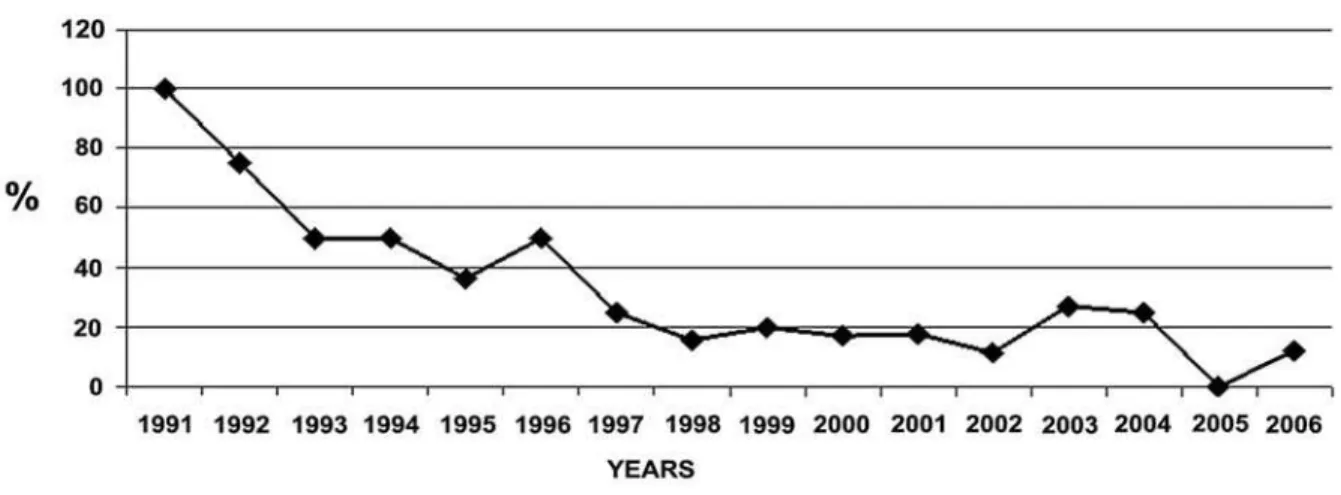
Urodynamic study performance rate gradu-ally decreased from 100% to 13% during the period studied (Figure-1). Urodynamic evaluation of 75 patients revealed detrusor overactivity in 26 (35%), detrusor overactivity with detrusor-sphincter dyssyn-ergia in 30 (40%), detrusor overactivity with impaired contractility in 1 (1%), a poor compliance bladder in 7
DQGQRUPDO¿QGLQJVLQ1RFRUUHODWLRQ Table 1 – Patient characteristics.
1 249
Gender no. (%) Female Male
162 (65) 87 (35) MS pattern no. (%)
Primary progressive Relapsing-remitting Secondary progressive
51 (20.6) 104 (41.7) 94 (37.5)
Median EDSS score (range) 5.0 (0-9)
Median disease duration
years (range) 4 (3 months - 26 years) Median age of patients during the initial urologic evaluation
years (range) 38 (8-68)
Median serum creatinine level
PJG/UDQJH 0.8 (0.3-2.0)
/876QR
Storage
9RLGLQJ
Mixed
185/198 (93) 47 (25) 9 (5) 129 (70) Incontinence n (%)
Urge Stress Mixed Total
Enuresis nocturna
160/198 (81) 149 (93) 6 (4) 3 (2) 1 (0.5) 1 (0.5) Urodynamic diagnosis no. (%)
1RUPDO '2 '2'6'
DHIC
Poor compliance
11 (15) 26 (35) 30 (40) 1 (1) 7 (9) Median post-void residual volume
P/UDQJH 40 (0-480)
Voiding Dysfunction in Multiple Sclerosis
was found between urodynamic diagnosis and upper urinary tract deterioration (p > 0.05) (Table-4).
COMMENTS
In this series 70% of MS patients had mixed
/876 DQG V\PSWRP VFRUHV ZHUH FRUUHODWHG ZLWK
EDSS score. The rate of upper urinary tract deteriora-tion was low (5%), and all patients were stable with conservative management. Although urodynamic
VWXGLHVPRVWRIWHQUHYHDOHG/876QRFRU
-relation was found between upper tract deteriora-tion and urodynamic abnormality. Since our study was retrospective, it may have limited implications. However, this study at least gives a clear message that prospective randomized studies are strongly needed in order to clarify the initial urologic evaluation, since
there is no established protocol for this subject in the guidelines. This might lead to a decrease in manage-ment cost and patient anxiety.
2XUVHULHVLVIDLUO\W\SLFDORIWKRVHSUHYLRXVO\
reported, with a majority of women, as usually found in MS (3,5,7,17,18). In our series 65% women and 42% of patients had a relapsing-remitting pattern of MS. This is quite comparable with the patients reported by Ciancio (68% women and 41%
relaps-LQJUHPLWWLQJSDWWHUQ7KLVVXJJHVWVWKDWRXU¿QG -ings are typical and likely to be comparable to other authors.
The majority of our patients (185 of 198)
KDG/876VLQFHWKHSDWLHQWVGHYHORSLQJXURORJLF FRPSODLQWVGXULQJWKHIROORZXSLQWKH1HXURORJ\
Department were referred to our clinic. In our study, the rates of mixed, storage and voiding symptoms
ZHUHIRXQGWREHDQGUHVSHFWLYHO\2XU
results are similar to the reports from Western coun-tries which revealed that storage symptoms such as urgency, frequency were the predominant urinary symptoms in MS (5,7). Araki et al. reported that voiding symptoms were equal to or higher than that of storage symptoms in Japan (19). However, in their
VWXG\WKHSURSRUWLRQVRIGHWUXVRUK\SRUHÀH[LDDQG
detrusor sphincter dyssynergia were higher than our study and those reported from Western countries.
When evaluating the relationship between neurologic and urologic abnormalities, we found a weak correlation between severity of EDSS and storage, voiding and total symptom scores. In some studies no correlation was found (20,21), whereas in others a direct correlation between EDSS score and storage and/or voiding score was reported (3,8,22). Araki et al. found that storage symptoms correlated well with expanded disability status scale scores but
YRLGLQJV\PSWRPVGLGQRW9DULDELOLW\LQWKHFRUUHOD -tion probably relates to the clinical course of MS which is characterized by exacerbations and remis-sions.
Multiple sclerosis is a disease with frequent
SUHVHQWDWLRQRI/876ZKHUHDVXSSHUWUDFWGHWHULRUD -tion is rare. Many other studies including ours also showed that progression to upper tract deterioration in MS was usually the exception rather than the rule (1,5,12,23). In the current series 5% of the patients had upper tract deterioration, although mild
hydronephro-Table 2 – Mean voiding, storage and total symptom score according to expanded disability status scale (EDSS) score.
Symptom Score EDSS Score
r p Value
9RLGLQJ 0.172 0.025
Storage 0.174 0.023
Total 0.212 0.006
Table 3 –7KHDEQRUPDOXOWUDVRXQG¿QGLQJVRIXSSHUDQG
lower urinary tract.
Abnormal Findings N (%)
Upper urinary tract
Unilateral hydronephrosis Bilateral hydronephrosis
1RQIXQFWLRQDONLGQH\ZLWK
contralateral mild Hydronephrosis
12 (5.2) 5 (2)
6 (2.6) 1 (0.4)
/RZHUXULQDU\WUDFW
Thick bladder wall Bladder diverticula
sis was present in all except one patient. Koldewijn et al. reviewed 14 MS series of 2,076 patients regarding upper tract deterioration and found its incidence to be as low as 0.34% (5).
Meta analysis of 1,882 patients showed that
DEQRUPDOXURG\QDPLF¿QGLQJVLQ06SDWLHQWVZLWK /876ZHUHFRPPRQZKHUHDVQHXURJHQLFGHWUXVRU
overactivity and detrusor sphincter dyssynergia being
Table 4 –7KHUHODWLRQVKLSRIDEQRUPDO¿QGLQJVRIXSSHUXULQDU\WUDFW887ZLWKUHVSHFWWRSDWLHQWFKDUDFWHULVWLFV
Abnormal UUT Normal UUT p Value
1RRIWKHSDWLHQWV1 12 (5.2) 218 (94.8)
*HQGHU1
Female Male
9 (6) 3 (4)
142 (94) 76 (96)
0.756
06SDWWHUQ1
Primary progressive (PP) Relapsing-remitting (RR) Secondary progressive (SP)
1 (2) 4 (4) 7 (8)
47 (98) 90 (96) 81 (92)
0.663* 0.260**
Median EDSS score (range)
5.3 (3-9)
5.0 (0-9)
0.230
Median disease duration
years (range) 5 (0-12) 4 (0-26) 0.410
Median age of patients during the initial urologic evaluation
years (range) 40 (31-49) 38 (8-68) 0.884
/8761
Storage
9RLGLQJ
Mixed
12 4 (9)
-8 (7)
160 39 (91) 8 (100) 113 (93)
0.612
,QFRQWLQHQFH1
Urge Stress Mixed Total
Enuresis nocturna
10 10 (7)
-150 139 (93)
6 (100) 3 (100) 1 (100) 1 (100)
1$
/RZHUXULQDU\WUDFWVWDWXV 1RUPDO
Abnormal
10 (5) 2 (17)
208 (95) 10 (83)
0.123
8URG\QDPLFGLDJQRVLV1 1RUPDO
'2 '2'6'
DHIC
Poor compliance
12 4 (36) 2 (8) 3 (10) 1 (100) 2 (29)
63 7 (64) 24 (92) 27 (90) - (-) 5 (71)
0.068***
0HGLDQSRVWYRLGUHVLGXDOYROXPHP/UDQJH 147 (0-480) 40 (0-430) 0.223
Voiding Dysfunction in Multiple Sclerosis
the most common (10,23). In contrast to detrusor sphincter dyssynergia in spinal cord injury, DSD in MS patients are rarely associated with upper tract deterioration while the reason for this is unclear (5,23-26). It has been speculated that possibility of poorly sustained detrusor contractions and less severe degree of DSD in MS could be responsible for this distinction (23,27). Detrusor overactivity and detrusor sphincter dyssynergia were the most common urodynamic di-agnoses in our study as in the previous studies, and
DOVRQRXURG\QDPLF¿QGLQJZDVGHWHUPLQHGWREHD
risk factor for upper tract deterioration as in the study
RI/LWZLOOHUHWDO
1RW VXUSULVLQJO\ ZH IRXQG QR DVVRFLDWLRQ
between the high proportion of detrusor overactiv-ity/detrusor-sphincter dyssynergia and incidence
RI XSSHU XULQDU\ WUDFW DEQRUPDOLWLHV /HPDFN HW
al. investigated the risk factors for deterioration of upper tract and showed that no disease related or urodynamic parameters were predictive of abnormalities on renal ultrasonography. In addi-tion, no patients in their series had any indication of obstructive uropathy more severe than mild
K\GURQHSKURVLV2XUILQGLQJVDJUHHZLWKWKLV
stance in that only one of our patients had unilat-eral non-functional kidney. Moreover, our ratio of upper tract deterioration was found to be low and comparable to those in other series, which ranged between 0-25% (5,14,18,23,28). In a recent study
GRQHE\/HPDFNHWDOWKHVHDXWKRUVFRPSDUHGWKH
detrusor pressures between MS patients with and without DSD and observed non-significant eleva-tions in detrusor pressures in both groups. This finding could explain the relatively low incidence of upper tract damage in patients with MS (15).
2XU XURG\QDPLF VWXG\ SHUIRUPDQFH UDWH
gradually decreased from 100% to 13% during the study period. Although our data is far from provid-ing strong evidence for the overuse of urodynamic studies during initial urologic evaluation of MS pa-tients, on the basis of the literature mentioned above and our increasing experience with MS patients this suggests that the multichannel urodynamic studies might be used only in the evaluation of patients with upper tract deterioration or with conservative treat-ment failure. We believe that this policy might lead to a decrease in the management cost and patient anxiety.
A weakness of our study was that our data was collected retrospectively. However, the literature is fully supportive of our local data. Another potential weakness of our study is that we were not able to use a unique protocol for initial urologic evaluation of these patients, since there is no previously established protocol for this subject in the guidelines. Despite these limitations, we believe that our results provide a useful insight for clinicians when counseling patients with MS.
CONCLUSIONS
The prevalence of mixed symptoms in patients with MS is higher than storage or voiding symptoms alone. Although detrusor overactivity and detrusor-sphincter dyssynergia were the most common urodynamic diagnoses, upper urinary tract deterioration was rare in this series. Prospective ran-domized studies are needed to clarify initial urologic evaluation for MS patients.
CONFLICT OF INTEREST
1RQHGHFODUHG
REFERENCES
+LQVRQ -/ %RRQH7% 8URG\QDPLFV DQG PXOWLSOH VFOHURVLV8URO&OLQ1RUWK$P :RUOG +HDOWK 2UJDQL]DWLRQ DQG 0XOWLSOH 6FOHURVLV
International Federation: Atlas. Multiple Sclerosis Resources in the World 2008. Thônex, CH, TushitaTushita
*UDSKLF9LVLRQ
$UDNL,0DWVXL02]DZD.7DNHGD0.XQR6
Relationship of bladder dysfunction to lesion site in multiple sclerosis. J Urol. 2003; 169: 1384-7.
%HPHOPDQV %/ +RPPHV 25 9DQ .HUUHEURHFN 3( /HPPHQV:$ 'RHVEXUJ:+ 'HEUX\QH )0
Evidence for early lower urinary tract dysfunction in clinically silent multiple sclerosis. J Urol. 1991; 145: 1219-24.
.ROGHZLMQ(/+RPPHV25/HPPHQV:$'HEUX\QH
FM, van Kerrebroeck PE: Relationship between lower urinary tract abnormalities and disease-related parameters in multiple sclerosis. J Urol. 1995; 154: 169-73.
&LDQFLR6-0XWFKQLN6(5LYHUD90%RRQH7%
Urodynamic pattern changes in multiple sclerosis. Urology. 2001; 57: 239-45.
*DOOLHQ35RELQHDX61LFRODV%/H%RW03%ULVVRW 59HULQ09HVLFRXUHWKUDOG\VIXQFWLRQDQGXURG\
-QDPLF¿QGLQJVLQPXOWLSOHVFOHURVLVDVWXG\RI
cases. Arch Phys Med Rehabil. 1998; 79: 255-7. 8. Giannantoni A, Scivoletto G, Di Stasi SM, Grasso
0*)LQD]]L$JUz(&ROOXUD*HWDO/RZHUXULQDU\
tract dysfunction and disability status in patients with multiple sclerosis. Arch Phys Med Rehabil. 1999; 80: 437-41.
0F*XLUH(-6DYDVWDQR-$8URG\QDPLF¿QGLQJVDQG
long-term outcome management of patients with mul-tiple sclerosis-induced lower urinary tract dysfunction. J Urol. 1984; 132: 713-5.
.DOVL9)RZOHU&-7KHUDS\,QVLJKWEODGGHUG\VIXQF
-WLRQDVVRFLDWHGZLWKPXOWLSOHVFOHURVLV1DW&OLQ3UDFW
Urol. 2005; 2: 492-501.
.RUQKXEHU++6FKW]$(I¿FLHQWWUHDWPHQWRIQHXUR -genic bladder disorders in multiple sclerosis with initial intermittent catheterization and ultrasound-controlled
WUDLQLQJ(XU1HXURO
6LUOV /7 =LPPHUQ 3( /HDFK *( 5ROH RI OLPLWHG
evaluation and aggressive medical management in multiple sclerosis: a review of 113 patients. J Urol. 1994; 151: 946-50.
.DVDELDQ1*.UDXVH,%URZQ:(.KDQ=1DJOHU
HM: Fate of the upper urinary tract in multiple
scle-URVLV1HXURXURO8URG\Q
.UKXW-+UDGtOHN3=DSOHWDORYi2$QDO\VLVRIWKHXS -per urinary tract function in multiple sclerosis patients.
$FWD1HXURO6FDQG
/HPDFN *( )URKPDQ ( 5DPQDUD\DQ 3:RPHQ
with voiding dysfunction secondary to bladder outlet dyssynergia in the setting of multiple sclerosis do not
GHPRQVWUDWHVLJQL¿FDQWO\HOHYDWHGLQWUDYHVLFDOSUHV -sures. Urology. 2007; 69: 893-7.
16. Kurtzke JF: Rating neurologic impairment in multiple sclerosis: an expanded disability status scale (EDSS).
1HXURORJ\
%DUEDOLDV*$1LNLIRULGLV*/LDWVLNRV(19HVLFRXUH -thral dysfunction associated with multiple sclerosis: clinical and urodynamic perspectives. J Urol. 1998; 160: 106-11.
/HPDFN*(+DZNHU.)URKPDQ(,QFLGHQFHRIXS -per tract abnormalities in patients with neurovesical dysfunction secondary to multiple sclerosis: analysis of risk factors at initial urologic evaluation. Urology. 2005; 65: 854-7.
$UDNL,0DWVXL02]DZD.1LVKLPXUD0.XQR
S, Saida T: Relationship between urinary symptoms and disease-related parameters in multiple sclerosis.
-1HXURO
*ROGVWHLQ,6LURN\0%6D['6.UDQH5-1HXURXUR -logic abnormalities in multiple sclerosis. J Urol. 1982; 128: 541-5.
21. Miller H, Simpson CA, Yeates WK: Bladder dysfunc-tion in multiple sclerosis. Br Med J. 1965; 1: 1265-9.
0F'RXJDOO$-0F/HRG-*$XWRQRPLFQHUYRXVV\V
-WHPIXQFWLRQLQPXOWLSOHVFOHURVLV-1HXURO6FL
Voiding Dysfunction in Multiple Sclerosis
/LWZLOOHU6()URKPDQ(0=LPPHUQ3(0XOWLSOH
sclerosis and the urologist. J Urol. 1999; 161: 743-57. Erratum in: J Urol. 1999; 162: 172.
2]NDQ%'HPLUNHVHQ2'XUDN+8\JXQ1,VPDLOR
-JOX9&HWLQHO%:KLFKIDFWRUVSUHGLFWXSSHUXULQDU\
tract deterioration in overactive neurogenic bladder dysfunction? Urology. 2005; 66: 99-104.
25. Wein AJ: Editorial comment on “Incidence of upper tract abnormalities in patients with neurovesical dys-function secondary to multiple sclerosis: Analysis of
risk factors at initial urologic evaluation. Urology, 65: 854-857, 2005”. J Urol. 2006; 175: 1030.
:\QGDOH--&DVWUR'0DGHUVEDFKHU+1HXURJHQLF
and Faecal Incontinence. Plymouth, England, Health
3XEOLFDWLRQ/WGSS
*RQRU6(&DUUROO'-0HWFDOIH-%9HVLFDOG\VIXQFWLRQ
in multiple sclerosis. Urology. 1985; 25: 429-31. 28. Andersen JT, Bradley WE: Abnormalities of detrusor
and sphincter function in multiple sclerosis. Br J Urol. 1976; 48: 193-8.
Accepted after revision: February 27, 2009
Correspondence address: 'U%XOHQW2QDO
Urology Department
Cerrahpasa School of Medicine Istanbul University