Jornal de Pediatria - Vol. 80, No.6, 2004 529
bran in constipated adults, as stated in the editorial.2 Furthermore, the use of wheat bran for adults is consecrated and is included in the majority of recommendations for dietary treatments, including those of the American Gastroenterological Association (AGA)8 and of Heaton, from the United Kingdom, a recognized expert on the subject, and who, in a textbook chapter9 cites further work with wheat bran for constipated adults, and which, while uncontrolled or published some decades ago, cannot be undervalued.
The most often quoted problem with respect to wheat bran use has been difficulties with patient acceptance. However, in my long experience of treating constipated children with wheat bran and also in the experience of other members of the pediatric gastroenterology course at the School of Medicine of Botucatu, UNESP, this difficulty is not significant over the short and medium terms, 10 which is the time scale over which supplementation is most necessary. The correspondents suggest that our experience be shared with the pediatric community, which is in fact happening, through lectures and several book chapters/reviews, including with the collaboration of Prof. Morais himself, one of which has been cited already.1 More detail will be offered in future publications in journals. It should be explained that at no point in the editorial2 was it stated that dietary fiber is the only element capable of and indispensable to preventing and treating all cases of constipation.... The editorial2 does indeed, however, contain the following, ...it is up to clinicians to find ways of making constipated children accept a diet..., IN ADDITION TO PERFORMING NECESSARY INTERVENTIONS...
Indeed, as the correspondents state, a large proportion of commercial fibers on sale in our country is soluble, but in the form of medication, which simply reinforces our decision to use the food product wheat bran. With respect of the glucomannan soluble fiber, referred to by the correspondents, I would like to remind that it has been indicated for the treatment of obesity,11 because it is one on the most viscous of fibers, which increases satiety and this effect on constipated children is worthy of evaluation.
The final questions raised by the correspondents are extremely pertinent. In addition, without any doubt whatsoever, randomized controlled clinical trials are still necessary and, if possible double-blind ones, in order to elucidate the role played by the different types of dietary fiber in constipated children. Whilst we await the results of such studies, each service should evaluate the therapeutic regimen it considers most adequate in the face of already existing evidence and the difficulties encountered in their own experience.
Helga Verena L. Maffei
Full professor, Department of Pediatrics, School of Medicine of Botucatu, Universidade Estadual Paulista (UNESP), Botucatu, SP, Brazil.
References
1. Maffei HVL, Morais MB. Constipação intestinal crônica funcional e suas complicações. In: Kotze L, Barbieri D, editores. Afecções gastrointestinais da criança e do adolescente. Rio de Janeiro: Revinter; 2003. p. 342-352.
2. Maffei HVL. Constipação crônica funcional. Com que fibra suplementar? J Pediatr (Rio J). 2004;80:167-8.
3. Freitas KC, Motta MEFA, Amâncio OMS, Fagundes-Neto U, Morais MB. Efeito da fibra do polissacarídeo de soja no peso e na umidade das fezes de ratos em fase de crescimento. J Pediatr (Rio J). 2004;80:183-8.
4. Motta MEFA, Tahan S, Fagundes-Neto U, Morais MB. Peso e umidade fecal na suplementação de fibra alimentar insolúvel em pacientes com constipação crônica funcional. Anais do XI Congresso Brasileiro de Gastroenterologia Pediátrica. I Congresso de Hepatologia Pediátrica. I Jornada de Suporte Nutricional em Gastroenterologia e Hepatologia Pediátricas; 04 a 07/05 de 2003; Salvador, Brasil.
5. Tomlin J, Read NW. Comparison of the effects on colonic function caused by feeding rice bran and wheat bran. Eur J Clin Nutr. 1988;42:857-61.
6. Müller-Lissner AS. Effect of wheat bran on weight of stool and gastrointestinal transit time: a meta analysis. BMJ. 1988;296:615-7.
7. Badiali D, Corazziari E, Habib FI, Tomei E, Bausano G, Magrini P, et al. Effect of wheat bran in treatment of chronic non organic constipation: a double-blind controlled trial. Dig Dis Sci. 1995;40:349-56.
8. Locke III GR, Pemberton JH, Phillips SF. AGA technical review on constipation. Gastroenterology. 2000;119:1766-78.
9. Heaton WH. Food, fibre and bowel function. In: Barbara L, Corinaldesi R, Gizzi G, Stanghellini V, editors. Chronic constipation. London: Saunders; 1996. p. 79-92.
10. Carvalho MA, Maffei HVL. Adherence to a high dietary fiber diet and outcome in childhood constipation. J Pediatr Gastroenterol Nutr. 2000;31(Suppl 2):S94.
11. Gonzalez Canga A, Fernandez Martinez N, Sahagun AM, Garcia Vieitez JJ, Diez Liebana MJ, Calle Pardo AP, et al. Glucomannan: properties and therapeutic applications. Nutr Hosp. 2004;19:45-50.
Dear. Editor
At the service for which I work there is a very interesting situation with respect of mortality rates: they are high primarily as a result of later death and of newborn babies (NB) with weights that, normally, would not be associated with death in developed countries. IT is true that the use of antenatal corticosteroids has been increasing, and, together with this, the rates of pulmonary problems have reduced greatly, primarily when associated with the use of nasal continuous positive airway pressure (CPAP). Using logistic regression with a multivariate model in a study of four important maternity hospitals in Rio de Janeiro,1 we found that ventilator usage, birth weight less than 1,250g, maternal vaginal hemorrhage and the male sex were all variables associated with a risk of death, with the use of pulmonary mechanical ventilation the primary indicator of death. The use of antenatal corticosteroid, caesarian delivery and total parenteral nutrition were all associated with reduced mortality. The use of pulmonary surfactant was shown to be associated with a risk of death, but without statistical significance. Currently the greatest cause of death after the fourth day of life is respiratory problems followed by neonatal sepsis. In conclusion, we are reducing hyaline membrane disease and its severity, but if the children remain on mechanical ventilation for more than 4 days they will be contaminated and die from
530 Jornal de Pediatria - Vol. 80, No.6, 2004
infection. In Table 2 of the article published by the Brazilian Neonatal Research Network (Rede Brasileira de Pesquisas Neonatais)2 the observed rates of antenatal corticosteroid use and number of antenatal consultations and were not given only statistically significant results were shown. Results ought to be listed even when they have no statistical value, since, if there were to be any interaction, these results would become important. Neither were the cut off points for gestational age, birth weight or SNAPPE-II scores given.
Were the article to show an interaction between these results, what might be happening is that the factors associated with reduced mortality, such as the use of antenatal corticosteroid and pulmonary surfactant, are reducing respiratory diseases or making them less serious, but, due to deficient care the children die later, particularly those put on pulmonary mechanical ventilation.
José Luiz Muniz Bandeira Duarte
Adjunct professor, School of Medicine, Universidade Estadual do Rio de Janeiro (UERJ). Coordinator of the Course of Pediatrics. Coordinator of the Neonatal Unit HUPE UERJ, Rio de Janeiro, RJ, Brazil. E-mail: [email protected] and [email protected]
References
1. Duarte JLMB, Mendonça GAS. Fatores associados à morte neonatal em recém-nascidos de muito baixo em quatro maternidades no município do Rio de Janeiro. Cad Saude Publica. 2005;21:109-18. No prelo.
2. Rede Brasileira de Pesquisa Neonatais. Uso antenatal de corticosteóide e evolução clínica de recém-nascidos pré-termo. J Pediatr (Rio J). 2004;80:277-84.
We are grateful to Prof. José Luiz Muniz Bandeira Duarte for his interest in our study1 and for his courtesy in presenting the conclusions of his work on mortality in four maternity units in Rio de Janeiro.2
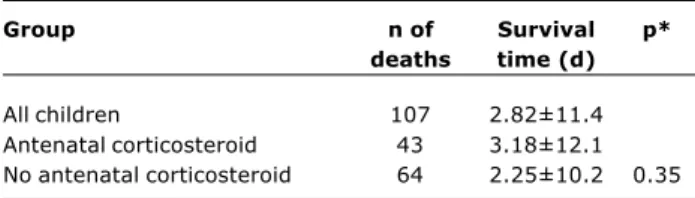
In the children analyzed by our study, infection was the most common cause of death according to autopsy reports. Of the 107 deaths, 48 (44%) were associated with infectious problems, 35 (32%) with problems caused by prematurity (pulmonary, hemorrhagic and metabolic problems) and 16 (15%) with perinatal anoxia. The survival time of the children that died are shown in Table 1. It can be seen that there was no association between antenatal corticosteroid use and length of life.
Authors reply
Table 2 - Variables that were not associated with the death after logistic regression model
Table 1 - Mean±standard deviation of the survival time of children who died
Group n of Survival p*
deaths time (d)
All children 107 2.82±11.4
Antenatal corticosteroid 43 3.18±12.1 No antenatal corticosteroid 64 2.25±10.2 0.35
Francisco Eulógio Martinez
Brazilian Neonatal Research Network, Department of Pediatrics, School of Medicine of Ribeirão Preto, Universidade de São Paulo (FMRP-USP), Ribeirão Preto, SP, Brazil.
E-mail: [email protected]
References
1. Rede Brasileira de Pesquisa Neonatais. Uso antenatal de corticosteróide e evolução clínica de recém-nascidos pré-termo. J Pediatr (Rio J). 2004;80:277-84.
2. Duarte JLMB, Mendonça GAS. Fatores associados à morte neonatal em recém-nascidos de muito baixo em quatro maternidades no município do Rio de Janeiro. Cad Saude Publica. 2005;21:109-118. No prelo.
* Comparison between children with and without antenatal corticosteroid.
As can be observed, these variables are a long way from having any impact on the mortality rate of these children.
Cut off points for gestational age, birth weight and SNAPPE-II scores were not given because these parameters were treated as continuous variables.
Without doubt the results presented indicate that the perinatal and postnatal care offered to our preterm children require great improvement and that infection constitutes an enormous challenge to be overcome during these periods. Descriptive and analytical studies of neonatal care are of fundamental importance to improve this care.
The duration of mechanical ventilation in days for the children that died was 10.3±19.7 and, for those that survived it was 4±11. We agree with Prof. Duarte that the longer duration of mechanical ventilation is associated with a greater incidence of infection. Among our children, the correlation coefficient between mechanical ventilation and positive blood culture was 0.241, with p < 0.001.
Prof. Duarte pointed out that in our paper, in Table 8, the use of antenatal corticosteroids and the number of antenatal consultations were not given, and suggests that, even with no statistical significance, they should have been listed, since these results would become important if they was any interaction. Table 2 lists the values requested.
Analyzed variable Odds ratio Confidence p interval
(95%)
Prenatal visits 1.00 0.891-1.12 0.99