Modulation of the prostaglandin-endoperoxide
synthase 2 gene expression by variant haplotypes:
in
fl
uence of the 3
0
-untranslated region
D.N. Piranda
1,2, R.B.V. Abreu
1, D.R. Freitas-Alves
1,3, M.A. de Carvalho
1,4and R. Vianna-Jorge
1,3,51
Coordenac¸ão de Pesquisa, Instituto Nacional de Câncer, Rio de Janeiro, RJ, Brasil
2
Programa de Pós-Graduac¸ão em Farmacologia e Química Medicinal, Instituto de Ciências Biomédicas,
Universidade Federal do Rio de Janeiro, Rio de Janeiro, RJ, Brasil
3
Programa de Pós-Graduac¸ão em Saúde Pública e Meio Ambiente, Escola Nacional de Saúde Pública Sérgio Arouca,
FIOCRUZ, Rio de Janeiro, RJ, Brasil
4
Instituto Federal do Rio de Janeiro, Rio de Janeiro, RJ, Brasil
5Programa de Pesquisa em Farmacologia e In
flamac¸ão, Instituto de Ciências Biomédicas,
Universidade Federal do Rio de Janeiro, Rio de Janeiro, RJ, Brasil
Abstract
The inducible inflammatory enzyme cycloxigenase-2 is up-regulated in cancer, and favors tumor progression. Cycloxigenase-2 is encoded by the prostaglandin-endoperoxide synthase 2(PTGS2)gene, which presents sequence variations in the promoter region (PR) and in the 30-untranslated region (30-UTR). Different PR (rs689465, rs689466, rs20417) and 30-UTR (rs5275) variants
were generated by site-directed mutagenesis, and combined in haplotypes to access expression levels using a reporter system (luciferase) in human cells (MCF-7 and HEK293FT). Luciferase activity did not differ significantly amongPTGS2PR constructs, except for pAAC (containing variant allele rs20417C), with 40% less activity than pAAG (wild-type sequence) in MCF-7 cells (Po0.01). Despite the lack of individual significant differences,PTGS2PR constructs enclosing rs689466G(pAGG and pAGC) showed an approximate two-fold increase in luciferase activity when compared to those containing rs689466A(pAAG, pGAC, pAAC and pGAG) in both cell lines (Po0.001 for MCF-7 and P=0.03 for HEK293FT). The effect ofPTGS230-UTR sequences varied between MCF-7 and HEK293FT: MCF-7 cells showed significant reduction (40–60%) in luciferase activity (at least Po0.01), whereas HEK293FT cells showed more diverse results, with an average 2-fold increase when combined constructs (PR and 30-UTR) were compared to respective parental PR sequences. The contribution of 30-UTR variant (rs5275) was not
consistent in either cell line. Despite the modulation of the 30-UTR, with variable effects of rs5275, the enhancing transcriptional
effect of rs689466Gwas still detectable (Po0.0001 in MCF-7 or P=0.03 in HEK293FT cells).
Key words: COX-2;PTGS2; Haplotypes; Gene expression; MCF-7; HEK293FT
Introduction
Cyclooxygenase (COX) mediates the conversion of arachidonic acid into prostaglandin H2, the precursor of prostaglandins and thromboxanes. Two isoforms of COX are known: COX-1 is constitutively expressed, participat-ing of physiological processes, whereas COX-2 is not detected in most resting cells, but can be induced by
growth factors, cytokines, and proinflammatory stimuli (1).
COX-2 catalyzes the synthesis of prostaglandin E2, which promotes cell proliferation, inhibition of apoptosis and angiogenesis (2), contributing to the pathological process
of chronic inflammatory diseases and carcinogenesis (1,2).
Although up-regulated COX-2 contributes to tumor development (2), the extent of COX-2 distribution vary
among individual studies (3,4). For instance, in invasive breast carcinoma, the reported frequencies of COX-2 detection by immunohistochemistry range from 17% to 84%, with a pooled estimate of 42% (3).
COX-2 is encoded by the prostaglandin
endo-peroxidase synthase 2 gene(PTGS2), whose expression
is modulated by transcriptional and post-transcriptional
mechanisms (1). The promoter region (PR) of thePTGS2
gene comprises several potential regulatory elements (1),
whereas the 30-untranslated region (30-UTR) encloses
22–23 copies of the element ‘‘ATTTA’’, which generate
consensus binding sequences for proteins that regulate
the stability (5) or degradation of mRNA (6).PTGS2is also
Correspondence: R. Vianna-Jorge:<[email protected]>
highly polymorphic, with several single nucleotide poly-morphisms (SNPs) in its regulatory regions, four of which (rs689465, rs689466, rs20417, and rs5275) appear to be the most common, with estimated global frequencies
40.1 (7).
Agúndez et al. (7) analyzed the SNPs upstream of
PTGS2 for their impact on modifying transcription factor
binding sites. The authors proposed that rs689466 and rs20417 are likely to be highly relevant, since they disrupt binding sequences for MYB and E2F, respectively. In agreement, such SNPs have been described in the
PR, affecting gene transcription in in vitrogene reporter
assays (8–10). In addition to the impact of PR SNPs in
gene transcription, the 30-UTR SNP rs5275 has been
shown to increase the stability of COX-2 mRNA, favoring gene expression (11).
Although PTGS2 SNPs in the PR or in the 30-UTR
have been studied separately regarding their effects on
gene transcription (8–10) or mRNA stability (11), there is
no work showing their combined influence on PTGS2
expression. Here, we developed anin vitromodel to explore
the modulation of PTGS2expression by haplotypes
com-bining SNPs from both the PR and the 30-UTR. The model
was tested in two different human cell lines: MCF-7, an estrogen responsive cell line derived from metastatic human breast adenocarcinoma, which is known to
expressPTGS2(12), and HEK293FT, a highly
transfect-able clonal isolate derived from human embryonal kidney cells HEK293, which does not constitutively express
PTGS2(13).
Material and Methods
Constructs
In order to analyze the most commonPTGS2
haplo-types, different PR and 30-UTR variants were generated
by site-directed mutagenesis using overlap extension PCR (14). Platinum Taq DNA Polymerase High Fidelity
(Thermo Fisher Scientific, USA) was used in all PCR
routines. Primers0 sequences for PCR and site-directed
mutagenesis routines are available upon request.
PR constructs. Dr. Dongxin Lin (10) kindly provided
PTGS2 PR constructs in pGL3-Basic vector enclosing
rs689465, rs689466 and rs20417 in the following com-binations: pAAG, pAAC, pAGC, and pAGG. Two novel constructs were generated (pGAC and pGAG), using plasmids pAAC or pAAG as initial templates. PCR
prod-ucts were cloned in pGL3-Basic vector inNheI andHindIII
restriction sites.
PR/30-UTR constructs. The PTGS230-UTR wild-type
sequence corresponding to the region comprising nucleo-tides 7993-9636 (AY382629.1, GI: 34576917) was obtained
by PCR amplification using a human genomic DNA as
template. The 30-UTR wild-type sequence was cloned in
pGL3-control vector at the XbaI site, and then used as
template to generate the rs5275Cvariant, by site-directed
mutagenesis. The 30-UTR enclosing the rs5275Cvariant
was cloned in pGL3-control vector at theXbaI site.
The cassettes containing thePTGS2wild-type 30-UTR
(rs5275T), or its variant (rs5275C), were subcloned into
PR constructs previously generated inXbaI sites, so that
the regulatory regions (PR and 30-UTR) ofPTGS2would
flank the luciferase reporter cassette. All constructs were
confirmed by sequencing using the BigDyet Terminator
v3.1 Cycle Sequencing Kit (Thermo Fisher Scientific)
and the ABI Prism 3130xl Genetic Analyser (Applied Biosystem, USA).
Transcription activation assay
MCF-7 and HEK293FT cells were cultured in RPMI medium supplemented with 10% fetal bovine serum and
100 U/mL penicillin/streptomycin (all Thermo Fisher Scientific)
in 5% CO2 at 37°C. Transient transfections were
con-ducted using X-tremeGENE9s,for MCF-7 cells, or Fugene6s
(both Roche, Germany) for HEK293FT cells, following
manufacturer’s instructions. MCF-7 cells were plated
(2.5104) in 96-multiwell plates, whereas HEK293FT
cells were plated (1105) in 24-multiwell plates. After
24 h, cells were transfected with the reporter plasmid to be
tested (0.2mg for MCF-7 or 1mg for HEK293FT cells) and
the control plasmid pRL-SV40 (0.01 mg for MCF-7 or
0.5mg for HEK293FT cells). Luciferase activity was
deter-mined 48 h after transfection, using the Dual-Luciferase Reporter Assay System (Promega, USA) following
manu-facturer’s instructions. At least 2 independent
transfec-tion experiments were performed for each set of results, comprising 12 replicates for each analyzed construct.
Statistical analysis
The comparison of luciferase activities according to
PTGS2 haplotypes was performed with the GraphPad
Prism 5.0 software (GraphPad Software, USA), using the non-parametric Mann-Whitney U-test for comparison of
two groups, or the Kruskal-Wallis test with Dunn’s
post-test for comparison of multiple groups. The threshold for
significance was set at Po0.05.
Results
A set of six different haplotypes limited to the PR (pAAG, pGAC, pAGG, pAAC, pGAG, pAGC) was assayed in MCF-7 cells (Figure 1A and B) and in HEK293FT cells (Figure 1C and D). The statistical analysis showed no
significant differences in luciferase activity, except for pAAC
(containing variant allele rs20417 C), which presented
approximately 40% reduction when compared to the wild-type sequence pAAG (Figure 1A) in MCF-7 cells. However,
despite the lack of significant differences for the other
con-structs, the presence of the rs689466Gvariant appears to
favor gene transcription. Thus, the mean luciferase activity of pAGG and pAGC shows an approximate two-fold increase
variant (pAAG, pGAC, pAAC and pGAG), either in MCF-7 cells (Figure 1B) or in HEK293FT cells (Figure 1D).
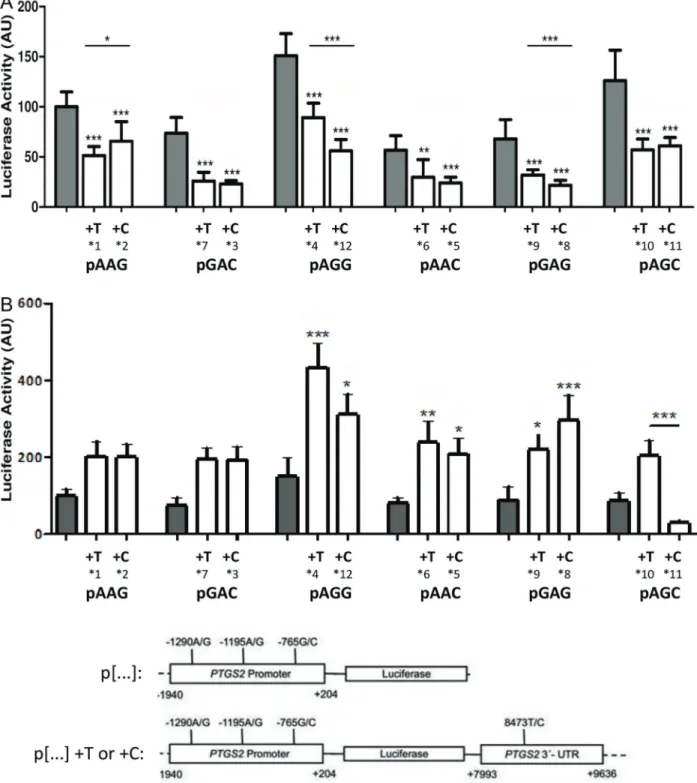
Secondly, we evaluated the effect of combining the
PTGS2 30-UTR, containing the sequence variation of
rs5275 (T or C), with thePTGS2PR variants in both cell
lines (Figure 2). In MCF-7 cells, the presence of either
PTGS230-UTR sequence significantly reduced luciferase
activity in relation to each respective parental PR con-struct (Figure 2A). In contrast, in HEK293FT cells, the
presence ofPTGS230-UTR sequences led to an increase
in luciferase activity (Figure 2B), except for pAGCC
(haplotype *11), which showed significant reduction in
luciferase activity when compared to pAGC (Figure 2B).
Concerning the effects of the 30-UTR SNP on the
combined PTGS2 constructs, the presence of the
vari-ant allele 8473C caused diverse results. In MCF-7 cells
(Figure 2A), the variant allele led to a significantly reduced
luciferase activity (Po0.01) when analyzing the related
constructs: pAGGT (haplotype *4) and pAGGC (haplotype *12) or pGAGT (haplotype *9) and pGAGC (haplotype *8), but increased activity of pAAGC (haplotype *2) in
com-parison to pAAGT (haplotype *1) (Po0.001), and no effect
when comparing the construct pairs pGACT (haplotype *7) and pGACC (haplotype *3), pAACT (haplotype *6) and pAACC (haplotype *5), and pAGCT (haplotype *10) and pAGCC (haplotype *11). In HEK293FT cells (Figure 2B),
Figure 1.Luciferase activity of constructs containing the promoter region of thePTGS2gene in MCF-7 cells (panels AandB) or in HEK293FT cells(panels CandD). The results are depicted for each construct (panels AandC) or in relation to rs689466A/Gallele (panels BandD), combining data obtained with constructs pAAG, pGAC, pAAC and pGAG (pNAN) or with pAGG and pAGC (pNGN). Data are reported as the fold variation of luciferase activity in relation to pAAG, and are the means±SD from at least 2 independent transfection experiments, comprising 12 replicates. Statistical analyses were conducted comparing each construct to pAAG (panels A
andC), or comparing pNGNversuspNAN (panels BandD). *Po0.05, **Po0.001, ***Po0.0001 (Mann-Whitney U-test and
Figure 2.Luciferase activity of constructs containing the promoter region alone or in combination with the 30-UTR (rs5275 TorC) of the PTGS2gene in MCF-7 cells (A) or in HEK293FT cells (B). Data are reported as the fold variation of luciferase activity in relation to pAAG, and are the means±SD from at least 2 independent transfection experiments, comprising 12 replicates. Cells were cotransfected with pGR-TK to normalize transfection efficiency. Statistical analyses were performed within each haplotype triad, i.e. comparing the results between constructs enclosing both PR and 30-UTR sequences (containing eitherrs5275 Tor C), as well as comparing each full
only pAGCT (haplotype *10) and pAGCC (haplotype *11)
were significantly different, with the latter showing lower
luciferase activity (Po0.001).
Interestingly, despite the modulation of the 30-UTR in
the final luciferase activity and regardless of the variable
effects of rs5275, the enhancing transcriptional effect
observed for constructs containing the rs689466Gvariant
is still detectable. Thus, the pooled luciferase activity of
haplotypes containing G or A at rs689466 were 66.9±
18.7vs34.3±18.2 (Po0.0001) in MCF-7 or 260.1±153.7vs
219±50.7 (P=0.03) in HEK293FT cells
Discussion
The present work is thefirst to evaluate the combined
contribution of the four most frequent PTGS2 SNPs on
the regulation ofPTGS2expression. Considering all
pos-sible combinations (n=16), 12 constructs were generated, comprising 10 haplotypes present in the Brazilian popula-tion (15) and 2 others that occur in populapopula-tions with more diverse haploblocks (16).
The data derived from PR haplotypes indicate no individual differences in the luciferase activity (with the exception of pAAC in MCF-7 cells). However, the results
suggest that the presence of the rs689466 G variant
favorsPTGS2transcription in relation to constructs
enclos-ing the rs689466Avariant. This latter result corroborates
the findings by Sakaki et al. (8) with HeLa cells, and by
Pereira et al. (9) with two colon cancer cell lines (HCA-7 and HCT-116), who showed higher transcriptional activity
associated with the rs689466Gvariant. In contrast, Zhang
et al. (10), also using HeLa cells, reported a 5–6-fold
increase in luciferase activity driven by constructs
contain-ing rs689466Awhen compared to those with theG
vari-ant at rs689466. The substitution of AbyGof rs689466
apparently eliminates a MYB-binding site (7,10) and creates an E-box motif (9), which might explain the dis-crepancy of results observed in different cell lines. We
have confirmed that both HEK293FT and MCF-7 cells
were expressing the necessary elements for PTGS2
transcription (RT-PCR approach, data not shown). Never-theless, other relatively frequent PR SNPs, such as rs10911904, rs34984585 and rs689462, which were not studied here, might also contribute to the regulation of
PTGS2transcription (7).
The insertion of the 30-UTR ofPTGS2led to different
results in gene expression depending on the host cell line
model. In MCF-7 cells, the presence of thePTGS230-UTR
significantly reduced luciferase activity in all haplotypes,
whereas in HEK293FT cells, there was an increase,
except for pAGCC, which showed significantly lower
luciferase activity than all other PTGS2 constructs. This
result corroborates the notion that the PTGS2 30-UTR
contributes to regulate gene expression (6), and that its
final effect may be either suppressive or enhancing
depending on the availability of mediators, such as TTP (tristetraprolin), which favors mRNA degradation, or HuR (Hu-Antigen R), which favors mRNA stabilization (5). We
have not evaluated the influence of HuR or TTP in our
experiments, but a previous study by Al-Ahmadi et al. (17) indicates that MCF-7 cells over-express TTP in relation to HuR, with a TTP/HuR mRNA ratio of 2 (17). In contrast, HEK293FT cells constitutively express HuR (18), but lack TTP (19).
Concerning PTGS2 30-UTR sequence variations,
Moore et al. (11) suggested that rs5275Cvariant disrupts
micro-RNA-mediated mRNA degradation. Our results indicate no increase in luciferase activity with haplotypes
containing rs5275C, except for pAAGC (haplotype *2) in
relation to pAAGT (haplotype *1) in MCF-7 cells. As the
presence of micro-RNAs that may downregulatePTGS2,
such as miR-542-3p, was not evaluated in MCF-7 or HEK293FT cells, it is possible that this post-transcriptional regulation was not fully operational in the cell models. Also, the data interpretation is limited by the fact that other
SNPs in PTGS2 30-UTR, such as rs36233646, which is
quite common mostly in African populations (7), and rs689470, which has been reported as a putative micro-RNA binding site (20), were not evaluated in our models. Taken together, our results corroborate the notion that
the 30-UTR of PTGS2 has a major influence on the
modulation of gene expression, with its effect depending on the cell machinery. Despite this major post-transcrip-tional modulation, and regardless of the variable effect of
rs5275 in either cell line, the differences betweenPTGS2
haplotypes appeared to remain mostly dependent on PR SNPs, especially rs689466, and its putative role on gene transcription.
We believe that the study presents an original and valid model to explore the functional impact of haplotypes affecting regulatory regions of target genes for
pharma-cogenetics studies, such asPTGS2, which may contribute
to understand diverse results from observational studies, especially in complex diseases as cancer.
Acknowledgements
The authors thank Dr. Guilherme Suarez-Kurtz for the use of laboratory facilities, and Dr. Dongxin Lin for kindly
providing PTGS2 constructs. This study was supported
by Conselho Nacional de Pesquisa e Desenvolvimento
(CNPq 474522/2010-5), Fundac¸ão Carlos Chagas Filho
de Amparo à Pesquisa no Rio de Janeiro (FAPERJ E-26/ 110356/2010), and INCT para Controle do Câncer (CNPq 573806/2008-0; FAPERJ E26/170.026/2008). D.N. Piranda
and R.B.V. Abreu were awarded fellowships by Coordenac¸ão
de Aperfeic¸oamento de Pessoal de Nível Superior (CAPES),
References
1. Tanabe T, Tohnai N. Cyclooxygenase isozymes and their gene structures and expression.Prostaglandins Other Lipid Mediat2002; 68–69: 95–114, doi: 10.1016/S0090-6980(02) 00024-2.
2. Zha S, Yegnasubramanian V, Nelson WG, Isaacs WB, De Marzo AM. Cyclooxygenases in cancer: progress and perspective. Cancer Lett 2004; 215: 1–20, doi: 10.1016/ j.canlet.2004.06.014.
3. Glover JA, Hughes CM, Cantwell MM, Murray LJ. A systematic review to establish the frequency of cyclo-oxygenase-2 expression in normal breast epithelium, ductal carcinoma in situ, microinvasive carcinoma of the breast and invasive breast cancer.Br J Cancer2011; 105: 13–17, doi: 10.1038/bjc.2011.204.
4. Xu F, Li M, Zhang C, Cui J, Liu J, Li J, et al. Clinicopatho-logical and prognostic significance of COX-2 immunohisto-chemical expression in breast cancer: a meta-analysis.
Oncotarget 2017; 8: 6003–6012, doi: 10.18632/oncotarget. 13990.
5. Young LE, Sanduja S, Bemis–Standoli K, Pena EA, Price RL, Dixon DA. The mRNA binding proteins HuR and tristetraprolin regulate cyclooxygenase 2 expression during colon carcinogenesis.Gastroenterology2009; 136: 1669– 1679, doi: 10.1053/j.gastro.2009.01.010.
6. Dixon DA. Post-transcriptional control of cyclooxygenase-2 gene expression. The role of the 30-untranslated region. J Biol Chem 2000; 275: 11750–11757, doi: 10.1074/jbc. 275.16.11750.
7. Agúndez JA, Blanca M, Cornejo-García JA, García-Martín E. Pharmacogenomics of cyclooxygenases. Pharmacoge-nomics2015; 16: 501–522, doi: 10.2217/pgs.15.6. 8. Sakaki M, Makino R, Hiroishi K, Ueda K, Eguchi J, Hiraide
A, et al. Cyclooxygenase-2 gene promoter polymorphisms affect susceptibility to hepatitis C virus infection and disease progression: SNP of COX-2 gene protects against HCV infection.Hepatol Res2010; 40: 1219–1226, doi: 10.1111/ j.1872-034X.2010.00727.x.
9. Pereira C, Sousa H, Silva J, Brandão C, Elgueta-Karstegl C, Farrell PJ, et al. The 1195G allele increases the tran-scriptional activity of cyclooxygenase-2 gene (COX-2) in colon cancer cell lines: 1195A4G polymorphism increases
cox-2 transcriptional activity.Mol Carcinog2014; 53(S1): E92– E95, doi: 10.1002/mc.22049.
10. Zhang X, Miao X, Tan W, Ning B, Liu Z, Hong Y, et al. Identification of functional genetic variants in and their
association with risk of esophageal cancer. Gastroenterol-ogy2005; 129: 565–576, doi: 10.1053/j.gastro.2005.05.003. 11. Moore AE, Young LE, Dixon DA. A common single-nucleotide polymorphism in cyclooxygenase-2 disrupts microRNA-mediated regulation.Oncogene2012; 31: 1592– 1598, doi: 10.1038/onc.2011.349.
12. Yang S, Han H. Effect of cycloxygenase-2 silencing on the malignant biological behavior of MCF-7 breast cancer cells.
Oncol Lett2014; 8: 1628–1634, doi: 10.3892/ol.2014.2395. 13. Mbonye UR, Wada M, Rieke CJ, Tang H-Y, DeWitt DL, Smith WL. The 19-amino acid cassette of cyclooxygenase-2 mediates entry of the protein into the endoplasmic reticulum-associated degradation system. J Biol Chem 2006; 281: 35770–35778, doi: 10.1074/jbc.M608281200.
14. Ho SN, Hunt HD, Horton RM, Pullen JK, Pease LR. Site-directed mutagenesis by overlap extension using the polymerase chain reaction.Gene; 77: 51–59, doi: 10.1016/ 0378-1119(89)90358-2.
15. Festa-Vasconcellos JS, Piranda DN, Amaral LM, Indio-do-Brasil V, Koifman S, et al. Polymorphisms in cycloxygenase-2 gene and breast cancer prognosis: association between PTGS2 haplotypes and histopathological features.Breast Cancer Res Treat2012; 132: 251–258, doi: 10.1007/s10549-011-1828-0. 16. Gangwar R, Mandhani A, Mittal RD. Functional
polymor-phisms of cyclooxygenase-2 (COX-2) gene and risk for urinary bladder cancer in North India.Surgery 2011; 149: 126–134, doi: 10.1016/j.surg.2010.04.004.
17. Al-Ahmadi W, Al-Ghamdi M, Al-Souhibani N, Khabar KS. miR-29a inhibition normalizes HuR over-expression and aberrant AU-rich mRNA stability in invasive cancer: miRNA inhibitor normalizes HuR over-expression.J Pathol 2013; 230: 28–38, doi: 10.1002/path.4178.
18. Drury GL, Di Marco S, Dormoy-Raclet V, Desbarats J, Gallouzi I-E. FasL expression in activated T lymphocytes involves HuR-mediated stabilization. J Biol Chem 2010; 285: 31130–31138, doi: 10.1074/jbc.M110.137919. 19. Cao H, Lin R. Quantitative evaluation of His-tag purification
and immunoprecipitation of tristetraprolin and its mutant proteins from transfected human cells. Biotechnol Prog
2009; 25: 461–467, doi: 10.1002/btpr.121.
20. Wang X, Zhao Y, Wang Y, Wang Z, Guan X. Association between a functional variant at PTGS2gene 30UTR and
its mRNA expression in lymphoblastoid cell lines:PTGS2