Prokaryotic expression of a novel mouse
pro-apoptosis protein PNAS-4 and
application of its polyclonal antibodies
P. Zhang
1*, C.T. Wang
1*, F. Yan
1, L. Gou
1, A.P. Tong
2, F. Cai
2, Q. Li
2, H.X. Deng
1and Y.Q. Wei
11
State Key Laboratory of Biotherapy, West China Hospital, West China Medical School,
2School of Life
Sciences, Sichuan University, Chengdu, Sichuan, China
Correspondence to: H.X. Deng, State Key Laboratory of Biotherapy, West China Hospital, West China
Medical School, Sichuan University, Keyuan Road 4, Chengdu, Sichuan, 610041, China
Fax: +86-28-8516-4060. E-mail: [email protected]
Mouse PNAS-4 (mPNAS-4) has 96% identity with human PNAS-4 (hPNAS-4) in primary sequence and has been reported to be involved in the apoptotic response to DNA damage. However, there have been no studies reported of the biological functions of mPNAS-4. In studies conducted by our group (unpublished data), it was interesting to note that overexpression of mPNAS-4 promoted apoptotic death in Lewis lung carcinoma cells (LL2) and colon carcinoma cells (CT26) of mice both in vitro and in vivo. In our studies, mPNAS-4 was cloned into the pGEX-6P-1 vector with GST tag at N-terminal in Escherichia coli strain BL21(DE3). The soluble and insoluble expression of recombinant protein mPNAS-4 (rmPNAS-4) was temperature-dependent. The majority of 4 was insoluble at 37°C, while it was almost exclusively expressed in soluble form at 20°C. The soluble rmPNAS-4 was purified by one-step affinity purification, using a glutathione Sepharose rmPNAS-4B column. The rmPNAS-rmPNAS-4 protein was further identified by electrospray ionization-mass spectrometry analysis. The search parameters of the parent and fragment mass error tolerance were set at 0.1 and 0.05 kDa, respectively, and the sequence coverage of search result was 28%. The purified rmPNAS-4 was further used as immunogen to raise polyclonal antibodies in New Zealand white rabbit, which were suitable to detect both the recombinant and the endogenous mPNAS-4 in mouse brain tissue and LL2 cells after immunoblotting and/or immunostaining. The purified rmPNAS-4 and our prepared anti-mPNAS-4 polyclonal antibodies may provide useful tools for future biological function studies for mPNAS.
Key words: Anti-mPNAS-4; Polyclonal antibody; Apoptosis-related protein family; One-step affinity purification
*These authors contributed equally to this study.
Research supported by the National Key Basic Research Program of China (#2004CD518800), National Natural Sciences Foundation of China (#20505006), and National 863 Projects.
Received January 31, 2008. Accepted May 26, 2008
Introduction
Apoptosis, programmed cell death, is a genetically regulated, morphologically distinct form of cell death. Apop-totic cells can be recognized by morphology such as smaller nuclei and condensed chromatin, by characteristic molecular features, and by some histochemical techniques such as in situ end labeling. Apoptosis is currently believed to be involved in a wide range of pathologic conditions,
including neurodegenerative and cardiovascular diseases, cancer, and autoimmune diseases. However, the mechan-ism of apoptosis is not clearly understood and therefore it is important to study genes involved in the regulation of this event.
PNAS-4 (hPNAS-4) is a novel pro-apoptotic gene acti-vated during the early response to DNA damage which is thought to play a critical role in cellular function regarding the maintenance of genomic integrity. James et al. (2) reported that the transcript level of hPNAS-4 is greatly up-regulated in glucocorticoid-treated human lens epithelial cells (HLE B-3), indicating that hPNAS-4 may be involved in perturbation of lens epithelial cell proliferation and differ-entiation.
The mouse homolog gene (denoted mPNAS-4), lo-cated in the 1H3 chromosomal region, encodes a 194-amino acid residue protein and possesses 96% identity with the hPNAS-4 protein. Consistent with the high se-quence conservation, data obtained in studies by our group (Zhang P, Wang CT, Yan F, Gou LT, Yuan Z, Tong AP, unpublished results) also showed similarity in the biological function between them. We observed that over-expression of mPNAS-4 can promote apoptotic death in lung carcinoma cells (LL2) and colon carcinoma cells (CT26) of Lewis mice both in vitro and in vivo, indicating that mPNAS-4 could be used as a new target for effective therapeutic intervention.
However, many of the properties of PNAS-4, such as its biological activity, are not well understood. Therefore, the expression and the preparation of recombinant mPNAS-4 protein (rmPNAS-mPNAS-4) and its polyclonal antibody should provide effective experimental tools for identifying its sub-cellular localization, expression profile, the interacting pro-teins, etc. This strategy of studying novel genes at the protein level should facilitate further investigations and is generally accepted worldwide (3-8).
In the present study, the full length mPNAS-4 (21 kDa) fused with glutathione (GST) residues (47 kDa) was ex-pressed in Escherichia coli BL21 (DE3) cells, and this recombinant protein (rmPNAS-4) was purified by one-step affinity purification on a glutathione Sepharose 4B column. The fusion protein was identified by electrospray ioniza-tion-mass spectrometry (ESI-MS) analysis and polyclonal antibodies against rmPNAS-4 were prepared. Western blot and immunohistochemistry analysis showed that the polyclonal antibodies were suitable to detect the presence of both the exogenous and endogenous mPNAS-4 effec-tively.
Material and Methods
Total RNA isolation
Total RNA was extracted from 0.1 g mouse liver tissues using a standard Trizol RNA isolation protocol (Invitrogen, USA). Prior to use, RNA concentrations were quantified by absorbance measurement, and RNA integrity was
con-firmed by electrophoresis.
RT-PCR amplification of mPNAS-4 cDNA
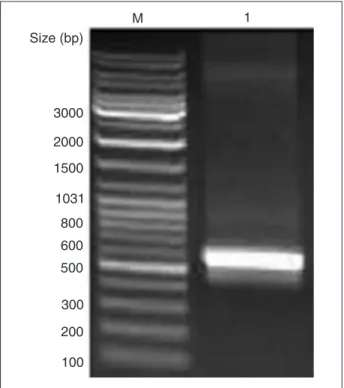
The forward primer was 5'-GCGGATCCATGGCCAA CCAGCCCATCATC-3' and the reverse primer was 5'-CCGCTCGAGCTATAGTTTTGTGTGGCGCCCAGG-3'. Sequences of the forward and reverse oligonucleotides contained BamHI and XhoI restriction sites (underlined), respectively. The primer pairs were designed according to the full-length cDNA sequence of the mPNAS-4 gene in GenBank (GenBank accession #NM_024282) and used in the reverse transcription-polymerase chain reaction (RT-PCR) with a one-step RT-PCR kit (TaKaRa, Japan) ac-cording to manufacturer instructions (Figure 1).
Plasmid construction and identification
The amplified mPNAS-4 cDNA and expression vector pGEX-6P-1 were digested with BamHI and XhoI, respec-tively, and then ligated overnight at 16°C, followed by transformation into competent E. coli XL1-Blue cells. The positive clones were detected by digestion with BamHI and XhoI (Figure 3) and confirmed by DNA sequencing.
Expression of the fusion protein
The expression plasmid pGEX-6P-1-mPNAS-4 was used to transform competent E. coli BL21 (DE3) cells. The bacterial cells were cultured in LB broth containing 100 µg/ mL ampicillin. When the absorbance at 600 nm reached 0.6, isopropyl-ß-D-thiogalactopyranoside (IPTG) was added to the culture at a final concentration of 1 mM for 16 h at 20°C to induce the expression of rmPNAS-4, and then harvested. The cell pellets were resuspended in phos-phate-buffered saline (PBS), pH 7.4, and sonicated for 90 s at 200 W on ice. The total lysate induced with IPTG was then separated into soluble and insoluble fractions by centrifugation at 800 g for 25 min at 4°C. The expression and solubility of mPNAS-4 were then analyzed in parallel by 12% SDS-PAGE followed by staining with Coomassie brilliant blue R-250 (Figure 4) at room temperature
Purification of the fusion proteins
pres-ence of recombinant protein in the eluted fractions was confirmed by Western blot using anti-GST monoclonal antibody with horse radish peroxidase (HRP) conjugates (Sigma, USA) as shown in Figure 5.
mPNAS-4 identification by mass spectrometry
The purified mPNAS-4 proteins were separated by 12% SDS-PAGE. The mPNAS-4 band was excised, and in-gel digestion of proteins was carried out using MS grade Trypsin Gold according to manufacturer instructions. Mass spectra were acquired with an ESI-Q-TOF MS. The MS/ MS data were acquired by the MassLynx software (Micro-mass, Waters, USA) and converted to PKL files by the ProteinLynx 2.2.5 software (Waters, USA). The pkl files were analyzed using the MASCOT search engine (www.matrixscience.com) (Figure 6).
Preparation of mPNAS-4 polyclonal antibodies and specificity analysis
The purified rmPNAS-4 identified by mass spectrom-etry was used as an immunogen to raise polyclonal anti-bodies in New Zealand white rabbit according to reported methods (9). Antibody titer was determined by ELISA. The antiserum was tested by Western blot analysis using the purified rmPNAS-4 and total proteins from mouse brain
tissue. Protein concentration was determined by the meth-od of Bradford (10). The protein samples were separated by 12% SDS–PAGE and electrophoretically transferred onto a polyvinylidene difluoride membrane. After blocking, the polyvinylidene difluoride membranes were incubated with antiserum at 1:4000 dilution for 1-2 h at room temper-ature and then incubated in 1:5000 diluted goat anti-rabbit IgG conjugated with HRP for 1 h. After washing three times with Tris-buffered saline with Tween, the membrane was developed using the enchanced chemiluminescence de-tection kit (Amersham Biosciences, USA). Non-immunized serum was used as the control (Figure 7A).
Cell immunohistochemistry
To determine whether the polyclonal antibodies were suitable for recognition of the endogenous mPNAS-4 pro-teins in cells, immunohistochemistry was performed in LL2 cells plated onto coverslips using the labeled streptavidin-biotin method. The anti-mPNAS-4 polyclonal antiserum was used as the primary antibody (1:1000) and the second antibody was a biotinylated anti-rabbit IgG. The coverslips were then stained with HRP-streptavidin reagents (Dako, USA) and diaminobenzidine and brown staining was con-sidered to be positive (Figure 7C). Non-immunized serum was used as the control (Figure 7B).
Analysis of apoptosis of mPNAS-expressing LL2 cells
Apoptosis in transient mPNAS-4-expressing LL2 cells was analyzed by Hoechst 33258 staining. LL2 cells were seeded onto 6-well plates and, when reaching 70-80% confluence, were transfected with enhanced green fluo-rescent protein (EGFP)-N1-mPNAS-4 and EGFP-N1
vec-tor. One day later, GFP fluorescence was detected under an inverted fluorescence microscope to evaluate the trans-fection efficiency. Cells were then fixed, washed twice with PBS and stained with Hoechst 33258 staining solution according to instructions (Beyotime, China). Stained nu-clei were detected under a fluorescence microscope (Fig-ure 8).
Results and Discussion
Cloning mPNAS-4 cDNA
To obtain mPNAS-4 gene-specific cDNA fragments, RT-PCR was performed with total RNA from mouse liver tissues. We obtained a fragment of approximately 600 bp in length, as shown in Figure 1, consistent with the ex-pected size.
Homology between mPNAS-4 and hPNAS-4
The amino acid sequence of mPNAS-4 possessed Figure 1.
Figure 1.Figure 1. Figure 1.
GST could produce correctly folded and soluble heterolo-gous proteins in bacterial cytoplasm (13,14). Thus, we selected pGEX-6P-1 containing the GST tag at the N-terminus to express mPNAS-4.
mPNAS-4 expression
IPTG were added to the E. coli BL21 (DE3) cells at a final concentration of 1 mM for 16 h at 20°C to induce the expression of rmPNAS-4. SDS–PAGE analysis revealed that the fusion protein with the GST tag at the N-terminal was about 47 kDa (Figure 4, lanes 2 and 3), which was consistent with the predicted molecular weight (containing GST tag sequences) and was present almost exclusively in soluble form (Figure 4, lane 3).
Temperature was one of the key factors for the induc-tion of eukaryotic proteins in bacteria. Because of rapid expression at high temperature, error folding usually oc-curred and the induced protein was in the form of an inclusion body. In our studies, we first induced the recom-binant protein at 37°C and most of it was insoluble. To obtain the soluble protein, we later changed the induction temperature. Ultimately, we obtained satisfactory results
Figure 3. Figure 3.Figure 3. Figure 3.
Figure 3. Identification of pGEX-6P-1-mPNAS-4 by PCR and BamHI/XhoI digestion. M = DNA marker; lane 1, plamid 1; lane 2, plasmid pGEX-6P-1-mPNAS-4 digested with BamHI/XhoI; lane 3, PCR prod-uct with plasmid pGEX-6P-1-mPNAS-4 as template. 96% identity with hPNAS-4, suggesting that mPNAS-4
might exert effects similar to those of hPNAS-4 (Figure 2), which has been reported to be a novel pro-apoptotic gene. We found that overexpression of mPNAS-4 resulted in the inhibition of proliferation and the promotion of apoptosis in LL2 cells and CT26 cells in vivo and in vitro (Zhang P, Wang CT, Yan F, Gou LT, Yuan Z, Tong AP, unpublished data).
Identification of the recombinant plasmid pGEX-6P-1-mPNAS-4
The purified PCR product was digested with BamHI/ XhoI and cloned into the pGEX-6P-1 vector treated with the corresponding enzymes. The recombinant plasmid pGEX-6P-1-mPNAS-4 was confirmed correctly by PCR, by digestion with BamHI/XhoI (Figure 3) and DNA se-quencing.
Expression of biologically active recombinant eukary-otic proteins in bacteria is difficult to achieve due to im-proper folding and poor solubility (11,12). The GST Gene Fusion System is one of the four main prokaryotic expres-sion systems available. As the good fuexpres-sion partner protein,
Figure 2. Figure 2.Figure 2. Figure 2.
at 20°C which were useful for further study.
Purification of mPNAS-4
The rmPNAS-4 protein was purified by one-step affinity purification using glutathione Sepharose 4B as described in Refs. 15-17. The presence of recombinant protein in the eluted fractions was confirmed by SDS–PAGE and West-ern blot using an anti-GST monoclonal antibody with HRP conjugates (Figure 5).
The PNAS-4 gene was first reported (1) at the 96th Annual Meeting of AACR in 2005 by Filippov, who reported that PNAS-4 might be involved in the apoptotic response to DNA damage. James et al. (2) later reported that PNAS-4 may be acting by disturbing lens epithelial cell proliferation and differentiation. Furthermore, Filippov et al. (1) reported that hPNAS-4 was a novel pro-apoptotic gene able to promote apoptosis in osteosarcoma U2OS cells in vivo. The mPNAS-4 protein possessed a high identity with the hPNAS-4 protein, and therefore we believed that mPNAS-4 could play an important role in cell proliferation and differentiation as we had found in our studies. However, the molecular mechanisms by which mPNAS-4 acted re-main unknown. Therefore, with a better understanding of mPNAS-4, the purified soluble fusion protein and the spe-cific antibody could open up new possibilities in many applications such as molecular immunology, the produc-tion of vaccines and studies involving protein-protein and DNA-protein interactions.
mPNAS-4 identification by ESI-MS analysis
The three representative peptide fragments in Figure 6 were unambiguously matched to the trypsin-digested ions of mPNAS-4, indicating that our expressed and purified protein rmPNAS-4 were completely correct.
One of the peptide fragments obtained by ESI-MS was the DUF-862 domain with high conservatism in the PNAS-4 protein family and having 100% identity with hPNAS-PNAS-4. These data indicated that the DUF-862 domain would be involved in the biological function of the PNAS-4.
Production of polyclonal antibodies against the recombinant protein and analysis of their specificity
The specificity of rabbit antiserum was determined by Western blot analysis using purified rmPNAS-4 and mPNAS-4 from mouse brain tissue as antigens. There were two positive bands at positions of 21 and 47 kDa, respectively (Figure 7A). However, non-immunized serum was negative. Immunohistochemistry using the anti-mPNAS-4 polyclonal antiserum in LL2 cells revealed strong brown staining in the cytoplasm, excluding the nuclei (Fig-ure 7C). However, the controls showed no staining in the
Figure 4. Figure 4. Figure 4. Figure 4.
Figure 4. Expression and identification of the recombinant pro-tein. M = protein molecular weight markers; lane 1, Escherichia coli BL21 (DE3)/pGEX-6P-1-mPNAS-4 whole cell proteins be-fore induction; lane 2, E. coli BL21 (DE3)/pGEX-6P-1-mPNAS-4 whole cell proteins after induction; lane 3, soluble fraction from induced cell lysates; lane 4, insoluble fraction from induced cell lysates.
Figure 5. Figure 5. Figure 5. Figure 5.
Figure 5. Purification of mPNAS-4. M = protein molecular weight markers. SDS–PAGE (12%) analysis of the crude extracts of Escherichia coli BL21 before and after induction with 1 mM isopropyl-ß-D-thiogalactopyranoside at 20°C (lanes 1, 2) and affinity chromatography-purified mPNAS-4 from the first to the third tube of elution (lanes 3-5). Western blot analysis with an anti-glutathione-tag mAb (lane 6).
cytoplasm (Figure 7B). These results indicate that our rabbit antiserum specifically and effectively recognized both exogenous recombinant mPNAS-4 and endogenous mPNAS-4 in tissues and cells.
Apoptosis induced by overexpression of mPNAS-4
Figure 6. Figure 6.Figure 6. Figure 6.
Figure 6. Electrospray ionization-mass spectrometry (ESI-MS) identification of tryptic peptides from the purified recombinant mPNAS-4 protein. A, ESI-MS of mPNAS-4 showing 3 peptides (asterisks) that could be sequence. The search parameters of the parent and fragment mass error tolerance were set at 0.1 and 0.05 kDa, respectively. B, An example of an MS/MS spectrum of the parent ion 940.4525. C, Output of the database search by the MASCOT program using MS/MS data resulted in the identification of mPNAS-4. The three peptide sequences of mPNAS-4 are shown in bold and underlined.
Figure 8. Figure 8. Figure 8. Figure 8.
Figure 8. Hoechst 33258 staining of LL2 cells transfected with mPNAS-4. After 24 h, LL2 cells treated with enhanced green fluorescent protein (EGFP)-N1-mPNAS-4 and EGFP-N1 vector were stained with Hoechst 33258. Nuclei were visualized by
fluorescence microscopy (200X). A, Wild-type LL2 cells. B, LL2 cells transfected with EGFP-N1 vector. C, LL2 cells overexpressed
with mPNAS-4. The arrows indicate the presence of apoptotic nuclear profiles. The quantitative analysis of these results is shown in D. The transfection efficiency of the two groups transfected with plasmid was about 70%, but apoptotic cells were much more numerous in the experimental group.
Figure 7. Figure 7. Figure 7. Figure 7.
References
1. Filippov V, Filippova M, Sinha D, DuerksenHughes PJ. PNAS-4: A Novel Pro-Apoptotic Gene Activated During the Early Response to DNA Damage. Proceedings of the Ameri-can Association for Cancer Research. 96th Annual Meet-ing. Anaheim, 2005.
2. James ER, Fresco VM, Robertson LL. Glucocorticoid-in-duced changes in the global gene expression of lens epithe-lial cells. J Ocul Pharmacol Ther 2005; 21: 11-27.
3. Guo F, Li SQ, Chu YH, Huang XF, Sun LM, Li YQ, et al. High-level expression, polyclonal antibody preparation and sub-cellular localization analysis of mouse Rhox5 protein. Protein Expr Purif 2007; 54: 247-252.
4. Rautureau G, Jouvensal L, Decoville M, Locker D, Vovelle F, Schoentgen F. Cloning, high yield over-expression, puri-fication, and characterization of CG18594, a new PEBP/ RKIP family member from Drosophila melanogaster. Pro-tein Expr Purif 2006; 48: 90-97.
5. Park HJ, Jeon JH, Kang SG, Lee JH, Lee SA, Kim HK. Functional expression and refolding of new alkaline es-terase, EM2L8 from deep-sea sediment metagenome. Pro-tein Expr Purif 2007; 52: 340-347.
6. Londer YY, Pokkuluri PR, Erickson J, Orshonsky V, Schiffer M. Heterologous expression of hexaheme fragments of a multidomain cytochrome from Geobacter sulfurreducens representing a novel class of cytochromes c. Protein Expr Purif 2005; 39: 254-260.
7. Menard LP, Lussier JG, Lepine F, Paiva de SC, Dubreuil JD. Expression, purification, and biochemical characteriza-tion of enteroaggregative Escherichia coli heat-stable en-terotoxin 1. Protein Expr Purif 2004; 33: 223-231.
8. Li A, Kato Z, Ohnishi H, Hashimoto K, Matsukuma E, Omoya K, et al. Optimized gene synthesis and high expression of human interleukin-18. Protein Expr Purif 2003; 32: 110-118. 9. Voss EW Jr, Miklasz SD, Petrossian A, Dombrink-Kurtzman MA. Polyclonal antibodies specific for liganded active site (metatype) of a high affinity hapten monoclonal anti-body. Mol Immunol 1988; 25: 751-759.
10. Bradford MM. A rapid and sensitive method for the quantita-tion of microgram quantities of protein utilizing the principle of protein-dye binding. Anal Biochem 1976; 72: 248-254. 11. LaVallie ER, McCoy JM. Gene fusion expression systems
in Escherichia coli. Curr Opin Biotechnol 1995; 6: 501-506. 12. Smith DB, Johnson KS. Single-step purification of polypep-tides expressed in Escherichia coli as fusions with glutathi-one S-transferase. Gene 1988; 67: 31-40.
13. Stevens RC. Design of high-throughput methods of protein production for structural biology. Structure 2000; 8: R177-R185.
14. Guzzo CM, Yang DC. Systematic analysis of fusion and affinity tags using human aspartyl-tRNA synthetase ex-pressed in E. coli. Protein Expr Purif 2007; 54: 166-175. 15. Kovacs-Nolan J, Sasaki E, Yoo D, Mine Y. Cloning and
expression of human rotavirus spike protein, VP8*, in Es-cherichia coli. Biochem Biophys Res Commun 2001; 282: 1183-1188.
16. Smith DB. Generating fusions to glutathione S-transferase for protein studies. Methods Enzymol 2000; 326: 254-270. 17. Lundberg M, Holmgren A, Johansson M. Human
glutare-doxin 2 affinity tag for recombinant peptide and protein purification. Protein Expr Purif 2006; 45: 37-42.
LL2 cells were stained with Hoechst 33258, 24 h after transient transfection. More nuclei of LL2 cells transfected with EGFP-N1-mPNAS-4 appeared to be hypercondensed
(brightly stained; Figure 8C) compared to control cells (Figure 8A,B). Furthermore, GFP fluorescence showed that about 70% of LL2 cells were transfected into both groups treated with the plasmid. The quantitative analysis of the transfection efficiency and apoptosis of cells from the two groups is shown in Figure 8D. Recombinant eu-karyotic proteins overexpressed in cells are likely to be biologically active in their natural conformation. In our previous studies (Yuan Z, Yan F, Zhang P, Wang CT, Gou LT, Zhao XY, Wei YQ, unpublished results), mPNAS-4 was also transfected into murine fibroblast NIH3T3 cells, but no obvious change was detected even after 72 h compared to control. Therefore, the present results indi-cate that the larger number of apoptotic cells found in the experimental group can be attributed mostly to overex-pression of mPNAS-4.
Because of its 96% identity with hPNAS-4, mPNAS-4 was also thought to be involved in the process of
apopto-sis. This hypothesis was supported by our studies, al-though the mechanism is still unknown.
As a member of a novel apoptosis-related protein family, mPNAS-4 is thought to play an important role during tumorigenesis and tumor development. Therefore, it was essential to identify how mPNAS-4 performs its function. The purified rmPNAS-4 with GST-tag would un-doubtedly be useful to investigate the proteins interacting with it by co-immunoprecipitation, tandem affinity purifica-tion-based MS technology and GST pull-down analysis (18-21). And the antibody produced will also serve as a tool to explore the function of mPNAS-4, permitting the identi-fication of its potential binding partners, the study of its structure and its mechanism of pathogenesis, and the progression of cancer cells.
Acknowledgments
18. Yan J, Yang XP, Kim YS, Joo JH, Jetten AM. RAP80 interacts with the SUMO-conjugating enzyme UBC9 and is a novel target for sumoylation. Biochem Biophys Res Commun 2007; 362: 132-138.
19. Huang X, Shi Z, Wang W, Bai J, Chen Z, Xu J, et al. Identification and characterization of a novel protein ISOC2 that interacts with p16INK4a. Biochem Biophys Res Commun 2007; 361: 287-293.
20. Quaedackers ME, van den Brink CE, van der Saag PT, Tertoolen LG. Direct interaction between estrogen receptor alpha and NF-kappaB in the nucleus of living cells. Mol Cell Endocrinol 2007; 273: 42-50.