Introduction
Biodiversity conservation has been one of the greatest
challenges of the last decades due to intense anthropic
interference mainly in forest environments, like the
native Araucaria Forests, for example, which are being
replaced by cultivation, especially of exotic plants. This
vegetation formation, which in the past occupied large
territories (Teixeira et al. 1986), is currently found in
small restricted areas.
The reduction of these forest areas results in changes that
affect the structure and dynamics of ecosystems in different
ways. Since lichenized fungi are important epiphytes in
forest areas (Hale 1983; Negi 2000), they are also infl uenced
by these environmental changes.
Characteristics of the substrate (Hale 1957; Brodo 1973;
Jesberger & Sheard 1973; Hawksworth & Hill 1984; Marcelli
1996; Schmidt et al. 2001), composition of macro and micro
nutrients (Hawksworth 1975), luminosity and humidity
(Honegger 1995; Brunialti & Giordani 2003; Martinez et
al. 2006) are among the factors that most affect lichenized
fungi distribution in forest areas. The acidity or alkalinity
of the tree bark can also affect species establishment (Brodo
1973; Cáceres et al. 2007) and pH can be critical for the
reproduction of many species (Hale 1957). Differences in
bark pH values can inhibit the establishment of organisms
favoring nitrophyte lichens (which occur on host trees with
basic pH) or acidophyte lichens (host trees with acid pH).
The presence or absence of these species can indicate the
degree of
eutrophication in the forest area (Herk 2001;
Wolseley et al. 2006; Fleig & Grüninger 2008).
Currently existing studies on Araucaria forest lichens
are mostly related to species surveys, with no ecological
connotation (but see Kaffer et al in press). In the region
of São Francisco de Paula, the works of Osorio & Fleig
(1986b), Fleig (1990a), Fleig & Grüninger (2000) and Fleig
& Grüninger (2008) cited 232 corticolous lichen
species.
Käffer & Martins Mazzitelli (2005) recorded 76 taxa in
the sub-basin of Sinos and Taquari – Antas Rivers. For the
São Francisco de Paula National Forest only 18 species of
lichenized fungi are reported (Osorio & Fleig 1986b).
The aims of this study were: 1) to evaluate how the
corticolous lichen community with a foliose, squamulose
and fi lamentous habit is distributed in native and planted
vegetation, 2) to investigate a possible manifestation of
preference by lichen species for host trees, as well as their
interaction in these different vegetation types and; 3) to
verify the relationship between host-tree bark pH and
1 Part of the Master’s dissertation of the fi rst Author
2 Fundação Zoobotânica do Rio Grande do Sul, Museu de Ciências Naturais, Porto Alegre, RS, Brasil 3 Instituto de Botânica, Seção de Micologia e Liquenologia, São Paulo, SP, Brasil
4 Universidade Federal do Rio Grande do Norte, Departamento de Botânica Ecologia e Zoologia, Centro de Biociências, Natal, RN, Brasil 5 Corresponding author: [email protected]
Distribution and composition of the lichenized mycota
in a landscape mosaic of southern Brazil
1Márcia I. Käffer
2,5, Marcelo P. Marcelli
3& Gislene Ganade
4Recebido em 7/09/2009. Aceito em 21/06/2010
RESUMO – (Distribuição e composição da micota liquenizada corticícola em um mosaico de paisagem do sul do sul do Brasil). Os fungos liquenizados são componentes epífi tos em áreas fl orestais, sendo que as ações antrópicas podem ocasionar modifi cações na composição e distribuição espacial das es-pécies. O objetivo deste trabalho é avaliar como a comunidade liquênica corticícola está distribuída na vegetação nativa e plantada, além de investigar uma possível manifestação de preferência da comunidade liquênica por forófi to e sua relação com o pH da casca dos mesmos. Foram analisados 120 forófi tos distribuídos em 12 manchas de vegetação nativa e plantada: Floresta Ombrófi la Mista, Plantações de Araucária, Pinos e Eucaliptos. Amostras adicionais de fungos liquenizados foram coletadas em todas as manchas de vegetação e/ou trilhas que levavam a estas, em coletas denominadas não sistemáticas. Foram registrados 113 táxons de fungos liquenizados, sendo 78 espécies no levantamento de comparação entre ambientes e 35 acrescentadas através das coletas adicionais. A maior diversidade de espécies foi registrada na Plantação de Araucária, enquanto que a maior ocorrência de táxons de ambientes sombreados foi verifi cada nas manchas da Floresta Ombrófi la Mista. O maior número de táxons liquênicos foi registrado em forófi tos com pH da casca básico. As va-riações registradas na composição e distribuição da comunidade liquênica podem estar relacionadas às características dos forófi tos encontrados nestas áreas.
Palavras-chave: Composição, liquens, forófi tos, Floresta de Araucária, pH da casca
ABSTRACT – (Distribution and composition of the lichenized mycota in a landscape mosaic of southern Brazil). Lichenized fungi are epiphytic components of forest areas where anthropogenic activities may cause changes in species composition and spatial distribution. The aim of this work is to evaluate how the lichen community is distributed on native and planted vegetation, and also to investigate possible preferences of the lichen community for specifi c host trees related to bark pH values. A total of 120 host-trees distributed in 12 remnants of native and planted vegetation were analyzed: native Araucaria forest and Araucaria, pine and eucalyptus plantations. Additional samples of lichenized fungi were collected in all vegetation types and adjacent trails, using a non-systematic sampling protocol. One hundred thirteen taxa of lichenized fungi were recorded, of which 78 species originated from the survey comparing the four habitats and 35 were added by additional collections. The highest species diversity was recorded in the Araucaria plantation while the greatest occurrence of shade tolerant taxa was found in the native Araucaria forest type. The largest number of lichen taxa was recorded on host-trees with basic bark pH. The wide variety of lichen community composition and distribution registered may be related to the host-tree characteristics found in these areas.
associated lichen species in the São Francisco de Paula
National Forest.
Material and methods
Study area – This study was carried out at the São Francisco de Paula National Forest (FLONA), classifi ed as a Conservation Unit for Sustainable Use, located in the town of São Francisco de Paula (29º 02’S; 50º 23’W), Rio Grande do Sul state, Brazil. The average altitude of the region is 912m above sea level, with an average temperature of 14.5ºC and average precipitation of 2252 mm.year-1 (Schneider et al. 1989). It encompasses an area of 1607 hectares, characterized by the dominance of Araucaria angustifolia (Araucariaceae, “Brazilian-pine”), with small monoculture stands of A. angustifolia and of species of the genera Pinus and Eucalyptus (Fig. 1). In native and planted vegetation types at São Francisco de Paula National Forest other tree species associated with A. angustifolia, Pinus spp. and Eucalyptus spp are usually found. They are distinguished by the greatest number of species, representatives of the families Myrtaceae, Lauraceae, Fabaceae, Cunoniaceae, Aquifoliaceae, Euphorbiaceae and Podocarpaceae.
Sampling and identifi cation – The species survey was carried out from March 2003 to April 2004 in the following vegetation types: native Araucaria forest (FO), Araucaria plantation (PA), Pine plantation (PP) and Eucalyptus plantation (PE), and also on the access trails surrounding these stands.
At each vegetation stand (FO, PA, PP and PE) 10 host trees with erect trunks and no branching below 150 cm height and with dbh over 8 cm were randomly sampled, comprising a total of 120 host trees. Each stand was selected based on availability and accessibility, but all stands were at least 1 ha in area and at least 100 m apart. Lichens were registered on tree bark from 30 cm to 150 cm above the ground for each selected tree in each of the four vegetation types. Surveys were performed using the Rubberband Method (Marcelli 1992) and all the species that touched the rubberband were identifi ed in the fi eld or collected for later identifi cation at the lab.
Additional samples of lichenized fungi were collected in all vegetation stands and adjacent trails, using a non-systematic sampling protocol. These samples aimed to record species that were not registered in the stands and were used as duplicates to be deposited as herbarium specimens.Some specimens were taken from the same sampled host trees, but at a point higher than 150 cm, and others were collected from twigs and branches that fell from tree crowns.
Lichen identifi cation was carried out by observing anatomical sections of thallus and fructifi cations using stereoscopic and optical microscopes. The external characteristics of the lobes, such as color and thallus aspect, lobe width and length, presence of pycnidia and rhizines, cilia and aspect of apothecia were also analyzed. Coloration tests with potassium hydroxide 20% (KOH), sodium hypochlorite (CaClO2), para-phenylenediamine (P) and fl uorescence under UV-light (long wave) were used to determine the presence of acid substances in the cortex and medulla, besides help from specialized literature for each taxonomic group and checking it against materials from the Prof. Dr. Alarich Schultz Herbarium (HAS) at Fundação Zoobotânica, Rio Grande do Sul state, Brazil. Identifi ed samples were incorporated into the Prof. Dr. Alarich Schultz Herbarium (HAS) of Fundação Zoobotânica, Rio Grande do Sul state, Brazil. The collected material is catalogued under numbers 43994 to 44130 in the above mentioned Herbarium (HAS).
Characterization of the host trees – A total of 120 host trees were sampled and characterized regarding bark type and pH. For the species that were not recognized in the fi eld, collections of branches and/or twigs were carried out for later identifi cation with the help of specialists and/or specialized literature. For each tree species the following bark types were identifi ed: furrowed, fi brous, and smooth by using specifi c literature for the species. Tree bark pH was determined in the fi eld, in a clean space on the tree trunk free of lichens and bryophytes by using a digital pH meter model PH – 1700 – Instrutherm, measured right after lichenized fungi were registered. Bark pH values have been characterized as acid (0 to 6.9), neutral (7.0) and basic (7.1 to 14).
Data analysis– In order to verify if the number of interactions between lichenized fungi and hosttrees is modifi ed between native and planted stands, matrices of lichen x host-tree interaction were built for each vegetation type. From these matrices an index of connectance (c) was calculated for eachstand by dividing the number of registered interactions by the number of possible interactions. For both the analyses mentioned above, only data from the lichenized fungi recorded in the survey of native and planted stands were used.
In order to investigate lichenized fungi distribution, their preference for hosttrees and the relation between bark pH and specimens, host-tree wealth and bark pH values were evaluated, as well as the wealth of lichenized mycota on each host tree.
Results
Species composition – A total of 113 taxa of lichenized
fungi is recorded, of which 78 species were sampled during
the survey for comparison between vegetation types and 35
added through additional non-systematic collections. The
reported taxa are distributed in 24 genera, fi ve of which
comprise new species to science, such as: Hypotrachyna sp.,
Canoparmelia sp.,
Parmotrema sp. 1, Parmotrema sp. 2 and
Parmelinella sp. Eight species are new records for Brazil:
Hypotrachyna
croceopustulata, Hypotrachyna singularis,
Lobaria cf.
casarettiana, Lobaria intermedia, Pannaria
cf.
saubinetti, Physcia atrostriata, Physcia erumpens
and
Pseudocyphellaria subrubella. Eight species are reported for
the fi rst time in Rio Grande do Sul state: Erioderma leylandi,
Hypotrachyna
steyermarkii,
Leptogium cf. bullatum,
Leptogium isidiosellum, Parmotrema bangii, Parmotrema
gardneri, Parmotrema neosubcrinitum and Parmotrema aff.
subarnoldii (Tab. 1).
Of all the reported species, 76.1% are colonized by
chlorophyceans and 23.9% by cyanobacteria. In total,
41 species were registered in the Araucaria forest, 61 in
Araucaria plantations, 31 in Pinus plantations and 40 in
Eucalyptus plantations. In relation to species that were found
exclusively in each habitat, there were 23 species found only
in native Araucaria forests, with 25 taxa found exclusively in
Araucaria plantations, seven found only in pine plantations,
and 16 species in Eucalyptus
plantations. We also found
that 42 species occurred in more than one vegetation type.
Of the material identifi ed, 38% of the species belong to the
Parmeliaceae family, followed by Stictaceae (16.8%) and
Collemataceae (12.4%). Regarding habit, foliose species
represent 93.8%, squamulose 4.4% and fi lamentous 1.7%.
The most representative genus was Parmotrema with 17
species, followed by Leptogium and Sticta with 13 taxa. The
genera Lobaria, Hypotrachyna and Heterodermia also stand
out with 12, nine and eight species, respectively.
Figure 1. Map of the study area representing the locations of the different vegetation types studied at the National Forest of São Francisco de Paula, southern Brazil.
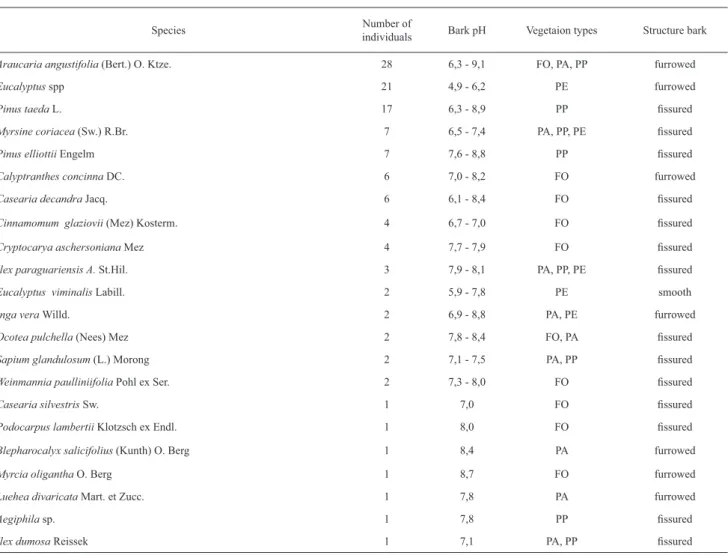
in pine plantations Pinus spp was the dominant tree
representing 80% of the sampled host trees, while in the
Eucalyptus plantation Eucalyptus represented 76.7% of the
sampled host trees (Tab. 2).
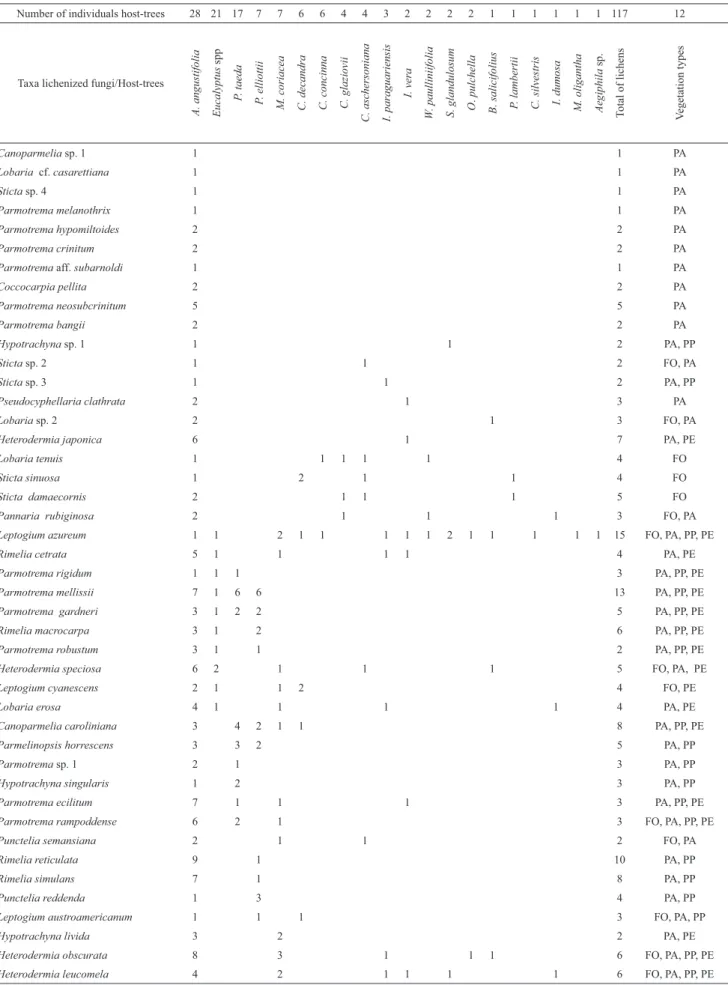
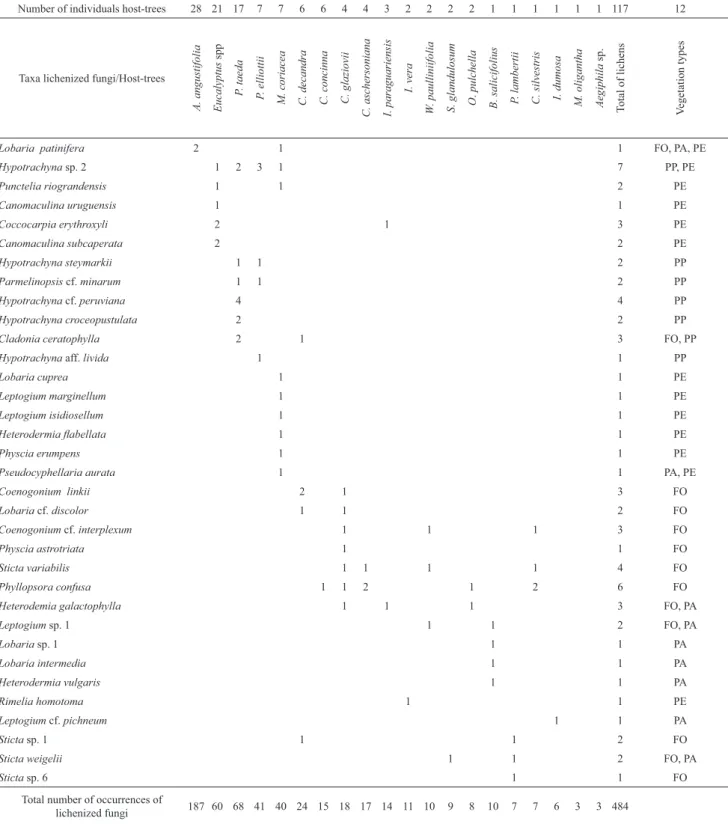
When the interaction matrices
between lichenized fungi and
host trees were analyzed the occurrence of a greater number
of interactions among taxa and host trees was clearly seen in
Eucalyptus plantations.
In native Araucaria forests and pine
plantations, the number of interactions was similar, while
the lowest connectance rates were observed in the Araucaria
plantation. In native Araucaria forests, lichenized fungi
taxa established themselves
in greater number on Casearia
decandra and A. angustifolia; in the Araucaria plantation
most of the specimens used A. angustifolia as host tree; in the
pine plantation Pinus spp. dominated, and in the Eucalyptus
plantation the host tree with the greater number of interactions
was
Myrsine coriacea (Tab. 3). The connectance index was 36%
for PE, 21% for FO, 21% for PP and 16% in the PA (Fig. 2).
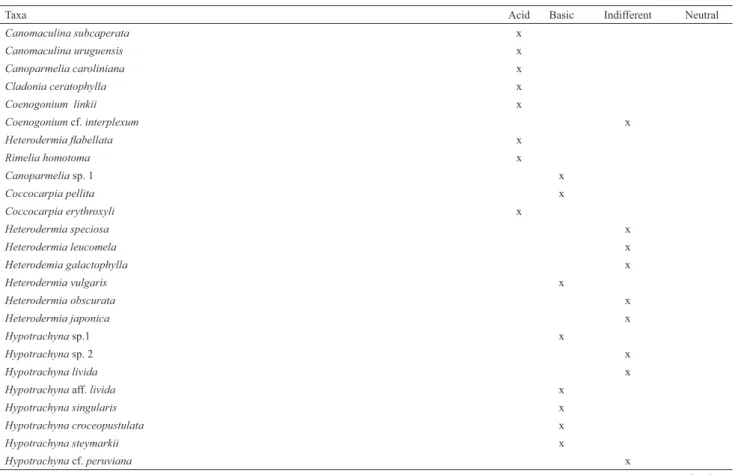
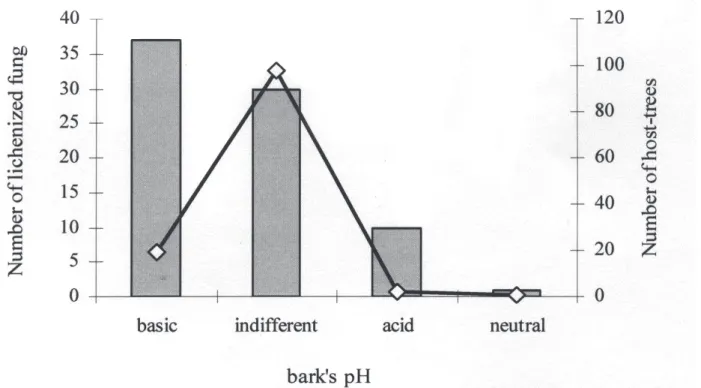
Distribution of the lichenized fungi and preference for host
trees – Of lichenized taxa occurring in the vegetation-type
survey, 47.4% of the specimens were recorded on basic
pH host trees, 38.5% were recorded on host trees with
indifferent pH values (acid, basic and/or neutral), 12.8%
on acid pH host trees and 1.3% on neutral pH host trees.
The most representative genera occurring in acid pH were
Canomaculina and Coenogonium with two specimens each,
while only one species with cyanobacteria was recorded
on these host trees, Coccocarpia erythroxyli. A greater
number of
representatives of the
Parmeliaceae family
(45.9%) occurred at basic pH, while 24.3% were lichens
with cyanobacteria, Leptogium and Sticta being the genera
that contributed the greatest number of specimens
(Tab. 4).
Table 1. Composition and occurrence of lichen species in four vegetation types in south Brazil: FO = native Araucaria forest, PA= Araucaria plantation, PP = Pine plantation and PE = Eucalyptus plantation. Caption: • new report for Brazil, ■ new species, ▲ new report for RS state, cl = chlorophycean, ci = cyanobacteria.
Taxa of lichenized fungi Vegetation types Algae Habit Family
FO PA PP PE
Canomaculina subcaperata (Kremp.) Elix x clorof. Fol. Parmeliac.
Canomaculina subsumpta (Nyl.) Elix x clorof. Fol. Parmeliac.
Canomaculina uruguensis (Kremp.) Elix x clorof. Fol. Parmeliac.
Canoparmelia caroliniana (Nyl.) Elix & Hale x x x clorof. Fol. Parmeliac.
Canoparmelia sp. 1 ■ x clorof. Fol. Parmeliac.
Cladonia ceratophylla (Sw.) Spreng. x x clorof. Esq. Cladoniac.
Cladonia ochrochlora Flörke x clorof. Esq. Cladoniac.
Coccocarpia erythroxyli (Spreng.) Swinsc. & Krog x ciano Fol. Coccocarpiac.
Coccocarpia palmicola (Spreng.) Arvidsson & Galloway x ciano Fol. Coccocarpiac.
Coccocarpia pellita (Ach.) Müll. Arg. ex R. Sant. x ciano Fol. Coccocarpiac.
Coenogonium linkii Ehrenb. x clorof. Fil. Gyalectac.
Coenogonium cf. interplexumNyl. x clorof. Fil. Gyalectac.
Dictyonema glabratum (Spreng.) D. Hawksw. x clorof. Fol. Thelephorac.
Dirinaria applanata (Fée) Awasthi x clorof. Fol. Physciac.
Dirinaria picta (Sw.) Clements & Shear x clorof. Fol. Physciac.
Erioderma leylandi (Taylor) Müll.Arg. ▲ x x clorof. Fol. Pannariac.
Heterodemia galactophylla (Tuck.) W. L. Culb. x x clorof. Fol. Physciac.
Heterodermia fl abellata (Fée) Awasthi x clorof. Fol. Physciac.
Heterodermia japonica (Sato) Swinsc. & Krog x x clorof. Fol. Physciac.
Heterodermia leucomela (L.) Poelt. x x x x clorof. Fol. Physciac.
Heterodermia lutescens Follmann x clorof. Fol. Physciac.
Heterodermia obscurata (Nyl.) Trevis x x x x clorof. Fol. Physciac.
Heterodermia speciosa (Wulf.) Trevis x x x clorof. Fol. Physciac.
Heterodermia vulgaris (Vain.) Follmann & Redón x clorof. Fol. Physciac.
Hypotrachyna croceopustulata (Kurok.) Hale • x clorof. Fol. Parmeliac.
Hypotrachyna livida (Taylor) Hale x x x clorof. Fol. Parmeliac.
Hypotrachyna aff. livida (Taylor) Hale x clorof. Fol. Parmeliac.
Hypotrachyna cf. peruviana (Nyl.) Hale x clorof. Fol. Parmeliac.
Hypotrachyna singularis (Hale) Hale • x x clorof. Fol. Parmeliac.
Hypotrachyna steymarkii (Hale) Hale ▲ x clorof. Fol. Parmeliac.
Hypotrachyna sp. 1 x x clorof. Fol. Parmeliac.
Hypotrachyna sp. 2 x clorof. Fol. Parmeliac.
Hypotrachyna sp. 3 x x clorof. Fol. Parmeliac.
Leptogium austroamericanum (Malme) Dodge x x x ciano Fol. Collematac.
Leptogium azureum (Sw.) Mont. x x x x ciano Fol. Collematac.
Leptogium cf. bullatum (Ach.) Nyl. ▲ x ciano Fol. Collematac.
Leptogium cochleatum (Dicks.) P. M. Jorg. & James x x ciano Fol. Collematac.
Leptogium aff. cochleatum (Dicks.) P. M. Jorg. & James x ciano Fol. Collematac.
Leptogium chloromelum (Sw.) Nyl. x ciano Fol. Collematac.
Leptogium cyanescens (Ach.) Körb. x x ciano Fol. Collematac.
Leptogium cf. pichneum (Ach.) Malme x ciano Fol. Collematac.
Leptogium isidiosellum (Riddle) Sierk ▲ x ciano Fol. Collematac.
Leptogium marginellum (Swartz) S. Gray x ciano Fol. Collematac.
Leptogium moluccanum (Pers.) Vain. x ciano Fol. Collematac.
Leptogium sp. 1 x x ciano Fol. Collematac.
Leptogium sp. 2 x ciano Fol. Collematac.
Lobaria cf. casarettiana (De Not.) Trev. • x ciano Fol. Collematac.
Lobaria cuprea (Müll. Arg.) Zahlbr. x clorof. Fol. Lobariac.
Taxa of lichenized fungi Vegetation types Algae Habit Family
FO PA PP PE
Lobaria discolor (Bory ex Delise) Hue x clorof. Fol. Lobariac.
Lobaria cf. discolor (Bory ex Delise) Hue x clorof. Fol. Lobariac.
Lobaria erosa (Eschw.) Nyl. x x clorof. Fol. Lobariac.
Lobaria cf. erosa (Eschw.) Nyl. x clorof. Fol. Lobariac.
Lobaria patinifera (Taylor) Hue x x x clorof. Fol. Lobariac.
Lobaria intermedia (Nyl.) Vain. • x clorof. Fol. Lobariac.
Lobaria tenuis Vainio x clorof. Fol. Lobariac.
Lobaria sp. 1 x clorof. Fol. Lobariac.
Lobaria sp. 2 x x clorof. Fol. Lobariac.
Lobaria sp. 3 x clorof. Fol. Lobariac.
Normandina pulchella (Borrer) Nyl. x clorof. Fol. F. imperfeitos
Pannaria rubiginosa (Ach.) Bory x x ciano Esq. Pannariac.
Pannaria cf. saubinetti (Mont.) Nyl. • x ciano Esq. Pannariac.
Paraparmelinella sp. ■ x clorof. Fol. Parmeliac.
Parmelinopsis horrescens (Taylor) Elix & Hale x x clorof. Fol. Parmeliac.
Parmelinopsis cf. minarum (Vain.) Elix & Hale x clorof. Fol. Parmeliac.
Parmotrema bangii (Vain.) Hale ▲ x clorof. Fol. Parmeliac.
Parmotrema catarinae Hale x clorof. Fol. Parmeliac.
Parmotrema chinense (Osbeck) Hale & Ahti x clorof. Fol. Parmeliac.
Parmotrema crinitum (Ach.) M. Choisy x clorof. Fol. Parmeliac.
Parmotrema eciliatum (Nyl.) Hale x x x clorof. Fol. Parmeliac.
Parmotrema gardneri (Dodge) Sérusiaux ▲ x x x clorof. Fol. Parmeliac.
Parmotrema hypomiltoides (Vain.) Fleig x clorof. Fol. Parmeliac.
Parmotrema melanothrix (Mont.) Hale x clorof. Fol. Parmeliac.
Parmotrema mellissii (Dodge) Hale x x x clorof. Fol. Parmeliac.
Parmotrema neosubcrinitum Ribeiro & Marcelli ▲ x clorof. Fol. Parmeliac.
Parmotrema rampoddense (Nyl.) Hale x x x x clorof. Fol. Parmeliac.
Parmotrema rigidum (Lynge) Hale x x x clorof. Fol. Parmeliac.
Parmotrema robustum (Degel.) Hale x x x clorof. Fol. Parmeliac.
Parmotrema aff. subarnoldi (Abb.) Hale ▲ x clorof. Fol. Parmeliac.
Parmotrema cf. subrugatum (Kremp.) Hale x clorof. Fol. Parmeliac.
Parmotrema sp. 1 ■ x x clorof. Fol. Parmeliac.
Parmotrema sp. 2 ■ x clorof. Fol. Parmeliac.
Peltigera sp. x ciano Fol. Peltigerac.
Phyllopsora confusa Swinsc. & Krog x clorof. Esq. Biatorac.
Physciaatrostriata Moberg • x clorof. Fol. Physciac.
Physciaerumpens Moberg • x clorof. Fol. Physciac.
Pseudocyphellaria aurata (Ach.) Vain. x x clorof. Fol. Stictac.
Pseudocyphellaria cf. berberina (G. Forster) Galloway & P. James • x clorof. Fol. Stictac.
Pseudocyphellaria clathrata (De Not.) Malme x clorof. Fol. Stictac.
Pseudocyphellaria subrubella Räs. • x clorof. Fol. Stictac.
Pseudocyphellaria sp. 1 x clorof. Fol. Stictac.
Pseudocyphellaria sp. 2 x x clorof. Fol. Stictac.
Punctelia constantimontium Sérusiaux x clorof. Fol. Parmeliac.
Punctelia graminicola (W. L. Culb.) & C. F. Culb.) Krog x x clorof. Fol. Parmeliac.
Punctelia reddenda (Sirt.) Krog x x clorof. Fol. Parmeliac.
Punctelia riograndensis (Lynge) Krog x clorof. Fol. Parmeliac.
Rimelia cetrata (Ach.) Hale & Fletcher x x clorof. Fol. Parmeliac.
Rimelia homotoma (Nyl.) Hale & Fletcher x clorof. Fol. Parmeliac.
Taxa of lichenized fungi Vegetation types Algae Habit Family
FO PA PP PE
Rimelia macrocarpa (Pers.) Hale & Fletcher x x x clorof. Fol. Parmeliac.
Rimelia reticulata (Taylor) Hale & Fletcher x x clorof. Fol. Parmeliac.
Rimelia simulans (Hale) Hale & Fletcher x x clorof. Fol. Parmeliac.
Sticta damaecornis (Sw.) Ach. x clorof. Fol. Stictac.
Sticta sinuosa Pers. x clorof. Fol. Stictac.
Sticta variabilis (Bory) Ach. x clorof. Fol. Stictac.
Sticta weigelii (Ach.) Vain. x x ciano Fol. Stictac.
Sticta sp. 1 x ciano Fol. Stictac.
Sticta sp. 2 x x ciano Fol. Stictac.
Sticta sp. 3 x x ciano Fol. Stictac.
Sticta sp. 4 x ciano Fol. Stictac.
Sticta sp. 5 x x ciano Fol. Stictac.
Sticta sp. 6 x clorof. Fol. Stictac.
Sticta sp. 7 x clorof. Fol. Stictac.
Sticta sp. 8 x x ciano Fol. Stictac.
Sticta sp. 9 x clorof. Fol. Stictac.
Table 1. Continuation.
Table 2. Host-tree characteristics and occurrence in four vegetation types at the National Forest of São Francisco de Paula. Vegetation types represent: FO = native
Araucaria forest, PA= Araucaria plantation, PP = Pine plantation and PE = Eucalyptus plantation.
Species Number of
individuals Bark pH Vegetaion types Structure bark
Araucaria angustifolia (Bert.) O. Ktze. 28 6,3 - 9,1 FO, PA, PP furrowed
Eucalyptus spp 21 4,9 - 6,2 PE furrowed
Pinus taeda L. 17 6,3 - 8,9 PP fi ssured
Myrsine coriacea (Sw.) R.Br. 7 6,5 - 7,4 PA, PP, PE fi ssured
Pinus elliottii Engelm 7 7,6 - 8,8 PP fi ssured
Calyptranthes concinna DC. 6 7,0 - 8,2 FO furrowed
Casearia decandra Jacq. 6 6,1 - 8,4 FO fi ssured
Cinnamomum glaziovii (Mez) Kosterm. 4 6,7 - 7,0 FO fi ssured
Cryptocarya aschersoniana Mez 4 7,7 - 7,9 FO fi ssured
Ilex paraguariensis A. St.Hil. 3 7,9 - 8,1 PA, PP, PE fi ssured
Eucalyptus viminalis Labill. 2 5,9 - 7,8 PE smooth
Inga vera Willd. 2 6,9 - 8,8 PA, PE furrowed
Ocoteapulchella (Nees) Mez 2 7,8 - 8,4 FO, PA fi ssured
Sapium glandulosum (L.) Morong 2 7,1 - 7,5 PA, PP fi ssured
Weinmannia paulliniifolia Pohl ex Ser. 2 7,3 - 8,0 FO fi ssured
Casearia silvestris Sw. 1 7,0 FO fi ssured
Podocarpus lambertii Klotzsch ex Endl. 1 8,0 FO fi ssured
Blepharocalyx salicifolius (Kunth) O. Berg 1 8,4 PA furrowed
Myrcia oligantha O. Berg 1 8,7 FO furrowed
Luehea divaricata Mart. et Zucc. 1 7,8 PA furrowed
Aegiphila sp. 1 7,8 PP fi ssured
Table 3. Connectance matrix between taxa of lichenized fungi and host-trees in four vegetation types at the National Forest of São Francisco de Paula.
Number of individuals host-trees 28 21 17 7 7 6 6 4 4 3 2 2 2 2 1 1 1 1 1 1 117 12
Taxa lichenized fungi/Host-trees
A. angustifolia Eucalyptus
spp
P
. taeda
P
. elliottii
M. coriacea C. decandra C. concinna C. glaziovii C. aschersoniana I. paraguariensis
I. vera
W
. paulliniifolia
S. glandulosum O
.
pulchella
B. salicifolius P
. lambertii
C. silvestris I. dumosa M. oligantha Aegiphila
sp.
T
o
tal of lichens
V
egetation types
Canoparmelia sp. 1 1 1 PA
Lobaria cf. casarettiana 1 1 PA
Sticta sp. 4 1 1 PA
Parmotrema melanothrix 1 1 PA
Parmotrema hypomiltoides 2 2 PA
Parmotrema crinitum 2 2 PA
Parmotrema aff. subarnoldi 1 1 PA
Coccocarpia pellita 2 2 PA
Parmotrema neosubcrinitum 5 5 PA
Parmotrema bangii 2 2 PA
Hypotrachyna sp. 1 1 1 2 PA, PP
Sticta sp. 2 1 1 2 FO, PA
Sticta sp. 3 1 1 2 PA, PP
Pseudocyphellaria clathrata 2 1 3 PA
Lobaria sp. 2 2 1 3 FO, PA
Heterodermia japonica 6 1 7 PA, PE
Lobaria tenuis 1 1 1 1 1 4 FO
Sticta sinuosa 1 2 1 1 4 FO
Sticta damaecornis 2 1 1 1 5 FO
Pannaria rubiginosa 2 1 1 1 3 FO, PA
Leptogium azureum 1 1 2 1 1 1 1 1 2 1 1 1 1 1 15 FO, PA, PP, PE
Rimelia cetrata 5 1 1 1 1 4 PA, PE
Parmotrema rigidum 1 1 1 3 PA, PP, PE
Parmotrema mellissii 7 1 6 6 13 PA, PP, PE
Parmotrema gardneri 3 1 2 2 5 PA, PP, PE
Rimelia macrocarpa 3 1 2 6 PA, PP, PE
Parmotrema robustum 3 1 1 2 PA, PP, PE
Heterodermia speciosa 6 2 1 1 1 5 FO, PA, PE
Leptogium cyanescens 2 1 1 2 4 FO, PE
Lobaria erosa 4 1 1 1 1 4 PA, PE
Canoparmelia caroliniana 3 4 2 1 1 8 PA, PP, PE
Parmelinopsis horrescens 3 3 2 5 PA, PP
Parmotrema sp. 1 2 1 3 PA, PP
Hypotrachyna singularis 1 2 3 PA, PP
Parmotrema ecilitum 7 1 1 1 3 PA, PP, PE
Parmotrema rampoddense 6 2 1 3 FO, PA, PP, PE
Punctelia semansiana 2 1 1 2 FO, PA
Rimelia reticulata 9 1 10 PA, PP
Rimelia simulans 7 1 8 PA, PP
Punctelia reddenda 1 3 4 PA, PP
Leptogium austroamericanum 1 1 1 3 FO, PA, PP
Hypotrachyna livida 3 2 2 PA, PE
Heterodermia obscurata 8 3 1 1 1 6 FO, PA, PP, PE
Heterodermia leucomela 4 2 1 1 1 1 6 FO, PA, PP, PE
salicifolius, Calyptranthes concinna, Casearia decandra,
Inga vera, Cryptocarya aschersoniana, Myrcia oligantha
and
Ocotea
pulchella
.
Of these 24 individuals no
lichenized fungi occurred on 20.8%. In table 4 there is a
list of the lichen taxa related to host-tree bark pH values
in sampled vegetation types from São Francisco de Paula
National Forest.
Discussion
This work reveals that a fair number of lichen species
could colonize tree plantation stands. This pattern is mainly
related to the light management procedures used at this
National Forest where tree plantations were allowed to grow
for longer periods than the usual seven years applied to
Number of individuals host-trees 28 21 17 7 7 6 6 4 4 3 2 2 2 2 1 1 1 1 1 1 117 12
Taxa lichenized fungi/Host-trees
A. angustifolia Eucalyptus
spp
P
. taeda
P
. elliottii
M. coriacea C. decandra C. concinna C. glaziovii C. aschersoniana I. paraguariensis
I. vera
W
. paulliniifolia
S. glandulosum O
.
pulchella
B. salicifolius P. lambertii C. silvestris I. dumosa M. oligantha Aegiphila
sp.
T
o
tal of lichens
V
egetation types
Lobaria patinifera 2 1 1 FO, PA, PE
Hypotrachyna sp. 2 1 2 3 1 7 PP, PE
Punctelia riograndensis 1 1 2 PE
Canomaculina uruguensis 1 1 PE
Coccocarpia erythroxyli 2 1 3 PE
Canomaculina subcaperata 2 2 PE
Hypotrachyna steymarkii 1 1 2 PP
Parmelinopsis cf. minarum 1 1 2 PP
Hypotrachyna cf. peruviana 4 4 PP
Hypotrachyna croceopustulata 2 2 PP
Cladonia ceratophylla 2 1 3 FO, PP
Hypotrachyna aff. livida 1 1 PP
Lobaria cuprea 1 1 PE
Leptogium marginellum 1 1 PE
Leptogium isidiosellum 1 1 PE
Heterodermia fl abellata 1 1 PE
Physciaerumpens 1 1 PE
Pseudocyphellaria aurata 1 1 PA, PE
Coenogonium linkii 2 1 3 FO
Lobaria cf. discolor 1 1 2 FO
Coenogonium cf. interplexum 1 1 1 3 FO
Physciaastrotriata 1 1 FO
Sticta variabilis 1 1 1 1 4 FO
Phyllopsora confusa 1 1 2 1 2 6 FO
Heterodemia galactophylla 1 1 1 3 FO, PA
Leptogium sp. 1 1 1 2 FO, PA
Lobaria sp. 1 1 1 PA
Lobaria intermedia 1 1 PA
Heterodermia vulgaris 1 1 PA
Rimelia homotoma 1 1 PE
Leptogium cf. pichneum 1 1 PA
Sticta sp. 1 1 1 2 FO
Sticta weigelii 1 1 2 FO, PA
Sticta sp. 6 1 1 FO
Total number of occurrences of
lichenized fungi 187 60 68 41 40 24 15 18 17 14 11 10 9 8 10 7 7 6 3 3 484
Figure 2. Connectance matrix (possible and accomplished interactions) between lichenized fungi taxa and host-trees in four vegetation types at the National Forest of São Francisco de Paula: FO = native Araucaria forest, PA= Araucaria plantation, PP = Pine plantation and PE = Eucalyptus plantation.
Table 4. Occurrence of lichenized fungi taxa according to bark pH in the four vegetation types at the National Forest of São Francisco de Paula.
Taxa Acid Basic Indifferent Neutral
Canomaculina subcaperata x
Canomaculina uruguensis x
Canoparmelia caroliniana x
Cladonia ceratophylla x
Coenogonium linkii x
Coenogonium cf. interplexum x
Heterodermia fl abellata x
Rimelia homotoma x
Canoparmelia sp. 1 x
Coccocarpia pellita x
Coccocarpia erythroxyli x
Heterodermia speciosa x
Heterodermia leucomela x
Heterodemia galactophylla x
Heterodermia vulgaris x
Heterodermia obscurata x
Heterodermia japonica x
Hypotrachyna sp.1 x
Hypotrachyna sp. 2 x
Hypotrachyna livida x
Hypotrachyna aff. livida x
Hypotrachyna singularis x
Hypotrachyna croceopustulata x
Hypotrachyna steymarkii x
Hypotrachyna cf. peruviana x
Taxa Acid Basic Indifferent Neutral
Leptogium cf. pichneum x
Leptogium cyanescens x
Leptogium azureum x
Leptogium austroamericanum x
Leptogium sp. 1 x
Leptogium isidiosellum x
Leptogium marginellum x
Lobaria cuprea x
Lobaria aff. discolor x
Lobaria erosa x
Lobaria cf. casarettiana x
Lobaria sp. 1 x
Lobaria sp. 2 x
Lobaria intermedia x
Lobaria patinifera x
Lobaria tenuis x
Parmelinopsis horrescens x
Parmelinopsis cf. minarum x
Parmotrema melanothrix x
Parmotrema robustum x
Parmotrema sp. 1 x
Parmotrema eciliatum x
Parmotrema rampoddense x
Parmotrema crinitum x
Parmotrema mellissii x
Parmotrema gardneri x
Parmotrema hypomiltoides x
Parmotrema rigidum x
Parmotrema aff. subarnoldi x
Parmotrema aff. subarnoldi x
Parmotrema bangii x
Pannaria rubiginosa x
Phyllopsora confusa x
Physciaerumpens x
Physciaastrotriata x
Pseudocyphellaria aurata x
Pseudocyphellaria clathrata x
Punctelia reddenda x
Punctelia graminicola x
Punctelia riograndensis x
Rimelia simulans x
Rimelia cetrata x
Rimelia macrocarpa x
Rimelia reticulata x
Sticta damaecornis x
Sticta sinuosa x
Sticta variabilis x
Sticta weigelii x
Sticta sp. 1 x
Sticta sp. 2 x
Sticta sp. 3 x
Sticta sp. 4 x
Sticta sp. 6 x
Figure 3. Relationship between lichenized fungi taxa and their host-trees according to the values of bark pH in the four vegetation types at the National Forest of São Francisco de Paula.
economically driven tree plantations. Moreover, plantations
were of small size and surrounded by large areas of native
forest which allows fl ora and fauna colonization to take place
(Fonseca et al. 2009). However, the greatest occurrence of
characteristic shade tolerant species was found in the native
Araucaria forests and Araucaria plantations, with an increase
in light demanding lichen species in the pine and Eucalyptus
plantations (see also Kaffer et al. 2009).
In the native Araucaria forest the greatest occurrence
of species from genera Phyllopsora and Coenogonium was
recorded. They were absent in other environments. These
areas present denser, stratifi ed tree tops which could favor
lower light penetration encouraging typical shade tolerant
species to become established.
Leptogium
is another
genus that is characteristic of shady, humid environments
(Wolseley 1991), however, species of this genus occurred
in several environments, especially Leptogium azureum that
was found in the four habitats studied, probably because
it is one of the genera which has the greatest adaptability
to different types of environment (Wolseley 1991). In the
Araucaria forests, gelatinous lichens, such as those
from the
genus Leptogium, occur in the lower humid layers and they
do not become very abundant (Fleig & Grüninger 2008).
Tree plantations showed a large number of light
demanding taxa from the family Parmeliaceae, a group
which was responsible for 40% of the total species recorded
in all environments. Species from the genus Parmotrema
were largely abundant in forest plantations. Only 5.7% of
Parmeliaceae species were recorded in the native Araucaria
forest environment; the greater representativeness of the
family Parmeliaceae found in this study corroborates other
studies carried out in native Araucaria forest areas in Rio
Grande do Sul (Fleig & Grüninger 2000; Käffer & Martins
–Mazzitelli 2005; Käffer et al. 2009).
Differences in lichen species composition recorded
in the Araucaria plantation when compared to the other
vegetation types could, among other reasons, be related to
the characteristics of the host trees found in these areas. In
the
Araucaria plantation stands, 76.7% of the host trees
analyzed were Araucaria angustifolia. Studies carried out
in forest areas have confi rmed that alterations in the lichen
community may be attributed to host-tree composition and
to the features of host-tree bark (Hale 1983; Ferry & Lodge
1996; Lõhmus et al. 2007). Of all the host trees sampled,
50% had bark with rough structure; 23.3% of these
belong
to A. angustifolia and 43.3% are characterized by fi ssured
structure. Differences in substrate texture are one of the most
obvious effects favoring lichen species colonization (Brodo
1973). However, this specifi city of lichens to the substratum
may also be related to other factors, such as bark porosity and
water retention (Jesberger & Sheard 1973; Kuusinen 1996;
Schmidt et al. 2001). Although other host trees have rough
bark structure, the main occurrence of lichenized fungi was
recorded on A. angustifolia.
Recent studies have related lichenized fungi
establishment to host-tree bark pH and ammonia levels
coming from anthropogenic sources, such as agriculture
and pasture (Loppi 1996; Herk 2001; Wolseley et al. 2006).
These variations in nitrogen ion concentration on host-tree
bark could be infl uencing lichen species establishment
favoring nitrophyte lichen species (Kermit & Gauslaa
2001; Wolseley et al. 2006; Fleig & Grüninger 2008).
Some lichen species with cyanobacteria are associated with
trunks with pH above 5.0 (Goward & Arsenault 2000;
Will-Wolf et al. 2002). In native and planted vegetation types at
FLONA only 15.4% of the taxa colonized by cyanobacteria
were recorded on host trees with pH above 5.0, from which
Leptogium can be pointed out, since it showed the greatest
occurrence on these trees. Fleig & Grüninger (2008) cited
Phaeophyscia hispidula (Ach.) Moberg, Physcia aipolia
(Ehrenb. ex Humb.) Fürnrohr, Physcia erumpens Moberg,
Dirinaria applanata (Fee) Awasthi and Canoparmelia
caroliniana (Nyl.) Elix & Hale as species that indicate
eutrophication. In the FLONA areas, P. erumpens occurred
on host-trees with basic pH, while C. caroliniana occurred
on bark with acid pH.
Regarding the host trees, there are a few studies on tree
bark pH concerning the lichenized mycota. In Brazil, there
is only a record of host trees in mangrove regions (Marcelli
1992), while for trees from native Araucaria forests, Pinus
and Eucalyptus monocultures, so far almost no data has
been published (but see Kaffer et al. 2009). In regions of
Europe and North America, studies indicate that conifers
usually have low pH, with variations between 3.0 and 6.0
(Hale 1983; Sillet et al. 2000a; Kermit & Gauslaa 2001;
Löbel et al. 2006; Wolseley et al. 2006; Larsen et al. 2007).
For the FLONA areas, individuals from the same species,
as for example, A. angustifolia, Pinus taeda and P. elliottii
and from the same genus, as Eucalyptus sp. presented bark
with acid, basic and/or neutral pH. Sillet et al. (2000b) also
recorded variations in pH values among the same host-tree
species. These variations in pH values on host-tree bark in
native and planted vegetation types at FLONA could be
associated, among other factors, with soil type, host-tree
age, tree physiological characteristics as well as with the
infl uence of anthropogenic activities that are intense in the
regions within the FLONA boundaries.
Diversity loss and changes in lichen communities in
forest and managed areas have been frequently described by
many researchers (Lesica et al. 1991; Hilmo & Sastad 2001;
Kanowski et al. 2003; Kantvilas & Jarman 2004; Lõhmus
et al. 2007). In Brazil, some studies have demonstrated
the great diversity of lichenized fungi in threatened
environments. Marcelli (1992) recorded 289 lichen taxa
on two species of host trees in a mangrove area on the São
Paulo coast, while Martins (2006) identifi ed 161 taxa on only
a single host-tree species in a coastal restinga area, in Rio
Grande do Sul state. For the native Araucaria forest area,
the percentage of recorded lichen species may be considered
low as yet, compared to the total number of referred species
for Rio Grande do Sul (Spielmann 2006). However, the
great species richness of corticolous lichenized taxa, plus
records of new species for science and new occurrences for
Brazil and Rio Grande do Sul state, indicate the ability of
establishment of this group in different forest compositions
as FLONA. Nevertheless, the differences observed in the
lichenized mycota composition in this landscape mosaic
demonstrate a tendency for species replacement, especially
the ones related to shaded environments.
Acknowledgements
We thank Leomar Paese for helping with the fi eld work, the National Forest of São Francisco de Paula (IBAMA) for granting access to the study area and the Natural History Museum of Fundação Zoobotânica do Rio Grande do Sul for providing the structure for the laboratory work. Gislene Ganade received a PQ grant from CNPq.
References
Brodo, I.M. 1973. Substratum ecology. Pp. 401-436. In: Hale, M.E. (ed.).
The Lichens. New York, Academic Press.
Brunialti, G. & Giordani, P. 2003. Variability of lichen diversity in a climatically heterogeneous area (Liguria, NW Italy). Lichenologist
35: 55-69.
Cáceres, M.E.S.; Lücking R. & Rambold, G. 2007. Phorophyte specifi city and environmental parameters versus stochasticity as determinants for species composition of corticolous crustose lichen communities in the Atlantic rainforest of northeastern Brazil. Mycological Progress 6(3):117-136.
Ferry, B.W. & Lodge, E. 1996. Distribution and succession of lichens associated with Prunus spinosa at Dungeness, England. Lichenologist
28: 129-143.
Fleig, M. 1990a. Liquens da Estação Ecológica de Aracuri. Novas ocorrências. Iheringia 4: 121-125.
Fleig, M. & Grüninger, W. 2000. Levantamento preliminar dos liquens do Centro de Pesquisas e Conservação da natureza Pró-Mata, São Francisco de Paula, Rio Grande do Sul, Brasil. Napaea 12: 5-20. Fleig, M. & Grüninger, W. 2008. Liquens da Floresta com Araucária
no Rio Grande do Sul. Pró-Mata: Guia de Campo 3. Tübingen, University of Tübingen.
Fonseca, C.R.; Ganade, G.; Baldissera, R.; Becker,C.G.; Boelter,C.R.; Brescovit, A.D.; Campos,L.M.; Fleck,T.; Fonseca, V.S.; Hartz, S.M.; Joner,F.; Käffer,M.I.; Leal-Zanchet,A.M.; Marcelli, M.P.; Mesquita, A.S.; Mondin, C.A.; Paz,C.P.; Petry, M.V.; Piovensan,F.N.; Putzke,J.; Stranz,A.; Vergara,M. & Vieira,E.M.2009. Towards an ecologically-sustainable forestry in the Atlantic Forest. Biological Consevation 142: 1209-1219.
Goward, R. & Arsenault, A. 2000. Cyanolichen distribution in young unmanaged forest: a dripzone effect. Bryologist 103(1): 28-37. Hale, M.E. 1957. Lectures notes Lichenology. Morgantown, West Virginia
University.
Hale, M.E. 1983. The Biology of lichens. 3ª ed. London, Edward Arnold. Hawksworth, D.L. 1975.Lichens – New Introductory, matter and supplementary. Index by Smith, A. L. 1921. Cambridge, The Richmond Publishing Co.
Hawksworth, D.L. & Hill, D.J. 1984. The lichen – Forming fungi. New York, Chapman & Hall.
Hilmo, O. & Sastad, S.M. 2001. Colonization of old-forest lichens in a young and an old boreal Piceaabies forest: an experimental approach.
Biological Conservation 102: 251- 259.
Honegger, R. 1996.Mycobionts. Pp. 24 –36. In: Nash, T.H. III (ed.). Lichen Biology. Cambridge, Cambridge University Press.
Versão eletrônica do artigo em www.scielo.br/abb e http://www.botanica.org.br/acta/ojs
Jesberger, J.A. & Sheard, J.W. 1973. A quantitative study and multivariateanalysis of corticolous lichen communities in the southern boreal forest of Saskatchewan. Canadian Journal of Botany51: 185-201. Lõhmus, A., Lõhmus, P.& Vellak, K. 2007. Substratum diversity explains
landscape-scale co-variation in the species-richness of bryophytes and lichens. Biological Conservation 135: 405-414.
Loppi, S. 1996. Lichens as bioindicators of geothermal air pollution in central Italy. Bryologist 99(1): 41-48.
Käffer, M.I. & Martins-Mazzitelli, S.M.A. 2005. Fungos liquenizados corticícolas e terrícolas da área da sub-bacia do Sinos e Taquari-Antas, Rio Grande do Sul, Brasil. Acta Botânica Brasílica19(4): 815-819.
Käffer, M.I.; Ganade, G. & Marcelli, M.P. 2009. Lichen diversity and composition in Araucaria Forest and tree monocultures in southern Brasil. Biodiversity and Conservation 18: 3543-3561.
Kanowski, J.; Catterall, C.P.; Wardell-Johnson, G.W.; Proctor, H. & Reis, T. 2003. Development of forest structure on cleared rainforest land in eastern Australia under different styles of reforestation. Forest Ecology and Management 183: 265-280.
Kantvilas, G. & Jarman, S.J. 2004. Lichens and bryophytes on Eucalyptus
oblique in Tasmania: management implications in production forest.
Biological Conservation 117: 359-373.
Kermit, T. & Gauslaa, Y. 2001. The vertical gradient of bark pH of twigs and macrolichens in a Picea abies canopy not affected by acid rain.
Lichenologist 33(4): 353- 359.
Kershaw, K. 1964. Preliminary observations on the distribution and ecology of epiphytic lichens in Wales. Lichenologist 2: 263-276.
Kuusinen, M. 1996. Epiphyte fl ora and diversity on basal trunks of six old-growth forest tree species in southern and middle boreal Finland.
Lichenologist 28: 443-463.
Larsen, R.S.; Bell, J.N.B.; James, P.W.; Chimonides, P.J.; Rumsey, F.J.; Tremper, A. & Purvis, O.W. 2007. Lichen and bryophyte distribution on oak in London in relation to air pollution and bark acidity.
Environmental pollution 146: 332 – 340.
Lesica, P.; McCune, B. & Cooper, S.V. 1991. Differences in lichen and bryophyte communities between old-growth and managed second-growth forest in the Swan Valley, Montana. Canadian Journal Botany 69: 1745- 1755.
Löbel, S.; Snäll, T. & Rydin, H. 2006. Species richness patterns and metapopulation processes – evidence from epiphyte communities in boreo-nemoral forest. Ecography 29: 169-182.
Martinez, I.; Carreño, F.; Escudero A. & Rubio, A. 2006. Are threatened lichen species well-protected in Spain? Effectiveness of a protected areas network. Biological Conservation 133: 500-511.
Marcelli, M.P. 1992. Ecologia liquênica nos manguezais do sul-sudeste brasileiro. Bibliotheca Lichenologica 47: 1-310.
Marcelli, M.P.1996. Biodiversity assessment in Lichenized Fungi: the necessary naive rollmakers. Pp. 93-107. In: Bicudo, C.E.M. & Menezes, N.A. (eds.). Biodiversity in Brasil: a fi rst approach. São Paulo, CNPq. Martins, S.M. de A. 2006. Estudo da comunidade liquenizada epifítica
em dodonea viscosa L. na restinga do Parque Estadual de Itapuã, Viamão, RS. Tese (Doutorado). Instituto de Botânica da Secretaria do Meio Ambiente. São Paulo.
Negi, H.R. 2000. On the patterns of abundance and diversity of macrolichens of Chopta-Tunganath in the Garhwal Himalaya. Journal Bioscience 25: 367-378.
Osorio, H.S. & Fleig, M. 1986a. Contribution to the lichen fl ora of Brazil XVII. Lichens from São Francisco de Paula, Rio Grande do Sul State.
Comunicaciones Botanicas del Museo de Historia Natural de Montevideo74(4): 1-4.
Osorio, H.S. & Fleig, M. 1986b. Contribution to the lichen fl ora of Brazil XVIII. Lichens from Itaimbezinho, Rio Grande do Sul State.
Comunicaciones Botanicas del Museo de Historia Natural de Montevideo75(4): 1-8.
Schmidt, J.; Kricke, R. & Feige, G.B. 2001. A measurements of bark pH with a modifi ed fl athead electrode. Lichenologist 33: 456-60. Schneider, P.R.; Brena, D.A.; Finger, C.A.G.; Longhi, S.J.; Hoppe, J.M.;
Vinadé, L.F.; Brum, E.T.; Salomão, A.L.F. & Soligo, A. 1989. Plano de manejo para a Floresta Nacional de São Francisco de Paula – RS. Santa Maria, Instituto Brasileiro do Meio Ambiente e Recursos Naturais Renováveis.
Sillet, S.C.; McCune, B.; Peck, J.E.; Rambo, T.R. & Ruchty, A. 2000a. Dispersal limitations of epiphytic lichens result in species dependent on old-growth forests. Ecological Applications 10(3): 789-799. Sillet, S.C.; McCune, B.; Peck, J.L.E. & Rambo, T.R. 2000b. Four years
of epiphyte colonization in Douglas-fi r forest canopies. Bryologist 103: 661-669.
Spielmann, A.A. 2006. Checklist of lichens and lichenicolous fungi of Rio Grande do Sul (Brazil). Caderno de Pesquisa, Sér. Bio. 18(2): 1-165. Teixeira, M.B.; Coura Neto, A.B.; Pastore, U. & Rangel Filho, A.L.R.
1986. Vegetação. Pp. 541-620. In: IBGE. Levantamento de recursos naturais. Rio de Janeiro, FIBGE.
Valencia, M.C. de & Ceballos, J.A. 2002. Hongos liquenizados. Bogotá, Universidad Nacional de Colombia.
Wolseley, P.A. 1991. Observations on the composition and distribution of the ‘Lobarion’ in forests of south East Asia. Pp 217-243. In: Galloway, D.J (ed). Tropical Lichens: Their systematics, conservation and ecology, Systematics Association special. Oxford, Clarendon Press.