Received: November 21, 2014. Accepted: March 27, 2015
ABSTRACT
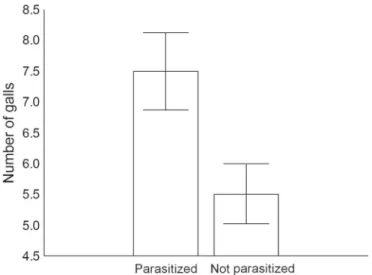
Mistletoes obtain nutrients and water from their hosts, with varying effects among those hosts. We assessed the factors that influence the colonization of the mistletoe Struthanthus flexicaulis on Baccharis dracunculifolia and the subsequent effects on host performance. We evaluated the incidence of S.flexicaulis according to size (height classes) and architecture of the host as well as its effects on various physiological parameters of the host. Furthermore, we assessed the occurrence of insect galls induced by Baccharopelma dracunculifoliae (Psyllidae), including the number of leaves infected, and the mortality of infected and non-infected branches. Taller hosts had a higher abundance of mistletoes (60%, p> 0.05). Physiological parameters of hosts were not affected by parasitism, although galling occurred more often (p <0.05) and leaf loss increased (p>0.05) on infected branches. Taller individuals are more colonized by mistletoes and more architecturally complex hosts support a greater number of mistletoes. Mistletoe causes a
top-down effect on host-associated organisms on parasitized branches. Mistletoes had a strong top-down effect on
B. dracunculifolia due to a reduction in the number of leaves on parasitized branches and the replacement of the bush crown, as well as an increased incidence of insect galls. Furthermore, the occurrence of a heavy parasite load increased the mortality rate of the host branches.
Keywords: Baccharopelma dracunculifoliae,insect galls; mistletoe; rupestrian grasslands, Struthanthus flexicaulis
Hemiparasitism effect on
Baccharis dracunculifolia
DC.
and consequences to its major galling herbivore
Thaise de Oliveira Bahia1, Irene Gélvez Zúñiga1, Matheus Lopes Souza2, Etiene Silva Coutinho1, Mauricio Quesada3 and G. Wilson Fernandes1,4*
1 Laboratório de Ecologia Evolutiva e Biodiversidade, Departamento de Biologia Geral, Instituto de Ciências Biológicas, Universidade Federal de Minas Gerais, 31270-901, Belo Horizonte, MG, Brazil
2 Laboratório de Fisiologia Vegetal, Departamento de Botânica, Instituto de Ciências Biológicas, Universidade Federal de Minas Gerais, 31270-901, Belo Horizonte, MG, Brazil
3 Centro de Investigaciones en Ecosistemas, Universidad Nacional Autónoma de México, PO Box 27-3 (Xangari), 58089, Morelia, Michoacan, Mexico 4 Department of Biology, Stanford University, CA 94035, Stanford, USA.
* Corresponding author: [email protected]
Introduction
Mistletoes are a taxonomically diverse group of flow-ering plants, widely distributed in terrestrial ecosystems that depend on host plants to acquire water and nutrients (Press & Phoenix 2005; Westwood etal. 2012). Mistletoes colonize different taxa of vascular plants and, in most cases, are harmful to their hosts, reducing growth and fertility and sometimes causing the host death (Press etal. 1999; Aukema 2003). These parasites depend on animals for both pollination and fruit dispersion (Aukema & Martínez-del-Rio 2002; Aukema 2003; García etal. 2009); thus, despite their negative effect on their hosts, they play an important role in structuring the community (Watson 2001; Aukema 2003; Kelly etal. 2004). The high potential for colonization, along with the ability to modify the structure and dynam-ics of communities via direct effects on the physiology and behavior of host species, make mistletoes a relevant group for ecological studies (Lei 2001; Press & Phoenix 2005).
the likelihood of seed deposition in these individuals (see Monteiro etal. 1992; Aukema & Martínez-del-Rio 2002; Mourão etal. 2009).
Mistletoes cause several negative effects on their hosts (Aukema 2003; Press & Phoenix 2005; Cuevas-Reyes et al. 2011). Effects can vary from lower reproductive vigor, water and nutrient balance interference, malfunction of woody tissues, reduction of photosynthetic rates, mortal-ity of infected branches and even, in extreme cases, host death (Lüttge etal. 1998; Press etal. 1999; Aukema 2003; Schwartz etal. 2003; Cuevas-Reyes etal. 2011; Westwood
etal. 2012). In addition to impact the fitness of their hosts, mistletoes also may influence the host’s interaction with their associated organisms. Therefore, plant parasites may exert a top- down effect to their hosts; increasing susceptibil-ity to natural enemies, including insect herbivores and even augmenting the chances of colonization by other parasites (Aukema 2003; Schwartz etal. 2003).
The Struthanthus flexicaulis – Baccharis dracunculifolia
systemis a good system to determine factors that promote colonization and to assess the impact of mistletoe on the host plant and possible top-down effects. Mistletoes are very common in tropical mountain grassland environments (Monteiro etal. 1992; Lüttge etal. 1998; Mourão etal. 2006; 2009; Cuevas-Reyes etal. 2011). Mistletoes can have vari-ous effects on this community and are known to infect at least 65 species of eudicot plants in Serra do Cipó, Brazil (Guerra & Pizo 2014). Baccharis dracunculifolia is common in the area and supports a high galling insect fauna (Lara & Fernandes 1994; Espírito-Santo & Fernandes 1998). Here, we assess the factors that influence the colonization by S. flexicaulis on B. dracunculifolia and their effects on host per-formance and report the direct effect that hemiparasitism may have on the major galling herbivore on the host plant. In this study we test the following hypotheses: (i) larger and architecturally more complex hosts support a greater number and larger mistletoes compared to smaller hosts; (ii) parasitism by mistletoes negatively affect the physi-ological performance of the host plant by reducing their photosynthetic rate and increasing their water stress and branch mortality; (iii) mistletoe causes a top-down effects on the hosts associated organisms with parasitized branches supporting a greater abundance of galling insect herbivores compared to healthy branches.
Materials and methods
Study area
This study was conducted in the Private Reserve Vel-lozia (19°16’54” S, 43°35’45” W) in Serra do Cipó, Minas Gerais, Brazil. The predominant physiognomy of this area is rupestrian grasslands, that are characterized by disperse shrubs and herbaceous vegetation. The climate type is tropical of altitude with cool summers and a well-defined
dry season from May to September. The average annual temperature is 21.27 °C with an average annual rainfall of 1247 mm3 (INMET 2015).
Species
Struthanthus flexicaulis (Mart.) Mart. (Loranthaceae) is one of the most common hemiparasitic species from Brazil. It has a wide distribution, occurring in several phy-tophysiognomies of the Cerrado landscape (Rizzini 1980). Its seeds are covered by a sticky substance that adheres to the host branch (Norton & Carpenter 1998), and is dispersed by birds (Guerra & Pizo 2014). Once the attached seeds of the mistletoe germinate, they insert their haustorium into the xylem of their host plant (Norton & Carpenter 1998). According to Guerra & Pizo (2014), S. flexicaulis is a generalist hemiparasite, occurring on 65 species within 20 plant families. Mistletoe leaves usually have greater stomatal conductance and greater transpiration than its hosts, provid-ing these parasitic plants a greater competitive physiological advantage than their hosts (Lüttge etal. 1998). The highest attack rate by S. flexicaulis is usually on the dominant plants on the landscape (Lüttge etal. 1998; Mourão etal. 2006).
Baccharis dracunculifolia DC. (Asteraceae) is a Brazilian native shrub, common in the Cerrado region; perennial, dioecious, measuring between 0.5 - 4.0 m tall, with flowering at the end of the rainy season (Espírito-Santo & Fernandes 1998). Due to the large number of achenes and the frequent occurrence in disturbed areas, the species show a great colonization capacity (Gomes & Fernandes 2002). The host
B. dracunculifolia serves as a perch for several species of birds, such as Elaenia cristata Pelzeln, 1868 (Passeriformes: Tyrannidae), the major seed disperser of the mistletoe S. flexicaulis in the study region (Mourão etal. 2006; Guerra & Pizo 2014). Baccharis dracunculifolia supports a rich fauna of galling insects (Espírito-Santo & Fernandes 1998). The psyllid, Baccharopelma drancunculifoliae Burckhardt (Hemiptera, Psylloidea) has great host specificity within the genus Baccharis (Fernandes et al. 1996; Burckhardt
et al. 2004). The leaf galls produced by B. baccharidis are green, spindle, and in the oviposition point the leaf tissue undergoes swelling, bends and forms a fusiform capsule, showing a single nymph per gall (Lara & Fernandes 1994).
Sampling
diam-eter of each branch, parasites were also grouped according to four diameter classes (0.1-0.2 cm; 0.3-0.5 cm; 0.6-1 cm; and >1.1 cm) to evaluate whether mistletoe size is related to the size of their host. The level of branching (1-7 levels) of each individual of B. dracunculifolia was also assessed to determine whether more architecturally complex plants are more colonized by mistletoes (see Espí rito-Santo etal. 2012 for details). The number of parasites on each host branch level was also recorded.
To evaluate whether Struthanthus flexicaulis affects the host physiological parameters such as water potential and total leaf number, 10 individual plants were randomly se-lected to analyze parasitized and non-parasitized branches. The following parameters were measured using an IRGA®: stomatal conductance (gs - mol m-1 s-1); transpiration rate (E - mol H2O m-2 s-1); CO2 absorption (e -μmol mol-1); and photosynthetic rate (A -μmol m-2 s-1). For the water potential, we used the Scholander® pressure chamber. In addition, we also evaluated if the parasite can cause the mortality of parasitized branches, by calculating the size of the parasite (diameter in the insertion point) and the branch survival condition, “dead“ or “alive”.
To assess whether the parasite mediates a top-down
effect by the organisms associated with Baccharis dracun-culifolia, the number of galls induced by B. dracunculifolia
was quantified in 102 parasitized and 102 non-parasitized branches (204 branches in total), at the different architecture levels of the host.
Statistical analyses
The effect of host size on the abundance and size of
Struthanthus flexicaulis was evaluated using total mistletoe abundance per plant and abundance by size classes as re-sponse variables and the size classes per host as explanatory variables. To test the effect of host architecture on mistletoe abundance, the total abundance of S. flexicaulis per host was used as the response variable, while the number of branching levels and host height represented the explana-tory variables. Additionally, to assess the branching levels where S. flexicaulis prevail, we use the number of parasites in each level as response variable and, the ramification level as the explanatory variable.
To determine the effect of mistletoes on host perfor-mance, absorption of CO2, stomatal conductance, tran-spiration rate and water potential were used as response variables, while the state of the branch (parasitized or non-parasitized) was used as the explanatory variable (see Lüttge et al. 1998). We also evaluated the effect of parasite size on branch mortality. To assess whether the parasite causes a top-down effects on hosts, we used the number of insect galls as response variable, and the branch condition (parasitized or non-parasitized) as the explanatory variable. Data were analyzed using the R software (R Develop-ment Core Team 2008). We conducted multiple regression
tests, using a Generalized Linear Models (GLM) (Sólymos 2009). For each model we used a suitable distribution of errors for each response variable, according to the critical model (Crawley 2007). All the models created were com-pared with the null model, and adjusted to the minimum adequate model with the omission of non-significant terms. The adequacy of the models was tested through residuals analysis (Crawley 2007).
Results
Individuals of Baccharis dracunculifolia had a high level of parasitism by Struthanthus flexicaulis. Among the 110 plants sampled, 63 (60%) had at least one mistletoe per plant. A total of 440 mistletoes were recorded in this survey. As expected, taller plants showed more parasites than shorter plants (X² = 609.53, P< 0.001, Fig. 1A). We did not observe parasites on hosts with less than 90 cm tall. Taller hostsalso presented statistically larger mistletoes(Tab. 1, Fig. 1B).
Architecturally, hosts that were more complexhad great-er mistletoe abundance (Tab. 1, Fig. 2A). Plant height and level of branching positively affected mistletoe abundance. There was an interaction between these two explanatory variables, indicating that there is a limit on branching levels (6° and 7°) that affects mistletoe abundances (Fig. 2A). We observed a higher mistletoe frequency on branches of 3º and 4º order (Fig. 2B). Parasitism did not affect the host photosynthetic capacity or the water potential. The CO2 absorption, stomatal conductance, transpiration rate, photo-synthetic rate, and water potential did not differ statistically in the presence of S. flexicaulis (Tab. 2).
Branches parasitized by Struthanthus flexicaulis had approximately 40% less leaves compared to non-parasitized branches (Tab. 3, Fig. 3A), leading to increased mortality of infected branches (Tab. 3). Larger mistletoes increased the probability of host branch mortality (Fig. 3B). Host branches that supported mistletoes with diameter larger than 1.2 cm had a 60% risk of death. Mistletoescaused a positive effect on the most common galling herbivore on
B. dracunculifolia (Tab. 3). Parasitized branches showed averaged 7.5 galls, ca. 30% more galls compared with non-infected branches (Fig. 4).
Discussion
Figure 1. Abundance of Struthanthus flexicaulis Mart. (Mart.) on Baccharis dracunculifolia DC. per size - A; and on each host class size – B.
Table 1.Deviance analysis of the effect of Struthanthus flexicaulis Mart. (Mart.) in size and architecture of host Baccharis dracunculifolia DC.
Response variable Explanatory variable Error distribution Deviance Residual DF Deviance
residual P
Size of B. dracunculifolia
individuals (Classes)
Parasite abundances Class 1 Quasi-Poisson 166.15 99 121.05 < 0.001
Parasite abundances Class 2 Negative binomial 143.78 99 87.59 < 0.001
Parasite abundances Class 3 Quasi-Poisson 178.34 99 71.14 < 0.001
Parasite abundances Class 4 Quasi-Poisson 114.07 99 74.71 < 0.001
Architectural level Parasite abundances Negative binomial 167.927 108 190.54 < 0.001
Height Parasite abundances Negative binomial 76.692 107 113.85 < 0.001
Architectural level: Height Parasite abundances Negative binomial 16.033 106 97.82 < 0.001
Architectural level By branch level Negative binomial 153.28 362 294.27 < 0.001
Table 2. Deviance analysis of the effect of Struthanthus flexicaulis Mart. (Mart.) on physiological parameters of the host, Baccharis dracunculifolia DC.
Response variable Explanatory variable Error distribution Deviance Residual DF Deviance residual F P
CO2 Absorption Branch level Gaussian 0.0027 10 0.2117 0.1278 0.73
Stomatal conductance Branch level Gaussian 0.0003 10 0.0656 0.0457 0.83
Transpiration rate Branch level Gaussian 0.00003 10 0.0007 0.4545 0.51
Water potential Branch level Gaussian 6.1838 32 1763.0 0.1122 0.74
Table 3. Deviance analysis of consequences of Struthanthus flexicaulis Mart. (Mart.) on individuals of Baccharis dracunculifolia DC.
Response variable Explanatory variable Error distribution Deviance Residual DF Deviance residual P
Number of leafs Branch level Negative binomial 5.1499 32 36.447 < 0.05
Number of galls Branch level binomial 6.4993 946 971.15 < 0.01
Mortality Parasite size Binomial 17.179 107 129.85 < 0.001
Figure 3.A- Number of leaves (mean and SE) on parasitized and non-parasitized branches of Baccharis dracunculifolia DC.; B- Comparison of mortality of infested branches of Baccharis dracunculifolia DC. relative to the size of the parasite. 1.0: alive branch, 0.0: dead branch.
and space. Our study supported the idea that the ontogenetic development of he host affects the level of parasitism by mistletoes, in which the availability and quality of resources may change during the life of the hosts (Fonseca & Benson 2003; Boege & Marquis 2006; Murphy et al. 2014). During plant ontogeny, many structural changes occur, including architectural differences (Barthélémy & Caraglio 2007).
As shown in other studies (Aukema & Martínez-del-Rio 2002; Roxburgh & Nicolson 2005; Arruda et al. 2009), we found that plants with more complex architecture tend also to have greater mistletoe abundance. Mistletoes were more frequent at the tree crowns, were intermediate branches are soft enough to allow the insertion of the haustorium and at the same time support mistletoe establishment. Branches with large diameters can hinder the penetration of the haustorium (Press & Phoenix 2005; Arruda et al.
2006). Another factor that interferes on mistletoe success is the size of the host plant. Our results are consistent with recent studies that demonstrated that larger hosts are more frequently attacked by mistletoes (Mourão et al. 2009; White
et al. 2011). Thies et al. (2003) also reported that the effects of parasitism depend on the size, intensity, growth, metabo-lism and photosynthetic capacity of mistletoe, as well as the host development. Moreover, crown deformation and/ or host mortality may affect the community structure due to a floristic composition loss (Cuevas-Reyes et al. 2011). In this manner, mistletoe infestation can be harmful to the host and, subsequently, to the community level. Increased dispersion of the seed disperser bird (Elaenia cristata) com-bined with the wide spreading occurrence of the host plant
B. dracunculifolia in the mountain range has facilitated the parasitism by the once stabilized population of the mistletoe.
As mistletoes obtain nutrients and water from their host plants, we expected reductions in stomatal conductance, transpiration rate, CO2 absorption, photosynthetic rate and water potential of parasitized hosts. Similarly, other authors that have studied the interference of S. flexicaulis on their hosts have not recorded changes in physiological parameters due to the interference caused by the mistletoe. It is possible that S. flexicaulis makes their host plants continue with a normal physiological metabolism but at the same time, the mistletoe drains the resources of their host acting as a sink in a source-sink relationship. Watling & Press (2001) report the effects of the parasitic angiosperms in the host in a num-ber of ways, ranging from direct effects on photosynthetic metabolism or in more indirect effects.
Mistletoe parasitism interfered with the vigor and performance of infected B. dracunculifolia individuals by reducing the number of leaves on attacked branches, and partial or total replacement of the shrub crown. Reduced performance could lead to a decrease in fruit and seed pro-duction as well as a repro-duction of new individual recruitment (Mourão et al. 2009). Crown shadowing can cause reduced competitive efficiency of the host (Westwood et al. 2012) or even mediate interaction with natural enemies (Schwartz
et al. 2003), which could lead to the death of the heavily parasitized hosts in the community.
The presence of mistletoes facilitated the occurrence of the major galling insect of the host plant which may ultimately led to a higher mortality of the attacked branches. These could potentially generate changes in competi-tive interactions and community dynamics (Pennings & Callaway 2002; Press & Phoenix 2005). A single parasitic plant may form connections among host species result-ing in strong impacts on the plant community, despite representing less than 5% of vegetation biomass (Press & Phoenix 2005). Hosts exposed to high infestation degrees are also more susceptible of the attack by insect herbivores and to environmental stress than healthy individuals of the same species (Norton & Carpenter 1998). In this study, we demonstrated high infestation of Struthanthus flexicaulis in
Baccharis dracunculifolia and a relationship between size, architecture, and performance-related factors of the host. We also showed a top-down control from S. flexicaulis over
B. dracunculifolia due to the increase of galls incidence and a reduction of the number of leaves. Furthermore, the results showed that the occurrence of major parasites increases the mortality rate of the host branches.
Acknowledgments
We thank two anonymous reviewers for their reviews on earlier versions of the ms. We also thank the Programa de Pós-Graduação em Ecologia, Conservação e Manejo da Vida Silvestre of the Universidade Federal de Minas Gerais, CAPES, CNPq, FAPEMIG, and Reserva Vellozia for logisti-cal and financial support.
References
Arruda R, Carvalho LN, Del-Claro K. 2006. Host specificity of Brazilian mistletoes Struthanthus aff. Polyanthus (Loranthaceae) in cerrado tropical savanna. Flora 201: 127-134.
Arruda R, Fadini RF, Carvalho L, et al. 2012. Ecology of Neotropical mistletoes: an important canopy-dwelling component of Brazilian forests and savannas. Acta Botanica Brasilica 26: 264-274.
Arruda R, Fadini RF, Mourão FA, Jacobi CM, Teodoro GS. 2009. Natural history and ecology of Neotropical mistletoes. In: Del-Claro K, Oliveira PS, Rico-Gray V. (eds.) Tropical Biology and Conservation Manage-ment: Natural history of tropical plants. Oxford, Eolss Publishers Co. Ltda. p. 133-154.
Aukema JE. 2003. Vectors, Viscin, and Viscaceae: mistletoes as parasites, mutualists, and resources. Frontiers in Ecological and the Environ-ment 1: 212 -219.
Aukema JE, Martínez-del-Rio C. 2002. Where Does a Fruit-Eating Bird Deposit Mistletoe Seeds? Seed Deposition Patterns and an Experiment. Ecology 83: 3489-3496.
Barthélémy D, Caraglio Y. 2007. Plant architecture: a dynamic, multilevel and comprehensive approach to plant form, structure and ontogeny. Annals of Botany 99: 375-407.
Burckhardt D, Espírito-Santo MM, Fernandes GW, Malenovsky I. 2004. Gall-inducing jumping plant-lice of the Neotropical genus Baccharo-pelma (Hemiptera, Psylloidea) associated with Baccharis (Asteraceae). Journal of Natural History 38: 2051-2071.
Crawley MJ. 2007. The R Book. 1st. edn. New York, John Wiley and Sons. Cuevas-Reyes P, Fernandes GW, González-Rodríguez A, Pimenta M. 2011. Effects of generalist and specialist parasitic plants (Loranthaceae) on the fluctuating asymmetry patterns of rupestrian host plants. Basic and Applied Ecology 12: 449-455.
Espírito-Santo MM, Faria ML, Silva JO, Oliveira KN, Fernandes GW. 2012. Parasitóides- Insetos benéficos e cruéis. Ciência Hoje 49: 34-39. Espírito-Santo MM, Fernandes GW. 1998. Abundance of Neopelma bac-charidis (Homoptera: Psyllidae) galls on the dioecious shrub Baccharis dracunculifolia (Asteraceae). Enviromental Entomology 27: 870-876. Fernandes GW, Carneiro MAA, Lara ACF, et al. 1996. Galling insects
on Neotropical species of Baccharis (Asteraceae). Tropical Zoology 9: 315-332.
Fonseca CR, Benson WW. 2003 Ontogenetic succession in Amazonian ant trees. Oikos 102: 407-413.
García D, Rodríguez-Cabal MA, Amico GC. 2009. Seed dispersal by a frugivorous marsupial shapes the spatial scale of a mistletoe popula-tion. Journal of Ecology 97: 217-229.
Gomes V, Fernandes GW. 2002. Germinação de aquênios de Baccharis dracunculifolia D.C. (Asteraceae). Acta Botanica Brasilica 16: 421-427. Guerra TJ, Pizo MA. 2014. Asymmetrical dependence between a Neo-tropical mistletoe and its avian seed disperser. Biotropica 46:285-293. INMET – Instituto Nacional de Meteorologia. 2015. Instituto Nacional de
Meteorologia: http://www.inmet.gov.br/portal/
Kelly D, Ladley JJ, Robertson AW. 2004. Is dispersal easier than pollina-tion? Two tests in new Zealand Loranthaceae. New Zealand Journal of Botany 42: 89-103.
Lara ACF, Fernandes GW. 1994. Distribuição de galhas de Neopelma baccharidis (Homoptera: Psyllidae) em Baccharis dracunculifolia
(Asteraceae). Revista Brasileira de Biologia 54: 661-668.
Lei SA. 2001. Survival and development of Phoradendron californicum and
Acacia greggii during a drought. Western North American Naturalist 61: 78-84.
Lüttge U, Haridasan M, Fernandes GW, et al. 1998. Photosynthesis of mistletoes in relation to their hosts at various sites in tropical Brazil. Trees 12: 167-74.
Marvier MA. 1998. Parasite impacts on host communities: plant parasitism in a California coastal prairie. Ecology 79: 2616-2623.
Monteiro RF, Martins RP, Yakamoto K. 1992. Host specificity and seed dispersal of Psittacanthus robustus (Loranthaceae) in south-weast Brazil. Journal of Tropical Ecology 8: 307-314.
Mourão FA, Carmo FF, Ratton P, Jacobi CM. 2006. Hospedeiras de
Struthanthus flexicaulis (Loranthaceae) em campos rupestres ferrugi-nosos no Quadrilátero Ferrífero, Minas Gerais. Lundiana 7: 103-109.
Mourão FA, Jacobi CM, Figueira JEC, Batista EKL. 2009. Effects of the parasitism of Struthanthus flexicaulis (Mart.) Mart. (Loranthaceae) on the fitness of Mimosa calodendron Mart. (Fabaceae), an endemic shrub from rupestrian fields over ironstone outcrops, Minas Gerais State, Brazil. Acta Botanica Brasilica 23: 820-825.
Murphy SM, Stoepler TM, Grenis K, Lill JT. 2014. Host ontogeny deter-mines parasitoid use of a forest caterpillar. Entomologia Experimen-talis et Applicata 150: 217-225.
Norton DA, Carpenter MA. 1998. Mistletoes as parasites: host specificity and speciation. Trends Ecology and Evolution 13: 101-105. Norton DA, De Lange PJ. 1999. Host specificity in parasitic mistletoes
(Loranthaceae) in New Zealand. Functional Ecology 13: 552-559. Pennings SC, Callaway RM. 2002. Parasitic plants: parallels and contrasts
with herbivores. Oecologia 131: 479-489.
Press MC, Phoenix GK. 2005. Impacts of parasitic plants on natural com-munities. New Phytologist 166: 737-751.
Press MC, Scholes JD, Watling JR. 1999. Parasitic plants: physiological e ecological interactions whit their hosts. In: Press MC, Scholes JD,Barker MG. (eds.). Physiological Plant Ecology. Oxford, Blackwell Scientific. p. 175-197.
R Development Core Team. 2008. R: A language and environment for statistical computing. R Foundation for Statistical Computing, Vienna, Austria. http://www.rproject. Org.
Rizzini CT. 1980. Loranthaceae of the central Brazil. Arquivos do Jardim Botânico do Rio de Janeiro 24: 19-50.
Roxburgh L, Nicolson SW. 2005. Patterns of host use in two African mistletoes: the importance of mistletoe-host compatibility and avian disperser behavior. Functional Ecology 19: 865-873.
Schwartz G, Hanazaki N, Silva MB, et al. 2003. Evidence for a stress hypothesis: hemiparasitism effect on the colonization of Alchornea castaneaefolia A. Juss. (Euphorbiaceae) by galling insects. Acta Ama-zonica 33: 275-280.
Sólymos P. 2009. Processing Ecological Data in R with the meta Package. Journal of Statistical Software 29: 1-28.
Thies C, Steffan-Dewenter I, Tscharntke T. 2003. Effects of landscape context on herbivory and parasitism at different spatial scales. Oikos 100: 18-25.
Watling JR, Press MC. 2001. Impacts of infection by parasitic angiosperms on host photosynthesis. Plant Biology 3: 244-250.
Watson DM. 2001 Mistletoe – a keystone resource in forests and woodlands worldwide. Annual Review of Ecology and Systematics 32: 219-249. Westwood JH, Yoder JI, Timko MP, Pamphilis CW. 2012. The evolution of
parasitism in plants. Trends in Plant Science 15: 227-235.