637
Universidade Federal da Paraíba, Câmpus I, Centro de Ciências Exatas e da Natureza, Departamento de Sistemática e Ecologia, 58059-900 João Pessoa, PB, Brazil. [email protected] (IML)
Assessing diet composition of seahorses in the wild using a non destructive
method:
Hippocampus reidi
(Teleostei: Syngnathidae) as a study-case
André Luiz da Costa Castro, Aline de Farias Diniz, Ieda Zaparolli Martins, Ana Lúcia
Vendel, Tacyana Pereira Ribeiro de Oliveira and Ierecê Maria de Lucena Rosa
This paper presents the results of the first analysis of the natural diet of Hippocampus reidi, one of the most sought after sea-horse species in the international aquarium trade. Its main goals were to investigate food items and prey categories consumed by the species, and to discuss feeding strategy and inter and intra-individual components of niche breadth. Data were gathered from October 2005 to September 2006 at the Mamanguape estuary, State of Paraíba, NE Brazil. Food items from seahorses anaesthetized with clove oil were obtained by using a modified version of the flushing method, and were counted and identified to the lowest possible taxonomic level. Specimens were marked and had their height, sex, life and reproductive stage recorded, and then returned to the same place where they were found for the further assessment of anaesthetization/gut flushing on sea -horses. Food items were analyzed using frequency of occurrence, relative abundance, index of preponderance and prey-specific abundance using the points method. The graphic method of Amundsen et al. (1996) was used to interpret the feeding strategy and contribution to niche breadth. Nematodes and crustaceans were the most important items found, the latter item usually being the most commonly found in the gut contents of syngnathids. No significant differences in diet composition were found between reproductive stages, however, a higher proportion of large items were consumed by the larger seahorses. The feeding strategy and niche breadth analysis suggests that H. reidi has a generalist feeding strategy, with high variation between pheno-types. Our results suggest that the anaesthetization-flushing technique has the potential to be a useful tool in seahorse research.
Este artigo apresenta os resultados do primeiro estudo sobre a alimentação natural de Hippocampus reidi, uma das espécies de cavalos-marinhos mais intensamente comercializadas pelo mercado aquarista. Seus principais objetivos foram descrever os itens alimentares e categorias de presas consumidos pela espécie e fornecer informações acerca da estratégia alimentar e dos componentes inter e intra-individuais para a largura de nicho. As amostragens foram realizadas mensalmente por meio de busca intensiva, entre outubro de 2005 e setembro de 2006, no estuário do rio Mamanguape, Paraíba, onde os cavalos marinhos foram marcados, anestesiados com óleo de cravo e submetidos à técnica da lavagem estomacal. Para cada cavalo-marinho registrou-se a altura, registrou-sexo, estágio de vida e estado reprodutivo. Após a coleta de dados, todos os cavalos-marinhos foram devolvidos ao mesmo local onde haviam sido encontrados e o material obtido através da lavagem foi identificado, em laboratório, até o menor nível taxonômico possível, com o auxílio de especialistas. Os itens alimentares foram descritos através de freqüência de ocorrência, abundância relativa, índice de preponderância e abundância específica; já a estratégia alimentar e contribuição para a largura de nicho foram descritos através do método de Amundsen. Os principais itens encontrados foram nematodos e crustáceos, não tendo sido encontradas diferenças entre os itens consumidos e o estado reprodutivo dos cavalos marinhos. Entretanto, verificou-se que exemplares de maior porte consumiram uma maior proporção de itens grandes. Os resultados sugerem que H. reidi apresenta uma estratégia alimentar generalista e com alta variação entre os fenótipos. Nossos resultados sugerem que a técnica da lavagem estomacal pode vir a representar uma ferramenta útil em estudos acerca de cavalos-marinhos.
Introduction
Seahorses (Hippocampus spp.) are among the many genera whose life histories might render them vulnerable to overfishing or other disruptions such as habitat damage (Foster & Vincent, 2004). Different species of Hippocampus
are harvested on a large-scale, and traded by at least 77 na-tions in high volumes and various product forms (McPherson & Vincent, 2004). Seemingly unsustainable exploitation has focused attention on the large gaps in our knowledge of wild seahorse biology and ecology (Woods, 2002), and has high-lighted the need for further research to assist both in situ and
ex situ conservation initiatives.
The most commonly encountered problems in attempts to keep and/or culture seahorses relate to the provision of ad-equate food and the treatment of diseases (Wilson & Vincent, 1998) which, in some cases result from inadequate feeding and malnutrition. Understanding how seahorses use food re-sources in the wild is also crucial for identifying factors that affect their distribution, choice of habitat and abundance, as well as for improving husbandry techniques.
Published data on the diet composition of seahorses from field-based studies, however, are limited to a few species (Tip -ton & Bell, 1988; Kanou & Kohno, 2001; Texeira & Musick, 2001; Woods, 2002; Kendrick & Hyndes, 2005), and typically based on destructive sampling.
In this study, we used a non-destructive approach to in-vestigate (a) diet composition, (b) feeding strategy and (c) inter and intra-individual components of niche breadth of
Hippocampusreidi Ginsburg, 1933, commonly known as the longsnout seahorse.
Hippocampusreidi is one the most widely held species of Hippocampus in public aquaria (Bull, 2002), and also one of the most sought after seahorse species in the international aquarium trade (Rosa et al., 2006). The species is currently listed as Data Deficient by the IUCN (2007).
Through this work we hope to increase our understanding of seahorse feeding ecology, and to stimulate the development of sampling approaches that can help to balance the need to use specimens in research and the conservation needs.
Material and Methods
Monthly samplings were carried out at the Mamanguape estuary, State of Paraíba, in northeastern Brazil, from Octo-ber 2005 to SeptemOcto-ber 2006, totaling 40 days of fieldwork. The Mamanguape estuary is 24 km long from east to west, and is part of a protected area (06°43’- 06°51’S, 35°07’- 34°54’W) that includes ca. 6.000 ha of mangrove forest (main species: Rhizophora mangle, Avicennia germinans, A. schaueriana, Laguncularia racemosa, and Conocarpus erectus).
Specimens of H. reidi were carefully hand-picked at shal-low water areas (0.01-2.0 m) and immediately transferred to plastic containers (2 L) containing filtered (40 mm mesh size) local seawater mixed with clove-oil (0.05%), a natural
anesthetic (Cunha & Rosa, 2006). Each sampled seahorse was marked with a cotton marker around the base of the tail (see Felício et al., 2006), and released at the same place where they were originally found (locations of initial collections were recorded using GPS).
Food items were obtained from the gut of the previ-ously anaesthetized seahorses through an adaptation of the flushing method (see Kamler & Pope, 2001), as follows: a needleless plastic syringe filled with 3 ml of freshwater was connected to a catheter (4 mm in diameter), which was gently introduced into the snout of each examined speci-men. The freshwater was slowly flushed down the snout of seahorses and provoked regurgitation of food items. Fol-lowing regurgitation, all items were filtered and preserved in 4% formaline.
Seahorses were then transferred to plastic containers with continuously aerated seawater, until their full recov-ery. Their height (following Lourie et al., 1999), sex, life stage and reproductive state were then recorded (adapted from Perante et al., 2002), as follows: Male seahorses were identified by the presence of a brood pouch, while sexual maturity was inferred by full development of the pouch. Females were considered as sexually mature based on their size being equivalent to the mature males (Foster & Vincent, 2004), and a bulging on their ovipositor region. All juvenile and subadult individuals were considered as immature. To avoid the risk of classifying young males (where brood pouches are absent) as females, all juvenile individuals were placed in the category “undetermined sex”. The height of the smallest male exhibiting a pouch (10.0 cm) was used to nominally define the transition from juvenile to subadult, while the smallest male exhibiting a fully developed brood pouch (12.5 cm) marked the transi-tion between subadult and adult.
In order to assess the potential effects of the methods on the specimens, we attempted to relocate marked specimens through visual censuses (transect and random search) to record their survival, life stage and reproductive status.
In the laboratory, preserved food items were counted and identified to the lowest possible taxonomic level, with the aid of taxonomy specialists. Where identification of items was not possible, these were classified as “digested matter” and “unidentifiable fragments” and were not included in the statistical analyses.
Times to induction of, and recovery from, clove oil anaesthetization for each seahorse were submitted to t tests and one-way analysis of variance (ANOVA) to evaluate the effectiveness of clove oil per sex, life stage and reproductive state for H. reidi. Honestly Significant Difference (HSD)
Food items were analyzed using the following methods: percentage frequency of occurrence (%O) (Hyslop, 1980) and relative abundance (%A) (Marshal & Elliott, 1997) using the points method (Vendel & Chaves, 1998), which accounts for gut fullness (Hyslop, 1980).
The values of “%O” and “%A” were combined through the index of preponderance, which produces a single value for each attribute based on frequency of occurrence (%O) and relative abundance (%A), using the equation:
where %A and %O are % abundance and occurrence of prey i (Marshall & Elliott 1997).
To assess possible variations in diet composition among sexes, life and reproductive stages, the IP values for each consumed item were calculated month by month, and then used in a similarity matrix constructed using the Bray–Curtis similarity coefficient (Clarke & Warwick, 2001). Additionally, a non-parametric one-way analysis of similarities (ANOSIM) and a similarity of percentages (SIMPER) were carried out using PRIMER (Clarke & Warwick, 2001).
The graphical analysis proposed by Amundsen et al. (1996) was used to interpret the stomach contents data. This method is a modification of the traditional method of Costello (1990) and allows prey importance, feeding strategy, and inter- and intra-individual components of niche breadth to be analyzed by a two-dimensional representation of prey abundance and frequency of occurrence.
Results
Throughout the study, 170 seahorses were sampled for diet, from which 65 were subsequently re-sighted in situ (n = 110 re-sightings). The maximum period between the first and last sighting was 219 days (mean = 80.35 ± 59.54 days), with no difference between sexes (t = -0.29; d.f. = 163; p = 0.77) or in the number of males and females re-sighted (χ² = 0.27; d.f. = 1; p = 0.61). Of the 65 individuals re-sighted, 41 changed from a non-reproductive to a reproductive state (two gave birth to young).
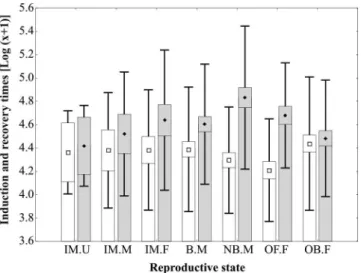
For all seahorses, induction of anaesthesia occurred more rapidly than recovery (induction: 89 ± 62 sec; re -covery: 119 ± 78 sec; t = -5.72; d.f .= 232; p < 0.001). No significant differences were found in the induction and recovery times between sexes (induction: t = -0.13; d.f. = 238; p = 0.89; recovery: t =1.72; d.f. = 234; p = 0.09) or life stages (induction: t = 0.29; d.f. = 238; p = 0.77; recovery: t = -0.37; d.f. = 234; p = 0.71). Although we did not find significant differences in the induction times (F(5,234) = 1.08; p = 0.37) among the different reproductive states, mature females and non-brooding males exhibited signifi -cantly different times for recovery (F(5,230) = 2.52; p = 0.03) (Fig. 1). During sampling, we recorded the mortality of three individuals (two before being anaesthetized, and one during the induction period), which have been
depos-ited in the Fish Collection of the Universidade Federal da Paraíba (UFPB 6031, UFPB 6032).
The diet analysis suggests that H. reidi has a generalist feeding strategy, with high variation between the phenotypes
Fig. 1. Mean values of induction (square) and recovery (loz-enge) times of Hippocampus reidi (n = 242) in seconds (box = standard error; whisker = standard deviation). Reproduc -tive state: IM = immature, OF = ovipositor region flat, OB = ovipositor region bulging, B = brooding, NB = non-brooding. Sex: U = undetermined, F = female, M = male.
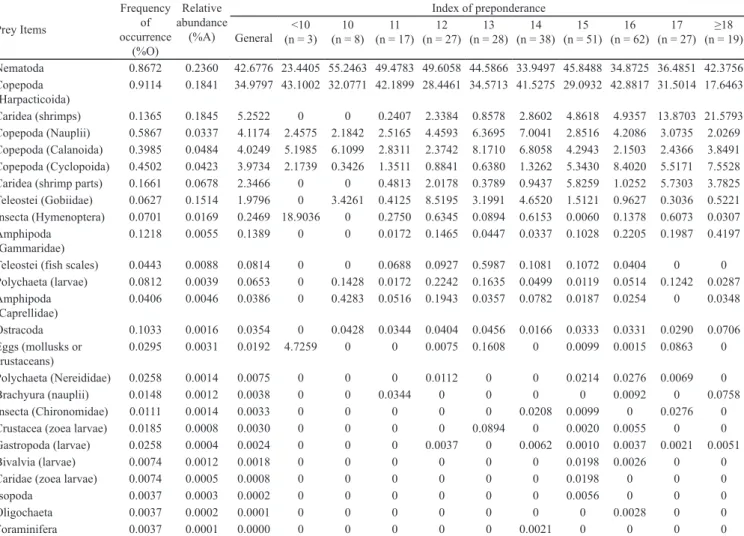
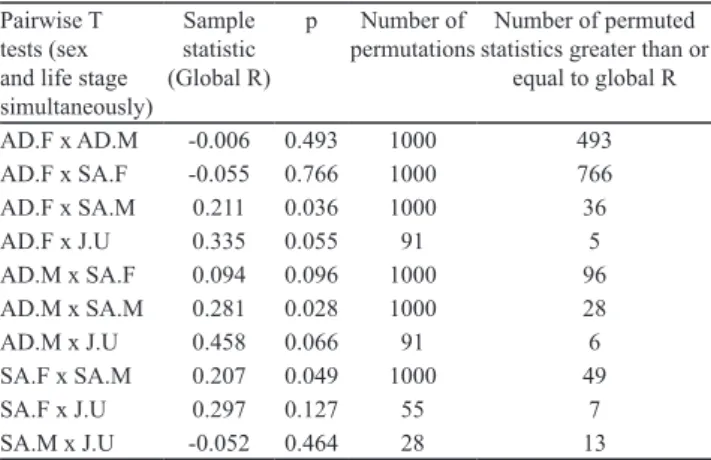
(Fig. 2; Tables 1-4). Generally, nematodes (IP = 42.6778) and harpacticoid copepods (IP = 34.9798) were the main prey categories consumed by H. reidi (n = 280). Hymenoptera (IP = 18.90) and eggs (possibly of mollusks or crustaceans) (IP = 4.73) were important categories to specimens smaller than 10 cm. Gobiid fishes and cyclopoid copepods were consumed by seahorses larger than 10 cm in height, while caridean shrimps were increasingly consumed by seahorses larger than 12 cm. (Table 1). Significant differences where found when compar -ing the diet accord-ing to sex and life stage simultaneously (R = 0.115; p = 0.014), particularly between subadult and adult males, and subadult males and females (Tables 2-3) – differ-ences related to a greater consumption of gobiid fishes and a comparatively lower consumption of harpacticoid copepods by the subadult males (Table 4).
As shown in Table 3, ANOSIM permutations with ju-veniles showed the biggest R values, related to their com-paratively greater consumption of calanoid and cyclopoid copepods and Hymenoptera insects (mean IP = 23.31, 9.75, 17.01, respectively) (Table 4). Adult females, on the other hand, separated from the remaing groups due to their large consumption of caridean shrimps (mean IP = 8.41) (Table 4).
Discussion
Although there are no published data on induction and recovery times for seahorses, anaesthetic substances such as MS-222 or AQUI-STM have been used in seahorse research
(Woods, 2000, 2002; Bull, 2002; Woods & Martin-Smith, 2004; Koldewey, 2005; Morgan & Bull, 2005). Among an -aesthetics, clove-oil (85-95% eugenol) has been considered as the most adequate product for anaesthetizing fishes, due to its low cost, reduced mortality, safety of use, low induction and recovery times, but sufficient to identify the fishes and record biological information (Griffiths, 2000). Our initial assessment of the use of clove oil in seahorse research sug-gests that it was an effective substance, as H. reidi individuals exhibited short induction (< 90 sec) and recovery times (< 120 sec). We also highlight the low mortality rate observed throughout the study period.
While crustaceans have been considered one of the main food items consumed by syngnathids (see Foster & Vincent, 2004 and Kendrick & Hyndes, 2005), the large consumption of nematodes found in our study has not been previously recorded to that group, exceptions being small amounts found in the gut
Table 1. Frequency, abundances and index of preponderance by height (IP) of prey taxa for 10 size classes of Hippocampus reidi (n = 280) in the wild. Number of stomachs examined is given in parentheses for each size class.
Prey Items
Frequency of occurrence
(%O)
Relative abundance
(%A)
Index of preponderance General
<10 (n = 3)
10 (n = 8)
11 (n = 17)
12 (n = 27)
13 (n = 28)
14 (n = 38)
15 (n = 51)
16 (n = 62)
17 (n = 27)
≥18 (n = 19) Nematoda 0.8672 0.2360 42.6776 23.4405 55.2463 49.4783 49.6058 44.5866 33.9497 45.8488 34.8725 36.4851 42.3756 Copepoda
(Harpacticoida)
0.9114 0.1841 34.9797 43.1002 32.0771 42.1899 28.4461 34.5713 41.5275 29.0932 42.8817 31.5014 17.6463 Caridea (shrimps) 0.1365 0.1845 5.2522 0 0 0.2407 2.3384 0.8578 2.8602 4.8618 4.9357 13.8703 21.5793 Copepoda (Nauplii) 0.5867 0.0337 4.1174 2.4575 2.1842 2.5165 4.4593 6.3695 7.0041 2.8516 4.2086 3.0735 2.0269 Copepoda (Calanoida) 0.3985 0.0484 4.0249 5.1985 6.1099 2.8311 2.3742 8.1710 6.8058 4.2943 2.1503 2.4366 3.8491 Copepoda (Cyclopoida) 0.4502 0.0423 3.9734 2.1739 0.3426 1.3511 0.8841 0.6380 1.3262 5.3430 8.4020 5.5171 7.5528 Caridea (shrimp parts) 0.1661 0.0678 2.3466 0 0 0.4813 2.0178 0.3789 0.9437 5.8259 1.0252 5.7303 3.7825 Teleostei (Gobiidae) 0.0627 0.1514 1.9796 0 3.4261 0.4125 8.5195 3.1991 4.6520 1.5121 0.9627 0.3036 0.5221 Insecta (Hymenoptera) 0.0701 0.0169 0.2469 18.9036 0 0.2750 0.6345 0.0894 0.6153 0.0060 0.1378 0.6073 0.0307 Amphipoda
(Gammaridae)
0.1218 0.0055 0.1389 0 0 0.0172 0.1465 0.0447 0.0337 0.1028 0.2205 0.1987 0.4197 Teleostei (fish scales) 0.0443 0.0088 0.0814 0 0 0.0688 0.0927 0.5987 0.1081 0.1072 0.0404 0 0 Polychaeta (larvae) 0.0812 0.0039 0.0653 0 0.1428 0.0172 0.2242 0.1635 0.0499 0.0119 0.0514 0.1242 0.0287 Amphipoda
(Caprellidae)
0.0406 0.0046 0.0386 0 0.4283 0.0516 0.1943 0.0357 0.0782 0.0187 0.0254 0 0.0348 Ostracoda 0.1033 0.0016 0.0354 0 0.0428 0.0344 0.0404 0.0456 0.0166 0.0333 0.0331 0.0290 0.0706 Eggs (mollusks or
crustaceans)
0.0295 0.0031 0.0192 4.7259 0 0 0.0075 0.1608 0 0.0099 0.0015 0.0863 0
Polychaeta (Nereididae) 0.0258 0.0014 0.0075 0 0 0 0.0112 0 0 0.0214 0.0276 0.0069 0
Brachyura (nauplii) 0.0148 0.0012 0.0038 0 0 0.0344 0 0 0 0 0.0092 0 0.0758
Insecta (Chironomidae) 0.0111 0.0014 0.0033 0 0 0 0 0 0.0208 0.0099 0 0.0276 0
Crustacea (zoea larvae) 0.0185 0.0008 0.0030 0 0 0 0 0.0894 0 0.0020 0.0055 0 0
Gastropoda (larvae) 0.0258 0.0004 0.0024 0 0 0 0.0037 0 0.0062 0.0010 0.0037 0.0021 0.0051
Bivalvia (larvae) 0.0074 0.0012 0.0018 0 0 0 0 0 0 0.0198 0.0026 0 0
Caridae (zoea larvae) 0.0074 0.0005 0.0008 0 0 0 0 0 0 0.0198 0 0 0
Isopoda 0.0037 0.0003 0.0002 0 0 0 0 0 0 0.0056 0 0 0
Oligochaeta 0.0037 0.0002 0.0001 0 0 0 0 0 0 0 0.0028 0 0
contents of Syngnathus taenionotus, S. abaster (Franzoi et al., 1993) and S. schlegeli (Huh & Kwak, 1997). The abundance
of nematodes may be a result of prey accessibility rather than preference, as they constitute the most abundant meiofaunal group in estuarine environments, representing 60-90% of the total fauna, followed by Harpacticoid copepods with 10-40% (Coull, 1999). The occasional consumption of insects (ants) observed in this study is unique, and is possibly related to the massive presence of mangrove trees along the margins of the estuary.
While Harpacticoida was the principal item consumed by
Hippocampuszosterae (Tipton & Bell, 1988), H. subelongatus
(Kendrick & Hyndes, 2005) and H. reidi (this study), the other studied seahorse species mostly consumed Cyclopoida cope-pods, amphipods and caridean shrimps (see Kanou & Kohno, 2001; Kendrick & Hyndes, 2005; Teixeira & Musick, 2001; Burchmore et al., 1984; Woods, 2002). These results highlight
the importance of crustaceans as a prey category to seahorses. The occasional consumption of larger prey like caridean shrimp and fishes by H. reidi - a situation also observed in S. typhle (Oliveira et al., 2007) and in the females of S. folletti
by Garcia et al. (2005) - could result in a larger energy intake by seahorses than preying upon smaller prey such as cope-pods; a desirable mechanism for a species that mainly uses a sit-and-wait strategy. Furthermore, Garcia et al. (2005) have suggested that, in the case of S. folletti, that feeding behavior may also determine higher between-phenotype variability than previously suggested.
The consumption of epibenthic prey (e.g. harpacticoid copepods, nematodes, polychaetes) by H. reidi has also been recorded for H. whitei, H. zosterae, H. abdominalis, H. breviceps, and H. subelongatus, which mainly consumed epibenthic invertebrates (Burchmore et al., 1984; Tipton &
Bell, 1988; Woods, 2002; Kendrick & Hyndes, 2005), and possibly reflect the sedentary behaviour of seahorses, rather
than a gape limitation.
The feeding strategy and niche breadth analyses conducted in this study suggested that H. reidi has a generalist feeding strategy, with high variation between phenotypes. Neverthe-less, similar to what has been recorded for S. typhle (Oliveira
et al., 2007), our findings suggest that H. reidi may have a specialist strategy in early life stages, consuming only small planktonic prey, and then becoming a moderately generalized benthonic predator. According to Foster & Vincent (2004), seahorses may change their diet ontogenetically, or as they grow, which may be a reflection of changes in feeding capabili -ties (e.g., change in mouth gape) and/or habitat shifts (Ryer & Orth, 1987; Tipton & Bell, 1988; Woods, 2002).
Syngnathids in general exhibit a high degree of trophic specialization compared with many other epibenthic or de-mersal marine teleosts, and such differences can be explained, at least in part, by differences in their snout morphologies and feeding behaviors, and also, in the case of seahorses, by their relatively restricted swimming ability (Kendrick & Hyndes, 2005). With swimming capabilities more suited to maneuver-ability than speed, and with a strongly prehensile tail (Hale, 1996; Consi et al., 2001), the seahorse body form is adapted to inhabiting relatively complex habitats and these fishes rarely venture into open water when feeding (Flynn & Ritz, 1999).
In our study we found that seahorses smaller than 10 cm consumed a larger proportion of Calanoida and Cyclopoida copepods, Hymenoptera (ants) and eggs than the larger indi-viduals, which consumed more larger prey items, such as fish and caridean shrimps. A similar result was found by Woods (2002), where smaller individuals of H. abdominalis (< 13.75
cm) consumed a larger proportion of total gut volume of amphipods than larger seahorses (> 13.8 cm), which mostly consumed caridean shrimps. Ontogenetic dietary shifts were also recorded to H. erectus, as smaller fish (<60 mm TL) fed
mainly on amphipods, with copepods secondarily important, Table 2. Global tests of the analyses of similarities (ANOSIM)
of the natural diet of Hippocampus reidi (n = 280), between life stages (1), sexes (2), sexes and life stage simultaneously (3) and reproductive states (4). Life stage: J = juveniles, SA = subadults, AD = adults. Sex: U = undetermined, F = females, M = males. Reproductive state: IM = immature, OF = oviposi-tor region flat, OB = oviposioviposi-tor region bulging, B = brooding, NB = non-brooding.
Global tests Sample statistic (Global R)
P Number of permutations
Number of permuted statistics greater than or equal to
global R
(1) J x SA x AD 0.126 0.076 1000 76
(2) U x F x M 0.084 0.103 1000 103
(3) J.U x SA.F x SA.M x AD.F x AD.M
0.115 0.014 1000 14
(4) IM.J x IM.F x IM.M x OF.F x NB.M x OB.F x B.M
0.039 0.139 1000 139
Table 3. Pairwise tests of the analyses of similarities (ANOSIM) of the natural diet of Hippocampus reidi (n = 280) between sexes and life stages simultaneously. Life stage: J = juveniles, SA = subadults, AD = adults. Sex: U = undeter-mined, F = females, M = males.
Pairwise T tests (sex and life stage simultaneously)
Sample statistic (Global R)
p Number of permutations
Number of permuted statistics greater than or
equal to global R
AD.F x AD.M -0.006 0.493 1000 493
AD.F x SA.F -0.055 0.766 1000 766
AD.F x SA.M 0.211 0.036 1000 36
AD.F x J.U 0.335 0.055 91 5
AD.M x SA.F 0.094 0.096 1000 96
AD.M x SA.M 0.281 0.028 1000 28
AD.M x J.U 0.458 0.066 91 6
SA.F x SA.M 0.207 0.049 1000 49
SA.F x J.U 0.297 0.127 55 7
while mid size and larger specimens fed almost exclusively on amphipods (Teixeira & Musick, 2001). Additionally, Tipton & Bell (1988) found an increase in the consumption of amphipods by larger specimens of H. zosterae, despite the dominance of harpacticoid copepods in all size classes, and Kanou & Kohno (2001) reported that juveniles H. mohnikei
exhibited a division of prey items between size classes, with the smaller seahorses feeding mainly on cyclopoid copepods smaller than those consumed by larger specimens.
Some authors state that the reproductive system of Syn-gnathidae may result in differential reproductive costs, which may be reflected in different prey selection by males and fe -males (Svensson, 1988; Steffe et al., 1989; Lyons & Dunne,
2003; Garcia et al., 2005). In seahorses it is known that the period of pregnancy represents a high energetic cost for the males (Teixeira & Musick, 2001). In H. zosterae, for example, male metabolic rates increases from 10 to 52% over pregravid levels (Masonjones, 2001), as these animals are responsible by osmotic regulation and oxygen and perhaps provide nutrition to the embryos (Strawn, 1958; Masonjones, 2001; Foster & Vincent, 2004). According to Lyons & Dunne (2004), the male
seahorse pregnancy may produce a behavioral response that limits the movements of males, reducing energetic expenditure on chasing larger vagile prey (Ryer, 1988; Lyons & Dunne, 2004) and risk of capture by predators (Lyons & Dunne, 2004; Oliveira et al., 2007). Thus, it is possible that the greater con-sumption of harpacticoid copepods and reduced concon-sumption of caridean shrimps and gobiid fishes by the adult males in the present study is related to reproduction, as found in another species of Syngnathidae (Ryer, 1988; Lyons & Dunne, 2004; Oliveira et al., 2007).
The flushing method, or gastric lavage, is the most simple and efficient method used to safely remove food items without sacrificing the fish (Hyslop, 1980; Hartleb & Moring, 1995; Hakala & Johnson, 2004), and has been used safely and ef-ficiently in studies of food habits of various salmonids and sturgeon species (see Kamler & Pope, 2001; Brosse et al., 2002).
However, because the great variability in the partitioning and length of the digestive tracts of different species of fish, it is not possible to predict which species will be amenable to the procedure unless the alimentary tract morphology is Table 4. Similarities of percentages (SIMPER) indicating which prey items contributed simultaneously to the dissimilarity between sexes and life stages in the natural diet of Hippocampus reidi (n = 280). Life stage: J = juveniles, SA = subadults, AD = adults. Sex: U = undetermined, F = females, M = males. **Significant values according to ANOSIM.
Prey items Mean index of preponderance Mean dissimilarity
J.U SA.F SA.M AD.F AD.M J.U x SA.F
J.U x SA.M
J.U x AD.F
J.U x AD.M
SA.F x SA.M
SA.F x AD.F
SA.F x AD.M
SA.M x AD.F
SA.M x AD.M
AD.F x AD.M 43.95 52.54 47.89 46.49 47.25** 39.55 39.54 47.93** 46.98** 39.35 Nematoda 20.71 43.51 37.05 33.64 32.89 2.84 4.17 2.48 2.79 4.29 2.53 2.87 4.14 4.52 2.85 Copepoda
(Harpacticoida)
22.77 36.03 13.84 31.47 36.95 3.30 4.23 3.02 3.21 5.48 2.57 2.24 4.70 5.17 2.51 Copepoda
(nauplii)
2.21 3.95 3.88 5.95 6.54 4.01 4.09 4.28 4.28 4.57 4.30 4.25 4.75 4.95 3.68
Caridea (shrimps)
0.00 1.34 0.00 8.41 3.81 1.54 0.00 4.23 3.22 1.62 4.53 3.58 4.42 3.35 4.39
Teleostei (Gobiidae)
0.00 1.57 27.98 7.18 1.97 1.58 6.25 4.05 1.76 6.92 4.38 2.67 7.12 6.45 4.12
Copepoda (Cyclopoida)
9.75 2.18 1.54 3.24 3.91 5.98 6.14 5.48 5.58 3.57 3.67 3.61 3.54 3.44 3.43
Copepoda (Calanoida)
23.31 1.16 4.86 2.88 4.93 7.70 7.79 7.04 7.03 4.27 3.07 4.26 3.98 4.03 3.91
Caridea (shrimp parts)
0.00 3.07 5.36 2.59 3.83 1.89 2.79 2.28 3.62 3.87 3.28 4.16 3.81 4.49 3.69
Insecta (Hymenoptera)
17.01 3.77 0.00 1.70 0.07 6.79 6.86 6.25 6.23 2.97 3.56 2.79 2.16 0.22 1.99
Amphipoda (Gammaridae)
0.00 0.17 0.17 0.55 1.11 0.37 0.35 1.13 1.00 0.68 1.30 1.26 1.30 1.25 1.64
Polichaeta (larvae)
0.00 0.08 3.85 0.50 1.12 0.22 3.26 0.99 1.06 3.43 1.08 1.19 3.42 3.51 1.49
Teleostei (fish scales)
0.00 1.79 0.50 1.45 0.07 1.77 0.71 1.63 0.19 2.25 2.68 1.78 2.07 0.82 1.60
Ostracoda 0.00 0.02 0.64 0.07 0.05 0.06 0.99 0.22 0.14 1.03 0.24 0.17 1.04 1.00 0.28
Gastropoda (larvae)
0.00 0.00 0.00 0.02 1.54 0.00 0.00 0.06 0.87 0.00 0.06 0.88 0.06 0.90 0.86
Polichaeta (Nereididae)
0.00 0.95 0.00 0.00 0.06 0.85 0.00 0.01 0.17 0.89 0.81 0.96 0.01 0.18 0.17
Eggs (mollusks or crustaceans)
known (Baker & Fraser, 1976). Some associated risks with the procedure may include a prolonged manipulation time and stress and some injuries to the flash tissues of esophagus, stomach or gut (Haley, 1998; Wanner, 2006).
Our results suggest that the flushing technique has the po -tential to replace destructive sampling procedures in seahorse research. Also, this technique may reduce research pressure on vulnerable wild seahorse stocks. Furthermore, the re-sighting of individuals in this study, particularly of those which had changed reproductive state or were sighted releasing young, suggests that the clove oil anaesthetization followed by the flushing procedure was non-destructive to the sampled indi -viduals. Nevertheless, caution should be taken while manipu-lating the specimens to avoid injuries and to minimize stress. Although encouraging, these first results are by no means conclusive, and we strongly recommend further research to better quantify the efficacy of the flushing method on seahorses and better evaluate potential impacts of the procedures on the behavior and growth of the anaesthetized specimens.
The results of the dietary analysis presented in this study provide essential ecological data that may help both in in situ and ex situ conservation actions directed to seahorses, particularly to Hippocampusreidi.
Acknowledgements
To IBAMA (Instituto Brasileiro do Meio Ambiente e dos Recursos Naturais Renováveis) for providing research permits (permit number 64 DIFAP/IBAMA 06/05), and for working in partnership with us. Within IBAMA, special thanks are due to Carla Marcon (GEREX-PB) for her enthusiasm and support throughout the study. To CAPES (Coordenação de Aperfeiçoamento de Pessoal de Nível Superior) for providing a M.Sc. scholarship to A. L. C. Castro. To CNPq (Conselho Nacional de Desenvolvimento Científico e Tecnológico) for providing a research fellowship to I. L. Rosa and A. L. Ven-del, and an undergraduate scholarship to A. F. Diniz and I. Z. Martins. Thanks are also due to the Universidade Federal da Paraíba (Departamento de Sistemática e Ecologia, Programa de Pós-Graduação em Ciências Biológicas and NEPREMAR) and FAPESQ for all their support. Special thanks are due to “Seu Arlindo”, Gabriel Brito, Eugênio Paulo-Junior, Gabri-elle Tenório and Josias Xavier for their fundamental support during field work.
Literature Cited
Amundsen, P. A., H. M. Gabler & F. J. Staldvik. 1996. A new ap-proach to graphical analysis of feeding strategy from stomach
contents data - modification of the Costello (1990) method.
Journal of Fish Biology, 48: 607-614.
Baker, A. N. & D. F. Fraser. 1976. A method for securing the gut
contents of small, live fish. Transactions of the American Fisher -ies Society, 105(4): 520-522.
Brosse L., P. Dumont, M. Lepage & E. Rochard. 2002. Evaluation of a gastric lavage method for Sturgeons. North American Journal of Fisheries Management, 22: 955-960.
Bull, C. (Ed.). 2002. Seahorse Husbandry in Public Aquaria: 2002 Manual, with chapters contributed by members of the Syngnathid Discussion Group. Chicago, John G. Shedd Aquarium, 56p. Burchmore, J. J., D. A. Pollard & J. D. Bell. 1984. Community
struc-ture and trophic relationships of the fish fauna of an estuarine
Posidonia australis seagrass habitat in Port Hacking, New South Wales. Aquatic Botany, 18: 71-87.
Clarke, K. R. & R. M. Warwick. 2001. Change in marine communi -ties: An approach to Statistical Analysis and Interpretation. 2.ed. Plymouth, Primer-E Ltd, 170p.
Consi, T. R., P. A. Seifert, M. S. Triantafyllou & E. R. Edelman.
2001. The dorsal fin engine of the seahorse (Hippocampus sp.). Journal of Morphology, 248: 80-97.
Costello, M. J. 1990. Predator feeding strategy and prey importance: a new graphical analysis. Journal of Fish Biology 36: 261-263. Coull, B. C. 1999. Role of meiofauna in estuarine soft-bottom
habi-tats. Austral Ecology, 24: 327-343.
Cunha, F. E. A. & I. L. Rosa. 2006. Anesthetic effects of clove-oil on
seven species of tropical reef fishes (Teleostei). Journal of Fish
Biology, 69: 1504-1512.
Felício, A. K. C, I. L. Rosa, A. Souto & R. A. Freitas. 2006. Feeding
behavior of the Longsnout seahorse Hippocampusreidi Ginsburg, 1933. Journal of Ethology, 24(3): 219-225.
Flynn, A. J. & D. A. Ritz. 1999. Effect of habitat complexity and
predatory style on the capture success of fish feeding on aggre -gated prey. Journal of the Marine Biological Association of the
United Kingdom, 79: 487-494.
Foster, S. J. & A. C. J. Vincent. 2004. Life history and ecology of seahorses: implications for conservation and management. Journal of Fish Biology 65: 1-61.
Franzoi, P., R. Maccagnani, R. Rossi & V. U. Ceccherelli. 1993. Life cycles and feeding habits of Syngnathus taenionotus and S. abaster (Pisces, Syngnathidae) in a brackish bay of the Po River delta (Adriatic Sea). Marine Ecology Progress Series, 97: 71-81. Garcia, A. M., R. M. Geraldi, & J. P. Vieira. 2005. Diet composition
and feeding strategy of the southern pipefish Syngnathus folletti
in a Widgeon grass bed of the Patos Lagoon Estuary, RS, Brazil. Neotropical Ichthyology, 3(3): 427-432.
Griffiths, S. P. 2000. The use of clove-oil as an anaesthetic and method for sampling intertidal rockpool fishes. Journal of Fish
Biology, 57: 1453-1464.
Hakala, J. P. & F. D. Johnson. 2004. Evaluation of a gastric lavage method for use on Largemouth Bass. North American Journal of Fisheries Management, 24: 1398-1403.
Hale, M. E. 1996. Functional morphology of ventral tail bending and prehensile abilities of the seahorse, Hippocampus kuda. Journal of Morphology, 227: 51-65.
Haley, N. 1998. A gastric lavage technique for characterizing diet of sturgeons. North American Journal of Fisheries Management, 18: 978-981.
Hartleb, C. F. & J. R. Moring. 1995. An improved gastric lavage
device for removing stomach contents from live fish. Fisheries
Research, 24: 216-265.
Huh, S. & S. N. Kwak. 1997. Feeding habits of Sygnathus schelegeli
in Eelgrass (Zostera marina) Bed in Kwangyang Bay. Journal of
the Korean Fisheries Society, 30(5): 896-902.
Hyslop, E. J. 1980. Stomach contents analysis, a review of methods and their application. Journal of Fish Biology, 17(4): 411-430. IUCN. 2007. 2007 IUCN Red List of Threatened Species. Available
from: http://www.iucnredlist.org. (20 October 2007).
Kanou, K. & H. Kohno. 2001. Early life history of a seahorse,
Hippocampusmohnikei, in Tokyo Bay, Japan. Ichthyological Research, 48: 361-368.
Kendrick, A. J. & G. A. Hyndes. 2005. Variations in the dietary compositions of morphologically diverse syngnathid fishes.
Environmental Biology of Fishes, 72: 415-427.
Koldewey, H. (Ed.). 2005. Syngnathid Husbandry in Public Aquari -ums: 2005 Manual, with chapters contributed by members of the Syngnathidae Discussion Group. London, Project Seahorse and Zoological Society of London, 137p.
Lourie, S. A., A. C. J. Vincent & H. J. Hall. 1999. Seahorses: an
identification guide to the world's species and their conservation.
London, Project Seahorse, 214p.
Lyons, D. O. & J. J. Dunne. 2003. Reproductive costs to male and
female worm pipefish. Journal of Fish Biology, 62:767-773.
Lyons, D. O. & J. J. Dunne. 2004. Inter and intra-gender analyses
of feeding ecology of the worm pipefish (Nerophis lumbricifor-mis). Journal of the Marine Biological Association of the United
Kingdom, 84(4361): 1-4.
Marshall, S. & M. Elliott. 1997. A comparison of univariate and multivariate numerical and graphical techniques for determining
inter- and intraspecific feeding relationships in estuarine fish.
Journal of Fish Biology, 51(3): 526-545.
Masonjones, H. D. 2001. The effect of social context and reproductive status on the metabolic rates of dwarf seahorses (Hippocampus zosterae). Comparative Biochemistry and Physiology Part A, 129: 541-555.
McPherson, J. M. & A. C. J. Vincent. 2004. Assessing East African trade in seahorse species as a basis for conservation under inter-national controls. Aquatic Conservation: Marine and Freshwater Ecosystems, 14(5): 521-538.
Morgan, S. & C. Bull. 2005. Potential techniques for tagging and marking seahorses. Project Seahorse Technical Report No.7, Version 1.0. Vancouver, Project Seahorse, 27p.
Oliveira, F., K. Erzini & J. M. S. Gonçalves. 2007. Feeding habits of the deep snouted pipefish Syngnathus typhle in a temperate coast-al lagoon. Estuarine, Coastcoast-al and Shelf Science, 72: 337-347. Perante, N. C., M. G. Pajaro, J. J. Meeuwig & A. C. J. Vincent. 2002.
Biology of a seahorse species, Hippocampus comes in central Philippines. Journal of Fish Biology, 60: 821-837.
Rosa, I. L., C. L. S. Sampaio & A. T. Barros. 2006. Collaborative
monitoring of the ornamental trade of seahorses and pipefishes
(Teleostei: Syngnathidae) in Brazil: Bahia State as a case study. Neotropical Ichthyology, 4(2): 247-252.
Ryer, C. H. & R. J. Orth. 1987. Feeding ecology of the northern
pipefish, Syngnathus fuscus, in a seagrass community of the lower Chesapeake Bay. Estuaries, 10: 330-336.
Ryer, C. H. 1988. Pipefish foraging: effects of fish size, prey size
and altered habitat complexity. Marine Ecology Progress Series, 48: 37-45.
Steffe, A. S., M. Westoby & J. D. Bell. 1989. Habitat selection and
diet in two species of pipefish from seagrass: sex differences.
Marine Ecology Progress Series, 55: 23-30.
Strawn, K. 1958. Life history of the pigmy seahorse, Hippocampus zosterae Jordan and Gilbert, at Cedar Key, Florida. Copeia,
1958: 16-22.
Svensson, I. 1988. Reproductive costs in two sex-role reversed
pipefish species (Syngnathidae). Journal of Animal Ecology,
57: 929-942.
Teixeira, R. L. & J. A. Musick. 2001. Reproduction and food habits of the lined seahorse, Hippocampuserectus (Teleostei: Syn-gnathidae) of Chesapeake Bay, Virginia. Revista Brasileira de Biologia, 61(1): 79-90.
Tipton, K. & S. S. Bell. 1988. Foraging patterns of two syngnathidae fishes: importance of harpacticoid copepods. Marine Ecology
Progress Series, 47(1): 31-43.
Vendel, A. L. & P. T. C. Chaves. 1998. Alimentação de Bairdiella ron-chus (Cuvier) (Perciformes, Sciaenidae) na Baía de Guaratuba, Paraná, Brasil. Revista Brasileira de Zoologia, 15(2): 297-305. Wanner, G. A. 2006. Evaluation of a gastric lavage method on juvenile pallid sturgeon. North American Journal of Fisheries Management, 26(3): 587-591.
Wilson, M. J. & A. C. J. Vincent. 1998. Preliminary success in closing the life cycle of exploited seahorse species, Hippocampus spp., in captivity. Aquarium Sciences and Conservation, 2: 179-196.
Woods, C. M. C. & K. Martin-Smith. 2004. Visible implant fluores -cent elastomer tagging of the big-bellied seahorse, Hippocampus abdominalis. Fisheries Research, 66: 363-371.
Woods, C. M. C. 2000. Preliminary observations on breeding and rearing the seahorse Hippocampusabdominalis (Teleostei: Syngnathidae) in captivity. New Zealand Journal of Marine and Freshwater Research, 34: 475-485.
Woods, C. M. C. 2002. Natural diet of the seahorse Hippocampus abdominalis. New Zealand Journal of Marine and Freshwater Research, 36: 655-660.
Zar, J. H. 1999. Biostatistical Analysis, 4th ed. New Jersey, Prentice Hall, 929p.