International Journal for Quality Research 9(1) 141–150 ISSN 1800-6450
Jorge Moutinho
1Fernanda Oliveira
Article info: Received 03.11.2014 Accepted 27.01.2015 UDC – 658.562
OPTIMIZING MAINTENANCE PROCESSES
ON CUSTOMER SITE IN A
DECENTRALIZED ORGANIZATION BASED
ON MULTI-SITE TEAMS
Abstract: This lecture focuses on the complexity to manage and optimize maintenance processes, operations and service tasks to equipments and systems installed at customer sites. Different locations, access and working environment may compromise any standardization of setup’s and operations. Multi-site teams based on geographic strategic locations, adds complexity to trainning, communication, supervising and monitoring processes. Logistics and information systems assume relevant rolls to consolidate global performance. Beside efficiency, effectiveness productivity and flexibility, field teams need skills on autonomy responsibility and proactivity.
This lecture also explores the needed adaptation of most part of available literature, normally based on production sites, as also of Lean- Kaizen principles to the fact that services can not be stocked, quality is normally more difficult to measure and customer is normally present when and where service is produced.
Keywords: Maintenance management, Lean, Kaizen, service organizations, complexity, scalability
1.
Introduction
1Maintenance became an important issue in our days and old paradigms around maintenance as “to be repaired in case of a breakdown” are not valid any more (Pinto, 2013, p. 2). It is a required function and also after sales selective decision factor in different and important business segments (ex: car industry, construction, health care, home equipments, sports and information and communication technologies). It is now a complex system where the integration of
1
Corresponding author: Jorge Moutinho email: [email protected]
from companies’ perspectives, as also from academic perspectives. Due to the fact that maintenance isn’t any more an issue to be discussed inside of the local maintenance teams, but globally in multidisciplinary teams, intra or inter companies, universities and organizations, different standards have been defined. (Ex: European Standards for Maintenance). In the next years, to support competitiveness, companies will have to achieve a high level of reliability, availability and safety of the production and operations activities. Meanwhile, to accomplish a maximum performance, companies, maintenance organizations and people will have to be prepared to change and to be committed to the change. Maintenance strategies, processes, workflows will have to be redesigned and adapted, as new tools and new technologies will have to be implemented in order to facilitate the development of processes (Baglee, 2014).
Some companies have decided for an internal structure and some others decided to outsource the maintenance function. The last decade, has been deeply analyzed and different standards have been defined (Ex: European Standards for Maintenance). Depending on variables of the item to be maintained (ex: size, weight, portability, integrated technology, cost), maintenance may have be moved to the item site or the item may have be moved to the maintenance site.
2.
Maintenance
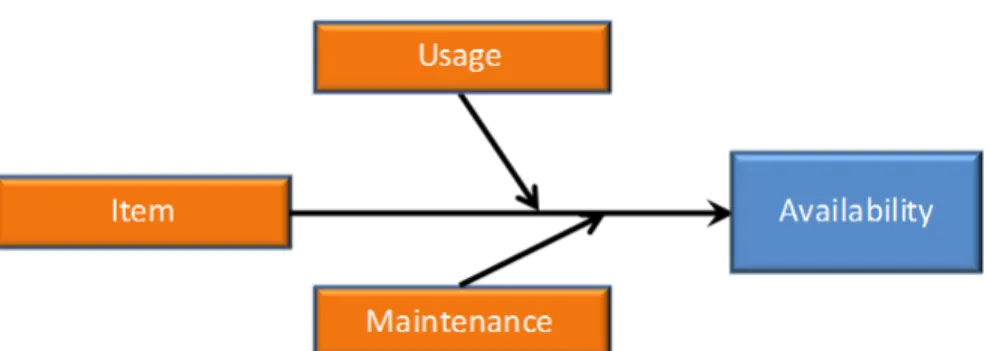
Maintenance is a service that can be described as a combination of all technical, administrative and managerial actions during the life cycle of an item, intended to retain it in, or restore it to, a state in witch it can perform the required function (EN 13306/2007). As a service, it is an intangible activity, can not be stocked, customer has an important role on the inputs and also as part of the process, there are a high variability
Figure 1. Main inputs vectors for availability
2.1. Case
In this paper Maintenance should maximize the availability of Active Medical Devices- AMD, (normally called as medical equipment) to end users, according to customers needs in a sustainable approach, providing service activities to different equipments in different locations, by decentralized and geographically located maintenance teams.
2.2. Equipments, customers and maintenance team profile
Equipments (items) installed in customer sites are of different types and different models but all single units (not integrated in big systems) that can work in stand alone mode. From physical aspects these devices are heavy with an average of 120kg, equiped with wheels to make them portable, meanwhile these equipments are not easy to transport due to their weight and size. From technological point these equipments are complex, the state of art of technologies integrating hydraulic, electronic, pneumatic, mechanical, electrical and software components.
Customers are located in different locations in the country, in a higher concentration in some areas like big cities and in a much diluted distribution in other areas like country side. In some cases access to customer building is very simple, with good parking areas near by, one or two floors to
visit. In other cases customers are located in big buildings, with high level security controls and parking areas way from the building like in complex hospitals. Normally it is not possible to find adequate maintenance installations and teams have to adapt to each customer site conditions. Maintenance is not the core business of customers, normally with low maintenance culture or background, but very sensible to the availability of the items as also to the time to repair in case of breakdowns. Normal requirements means values higher than 98% for availability and times less than 24hours to repair (downtime).
the total time. Due to the fact these teams are geographically distributed, it is difficult, costly and traveling time consuming to perform meetings, trainning, team building and all other activities to be implemented in a synchronous mode and that can be normally implemented in a centralized organization. As a consequence of theses facts, maintenance teams have very low opportunities for internal discussions, or knowledge exchange and learning processes. Each single element of the technical teams is different, as a person and as a technician, from all the other team elements due to social, economic and geographic stratifications, but also due to the age, physical conditions, personal and professional maturity as well experience and
motivation. These are some of the reasons why the outcomes of the maintenance activities, based in Standard Operations Procedures (SOP’s) are different from one technician to the other, having an important influence on the performance and sustainability of the organization.
2.3. Optimization process in this context and it barriers
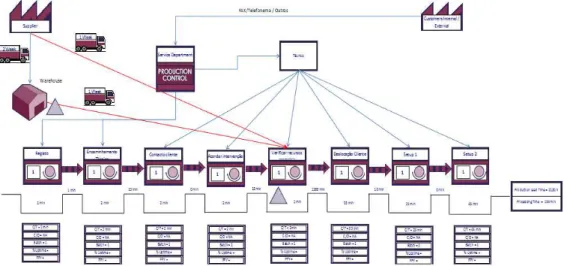
In Figure 2, it is possible to find that different interfaces (internal and external) take place in a simple customer requested repair activity. Optimization should be achieved in the whole maintenance chain as an end-2-end process and in both directions for continuous improving cycles.
Figure 2. A Value Stream Map for repairing activities
In Figure 2, it is possible to find that different interfaces (internal and external) take place in a simple customer requested repair activity. Optimization should be achieved in the whole maintenance chain as an end-2-end process and in both directions for continuous improving cycles.
In a standard model of a decentralized maintenance organization based on multi-site teams, each time a customer identifies a failure of an equipment or system, he
organization is able to be agile and flexible to adapt to the different requests from customers day after day. After receiving the customer request, the technician has to check that all the needed resources as materials, tools, instruments, spare parts, documentation, as well the car and mobile communications systems are available and in good conditions to be used. The next step will be to travel to the customer and then start the technical activities in order to deliver and return the equipment ready to be used to the customer closing the request. To make this happen in an optimized way, the maintenance team has to assure that all performed tasks are the needed tasks, correctly implemented, at the right moment and location, in on step time, but also in a cost/profit acceptable context. It is not on the scope of this paper the analysis of the maintenance organization and suppliers interface. Meanwhile, this is a strategic interface of supply chain management program for goods (spare part, tools and materials) and services (calibration,
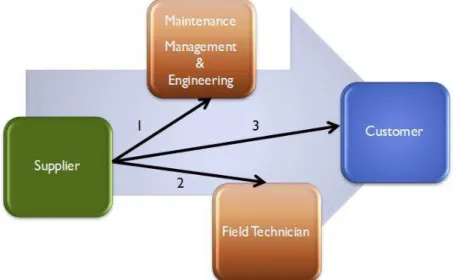
outsourced maintenance). For this reason the interface with suppliers may also have a very important impact on stability and performance of the maintenance organization (Furtado, 2014). Depending on the location where the suppliers are delivering the goods or services, the interface with the maintenance organization will need to be adapted. Figure 3 shows the three most used distribution channels from suppliers to customers. Channel 1 represents the direct delivery from supplier to Maintenance organization and this is the most common solution found in field. Channel 2 and 3 represents a direct delivery to the field, technician or customer. Direct delivery from supplier to final customer (channel 3) allows high level of optimization in the complete supply chain management but requires also a high demanding interface integration regarding material or service flow and information flow synchronization. For this reason, it is frequently not implemented in the maintenance context.
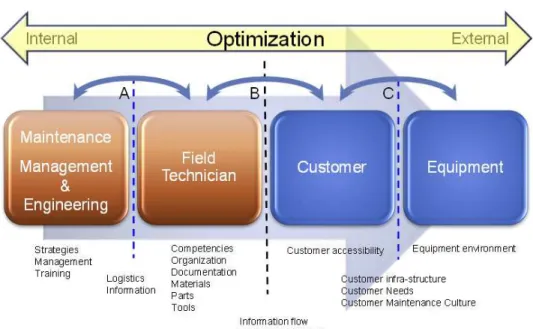
Figure 4. Maintenance chains and barriers
Figure 4, shows the major components and barriers of the maintenance chain from maintenance organization to equipment in customer site. The interface A between maintenance organizations and maintenance teams, the interface B between maintenance teams and customers as well the interface C between customers and the equipments, seams to be the most important interfaces to take into consideration. Other important interfaces are identified between maintenance teams and equipments as well the interface between both customer and maintenance companies. Strategic vision communication, organization culture change, employee’s involvement and network relationships are success factors for lean implementation (Kovacheva, 2010).
2.4. Barriers A, B and C
Inside of the maintenance organization we can find barrier A mainly based on physical distance. Management is based in headquarters and maintenance teams are based in field. Communication, projects deployment and materials flows, that can
global success (Covey, 1989). In barrier B we have the interface between both companies and for this it is considered as a critical interface. Questions related to image, profitability and performance are important issues. It also defines how the maintenance teams interact with customers. Figure 2 shows that communication, traveling, information flow, parking areas, building structure, customer maintenance workflow and maintenance areas, is part of the complete process and have a great impact on performance. Meanwhile, depending on customer maintenance culture and/or background it is not easy to influence or change customer internal processes to fit maintenance needs. Barrier C is an internal customer interface and it is very difficult and sensible to work around. We can say that the weakness/strongest of this interface depends on customer knowledge on maintenance culture, operation environment, methods and also hierarchies.
3.
Optimization solutions through
the barriers
Online tools are some of the solutions to share data and information in a synchronous or asynchronous mode with application on planning, monitoring, controlling, reporting, training, meetings and documents sharing.
With the asynchronized mode it is not mandatory to have all members at the same place at the same time. Traveling is reduced and driving time can be used as productive time. Preparation of teams to become autonomous and responsible in Time, Quality and Cost vectors can be implemented to allow each member to decide and control the results of his own activities and his targets. Autonomy and responsibility must be balanced with adequate key performance indicators to keep process in the track. Communications problems can be reduced by teams empowerment based on maintenance process, optimization tools, change management and team building training (Puvanasvaran, 2009). Standards definition and implementation allows having common attitudes, protocols and language. Personification and isolation became highly reduce and with it as well, the complexity and variability of maintenance. Development and implementation of adequate and adapted evaluation methods allows to identify and to mitigate deviations on team members, supporting a more homogeneous global team. To consolidate all of these improving steps and to assure that on daily work things are done in the correct way, place and time, a regular Technical Audits program has to be implemented to maintenance teams in field.
Standardization was found as a good solution to improve flexibility and autonomy of maintenance teams regarding car setup, materials, tools, measuring instruments and communication, as also to reduce the variability for maintenance processes at customer site environment. The hotline management tool was redesigned to improve communication interface between customers and maintenance organization and/or maintenance reducing times and redundancy. A wireless mobile workforce management platform was found as desirable tool for next improvements.
Training on safety, rules, norms, guidelines or maintenance standards was decided to be implemented. In parallel, training on maintenance culture was important to make customers to realize how maintenance can add value to his own company. The culture change is needed to achieve a lean culture (Hook, 2008). Finally a Total Productive Program – TPM, was implemented with equipment end users (operators). A reporting tool was decided to be implemented to communicate and reinforce the benefits and/or add value of maintenance activities to each customer core business processes.
4.
Conclusions
Maintenance is one of the most important top management topics in our days and it will be in the next years one of the most important competitiviness argument. Decentralized customers and decentralized maintenance teams, introduce a number of variables, with high variability. Creates a very complex context to implement standards, develop homogeneous attitudes and behaviors as also to setup monitoring and supervising systems. In other hand, this context promotes, single attitudes, isolation and multiple scenarios. To reach consolidated and sustainable results, it is important to look for improvements on an end-2-end process base and involve all actors on the rethinking of the strategies,
principles, values, processes and maintenance models.
High level of availability of systems and low maintenance cost are the triggers for solutions based on remote maintenance, auto maintenance and predictive maintenance. New tools and technologies have to be implemented for data, information and knowledge management, as well for human and materials resource planning and management. The Hoshin kanri methodology widely used in some organizations, may be a excellent support for a strategic approach to maintenance, since the technique proposes a structure to align strategic objectives with key performance indicators, sets performance targets and defines improvement actions.
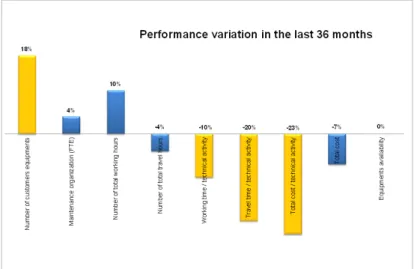
customers, allow the involvement and development of common strategic in a win-win relation. Results of the performance variation of the last 36 months presented in Figure 5, show that it was possible to support an increasing of 18% of customer equipments in the market, maintain the
equipment availability constant and reduce the total costs in 7%, while a significant cost reduction of the working and traveling time per maintenance action, took place.
This context of maintenance is still an opportunity for next studies development's and optimization programs.
References
:
Cabral, J.P.S. (2004). Gestão da Manutenção – dos conceitos à práctica. Lidel-Edições Técnicas, Lisboa
Clark, G. (2010). Lean Maintenance – A Risk-Based approach. Retrieved 2 February 2015, from http://www.ispe.org/
Hook, M. (2008). Lean principles in industrialized housing production: the need for a cultural change. Lean Construction Journal 2008. Retrieved 2 February 2015, from http://www.researchgate.net/publication/228433776_Lean_principles in_industrialized_ housing_ production_the_need_for_a_cultural_change/file/60b7d515d33fe5d248.pdf Kovacheva, A.V. (2010). Challenges in Lean Implementation. Master thesis. University of
Aarhus. Denmark
Pinto, J.P.O. (2013). Manutenção Lean, Lidel-Edições Técnicas, Lisboa
Pinto, J.P.O. (2010). Gestão de Operações na Industria e nos Serviço, (3ª ed.), Lidel-Edições Técnicas, Lisboa
Puvanasvaran, P., Megat, H., Sai Hong, T., & Mohd.Razali, M. (2009). The roles of communication process for an effective lean manufacturing implementation. Journal Of Industrial Engineering And Management, 2(1). doi:10.3926/jiem.2009.v2n1.p128-152 IBM. (2013). Collaborate instantly with social communications using integrated voice, data,
and video. Retrieved 2 February 2015, from http://www-03.ibm.com/software/products/en/ibmsamewww.ibm.com
Citrix. (2013). Transform your organization with mobile workstyles. Retrieved 2 February 2015, Retrieved from http://www.citrix.com/solutions.html.
Webex.(2013). Get unlimited meetings in HD video. Retrieved 2 February 2015, from http://www.webex.co.uk/
Furtado, A. (2014). The role of adequate reference materials in density measurements in hemodialysisI, IMEKO joint Symposium 2014, Madeira
Covey, S. (1989). The seven habits of highly effective people. New York: Simon and Schuster. Haarman, M. (2014), Value Driven Maintenance – Discover the Hidden Value in Your
Maintenance Organization,
Baglee, D. (2014), Critical study of essential elements linked with the adoption of condition-based maintenance,
Jorge Moutinho
Fresenius Medical Care, Portugal SA
Fernanda Oliveira
Fresenius Medical Care, Portugal SA