Vivian Costa Fermo
I, Vera Radünz
I, Luciana Martins da Rosa
I, Monique Mendes Marinho
I I Universidade Federal de Santa Catarina, Postgraduate Program in Nursing. Florianópolis, Santa Catarina, Brazil.How to cite this article:
Fermo VC, Radünz V, Rosa LM, Marinho MM. Patient safety culture in a bone marrow transplantation unit. Rev Bras Enferm. 2015;68(6):827-34. DOI: http://dx.doi.org/10.1590/0034-7167.2015680620i
Submission: 06-11-2015 Approval: 08-16-2015
ABSTRACT
Objective: evaluate the patient safety culture in the perspective of health professionals from a bone marrow transplantation unit
of an oncology research center, at a reference hospital for cancer treatment in Santa Catarina, Brazil. Method: a quantitative cross-sectional study that used the Safety Attitudes Questionnaire was conducted between August and September 2013. The study analyzed 33 professional surveys. Statistical data analysis used descriptive and inferential statistics. Results: among the dimensions analyzed, only “job satisfaction” reached a mean score above 75, considered positive in terms of patient safety culture. Conclusion: the dimensions of safety culture present in the survey have to be valued by professionals and managers to allow safe patient care.
Key words: Culture; Patient Safety; Bone Marrow Transplantation.
RESUMO
Objetivo: avaliar a cultura de segurança do paciente sob a ótica dos profi ssionais da área de saúde da unidade de Transplante de
Medula Óssea do Centro de Pesquisas Oncológicas, hospital de referência no tratamento do câncer em Santa Catarina, Brasil.
Método: pesquisa de abordagem quantitativa, do tipo survey transversal, desenvolvida a partir do Questionário de Atitudes de
Segurança, entre agosto e setembro de 2013. Foram incluídos 33 inquéritos de profi ssionais. Para análise dos dados utilizou-se a estatística descritiva e inferencial. Resultados: entre as dimensões analisadas, somente a “satisfação no trabalho” alcançou a média de escore acima de 75, avaliada como positiva para a cultura de segurança do paciente. Conclusão: as dimensões da cultura de segurança presentes no inquérito necessitam ser valorizadas por profi ssionais e gestores para o alcance de um cuidado seguro ao paciente.
Descritores: Cultura; Segurança do Paciente; Transplante de Medula Óssea.
RESUMEN
Objetivo: evaluar la cultura de seguridad del paciente desde la perspectiva de los profesionales de salud en la unidad de
Trasplante de Médula Ósea del Centro de Pesquisa Oncológica, hospital de referencia para el tratamiento del cáncer en Santa Catarina, Brasil. Método: estudio con un enfoque cuantitativo y transversal, mediante la aplicación del Cuestionario de Actitudes Seguridad en los meses de agosto y septiembre de 2013. Se incluyeron 33 estudios profesionales. El análisis estadístico de los datos se utilizó estadística descriptiva e inferencial. Resultados: entre las dimensiones evaluadas, sólo la “satisfacción laboral” obtuvo la media de score mayor de 75, evaluada como positiva para la cultura de seguridad del paciente. Conclusión: las dimensiones de la cultura de seguridad presentes en el estudio tienem que ser valorados por profi sionales y gerentes para lograr uma atención segura al paciente.
Palabras clave: Cultura; Seguridad del Paciente; Trasplante de Médula Ósea.
Patient safety culture in a bone marrow transplantation unit
Cultura de segurança do paciente em unidade de Transplante de Medula Óssea
Cultura de seguridad del paciente en unidad de Trasplante de Médula Ósea
INTRODUCTION
Patient safety has been considered a theme of global interest; and based on that, many countries have developed initiatives to encourage health institutions to provide safe care, that is, obtain favorable results to patients without causing any risk of damage.
This concern was first discussed in studies published in the 1970s, showing that adverse events are present in hospitals in several countries, constituting a global public health prob-lem(1-5). The main publication was the book titled To Err is
Human: Building a Safer Health Care System, in 2000, which stated that, in the United States of America (USA), between 44,000 and 98,000 people die every year from errors associ-ated with health treatment and health care provided in hospi-tals, caused by faulty systems, processes and conditions that lead people to make mistakes or fail to prevent them(6). This reality causes damages to patients, professionals, health insti-tutions and loss of public funds.
To control and improve this scenario, in 2002, the World Health Organization (WHO) started to establish standards and provide support to countries in the development of policies and practices related to patient safety(7). Based on the goals proposed by the WHO, several institutions and experts start-ed to develop strategies for safer patient care; including the implementation of a patient safety culture, indicated by the Joint Commission (TJC), the Joint Commission International (JCI) and the National Patient Safety Agency(8-9).
Safety culture is understood as a factor of performance, train-ing and behavior of health professionals that makes these profes-sionals see patient safety as one of their priorities(9). To make it a reality, it is very important to analyze the organizational fac-tors that hinder the safety culture. For this reason, in the 1980s, safety culture measurements through scales started to be used by health institutions. The evaluation instruments include the Safety Attitudes Questionnaire (SAQ), due to its good psycho-metric properties(10). Hospitals are recommended to use the SAQ every 12 to 18 months to generate a profile of potentialities and fragilities and allow proper improvement interventions(11).
Health institutions are taking care of people with increas-ingly complex diseases, treatments and technology processes, requiring more efforts towards a broad system of patient safety culture. In these scenarios, special cases have been seen in units of bone marrow transplantation (BMT) and hematopoi-etic stem cell transplantation (HSCT), as during the process, patients are constantly exposed to invasive technologies, med-ical procedures of high complexity, immunosuppression and antimicrobial resistance.
The objective of this study is to evaluate the patient safety culture in the perspective of health professionals from the bone marrow transplantation unit of an oncology research center (CEPON), at a reference hospital for cancer treatment in Santa Catarina, Brazil.
METHOD
This is a quantitative cross-sectional study. All professionals from the technical team that work in the BMT unit of CEPON,
specialized in autologous HSCT, received an invitation to participate in this study. This unit has 11 beds and conducts, on average, four autologous HSCT procedures every month. The team is comprised of one social worker, one dentist, nine nurses, one physical therapist, 14 physicians, one nutritionist, one psychologist, 17 nursing technicians, and one occupa-tional therapist, totaling 46 professionals.
The inclusion criterion was professionals who had been working in the sector for more than four weeks. Two profes-sionals were excluded, as at data collection, they had been away from work for a long period. Both criteria for participant selection were recommended by the authors of the instrument used in this study(12). Thus, 44 health professionals were in-vited to participate in this study, of whom 33 answered the survey, resulting in a response rate of 75%.
A response rate between 65% and 85% is considered good to evaluate the patient safety culture, whereas values below 60% only express the opinions of professionals about the theme(13-14). Therefore, the values presented in this study ex-press the patient safety culture in the analyzed BMT unit.
The Safety Attitudes Questionnaire (SAQ) – ICU Version(12), translated into Portuguese and adapted to the BMT unit with the permission of the authors, was used for data collection. This instrument presents 64 items in total, plus the follow-ing information: quality of collaboration and communica-tion among professionals; professional category; age; gender; length of experience in Oncology; length of experience in a BMT unit; and recommendations for patient safety in the stud-ied unit. Although the instrument analyzes 64 items, only 30 of them are considered in the analysis of six dimensions of safety culture: teamwork climate, safety climate, work condi-tions, stress recognition, perception of unit and hospital man-agement, and job satisfaction.
Data were collected in August and September 2013. The professionals were invited to participate in the study during their work shift and in their workplace, and they received two copies of a free and informed consent form (FICF) in a white envelope, and a brown envelope with the questionnaire to be answered. After answering it, each professional deposited both sealed envelopes (one with the instrument and one with the FICF), in a dropbox to ensure anonymity. No identification was made in the questionnaire.
This study was approved by the Research Ethics Commit-tee (REC) of the Federal University of Santa Catarina, CAAE 14890113.1.0000.0121, and by the REC of CEPON (co-partic-ipating institution), CAAE 14890113.1.3001.5355. This study was conducted according to the legal requirements defined in Resolutions 196/96(15) and 466/2012(16). Both these resolu-tions are mentioned because when the project was submitted for ethical evaluation, Resolution 196 was in force; however, at data collection, Resolution 466 had been created. Then, the REC of CEPON requested that, during the study, proper adaptations should be made, based on Resolutions 466/2012, while the study was conducted. Thus, the request from the REC was fulfilled.
2=disagree, 3=neither agree nor disagree, 4=agree, and 5=strongly agree) to a 100-point scale, in which 100 means the ‘desirable level’. Hence, the scores assumed the follow-ing levels: strongly disagree=0, disagree=25, neither agree nor disagree=50, agree=75, and strongly agree=100. Some items present a reverse score, so in these questions a reduced score means a more positive attitude. The answers in every scale of attitudes were added up and divided by the number of items in a scale, creating a score ranging from 0 to 100, and any score ≥ 75 was considered a positive score(12).
For statistical analysis of data, the significance level of 5% was considered and data values were presented with a 95% confidence interval. Descriptive statistics was used, with cal-culation of mean values, and inferential statistics, through one-way ANOVA and Fisher’s exact test. With non-normal error distribution and non-homogeneous variance within the groups, even after data transformation with ANOVA, Kruskal-Wallis test was used to compare the distribution of mean val-ues. Data were entered into Microsoft Office Excel 2010®and processed with the Statistical Package for the Social Sciences (SPSS), version 17.0.
RESULTS
Profile of health professionals from the BMT unit
Regarding the sociodemographic aspect, most participants were female professionals and nursing technicians. The cate-gory of “other professionals of higher education level” includes social workers, dentists, physical therapists, nutritionists, psy-chologists and occupational therapists. Age ranged between 26 and 55 years, with the mean age of participants being approxi-mately 40 years, with a standard deviation of 7.9 years. Also, 13 participants (40%) did not answer this question. Most profes-sionals, 24 participants (72.72%), had more than five years of experience in Oncology, 20 (60.60%) of these had worked in a BMT unit for more than five years (Table 1).
Male professionals who answered the instrument were phy-sicians. Among female participants, 13 (41.9%) were nursing technicians, followed by eight nurses (25.8%), six were from the category of other professionals of higher education level (19.4%) and four were physicians (12.9%). When conduct-ing Fisher’s exact test, the relationship between profession and gender was close to a significant probability value (0=0.057), that is, the probability that this gender distribution in profes-sions may be due to a sample error is low.
Age categories are well distributed among the professions. Individuals between 41 and 60 years old were mostly nurs-ing technicians and physicians, with three participants each (33.3%, respectively), followed by the category of other pro-fessionals of higher education level, with two participants (22.2%), and nurse, with one participant (11.1%). Individuals between 20 and 40 years were mostly nurses, with four partici-pants (36.4%), followed by three nursing technicians (27.3%), two physicians (18.2%) and two members in the category of other professionals of higher education level (18.2%). This distribution indicates a high probability that it may be due to a sample error (p=726).
Among the professionals of higher education level (except for physicians and nurses), four (66.7%) worked in a 30-hour regime. The nurses were equally distributed into 30- and 40-hour regimes, with four (50%) participants in each regime. Among the nursing technicians, eight (72.7%) worked in the 30-hour regime. Lastly, half the physicians worked in the 40-hour regime, two in the 20-40-hour regime (33.3%) and only one physician worked 50 hours a week (16.7%). These differences among the working hours and the type of profession were sig-nificant when conducting Fisher’s exact test (p=0.026).
When analyzing the distribution of working hours ac-cording to the employment status, eight (61.5%) among 13 contracted individuals worked 40 hours a week, whereas 13 (72.2%) among 18 individuals who were civil servants worked in the 30-hour regime.
Regarding the length of experience in Oncology, 16 partici-pants (51.6) said they had more than ten years and one month of experience. When analyzing the number of members from
Table 1 - Sample distribution according to demographic
variables and professional characteristics, bone marrow transplantation unit, Santa Catarina, Bra-zil, 2013
Variables n %
Gender (n=33) Male
Female 312 93.96.0
Age (n=20) 20 to 40 years
41 to 60 years 119 55.045.0
Professional category (n=33) Nurses
Physicians
Nursing technicians
Other professionals of higher education level
8 6 13 6 24.2 18.2 39.4 18.2
Employment status (n=31) Contract
Civil servant 1318 41.958.1
Working hours (n=31) 15 hours 20 hours 30 hours 40 hours 50 hours 1 3 16 10 1 3.2 9.7 51.6 32.3 3.2
Length of experience in Oncology (n=31) 4 weeks to 6 months
7 months to 1 year
1 year and 1 month to 5 years 5 year and 1 month to 10 years 10 years and 1 month or more
1 2 4 8 16 3.2 6.5 12.9 25.8 51.6
Length of experience in a BMT unit (n=32) 4 weeks - 6 months
7 months - 1 year
1 year and 1 month - 5 years 5 year and 1 month - 10 years 10 years and 1 month or more
each professional category in relation to years of experience, four physicians (66.7%), four nurses (50%) and three (50%) other professionals of higher education level had more than 10 years of experience. Among the nursing technicians, five (45.5%) had more than ten years and one month of experi-ence, and four of them (36.4%) reported five years and one month to ten years of experience. The probability that this finding may be due to a sample error is 89.3% (p=0.893).
Unlike the length of experience in Oncology, the profes-sionals showed an unequal distribution among the catego-ries of length of experience in a BMT unit. Three participants (50%) from the category of other professionals of higher ed-ucation level had only four weeks to six months of experi-ence. Among the nurses, two (25%) had worked in a BMT unit between one year and one month and five years, two (25%) between five years and one month and ten years, and two (25%) for more than ten years and one month. Among the nursing technicians, five (41.7%) reported ten years or more, among the physicians, three (50%) reported between five and ten years, and three (50%) had more than 10 years of experi-ence. These findings indicate a high probability that they may be due to a sample error (p=0.415).
Patient safety culture in the BMT unit
Regarding the analysis of the six dimensions that comprise the SAQ and through which the patient safety culture can be evaluated in a BMT unit, only the dimension of job satisfac-tion reached the mean value proposed by the instrument authors(12) for a proper safety culture, that is, having a score above 75 (Table 2).
After the calculation of mean values from scores of every dimension, an attempt was made to identify factors that influ-ence the evaluation. The first factor analyzed was the profes-sional category (Table 3).
Statistical analysis of the factors that influence an evalu-ation of the patient safety culture showed that “job satisfac-tion” was statistically significant, with 0.05 p value with the Kruskal-Wallis test.
It is noteworthy that teamwork climate was positively evalu-ated by nurses, perception of unit and hospital management by physicians, and job satisfaction by nurses, physicians and other professionals of higher education level.
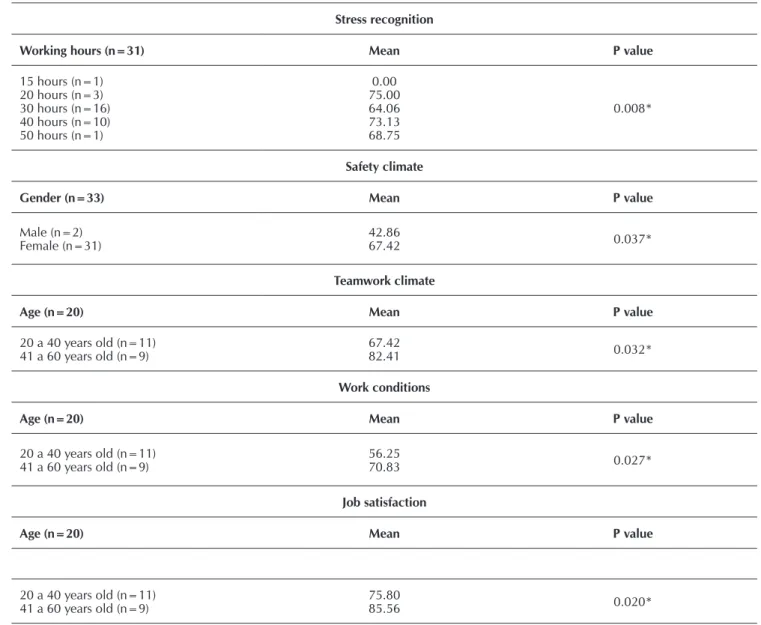
Besides the professional category, other aspects of the profes-sional profile were also statistically analyzed to recognize char-acteristics that influence the patient safety culture (Table 4).
Table 2 - Distribution of dimensions related to the patient safety culture, according to the mean score, as indicated by the
participants, bone marrow transplantation unit, Santa Catarina, Brazil, 2013
Dimension Mean Standard deviation Minimum value Maximum value
Safety climate Teamwork climate Work conditions Stress recognition
Perception of unit and hospital management Job satisfaction
65.9 74.1 57.51 65.9 66.9 78.7
16.3 13.9 18.5 20.3 15.9 10.5
36 46 19 0 33 55
100 100 88 100 98 100
Table 3 - Distribution of professional categories according to mean values of dimensions related to the safety culture, bone
marrow transplantation unit, Santa Catarina, Brazil, 2013
Nurses Physicians Nursing technicians Other professionals of
higher education level
Dimensions Mean SD Mean SD Mean SD Mean SD P value
Safety climate 72.3 19.3 55.9 19.7 67.1 14.1 64.8 10.9 0.324
Teamwork climate 81.7 13.9 70.8 18.6 72.1 11.1 71.5 14.3 0.372
Work conditions 58.6 20.8 66.7 25.8 51.7 13.2 59.4 17.5 0.439*
Stress recognition 71.8 14.5 70.8 22.2 61.0 12.0 63.5 36.7 0.621*
Perception of unit and
hospital management 67.2 16.1 75 20.9 61.0 16.3 71.2 13.0 0.300*
Job satisfaction 84.2 9.6 80.8 16.2 73.1 7.8 81.7 5.2 0.07*
DISCUSSION
The dimension of “safety climate” evaluated the perception of professionals as for the organization’s strong and proactive commitment to patient safety(12). Improvements are required in management of errors, discussion and organizational learning from the systemic error approach, proper feedback on the per-formance of professionals, encouragement among colleagues to report concerns about patient safety, and better communication in the BMT unit about the proper ways to inform issues related to patient safety. Gender influenced the evaluation of “safety cli-mate”, as the male professionals perceived the work environment as safer than female professionals; however, this result might have occurred due to the small number of male participants.
The challenge to discuss and manage mistakes affects the recognition of human fallibility, reporting of incidents,
collective learning from error identification, knowledge of contributing factors and their root cause, which favor repeat-ing errors(17). The professionals should understand that, for a mistake to occur, there are factors contributing to its origin or evolution(18).
The health institution should develop protection measures to prevent mistakes. It should be clear to professionals that most mistakes cannot be avoided by health professionals work-ing individually. As the health system is a group of dependent elements that interact to achieve a common objective, it is necessary to introduce mechanisms to pull down structural obstacles, leverage leadership, involve the professionals, and not generate guilt without considering knowledge, evolution and improvement, so that a system could be revised to identify how faults go past the defense, and make safe care an easily performed routine practice(19).
Table 4 - Demographic variables and characteristics of professionals with significant differences regarding the dimensions
analyzed, bone marrow transplantation unit, Santa Catarina, Brazil, 2013
Stress recognition
Working hours (n=31) Mean P value
15 hours (n=1) 20 hours (n=3) 30 hours (n=16) 40 hours (n=10) 50 hours (n=1)
0.00 75.00 64.06 73.13 68.75
0.008*
Safety climate
Gender (n=33) Mean P value
Male (n=2)
Female (n=31) 42.8667.42 0.037*
Teamwork climate
Age (n=20) Mean P value
20 a 40 years old (n=11)
41 a 60 years old (n=9) 67.4282.41 0.032*
Work conditions
Age (n=20) Mean P value
20 a 40 years old (n=11)
41 a 60 years old (n=9) 56.2570.83 0.027*
Job satisfaction
Age (n=20) Mean P value
20 a 40 years old (n=11)
41 a 60 years old (n=9) 75.8085.56 0.020*
The dimension of “teamwork climate” involved the qual-ity of collaboration perceived among the professionals(12). The team of the studied unit was made up of different professional health categories, and had the common objective of providing proper care to patients submitted to hematopoietic stem cell transplantation. While providing health care, the suggestions from the nursing team are well accepted by the team, the pro-fessionals receive the required support from their colleagues in the provision of health care to patients, and the team mem-bers easily make questions about something they have not un-derstood. However, improvements are required for a proper resolution of disagreements during the work process, team-work coordination between physicians and nurses, and to fa-cilitate the communication of issues related to patient care.
Professional health areas are complementary and interde-pendent, but every professional category has its own specifici-ties, technical knowledge, work instruments and activispecifici-ties, cre-ating a complex work network(20). In this process, it is extremely important to keep mutual help, respect, and clear and effective communication, joining individual skills to achieve common goals and objectives and provide high-quality safe care.
The dimension of “work conditions” was related to the quality perceived of the work environment and logistic sup-port, such as human resources and equipment(12). In the stud-ied unit, this dimension presented the greatest fragility, requir-ing interventions that favor better trainrequir-ing to recently admitted professionals, availability of information required for diagnos-tic and therapeudiagnos-tic discussions in the professional daily rou-tine, a constructive approach to professionals with problems and proper supervision of interns. In the work process, good management, effective equipment and in good operating con-ditions, infrastructure of high quality, information available for decision making, management of conflicts and problems, and proper supervision are required. These factors allow a better performance and work productivity.
Although the work conditions were not evaluated as posi-tive for patient safety, the safety attitude of “I would feel safe if I were treated here as a patient”, present in the dimension of safety climate, received a positive score. A Brazilian study(21) identified the same reality and concluded that professionals do not recognize work conditions as potential facilitators for errors, concentrating the responsibility for work quality and safety on the professionals.
The dimension of “perception of hospital and unit man-agement” referred to the approval by the professionals of the work performed by the hospital management(14). The results showed that support is required from the administration in daily efforts of professionals and to promote improvements in the communication in due time of adverse events that may affect the work of professionals. A positive evidence was that professionals believed the team size was sufficient to take care of the number of patients hospitalized in the unit.
For a positive safety culture, the institution’s managers should emphasize safety and, during the work process, they should assume an attitude that accepts criticism and opposite opinions, promote and encourage feedback, establish safety parameters and facilitate staff training. Also, communication
about safety should be valued, so that team members can re-port errors, describe the factors involved to allow investiga-tions and improvements, and then, better work condiinvestiga-tions and reduced accidents(21-22).
The dimension of “job satisfaction” referred to a positive experience at the workplace, through factors that influence motivation, such as pleasure and autonomy in professional practice(12). Data showed that the professionals like their work, appreciate and are proud of working in the institution. That can be seen in the fact that the participants like to work with patients submitted to hematopoietic stem cell transplantation, as most of them have worked in a BMT unit for more than five years. It is noteworthy that this institution is recognized in the whole state of Santa Catarina for its reference and high-quality service in cancer treatment, with positive repercussion in the satisfaction of its employees.
Professional satisfaction may be determined by some factors related to the institutional context and security; for instance, the prestige, satisfaction and social status the institution pro-vides(23). Satisfied professionals present a lower probability to request a transfer to another unit or even to another institution, which ensures reduced turnover of professionals. If the institu-tion implements improvement acinstitu-tions through a systemic er-ror approach and organizational learning, in the long run, the low turnover and professional empowerment regarding safe care may contribute to patient safety.
When identifying the evaluation of job satisfaction as sta-tistically significant, the mean score from the nursing techni-cians was the only score that did not reach the value indi-cated by the instrument authors as proper for a positive patient safety culture.
This finding may be related to the challenges they have in their profession. Studies show the main challenges of this professional category in the activities they perform: lack of material resources, low remuneration, lack of continuing education, lack of human resources and recognition for the work they perform, lack of integration in the work team, and overload. These fragilities end up impacting negatively their professional satisfaction(24).
The dimension of “stress recognition” was related to the fact that these professionals understand how stressing fac-tors affect work performance. Excessive workload, fatigue, and tense or hostile situations affect their performance and lead to mistakes(12). The results indicated that a working week over 20 hours in the evaluation of this dimension was directly related to their expressive performance, and positive scores were from those who work 20 hours a week. Thus, the profes-sionals with excessive working hours consider these factors as inherent and common to the work process and, consequently, they may not reflect and discuss with other colleagues and managers about this reality for a positive change aiming the patient safety; on the other hand, professionals working less may have a better perception that stressing factors may harm their professional performance.
REFERENCES
1. Montserrat-Capella D, Suárez M, Ortiz L, Mira JJ, Duarte HG, Reveiz L, et al. Frequency of ambulatory care adverse events in Latin American countries: the AMBEAS/PAHO cohort study. Int J Qual Health Care [internet]. 2015[cited 2015 May 30];27(1):52-9. Available from: http://intqhc. oxfordjournals.org/content/27/1/52.long
2. Aranaz-Andrés JM, Limón R, Mira JJ, Aibar C, Gea MT, Agra Y. What makes hospitalized patients more vulner-able and increases their risk of experiencing an adverse event? Int J Qual Health Care [internet]. 2011[cited 2015 May 30];23(6):705-12. Available from: http://intqhc.oxfor djournals.org/content/23/6/705.long
3. Letaief M, El Mhamdi S, El-Asady R, Siddigi S, Abdullatif A. Adverse events in a Tunisian hospital: results of a retro-spective cohort study. Int J Qual Health Care. 2010[cited 2015 May 30];22(5):380-5. Available from: http://intqhc. oxfordjournals.org/content/22/5/380.long
4. Souza P, Serranheira F, Leite E, Nunes C, Uva AS. Segu-rança do doente: eventos adversos em hospitais portugue-ses: estudo piloto de incidência, impacto e evitabilidade. Lisboa: Escola Nacional de Saúde Pública; 2011. 5. Aranaz-Andrés JMR, Aibar-Remón C, Limón-Ramirez R,
Amarilla A, Restrepo FR, Urroz O, et al. Prevalence of adverse events in the hospitals of five Latin American countries: results of the “iberoamerican study of adverse events” (IBEAS). BMJ Qual Saf [internet]. 2011[cited 2015 May 30];20(12):1043-51. Available from: http://quality safety.bmj.com/content/20/12/1043.long
6. Kohn L, Corrigan J, Donaldson M. To err is human: build-ing a safer heath system. Washbuild-ington, DC: Committee on Quality of Health Care in America. Institute of Medicine: National Academy Press; 2000.
7. Ministério da Saúde (BR), Agência Nacional de Vigilância Sanitária. Segurança do Paciente e Qualidade em Servi-ços de Saúde. Brasília (DF): Ministério da Saúde; 2011.
8. Nieva VF, Sorra J. Safety culture assessment: a tool for im-proving patient safety in healthcare organizations. Qual Saf Health Care [internet]. 2003[cited 2015 May 30];12:(suppl 2):17-23. Available from: http://www.ncbi.nlm.nih.gov/ pmc/articles/PMC1765782/pdf/v012p0ii17.pdf
9. National Patient Safety Agency. Seven steps to patient safety for primary care - The full reference guide [internet]. London: 2006[cited 2012 Dec 28]. Available from: www.nrls.npsa. nhs.uk/EasySiteWeb/getresource.axd?AssetID=60044&. 10. Carvalho REFC, Cassiani SHB. Cross-cultural
adapta-tion of the Safety Attitudes Quesadapta-tionnaire – Short Form 2006 for Brasil. Rev Latino-Am Enfermagem [internet]. 2012[cited 2012 May 10];20(3): 575-82. Available from: http://www.scielo.br/readcube/epdf.php?doi=10.1590/ S0104-11692012000300020&pid=S0104-116920120 00300020&pdf_path=rlae/v20n3/a20v20n3.pdf
11. Sexton JB1. Paine LA, Manfuso J, Holzmueller CG, Mar-tinez EA, Moore D, et al. A check-up for safety culture in “My Patient Care Area”. Jt Comm J Qual Patient Saf [inter-net]. 2007[cited 2015 May 30];33(11):699-703. Available from: http://www.ncbi.nlm.nih.gov/pubmed/18074719 12. Sexton JB, Helmreich RL, Neilands TB, Rowan K, Vella K,
Boyden J, et al. The safety attitudes questionnaire: Psycho-metric Properties, Benchmarking Data, and Emerging Re-search. BMC Health Serv Res [internet]. 2006[cited 2015 May 30];6:44-54. Available from: http://www.ncbi.nlm.nih. gov/pmc/articles/PMC1481614/pdf/1472-6963-6-44.pdf 13. Sexton JB, Thomas EJ. The safety attitudes questionnaire
(SAQ): guidelines for administration. Texas: The Univer-sity of Texas Center of Excellence for Patient Safety Re-search and Practice; 2003.
14. Pronovost P, Sexton B. Assessing safety culture: guidelines and recommendations. Qual Saf Health Care [internet]. 2005[cited 2015 May 30];14(4): 231-3. Available from: http://qualitysafety.bmj.com/content/14/4/231.full professionals over 40 years of age have more professional
ex-perience in Oncology and BMT, which has a positive impact on the interpersonal relation and resolution of disagreements among the team members, ensuring greater empowerment when performing their functions and leading to a lower prob-ability of doubt in diagnostic and therapeutic actions, and bet-ter experience and skills when dealing with problems.
CONCLUSION
The result of this safety culture evaluation in a BMT unit shows fragilities in the five dimensions analyzed: safety cli-mate, teamwork clicli-mate, work condition, stress recognition, and perception of unit and hospital management. Hence, it is extremely important to engage the whole institution to make patient safety a priority while providing health care services.
The team of health professionals and managers, based on the findings of this study, should discuss, using open and
effective communication, and implement actions to strength-en a patistrength-ent safety culture in the unit. For this purpose, ev-eryone involved should consider a mistake as an opportunity to learn, not reprehending colleagues in situations that may put a patient at risk, but otherwise observing their workplace, analyzing changes that can be implemented that will make it a proper environment for assertive actions while providing health care.
15. Ministério da Saúde (BR). Conselho Nacional de Saúde, Comissão Nacional de Ética em Pesquisa. Resolução n. 196 de 10 de outubro de 1996: diretrizes e normas re-gulamentadoras de pesquisa envolvendo seres humanos. Brasília (DF): MS; 1996.
16. Ministério da Saúde. Conselho Nacional de Saúde. Reso-lução n. 466. de 12 de dezembro de 2012. Diretrizes e normas regulamentadoras para pesquisas envolvendo seres humanos. Diário Oficial da União 13 jun 2012; Seção 1. 17. World Health Organization. Patient Safety: global
priori-ties for research in patient safety. Geneva: World Health Organization; 2008.
18. World Health Organization. Conceptual framework for the international Classification for Patient Safety [internet]. WHO: 2009[cited 2012 Dec 28]; Available from: http:// www.who.int/patientsafety/implementation/taxonomy/ icps_technical_report_en.pdf
19. Montserrat-Capella D. Eventos adversos. In: Organizaci-ón Panamericana de la Salud. Enfermería y seguridad de los pacientes. Washington DC: OPS; 2011:43-53. 20. Patterson. PD, Pfeiffer AJ, Weaver MD, Krackhardt D,
Arnold RM, Yealy DM, et al. Network analysis of team
communication in a busy emergency department. BMC Health Serv Res [internet]. 2013[cited 2015 May 30];13(109):1-12. Available from: http://www.biomedcen-tral.com/1472-6963/13/109
21. Correggio TCD, Amante LN, Barbosa SFF. Avaliação da cul-tura de segurança do paciente em Centro Cirúrgico. Rev SOBECC [internet]. 2014[cited 2015 May 30];19(2):67-73. Available from: http://itarget.com.br/newclients/sobecc.org. br/2015/pdfs/site_sobecc_v19n2/02_sobecc_v19n2.pdf
22. Onã PMP. Are there differences in patient safety between different countries using the HSOPSC? Master of Public Health. Copenhagen University, Copenhagen (Denmark); 2012.
23. Filho AP, Andrade JCS, Marinho MMO. [Culture e safety management: the proposal of a model]. Gest. Prod [internet]. 2011[cited 2015 May 30];18(1):205-20. Available from: http://www.scielo.br/pdf/gp/v18n1/15.pdf Portuguese.