rev bras hematol hemoter.2 0 1 4;3 6(4):293–296
Revista Brasileira de Hematologia e Hemoterapia
Brazilian Journal of Hematology and Hemotherapy
w w w . r b h h . o r g
Case Report
T-cell/myeloid mixed-phenotype acute leukemia
with monocytic differentiation and isolated
17p deletion
Germison Silva Lopes
a, João Paulo de Vasconcelos Leitão
a, Jacques Kaufman
a,
Fernando Barroso Duarte
a, Daniel Mazza Matos
b,∗aUniversidade Federal do Ceará (UFC), Fortaleza, CE, Brazil
bCentro de Hematologia e Hemoterapia do Ceará (Hemoce), Fortaleza, CE, Brazil
a r t i c l e
i n f o
Article history:
Received 23 September 2013 Accepted 19 December 2013 Available online 3 April 2014
Keywords:
Acute monocytic leukemia Flow cytometry
Chromosome deletion Antigens
a b s t r a c t
Mixed phenotype acute leukemia is a rare subtype of leukemia that probably arises from a hematopoietic pluripotent stem cell. The co-expression of two of myeloid, B- or T-lymphoid antigens is the hallmark of this disease. Herein, the case of a 28-year-old female patient is reported who presented with hemoglobin of 5.8 g/dL, white blood cell count of 138×109/L and platelet count of 12×109/L. The differential count of peripheral blood revealed 96% of blasts. Moreover, the patient presented with lymphadenopathy, splenomegaly and bone marrow infiltration by monocytoid blasts characterized as 7% positivity by Sudan Black cyto-chemical staining. Immunophenotyping revealed the involvement of blasts of both T- and monocytic lineages. The cytogenetic analysis showed an isolated 17p deletion. Thus, the diagnosis of T-cell/myeloid mixed phenotype acute leukemia was made with two particular rare features, that is, the monocytic differentiation and the 17p deletion as unique cyto-genetic abnormalities. The possibility of concomitant expressions of T-cell and monocytic differentiation antigens in the same blast population is hard to explain using the classical model of hematopoiesis. However, recent studies have suggested that myeloid potential per-sists even when the lineage branches segregate toward B- and T-cells. The role of an isolated 17p deletion in the pathogenesis of this condition is unclear. At present, the patient is in complete remission after an allogeneic stem cell transplantation procedure.
© 2014 Associac¸ão Brasileira de Hematologia, Hemoterapia e Terapia Celular. Published by Elsevier Editora Ltda. All rights reserved.
∗ Corresponding author at: Avenida José Bastos, 3390, 60431-086 Fortaleza, CE, Brazil. E-mail address: [email protected] (D.M. Matos).
http://dx.doi.org/10.1016/j.bjhh.2014.03.004
294
rev bras hematol hemoter.2 0 1 4;3 6(4):293–296Introduction
Mixed phenotype acute leukemia (MPAL) is a heteroge-neous group of rare and poorly differentiated diseases that comprises about 2–5% of all acute leukemias.1,2 This kind of leukemia can be classified as B-cell/myeloid, T-cell/myeloid, B/T-lymphoid and, more rarely, as trilineage B-cell/T-cell/myeloid.3 The T-cell/myeloid phenotype repre-sents 35% of all MPAL.4
Most MPAL cases have been associated with cytogenetic aberrations, mainly complex karyotypes. The t(9;22) and 11q23/MLL rearrangements are the most common recurrent abnormalities. Unlike acute myeloid leukemia, with recurrent genetic abnormalities, the role of cytogenetic aberrations in the pathophysiology of MPAL remains unclear.4
Herein, the case of a patient with T-cell/myeloid acute leukemia with monocytic differentiation and an isolated 17p deletion is reported.
Case report
A 28-year-old female was admitted with a 3-week history of asthenia, fever, odynophagia and purpura. On physi-cal examination, neck lymphadenopathy (the largest being 1.5 cm), hepatomegaly (3 cm below the right costal margin) and splenomegaly (10 cm below the left costal margin) were found. The results of laboratory tests were as follows: hemoglobin concentration was 5.8 g/dL and white blood cell count was 138×109/L. The platelet count was 12.0×10⁹/L. A peripheral
blood smear revealed 96% of blasts. Serology for B and C hep-atitis, HIV, and HTLV-I/II virus were all negative.
A bone marrow aspirate was performed for flow cytometry, cytogenetics and molecular biology studies. The bone marrow aspirate was hypercellular with 98% of medium- to large-sized blasts, a high nuclear-to-cytoplasmic ratio and basophilic cytoplasm. The nuclei were irregular, with a monocytoid aspect in most cells, and fine chromatin with a prominent nucleoli (Figure 1). Sudan Black cytochemical staining was positive in only 7% of blasts.
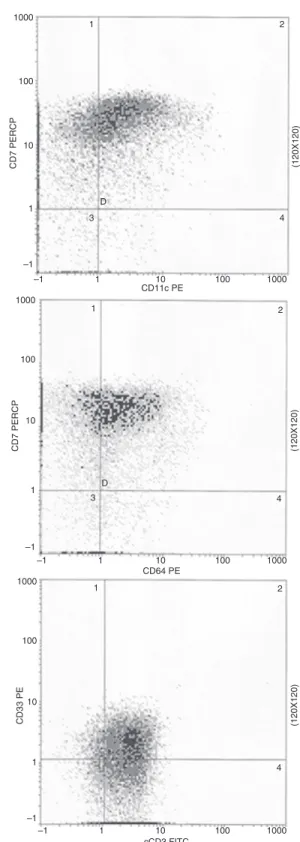
Three-color multiparameter flow cytometry analysis was performed in a Coulter EPICS XL-MCL flow cytometer equipped with an argon ion laser using the erythrocyte lyse-wash prepa-ration method. Immunophenotyping revealed the existence of a unique population of blast cells that were positive for both monocytic and T-lineage differentiation. The blasts exhibited co-expression of monocytic differentiation markers, CD11c and CD64, together with the CD7 antigen (Figure 2). More-over, the blasts were positive for the specific T-cell lineage intracytoplasmic CD3 (cCD3). The blasts were also positive for CD13, CD33, partial CD34, CD38, CD45weak, CD117 and par-tial myeloperoxidase; they were negative for CD1a, CD2, CD4, CD5, CD8, CD10, CD11b, CD14, CD19, CD56, CD61, CD79a and HLA-DR.
Cytogenetic analysis by G-banding showed a
46,XX,del(17)(p11.2) karyotype (Figure 3). Molecular anal-ysis by polymerase chain reaction (PCR) of the BCR/ABL1, TEL/AML1andMLL/AF4fusion genes were all negative.
The patient was treated at the beginning with the frac-tionated cyclophosphamide, vincristine, Adriamycin, and
Figure 1 – Bone marrow aspirate: blasts exhibit a monocytoid nuclear aspect and fine chromatin with a prominent nucleoli.
dexamethasone (Hyper-CVAD) regimen and achieved hemato-logical remission. However, at the end of the initial treatment, minimal residual disease measured by flow cytometry showed the presence of 0.03% T-cell/myeloid blasts in the bone mar-row. Thus, allogeneic stem cell transplantation was performed and, at present, the patient is in complete hematological remission.
Discussion
rev bras hematol hemoter.2 0 1 4;3 6(4):293–296
295
1 2
3
–1 1 10 100 1000
CD11c PE
4
1 2
3
–1 1 10 100 1000
CD64 PE D
D
4
1
–1 –1
1 10 100 1000 –1 1 10 100 1000
1
4
10 100 1000
cCD3 FITC
CD33 PE
CD7 PERCP
–1 1 10 100 1000
CD7 PERCP
(120X120)
(120X120)
(120X120)
2
Figure 2 – Flow cytometric analysis of bone marrow sample at diagnosis. Blasts show co-expression of CD11c and CD64 antigens together with CD7 and are also positive for cCD3 and CD33 antigens.
Mixed phenotype acute leukemia is an uncommon entity.1 The T-cell/myeloid phenotype represents about one-third of all patients with the diagnosis of MPAL.4,6Moreover, cases of T-cell/myeloid acute leukemia with monocytic differentiation are even rarer.
Figure 3 – G-banding chromosome analysis showing isolated del(17)(p11.2). Thus, based on the 2008 revision of the WHO classification of myeloid neoplasms and acute leukemia,5a diagnosis of MPAL, T-cell/myeloid with a monocytic component was made.
Thus, in a recent published series of 100 cases of MPAL, Matutes et al. reported only four cases with CD14 expression and 13 cases showing positivity for lysozyme.4Owaidah et al., using the criteria of the European Group for Immunopheno-typing of Leukemias (EGIL), published 23 cases of biphenotypic acute leukemia (BAL) with none expressing CD14, although the CD64 antigen was expressed in three cases and the CD11b was found in seven.6However, it is important to underscore that none of these authors mentioned whether there was con-comitant expression of at least two monocytic markers in the leukemic cells as required by the WHO classification, and thus, it is actually unclear whether monocytic differentiation was really present in these series. In fact, out of 20 cases of T-cell/myeloid acute leukemia recently published in the liter-ature, only one clearly proved monocytic differentiation.3
Interestingly, the monocytic component of the cur-rent MPAL case cannot be easily explained by the classic model of binary split differentiation between lymphoid and myelomonocytic lineages and, indeed, it is hard to justify the existence of both T-cell and monocytic involvement in the same leukemic cell. However, recent evidence has shed some light on this intricate question suggesting that in the early stages of hematopoiesis, the separation of the B-cell and T-cell lymphoid lineages may occur prior to the loss of myeloid/macrophage potential.7 Moreover, early T-cell pre-cursors, a subset of thymocytes, are recent immigrants from the bone marrow to the thymus that retain multilineage dif-ferentiation potential, which suggests their direct derivation from hematopoietic stem cells. So, we could hypothesize that T-cell/monocytic leukemia cells arise from an immature pre-cursor before the loss of myeloid differential potential.8,9
With regard to cytogenetic findings, chromosomal abnor-malities were shown to be present in 68–91% of the cases of MPAL/BAL.4,6 Rubnitz et al. reported 35 cases of MPAL; in the T-cell/myeloid subgroup, there were just three cases with abnormalities of chromosome 17, namely, t(17,19), ins(15,17) and −17, all of them in a complex karyotype.2 Thus, as far
296
rev bras hematol hemoter.2 0 1 4;3 6(4):293–296control of apoptosis. Approximately 32% of acute leukemia cases with del(17p) havep53mutations. Higher percentages have been found in other hematologic malignancies.11 The role of the 17p deletion in the prognosis of MPAL remains unclear.
In summary, this is a case of T-cell/myeloid MPAL with two extremely rare features: monocytic differentiation and isolated 17p deletion.
Conflicts of interest
The authors declare no conflicts of interest.
Acknowledgements
The authors thank Francisco Emiliano Rafael Dantas for the clinical patient assistance, Ronald Feitosa Pinheiro for performing cytogenetic analysis and Andrea Santos do Nasci-mento for technical assistance with flow cytometry.
r e f e r e n c e s
1. Aribi A, Bueso-Ramos C, Estey E, Estrov Z, O’Brien S, Giles F, et al. Biphenotipic acute leukemia. Br J Haematol.
2007;138:213–6.
2. Rubnitz JE, Onciu M, Pounds S, Shurtleff S, Cao X, Raimondi SC, et al. Acute mixed lineage leukemia in children: the experience of St Jude Children’s Research Hospital. Blood. 2009;113:5083–9.
3. Colovic M, Colovic N, Jankovic G, Kraguljac Kurtovic N, Vidovic A, Djordjevic V, et al. Mixed phenotype acute leukemia of
T/myeloid type with a prominent cellular heterogeneity and unique karyotypic aberration 45, XY, dic(11;17). Int J Lab Hematol. 2012;34:290–4.
4. Matutes E, Pickl WF, Van’t Veer M, Morilla R, Swansbury J, Strobl H, et al. Mixed-phenotype acute leukemia: clinical and laboratory features and outcome in 100 patients defined according to the WHO 2008 classification. Blood. 2011;117:3163–71.
5. Vardiman JW, Thiele J, Arber DA, Brunning RD, Borowitz MJ, Porwit A, et al. The 2008 revision of the World Health Organization (WHO) classification of myeloid neoplasms and acute leukemia: rationale and important changes. Blood. 2009;114:937–51.
6. Owaidah TM, Al Beihany A, Iqbal MA, Elkum N, Roberts GT. Cytogenetics, molecular and ultraestructural characteristics of biphenotypic acute leukemia identified by the EGIL scoring system. Leukemia. 2006;20:620–6.
7. Bell JJ, Bhandoola A. The earliest thymic progenitors for T cells possess myeloid lineage potential. Nature. 2008;452: 764–7.
8. Wada H, Masuda K, Satoh R, Kakugawa K, Ikawa T, Katsura Y, et al. Adult T-cell progenitors retain myeloid potential. Nature. 2008;452:768–72.
9. Coustan-Smith E, Mullighan CG, Onciu M, Behm FG, Raimondi SC, Pei D, et al. Early T-cell precursor leukaemia: a subtype of very high-risk acute lymphoblastic leukaemia. Lancet Oncol. 2009;10:147–56.
10. Soenen V, Preudhomme C, Roumier C, Daudignon A, Laï JL, Fenaux P. 17p deletion in acute myeloid leukemia and myelodysplastic syndrome. Analysis of breakpoints and deleted segments by fluorescence in situ. Blood. 1998;91:1008–15.