ABSTRACT
Can a bleaching toothpaste containing Blue
Covarine demonstrate the same bleaching as
conventional techniques? An
in vit ro
, randomized
and blinded study
Andréa Abi Rached DANTAS1, Janaina Freitas BORTOLATTO1, Ávery RONCOLATO1, Hugo MERCHAN1, Michael Christopher FLOROS2, Milton Carlos KUGA1, Osmir Batista de OLIVEIRA JUNIOR1
1- Universidade Estadual Paulista, Faculdade de Odontologia de Araraquara, Departamento de Odontologia Restauradora, Araraquara, SP, Brazil. 2- Trent University, Department of Physics & Astronomy and Department of Chemistry, Center for Biomaterials Research, Peterborough, Canada.
Corresponding address: Andréa Abi Rached Dantas - Departamento de Odontologia Restauradora - Faculdade de Odontologia de Araraquara - Universidade
Estadual Paulista - Rua Humaitá, 1680 - Araraquara - SP - 4801-903 - Brazil - Phone/Fax: +551633016511 - e-mail: [email protected]
6XEPLWWHG-XQH0RGL¿FDWLRQ$XJXVW$FFHSWHG6HSWHPEHU
O
bjective: The purpose of this in vit r o study Zas to compare the ef¿cacy of a bleachingtoothpaste containing Blue Covarine vs. conventional tooth bleaching techniques using
pero[ides both inof¿ce and athome. 0aterial and 0ethods: 6amples Zere randomly
distributed into ¿ve e[perimental groups n : C Control BC ± Bleaching toothpaste
containing Blue Covarine; WBC – Bleaching toothpaste without Blue Covarine; HP35 -
,n-of¿ce bleaching using 35 hydrogen pero[ide; and CP – At-home bleaching with
carbamide pero[ide. The dental bleaching ef¿cacy was determined by the color
difference Ʃ(, luminosity Ʃ/, green-red a[is Ʃa, and blue-yellow a[is Ʃb. The C,(/ab
coordinates were recorded with reÀectance spectroscopy at different times: T - baseline,
T1 – immediately after bleaching, T2 - 7 days, T3 - 14 days, and T4 - 21 days after the end of treatments. Data were analyzed by a repeated measures mixed ANOVA and post
hoc Bonferroni test, with a signi¿cance level of 5. 5esults: No signi¿cant differences
were found between the treatment groups C, BC, and WBC. The groups HP35 and CP10
showed signi¿cantly higher whitening ef¿cacy than groups C, BC, and WBC. Conclusions:
There were no signi¿cant differences in the whitening ef¿cacy between a Blue Covarine
containing toothpaste, a standard whitening toothpaste, and a control. Neither of the
whitening toothpastes tested were as effective as in-of¿ce or at-home bleaching treatments.
Keywords: Tooth bleaching. Dentifrices. Color. (f¿cacy. 6pectrophotometers.
INTRODUCTION
Conventional tooth bleaching techniques are based on the action of free radicals from the reaction of hydrogen or carbamide peroxides with the tooth structure10. However, free radicals can also cause adverse biological reactions in addition to the desired aesthetic result3-5,17,19. During tooth bleaching, the most common negative effect is trans- and post-operative tooth sensitivity from peroxide based free radicals4,8,16. According to Dahl and Pallensen4 (2003), tooth sensitivity occurs both in at-home (15 to 65% incidence) and in-of¿ce tooth bleaching (67 to 78% incidence) and
effect occurs by deposition of a thin blue ¿lm on the enamel surface13. The toothpaste contains Blue Covarine, a pigment which is uniformly deposited and retained on pellicle-coated tooth surfaces causing a color shift that ultimately induces an increase in the measurement and perception of tooth whiteness. By modifying the visual perception of tooth structure color through displacement of the axis b* from yellow to blue, an illusion of higher luminosity and bleaching is obtained13.
Despite the positive results reported in laboratory and clinical studies2,12,13, it has not been proven yet that this bleaching ¿lm can prevail over the color of the tooth structure in situations of higher aesthetic challenge, such as very yellow or gray teeth, or if under these conditions the ¿nal perception of tooth color will be the sum of the yellow and blue colors, or gray and blue, resulting in gray-blue or greenish teeth, respectively, and not in the desired bleaching effect. Furthermore, the ef¿cacy of this bleaching toothpaste still has to be compared to conventional bleaching techniques.
This study was conducted to evaluate how a toothpaste containing Blue Covarine and modi¿ed silica is compared to traditional tooth bleaching techniques using peroxides. The null hypothesis we tested was if the average bleaching obtained with the toothpaste containing Blue Covarine and modi¿ed silica is similar to other bleaching treatments.
MATERIAL AND METHODS
Study design and sample preparation A controlled laboratory, randomized, paired and blinded study was performed.
After prophylaxis, 90 bovine incisors were selected according to similar color, good structural integrity, and surface regularity. First, the roots of the teeth were removed using a low-speed, water-cooled diamond saw (Isomet 4000, Buehler Ltd., Lake Bluff, IL, USA). Then, the teeth were sectioned in mesiodistal and cervicoincisal directions to obtain dental blocks with dimensions of 6.0x6.0x2.0 mm. The samples were numbered and randomly assigned into experimental groups by random drawing, using Microsoft Excel 2010 (Microsoft, Redmond, WA, USA). Then, they were embedded in a neutral gray acrylic resin in sets of ¿ve dental blocks that were coded and stored in arti¿cial saliva under stirring at a temperature of 36±1.0°C for a week prior to testing. The 15 experimental sets were randomly distributed into 5 experimental groups (n=15), according to the bleaching technique: in-of¿ce with 35% hydrogen peroxide - HP35 (Whiteness HP® - FGM Produtos Odontológicos, Joinville, SC, Brazil), at-home using 10% carbamide peroxide - CP10 (Whiteness Perfect® - FGM Produtos Odontológicos,
Joinville, SC, Brazil); a Blue Covarine containing toothpaste - BC (Close Up White Now – Unilever Brazil, São Paulo, SP, Brazil), and a bleaching toothpaste without Blue Covarine - WBC (Colgate MaxWhite – Colgate Palmolive Brazil, São Paulo, SP, Brazil). The control group (C) did not receive any treatment. The arti¿cial saliva was changed once a week for all samples.
Sample size determination
The primary outcome of this study was the color difference determined by delta E (ƩE). The sample size calculation was based on data obtained from a previous pilot study using an in-of¿ce bleaching agent containing 35% hydrogen peroxide that lead to a ƩE value of 11±2.0 after two bleaching sessions. With a signi¿cant level of 5%, statistic power of 80%, and considering an increase in the primary outcome measure from ‘‘11’’ in HP35 group to ‘‘9’’ in the BC group, a minimum of 14 samples each group would be required.
Bleaching protocols
B o t h B C a n d W B C g r o u p s u n d e r w e n t toothbrushing in a brushing test machine (MAVTEC – Comércio e Serviços e Desenvolvimento para Laboratório, Ribeirão Preto, SP, Brazil). For each experimental set, the samples were ¿xed in the machine and brushed with a toothpaste corresponding to their group for 3 min per day to simulate the recommended toothbrushing technique for patients (3 times per day, 1 min each time). Each toothpaste was mixed in distilled water and in a sodium carboxymethyl cellulose solution at 0.5% (CMCS), in the toothpaste:water:CMCS ratio of 1:1:1, according to a method from Joiner, et al.12,13 (2010, 2008). The brushing test machine was programmed at 150 strokes/min, with a load of 375g, totaling 450 strokes per day. After toothbrushing, each set was washed in water to completely remove the toothpaste, and stored in arti¿cial saliva.
The HP35 group was subjected to an in-of¿ce tooth bleaching protocol using 35% hydrogen peroxide (Whiteness HP, FGM Produtos Odontológicos, Joinville, SC, Brasil). The bleaching agent was prepared as recommended by the manufacturer. Two bleaching sessions were performed with a seven-day interval between them. In each of the bleaching sessions, the bleaching agent was applied for three sessions, 15 min each in duration. After each session, the sample sets were washed and placed in arti¿cial saliva. The total time of contact between the bleaching agent and the dental enamel was 90 min.
fabricated with 1 mm acetate plaques (Whiteness, FGM Produtos Odontológicos, Joinville, SC, Brasil) to uniformly apply a 1 mm thick bleaching gel over each dental block. The tray and the respective set were placed in a container with arti¿cial saliva and kept under gentle agitation at a temperature of 36±1oC for 4 h daily. Then, the bleaching agent was removed, and the sample was washed in water and stored in arti¿cial saliva. This procedure was repeated for 14 consecutive days, and the total contact time of the bleaching gel with the dental structure was 3360 minutes. The control group samples remained in arti¿cial saliva under stirring and controlled temperature (36±1.0°C) over the course of the experiment.
Dental Eleaching eI¿cacy
The ef¿cacy was measured by a reÀectance spectrophotometer (Vita EasyShade® – Vident,
Brea, CA, USA) with a previously calibrated (ICC=0.74) and blinded examiner, using a reflectance spectrophotometer. The analyses were determined based on ¨L, ¨a, ¨b, and
¨E coordinates, from the CIELab system and assessed at T0 – baseline prior to treatment, T1 – immediately after toothbrushing or tooth bleaching treatments, T2 – 7 days after the conclusion of treatment, T3 - 14 days after the conclusion of treatment, and T4 – 21 days after the conclusion of the treatment. The dependent variable was the ef¿cacy, and the independent variables were experimental groups and evaluation times. The latter was also the one that generated the repeated measures variable. To evaluate the effect of the treatments on the color difference, the difference between the color at T0 and subsequent records (T1, T2, T3 and T4) were considered. The following formula was used to calculate the bleaching ef¿cacy,
¨E:¨E*=>(¨L*)2(¨a*)2(¨b*)2 ]1/2.
Statistical analysis
Data for the color difference (¨E) and each CIELab color axis (L*, a*, and b*) were analyzed by a repeated measures mixed ANOVA. First, the conditions for the application of this test, namely normal distribution, sphericity, and homogeneity of
variances, were tested through the Shapiro-Wilk, Mauchly, and Levene tests, respectively (p<0.05). The Mauchly test indicated the need for using the Greenhouse-Geisser correction (p<0.001). The Bonferroni test was used to identify which pairs of means differed for the interaction between the variables and experimental groups. All the statistical tests were performed with the assistance of the PAWS Statistics Software (PASW Statistics 21.0, SPSS Inc, Chicago, IL, USA), considering a type I error probability (Į) of 0.05.
RESULTS
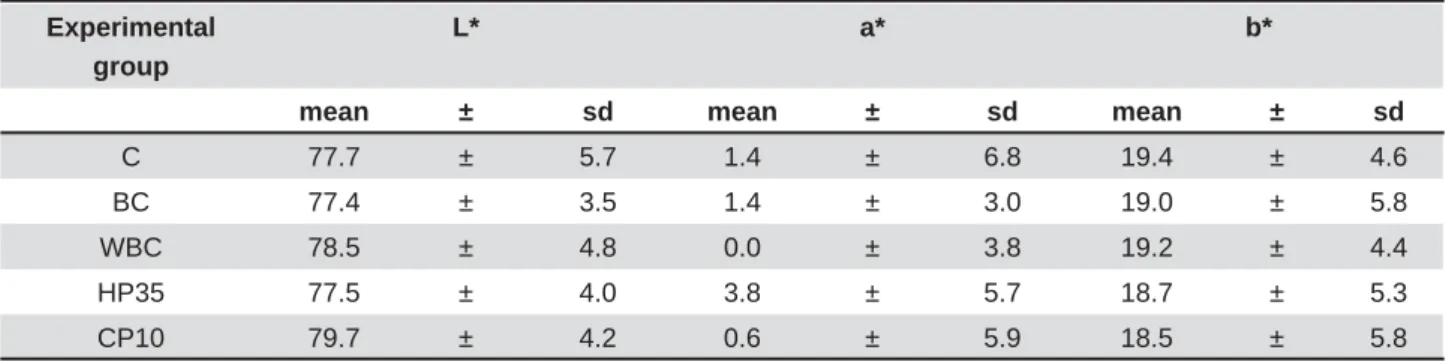
Each experimental group color characteristics (L*, a*, and b*) at baseline - means ± standard deviation (SD) – are shown in Table 1.
Color diIIerence ¨E
The repeated measures mixed ANOVA showed significance for experimental groups, and the interaction between evaluation times and experimental groups (p<0.001). Since there was signi¿cance between the interaction of the factors, a post h oc Bonferroni test was performed and demonstrated signi¿cant differences between the groups CP10 and HP35 for the treatments C, BC, and WBC. The means and con¿dence intervals (95% CI) are shown in Table 2.
Luminosity ¨L
Significance was found for the factors experimental group (p<0.001) and evaluation time (p=0.006). The interaction between factors showed up at the signi¿cance threshold (p=0.054). The Bonferroni test demonstrated statistically signi¿cant differences between groups WBC, HP35 and groups CP10, C and BC. Table 3 shows means and con¿dence intervals (95% CI).
*reenred a[is ¨a
Despite the results from the repeated measures mixed ANOVA, which demonstrate statistically signi¿cant differences in the signi¿cance threshold for time evaluation (p=0.049), the Bonferroni post-test found no signi¿cant difference between
Experimental group
L* a* b*
mean ± sd mean ± sd mean ± sd
C 77.7 ± 5.7 1.4 ± 6.8 19.4 ± 4.6
BC 77.4 ± 3.5 1.4 ± 3.0 19.0 ± 5.8
WBC 78.5 ± 4.8 0.0 ± 3.8 19.2 ± 4.4
HP35 77.5 ± 4.0 3.8 ± 5.7 18.7 ± 5.3
CP10 79.7 ± 4.2 0.6 ± 5.9 18.5 ± 5.8
the evaluation times. The means and con¿dence intervals (95% CI) are shown in Table 3.
Blueyellow a[is ¨E
The repeated measures mixed ANOVA showed signi¿cant differences for the factors evaluation time, experimental group, and the interaction between factors (p<0.001). Overall, the Bonferroni test demonstrated that treatments HP35 and CP10 were signi¿cantly different than treatments C, BC, and WBC. Table 3 shows means and con¿dence intervals (95% CI).
DISCUSSION
Several studies in tooth bleaching using peroxide based products have shown that the yellow-blue axis is the most important factor for the perception of tooth bleaching6,7. Furthermore, a reduction in the b* value occurs more quickly and to a higher extent than reductions in the L* value9,15. This observation was applied in developing the bleaching toothpaste containing Blue Covarine11,13. The “optical” bleaching effect of this toothpaste is based on the change in the perception of the original color of the teeth, due to deposition of a thin blueish color ¿lm on the tooth structure after brushing. The presence of the ¿lm should reduce
the axis b* initial value (blue-yellow), lessening the yellow appearance of teeth. This toothpaste also has a dentifrice abrasive system for the removal of extrinsic stains compared to other whitening toothpastes based on silica14. However, the results of this study showed no evidence of a bleaching effect when using the toothpaste containing Blue Covarine. The analysis of the parameters ƩE, ƩL,
Ʃa, and Ʃb were not identi¿ed as statistically significant differences between the toothpaste containing Blue Covarine group, the control group or a toothpaste without Blue Covarine.
Torres, et al.18 (2013) also found no difference in the parameters of ƩE, ƩL, and Ʃb. A similarity between our current study and the study of Torres, et al.18 (2013) was the use of a spectrophotometer for color measurement, whereas studies that prove the presence of the thin ¿lm Blue Covarine evaluated the color alteration by digital images2 or a colorimeter1,13,14. These methods measure the color from the tooth surface, and therefore may have a greater sensitivity to show the presence of a Blue Covarine ¿lm. The reÀectance spectrophotometer Vita Easyshade Advance, used in this study, is designed speci¿cally for color analysis of teeth, ceramics and other translucent materials. This instrument is programmed to record the color of dentin and deep layers of enamel, ignoring the
Evaluation time Experimental group
C BC WBC HP35 CP10
mean CI 95% mean CI 95% mean CI 95% mean CI 95% mean CI 95%
T1 5.9b 1.8 4.2b 1.8 5.4b 1.8 8.3ab 1.8 11.0a 1.8
T2 4.9b 1.8 4.0b 1.8 5.2b 1.8 11.7a 1.8 10.4a 1.8
T3 4.3b 1.8 4.2b 1.8 6.8ab 1.8 10.7a 1.8 10.5a 1.8
T4 8.7ab 1.8 4.2b 1.8 4.1b 1.8 10.4a 1.8 10.2a 1.8
'LIIHUHQWOHWWHUVLQGLFDWHVLJQL¿FDQWGLIIHUHQFHVS
Table 2- 0HDQDQGFRQ¿GHQFHLQWHUYDOV&,RIFRORUGLIIHUHQFHǻ(IRUHDFKH[SHULPHQWDOJURXSDWDOOHYDOXDWLRQWLPH SRLQWV'LIIHUHQWOHWWHUVLQGLFDWHVLJQL¿FDQWGLIIHUHQFHVS
Evaluation
time Experimental group
C BC WBC HP35 CP10
ǻ/ ǻD ǻE ǻ/ ǻD ǻE ǻ/ ǻD ǻE ǻ/ ǻD ǻE ǻ/ ǻD ǻE
T1 -1.8fg -1.6a -3.8de 0.8defg -1.2a -1.9e 3.4abcd -1.4a -2.2e 4.5abc -0.2a -6.2cd 6.3ab -1.3a -8.1abc
T2 -1.8fg -2.9a -2.3e 0.6efg -1.9a -1.7e 2.8bcde -1.9a -3.0de 2.0cde -1.4a -10.5a 5.1abc -1.7a -8.0abc
T3 -0.2efg -2.7a -1.3e 1.7def -1.6a -1.2e 3.6abcd -1.2a -1.4e 3.2abcde -1.7a -9.7ab 6.6a -1.4a -7.1bc
T4 -2.4g -2.7a -0.4e -0.5fg 0.0a 1.3f 2.4cde -1.1a -1.4e 5.0abc -1.3a -8.4abc 4.3abc -1.9a -8.0abc
'LIIHUHQWOHWWHUVLQGLFDWHVLJQL¿FDQWGLIIHUHQFHVS&RQ¿GHQFHLQWHUYDOVRIOXPLQRVLW\ǻ/JUHHQUHGD[LVǻDDQG EOXH\HOORZD[LVǻEZHUHDQGUHVSHFWLYHO\
reflection and the surface irregularities of the enamel. Therefore, this may be responsible for the lack of an apparent bleaching effect on the specimens analyzed, as the Blue Covarine ¿lm, responsible for the optical bleaching effect, is deposited only on the surface of teeth, and may not be effectively detected by spectrophotometric methods. Another reason is that the acquired pellicle may not have been properly formed, because the specimens used in this study were stored in arti¿cial saliva, whereas in other studies human saliva was used, having an indication of a strong af¿nity of the Blue Covarine with some components of the acquired pellicle1,13.
Except for Ʃa, groups C, BC, and WBC were signi¿cantly different from groups HP35 and CP10 for all other parameters analyzed. The latter groups were used as positive controls because they are substances with proven ef¿cacy in tooth bleaching. Thus, the null hypothesis was rejected because the bleaching toothpaste containing Blue Covarine did not promote tooth bleaching similar to at-home and in-of¿ce techniques. As previously demonstrated, in-of¿ce and at-home bleaching products promoted similar bleaching, which remained in the T4 analysis, demonstrating that both techniques are effective and stable for at least 21 days after the end of the treatment.
CONCLUSION
Within the limitations of this in vit ro study, it can be concluded that the use of bleaching toothpastes either with or without Blue Covarine is signi¿cantly less effective at whitening teeth than either an in-of¿ce 35% hydrogen peroxide or an at-home 10% carbamide peroxide bleaching agent. Furthermore, the bleaching toothpaste with Blue Covarine did not show a statistically signi¿cant improvement over a conventional bleaching toothpaste without Blue Covarine, and neither of these bleaching toothpaste were more effective than the control.
ACKNOWLEDGEMENTS
We thank the Scienti¿c Initiation Program of the Dean of Research at UNESP (PIBIC - UNESP) and FGM for their support to this research.
REFERENCES
1- Ashcroft AT, Cox TF, Joiner A, Laucello M, Philpotts CJ, Spradbery PS, et al. Evaluation of a new silica whitening toothpaste containing blue covarine on the colour of anterior restoration materials in vit r o. J Dent. 2008;36:26-31.
2- Collins LZ, Naeeni M, Platten SM. Instant tooth whitening from a silica toothpaste containing blue covarine. J Dent. 2008;36:21-5. 3- Costa CA, Riehl H, Kina JF, Sacono NT, Hebling J. Human pulp responses to in-of¿ce tooth bleaching. Oral Surg Oral Med Oral Pathol Oral Radiol Endod. 2010;109(4):e59-64.
4- Dahl JE, Pallesen U. Tooth bleaching - a critical review of the biological aspects. Crit Rev Oral Biol Med. 2003;14(4):292-304. 5- Dias Ribeiro AP, Sacono NT, Lessa FC, Nogueira I, Coldebella CR, Hebling J, et al. Cytotoxic effect of a 35% hydrogen peroxide bleaching gel on odontoblast-like MDPC-23 cells. Oral Surg Oral Med Oral Pathol Oral Radiol Endod. 2009;108(3):458-64. 6- Gerlach RW, Barker ML, Sagel PA. Objective and subjective whitening response of two self-directed bleaching systems. Am J Dent. 2002;15:7A-12A.
7- Gerlach RW, Gibb RD, Sagel PA. A randomized clinical trial comparing a novel 5.3% hydrogen peroxide whitening strip to 10%, 15%, and 20% carbamide peroxide tray-based bleaching systems. Compend Contin Educ Dent Suppl. 2000;(29):S22-8; quiz S42-3.
8- Goldberg M, Grootveld M, Lynch E. Undesirable and adverse effects of tooth-whitening products: a review. Clin Oral Investig. 2010;14(1):1-10.
9- Goodson JM, Tavares M, Sweeney M, Stultz J, Newman M, Smith V, et al. Tooth whitening: tooth color changes following treatment by peroxide and light. J Clin Dent. 2004;16(3):78-82.
10- Joiner A. The bleaching of teeth: a review of the literature. J Dent. 2006;34(7):412-9.
11- Joiner A. A silica toothpaste containing blue covarine: a new technological breakthrough in whitening. Int Dental J. 2009;59(5):284-8.
12- Joiner A. Whitening toothpastes: a review of the literature. J Dent. 2010;38:e17-24.
13- Joiner A, Philpotts CJ, Alonso C, Ashcroft AT, Sygrove NJ. A novel optical approach to achieving tooth whitening.J Dent. 2008;36:S8-14.
14- Joiner A, Philpotts CJ, Ashcroft AT, Laucello M, Salvaderi A.
I n vit r o cleaning, abrasion and Àuoride ef¿cacy of a new silica based whitening toothpaste containing blue covarine. J Dent. 2008;36:S32-7.
15- Kleber CJ, Putt MS, Nelson BJ. I n v it r o tooth whitening by a sodium bicarbonate/peroxide dentifrice. J Clin Dent. 1997;9(1):16-21.
16- Markowitz K. Pretty painful: why does tooth bleaching hurt? Med Hypotheses. 2010;74(5):835-40.
17- Roderjan DA SR, Hebling J, Souza Costa CA, Soares DG, Reis A, Loguercio AD. Histopathological features of dental pulp tissue from bleached mandibular incisors. J Mater Sci Engin B. 2014;4(6):178-85.
18- Torres CR, Perote LC, Gutierrez NC, Pucci CR, Borges AB. Ef¿cacy of mouth rinses and toothpaste on tooth whitening. Oper Dent. 2013;38(1):57-62.
19- Trindade FZ, Ribeiro AP, Sacono NT, Oliveira CF, Lessa FC, Hebling J, et al. Trans-enamel and trans-dentinal cytotoxic effects of a 35% H2O2 bleaching gel on cultured odontoblast cell lines