477
Pakistan Veterinary Journal
ISSN: 0253-8318 (PRINT), 2074-7764 (ONLINE)
Accessible at: www.pvj.com.pk
Clinicopathological Effects of Prolonged Intoxication of Aflatoxin B1 in Broiler Chicken
Zahid Hussain1, Muhammad Zargham Khan2, Muhammad Kashif Saleemi2*, Ahrar Khan2 and Shahid Rafique3
1Poultry Research Institute Rawalpindi, Pakistan; 2Department of Pathology, University of Agriculture, Faisalabad,
Pakistan; 3Animal Sciences Division, Pakistan Agricultural Research Council, Islamabad, Pakistan
*Corresponding author: [email protected]
ARTICLE HISTORY (15-526) A B S T R A C T
Received: Revised: Accepted: Published online:
December 31, 2015 August 31, 2016 September 04, 2016 September 17, 2016
In this study pure Aflatoxin B1 (AFB1) was given to broiler birds at the rate of 50, 100, 200, 400 and 800µg/kg feed for 28 days. Birds of experimental groups intoxicated with 50, 100 and 200µg/kg feed did not show any clinical and behavior alteration. Birds of experimental groups intoxicated with 400 and 800µg/kg showed depression, ruffled feathers and had decreased feed intake, increased water consumption with soft to watery feces. Birds fed 800µg/kg AFB1 for 28 days also exhibited nervous signs (torticollis). Mortality occurred in all treatment groups with the exception of those given 50 and 100µg/kg AFB1 for 28 days. Clinical signs and mortality percentages score increased with the increase in AFB1 levels. Dose related significantly decreased in relative organs weight were recorded in all groups with the exception of birds given 50 and 100µg/kg AFB1 for 28 days. Significantly increased scores of gross lesions were recorded with increasing dietary levels of AFB1. The present study concluded that, AFB1 at level of 50µg/kg feed did not show any behavioral, gross and pathological effect on broilers when fed continuously for 28 day. In other groups pathological changes were seen in dose related manner. Severe changes were seen in higher dose levels.
©2016 PVJ. All rights reserved Key words:
Aflatoxin B1 Broilers Clinical signs Gross lesions Intoxication Mortality
To Cite This Article: Hussain Z, Khan MZ, Saleemi MK, Khan A and Rafique S, 2016. Clinicopathological effects of prolonged intoxication of aflatoxin B1 in broiler chicken. Pak Vet J, 36(4): 477-481.
INTRODUCTION
Mycotoxins are produced by some toxigenic fungi under favorable environmental conditions (Ahmad et al., 2012; Lee and Ryu, 2015; Elzupir et al., 2015). Mycotoxins are second most important issue faced by the world poultry industry after high feed prices. Aflatoxins (AF) are detected in finished poultry feeds and its ingredients throughout this globe (Binder et al., 2007; Saleemi et al., 2012; Ahangarkani et al., 2014; Greco et al., 2015; Zainudin and Perumal, 2015). Presence of aflatoxins in poultry feed and consumption of AF-contaminated feed and feed stuff by the birds leads to retarded growth, decreased feed intake, high mortality, lower egg laying capacity, and discarding of carcass (Hassan et al., 2012b; Khan et al., 2014; Nazir et al., 2014; Bilal et al., 2014; Valtchev et al., 2015).
Aflatoxins are of four types B1, B2, G1 and G2. AFB1 is a known carcinogen. In the published literature, immunotoxicity in birds and mammals of AFB1 is proven (Mehrzad et al., 2015; Ben Salah-Abbes et al., 2015) and even it harmfully distresses the immune system of developing embryos (Qureshi et al., 1998) which has been
also reported in recent findings by Zahoor-ul-Hassan et al. (2012). Moreover, in embryos hatched from eggs collected from aflatoxins exposed hens also showed severe DNA damage in B- and T-lymphocytes (Zhang et al., 2015). In the developing countries, the same food chain is shared by the animal and human population which may result in provision of poor quality grains to the human population. Keeping in view the grains quality, the present study was planned and executed with the objectives to determine clinicopathological effects of prolonged aflatoxins intoxication in broiler chicks.
MATERIALS AND METHODS
Production and quantification of aflatoxins: Aflatoxins were produced on rice (Hussain et al., 2008).
Briefly, 25ml distilled water plus 25μl trace metal
(ZnSO4· 7H2O = 1.0g, CuSO4· 5H2O = 0.50g, in 100 ml
distilled water) solution was added to the rice. Spores of Aspergillus flavus (link: Fries. A. NRRL 6540 and CECT. 2687) were inoculated into rice. Quantifications of aflatoxins were carried out by HPLC method 990.33 (Anonymous, 2000).
Preparation of experimental feeds: Feed (corn, soy meal) with 22% total protein, providing 3000 Kcal/kg metabolizable energy was prepared and was analyzed for Aflatoxin, Ochratoxin and Zearalenone by TLC (Howell and Taylor, 1981). AFB1 quantity to be mixed with feed for every group was calculated. Fermented rice comprising the required amount of AFB1 were weighed and extracted by soaking into a threefold quantity of chloroform (100:300) for overnight and filtered through cotton cloth. All solvent was evaporated through rotary evaporator. Then concentrated residues were re-suspended into 100ml Polyethylene glycol and evenly mixed with 0.5kg, then in 2kg and finally in the required quantity of feed.
Experimental Birds: Broiler chicks (n=480) of 14 days of age were divided equally into 6 groups (A-F). Group A was kept as a nontoxic control group. Aflatoxin B1 suspended in polyethylene glycol was mixed in the feed of these groups at a level of 0, 50, 100, 200, 400, and 800µg/ kg feed dose levels. On days 1, 5, 10, 15, 20, 25, 28, 31, 36 and 42 of the experiment, six birds were killed humanely from each group. The remaining chickens were killed humanely at 56 days of age, i.e., end of the experiment.
Clinical signs and behavior alterations: Clinical signs and behavior alterations were recorded two times daily for desirability to feed and water, alertness, feces consistency, feather appearance and nervous signs. Each clinical signs were subjectively assigned a score from 0-3 according to its absence (0) and intensity (1-3) and number of birds showing the sign in each group. Two observations for each condition was recorded every day and averaged. Daily score was added at the end of the experiment to get a total score of each group in each experiment (Hussain et al., 2010). Mortalities of experimental birds in each group, their organ absolute and relative weights were recorded at each killing.
Gross and microscopic pathology: Six birds were individually weighed, sacrificed for gross examinations of visceral organs. Liver and kidneys were collected from each bird and fixed in formalin (10% neutral buffered) for further tissue studies. The gross lesions were subjected to score (0-2) depending upon the absence (0) and intensity (1-2). Values assigned for a particular lesion for all birds of a group necropsied were added to obtain an individual lesion score and summed up to obtain a lesion score for a particular time. Finally, a cumulative lesion score for a group was obtained by adding of all lesion scores of that group.
Statistical analysis: One-way ANOVA test was applied to analyze the data by using MSTAT C statistical software. The group means were compared by using DMR
test and significance level was P≤0.05.
RESULTS AND DISCUSSION
In this experiment different feed levels of Aflatoxins were calculated on the basis of AFB1 concentration in the fermented rice, ranging from 0, 50, 100, 200, 400 and 800µg/kg feed. Feed aflatoxins at concentrations varying from 50 to 2000µg/kg for variable time periods have been used to induce aflatoxicosis of subacute, acute and chronic
(Rosa et al., 2001; Ortatatli et al., 2005). In this study different dose levels (50, 100, 200, 400 and 800 µg AFB1/ kg feed) were offered to chicks of 14 days of age for 28.
Clinical signs and behavioral alterations: A subjective comparison of different clinical signs and behavioral alterations based upon the visual assessment of has been shown in Table 1. All the parameters in this table indicated surge in severity of the clinical signs with an increase in the dietary levels of aflatoxins.
Birds of group A (control), B (50µg/kg) and C (100µg/kg) behaved normally in terms of attraction toward feed, water intake, fecal consistency, feather condition and nervous signs throughout the length of the experiment. The lesser attraction toward the feed and increased interest in drinking water was observed in groups D (200µg/kg), E (400µg/kg) and F (800µg/kg) as compared with other groups. The consistency of feces of the birds of groups A (0µg/kg), B (50µg/kg) and C (100µg/kg) was firmed while those of Groups D (200µg/kg) had loose droppings. Birds of Groups E 400µg/kg) and F (800µg/kg) had watery droppings. Feather of birds of group A were shiny while the feathers of birds of group B (50µg/kg), C (100µg/kg) and D (200µg/kg) did not vary from those of Group A. Groups E and F showed less shiny, ruffled and broken feathers as compared with control group A. Similar clinical signs have already been reported (Kubena et al., 1998; Hussain et al., 2008; Khan and Zahoor, 2014). All these researchers described unthriftiness, increased water intake, anorexia and mortality as general changes during aflatoxicosis. During toxicity, increased water intake could be an effort to dodge desiccation thus regaining water loss from the body due to diarrhea. Nervous signs comprising of torticollis (Fig. 1) were observed in some birds of group F (800µg/kg) only started on day 20th of the experiment, while other birds
of other groups did not show signs of nervous derangement. Nervous derangement resulting as torticollis was observed only in some of the birds given 800µg AFB1/kg feed for 28 days in the present study. Similar nervous signs have also been reported by Chohota et al. (2000) during a concurrent outbreak of chlamydiosis and aflatoxicosis in chickens having 500ppb aflatoxin in feed. Signs of nervous derangement have been observed in ducks suffering from aflatoxicosis (Hoerr, 2003). No clinical signs were observed in the present study in group A (0µg AFB1/kg) and B (50µg AFB1/kg). Similar results were reported by Ortatatli and Oguz. (2001). In this experiment a subjective scoring of clinical signs revealed an increase in severity of signs with the escalation of AF consumption through feed in the same age birds, suggested a dose related increase and age related decrease in severity of clinical signs of aflatoxicosis.
Table 1: Clinical signs and behavior score of broilers given different levels of dietary aflatoxin B1 from 14 days to 42 days of age
Clinical signs and behavior Score range Groups (Aflatoxin B1 µg/kg feed)
A (0) B (50) C (100) D (200) E (400) F (800)
Alertness normal – depressed 0-3 - - - 30 30 62
Attraction to feed normal – less interest 0-3 - - - 110 120 132
Attraction to water normal – more/less interest 0-3 - - 56 86 112 168
Feces consistency normal form – watery 0-3 - - - 138 142 150
Feather normal shiny – ruffled & Broken 0-3 - - - - 56 112
Nervous derangement: no – present 0-3 - - - 9
Cumulative score 0 0 56 364 460 633
Table 2: Mortality of broiler chicks given different dietary levels of aflatoxin B1 from 14 days to 42 days of age
Experiment (weeks/Days) Age of birds (Days)
Groups (Aflatoxin B1 µg/kg feed) Weeks
Days A B C D E F
0 50 100 200 400 800
1 - 14-21 - - - -
2 - 22-24 - - - -
2 10
11 12 13
25 26 27 28
- - - -
- - - -
- - - -
- - - -
- - - -
1 1 2 1 3
- 29
30-35 - -
- -
- -
2 -
2 -
- -
4 - 36-42 - - - -
5 - 43-49 - - - -
Mortality (No.) - - - 4 5
Mortality (%) - - - - 3.33 6.33 8.33
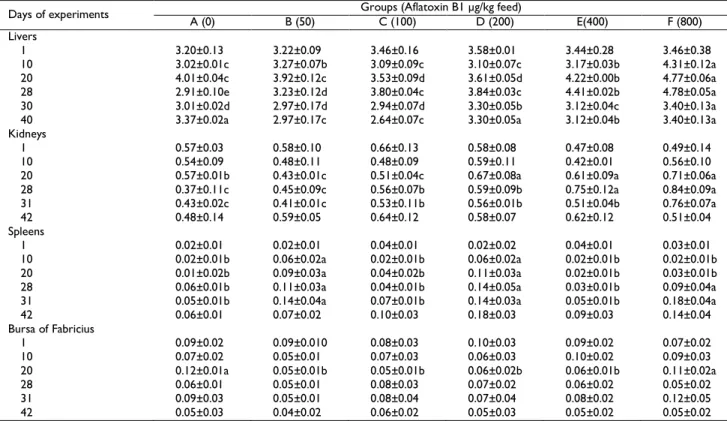
Relative organ weights: The relative organ weights of different organs on each killing were shown in Table. 3. These results showed significantly higher values with an increase in feeding AFB1 levels. The relative weight of each organ was increased up to 31st day of the experiment.
On day 42 weights of all the organs were non-significantly different from control.
Same dietary levels of aflatoxins, however, resulted in a non-significant difference in body weight of birds above 21 days of age suggesting an age related development of resistance in chicks towards aflatoxins. Quezada et al. (2000) reported a non-significant change in body weight of 4 weeks old broiler chicken by feeding AFB1 up to 2.0µg/g of feed. Our result showed a similar trend of age related development of resistance.
Gross lesions: Birds in Group A and B did not show any abnormality and gross lesions throughout the length of the experiment. Liver was normal in color and consistency. Kidneys, heart, spleen, thymus, intestine and subcutaneous tissues were normal in appearance throughout the length of the experiment.
The constant gross lesion observed in the current study was hepatomegaly and anemic liver of birds. This change was followed by moderately enlarged kidneys and hemorrhages on different organs/tissues of the body of the intoxicated birds. Birds in Group C (100µg/kg) showed moderate enlargement of the liver and kidneys on 25th and
28th days of the experiment. In group D and E no such
changes were observed in any organ or tissue on days 1, 5, 10 and 15. On days 20 and 25 there was a moderate enlargement of liver and kidneys. On day 28 livers and kidneys were larger than those of group A and pale in color some of the birds also showed some petechial hemorrhages on these organs (Fig. 2A). On day 31, liver was moderately enlarged, but no hemorrhages were present on it. On days 36 and 42 all organs appeared normal, when compared with those of the control birds. Birds in group F (8200µg/kg) showed gross enlargement of liver and kidneys on day 15 of the experiment. On day 20 and 25 enlarged livers were light in color and friable in nature (Fig. 2B). On day 28 different organs also showed the presence of petechial and ecchymotic hemorrhages. On day 31 no hemorrhagic lesions were present in any organ, but swelling of liver and kidneys was still persistent. On day 36 and 42 all the organs were normal in size, appearance and consistency compared with those of group A. Similar lesions in the liver have been reported by Khan et al. (2014) in the layer breeders.
Enlarged livers and kidneys in the present study were also evident by the significant increase in relative weights of these organs in different groups. A subjective comparison of different gross lesions based upon the visual assessment of birds of different treatment groups has been shown in Table 4. Pallor of the liver attained the highest score in group F (800µg/kg), which was significantly different from groups D (200µg/kg) and C (100µg/kg). Group C (100µg/kg) showed significantly lower values than B (50µg/kg) and F (800µg/kg).
Fig. 1: Torticollis in bird on 20th day of experiment fed AFB1 800µg/kg (group F).
Table 3: Relative weights (% of body weight) of different organs of birds given different levels of dietary aflatoxin B1 from 14 days to 42 days of age
Days of experiments Groups (Aflatoxin B1 µg/kg feed)
A (0) B (50) C (100) D (200) E(400) F (800)
Livers
1 3.20±0.13 3.22±0.09 3.46±0.16 3.58±0.01 3.44±0.28 3.46±0.38
10 3.02±0.01c 3.27±0.07b 3.09±0.09c 3.10±0.07c 3.17±0.03b 4.31±0.12a
20 4.01±0.04c 3.92±0.12c 3.53±0.09d 3.61±0.05d 4.22±0.00b 4.77±0.06a
28 2.91±0.10e 3.23±0.12d 3.80±0.04c 3.84±0.03c 4.41±0.02b 4.78±0.05a
30 3.01±0.02d 2.97±0.17d 2.94±0.07d 3.30±0.05b 3.12±0.04c 3.40±0.13a
40 3.37±0.02a 2.97±0.17c 2.64±0.07c 3.30±0.05a 3.12±0.04b 3.40±0.13a
Kidneys
1 0.57±0.03 0.58±0.10 0.66±0.13 0.58±0.08 0.47±0.08 0.49±0.14
10 0.54±0.09 0.48±0.11 0.48±0.09 0.59±0.11 0.42±0.01 0.56±0.10
20 0.57±0.01b 0.43±0.01c 0.51±0.04c 0.67±0.08a 0.61±0.09a 0.71±0.06a
28 0.37±0.11c 0.45±0.09c 0.56±0.07b 0.59±0.09b 0.75±0.12a 0.84±0.09a
31 0.43±0.02c 0.41±0.01c 0.53±0.11b 0.56±0.01b 0.51±0.04b 0.76±0.07a
42 0.48±0.14 0.59±0.05 0.64±0.12 0.58±0.07 0.62±0.12 0.51±0.04
Spleens
1 0.02±0.01 0.02±0.01 0.04±0.01 0.02±0.02 0.04±0.01 0.03±0.01
10 0.02±0.01b 0.06±0.02a 0.02±0.01b 0.06±0.02a 0.02±0.01b 0.02±0.01b
20 0.01±0.02b 0.09±0.03a 0.04±0.02b 0.11±0.03a 0.02±0.01b 0.03±0.01b
28 0.06±0.01b 0.11±0.03a 0.04±0.01b 0.14±0.05a 0.03±0.01b 0.09±0.04a
31 0.05±0.01b 0.14±0.04a 0.07±0.01b 0.14±0.03a 0.05±0.01b 0.18±0.04a
42 0.06±0.01 0.07±0.02 0.10±0.03 0.18±0.03 0.09±0.03 0.14±0.04
Bursa of Fabricius
1 0.09±0.02 0.09±0.010 0.08±0.03 0.10±0.03 0.09±0.02 0.07±0.02
10 0.07±0.02 0.05±0.01 0.07±0.03 0.06±0.03 0.10±0.02 0.09±0.03
20 0.12±0.01a 0.05±0.01b 0.05±0.01b 0.06±0.02b 0.06±0.01b 0.11±0.02a
28 0.06±0.01 0.05±0.01 0.08±0.03 0.07±0.02 0.06±0.02 0.05±0.02
31 0.09±0.03 0.05±0.01 0.08±0.04 0.07±0.04 0.08±0.02 0.12±0.05
42 0.05±0.03 0.04±0.02 0.06±0.02 0.05±0.03 0.05±0.02 0.05±0.02
Values (mean+SD) with different letters in a row differ significantly (P≤0.05).
Table 4: Gross lesions score in different organs of broiler chicks given different levels of dietary aflatoxin B1 from 14 days to 42 days of age
Lesions
Groups (aflatoxin B1 µg /kg feed) A
(0) B (50)
C (100)
D (200)
E (400)
F (800)
Pallor Liver - - 2c 6bc 14ab 16a
Friable liver - - - 15
Hemorrhages Subcutis - - - 12
Muscular - - - - 10b 21a
Hepatic - - 26b 34ab 32ab 43a
Kidneys - - 10c 28b 31ab 38a
Enteric - - - - 16 22
Heart - - - 3
Enlargement of organs
Liver - - 37c 42bc 52b 72a
Kidneys - - 18c 28bc 36ab 40a
Heart - - - 20
Cumulative Score for each group - - 93d 138c 19b 287a Values with different letters in each row differ significantly (P≤0.05). The maximum possible for each organ was 96 and cumulative score 1056.
The score for hemorrhages on muscles was significantly higher in group F as compared with E. A score of hemorrhages on the liver were significantly higher in group F as compared with group A. The score for hemorrhages on kidneys were highest in group F and significantly different from groups D and C. Group C was also significantly lower from group B. Liver enlargement attained a maximum score in group F (800µg/kg), followed by E, D and C. Group F was significantly different from E which in term was significantly higher than group C. Enlargement of kidneys had highest score in Group F and was significantly different from groups D and C. The cumulative score for gross lesions were significantly different between the groups C, D, E and F, being highest in F followed by E, D and C. These results are in line with (Ortatatli et al., 2005; Shivachandra et al., 2003). Enlarged livers due to aflatoxicosis have also been reported in other birds like Japanese quails (Parlat et al., 1999).
Conclusions: Aflatoxin B1 at level of 50µg/kg feed did not show any behavioral alterations, gross and pathological effect in broilers when fed continuously for 28 days. In other groups pathological changes were seen in a dose related manner. Severe changes were seen in higher dose levels.
Author’s contribution: MKS and MZK conceived the
idea and tailored the project. ZH executed the project, laboratory analysis and manuscript preparation. AK and SR contributed in data analysis, interpretation of research findings and manuscript preparation. All authors approved the final version of manuscript.
REFERENCES
Ahangarkani F, Rouhi S and Azizi IG, 2014. A review on incidence and toxicity of fumonisins. Toxin Rev, 33: 95-100.
Ahmad MF, Saleemi MK, Khan MZ, Muhammad F, Zahoor-ul-Hassan, et al., 2012. Effects of Ochratoxin A feeding in White Leghorn cockerels on hematological and serum biochemical parameters and its amelioration with silymarin and vitamin E. Pak Vet J, 32: 520-524.
Anonymous, 2000. Official method of Analysis. No. 990.33: Natural Toxins, Vol. 2, 17th Ed. Association of Official Analytical Chemist, Gaithersburg, MD, USA, pp: 20-22.
Ben Salah-Abbes J, Abbes S, Jebali R, Haous Z and Oueslati R, 2015. Potential preventive role of lactic acid bacteria against aflatoxin M-1 immunotoxicity and genotoxicity in mice. J Immunotoxicol, M-12: 107-114.
Bilal T, Aksakal DH, Sunnetci S, Keser O and Eseceli H, 2014. Detection of aflatoxin, zearalenone and deoxynivalenol in some feed and feedstuffs in Turkey. Pak Vet J, 34:459-463.
Binder EM, Tan LM, Chin LJ, Handl J and Richard, 2007. Worldwide occurrence of mycotoxins in commodities, feeds and feed ingredients. Animal Feed Sci Tech, 137: 265–282.
Chohota R, Katock RC, Singh SP, Verma S and Mahajan A, 2000. Concurrent outbreak of chlamydosis and aflatoxicosis among chickens in Himaschal Pradesh, India. Vet Arhiv, 70: 207-213. Dos Anjos FR, Ledoux DR, Rottinghaus GE and Chimonyo, M, 2016.
reducing the toxic effects of aflatoxins in chicks. World Mycotoxin J 9: 63-72.
Elzupir AO, Alamer AS and Dutton MF, 2015. The occurrence of aflatoxin in rice worldwide: a review Toxin Rev, 34: 37-42. Greco M, Pardo A and Pose G, 2015. Mycotoxigenic fungi and natural
co-occurrence of mycotoxins in rainbow trout (Oncorhynchus mykiss) feeds. Toxins, 7: 4595-4609.
Hassan ZU, Khan MZ, Khan A, Javed I, Sadique U, et al., 2012. Ochratoxicosis in White Leghorn breeder hens: Production and breeding performance. Pak Vet J, 32: 557–561.
Hoerr FJ, 2003. Mycotoxicoses. In Disease of Poultry. 11th Ed. Iowa State Press Ames, Iowa USA. pp: 1109-1113.
Howell MV and Taylor PW, 1981. Determination of aflatoxins, ochratoxin a, and zearalenone in mixed feeds, with detection by thin layer chromatography or high performance liquid chromatography. J Assoc Official Analyt Chem, 64: 1356-1363. Hussain Z, Khan MZ and Hassan Z, 2008. Production of aflatoxins from
Aspergillus flavus and acute aflatoxicosis in young broiler chicks. Pak J Agri Sci, 45: 96-102.
Hussain Z, Khan MZ, Khan A, Javed I, Saleemi MK, et al., 2010. Residues of aflatoxin B1 in broiler meat: effect of age and dietary aflatoxin B1 levels. Food Chem Toxicol, 48: 3304-3307.
Jakhar KK and Sadana JR, 2004. Sequential pathology of experimental aflatoxicosis in quail and the effect of selenium supplementation in modifying the disease process. Mycopathologia, 157: 99-109. Khan A, Hussain HI, Sattar A, Khan MZ and Abbas RZ, 2014.
Toxico-pathological aspects of arsenic in birds and mammals: A review. Int J Agri Biol, 16: 1213-1224.
Khan FA and Zahoor M, 2014. In vivo detoxification of aflatoxinB1 by magnetic carbon nanostructures prepared from bagasse. BMC Vet Res, 10: Article Number: 255.
Kubena LF, Harvey BR, Bailey RH, Buckley SA and Rottinghaus GE, 1998. Effects of hydrated sodium calcium aluminosilicate (T-BindTM) on mycotoxicosis in broiler chicks. Poult Sci, 77: 1502-1509. Lee HJ and Ryu D, 2015. Advances in mycotoxin research: Public health
perspectives. J Food Sci, 80: T2970-T2983.
Mehrzad J, Devriendt B, Baert K and Cox E, 2015. Aflatoxins of type B and G affect porcine dendritic cell maturation in vitro. J Immunotoxicol, 12: 174-180.
Nazir KHMNH, Hassan J, Durairaj P and Yun H, 2014. Isolation and identification of Aspergillus flavus from poultry feed samples using combined traditional-molecular approach and expression of CYP64A1 AT mRNA level. Pak J Agr Sci, 51: 287-291.
Ortatatli M and Oguz H, 2001 Ameliorative effects of dietary clinoptilolite on pathological changes in broiler chickens during aflatoxicosis. Res Vet Sci, 71: 59-66.
Ortatatli M, Ciftci MK, Tuzcu M and Kaya A, 2002. The effects of aflatoxin on the reproductive system of roosters. Res Vet Sci, 72: 29-36.
Ortatatli M, Oguz H, Hatipog lu F and Karaman M, 2005. Evaluation of pathological changes in broilers during chronic aflatoxin (50 and 100 ppb) and clinoptilolite exposure. Res Vet Sci, 78: 61-68. Parlat SS, Yildiz AO and Oguz H, 1999. Effect of clinoptilolite on
performance of Japanese quail (Coturnix coturnix japonica) during experimental aflatoxicosis. British Poult Sci, 40: 495-500. Quezada T, Cuellar H, Jaramillo-Juarez F, Valdivia AG, and Reyes JL,
2000. Effects of aflatoxin B(1) on the liver and kidney of broiler chickens during development. Comp Biochem Physiol C Toxicol Pharmacol, 125: 265-272.
Qureshi MA, Brake J, Hamilton PB, Hagler WM and Nesheim, 1998. Dietary exposure of broiler breeders to aflatoxin results in immune dysfunction in progeny chicks. Poult Sci, 77: 812–819. Rosa CAR, Miazzo R, Magnoli C, Salvano M, Chiachiera SM, et al., 2001.
Evaluation of the efficacy of bentonite from the south of Argentina to ameliorate the toxic effects of aflatoxin in broilers. Poult Sci, 80: 139-144.
Saleemi MK, Khan MZ, Khan A, Mehmood MA, Farooq M, et al., 2012. Molecular identification of black Aspergilli isolated from poultry feeds by sequencing of ITS-region. Pak Vet J, 32: 171–174. Shivachandra SB, Sah RL, Singh SD, Kataria JM and Manimaran K, 2003.
Immunosuppression in broiler chicks fed aflatoxin and inoculated with fowl adenovirus serotype-4 (FAV-4) associated with hydropericardium syndrome. Vet Res Commun, 27: 39-51. Tessari EN, Oliveira1CA, Cardoso AL, Ledoux DR and Rottinghaus GE,
2006. Effects of aflatoxin B1 and fumonisin B1 on body weight, antibody titres and histology of broiler chicks. British Poult Sci, 47: 357-364.
Valtchev I, Koynarski T, Sotirov L, Nikolov Y, and Petkov P, 2015. Effect of aflatoxin B1 on Moulard duck’s natural immunity. Pak Vet J, 35: 67-70.
Zainudin NAIM and Perumal N, 2015. Mycotoxins production by fusarium and aspergillus species isolated from cornmeal. Int J Agri Biol, 17: 440-448.