AR
TICLE
1 Universidad de Córdoba. Avd. Medina Azahara º5. 14071 Córdoba España. [email protected]
Burnout and its relation to sociodemographic variables
among education professionals working with people
with disabilities in Córdoba (Spain)
Abstract The main objective of this study was to determine the level of burnout among education professionals working with people with disabilities in Córdoba, Spain and the association between these levels and sociodemographic characteristics (sex, age, marital status, and level of education). Design: descriptive, cross-sectional study to deter-mine prevalence. Population: 157 professionals. Evaluation tools: questionnaire to obtain infor-mation on sociodemographic characteristics and the Maslach Burnout Inventory (MBI). Statistical tests: Pearson’s bivariate correlation, the Student’s t-test, Levene’s test, single factor ANOVA, and the post hoc multiple comparison test (Bonferroni). The findings of this study confirm the variety of variables that influence burnout and its dimen-sions. The study shows the incidence of burnout according to the sex, age, marital status, and level of education of the professionals who participated in this research. Based on an exhaustive scientific literature review on the topic and considering the findings of this study, there is an irrefutable need for further research into burnout among profes-sionals who work with people with disabilities. It is hoped that the findings obtained by this study will help in the elaboration of future initiatives directed at the detection, early care, and reduction of this syndrome among this group.
Key words Mental health, Professionals, Educa-tion, Disability, Burnout
Vicente J. Llorent 1
Llo
re
nt
VJ
, R
uiz-C
Introduction
Burnout is the object of numerous studies given its great importance and high impact on work-ers. Stress within and outside the workplace, es-pecially that caused by the demands of updating and professional training requirements during and outside working hours, is a prominent factor underlying this current trend.
Since its discovery, burnout1, also called job
strain2 and burnout syndrome3, is conceived as
a response to interpersonal and emotional job stress in workers who provide specialist services. Burnout has become increasingly present in var-ious professions and is increasingly recognized as a serious problem affecting the quality of life of
many people4. This problem, intensified by poor
and often abusive working conditions, can have serious effects on the mental health of education professionals. This situation is aggravated by sal-ary reductions in times of economic crisis, longer working hours, and an increase in the demands placed upon the teaching profession by society, which in turn has a detrimental effect on the
quality of academic life of students5.
In the middle of the 1980s, research revealed a number of crucial factors affecting the level of burnout among individuals and groups, such as social values, the moment in history, and
eco-nomic status6. For this reason and given the
ex-istence of various theories explaining the
appear-ance of burnout7, theorists and researchers have
faced a number of difficulties in reaching con-sensus regarding the development process of this
phenomenon8.However, it is generally agreed
that the syndrome is associated with high levels of emotional exhaustion, depersonalization, and
reduced personal accomplishment at work9.
As quality of life in more developed countries improves due to the expansion of social services, people begin to demand more and better ser-vices, particularly in the education sector, thus increasing the demands on teachers and requir-ing the constant investment of large amounts of emotional, cognitive and physical energy by
teachers10.
Burnout among professionals working in health and social sciences has been a major focus of researchers’ efforts, and studies have clearly shown that the teaching profession is one of the most affected by burnout. A series of important studies clearly illustrate the high levels of
burn-out among teachers in Spain11-17, while a
num-ber of recent international studies have also
ad-dressed teacher burnout18-23.
Further research is necessary to investigate the dimensions of burnout and the various per-sonal characteristics associated with the syn-drome among education professionals who work with people with disabilities, in settings where education and social services interlock.
The present study intends to provide infor-mation about burnout specifically among pro-fessionals who work with people with disabili-ties, a relatively narrow group of people who are
significantly more vulnerable to the syndrome24.
With this in mind, data was collected from resi-dential care facilities and educational centers for people with disabilities, where learning processes are focused primarily on special basic education, personal autonomy programs, and transition to adult life and work programs. In line with pre-vious research, this study analyzes the sociode-mographic characteristics of these professionals focusing on the following variables: age, sex,
marital status, and level of education8,18,21,25-27.
The main aim of this research is to determine the levels of burnout among education profes-sionals who provide direct care and services to people with disabilities in Córdoba, Spain, and explore the association between these levels and the abovementioned sociodemographic charac-teristics.
Methods
Design
This study addresses a matter of evident con-cern to contemporary society: burnout in profes-sionals who work with people with disabilities. Given that this is a relatively new area of burnout research, the data collected and analyzed by this study illustrates the existing reality of a specific context (Córdoba) during a particular time pe-riod, thus facilitating the identification of the number of individuals who suffer from this syn-drome within a population sample. This study is therefore an example of a descriptive cross-sec-tional study to determine prevalence of this con-dition.
Population
aúd
e C
ole
tiv
a,
21(10):3287-3295,
2016
psychologists, educational psychologists, physio-therapists, auxiliary educational technicians, so-cial educators, carers, and monitors. With respect to gender, 110 professionals were women (70%), while 47 were men (30%). The average age of the sample was 39 years (standard deviation of 13.25).
Tool
Data was collected using a questionnaire to obtain information on sociodemographic char-acteristics and the Maslach Burnout Inventory (MBI).
The questionnaire was based on similar ques-tionnaires used in previous studies on
burn-out8,13,18,21,25-30 and comprised nine items with
open-ended and closed-ended questions to ob-tain information on the study variables: sex, age, marital status, level of education, years of experi-ence, type of contract, length of time in current position, and length of time spent working at the company. Given the wide range of variables, this article focuses on the personal characteristics of the simple members (sex, age, marital status, and level of education).
To assess burnout levels, the study used the
Maslach Burnout Inventory (MBI)31, which finds
considerable consensus in the scientific commu-nity and has been used in various studies
ad-dressing the issue11,14,15,19-22,32. The MBI consists
of 22 items scored on a seven-point frequency rating scale ranging from 0 (never) to 6 (every-day) that assess the syndrome’s three dimensions: emotional exhaustion, depersonalization, and personal accomplishment.
Procedure
After obtaining authorization from the spe-cial education colleges and companies, an ethical agreement was signed preserving the anonymity of individuals and institutions. The question-naires were then distributed to the profession-als, who voluntarily agreed to participate in the study. Three days later the questionnaires were collected.
Statistical tests
The data was grouped, tabulated and ana-lyzed using the Statistical Package for the So-cial Sciences (SPSS) software package. First, a descriptive analysis was conducted to compare the sociodemographic characteristics of the
re-spondents. Inferential statistical analysis was then performed using inductive methods and procedures (sampling, variables, hypothesis test-ing) to determine the statistical properties of a population based on a sample data set and using various statistical tests such as Pearson’s bivari-ate correlation, the Student’s t-test, Levene’s test, single factor ANOVA, and the post hoc multiple comparison test (Bonferroni).
Results
The following sections outline the results of the data analysis. Burnout and its three dimensions were analyzed in relation to four sociodemo-graphic variables: sex, age, marital status, and level of education of the professionals.
Analysis of the prevalence of burnout
Table 1 shows the National Burnout Scale33,
which is used as a point of reference to compare the average MBI scores observed in the present study in order to determine the level of burnout and its three dimensions (low, medium, high) among the sample members.
It can be observed that, based on the
Nation-al Burnout ScNation-ale33, the level of overall burnout
among sample members is high (69.91), while the level of emotional exhaustion, depersonaliza-tion, and personal accomplishment was medium (16.55), very high (12.36), and very low (43.01), respectively.
Using the SPSS 19 software package, indi-viduals were grouped into three level categories (high, medium, and low) according to their aver-age scores. The results show that 70% of individ-uals suffered from high levels of overall burnout, while 30% experienced medium levels. Levels of emotional exhaustion were very high in 14% of the professionals and low in 51%, while levels of depersonalization were very high in 95% of in-dividuals and medium in only 5% of cases. Lev-els of personal accomplishment were very low in 80% of the sample, while only 8% of profession-als felt highly fulfilled.
Descriptive statistics
Llo re nt VJ , R uiz-C
and its three dimensions and the variables and homogeneity of variances.
Burnout and sex
It is important to consider the relationships between burnout and its three dimensions and
sex in the light of previous research21,27.
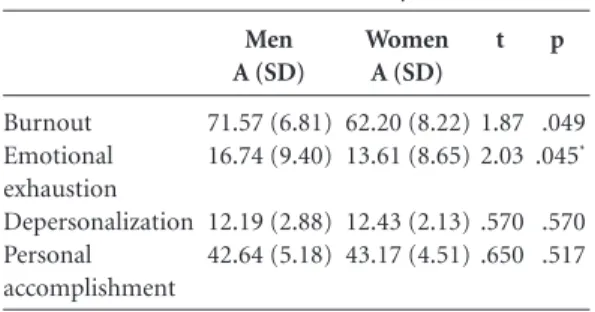
It can be observed from the results of the Student’s t-test shown Table 2 that there was a statistically significant relationship between sex and overall burnout (p = 0.039), and sex and emotional exhaustion (p = 0.045). No significant relationship was found between sex and deper-sonalization (p = 0.570) and sex and personal accomplishment (p = 0.517). Levels of overall burnout and emotional exhaustion are higher in men (71.57 compared to 62.20 and 16.74 com-pared to 13.61, respectively).
Burnout and age
This section outlines the relationship be-tween burnout and its dimensions and the age of the professionals, furthering previous research
concerning burnout18,21,34,35.
Table 3 shows the results of the bivariate Pear-son correlation, indicating that there is a positive correlation between age and overall burnout (r = 0.253; p= .001) and age and emotional exhaus-tion (r = 0.297; p = .001). The results also suggest that levels of burnout and emotional exhaustion are greater in older professionals.
Student’s t-test was performed to corroborate these findings and, at the same time, determine at what ages these relationships take place. Aged was classified into two time intervals whose point
of reference was 50 years21 (professionals aged 49
years and under; and those aged 50 years and over).
Table 3 shows the results of this test, high-lighting that there was a significant relationship between age and burnout (p = 0.000) and age and emotional exhaustion (p = 0.000). Howev-er, no significant relationship was found between age and personalization (p = 0.315) and age and personal accomplishment (p = 0.864).
The results also clearly show that profes-sionals aged 50 years and over suffer from much higher levels of burnout (73.74) than those aged 49 years and under (68.47). It is also important to highlight that the level of emotional exhaustion in professionals aged 50 years and over is medi-um (18.79), while in those aged 49 years and un-der it is very low (12.95).
Burnout and marital status
The marital status categories were chosen
based on previous studies18,21: 1. With a steady
partner – has been in a relationship for over six months; and 2. Without a steady partner – have been in a relationship for six months or less.
Table 4 shows the relationship between marital status and burnout and its dimensions. A significant relationship was only found be-tween marital status and depersonalization (p = 0.004), showing that levels of depersonalization are higher in professionals with a steady partner (12.75) than in those without (11.62). No signifi-cant relationship was found between marital sta-tus and overall burnout (p = 0.758) and the other dimensions, emotional exhaustion (p = 0.158), and personal accomplishment (p = 0.464).
Burnout and level of education
The following outlines the relationship be-tween burnout and its three dimensions and level of education. First, the professionals were
Burnout Emotional exhaustion Depersonalization Personal accomplishment Men A (SD) 71.57 (6.81) 16.74 (9.40) 12.19 (2.88) 42.64 (5.18)
Table 2. Burnout and its dimensions by sex.
t 1.87 2.03 .570 .650 Women A (SD)
62.20 (8.22) 13.61 (8.65) 12.43 (2.13) 43.17 (4.51) p .049 .045* .570 .517
Note: p < .050 / A = average/ SD = standard deviation Source: authors’ elaboration.
Burnout Emotional exhaustion Depersonalization Personal accomplishment Low < 33 < 15 <5 < 40
Table 1. National Burnout Scale and average MBI33
scores obtained in the study.
High > 67 > 25 > 9 > 35 Medium
34 to 66 16 to 24 4 to 8 39 to 34
Study N= 157 69.91 16.55 12.36 43.01
Note: p < 0.050
aúd
e C
ole
tiv
a,
21(10):3287-3295,
2016
grouped according to their level of education (1.
Basic education: Educación General Básica;
Edu-cación Primaria Obligatoria; EduEdu-cación Secund-aria Obligatoria (equivalent to Primary or Ele-mentary School and Middle School and the first two years of High School or Secondary School);
2. Secondary education: Bachillerato Unificado
Polivalente, Curso de Orientación Universitaria, Bachillerato (equivalent to the final two years of Secondary School); and 3. Higher education:
Ciclos Formativos de Grado Superior and univer-sity). Various tests were used to measure associa-tion, including Levene’s test, single factor ANO-VA, and the post hoc multiple comparison test (Bonferroni).
Levene’s test showed that there was an inter-esting relationship between level of education and emotional exhaustion (p = 0.044) and level of education and personal accomplishment (p = 0.008). However, no significant association was found between level of education and overall burnout (p = 0.647) and depersonalization (p= 0.655).
Single factor ANOVA was performed to cor-roborate these findings. The results shown in Ta-ble 5 indicate that level of education is associated with overall burnout (p = 0.003), emotional ex-haustion (p = 0.003), and personal accomplish-ment (p = 0.011). No significant association was found between this variable and depersonaliza-tion (p = 0.372).
A post hoc multiple comparison test (Bon-ferroni) was also performed to determine which level of education category is most affected by burnout and each dimension. The results showed that professionals who had completed only basic education were more affected by burnout than those who had completed secondary (difference between means = 6.64; p = 0.020; d = 0.864) and higher education (difference between means = 7.62; p = 0.002; d = 0.864).
With respect to the dimensions, levels of emotional exhaustion were higher in profession-als who had completed only basic and second-ary education than in those who had completed higher education (difference between means = 7.07, p = 0.014, d = 0.864 and difference between means = 4.24, p = 0.042, d = 0.45 respectively). Furthermore, professionals who had only com-pleted secondary education feel more profession-ally fulfilled than those who had completed high-er education (diffhigh-erence between means = 2.70; p = 0.010; d = 0.864). No significant association was found between level of education and deper-sonalization (p = 0.372).
It is important to highlight that, in compar-ison to the National Burnout Scale (Table 1), the level of burnout was particularly high in all groups: basic education (76.64), secondary ed-ucation (70.00), and higher eded-ucation (69.03). It is also important to note that levels of emo-tional exhaustion were medium in professionals
Burnout
Emotional exhaustion Depersonalization Personal accomplishment
49 years and under A (SD )
68.47 (7.76) 12.95 (8.62) 12.47 (2.13) 43.05 (4.57) Table 3. Burnout and its dimensions by age.
t
3.90 3.79 1 .172 50 years and over A (SD )
73.74 (6.91) 18.79 (8.58) 12.05 (2.92) 42.91 (5.13)
p
.000*
.000*
.315 .864
Note: p< .050 / A = average/ SD = standard deviation Source: authors’ elaboration.
Burnout
Emotional exhaustion Depersonalization Personal accomplishment
Steady partner A (SD)
69.77 (8.29) 13.80 (8.36) 12.75 (2.03) 43.22 (4.46) Table 4. Burnout and its dimensions by marital status.
t
.308 1.42 2.94 .734 Without steady partner A (SD)
70.18 (7.12) 15.93 (9.94) 11.62 (2.77) 42.64 (5.18)
p
.758 .158 .004*
.464
Llo
re
nt
VJ
, R
uiz-C
who had completed basic (20.07) and secondary (17.24) education and low among the higher ed-ucation group (13.00). Furthermore, level of per-sonal accomplishment was low among all profes-sionals regardless of the level of education: basic education (43.73), secondary education (40.88), and higher education (43.58).
Discussion
The scientific literature on burnout produced in recent decades highlights that the teaching profession is one of the most affected by this syndrome. For this reason, the intention of this study from the beginning was to determine the level of burnout among professionals who work specifically with people with disabilities in Cór-doba, and the influence of the sociodemographic variables sex, age, marital status, and level of ed-ucation.
One of the most alarming findings from this study is that 70% of the professionals suffer from high levels of burnout. This finding corroborates the results of previous studies conducted at
na-tional and internana-tional level36-39, which show
that the prevalence of burnout in study samples was over 50%.
This study also shows there are clear gender differences in burnout levels, whereby men expe-rience higher levels of burnout than women, as
found in previous studies27,28. Likewise, men
ex-perience higher levels of work-related emotional exhaustion than women.
The present study also highlights that age is a relevant social variable, since professionals aged 50 years and over suffer from very high levels of burnout, corroborating the findings of several
studies21,35. This may be due to the fact that age
and outdated knowledge and skills may result in an accumulation of work and non-work-related fatigue, which together lead to the appearance of
and gradual increase in burnout. However, oth-er studies on burnout place maximum levels of
burnout on other age groups16,29, which may be
related to level of experience and training. With respect to age, professionals aged 50 years and over suffered more from depersonal-ization than those aged 49 years and under. This finding reinforces similar results from previous
studies25. This may be due to the fact that, over
time, professionals who have been working with people on a daily basis for many years can be-gin to lose empathy. As a result, older people may change their attitude and tend to become more emotionally detached from other people’s
prob-lems and concerns on a professional level35. Along
these lines, this study confirms that professionals aged 50 years and over experience higher levels of burnout and, notably, emotional exhaustion than those aged 49 years and under, who experience very low levels.
The study findings show that there is no sig-nificant association between burnout and marital status. Thus, whether or not the professional has a steady partner is irrelevant to the appearance and development of the syndrome. However, fur-ther analysis showed that fur-there is an association between marital status and depersonalization, whereby professionals with a steady partner feel more depersonalized than those without.
With respect to education level, the results show that professionals who have only complet-ed basic complet-education suffer higher levels of burnout out than those who have completed secondary and higher education. It is also interesting to note that those who have only completed basic edu-cation suffer from higher levels of emotional ex-haustion than professionals who have completed secondary education, while those who have com-pleted secondary education experience greater levels of emotional exhaustion than those who have completed higher education. This may be related to work expectations, which are inversely
Burnout
Emotional exhaustion Depersonalization Personal accomplishment
Basic A (SD)
76.64 (6.97) 20.07 (4.65) 12.79 (2.52) 43.73 (2.08)
Table 5. Burnout and its dimensions by level of education.
Higher A (SD)
69.03 (7.48) 13.00 (8.55) 12.45 (2.31) 43.58 (4.52) Secondary A (SD)
70.00 (8.33) 17.24 (10.21) 11.88 (2.50) 40.88 (5.52)
F
6.18 6.19 .994 4.66
Note: p< .050 / A = average/ SD = standard deviation Source: authors’ elaboration.
p
.003*
.003*
aúd
e C
ole
tiv
a,
21(10):3287-3295,
2016
proportional to emotional exhaustion. With re-spect to personal accomplishment, it is interest-ing to note that professionals who have complet-ed secondary complet-education feel more professionally fulfilled than those who had completed higher education.
The conclusions drawn from this study un-derscore the need for further research into burn-out in professionals who work with people with disabilities, a group that is severely affected by
this syndrome40. This meticulous scientific
con-tribution seeks to nourish scientific knowledge
Llo
re
nt
VJ
, R
uiz-C
References
Freudenberger HJ. Staff Burnout. Journal of Social Is-sues 1974; 30(1):159-165.
Maslach C. Job Burnout: How people cope. Journal of Public Welfare 1977; 36(2):56-58.
Gil-Monte PR, Peiró JM. Perspectivas teóricas y mod-elos interpretativos para el estudio del Síndrome de Quemarse por el Trabajo (Burnout). Revista de
Psicología del Trabajo y de las Organizaciones 1997;
16(2):135-149.
Pereda L, Márquez F, Hoyos MT, Yánez MI. Síndrome de Burnout en médicos y personal paramédico. Revista de Salud Mental 2009; 32(5):399-404.
Rosales Y, Rosales FR. Burnout estudiantil universitar-io. Conceptualización y estuduniversitar-io. Revista de Salud Men-tal 2013; 36:337-345.
Sarason SB. Caring and compassion in clinical practice. San Francisco: Jossey; 1985.
Gil-Monte PR, Unda Rojas S, Sandoval Ocaña JI. Va-lidez factorial del Cuestionario para la Evaluación del Síndrome de Quemarse por el Trabajo (CESQT) en una muestra de maestros mexicanos. Revista de Salud Mental 2009; 32(3):205-214.
Wheeler DL, Vassar M, Worley JA, Barnes LB. A me-ta-analysis of coefficient alpha for the Maslach Burn-out Inventory. Journal of Educational and Psychological
Measurement 2011; 71(1):231-244.
Leiter MP, Maslach C. The impact of interpersonal en-viroment on burnout and organizational commitment.
Journal of Occupational Behavior 1988; 9(4):297-308. Shirom A. Burnout and health: expanding our knowl-edge. Journal of Stress and Health 2009; 25(4):281-285. Guerrero E, Rubio JC. Fuente de estrés y Síndrome de “Burnout” en orientadores de institutos de Enseñanza secundaria. Revista de Educación 2008; 347:229-254. Fernández M. Burnout, Autoeficacia y Estrés en mae-stros. Revista Ciencia y Trabajo 2008; 30:120-125. Arís N. Burnout Syndrome in educators. Electronic
Journal of Research in Educational Psychology 2009;
7(2):829-848.
Pena M, Extremera N. Inteligencia emocional percibida en profesorado de primaria y su relación con los niveles de Burnout e ilusión por el trabajo (engagement). Re-vista de Educación 2012; 359:1-15.
Gil-Monte PR, Figueiredo H. Psychometric properties of the ‘Spanish Burnout Inventory’ among employees working with people with intellectual disability. Journal of Intellectual Disability Research 2013; 57(10):659-968. Pizarro JP, Raya JJ, Castellanos S, Ordóñez N. La per-sonalidad eficaz como factor protector frente al Burn-out. Revista Iberoamericana de Educación 2014; 66:15-18.
Bermejo L, Prieto M. Bienestar docente del Síndrome de Burnout al Engagement en profesores. España: Publicia; 2015.
1. 2. 3.
4.
5.
6. 7.
8.
9.
10. 11.
12. 13.
14.
15.
16.
17. Collaborations
aúd
e C
ole
tiv
a,
21(10):3287-3295,
2016
Gómez C, Rodríguez V, Dávila M, Avella C, Caballero A, Vives N, Mora LS, Márquez G, Prieto Y, Sandoval N, Cotes Z, Hernández S. Prevalencia y características del síndrome de agotamiento profesional en docentes de tres colegios públicos de Bogotá (Colombia). Revista Colombiana de Psiquiatría 2009; 38(1):50-65
Hastings R, Devereux J, Noone S. Staff and Burnout in intellectual disability services: Work stress theory and application. Journal of Applied Research in Intellectual Disabilities 2009; 22:561-573.
Olivares V, Vera A, Juárez A. Prevalencia del Síndrome de Quemarse por el Trabajo (Burnout) en una muestra de profesionales que trabajan con personas con dis-capacidades en Chile. Revista Ciencia y Trabajo 2009; 32:63-71.
Correa Z, Muñoz I, Chaparro AF. Síndrome de Bur-nout en docentes de dos universidades de Popayán, Co-lombia. Revista de Salud Pública 2010; 12(4):589-598. Rionda A, Mares MG. Burnout en profesionales de pri-maria y su desempeño laboral. Revista Latioamericana de Medicina Conductual 2011; 1(2):43-50.
Hensel JM, Lunsky Y, Dewa CS. Exposure to client ag-gression and Burnout among community staff who support adults with intellectual disabilities in Ontario, Canada. Journal of Intellectual Disability Research 2012; 56(9):910-915.
Mercado A, Gil PR. Características psicométricas del “Cuestionario para la evaluación del Síndrome de Que-marse por el Trabajo” en maestros mexicanos. Revista de Educación 2012; 359:260-273.
Morán C. Personalidad, afrontamiento y Burnout en profesionales de atención a personas con discapacidad intelectual. Revista Española sobre Discapacidad Intelec-tual 2005; 213(36):30-39.
Dubai SA, Rampal KG. Prevalencia y factores asociados al burnout en los médicos de Yemen. Journal of Occu-pational Salud 2010; 52:58-65.
Barahona M. Identificación del Burnout en profe-sionales de la salud y factores relacionados con este fenómeno. Revista de Salud Mental 2012; 1:36-47. Golembiewski RT, Scherb K, Boudreau A. Burnout in cross-national settings: Generic and model-specific per-spectives. New York: Hemisphere; 1993.
Gil-Monte PR, Carretero N, Roldan MD, Núñez EM. Prevalencia del síndrome de quemarse por el trabajo (Burnout) en monitores de taller para personas con discapacidad. Revista de Psicología del Trabajo y de las Organizaciones 2005; 12(1):107-123.
Voltmer E, Wingenfeld K, Spahn C, Driessen M, Schulz M. Work-related behaviour and experience patterns of nurses in different professional stages and settings compared to physicians in Germany. International Journal of Mental Health Nursing 2013; 22(2):180-189. 18.
19.
20.
21.
22.
23.
24.
25.
26.
27.
28.
29.
30.
Maslach C, Jackson SE. The measurement of experi-enced Burnout. Journal of occupational Behaviour 1981; 2:99-113.
Graut A, Flichtentrei D, Suñer R, Font S, Prats M, Braga F. El Burnout percibido o sensación de estar quema-do en profesionales sanitarios: prevalencia y factores asociados. Revista de Gestión de Riesgos Laborales 2008; 91(set-des):64-79.
Gil-Monte PR, Peiró JM. Un estudio comparativo sobre criterios normativos y diferenciales para el diagnóstico del Síndrome de Quemarse por el Trabajo (Burnout) según el MBI en España. Revista de Psicología del Traba-jo y de las Organizaciones 2000; 16(2):135-149. Zhu W, Wang Z, Lan YJ, Wu S. Occupational stress and job Burnout in nurses. Sichuan Dau Xue Bao Yi Xue Ban 2010; 2:281-283.
Yslado MR, Nunez Z, Norabuena F. Diagnóstico y pro-grama de intervención para el Síndrome de Burnout en profesores de educación primaria de distritos de Hua-raz e Independencia (2009). Revista de Investigación Psicológica 2010; 13(1):151-162.
Ruiz-Calzado I. Burnout en docentes de Educación Es-pecial de Córdoba (España). Revista Opción 2016. (En prensa).
Imai H, Nakao H, Tsuchiya M, Kuroda Y, Katoh T. Burnout and work environments of public health nurs-es involved in mental health care. Occup Environ Med
2008; 61(9):764-768.
Oliveira KV, Kovacs MH, Wanick S. Burnout entre médicos da Saúde da Família: os desafios da
transfor-mação do trabalho. Cien Saude Colet 2011;
16(8):3373-3382.
Jiménez A, Jara MJ, Miranda ER. Burnout, apoyo social y satisfacción laboral en docentes. Revista Semestral da Associação Brasileira de Psicologia Escolar e Educacional
2012; 16(1):125-134.
Ruiz-Calzado I, Llorent, VJ. El Burnout en los profe-sionales de la educación que trabajan con personas con discapacidad en Córdoba (España). Influencia de las variables laborales. Educación XXI 2015; (en prensa).
Article submitted 27/03/2015 Approved 26/10/2015
Final version submitted 28/10/2015 31.
32.
33.
34.
35.
36.
37.
38.
39.