Dementia & Neuropsychologia 2007;1(4):366-373
Semantic dementia
Brazilian study of nineteen cases
Mirna Lie Hosogi Senaha
1, Paulo Caramelli
2, Claudia Sellitto Porto
3, Ricardo Nitrini
4Abstract – The term semantic dementia was devised by Snowden et al. in 1989 and nowadays, the semantic dementia syndrome is recognized as one of the clinical forms of frontotemporal lobar degeneration (FTLD) and is characterized by a language semantic disturbance associated to non-verbal semantic memory impairment.
Objectives: The aim of this study was to describe a Brazilian sample of 19 semantic dementia cases, emphasizing the clinical characteristics important for differential diagnosis of this syndrome. Methods: Nineteen cases with semantic dementia were evaluated between 1999 and 2007. All patients were submitted to neurological evaluation, neuroimaging exams and cognitive, language and semantic memory evaluation. Results: All patients presented fluent spontaneous speech, preservation of syntactic and phonological aspects of the language, word-finding dif-ficulty, semantic paraphasias, word comprehension impairment, low performance in visual confrontation naming tasks, impairment on tests of non-verbal semantic memory and preservation of autobiographical memory and visuospatial skills. Regarding radiological investigations, temporal lobe atrophy and/or hypoperfusion were found in all patients. Conclusions: The cognitive, linguistic and of neuroimaging data in our case series corroborate other studies showing that semantic dementia constitutes a syndrome with well defined clinical characteristics associated to temporal lobe atrophy.
Key words: semantic dementia, semantic memory, fluent progressive aphasia, primary progressive aphasia, word comprehension, temporal lobe.
Demência semântica: estudo brasileiro de 19 casos
Resumo – O termo demência semântica foi lançado por Snowden et al. em 1989 e, atualmente, a síndrome da demência semântica é reconhecida como uma das formas clínicas da degeneração lobar fronto-temporal (DLFT) e é caracterizada por distúrbio semântico da linguagem associado a comprometimento semântico não-verbal.
Objetivos: Este trabalho teve como objetivo descrever uma amostra brasileira de 19 casos de demência semântica, ressaltando as características clínicas importantes para a realização do diagnóstico diferencial desta síndrome.
Métodos: Foram estudados 19 casos com demência semântica avaliados entre 1999 e 2007. Todos os pacientes foram submetidos à avaliação neurológica, exames de neuroimagem e avaliação cognitiva, da linguagem e da memória semântica. Resultados: Todos os pacientes apresentaram produção espontânea fluente, preservação dos aspectos sintáticos e fonológicos da linguagem, dificuldade em encontrar palavras, parafasias semânticas, dificuldade de compreensão de palavras, baixo desempenho em provas de nomeação por confrontação visual, falhas em provas que avaliam a memória semântica não-verbal e preservação da memória autobiográfica e de ha-bilidades visuoespaciais. Em relação aos achados de neuroimagem, o comprometimento do lobo temporal (atrofia e/ou hipoperfusão) foi encontrado em todos os pacientes.Conclusões: Os achados cognitivos, lingüísticos e de neuroimagem do nosso grupo de pacientes corroboram outros estudos que mostram que a demência semântica constitui uma síndrome com características clínicas bem definidas associada à atrofia do lobo temporal.
Palavras-chave: demência semântica, memória semântica, afasia progressiva fluente, afasia progressiva primária, compreensão de palavras, lobo temporal.
1Speech Pathologist, Member of Behavioral and Cognitive Neurology Unit of the Department of Neurology, University of São Paulo School of Medicine,
São Paulo, Brazil. 2Associate Professor, Department of Internal Medicine, Faculty of Medicine, Federal University of Minas Gerais, Belo Horizonte, Minas
Gerais, Brazil. 3Neuropsychologist, Member of Behavioral and Cognitive Neurology Unit of the Department of Neurology, University of São Paulo School
of Medicine, São Paulo, Brazil. 4Behavioral and Cognitive Neurology Unit of the Department of Neurology, and Cognitive Disorders Reference Center
(CEREDIC). Hospital das Clínicas of the University of São Paulo School of Medicine, São Paulo, Brazil.
Currently, it is acknowledged that a language distur-bance can often be the first symptom of a neurodegen-erative disease and remain the main manifestation of the disease for a significant period. The presence of a progres-sive and predominant language disturbance in the first two years, this being the only factor compromising one of the main criteria for the diagnosis of the primary activities of daily living is progressive aphasia syndrome (PPA).1-4 The existence of this syndrome was reported by Mesulam5 in 1982 through the publication of a paper in which five cases were described with progressive language deterioration without a generalized dementia, associated to left perisyl-vian region atrophy.
After the publication of this seminal article by Me-sulam5 there was great interest in studies on PPA and within a decade more than 100 cases had been reported in the literature.3,6-7 Heterogeneity of the clinical forms of this syndrome became apparent from the different pub-lications. Typically, the PPA initial phase is characterized by an anomic stage. With disease progression, different manifestations can be observed: the anomia continues as a universal finding, but disturbances in the semantic, pho-nological and syntactic aspects of oral and written language vary considerably. Thus, the fluency criteria (articulation, flow, and number of words per utterance) began to be used for the division of the PPA forms. Therefore, the PPA, after the initial anomic stage, has been classified into: non-fluent progressive aphasia (NFPA) with and without agramma-tisms, and fluent progressive aphasia (fPPA) with compre-hension deficits.
According to Mesulam,2 patients with NFPA with agrammatism present deficits in the syntactic and phono-logical aspects of the language in a very similar way to the classic Broca’s aphasia. The main characteristics found are: word-finding deficits, fluency impairment, production of short sentences (telegraphic) with tendency toward gram-matical word absence and difficulties in complex sentences comprehension. The NFPA without agrammatism, also called logopenic progressive aphasia (LPA), occurs from the intensification of the anomia which started in the anomic stage, in such a way that the patient’s speech is marked by long pauses. In addition, LPA patients present production of correct syntactically simple sentences, along with dif-ficulties in syntactic comprehension and preservation of semantic comprehension. The fPPA with comprehension deficits is characterized by spontaneous speech fluency, anomia and word comprehension impairment.
The term semantic dementia (SD) was devised in 1989 by Snowden et al.8 through the publication in which three patients who presented progressive semantic impairment, characterized by deficits in naming and comprehension of
words and objects were described. The patients presented fluent speech, anomia and difficulties in understanding the meaning of words, in spite of the preservation of sentence comprehension. Associated to the language semantic dis-turbance, the patients presented difficulties in recognizing and identifying objects despite the preservation of percep-tual abilities.
Another important study on SD characterization was published by the Cambridge group in 1992. Hodges et al.,9 from a description of five cases, proposed that SD course incorporated the following characteristics: (1) selective impairment of semantic memory causing severe anomia, spoken and written single-word comprehension impair-ment, reduced generation of exemplars on category fluency tests and an impoverished general knowledge; (2) relative sparing of syntax and phonology; (3) normal perceptual skills and non-verbal problem-solving abilities; (4) rela-tively preserved autobiographical and episodic memory; (5) surface dyslexia. The researchers mentioned that some cases with compatible characteristics with SD had been described in the literature under the PPA nomenclature because the main manifestations of SD are language prob-lems. For this reason, they suggest that the use of the SD label should be more pertinent for the cases of fPPA related to verbal and nonverbal semantic knowledge impairment, because the alterations of these patients are not limited to linguistic aspects. Hodges et al. also proposed that the PPA term should be used only for NFPA patients, who have language verbal output deficits with preservation of word comprehension and nonverbal semantic knowledge. From this publication by the Cambridge group, the SD terminol-ogy began to be used by some researchers, as synonymous to fPPA and controversies in the literature and in clinical practice regarding the differentiation between PPA and SD started emerged. Some researchers use the SD label to des-ignate the fluent subtype of PPA, while according to others, SD constitutes a new syndrome.
Consequently, some groups started attributing PPA only to those patients with NFPA and the SD term to pa-tients with fPPA. This classification, contrasting NFPA and SD, was used in the consensus on clinical diagnostic criteria of frontotemporal lobar degeneration (FTLD)10. However, this idea is not unanimous: for some researchers, including Mesulam, the notion that PPA is always non-fluent is in-correct.1-2,11 These researchers defend the idea that PPA in-cludes cases of non-fluent and fluent progressive aphasias.
onset with gradual progression and (b) nonfluent spon-taneous speech with at least one of the following: agram-matism, phonemic paraphasias, and anomia. Also in the consensus, SD is characterized as “semantic aphasia and associative agnosia” and the core features established are: (a) insidious onset and gradual progression, (b) fluency, empty spontaneous speech, (c) loss of word meaning, (d) semantic paraphasias and/or prosopoagnosia and/or, (f) associative agnosia, (g) preserved perceptual matching and drawing reproduction, (h) preserved single-word repeti-tion, (i) preserved ability to read aloud and to write to dic-tation orthographically regular words.
Besides the controversies mentioned previously, an-other issue raised by the Cambridge group is related to the different interpretations given to the consensus on clinical diagnostic criteria of FTLD10 for SD, mainly over the is-sue regarding the presence of associative agnosia and/or prosopoagnosia associated to the aphasic disturbance.12 Ac-cording to the Cambridge researchers,12,13 the designation of SD as “semantic aphasia and associative agnosia” creates confusion and divides opinion in the scientific field regard-ing the fPPA x SD question. However, for some researchers the diagnosis of SD is valid just for those patients whose gnosic impairment interferes in the activities of daily liv-ing, whereas for others such as the Cambridge group, the diagnosis of SD can be attributed to patients presenting mistakes in tests that evaluate nonverbal semantic knowl-edge in spite of the fact that this difficulty does not influ-ence recognition of objects and family members in their daily life. Therefore, Adlam et al.12 suggest that the criteria of consensus for SD10 should be modified regarding the use of the agnosia term where this should be replaced by “com-promise in tests of nonverbal associative knowledge.”
In relation to the anatomical aspects, Gorno-Tempini et al.14 carried out a study with 31 patients with PPA using voxel based morphometry on MRIs. Analyses of all patients showed that the left perisylvian region and the anterior temporal lobes were atrophied. In an analysis dividing the patients according to their clinical manifestations, the authors found the following data: NFPA with agramma-tism was associated with left inferior frontal and insular
atrophy;LPA was associated with left posterior temporal cortex and inferior parietal lobe, and SD was associated with anterior temporal involvement.
The objective of the present study was to describe a Brazilian sample of 19 cases of SD, emphasizing the clini-cal characteristics important for the differential diagnosis of this syndrome.
Methods
Nineteen patients with SD were evaluated between 1999 and 2007. The concept of SD used in this study follows the definition proposed by Addlam et al.12
The patients were submitted to neurological examina-tion, neuroimaging assessment and cognitive, language and semantic memory evaluation. All the patients were submitted to structural (MRI) neuroimaging assessment, except for one case that was submitted to structural (CT) assessment. Additionally, 13 patients were submitted to functional (SPECT) neuroimaging assessment. Most of the patients underwent full neuropsychological evaluation (14) although five patients were submitted to the brief cognitive evaluation.
All of the patients were submitted to the same language and semantic memory evaluation by the same researcher (MLHS) which included: communication functional evalu-ation, aphasia battery tests (Beta MT-86,15 Boston Diagnos-tic Aphasia Exam,16 Boston Naming Test,17 HFSP reading and writing protocols18) and tasks of semantic memory battery described in an earlier paper.19
Results
Nineteen patients, 9 men and 10 women, were evalu-ated. The main demographic data and Mini-mental State Examination (MMSE)20,21 scores are shown in Table 1. All patients were right-handed aged between 58 and 88 years. Of the 19 patients, 11 (57.9%) had disease onset in the presenile phase.
Figure 1 shows the frequency of main linguistic, cog-nitive and neuroimaging findings of 19 patients with se-mantic dementia. All the patients presented in spontane-ous speech: speech fluency, preservation of syntactic and phonological language aspects, word-finding difficulty. Semantic paraphasias were observed in all patients, unlike the phonemic paraphasias which were not verified in any patients. Formal tasks revealed: word comprehension dif-ficulty, low performance in visual confrontation naming tasks, impairment on tests of non-verbal semantic memory and preservation of the autobiographical memory and of visuospatial skills.
Regarding writing abilities, surface dysgraphia was ob-served in majority of the patients (78.9%). In relation to
Table 1. Demographic data of semantic dementia patients.
Mean(SD*)
Minimum/ maximal values
Age 70.3 (9.2) 58-88
Age of onset 66.6 (9.1) 53-82
Educational level 11.9 (5.0) 3-18
Mini-Mental State Exam 21.1 (6.1) 11-29
reading, surface dyslexia was verified in almost half of the patients (47.4%) and the semantic dyslexia in 33.3%.
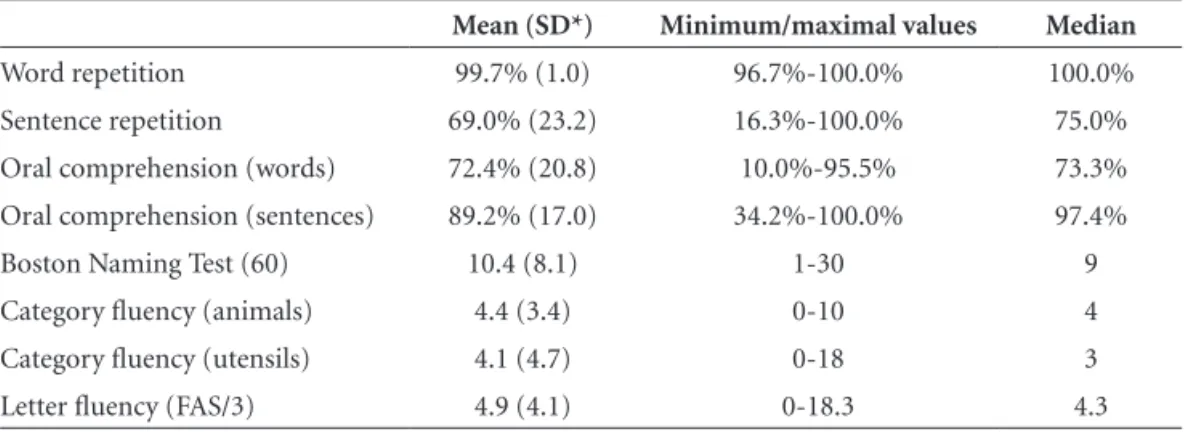
Table 2 shows the patients’ performance in repetition, oral comprehension, naming and verbal fluency tasks. It can be observed that our case series had similar perfor-mance in word repetition, but the same was not observed in sentence repetition. The dissociation between perfor-mances comparing word comprehension (semantic) and the sentence comprehension (syntactic) is evident. All pa-tients had better performance in sentence comprehension tasks than in semantic comprehension. Moreover, variabili-ty of intensivariabili-ty of semantic comprehension impairment was observed through minimum and maximum values: some patients presented intense difficulties and others, mild difficulties. In relation to syntactic comprehension, seven patients obtained maximum performance in the sentence comprehension task and 12 patients (63.2%) obtained per-formance of over 90% correct answers. Low perper-formance of some patients on the sentence comprehension tasks was due to interference from semantic impairment. To
exem-plify, the patient that presented the lowest performance in the sentence comprehension task queried, during execution of the task, the meaning of words that composed the sen-tences of the test such as: “pushes”, “pulls”, “proceeds.” The marked semantic difficulty of this patient was obviously also verified in the word comprehension task. She obtained only 10% correct responses. In visual confrontation nam-ing task, all patients presented low performance while in tasks of verbal fluency, the patients evoked low numbers of elements where difficulty was more intense in the category than in the letter fluency (FAS).
Regarding the neuroimaging assessment, involvement of temporal lobes (atrophy and/or hypoperfusion) was found in all patients (Figure 1). Most of the patients pre-sented temporal lobe atrophy, which was more prominent on the left side, and only one case presented temporal lobe atrophy and hypoperfusion predominantly in the right hemisphere. Figure 2 shows MRI images of some cases. Hypoperfusion limited to the temporal lobes was found in most patients, however three cases presented extension
Figure 1. Frequency of main linguistic, cognitive and neuroimaging findings of nineteen patients with semantic dementia.
Table 2. Performance of semantic dementia patients on language tasks.
Mean (SD*) Minimum/maximal values Median
Word repetition 99.7% (1.0) 96.7%-100.0% 100.0%
Sentence repetition 69.0% (23.2) 16.3%-100.0% 75.0%
Oral comprehension (words) 72.4% (20.8) 10.0%-95.5% 73.3%
Oral comprehension (sentences) 89.2% (17.0) 34.2%-100.0% 97.4%
Boston Naming Test (60) 10.4 (8.1) 1-30 9
Category fluency (animals) 4.4 (3.4) 0-10 4
Category fluency (utensils) 4.1 (4.7) 0-18 3
Letter fluency (FAS/3) 4.9 (4.1) 0-18.3 4.3
of the hypoperfusion to the parietal lobe, and two cases to the frontal lobe.
Majority of the patients presented no behavior altera-tions. However, two cases presented disinhibition since the first evaluation. A further 2 patients out of 7 who were followed up, presented behavioral alterations with progres-sion of the disease.
Discussion
In our sample, in spite of the fact that most patients had disease onset in the presenile phase, the average age of onset was higher than other studies in the literature.3,6,14,22 The performance and variability found in scores on the MMSE20,21 can be attributed to the different degrees of se-mantic deficits and verbal production. The impact of the language disturbance should be considered, in the patients’ cognitive evaluation with PPA and SD, in interpreting the findings, because formal tests of neuropsychological batter-ies often depend on verbal comprehension of instructions, verbal responses or covert verbal reasoning.1,2 In PPA and SD cases, the evaluations of autobiographical memory and activities of daily living should be valued.
The linguistic and cognitive findings showed that the patients constituted a group with very homogeneous char-acteristics (Figure 1). This homogeneity can be explained taking into account that the primordial alteration that oc-curs in SD is semantic memory dissolution. This semantic
deficit explains the anomia, low performance in word com-prehension, verbal fluency tasks, both reading and written by lexico-semantic processes, and impairment in tests of non-verbal semantic memory. Nevertheless, akin to SD the impairment is limited to the semantic memory where pa-tients have good performance in abilities not depending on semantic memory for instance, autobiographical memory, visuospatial skills and word repetition.
In surface dysgraphia and dyslexia, writing and the reading, respectively, are accomplished mainly by pho-neme-grapheme conversion in the writing, and grapheme-phoneme conversion in the reading due to the semantic impairment. Consequently, patients with surface dysgraph-ia have difficulty in writing irregular words correctly in spite of preservation of writing regular words and non-words. The same occurs in patients with surface dyslexia that preserve the capacity to read regular words and non-words alongside the difficulty in reading irregular non-words. The regularization mistakes, that is, the application of the rules of conversion of the language, are pathognomonic symptoms of surface dysgraphia and dyslexia. As shown Figure 1, surface dysgraphia was not diagnosed in four of the 19 patients, however only one case did not pres-ent indications of isolated errors in the lexicon-semantic processing of the writing. This subject however presented a significant disturbance of reading and writing. Another SD case with similar intense disturbance of reading and
writing as our patient has been previously described.9 The other three patients not diagnosed as surface dysgraphics, presented regularizations in the writing of irregular words and were capable of writing through conversion, but we ruled out surface dysgraphia diagnosis in these patients, because two of them had low education (three years) and the other patient was a foreigner and had not received for-mal education in the Portuguese language. Therefore, the regularization mistakes found in these patients may not necessarily have reflected a pathological process, but rather an educational process.
Regarding reading, surface dyslexia was verified in al-most half of the patients (47.4%) and semantic dyslexia in 26.3% of patients. The frequent co-occurrence of surface dyslexia and semantic dementia has been raised and dis-cussed by several researchers,23-31 and in 1992, Hodges et al.9 included the presence of surface dyslexia as one of the cri-teria for the diagnosis of semantic dementia. However, we propose that the semantic dyslexia can also be one of the manifestations of the semantic dementia, and their mani-festations can be explained by three reading routes based on cognitive models.32 Semantic dyslexia is characterized by the reading possibility through the grapheme-phoneme conversion process and by the possibility of direct lexical reading without access to the semantic system. Thus, pa-tients with semantic dyslexia read irregular words correctly, but they do not access the meaning of the word.
The reasoning mentioned previously behind the impact of the disturbance of the semantic memory in different lin-guistic abilities, among them, naming and word comprehen-sion, that take place in SD was put forward by Warrington in 1975.33 From the concepts established by Tulving34 be-tween the distinction among the long term memories in semantic and episodic memories, Warrington reported for the first time, three cases of degenerative disease with se-lective semantic memory impairment in conjunction with relative preservation of episodic memory. The patients seen by Warrington,33 who would now be classified as SD, pre-sented difficulties in recognizing objects in the absence of a sensorial alteration. Moreover, the cases also presented dif-ficulty in understanding the meaning of words and in nam-ing objects and pictures. Other lnam-inguistic abilities were pre-served as well as episodic memory and visuospatial ability.
This feature of SD - selective semantic memory im-pairment together with relative preservation of episodic memory - differentiates SD from Alzheimer’s disease that is characterized in the initial phase by episodic memory impairment. Therefore, it is necessary to be attentive to patient’ memory complaints during the anamnesis, investi-gating if their complaints and problems stem from seman-tic memory or episodic memory impairment.
Besides linguistic and cognitive homogeneous char-acteristics, our patients also presented a relatively similar atrophy pattern: all the patients presented temporal lobe involvement, most with predominant atrophy to the left side. One of our patients presented temporal atrophy pre-dominantly in the right hemisphere. These findings mirror those described in the literature.10,14,35-39
The cognitive, linguistic and neuroimaging data of our case series corroborates other studies showing that SD seems to constitute a syndrome with well defined clinical characteristics associated to temporal lobe atrophy.12,14,37,39
Regarding the differentiation between fPPA and SD, it is important to bear in mind the views of several researchers studying this area. A consensus on classification of PPA has not yet been well established.37-40 Our patients can be classi-fied as SD, and not as fPPA, since they presented language semantic disturbance and impairment on tests of non-ver-bal semantic memory. On the other hand, some researchers could argue that the impairment on the nonverbal seman-tic memory tests seen in most of our patients does not interfere in their activities of daily living and therefore, their difficulties mainly involve linguistic abilities and thus meet the diagnostic criteria of fPPA. According to our ex-perience, fPPA cases with disturbance similar to semantic aphasia but without non-verbal semantic impairment can develop SD19 with progression of the disease. However, we disagreed with the view that every fPPA is an early SD.
The differential diagnosis between neurodegenerative diseases with prevalence of language (SD and PPA) and other neurodegenerative diseases such as Alzheimer’s dis-ease is of great importance to the patient and their rela-tives. SD and PPA patients can be capable, after onset of symptoms, of maintaining many of their functional and even work activities.
Acknowledgments – We are grateful to Dr. Marcelo Calderaro, Dr. Marcia Rubia Gonçalves Rodrigues and Dr. Niures Matioli for their collaboration in neurological ex-amination of some patients.
References
1. Mesulam MM. Primary progressive aphasia. Ann Neurol 2001;49:425-432.
2. Mesulam MM. Primary progressive aphasia – a language-based dementia. N Engl J Med 2003;349:1535-1542. 3. Mesulam MM, Weintraub S. Primary progressive aphasia:
sharp-ening the focus on a clinical syndrome. In: Boller F, Forette F, Kha-chaturian ZS, Poncet M, editors. Heterogeneity of Alzheimer´s disease. Berlim Heiderlberg: Springer-Verlag. 1992:43-66. 4. Rogaslki E, Mesulam MM. An update on primary progressive
5. Mesulam MM. Slowly progressive aphasia without general-ized dementia. Ann Neurol 1982;11: 592-598.
6. Westbury C, Bub D. Primary progressive aphasia: a review of 112 cases. Brain Lang 1997;60: 381-406.
7. Tyrrel PJ, Warrington EK, Frackowiak RS, Rossor MN. Het-erogeneity in progressive aphasia due to focal cortical atro-phy: a clinical and PET study. Brain 1990;113:1321-1336. 8. Snowden JS, Goulding PJ, Neary D. Semantic dementia: a form of
circumscribed cerebral atrophy. Behav Neurol 1989;2:167-182. 9. Hodges JR, Patterson K, Oxburry S, Funnell E. Semantic de-mentia. Progressive fluent aphasia with temporal lobe atro-phy. Brain 1992;115:1783-1806.
10. Neary D, Snowden JS, Gustafson L, et al. Frontotemporal lo-bar degeneration. A consensus on clinical diagnostic criteria. Neurology 1998;51:1546-1554.
11. Mesulam MM, Grossman M, Hillis A, Kertesz A, Weintraub S. The core and halo of primary progressive aphasia and se-mantic dementia. Ann Neurol 2003;54(5 Suppl):11-14. 12. Adlam ALR, Patterson K, Rogers TT, et al. Semantic dementia
and fluent primary progressive aphasia: two sides of the same coin? Brain 2006;129:3066-3080.
13. Knibb JA, Xuereb JH, Patterson K, Hodges JR. Clinical and pathological characterization of progressive aphasia. Ann Neurol 2006;59:156-165.
14. Gorno-Tempini ML, Dronkers NF, Rankin KP, et al. Cogni-tion and anatomy of three variants of primary progressive aphasia. Ann Neurol 2004;55:335-346.
15. Nespoulous JL, Lecours AR, Lafond D, Parente MAMP. Pro-tocole Montréal-Tolouse MT-86 d’examen linguistique de l’aphasie-version Beta. Laboratoire Théophile-Alajouanine, Montréal;1986.
16. Goodglass H, Kaplan E. The Assessment of Aphasia and Relat-ed Disorders. 2nd ed., Philadelphia, PA: Lea & Febiger;1983. 17. Kaplan E, Goodglass H, Weintraub S. The Boston Naming
Test. Philadelphia: Lea & Febiger, 1983.
18. Parente MAMP, Hosogi ML, Delgado AP, Lecours AR. Proto-colo de Leitura para o projeto HFSP,São Paulo;1992. 19. Senaha MLH, Caramelli P, Porto CS, Nitrini R. Verbal and
non-verbal semantic impairment: from fluent primary pro-gressive aphasia to semantic dementia. Dement Neuropsychol 2007;1(2):203-211.
20. Folstein MF, Folstein SE, Mchugh PR. Mini-mental state. A practical method for grading the cognitive state of the pa-tients for the clinician. J Psychiatr Res 1975;12:189-198. 21. Brucki SM, Nitrini R, Caramelli P, Bertolucci PH, Okamoto
IH. Suggestions for utilization of the mini-mental state ex-amination in Brazil. Arq Neuropsiquiatr 2003;61:777-781. 22. Clark DG, Charuvastra A, Miller BL, Shapira JS, Mendez
MF. Fluent versus nonfluent primary progressive aphasia: a comparison of clinical and functional neuroimaging features. Brain Lang 2005;94:54-60.
23. Patterson K, Hodges JR. Deterioration of word meaning: im-plications for reading. Neuropsychologia 1992;30:1025-1040. 24. Parkin AJ. Progressive aphasia without dementia: a clinical and cog-nitive neuropsychological analysis. Brain Lang 1993;44:201-220. 25. Funnell, E. Responses biases in oral reading: an account of the
co-ocorrence of surface dyslexia and semantic dementia. Q J Exp Psychol, 1996;49:417-446.
26. Graham NL, Patterson K, Hodges JR. The impact of seman-tic memory impairment on spelling: evidence from semanseman-tic dementia. Neuropsychologia 2000;38:143-163.
27. Graham NL, Hodges JR, Patterson K. The relationship be-tween comprehension and oral reading in progressive fluent aphasia. Neuropsychologia 1994;32:299-316.
28. Ward J, Stott R, Parkin AJ. The role in reading and spelling: evidence for the “summation hypothesis”. Neuropsychologia 2000;38:1643-1653.
29. Fushimi T, Komori K, Ikeda M, Patterson K, Ijuin M, Tanabe H. Surface dyslexia in a Japanese patient with semantic de-mentia: evidence for similarity-based orthography-to-pho-nology translation. Neuropsychologia 2003;41:1644-1658. 30. Noble K, Glosser G, Grossman M. Oral reading in dementia.
Brain Lang 2000;74:48-69.
31. Cappelletti M, Kopelman M, Butterworth B. Why semantic dementia drives you to the dogs (but not horses): a theorical account. Cogn Neuropsychol 2002;19:483-503.
32. Senaha MLH, Caramelli P, Nitrini R, Charchat-Fichman H, Weekes, BS. Semantic dementia without surface dyslexia: evi-dence from Portuguese. Brain Lang 2006;99:42-43.
33. Warrington EK. Selective impairment of semantic memory. Q J Exp Psychol 1975;27:635-657.
34. Tulving E. Epsidodic and semantic memory. In: Tulving E, Donaldson W, editors. Organization of memory. New York: Academic Press; 1972:381-403.
35. Desgranges B, Matuszewski V, Piolino P, et al. Anatomical and functional alterations in semantic dementia: a voxel-based MRI and PET study. Neurobiol Aging 2007;28:1904-1913. 36. Thompson SA, Patterson K, Hodges JR. Left/right asymmetry
of atrophy in semantic dementia. Behavioral–cognitive im-plications. Neurology 2003;61:1196-1203.
37. Amici S, Gorno-Tempini ML, Ogar JM, Dronkers NF, Miller BL. An overview on primary progressive aphasia and its vari-ants. Behav Neurol 2006;17:77-87.
38. Seeley WW, Baure AM, Miller BL, Gorno-Tempini ML, Kramer JH, Weiner M, Rosen HJ. The natural history of temporal vari-ant frontotemporal dementia. Neurology 2005;64:1384-1390. 39. Knibb JA, Hodges JR. Semantic dementia and primary pro-gressive aphasia: a problem of categorization. Alzheimer Dis Assoc Disord 2005, 19(1 Suppl):7-14.
APPENDIX
Illustrative case report
Case SD2 – A 65-year-old right-handed, retired teacher, presented 3 year history of word finding difficulty together with impaired word comprehension and impaired people recogni-tion (prosopoagnosia). The onset of the disease was slowly insidious with steady worsening. Day-to-day and personal autobiographic memories were unaffected. She continued taking care of her house without difficulty, went shopping in supermarkets and remained able to drive. She did not present depression signs. In the neurological exam, except for the alterations in semantic memory, no other abnormalities were seen. An MRI revealed bilateral temporal atrophy, more marked on the right, including hippocampal atrophy, most intense on the right side. A SPECT scan showed hypoperfusion confined to the right temporal lobe.
Neuropsychological testing revealed a decline in the Dementia Rating Scale – 116/144. Her score on the MMSE was 26/30. There was discrepancy between Verbal and Performance IQ in WAIS scores, which was more marked for verbal (102) than performance (106). Digit Span was 8 forward, 4 backward. Her day-to-day memory was unaffected. Constructional ability was preserved (copy of the Complex Rey-Osterrieth figure: 36/36).