Dementia & Neuropsychologia 2007;1(4):381-385
Semantic, phonologic, and verb fluency
in Huntington’s disease
Mariana Jardim Azambuja
1, Monica Santoro Haddad
2, Marcia Radanovic
3,
Egberto Reis Barbosa
4, Letícia Lessa Mansur
5Abstract – Verbal fluency tasks have been identified as important indicators of executive functioning impairment in patients with frontal lobe dysfunction. Although the usual evaluation of this ability considers phonologic and semantic criteria, there is some evidence that fluency of verbs would be more sensitive in disclosing frontostriatal physiopathology since frontal regions primarily mediate retrieval of verbs. Huntington’s disease usually affects these circuitries. Objective: To compare three types of verbal fluency task in the assessment of frontal-striatal dysfunction in HD subjects. Methods: We studied 26 Huntington’s disease subjects, divided into two subgroups: mild (11) and moderate (15) along with 26 normal volunteers matched for age, gender and schooling, for three types of verbal fluency: phonologic fluency (F-A-S), semantic fluency and fluency of verbs. Results: Huntington’s disease subjects showed a significant reduction in the number of words correctly generated in the three tasks when compared to the normal group. Both controls and Huntington’s disease subjects showed a similar pattern of decreasing task performance with the greatest number of words being generated by semantic elicitation followed by verbs and lastly phonologic criteria. We did not find greater production of verbs compared with F-A-S and semantic conditions. Moreover, the fluency of verbs distinguished only the moderate group from controls. Con-clusion: Our results indicated that phonologic and semantic fluency can be used to evaluate executive functioning, proving more sensitive than verb fluency. However, it is important to point out that the diverse presentations of Huntington’s disease means that an extended sample is necessary for more consistent analysis of this issue.
Key words: Huntington’s disease, verbal fluency, neuropsychological tests, cognition.
Fluência semântica, fonológica e de verbos na doença de Huntington
Resumo – As provas de fluência verbal têm sido consideradas como importantes indicadores de comprometi-mento executivo em pacientes com disfunção de lobo frontal. Embora a avaliação usual dessas habilidades seja baseada em critérios fonológicos e semânticos, existem evidências de que a fluência de verbos seria mais sensível para desvelar a fisiopatologia fronto-estriatal, já que regiões frontais são mediadoras primárias da recuperação de verbos e que a doença de Huntington afeta esses circuitos. Objetivo: Comparar três tipos de fluência verbal na avaliação da disfunção fronto-estriatal, em indivíduos com doença de Huntington. Métodos: Estudamos 26 sujeitos com doença de Huntington divididos em dois grupos: leve (11) e moderado (15), e 26 voluntários normais, emparelhados segundo idade, gênero e escolaridade, nas três condições de fluência: fonema inicial (F-A-S), fluência semântica (animais) e fluência de verbos. Resultados: Os indivíduos com doença de Huntington mostraram redução significante no número de palavras geradas corretamente nas três condições, quando com-parados com o grupo normal. Em controles e na doença de Huntington, notamos comportamento semelhante: maior número de itens gerados por elicitação semântica, seguidos pelos critérios fluência de verbos e fonológico. Não encontramos alteração mais acentuada na produção de verbos, quando comparada com as condições F-A-S e semântica; a fluência de verbos distinguiu somente os doentes mais graves dos controles. Conclusão: Nossos resultados indicam a fluência fonológica e semântica podem ser utilizadas e são mais sensíveis do que a fluência de verbos para avaliar o funcionamento executivo. É importante pontuar, entretanto, que a diversidade de apre-sentação da doença de Huntington exige a ampliação da casuística para análise consistente do tema.
Palavras-chave: doença de Huntington, fluência verbal, testes neuropsicológicos, cognição.
1MSc inExperimental Physiopathology. 2MD, MSc, Assistant-Physician Division of Neurology, Hospital das Clinicas, University of São Paulo School of
Medicine, São Paulo, Brazil. 3MD, PhD Member of Behavioral and Cognitive Neurology Unit of the Department of Neurology, University of São Paulo
School of Medicine, São Paulo, Brazil. 4MD, PhD, Associate-Professor, Department of Neurology, University of São Paulo School of Medicine, São Paulo,
Brazil. 5PhD, Assistant-Professor, Department of Physiotherapy, Speech-Hearing-Language Pathology and Occupational Therapy, University of São Paulo
School of Medicine
Verbal fluency tasks have been identified as important indicators of executive function impairment in patients with frontal lobe dysfunction.1 Thus, various studies have indicated poor performances on phonologic and seman-tic fluency tests in individuals with Huntington’s disease (HD).1-6 The loss in verbal fluency appears early in the course of HD and worsens as the disease progresses.7
Rosser and Hodges1 compared patients with Alzheim-er’s disease (AD), Progressive Supranuclear Paralysis (PSP) and Huntington disease (HD) in semantic verbal fluency and phonological tasks. They suggested that the poor per-formance in patients with frontal-executive dysfunction is related to problems in initiating mechanisms to recuperate information secondary to the rupture of the frontal-striatal circuit. The same pattern was perceived in other studies,6-8 one of them using priming tasks.9 According to these au-thors, the poor performance reflects a difficulty in generat-ing strategies that enable retrieval of the stored information.
Although the usual evaluation of this ability is per-formed using the letter and semantic criteria, there is some evidence10,11 that action fluency would be more sensitive to disclose fronto-striatal physiopathology since verb retrieval is primarily mediated by frontal regions.
Indications of performance dissociation in tasks to gen-erate nouns and verbs were proposed by Piatt,10 who veri-fied that verb fluency is disproportionately prejudiced in patients with Parkinson’s dementia. Cappa11 also identified an important role of the frontal lobe in action naming.
To date, the performance of patients with HD in verb fluency has been little investigated. In patients with HD and dementia, worse results in the generation of verbs than nouns were found.12
Our objective was to compare three types of verbal flu-ency task in the assessment of frontostriatal dysfunction in HD subjects.
Methods
We studied 26 patients with HD and 26 normal vol-unteers in three types of verbal fluency: initial phoneme fluency (F-A-S), semantic fluency (animals) and fluency of verbs.The HD group was divided into two subgroups – mild (11) and moderate (15) patients – according to functional capacity, measured by the Unified Huntington Disease Rating Scale.13 The criteria of inclusion for the con-trol group were: absence of cognitive complaints, absence of previous neurological or psychiatric disease, and normal neurological examination.
Each participant performed the Mini Mental State Ex-amination (MMSE) and three verbal fluency tasks: phone-mic, semantic and fluency of verbs. For phonologic fluency, three trials were performed (with the phonemes F, A, S). For semantic and fluency of verbs, subjects were asked to gener-ate as many words as possible for animal and verb cgener-ategories, respectively. For each category 60 seconds were allowed. To better characterize the alterations encountered, the errors on the fluency tests were classified into perseverations (repetition of an item that has already been mentioned or a word with a different suffix), intrusions (the inclusion of an item from an-other category or, in the case of phonological, emitting a word that begins with another phonological) or others (inappro-priate answers that cannot be classified as described above).1 Patients and controls signed a Term of Informed Consent and the research was approved by the Ethics Committee of Hospital das Clínicas da FMUSP under the number 075/03.
Statistical analysis
The results obtained for each task were compared for intergroups using ANOVA with the Bonferroni post-test. Analysis of Covariance (ANCOVA) was performed to con-trol for differences in schooling among groups for all vari-ables of interest. The significance value adopted was 5%.
Table 1. Age, education and MMSE scores for controls and HD patients.
Variable Controls (26) Mild HD (11) Moderate HD (15) P Intergroup difference
Age 47.9 (10.5) 45.7 (10.9) 49.5 (11.3) 0.678 –
Schooling 8.85 (4.45) 11.4 (3.2) 7 (3.67) 0.029 Mild & moderate HD
MMSE 28 (1.4) 24.7 (1.6) 20.1 (3.8) < 0.0001 All groups differ
HD: Huntington’s disease; MMSE: Mini Mental State Examination; all values are expressed as mean (Standard Deviation).
Table 2. Total number of words generated in verbal fluency tasks for controls and HD patients.
Variable Controls (26) Mild HD (11) Moderate HD (15) P Intergroup difference
FAS 10.6 (2.8) 6.2 (2.7) 3.3 (2) < 0.0001 All groups differ
Results
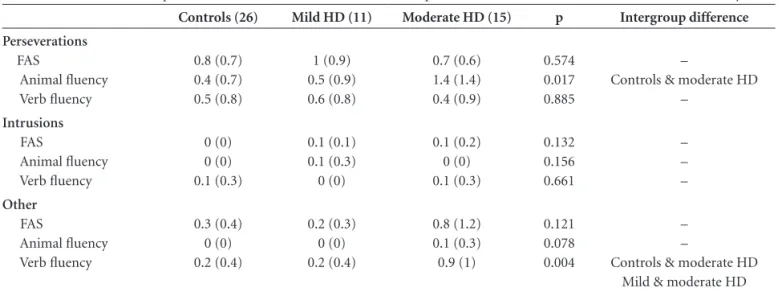
Age did not differ among the three groups. Educational level was statistically different between mild and moderate HD patients. The control group had higher scores on the Mini Mental Status Examination (Table 1). HD patients of the two groups showed a significant reduction in the num-ber of words generated in the FAS and animal fluency tasks compared to normal. Controls and moderate HD groups differed for verbal fluency (Table 2). For both groups, we noted similar performance patterns where the greatest number of words was generated in the animal category, followed by verbs and phonemic. Relative to the number of “perseverations”, there was a difference between control
and moderate groups in the animal fluency task, whereas considering “other type of errors” the controls differed from moderate, and the mild differed from the moderate group in verb fluency (Table 3). Additional analysis of Co-variance (ANCOVA) was performed to control the influ-ence of schooling on all variables of interest (Table 4). The level of schooling only influenced the MMSE scores.
Discussion
The verbal fluency tasks are traditional measures of ex-ecutive function, demanding the skill to mentally manipu-late and co-ordinate a large quantity of diverse informa-tion, in order to recall elements of a given category.10 They also depend on the integrity of semantic and phonological memory. Since Huntington’s Disease is characterized by a functional decline in the fronto-subcortical system, there is expected impairment on fluency tasks – especially fluency of verbs, considered by some to be more sensitive to detect fronto-striatal damage.
In this study HD patients with varying degrees of disease evolution performed worse than controls on the three proposed tasks (semantic, phonologic and fluency of verbs). Nevertheless, both groups (HD and controls) be-haved similar in terms of performance patterns, producing more words in the semantic than in the phonologic task.
The difficulties in verbal fluency tasks experienced by individuals with HD have already been amply described in the literature.1,3,10,14 Akin to the present study, Hodges15 and Rosser and Hodges1 found similar results in patients with HD and controls, with greater recall of words in semantic fluency than in phonologic fluency. Although the two tasks demand the same processes of unleashing and monitoring, controlled by a central executive, this difference appears to
Table 3. Performance of HD patients and controls relative to the number of perseverations, intrusions and other errors in the fluency tasks.
Controls (26) Mild HD (11) Moderate HD (15) p Intergroup difference
Perseverations
FAS
Animal fluency Verb fluency
0.8 (0.7) 0.4 (0.7) 0.5 (0.8)
1 (0.9) 0.5 (0.9) 0.6 (0.8)
0.7 (0.6) 1.4 (1.4) 0.4 (0.9)
0.574 0.017 0.885
–
Controls & moderate HD –
Intrusions
FAS
Animal fluency Verb fluency
0 (0) 0 (0) 0.1 (0.3)
0.1 (0.1) 0.1 (0.3) 0 (0)
0.1 (0.2) 0 (0) 0.1 (0.3)
0.132 0.156 0.661
– – –
Other
FAS
Animal fluency Verb fluency
0.3 (0.4) 0 (0) 0.2 (0.4)
0.2 (0.3) 0 (0) 0.2 (0.4)
0.8 (1.2) 0.1 (0.3) 0.9 (1)
0.121 0.078 0.004
– –
Controls & moderate HD Mild & moderate HD HD: Huntington’s disease; all values are expressed as mean (Standard Deviation).
Table 4. Analysis of Covariance (ANCOVA) results, controlling for schooling in all variables of interest.
Dependent variable Significance (p)
MMSE 0.002
FAS 0.300
Animal fluency 0.135
Verb fluency 0.230
Perseveration FAS 0.135
Intrusions FAS 0.212
Other errors FAS 0.156
Perseveration animal fluency 0.806
Intrusions animal fluency 0.442
Other errors animal fluency 0.471
Perseveration verb fluency 0.572
Intrusions verb fluency 0.423
reflect the nature of the semantic representations as op-posed to the letter instances or specificity of clues used for recall in each of the tasks. There are indications that the representation of the semantic system is organized into categories, leading to easier recall of semantically related items compared with other conditions. Phonologic fluency depends on the phonologic level of the word representa-tion, without reference to a meaning and as a result, with a slower activation velocity.1
The poor results in patients with HD on verbal fluency tasks has been attributed to an alteration of the fronto-striatal circuits,10 which control aspects of the executive function and include attention, information recovery, and operational memory. Majority of authors believe that in HD this reflects the difficulty in generating strategies to search for information rather than a compromise of se-mantic memory1,11. The fact that HD patients present better results in semantic fluency than in phonologic, an aspect found in this work and reports by other authors,1,5 advocates the view that good performance on semantic flu-ency depends more on preservation of semantic storage than phonologic and fluency of verb tasks. Furthermore, Rosser and Hodges1 found an opposite pattern in patients with Alzheimer’s disease who had worse results in seman-tic than in phonologic fluency compared to patients with HD and Progressive Supranuclear Paralysis, a dissociation which reinforces these findings. The qualitative analysis of the types of errors also helps in identifying the nature of the difficulties encountered. We verified statistical differ-ence in the number of perseverations, in the task of animal fluency, between controls and moderate HD group while other type of errors (e.g. proper names, non-words, su-perordinate categories), also showed differences between controls and the moderate HD group as well as between mild and moderate HD groups. Our results differed from Pillon16 and Péran12 who did not find a different frequency of intrusions or perseverative errors in retrieval tasks of verbal material and generation of nouns and verbs, be-tween HD and controls. Our findings suggest the necessity of additional investigation to verify the reasons for the par-ticular performance observed in verbal fluency tasks and ascertain whether the errors are related to a specific loss in the elaboration of strategies to search for information, or self-monitoring, or inhibition of responses, all character-istics of executive function loss.
In our study, besides the traditional measures (semantic and phonologic fluency), we also performed a verb flu-ency task, not usually explored but indicated as sensitive for frontostriatal physiopathology.10 Unexpectedly, we did not find a significantly greater impairment in the produc-tion of verbs when compared to other fluency. For the two
HD groups, performance on this verb task was lower than for semantic fluency but higher than for letter fluency, a pattern which repeated for the control group.
To our knowledge, no studies have yet evaluated verb recall and compared this with semantic and phonologic fluency in HD patients. Peran12 investigated concrete noun generation and actions in 26 patients with HD, 17 without dementia and 9 with. This task is differs to that of flu-ency, as verbal stimuli are presented (nouns or verbs) to be paired with semantically related items of the same category (nouns with nouns and verbs with verbs) or of the op-posite category (nouns with verbs and verbs with nouns). However, the task shares some similar characteristics to the fluency task, due to the need for recall and transference between different categories. In this study, the HD group presented worse results than the controls in the four tasks. However, only the group with dementia displayed a signifi-cant difference between the generation of verbs and nouns, with worse results for the two tasks where generation of verbs was required. Piatt10 also verified that verb fluency differentiated patients with Parkinson and dementia from control individuals. Damasio and Tranel17 found difficulties in generation of verbs but not in nouns, in patients with a frontal lesion, while the opposite pattern was verified in patients with a posterior lesion. Cappa11 observed similar dissociations between patients with Alzheimer’s and fron-to-temporal dementia. Our study found worse results in verbs than in semantic and phonologic fluency. However, the fact that none of these studies analyzed the three tests jointly prevents comparison with our results.
One of the reasons for better results in fluency of verbs than in the phonologic task could be related to the large variety of possible existing verbs (verbs which represent actions, feelings, states). At least a proportion of the verbs can be recovered using semantic strategies, which would fa-cilitate the results in this task compared to phonologic flu-ency. Supposing that the verb fluency task is supported in the two networks (attentional and semantic), we could as-sume that both phonologic and semantic fluency would be sensitive to detect executive function problems in the early phases of HD. With the evolution of the disease, fluency of verbs would indicate the intensification of these difficulties. In the future, a broader qualitative analysis investigat-ing different types of verbs could further understandinvestigat-ing of this task.
terms of presentation and a larger sample is necessary to confirm these results.
Supported by a grant from FAPESP (Brazil).
References
1. Rosser A, Hodges JR. Initial letter and semantic category flu-ency in Alzheimer’s disease, Huntington’s disease, and pro-gressive supranuclear palsy. J Neurol Neurosurg Psychiatry 1994;57:1389-1394.
2. Bayles KA, Tomoeda CK. Confrontation naming impairment in dementia. Brain Lang 1983;9:98-114.
3. Tröster AI, Salmon DP, McCullough D, Butters N. A Compari-son of the category fluency deficits associated with Alzheim-er’s and Huntington’s disease. Brain Lang 1989;37:500-513. 4. Troyer AK, Moscovitch M, Winocur G. Clustering and switching as two components of verbal fluency: evidence from younger and older healthy adults. Neuropsychology 1997;11:138-146.
5. Ho AK, Sahakian, BJ, Robbins TW, Barker RA, Rosser AE, Hodges JR. Verbal fluency in Huntington’s disease: a longitu-dinal analysis of phonemic and semantic cluster and switch-ing. Neuropsychologia 2002;40:1277-1284.
6. Arango-Lasprilla JC, Rogers H, Lengenfelder J, Deluca J, Moreno S, Lopera F. Cortical and subcortical diseases: do true neuropsychological differences exist? Arch Clin Neuropsychol 2006;21:29-40.
7. Butters N, Wolfe J, Granholm E, Martone M. An assessment of verbal recall, recognition and fluency abilities in patients with Huntington’s disease. Cortex 1986;22:11-32.
8. Hodges JR, Salmon DP, Butters N. The nature of the naming
deficit in Alzheimer’s and Huntington’s disease. Brain 1991; 114:1547-1558.
9. Smith S, Butters N, White R, Lyon L, Granholm. Priming se-mantic relations in patients with Huntington’s Disease. Brain Lang 1988; 33:27-40.
10. Piatt AL, Fieldes JA, Paolo AM, Tröster AI. Action (verb naming) fluency as an executive function measure: con-vergent and dicon-vergent evidence of validity. Neuropsycholo-gia1999;37:1499-1503.
11. Cappa SF, BinettiG, Pezzini MA, Padovani A, Rozzini L, Tra-bucchi M. Object and action naming in Alzheimer’s disease and frontotemporal dementia. Neurology 1998;50:351-355. 12. Péran P, Démonet JF, Pernet C, Cardebat D. Verb and noun
generation tasks in Huntington’s disease. Mov Disord 2003; 19:565-571.
13. Huntington Study Group. Unified Huntington’s disease rat-ing scale: reliability and consistency. Mov Disord 1996; 11: 136-142.
14. Butters N, Granholm E, Salmon DP, Grant I, Wolfe J. Episodic and semantic memory: A comparison of amnesic and de-mented patientes. J Clin Exp Neuropsychol 1987;9:479-497. 15. Hodges JR, Salmon DP, Butters N. Differential impairment of
semantic and episodic memory in Alzheimer’s and Hunting-ton’s disease: a controlled prospective study. J Neurol Neuro-surg Psychiatry 1990;53:1089-1095.
16. Pillon B, Deweer B, Agid Y, Dubois B. Explicit memory in Alzheimer’s, Huntington’s, and Parkinson’s Diseases. Arch Neurol 1993;50:374-379.