Artigo Original
Regina Aparecida Pimenta1 María Eugenia Dájer2 Adriana Hachiya2 Domingos Hiroshi Tsuji2 Arlindo Neto Montagnoli1,3
Descritores
Voz Treinamento da voz Qualidade da voz Acústica Fonoterapia Keywords
Voice Voice training Vocal quality Acoustics Speech therapy
Correspondence address:
Regina Aparecida Pimenta, Rua João Ramalho, 516/15, Jardim Centenário, São Carlos (SP), Brasil, CEP: 13564-090. E-mail: [email protected]
Received: 07/04/2012
Study carried out at Universidade de São Paulo – USP – São Carlos (SP), Brazil.
(1) Engineering School of São Carlos, Universidade de São Paulo – USP – São Carlos (SP), Brazil. (2) School of Medicine, Universidade de São Paulo – USP – São Paulo (SP), Brazil.
(3) Universidade Federal de São Carlos – UFSCar – São Carlos (SP), Brazil. Financial support: São Paulo Research Foundation (FAPESP).
Conlict of interests: nothing to declare.
identiied effects of voiced vibration and vocal fry exercises
Parâmetros acústicos e quimograia de alta velocidade
identiicam efeitos imediatos dos exercícios de vibração
sonorizada e som basal
ABSTRACT
Purpose: To identify the immediate effects of voiced vibration and vocal fry exercises on healthy subjects by means of acoustic parameters and high-speed kymography.
Methods: Thirty healthy subjects (18 women and 12 men, aged from 19 to 45 years old) participated in this study. The voices were recorded at the range of 44.100 samples/second, before and after of the vocal exercises. We developed a computational routine to extract jitter and shimmer. High-speed kymography was generated from laryngeal images for the analysis of the phase times: closed (CPh), open (OPh), of closing (cPh) and of opening (oPh) and used the paired t-Student test and the Mann-Whitney test, with a signiicance level of 0.05. Results: After voiced vibrations, acoustic parameters showed reduced jitter for both genders (p=0.018 for men and p<0.01 for women) and reduced shimmer for female voices (p<0.01). There was a decrease in CPh (p=0.046) and cPh (p=0.026) and an increase in OPh (p=0.05) in female vocal folds. After vocal fry, we identiied decreased jitter (p<0.01) in female voices and cPh (p=0.026) in male vocal folds. Conclusion: We observed more positive immediate effects of the voiced vibrations, mainly in voice quality and vocal folds among females. Nevertheless, studies with larger male sample and investigation of the appropriate time of vocal fry are necessary to conirm the results of this search.
RESUMO
INTRODUCTION
In the Speech Language Pathology and Audiology clinic, vocal techniques are used for vocal improvement or for treat-ing vocal disorders. Therefore, speech language pathology and audiology aims at a healthy emission and at the prevention of phonotraumas during vocal production(1,2). In the past few years, researchers have been making efforts to prove the physiological effects that vocal exercises have on vocal quality and on the vocal folds of healthy individuals or those with dysphonia(3,4).
Out of the therapy techniques developed throughout history, two of them have been drawing the attention of researchers. The irst one is the voiced vibration, which is commonly used for most of the vocal disorders(5,6) since its effects are eas-ily noticed by the ears of the pathologist and the patient(2,5). The other one is the vocal fry, presenting several therapeutic indications, even though it is still not used much for present-ing numberless divergences among researchers and speech language pathologists(4,7,8).
It is essential that the performance of vocal techniques be measured to prove their real effect on the vocal folds and on the vocal quality of healthy or dysphonic individuals. In this sense, the methods of evaluation allow describing the physiological aspects of the voice in several types of vocal production(9). The acoustic analysis contributes with both quantitative and qualitative data. Even if the jitter and shimmer parameters are not so robust to assess very deviated voices, they have been very much used in studies in which the participants contribute with experimental and control data at the same time(10). Another way of analyzing the voice is to assess laryngeal images. The most recent high-speed ilming technique reveals the real vocal fold cycle. From the pictures of these images, it is possible to generate kymographs and extract objective parameters, in order to analyze the vibration behavior of the vocal folds in detail(11). Extending the knowledge about the effects of vocal tech-niques is a current need of speech language pathology and au-diology. Therefore, the objective of this study is to identify the immediate effects of voiced vibration and vocal fry in healthy individuals by means of acoustic parameters and high-speed kymography obtained from video laryngoscopy.
METHODS
This study was approved by the Research Ethics Committee of Universidade Federal de São Carlos. All the participants were delivered written material informing them of the objec-tives of the study, and then they signed the informed consent. Data were collected in the outpatient clinic of the Voice Group at the Division of the Otorhinolaryngologic Clinic Division of Hospital das Clínicas in the School of Medicine,
Universidade de São Paulo. Participants went through speech language pathology and audiology screening, when each one responded to an anamnesis that investigated vocal habits. Afterwards, they were submitted to auditory–perceptual as-sessment, where they performed according to the concepts of the visual analogue scale(12) by an experienced speech language
pathologist. The global degree of vocal emission in continu-ous speech was accessed, and the interval between 0.0 and 34.5 mm(12) was considered as the normal variability of vocal quality for the study sample. Forty-four individuals were as-sessed from September 2010 to November 2011. Out of these, nine were excluded for failing the speech language pathology and audiology screening, and ive for presenting alterations to the laryngeal examination (two with signs of gastroesophageal relux, two with small nodules and one with laryngeal micro diaphragm). These participants were oriented as to their vocal health and the need for evaluation and adequate treatment.
The individuals included in this study were the ones who did not present with history of smoking and alcoholism, and who were free of digestive and hormonal changes, as well as inlammatory processes in the airways. Collection selected 30 individuals (12 men and 18 women), aged between 19 and 45 years, with good general health status. Voice recordings and high-speed video laryngoscopy were performed in two mo-ments, before and after vocal exercises. In order to process and analyze the acoustic signals and the laryngeal images, algo-rithms developed by the Medical Engineering Research Group (GPEM/ National Council for Scientiic and Technological Development – CNPq) were used.
In voice collection, the acoustic recording used the fol-lowing equipment: notebook with Intel Dual-Core processor T4400 2,2 GHz, attached to an external USB sound card and a unidirectional microphone with minimum sensitivity of 44 dB and response frequency of 60 to 12 kHz. Collection was performed in an acoustically treated room, with the microphone placed 4 cm away from the mouth, forming an angle of 45 to 90°(13).
Voice signals were stored in the .wav format, with rates of 44,100 samples per second. High-speed video laryngoscopy was conducted by a laryngologist in which high-speed image recording system by Richard Wolf (Knittlingen, Germany) was used, with high-performance light source (AUTO LP 5132), rigid laryngoscope (90° angle) and head camera (HRES ENCODAM 5562). Examinations were stored at a rate of 4000 pictures per second and converted to the .AVI format for image processing.
The investigated parameters were isolated by controlling the frequency emission and intensity. The procedure was per-formed before and after the vocal exercises with the objective of promoting the same vibration conditions to the vocal folds and emissions. Therefore, it was possible to rule out the inluences of these variables in the acoustic parameters and in video laryn-goscopy(10). The comfortable emission intensity and frequency of each subject was extracted during the irst acoustic record-ing of the sustained vowel /ε/. In the case of intensity, a sound
pressure level measuring device from RadioShack (33-2055, Nova York, United States) was used and placed 30 cm from the labial commissure. The fundamental frequency was extracted by using the virtual keyboard of the SpeechPitch software.
pathologist in charge of this research. Intensity was controlled with the sound pressure measuring device, previously used to extract this data. The maximal variation of 2 dB during the other emissions was accepted, and for the reproduction of the fundamental frequency in the following stages of collection, each participant was oriented to emit the sustained vowel /ε/
according to the orientations of the speech language patholo-gist. The speech language pathologist presented auditory and visual support with the same virtual keyboard used in the data extraction stage.
As to the acoustic recording performed before vocal exer-cises, each individual remained sitting, with the spine erect, and emitted a sustained vowel /ε/ at comfortable frequency
and intensity. Afterwards, high-speed video laryngoscopy was conducted.
Participants received topical anesthetic before the exami-nation. Rigid laryngoscope was introduced into the mouth of the participant, while they emitted the sustained vowel /ε/ at
controlled frequency and intensity, as previously described. In the next stage, a specialized speech language pathologist oriented the participants to perform vocal exercises. After the vocal exercises, their voice was recorded and high-speed video laryngoscopy was conducted, respectively. These records were in accordance with the same protocol described for the pre-vocal exercise moment.
Laryngological examinations were performed by the same laryngologist, the doctor who collaborated in this research, and the position of the rigid endoscope was controlled during examinations(14). The rigid endoscope was placed parallel to the vocal folds, in the same angle and distance used in the pre-vocal exercises.
The 30 participants were randomly divided into two experi-mental groups. Since the exercises of lip or tongue vibration presented similar impacts on the voice(2), the 15 individuals (six men and nine women) were asked to perform voiced vibrations that they felt more able to execute with simultaneous voice emission, throughout the longest phonation time(6).
According to the recommendations by Menezes et al.(15), the voiced vibrations were exercised by male individuals for ive minutes, with an average of 20 vibrations, and female participants exercised it for three minutes, with an average of ten vibrations. Another 15 individuals (six men and nine women) were told to perform vocal fry throughout the lon-gest phonation time. With the objective of avoiding muscular fatigue, due to the severe contraction of the thyroarytenoid muscle, each individual exercised vocal fry for one minute, regardless of gender. In average, the emission of vocal fry was performed four times.
Pre- and post-acoustic recordings of vocal exercises were processed with an algorithm developed by means of pro-gramming language, C Sharp, which belongs to the software package, Visual Studio, by Microsoft. The algorithm begins the analysis process by normalizing the signals to standardize the amplitude levels. Afterwards, it extracts the perturbation parameters automatically.
Voice is an almost periodical signal that presents perturba-tions in the glottal cycles along the frequency (jitter) and inten-sity (shimmer)(16). These two parameters have been described as robust measures of the biomechanical properties of the vocal folds in situations of vocal assessment, which compares the results of therapeutic interventions(10). For this study, the algorithms developed to calculate the jitter and shimmer values were based on the proposal of Davis(17,18). Normality values were validated in 0.18% (standard deviation of 0.1%) for jitter and 1.08% (standard deviation of 0.37%) for shimmer(19).
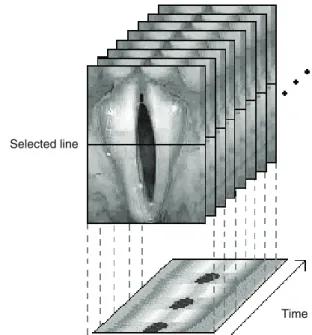
High-speed kymographs are obtained by the juxtaposition of a sequence of frames of laryngeal images(20,21). To make the images, high-speed video laryngoscopies were converted to .AVI extension and processed by the system software that captures the images (HRES). This system enables the selec-tion of one point to juxtapose the frames of laryngeal images. High-speed kymographs were obtained from the medial region of the laryngeal image for the juxtaposition of the image frames with time (Figure 1). Mean point was chosen due to the higher mobility of the vocal folds(22,23). For the analysis of kymographs, an algorithm was developed using the programming language, C Sharp, of the software package, Visual Studio, by Microsoft, which extracts the following parameters in milliseconds: closed phase (CPh), open phase (OPh), of closing phase (cPh) and of opening phase (oPh) (Figure 2).
All data were statistically treated by the paired t-Student test. Data that did not pass normality or homogeneity were treated with the Mann-Whitney test, both with signiicance level of 0.05.
Selected line
Time
RESULTS
Perturbation parameters
The results of the voiced vibration exercise presented sig-nii cant jitter changes for both genders; however, concerning shimmer, changes only happened among female participants (Table 1).
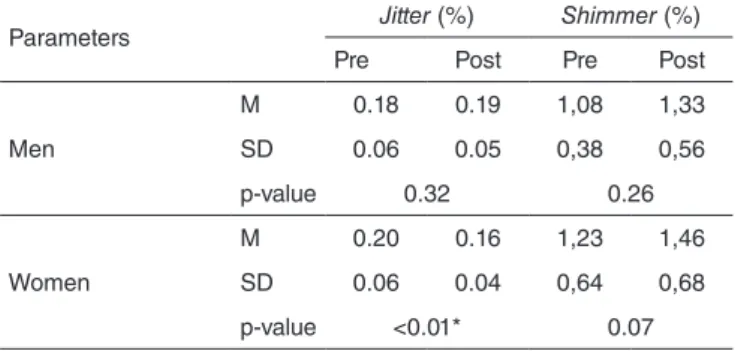
The group that performed the vocal fry exercise presented signii cant jitter changes among female voices. Statistical dif-ferences related to shimmer were not observed for any of the genders (Table 2).
High-speed kymography analysis
After the voiced vibration exercise, the statistical analy-sis identified significant changes for the following phases:
close, open and closing in female vocal folds (Table 3). Figure 3 presents the vocal folds of a female sample, in which the times of each phase in the vibration are indicated, before and after voiced vibrations. After the exercise of vo-cal fry, a statistivo-cal difference was observed for the closing phase in male vocal folds (Table 4).
Figure 2. Images of a high-speed video laryngoscopy of healthy vocal folds of a female adult emitting the sustained vowel /ε/. (A) Frames of the sequence of a glottal cycle with the approximation of vocal folds to begin the vocal production and the sequence of sustained phona-tion; (B) High-speed kymography corresponding to the sequence demonstrated above, with the indications of (C) right vocal fold, (D) left vocal fold; (b1) vocal folds closing up to begin vocal production; (b2) total period of a vibration cycle; (b3) time of closed phase; (b4) time of open phase; (b5) time of opening phase; and (b6) time of closing phase of vocal folds
A
B
Table 1. Mean values, standard deviations and p values of perturbation parameters for individuals who performed the voiced vibration exercise
Parameters
Jitter (%) Shimmer (%) Pre Post Pre Post M 0.23 0.20 1,24 1,27
Men SD 0.06 0.05 0,50 0,41
p-value 0.018* 0.780 M 0.32 0.27 1,24 1,01
Women SD 0.12 0.11 0,48 0,40
p-value <0.01* <0.01*
*Values with significant differences
Paired Student´s t, with significance level of 0.05
Caption: M = Mean values; SD = standard deviation
Table 2. Mean values, standard deviations and p values of perturba-tion parameters for individuals who performed the vocal fry exercise
Parameters
Jitter (%) Shimmer (%) Pre Post Pre Post M 0.18 0.19 1,08 1,33
Men SD 0.06 0.05 0,38 0,56
p-value 0.32 0.26 M 0.20 0.16 1,23 1,46
Women SD 0.06 0.04 0,64 0,68
p-value <0.01* 0.07
*Values with significant differences
Paired Student´s t, with significance level of 0.05
Caption: M = Mean values; SD = standard deviation
Table 3. Mean values, standard deviations and p values for the phases of the fundamental cycle of individuals who performed the voiced vibra-tion exercise
Parameters CPh OPh cPh oPh
pre post pre post pre post pre post
Men
M 3.20 2.71 3.81 4.00 1,74 2,19 2,22 1,93
SD 0.87 1.23 1.62 1.75 0,91 1,01 0,97 0,93
p-value 0.21 0.06 0.08 0.06
Women
M 2.42 2.01 3.08 3.45 1,49 1,89 1,59 1,77
SD 0.99 1.29 1.09 1.14 0,81 0,91 0,33 0,69 p-value 0.046* 0.050* 0.026* 0.360
*Values with significant differences
Paired Student´s t test with significance level of 0.05
Caption: CPh = closed phase; OPh = open phase; cPh = closing phase;
oPh = opening phase; M = mean values; SD = standard deviation
A
B C
DISCUSSION
This study was conducted with the objective of identifying the immediate effects of voiced vibration and vocal fry exer-cises on vocal quality and on vocal folds of healthy individuals. To achieve this, the study used perturbation parameters of acous-tic analysis and parameters related to the duration of kymograph phases obtained from high-speed video laryngoscopies.
The results of the acoustic analysis demonstrated that the female voices were most inl uenced by vocal exercises after voiced vibration, and perturbation parameters signii cantly de-creased for the female gender (p<0.01 for jitter and shimmer). With regard to male voices, the jitter signii cantly decreased (p=0.018) and there were no signii cant changes for the shim-mer. According to literature(24,25), decrease of these parameters is an expected effect of the exercise. However, the shimmer results for the male gender are in agreement with some studies that did not i nd changes in the perturbation parameters after tongue vibrations(5,25). Generally, our results indicate the im-mediate effect of voiced vibrations and lower mean perturbation of the voice signal in relation to the variation of frequency and amplitude. Lack of statistical corroboration concerning the shimmer of the male sample suggests the realization of more studies, with a larger sample for the gender.
After the vocal fry exercise, female voices presented sig-nii cant jitter decrease (p<0.01) and increased shimmer values (p=0.07). There were no statistical differences for male voices. Literature describes the physiological effect of the vocal fry as the increment in perturbation measures during emission, both in frequency and amplitude(8,26).
A case study assessed the healthy voice of five adult women and did not i nd changes in the mentioned parameters(4). Another study verii ed increased jitter in two adult women with hourglass-shaped glottal gap(4,8). Our results diverge from the aforementioned ones; however, there is no consensus in current literature on the indication of time of execution of the vocal fry for therapeutic application(26). The duration of the exercise may not have been sufi cient to cause signii cant changes in the studied voices. Besides, the anatomical and physiological differences presented by the genders should be considered. For instance, male vocal folds may require longer time of execution of vocal exercises in order to cause any effect in its vibration pattern, once they are denser and longer due to the more prominent angle of the thyroid cartilage(27,28).
Regarding the analysis of high-speed kymographs, the search for studies investigating vocal folds under the immediate effect of vocal exercises found analyses that performed laryngo-logical assessment by the visual analysis of video stroboscopy. In these studies, the parameters that were frequently evaluated were: glottic closure, laryngeal vestibule constriction and am-plitude and symmetry of vocal fold vibrations. No studies that used video kymography were found for this purpose.
In this study, the analysis of high-speed kymographs presented similar behaviors in the vibrating cycles of both genders; however, different with regard to the type of vocal exercise. After the voiced vibrations, decreased mean values of CPh were observed, and the difference occurred specially
Figure 3. Images of high-speed kymography exemplify the phases of the glottal cycle of vocal folds in a female sample. (A) High-speed ky-mography before the voiced vibration exercise; (B) high-speed vibration after the voiced vibration exercised performed in the same frequency as the pre-vocal exercise emission (4.88 ms for the total vibration cycle). The decreased time of the closed phase is observed (from 2.13 to 1.25 ms), with increased length of the open phase (from 2.75 to 3.63 ms) and the closing phase (from 1.38 to 2.13 ms). Opening phase remained the same for both moments (1.50 ms)
A
Table 4. Mean values, standard deviation and p values of the phases of the fundamental cycle for individuals who performed the vocal fry exercise
Parameters CPh OPh cPh oPh
pre post pre post pre post pre post
Men
M 3.84 3.87 3.98 3.84 2.20 1.83 1.79 2.01
SD 0.93 0.87 1.05 0.91 0.72 0.65 0.48 0.44
p-value 0.930 0.330 0.026* 0.210
Women
M 2.41 2.62 2.55 2.39 1.18 1.08 1.41 1.26
SD 0.45 0.34 0.55 0.59 0.37 0.28 0.26 0.38 p-value 0.13 0.29 0.35 0.13
*Values with significant differences
Paired Student´s t test with significance level of 0.05
Caption: CPh = closed phase; OPh = open phase; cPh = closing phase;
oPh = opening phase; M = mean values; SD = standard deviation
A
in female vocal folds (p=0.046). There was increased OPh and cPh in both genders (OPh: p=0.06 for men and p=0.05 for women; cPh: p=0.08 for men and p=0.026 for women). oPh decreased in male vocal folds (p=0.06) and increased, however, not relevantly, in female vocal folds (p=0.36).
According to Titze(1), voiced vibrations are semi-occluded vocal tract exercises whose application aims at producing the following effects: normal vocal intensity, with energy saving, and minor mechanical trauma.
Voiced vibrations promote changes in vibration patterns, because during its performance the vocal folds gently get closer, adapting the glottic air low and minimizing the impact of col-lisions. These aspects were described by mathematical models. The kymography generated from high-speed laryngeal images shows the same characteristics; however, it is used to analyze the effect of exercises on human larynxes.
In our results, the effects described by Titze(1) were observed in vibration cycles of male vocal folds, however, with no sig-niicant relevance. The indings for the gender suggested soft contact of the vocal folds during vocal production due to the slow approximation of vocal fold mucosa, and its faster separa-tion and longer time of open glottis. In female glottal cycles, these changes were signiicant. Results suggest soft contact between vocal folds due to decreased speed of approximation of the vocal fold mucosa and the longest time of open glot-tis, spending less time in the closed position. The parameters without statistical corroboration indicate the need for research, with the participation of more male samples.
As to the analysis performed after vocal fry, the mean values presented slight variations, with increased CPh and decreased OPh for both genders. oPh increased in male vocal folds and de-creased in female vocal folds. There was dede-creased cPh for both genders, and this was the only measure with signiicant changes for male vocal folds (p=0.026). According to literature(2,7,8,26), during the emission of vocal fry, vocal folds become shorter, in medial position, with irmer glottic closure due to maximal contraction of the thyroarytenoid muscle. Under these condi-tions, vocal fold mucosa presents more vibration amplitude, that is, it becomes looser along the free border, thus enabling more oscillatory movement. In our research, na effect indicated by vocal fry is the fast approximation of male vocal folds (p=0.026 cPh) in response to higher mobility of their mucosa. The result of the other phases, which did not present signiicant changes, need to be further investigated with a larger sample and longer duration of the exercise. The one minute emission of vocal fry may not have been suficiently adequate to promote effective changes on the studied vocal folds.
The chosen equipment and methods, to extract parameters from acoustic signs and high-speed images, were eficient for the study of healthy voice under the effect of vocal exercises. It is believed that they can be useful to assess the different dimensional aspects of the voice in studies that investigate pathologies or therapeutic processes.
With the results of this study, it is possible to indicate the following therapeutic objectives in clinical practice: voiced vibration exercises can be more oriented when the intention
is to reach more resistant vocal quality, more periodical cord vibrations, and soft contact between vocal folds. Both patients with mass lesions in vocal folds and individuals with occupa-tional use of the voice can beneit from this technique. The vocal fry exercise, despite presenting a few expressive results, proved to be eficient for vocal objectives with the indication to promote increased mobility of vocal folds; and the vocal emission of patients who present with glottic insuficiency is favored by this technique.
CONCLUSION
It was possible to identify the immediate effects of voiced vibrations and vocal fry on healthy voices by means of the analysis of acoustic parameters and high-speed kymographs. Some immediate effects of voiced vibrations were identiied, such as decreased jitter in vocal emission in both genders; de-creased shimmer in vocal emission in females; and dede-creased effort with increased eficacy with regard to vocal production among females, which was observed in high-speed kymography parameters.
After the vocal fry exercise, the immediate effects of de-creased jitter among female participants were identiied, as well as increased glottic closure among male participants, indicated by the closing phase parameter of high-speed kymography.
It was also possible to identify more positive immediate effects after voiced vibrations, especially concerning quality and female vocal folds. However, studies with larger male samples, and investigation on adequate duration of vocal fry to corroborate the results of this research, are necessary.
*RAP was in charge of the elaboration of the project; study design and data collection, tabulation and analysis; and elaboration and execution of the manuscript. MED supervised the elaboration of the project, study design and data collection and analysis and gave intellectual contribution for the execution of the manuscript. AH was in charge of data collection and gave intellectual contribution for the writing of the manuscript. DHT supervised data collection and gave intellectual contribution for the writing of the manuscript. ANM idealized the research project; was in charge of study design and general orientation in all of the stages of elaboration and execution of the research; oriented and gave intellectual contribution for the elaboration and execution of the manuscript.
REFERENCES
1. Titze IR. Voice training and therapy with a semi-occluded vocal tract: rationale and scientific underpinnings. J Speech Lang Hear Res. 2006;49(2):448-59.
2. Behlau M. Voz. O livro do especialista. Vol. 2. Rio de Janeiro: Revinter; 2005.
3. Behlau M, Madazio G, Feijó D, Pontes P. Avaliação de voz. In: Behlau M (org.). Voz: O livro do especialista. Vol. 1. Rio de Janeiro: Revinter; 2001. p. 85-245.
4. Brum DM, Cielo CA, Finger LS, Manfrin JA. Considerações sobre modiicações vocais e laríngeas ocasionadas pelo som basal em mulheres sem queixa vocal. Rev Soc Bras Fonoaudiol. 2010;15(2):282-8. 5. Azevedo LL, Passaglio KT, Rosseti MB, Silva CB, Oliveira BFV, Costa
6. Costa HO, Silva MAA. O trabalho fonoaudiológico com a voz cantada. In: Costa HO, Silva MAA (eds.). Voz cantada: evolução, avaliação e terapia fonoaudiológica. São Paulo: Lovise; 1998. p. 141-68.
7. Cronemberger FF. Considerações teóricas sobre o vocal fry [monograia]. Salvador: CEFAC; 1999.
8. Bolzan GP, Cielo CA, Brum DM. Efeitos do som basal em fendas glóticas. Rev CEFAC. 2008;10(2):218-25.
9. Elliot N, Sundberg J, Gramming P. Physiological aspects of a vocal exercise. J Voice. 1997;11(2):171-7.
10. Brockmann-Bauser M, Drinnan MJ. Routine acoustic voice analysis: time to think again? Curr Opin Otolaryngol Head Neck Surg. 2011;19(3):165-70. 11. Yan Y, Damrose E, Bless D. Functional analysis of voice using
simultaneous high-speed imaging and acoustic recordings. J Voice. 2007;21(5):604-16.
12. Yamazaki R, Leão SHS, Madazio G, Padovani M, Azevedo R, Behlau M. Correspondência entre escala analógico-visual e a escala numérica na avaliação perceptivo-auditiva das vozes. In: XVI Congresso Brasileiro de Fonoaudiologia; 2008. Campos do Jordão.
13. Titze, I.R. Workshop on acoustic voice analysis: summary statement. National Center for Voice and Speech. Colorado: Institute on Deafness and Other Communication Disorders;1995. p. 36
14. Pontes PAL, Madazio G, Behlau M, Cantoni LA. A influência da angulação na posição do telescópio na videoquimograia laríngea. Rev Bras Otorrinolaringol. 2005;71(6):803-12.
15. Menezes MH, de Campos Duprat A, Costa HO. Vocal and laryngeal effects of voiced tongue vibration technique according to performance time. J Voice. 2005;19(1):61-70.
16. Wertzner HF, Schreiber S, Amaro L. Análise da freqüência fundamental,
jitter, shimmer e intensidade vocal em crianças com transtorno fonológico. Rev Bras Otorrinolaringol. 2005;71(5):582-8.
17. Davis SB. Acoustic characteristics of normal and pathological voices. ASHA. 1979;11:97-115.
18. Cooley JW, Tukey JW. An algorithm for the machine calculation of complex Fourier series. Math Comput. 1965;19(90):297-301.
19. Pimenta RA, Dajer ME, Montagnoli AN. Análise acústica de vozes normais e patológicas usando o método de correlação e de derivada do sinal de voz. In: XVIII Congresso Brasileiro de Fonoaudiologia; 2010.Curitiba. 20. Tsuji D, Sennes LU. Videoquimografia de laringe: novo método
de avaliação da vibração cordal. Arq Fund Otorrinolaringol. 1998; 2(4):136-40.
21. Koishi HU, Tsuji DH, Imamura R, Sennes LU. Vocal intensity variation: a study of vocal folds vibration in humans with videokymography. Rev Bras Otorrinolaringol. 2003; 69(4):464-70.
22. Kurita S. Layer structure of the human vocal fold: morphological investigation. Otologia (Fukuoka).1980;26:973-97.
23. Haji T, Isshiki N, Mori K, Omori K, Taira T, Honjo I. Experimental study of the mobility of the vocal fold mucosa. Folia Phoniatr. 1991;43(1):21-8.
24. Guberfain J, Muller MM, Sarvat M. The perceptual, acoustics and laryngological analysis of tip of tongue sound vibration technique and it’s consequences in actors. In: World Voice Consortium. 2nd World Voice
Congress and 5th International Symposium of Phonosurgery. Scientiic
program; 1999. São Paulo.
25. Cordeiro GF, Montagnoli AN, Nemr NK, Menezes MHM, Tsuji DH. Comparative analysis of the closed quotient for lip and tongue trills in relation to the sustained vowel /e/. J Voice. 2012;26(1):17-22.
26. C i e l o C A , E l i a s V S , B r u m D M , F e r r e i r a F V. M ú s c u l o tiroaritenoideo e som basal: uma revisão de literatura. Rev Soc Bras Fonoaudiol. 2011;16(3):362-9.
27. Slavit DH. Phonosurgery in the elderly: a review. Ear Nose Throat J. 1999;78(7):505-9.