Background
Measles is one of the most infectious diseases known to man and remains the leading cause of vaccine-preventable deaths worldwide. Prior
to the introduction of the vaccine, practical-ly all children became infected. In 1994, dur-ing the Pan American Sanitary Conference, the Americas embarked on the goal of inter-ruption of indigenous measles transmission.
PAHO’s recomen-ded strategy for the interruption of mea-sles transmission in-cludes: (a) an initial mass vaccination
cam-paign (catch-up) for children aged 9 months to 14 years, (b) vaccination of children aged >1 year old in routine vaccina-tion services (keep-up), and (c) complementary mass vaccina-tion campaigns every four years (follow-up), for all children ages 1 to 4 years. PAHO has recommended reaching a 95% vaccination coverage in every municipality of the countries. This strategy is complemented by (a) a sensitive surveillance system capable of timely detecting suspected measles circula-tion, (b) the confirmation and thorough investigation of all cases, (c) an effective virologic surveillance system, and (d) strong supervision of vaccination activities, including rapid house-to-house monitoring of vaccination coverage.
In the Americas, from 1990 to 1996, measles cases declined from approximately 250,000 to 2,109. In 1997 there was a resurgence of measles virus circulation, with 52,284 confirmed cases reported from Brazil, which started with a large urban out-break in São Paulo. The virus strain that caused the outbreak was D6, which had been circulating since at least 1995 in Bra-zil and possibly other countries of the Re-gion. The D6 outbreak spread to Argentina and Bolivia, where the largest number of measles cases ocurred during 1998 and 1999, respectively, and then to the Dominican Republic and Haiti, which had the largest number of cases in 2000 and 2001 (Figure 1). Sustained vacci-nation efforts by these countries led to the progressive decrease of cases region-wide to 3,209 in 1999, and 1,754 in 2000. In 2001, the total number of confirmed measles cases had dropped to 541, the lowest yearly number since the beginning of the hemispheric measles initiative. Since September, 2001, no other viruses of the D6 strain have been identified in the Americas. Moreover, numerous countries with high measles vaccination coverage, including Brazil, Canada, Chile, Costa Rica, El Salvador, Chile, Mexico, Peru, United States and Uruguay, had measles importations during 1999-2002 with
In this issue:
Six weeks without reported indigenous measles
transmission in the Americas . . . 1 Accelerated rubella control and prevention of CRS:
evolving strategies . . . 2
Supervision: an under-utilized management tool
to identify risk areas . . . 4 Achieving equitable immunization coverage:
The Bolivia Project . . . 4 Quality control system for the surveillance of
bacterial meningitis and pneumonia . . . 6 Diphtheria outbreak in Paraguay – an update. . . 7
EPI Newsletter
Expanded Program on Immunization
in the Americas
Volume XXIV, Number 5
IMMUNIZE AND PROTECT YOUR CHILDREN
October 2002
Six weeks without reported indigenous measles
transmission in the Americas
0 100 200 300 400 500 600 700 800 900 1000
Haiti DOR Colombia Venezuela Others
No. Cases
Months
January February March
April May June July
August
September
October
November December
January February March
April May June July
August
September
October
Figure 1. Confirmed measles by month, the Americas, January 2001 - October 2002
limited or no secondary transmission. In August, 2001, after an importation from Europe, a new measles outbreak began in Venezuela and spread to neighboring Colombia (Figure 1). The virus responsible was a new measles strain, d9, never before identified in the Americas. Following important vaccination ef-forts in both countries, these outbreaks are being controlled. As of October 15, 2002 and since the beginning of these out-breaks, a total of 2,495 cases in Venezuela, and 128 in Colombia have been confirmed. The last confirmed case oc-curred in Venezuela in September 20, 2002. Since then, no oth-er indigenous measles cases have been reported. This represents the longest period without reports of indigenous measles transmission since the Regional Plan of Action for Measles Eradication was implemented in 1996.
Editorial Note:By interrupting regionwide the indigenous transmission of at least one measles strain (D6) for over a year,
by experiencing an unprecedented six weeks without reports of any indigenous measles, and by experiencing repeated measles importations with limited or no secondary transmission, coun-tries of the Americas have shown that global measles eradica-tion, following PAHO’s recommended strategies, is possible. Nonetheless, intensive active search for cases in areas of civil unrest in Colombia, and areas of Colombia and Venezuela that still maintain either low measles coverage or insufficient sur-veillance will be needed to confirm that indigenous measles transmission has effectively been interrupted.
To maintain the Region free of indigenous measles trans-mission in the absence of global measles eradication, all countries in the Americas will need to: (1) achieve and main-tain high (>95%) vaccination coverage by municipality dur-ing both routine and follow-upmeasles vaccination, and (2) maintain strong surveillance and case investigation efforts.
Accelerated rubella control and prevention of CRS
evolving strategies
In response to ongoing rubella virus circulation and the potential for major rubella epidemics in the Region, PAHO’s 1997 Technical Advisory Group on Vaccine Preventable Diseases (TAG) addressed the issue and recommended the implementation of a regional initiative to strengthen rubella control and congenital rubella syndrome (CRS) prevention efforts. At the time, the initiative included the introduction of a rubella-containing vaccine into routine childhood im-munization programs; vaccination of women of childbearing age; the development of specific vaccination strategies for the accelerated rubella control and CRS prevention; the de-velopment of integrated surveillance systems for measles and rubella; the implementation of a CRS surveillance sys-tem; and support for enhanced laboratory capabilities in rubella virus isolation.
In 1986, sixteen years after licensure of the rubella vac-cine, six countries (the United States, Canada, Cuba, Panama, Costa Rica and Uruguay) had introduced MMR vaccine into their childhood programs. It was only in 2002, that 41 of the 44 countries and territories in the Americas had finally intro-duced a rubella-containing vaccine (MR or MMR) in their na-tional childhood immunization program. The remaining three countries, Peru, Haiti and the Dominican Republic will follow suit between 2003 and 2004.
Using a combined strategy that targeted adult women and children with a rubella-containing vaccine, Cuba was the first country to eliminate rubella and CRS, with the last CRS case reported in 1989, and the last rubella case in 1995. This goal was largely achieved through the implementation of two mass vaccination campaigns in 1985 and 1986, ini-tially targeting women aged 18 to 30 years, and subsequent-ly children aged 1 to 14 years.
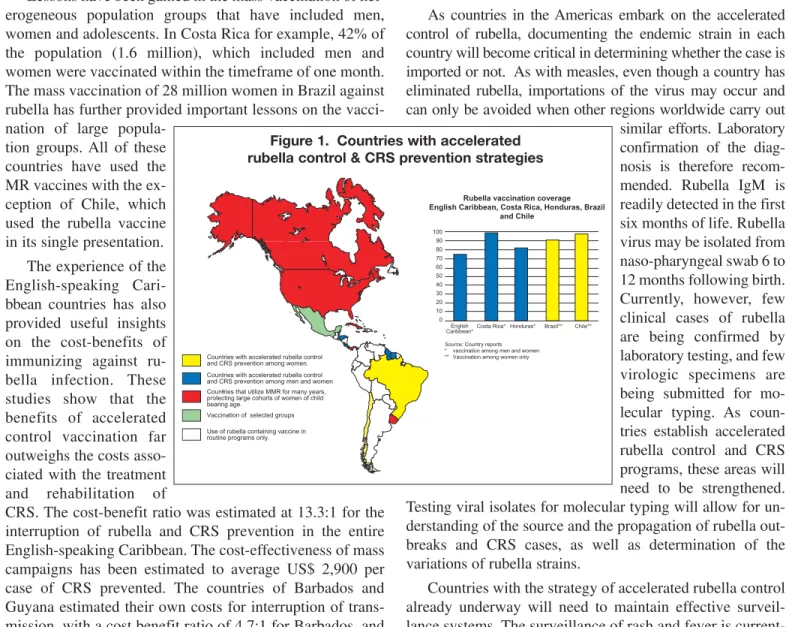
At the 1999 TAG held in Canada, an accelerated rubella control and CRS prevention strategy was developed for the Americas, which followed the experience of the English-speaking Caribbean countries and Cuba in adult mass vacci-nation campaigns against rubella. The strategy rests on the combined vaccination of adult men and women, coupled with rubella vaccine introduction into national childhood im-munization programs. This combined vaccination strategy seeks to achieve rapid reduction of rubella virus circulation, while preventing the shift of disease burden to susceptible young adults, particularly women of childbearing age, thus, avoiding the incidence of CRS. The principal rationale of an accelerated vaccination strategy is to reduce the time it takes to interrupt rubella virus circulation and prevent CRS occur-rence. Most countries in the Region have already implement-ed routine childhood rubella vaccination, and this strategy is protecting children as they reach their first year of life. Nevertheless, this vaccination strategy is likely take over 20 years to control CRS, as several cohorts of childbearing women will remain susceptible to rubella virus.
for the continuos development of successful and sustainable vaccination strategies of adults that reach coverage levels of at least 90%.
Lessons have been gained in the mass vaccination of het-erogeneous population groups that have included men, women and adolescents. In Costa Rica for example, 42% of the population (1.6 million), which included men and women were vaccinated within the timeframe of one month. The mass vaccination of 28 million women in Brazil against rubella has further provided important lessons on the vacci-nation of large
popula-tion groups. All of these countries have used the MR vaccines with the ex-ception of Chile, which used the rubella vaccine in its single presentation. The experience of the English-speaking Cari-bbean countries has also provided useful insights on the cost-benefits of immunizing against ru-bella infection. These studies show that the benefits of accelerated control vaccination far outweighs the costs asso-ciated with the treatment and rehabilitation of
CRS. The cost-benefit ratio was estimated at 13.3:1 for the interruption of rubella and CRS prevention in the entire English-speaking Caribbean. The cost-effectiveness of mass campaigns has been estimated to average US$ 2,900 per case of CRS prevented. The countries of Barbados and Guyana estimated their own costs for interruption of trans-mission, with a cost benefit ratio of 4.7:1 for Barbados, and of 38.8:1, for Guyana, and a cost-effectiveness of US$ 1,633 per CRS case prevented.
The impact of accelerated rubella vaccination strategies on rapid reduction of CRS morbidity in Cuba, the English-speaking Caribbean and in Chile is being reported, as well as the rapid interruption of rubella virus transmission in Costa Rica. CRS is now recognized as a serious public health problem, but limited surveillance data remains a source of concern, providing only a partial view of real disease burden and success of initiatives. In response, additional tools that can enhance the identification of suspected CRS cases are being implemented. These include the collaboration with re-gional systems such the Perinatal Information System (SIP 2000) from the Latin American Center for Perinatology and Human Development (CLAP) and the Congenital Malformation Latin-American Collaborative Study (ECLAMC). Information collected includes: history of ex-posure to rubella, clinical illness during the mother's
preg-nancy, vaccination status of the mother, as well as laborato-ry confirmation of maternal rubella and any congenital mal-formations, hepato-splenomegaly and purpura in the newborns.
As countries in the Americas embark on the accelerated control of rubella, documenting the endemic strain in each country will become critical in determining whether the case is imported or not. As with measles, even though a country has eliminated rubella, importations of the virus may occur and can only be avoided when other regions worldwide carry out similar efforts. Laboratory confirmation of the diag-nosis is therefore recom-mended. Rubella IgM is readily detected in the first six months of life. Rubella virus may be isolated from naso-pharyngeal swab 6 to 12 months following birth. Currently, however, few clinical cases of rubella are being confirmed by laboratory testing, and few virologic specimens are being submitted for mo-lecular typing. As coun-tries establish accelerated rubella control and CRS programs, these areas will need to be strengthened. Testing viral isolates for molecular typing will allow for un-derstanding of the source and the propagation of rubella out-breaks and CRS cases, as well as determination of the variations of rubella strains.
Countries with the strategy of accelerated rubella control already underway will need to maintain effective surveil-lance systems. The surveilsurveil-lance of rash and fever is current-ly the most effective tool. Surveillance systems and adequate laboratory diagnosis should be able to detect rubel-la activity, document the impact of the rubelrubel-la vaccination strategy being implemented, as well as closely investigate and obtain knowledge of each confirmed case, rather than simply tracking the location where the virus is circulating. Emphasis should be placed on laboratory confirmation of all suspected rubella cases.
Countries are reporting great progress in their efforts to control rubella and prevent CRS. Health authorities in the Region have embraced the challenge by providing key politi-cal support at the country level. At the 26th Pan American Sanitary Conference celebrated in September, 2002, PAHO’s Governing Bodies approved a resolution calling for Member States to undertake accelerated control of rubella and congen-ital rubella syndrome prevention initiatives, and to continue improving epidemiological surveillance of rubella and CRS, as well as laboratory diagnosis and investigation procedures.
100 90 80 70 60 50 40 30 20 10 0
English
Caribbean*Costa Rica* Honduras* Brazil** Chile**
Rubella vaccination coverage English Caribbean, Costa Rica, Honduras, Brazil
and Chile
Source: Country reports * vaccination among men and women ** Vaccination among women only
Countries with accelerated rubella control and CRS prevention among women. Countries with accelerated rubella control and CRS prevention among men and women Countries that utilize MMR for many years, protecting large cohorts of women of child bearing age.
Vaccination of selected groups Use of rubella containing vaccine in routine programs only.
Supervision is not being used systematically by all coun-tries of the Region as an effective management tool. This lack of regular supervision has contributed to failures in iden-tifying areas at risk for low vaccination coverage, resulting in inadequate and/or insufficient resources and management at-tention in these areas. Country data on vaccination coverage at the municipal level, results of measles outbreak investiga-tions, on house-to-house monitoring of vaccination cam-paigns, and surveys show insufficient vaccination coverage, particularly in poor and under-served rural population groups, as well as among rural migrants residing in the out-skirts of large cities. To improve routine immunization serv-ices, PAHO has proposed strengthening regular supervision at all health establishments, as both an educational tool, and as a means to enhance accountability at the local level.
Key components of an effective supervision strategy • Standardized supervision protocols that include the
fol-lowing activities
At health establishments supervisors should review: (a) vaccination practices, including injection practices, and disposal of used syringes; (b) administrative data on vaccination, local population estimates, evaluation of DTP1 (or BCG)/DTP3 (or measles) drop-out rates; (c) cold chain equipment, including maintenance of ade-quate refrigerator temperature; (d) weekly reporting of vaccine-preventable diseases; and (e) programming and implementation of outreach vaccination activities.
At the community level supervisors should: (a) perform house-to-house monitoring of vaccination of children ages 0-4 years, to determine first-hand the completion
of their vaccination schedule, feedback on problems en-countered by parents when children were vaccinated, and reasons for non-vaccination; (b) seek cooperation and feedback from local authorities, community lead-ers, organizations and private health care providers; (c) utilize information obtained to provide educational feedback to health staff managing health establishments on ways to improve program performance.
Written feedback: Prepare a short report of the visit (with a copy for the health establishment) that includes: (1) main findings; (2) areas in need of improvement and remedial steps needed; (3) feedback from the local man-ager; and (4) expected date of next supervisory visit.
• Existing indicators to be used to select high-risk areas that require frequent visits
Selection criteria could include: (1) populations with in-sufficient health services; (2) areas with low vaccination coverage or high drop-out rates; (3) areas with silent surveillance; and (4) areas with rural-to-rural migration.
• Sufficient resources should be made available for the implementation of regular supervision
Ensure that National Plans of Action for immunization include adequate resources to support regular supervi-sion at both the national and local levels, and take into account resources for training supervisors.
The sustained implementation of a well-managed super-vision strategy will aid in improving program perform-ance and accountability at all health establishments, particularly at those in high-risk. These efforts should al-so help countries in attaining uniform, quality immuniza-tion in all municipalities.
Supervision: an under-utilized management tool to identify risk areas
Achieving equitable immunization coverage: The Bolivia Project
Background
Vaccines are considered one of the most cost-effective practices in the field of public health. Accordingly, they are generally offered free of charge in health services and the Expanded Program of Immunization (EPI) is considered a key component within basic health care strategies for the general population. EPI’s goal is to guarantee and ensure universal access to immunization services for all children with special emphasis given to the population at increased risk of contracting vaccine-preventable diseases. The search for equity in the delivery of vaccination services is a key pri-ority for national immunization programs. Thus, the exis-tence of municipalities with coverage levels under 80% demonstrates that coverage is not equally distributed throughout a country. Such municipalities constitute
developed. Municipalities at risk were defined as those re-porting DPT3 or pentavalent 3 coverage levels under 80%.
Methods
As a part of the strategic plan to reduce the number of municipalities at risk, those reporting low coverage for var-ious years were analyzed for years 1997 to 2001. Data pre-pared by the EPI program using the National Health Information System (SNIS) database utilized to determine the number of doses of vaccine administered, and data from the National Institute of Statistics (INE) were used to deter-mine the population for the denominator in coverage calcu-lations. The information of the study corresponds to years 1997 through 2001 for DTP3/ pentavalent 3. Pentavalent vaccine was introduced in Bolivia in July 2000.
Among the municipalities selected for interventions, a working group will be organized with the participation of municipal mayors, health workers, and grass-roots organiza-tions. This group will be responsible for developing local medium and long-term plans, which will be signed as agree-ments between all members of the group. The central level of the Ministry of Health will assign staff for direct techni-cal support and monitoring of the project.
Classification of Municipalities
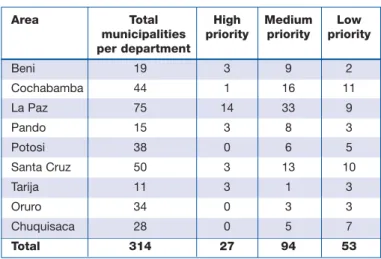
Bolivia has 314 municipalities and a total population of 8,328,772 (for year 2001), of which 251,363 are children un-der 1 year of age. There are 27 municipalities classified as high priority with a combined population of 8,077 children under 1 year of age (Table 1). The majority of municipalities in this category are rural and indigenous. The average popu-lation per municipality of children less than 1 year old in these high-priority municipalities is 300. There are 94 mu-nicipalities classified as medium priority with a total
popu-lation of 93,363 children under the age of 1. Thirty three (35%) of these municipalities are located in La Paz . There are 53 municipalities classified as low priority with a total population of 45,458 children under 1 year of age. The greatest proportion of the population in this priority group are located in Cochabamba (52%) and in Santa Cruz (12%). Finally, there are 140 municipalities that were not classified as being at risk, with a population of 106,178 children less than 1 year of age. The area with greatest percentage of mu-nicipalities is this category is Potosi with 20%.
Immunization Equity Plan
The national immunization program is developing and implementing a strategy that seeks, through dialogue with local community leaders, local level commitment for the support of the national program. This strategy will include the use of mobile vaccination brigades (BEARs), which are widely used in Bolivia to work on municipalities considered at high-risk. As usual, the brigades will work closely with lo-cal community members in developing a diagnosis of the problem and for implementing an agreed upon plan. Technical assessments will evaluate the causes of low cov-erage and undertake comprehensive reviews of problems en-countered. Part of the analysis of problems associated with coverage estimates will be based on the reliability of official denominators, that is populations, for each municipality, combined with the use of PAHO’s rapid monitoring tools as a part of supervision and situation analysis activities. Challenges for the analysis include how to best assess cov-erage levels in municipalities with intense migration that can result in erroneous populations figures.
A critical component of the Project is the permanent link and communication between municipalities and the Departmental and the Central level of the Ministry. It is im-portant that the Ministry give staff the responsibility to mon-itor these municipalities and provide technical support for the timely implementation of plans. In the medium-term, an Definition of chronic low-coverage municipality
A chronic low-coverage municipality was defined as any municipality with coverage levels below 80% during two or more or years during the last five years. Muni-cipalities were grouped into high priority, medium priori-ty, and low priority. This classification aided in the prio-ritization of municipalities for vaccination activities.
* High priority: Municipalities that reported DPT3 or pentavalent 3 vaccination coverage under 80% for all of the last five years.
* Medium priority: Municipalities that reported DPT3 or pentavalent 3 vaccination coverage under 80% dur-ing three to four years of the last five years.
* Lower priority:Municipalities that reported DPT3 or pentavalent 3 vaccination coverage under 80% in two years of the last five years.
Table 1. Number of municipalities at risk by Department and priority classification,
Bolivia, 1997-2001
Area Total High Medium Low municipalities priority priority priority per department
Beni 19 3 9 2
Cochabamba 44 1 16 11
La Paz 75 14 33 9
Pando 15 3 8 3
Potosi 38 0 6 5
Santa Cruz 50 3 13 10
Tarija 11 3 1 3
Oruro 34 0 3 3
Chuquisaca 28 0 5 7
A key task at hand following the implementation of the regional surveillance system for S. pneumoniae, that was lat-er expanded to include H. influenzae and N. meningitidis, has been the standardization of laboratory methodologies and the commitment of laboratories to Quality Assurance at all levels. These efforts seek to ensure that regional and country technically valid data are produced.
The standardization has been achieved through effective training programs that began at the main reference center, the National Streptococcus Centre in Albert, Canada, to every public health laboratory in the Region, and from there to laboratories at participating hospitals. Close collaboration has been established among public health laboratories of the different countries that joined the system, which also in-volved research collaborations and knowledge sharing and expertise. The training involved primary isolation, identifi-cation, susceptibility testing, characterization of pneumo-cocci, as well as serotyping, antibiotic susceptibility testing, and in some instances, molecular analyses.
The Quality Control-Quality Assurance system has in-cluded: proficiency testing (panel of unknowns sent from the main reference center to sub-regional centers in Mexico, Colombia and Brazil, and then to public health laboratories in the rest of the Americas), and verification of submitted isolates (10% of all typable S. pneumoniae, all ‘non-typable’ S. pneumoniae, and 25% of antibiotic resistant strains). The quality system is active, as it involves continuous communi-cation between the centers and countries, discussions and preparation of summary report of results. The panels used are designed based on appropriate level of challenge, and as an educational and improvement tool. These need to be eval-uated as part of routine laboratory processes, to monitor all components of the testing system (media, reagents,
antis-era), technical precision and test interpretation, as well as data entry and reporting.
In 2001, contacts were made with the Haemophilus Reference Center of the United Kingdom’s Public Health Laboratory System, a WHO Collaborating Center, to act as the external QC-QA reference center for H. influenzaein the Americas. At the end of 2001, a workshop was conducted to standardize laboratory techniques for Neisseria meningi-tidis, and the decision was taken to request the services of the Instituto Adolfo Lutz in Sao Paulo, Brazil as the ref-erence center for meningococci. Thus, by the year 2002, the surveillance of bacterial meningitis and pneumonia is being supported by a QC-QA system that addresses the quality of data referring to S. pneumoniae, H. influenzae and N. meningitidis.
In September 2002, a meeting was held in Cuernavaca, Morelos, Mexico to discuss the status of the QC-QA system with representatives from the Regional (Canada and the United Kingdom) and sub-regional reference centers (Brazil, Colombia and Mexico). The purpose of the meeting was to provide updates of results, as well as share lessons learned. In general, results on the panels from three sub-regional centers sent from the NCS correlate over 90% of the time for serotyp-ing and antimicrobial susceptibility of S. pneumoniae. When errors occur, they are deemed minor. Some discrepancies were observed on submitted isolates (15% for serotyping and 10% for antimicrobial susceptibility), but they were almost always resolved on repeat testing by the submitting laboratory. Overall, for panels sent by the Haemophiluslaboratory results have been of good standards, with some problems in the inter-pretation of slide agglutinations, but PCR would provide a type for strains that give inconclusive results on slide agglutination. Almost all H. influenzaetype b were identified correctly.
Quality control system for the surveillance of
bacterial meningitis and pneumonia
evaluation of the participation of community and municipal authorities will be carried out to improve the functioning of the plan, and to give recognition to municipalities who have effectively eliminated or lowered a risk classification. This immunization equity plan is currently included in the na-tional government’s Health Plan that addresses the reduction of social exclusion from national health services. Community participation is a key aspect of the immuniza-tion equity plan which will ensure access for those who are currently not benefiting from health services.
Editorial Note:Achievement of high vaccination cover-age levels at the local level is a key mission goal for PAHO and for national immunization programs. Although regional and national coverage levels by vaccine are quite high, vari-ation exists in many, if not most, countries at the local level.
The QC-QA system from the sub-regional centers to the countries has also obtained good results in the correlation of serotyping and antimicrobial susceptibility. Among major problems identified is international transportation. Shipping of isolates is more difficult getting every day: import per-mits are required, costs are high, and there are limited couri-er options. This is reflected on the sporadic reception and submission of isolates. QC-QA programs require financial resources, which are unfortunately becoming more reduced at regional public health laboratories.
In conclusion, the QA-QC system has strengthened pub-lic health laboratories in the Region through inter-country and inter-laboratory technical and scientific collaborations, as well as by supporting the validity of information being generated from the surveillance system of bacterial pneu-monia and meningitis. It is important that National Authorities recognize the value of QA and QC, and provide the necessary support to strengthen these activities and ex-tend them to the whole public health laboratory system in their respective countries.
Diphtheria outbreak in Paraguay – an update
Background
During epidemiological week 7 of 2002 (week ending February 2) a diphtheria case in a 4 year old child was reported from the district of Capiata in the Central region of Paraguay (see EPI Newsletter, June 2002). During epidemiological week 13 (March 30), a second case from the same region was reported in the district of J. Augusto Saldivar. Subsequently, two additional cases were reported in week 15 (April 13) and were later laboratory-confirmed. As of
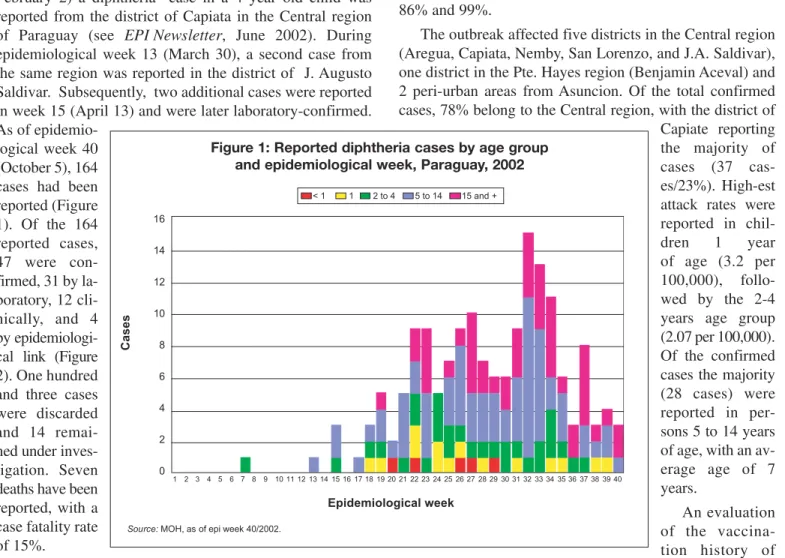
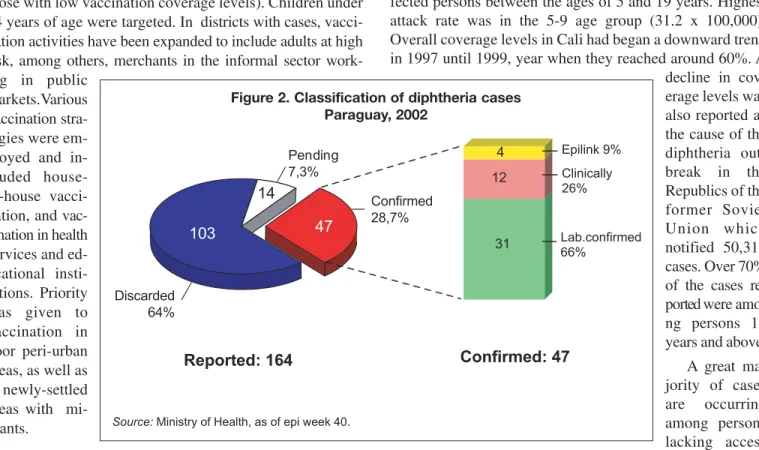
epidemio-logical week 40 (October 5), 164 cases had been reported (Figure 1). Of the 164 reported cases, 47 were con-firmed, 31 by la-boratory, 12 cli-nically, and 4 by epidemiologi-cal link (Figure 2). One hundred and three cases were discarded and 14 remai-ned under inves-tigation. Seven deaths have been reported, with a case fatality rate of 15%.
Diphtheria had shown a decreasing trend in Paraguay for the past 22 years, with the exception of a reported increase from 1985 to 1987. In 1985, Paraguay reported the highest rate ever per 100,000 persons, i..e, 0.75. From 1996 to 2000 no cases were reported. In 2001, an isolated case, reported from the Department of Alto Parana, was later confirmed as diphtheria. No additional cases were reported from that area even after a thorough investigation. Between 1995 and
2001, national coverage for DPT3 ranged between 79% and 89%. Reported vaccination coverage in 2001 for DPT3 in the affected areas of the diphtheria outbreak ranged between 86% and 99%.
The outbreak affected five districts in the Central region (Aregua, Capiata, Nemby, San Lorenzo, and J.A. Saldivar), one district in the Pte. Hayes region (Benjamin Aceval) and 2 peri-urban areas from Asuncion. Of the total confirmed cases, 78% belong to the Central region, with the district of Capiate reporting the majority of cases (37 cas-es/23%). High-est attack rates were reported in chil-dren 1 year of age (3.2 per 100,000), follo-wed by the 2-4 years age group (2.07 per 100,000). Of the confirmed cases the majority (28 cases) were reported in per-sons 5 to 14 years of age, with an av-erage age of 7 years.
An evaluation of the vaccina-tion history of the 47 confirmed cases revealed that 74% (35 cases) lacked proof of vaccination, be it through a vaccination card or through the register in a health service, 13% (6 cases) showed an incomplete vaccination schedule, and only 13% (6 cases) had full proof of vaccination. Cases predominantly affected children living in extreme pover-ty in poor, peri-urban areas.
1 2 3 4 5 6 7 8 9 10 11 12 13 14 15 16 17 18 19 20 21 22 23 24 25 26 27 28 29 30 31 32 33 34 35 36 37 38 39 40
Epidemiological week
Cases
16
14
12
10
8
6
4
2
0
< 1 1 2 to 4 5 to 14 15 and +
Source: MOH, as of epi week 40/2002.
Pan American Health Organization
Pan American Sanitary Bureau Regional Office of the World Health Organization
Division of Vaccines and Immunization
525 Twenty-third Street, N.W. Washington, D.C. 20037 U.S.A.
http://www.paho.org (Search: EPI Newsletter) The EPI Newsletter is published every two months, in Spanish,
English and French by the Division of Vaccines and Immunization (HVP) of the Pan American Health Organization (PAHO), Regional Office for the Americas of the World Health Organization (WHO). Its purpose is to facilitate the exchange of ideas and information concerning immunization programs in the Region, in order to promote greater knowledge of the problems faced and their possible solutions.
References to commercial products and the publication of signed articles in this Newsletter do not constitute endorsement by PAHO/WHO, nor do they necessarily represent the policy of the Organization.
Editor: Gina Tambini
Associate Editor: Mónica Brana ISSN 0251-4729
Vaccination was intensified in the entire country, partic-ularly in the affected areas and in high-risk areas (defined as those with low vaccination coverage levels). Children under 14 years of age were targeted. In districts with cases, vacci-nation activities have been expanded to include adults at high risk, among others, merchants in the informal sector work-ing in public
markets.Various vaccination stra-tegies were em-ployed and in-cluded house-to-house vacci-nation, and vac-cination in health services and ed-ucational insti-tutions. Priority was given to vaccination in poor peri-urban areas, as well as in newly-settled areas with mi-grants.
____________
Editorial Note:The incidence of diphtheria had shown a significant reduction in the Americas as a result of increased vaccination coverage. In 1978, there were 6,857 reported cases, the highest number of cases recorded in the Region. Since then, a gradual decline in cases is evident, with 113 cases in 2000, and 68 cases reported in 2001. In 2002, as of epidemiological week 40, Paraguay has reported 164 cases. Failure in maintaining uniform and high level DPT3 vaccination coverage is the most probable cause for these
outbreaks. This was the case in the 2000 diphtheria outbreak in Cali, Colombia, which reported 8 confirmed cases and af-fected persons between the ages of 5 and 19 years. Highest attack rate was in the 5-9 age group (31.2 x 100,000). Overall coverage levels in Cali had began a downward trend in 1997 until 1999, year when they reached around 60%. A decline in cov-erage levels was also reported as the cause of the diphtheria out-break in the Republics of the former Soviet Union which notified 50,319 cases. Over 70% of the cases re-ported were amo-ng persons 15 years and above.
A great ma-jority of cases are occurring among persons lacking access to vaccination services or who have an incomplete vaccina-tion schedule. In Colombia, 5 (62%) of the cases had an in-complete vaccination schedule and were under the poverty line. In Paraguay, 35 (74%) of the confirmed cases, mostly poor, lacked proof of vaccination. This points to the need of improving access to health services in the under 5 years of age population group. The occurrence of cases among adults also indicates the need to prioritize vaccination services among adults at high-risk, particularly population groups with poor access to health services, as is the case in Paraguay.
Source: Ministry of Health, as of epi week 40.
Clinically 26% Epilink 9%
Lab.confirmed 66%
4
31 12
14
47 103
Pending 7,3%
Confirmed 28,7%
Discarded 64%
Reported: 164 Confirmed: 47