Mailing Address: Antonio Luiz Pinho Ribeiro • Rua Campanha, 98/101 - 30310-770 – Belo Horizonte, MG - Brazil
E-mail: [email protected] Received on 10/04/05 • Accepted on 12/28/05
The Portuguese Version, Cross-Cultural Adaptation and
Validation of Specific Quality-of-Life Questionnaire -
AQUAREL - for Pacemaker Patients
Bruna Guimarães Oliveira, Jorge Gustavo Velasquez Melendez, Rozana Mesquita Ciconelli, Leonor Garcia Rincón, Ana Amélia Soares Torres, Lidiane Aparecida Pereira de Sousa, Antonio Luiz Pinho Ribeiro
Faculdade de Medicina, Escola de Enfermagem e Hospital das Clínicas da Universidade Federal de Minas Gerais e Universidade Federal de São Paulo - Belo Horizonte, MG - Brazil
O
BJECTIVETo translate, to make the cultural adaptation and to evaluate reproducibility and validity of the Portuguese version of the AQUAREL (Assessment of QUAlity of life and RELated events) questionnaire, which is a specifi c tool to assess quality of life in pacemaker patients.
M
ETHODSWe evaluated 202 pacemaker patients: 63 patients during the cross-cultural adaptation stage and 139 during the reproducibility and validity evaluation stages. The questionnaire translation was reviewed repeatedly until
≥85% of patients correctly understood the questions. Reproducibility of the fi nal version was tested in 69 patients in whom the interview was performed twice by the same researcher. Validity was checked by the correlation between scores obtained in AQUAREL domains and those obtained in SF36 domains, in the functional class and the distance walked in the six-minute test.
R
ESULTSThe internal consistency of AQUAREL was adequate, with Cronbach’s alpha coeffi cient varying between 0.59 and 0.85. Reproducibility was good, with high correlation coeffi cients (0.68-0.89) and random distribution of data in Bland and Altman plots, without systematic bias. A signifi cant association was observed among AQUAREL domains and those obtained in SF36 domains and the functional class (p<0.01), although significant correlations with the distance walked in the six-minute test were not found.
C
ONCLUSIONThe Portuguese version of the AQUAREL questionnaire is easy and rapid to apply, and could be used as a specifi c questionnaire to assess quality of life in pacemaker patients.
K
EY WORDSIn the last decades, health interventions have aimed not only at extending human life but also at reaching a better quality of life. Instruments for measuring quality of life were developed and nowadays they are useful tools to objectively test if an intervention is able to allow patients to live better1,2. In the segment of artifi cial cardiac
stimulation, new technological developments make new resources available every day. Thus, the evaluation of the impact of different modes of stimulation and of resources for programming on the quality of life is essential for choosing the treatment regimen to be employed and defi ning its cost-benefi t ratio3-7.
When a specifi c population group is studied, it is important to be sure that the proposed intervention is able to bring benefi ts both to the general aspects of patients’ well-being and to the limitations and symptoms related specifi cally to the disease. The exclusive use of generic instruments to evaluate quality of life in pacemaker patients can reduce the ability of the investigation to recognize the potential benefi ts attained, the effect of which could have been recognized if a specifi c instrument had been used8,9. The evaluation of quality of life (QOL)
is considered ideal in pacemaker patients when it is performed through the association of a generic and a specifi c instruments10 .
Stofmeel et al11,12 proposed a specifi c questionnaire to
evaluate the quality of life in pacemaker patients that is composed of 20 questions distributed into three domains (chest discomfort, arrhythmia, exertional dyspnea) named AQUAREL (Assessment of QUAlity of life and RELated events).AQUAREL should be used as an extension of the generic questionnaire Medical Outcomes Study 36-item Short Form (SF-36), comprising 36 items grouped in eight domains: physical functioning, role physical, bodily pain, general health, vitality, social functioning, role emotional and mental health, which have already been translated and validated in Portuguese13.
The objective of the current study was to translate, to make a cross-cultural adaptation and to evaluate reproducibility and validity of the Portuguese version of the questionnaire AQUAREL (Assessment of QUAlity of life and RELated events) which is specifi c for assessing quality of life in pacemaker patients.
M
ETHODSThis is a cross-sectional observational study, with a descriptive and analytical component, performed at the Laboratory for Evaluation and Control of Artifi cial Cardiac Stimulation at the Hospital das Clínicas da Universidade
Federal de Minas Gerais (UFMG) between 2002 and
2003. The research project was approved by the Research Ethics Committee of UFMG and all patients signed the informed consent term.
The study enrolled patients aged over 17 years, who presented at the Laboratory for a routine visit and
follow-up after implantation (more than 3 months), without unstable clinical picture or limitations in speech, hearing and understanding that could prevent communication required for the interview. As to the reproducibility tests, the inclusion criterion was also considered the patient’s availability to return to the unit and fi ll the AQUAREL questionnaire in again. From 202 patients studied, 63 participated in the phase of cross-cultural adaptation and 139 patients participated in the evaluation of reproducibility and validity of the translated version of the questionnaire. The six-minute walk tests, which was a method used in the process of validation, included 74 patients who were physically able to walk without any help, were willing to take the test and did not present any clinical contraindications such as unstable angina, class IV congestive heart failure or severe cardiovascular or systemic disease. Patients were randomly selected out of 1,400 individuals registered in the Laboratory, with no other additional selection criterion. The sample was considered representative of the universe of patients followed up in a pacemaker clinic in a Brazilian capital city.
The AQUAREL questionnaire was submitted to the process of validation after translation and cultural adaptation for use by Portuguese speakers, according to the recommendations presented in the literature. Complying with these recommendations, the whole process of translation and cultural adaptation was accompanied by a Review Committee comprising a team of specialists who work at the Pacemaker Laboratory: three cardiologists, one nurse and two medical students. The Review Committee was responsible for coordinating and performing adjustments that were necessary in the phase of cultural adaptation, as well as for recording all processes.
Translation and cultural adaptation followed the planning described in fi gure 1 and which was designed based on the methodology of translation of questionnaires to other languages proposed in the specifi c literature14-16.
Reproducibility of the fi nal Portuguese version of the AQUAREL questionnaire was tested by using the questionnaire in two interviews carried out by one single interviewer. The intervals between the interviews to answer the questionnaire were a minimum of 6 days and a maximum of 15 days, and the interviews occurred at the same time of the day for each patient. Thus, the sample tested during this phase was composed of 69 patients, 47.6% females and 52.4% males, who were available to return to the Laboratory again. The questionnaires were codifi ed and entered in a database, and an algorithm was used to calculate the individual score values, which were obtained for each domain of the AQUAREL questionnaire (chest discomfort, arrhythmia, exertional dyspnea) according to the defi nition in the original version11.
The values obtained range from zero (which represents all complaints) to 100 (which represents absence of complaints): the latter represents a perfect quality of life. The statistical analysis to evaluate reproducibility was carried out through different methods: 1) comparison of the means of mean scores obtained in the population in each interview by using Student’s t test for dependent samples. The differences of means not statistically different from zero (p >0.05) were considered indicators of appropriate reproducibility; 2) Bland and Altman plots17 which graphically shows the difference of scores
obtained from the interviews in the group of mean values; 3) Pearson’s correlation coeffi cient among the individual values obtained in the fi rst and second interviews.
The analysis of internal consistency of the compo-nents in each domain of the questionnaire was
performed through the calculation of Cronbach’s alpha coeffi cient18. Values higher than 0.5 indicate acceptable
internal consistency, and higher than 0.7 are considered optimal values.
The validity of the AQUAREL questionnaire fi nal version in Portuguese was assessed through the participation of 139 patients in the study associating the scores obtained in the domains of the AQUAREL questionnaire and the SF36 questionnaire, the functional class score and the distance walked in the 6-minute test (performed in 74 patients). The selection of such parameters, considered here as a reference standard to assess the validity of the instrument to recognize the clinically significant differences, took into consideration their clinical importance and their use in the validation of the AQUAREL questionnaire in its original version.
SF-36 is a largely used and duly validated generic questionnaire that is part of the evaluation of the general aspects. A positive correlation is expected to be found among the scores of the domains of SF-36 questionnaire and the questionnaire under evaluation. The functional class was evaluated by the researcher with the use of a scale of specifi c activity according to functional class I-IV, similar to that used by the New York Heart Association and proposed by Goldman et al19. The 6-minute walk test is a method for evaluation
of the submaximal functional capacity. Before the test, the individuals remained at rest for at least 10 minutes, an interval when their personal data was obtained and the individuals were given the necessary instructions. The possible contraindications to the procedure were also analyzed. Participants were previously trained and
Stage Participants Product
Initial translation
1 English teacher
2 people profi cient in English
Translation 1 Translation 2 Translation 3
Translation synthesis
Revising Committee and three previous participants Translation synthesis
Back translation
2 individuals from the United States Back translation 1 Back translation 2
Translation
Revising Committee (translation synthesis + back
translations) Translated version 1
Cultural adaptation Population: in verifi cation (understanding report) by the
Committee: in adjustments Translated version 2...n
Culturally adapted translated version
submitted to two tests with a 20-minute interval for resting. The two evaluations with the 6-minute walk tests aimed to eliminate the learning effect of the procedure. Additionally, if a difference greater than 10% was found in the distance walked between the fi rst and the second test, a third evaluation would be performed20 . The subjects
were encouraged in a standardized manner during the test, and in case of chest pain, disproportional exertional dyspnea, excessive sudoresis, paleness or malaise, the test would be immediately interrupted. It is considered a simple test that reproduces daily activities and can be easily performed. Moreover, it requires little equipment, it is safe and fast, and presents good correlation with other types of physical exercises such as the treadmill or stationary bicycle test21-23.Evaluation of validity of the
Portuguese version of the AQUAREL questionnaire was conducted through analysis of Pearson’s correlation, as well as comparison of mean values using the analysis of variance and Tukey’s test. The results were considered statistically signifi cant at a p ≤ 0.05.
R
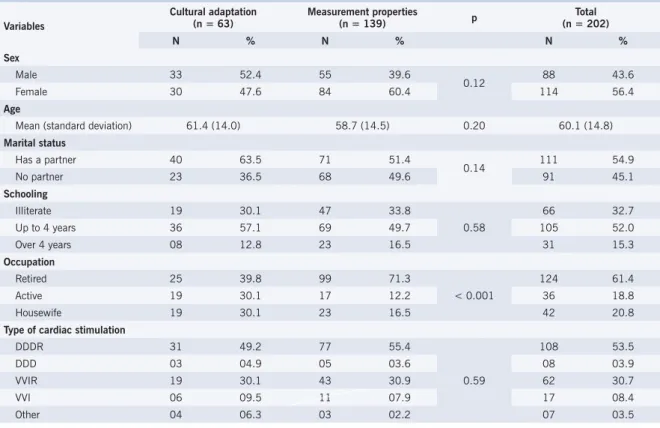
ESULTSA total of 202 patients with mean age of 60.1 years (17-82) participated in the study; in that, 56.4% were females and 61.4% were patients retired or on leave (table 1). More than 50% of patients reported a marital relationship; 84.7% of patients reported they had attended school for less than 4 years and 32.7% had
never attended school. A larger proportion among the 139 patients who underwent the evaluation of measurement property (reproducibility and validity) was already retired; however, no other signifi cant differences were found between the two groups.
The study involved three tests with two timepoints of cultural adjustment until the index defi ned as 85% of correct understanding was reached. In the fi rst test (with 10 patients), 16 out of 20 questions presented an index higher than 15% of incorrect or dubious understanding; in the second test (23 patients), 10 questions had to be adjusted; and, in the third test (30 patients), all the questions presented pre-established indexes considered acceptable, with less than 5% of incorrect or dubious understanding.
Out of 139 patients who participated in the second phase of the study, 69 patients (47.5%) participated in the reproducibility study and returned for the second application of the AQUAREL questionnaire after seven days, in average. Table 2 presents the means and standard deviations of the scores obtained in both interviews. There are no signifi cant differences between the scores obtained in two timepoints in any domain of the AQUAREL questionnaire. Therefore, the mean difference between the scores obtained is close to zero in spite of a relatively large confi dence interval (fi gure 2 to 4).
Intraobserver correlation coeffi cients obtained between the fi rst and second interviews were elevated and highly
Table 1 – Social-demographic characteristics and mode of artifi cial cardiac stimulation of patients participating in the study during the phases of cultural adaptation and evaluation of the measurement properties
Variables
Cultural adaptation (n = 63)
Measurement properties
(n = 139) p
Total (n = 202)
N % N % N %
Sex
Male 33 52.4 55 39.6
0.12 88 43.6
Female 30 47.6 84 60.4 114 56.4
Age
Mean (standard deviation) 61.4 (14.0) 58.7 (14.5) 0.20 60.1 (14.8)
Marital status
Has a partner 40 63.5 71 51.4
0.14 111 54.9
No partner 23 36.5 68 49.6 91 45.1
Schooling
Illiterate 19 30.1 47 33.8
0.58
66 32.7
Up to 4 years 36 57.1 69 49.7 105 52.0
Over 4 years 08 12.8 23 16.5 31 15.3
Occupation
Retired 25 39.8 99 71.3
< 0.001
124 61.4
Active 19 30.1 17 12.2 36 18.8
Housewife 19 30.1 23 16.5 42 20.8
Type of cardiac stimulation
DDDR 31 49.2 77 55.4
0.59
108 53.5
DDD 03 04.9 05 03.6 08 03.9
VVIR 19 30.1 43 30.9 62 30.7
VVI 06 09.5 11 07.9 17 08.4
Fig. 2 – Reproducibility between two successive assessments of the AQUAREL questionnaire in the domain chest discomfort. In A, the dispersion chart and Pearson correlation coeffi cient values. In B, the Bland and Altman plots, in which the differences between the fi rst and second assessment scores are plotted against the mean values obtained, thus enabling identifi cation of the variation amplitude and of the existing systematic biases between the two interviews.
r = 0.69
CI 95% 0.54 - 0.80
p <0.0001
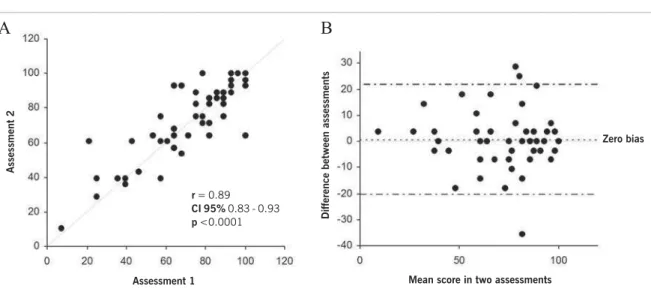
signifi cant (p ≤ 0.001) in the domains of chest discomfort (fi g. 2A), dyspnea (fi gure 3A) and arrhythmia (fi gure 4A) of the AQUAREL questionnaire. The Bland and Altman plots, displayed in fi gures 2 to 4 (B), show the absence of a systematic bias between the fi rst and second evaluations in the three domains; however, they reveal a relatively large variation of scores between the interviews.
Table 3 shows the values calculated for verifi cation of
internal consistency among the items that make up each domain by means of Cronbach’s alpha coeffi cient. The scores ranged from 0.678 to 0.849 in the fi rst application of the questionnaire, and from 0.592 to 0.818 in the second application; the lowest scores were found in the arrhythmia domain.
The questionnaire’s validity was evaluated in 139 patients, of which 74 (53.2%) performed the 6-minute
Table 2 – Scores of the AQUAREL questionnaire domains in two distinct timepoints in patients participating in the study during the phase of reproducibility evaluation (n=69)
AQUAREL Domains Interview 1 Mean (SD)
Interview 2
Mean (SD) Mean difference (95% CI) p
Chest discomfort 86.2 (20.0) 86.8 (18.0) 0.6 (-29.7 to 30.9) 0.74 Dyspnea 76.3 (23.59) 77.1 (22.1) 0.8 (-20.7 to 22.3) 0.55 Arrhythmia 83.0 (17.7) 83.4 (16.6) 0.4 (-20.9 to 22.0) 0.77 SD- Standard deviation; CI- confi dence interval.
r = 0.89
CI 95% 0.83 - 0.93
p <0.0001
A
B
Fig. 3 – Reproducibility between two successive assessments of the AQUAREL questionnaire in the domain dyspnea. In A, the dispersion chart and Pearson correlation coeffi cient value. In B, the Bland and Altman plot.
Assessment 2
Assessment 1
Difference between assessments
Mean score in two assessments
Zero bias
Assessment 2
Assessment 1
Difference between assessments
Mean score in two assessments
Zero bias
A
B
r = 0.81
CI 95% 0.71 - 0.88
p <0.0001
Fig. 4 – Reproducibility between two successive assessments of the AQUAREL questionnaire in the domain arrhythmia. In A, the dispersion chart and Pearson correlation coeffi cient values. In B, the Bland and Altman plot.
walk test. Patients considered functional class II or III presented signifi cantly lower scores compared with class I patients (table 4). Additionally, elevated correlation coefficients were seen among the domains in the AQUAREL and SF-36 questionnaires (table 5). However, no variation in the scores of quality of life in the AQUAREL questionnaire was seen in terms of the distance walked in the 6-minute test (table 6).
D
ISCUSSIONIn the translation and back-translation, there was no great discrepancy among the three translation pieces and the back-translation performed in this study.
In the cultural adaptation, the low schooling levels in general were manifested in all phases of application and adjustment of the translated questionnaire. It was necessary to include explanatory notes in order to maintain fidelity to the purpose of the original version. The progressive improvement in understanding shown in several phases of the cultural adaptation test demonstrates that the simple translation does not guarantee the equivalence with the original questionnaire. Thus, the importance pointed out in the literature to the use of a systemized guide in the process of translation and cultural adaptation stands out14,16.
The high percentage of illiteracy (32.7% of illiterate patients) in this study justifi ed the use of a questionnaire as an interview.
Reproducibility, also called reliability, is the property
shown by the instrument to reproduce similar results when applied to similar situations13. The results of the
reproducibility test in this study show the existence of adequate reliability of the questionnaire in this group of patients, as verifi ed by the lack of signifi cant differences between the means of the scores obtained in the domains of the questionnaire when it is repeatedly applied, as well as by the high values (0.68 to 0.89) of the intraobserver correlation coeffi cients. However, the 95% confi dence intervals of the score differences between the two timepoints were relatively large, with 20 points in the domains of arrhythmia and dyspnea, and close to 30 points in the domain of chest discomfort (fi gures 2 to 4), indicating potential limited use of this instrument to evaluate individual quality of life.
An aspect that should be emphasized is that the differences were randomly distributed in regard to mean values of quality of life scores for both results obtained in two separate interviews (fi gures 2 to 4), denoting that there are no systematic biases in the values obtained. In terms of internal consistency of the translated version of AQUAREL questionnaire, which was verified by Cronbach’s alpha coeffi cient, the scores found are within the limits considered as acceptable for the domains of arrhythmia and dyspnea (>0.5) and as ideal for the domain of chest discomfort (>0.7). Although the original version of AQUAREL presented an acceptable interobserver reproducibility, a noteworthy limitation in the current study was the absence of reproducibility evaluation among different observers.
Table 3 – Internal consistency (Crombach´s alpha coeffcient) between the items that comprise the AQUAREL questionnaire domains applied in two time points in patients participating in the study
during the phase of reproducibility evaluation (n = 69)
AQUAREL Domains Interview 1 Interview 2
Chest discomfort 0.8497 0.8180
Dyspnea 0.6606 0.6455
Arrhythmia 0.6788 0.5921
Assessment 2
Assessment 1
Difference between assessments
Mean score in two assessments
Table 4 – Quality of life scores in the AQUAREL questionnaire domains by functional class of 139 pacemaker patients
AQUAREL questionnaire domains
Functional class Chest discomfort Dyspnea Arrhythmia
mean SD mean SD mean SD
I 91.8** 15.8 86.1** 18.6 86.3** 17.0
II 77.5 20.1 62.3 25.1 73.5 20.7
III 71.5 24.4 52.6 25.2 67.2 22.6
0.000* 0.000* 0.000*
*p < 0.0001 differences between classes I, II and III. **p < 0.004 difference between class I in relation to class II and III (Tukey´s test). SD- standard deviation.
Table 5 – Pearson´s correlation coeffi cient between the scores of SF-36 and AQUAREL questionnaire domains in 139 pacemaker patients
SF-36 Questionnaire Domains AQUAREL Questionnaire Domains
Chest discomfort Dyspnea Arrhythmia
Physical functioning 0.531* 0.667* 0.572*
Role physical 0.489* 0.603* 0.468*
Bodily pain 0.452* 0.528* 0.447*
General health 0.456* 0.571* 0.493*
Vitality 0.357* 0.602* 0.461*
Social functioning 0.245* 0.461* 0.371* Role emotional 0.254* 0.304* 0.383*
Mental health 0.436* 0.528* 0.459*
Note: * p < 0.01 (Bonferroni correction for multiple comparisons).
Table 6 – Quality of life scores in the AQUAREL questionnaire domains in groups by distance walked in the 6-minute walk test in 74 pacemaker patients
Distance walked (meters)
AQUAREL Questionnaire Domains
Chest discomfort Dyspnea Arrhythmia
N Mean SD Mean SD Mean SD
283.0 - 442.0 23 88.8 17.2 81.2 17.2 86.5 14.6 442.1 – 537.0 25 87.0 19.5 74.7 26.0 82.6 15.8 537.1 – 831.0 26 87.0 17.9 80.2 22.5 83.7 21.1
P 0.922 0.546 0.720
SD - standard deviation.
Validation is the process through which one seeks to demonstrate the capacity of an instrument and to measure what has been proposed. There are many diffi culties involved in validating complex and subjective measurements, such as quality of life, which do not have a reference standard. Validity is confi rmed only after successive studies show relevant aspects of the instrument evaluated. The current study compared the scores obtained in the domains of the AQUAREL questionnaire and the distance walked in the 6-minute walk test, the functional class and the SF-36 questionnaire; such parameters were also used to validate the AQUAREL questionnaire in its original version in English12.
The correlations observed between the scores of the AQUAREL questionnaire domains and the instruments already validated, such as the SF-36 questionnaire and the functional class by specifi c activities of the Goldman scale, suggest that the AQUAREL questionnaire is an instrument to evaluate quality of life that is able to record – through variations in its specifi c scores – changes
in the subjective sensations from the standpoint of pacemaker patients.
The scores of each domain of the AQUAREL ques-tionnaire do not correlate with the distance walked by patients in the 6-minute walk test. Houghton et al23
also did not fi nd a signifi cant correlation between the 6-minute walk test and the questionnaire of quality of life evaluation in patients with congestive heart failure. Olsson et al24, in a recent systematic review, highlighted
the weak relationship between the distance walked in the 6-minute walk test and the symptoms of heart failure severity. Additionally, age is an important confounding factor, since it is known to be associated with the distance walked and to the scores of quality of life (Sousa et al, unpublished data).
sensitivity of the Portuguese version of the AQUAREL questionnaire25. It is also important to note that this study
involved a signifi cant yet limited number of patients, and it was carried out in a single institution, which represents a restricted universe. Studies in other areas of the country and with distinct patients are desirable before the full use of the questionnaire in the clinical practice is adopted.
In conclusion, a Portuguese version of the AQUAREL questionnaire was obtained from the translation and cultural adaptation performed according to the current guidelines. Improvements attained in patients’
comprehension during the cultural adaptation stress the need to strictly follow the advocated processes of adaptation of a questionnaire to another language. The AQUAREL questionnaire in its Portuguese version presented in this study is practical, easy to be applied and it presented satisfactory reproducibility and validity. Our results suggest that the Portuguese version of the AQUAREL questionnaire could be used, when associated to the generic questionnaire SF-36, to assess quality of life in groups of pacemaker patients. Further studies are required to establish the questionnaire sensitivity and to confi rm its applicability in other areas of the country.
1. Ciconelli RM. Medidas de avaliação de qualidade de vida. Rev Bras Reumatol. 2003; 43: 9-13.
2. Ferrans CE. Development of a conceptual model of quality of life. Sch Inq Nurs Pract. 1996; 10: 293-304.
3. Lamas GA, Orav EJ, Stambler BS, et al. Quality of life and clinical outcomes in elderly patients treated with Ventricular Pacing as compared with dual-chamber pacing. N Engl J Med. 1998; 338: 1097-104.
4. Lamas GA, Lee KL, Sweeney MG, et al. Ventricular pacing or dual-chamber pacing for sinus-node dysfunction. N Engl J. Med 2002; 346(24): 1854-62.
5. Lau W, Paquette M, Irvine J, et al. Quality of life improves after pacing in the Canadian trial of physiologic pacing (CTOPP) independent of pacing mode. Pacing Clin Eletctrophysiol. 1999; 22: 905. 6. Malcolm AB, Charles RK, Stuart JC. Survival, quality of life, and clinical
trials in pacemaker patients. In: Ellenbogen KA, Kay GN, Wilkoff BL. Clinical Cardiac Pacing and Defi brillation.Clinical Cardiac Pacing and Defi brillation, 2nd ed. Philadelphia: WB Saunders; 2000:383-404.
7. Newman D, Lau C, Tang ASL, et al. Effect of pacing mode on health-related quality of life in Canadian trial of physiologic pacing. Am Heart J. 2003; 145: 430-7.
8. Linde C. How to evaluate quality of life in pacemaker patients: Problems and Pitfalls. Pacing Clin Eletctrophysiol. 1996; 19: 391-7. 9. Montanes A, Hennekens CH, Zebede J, Lamas G. Pacemaker
mode selection: the evidence from randomized trials. Pacing Clin Eletctrophysiol. 2003; 26: 1270-82.
10. Stofmeel MA, Post MW, Kelder JC, Grobbee DE, Van Helmel NM. Quality-of-life of pacemaker patients: a reappraisal of current instruments. Pacing Clin Eletctrophysiol. 2000; 23: 946-52. 11. Stofmeel MA, Post MW. Kelder JC, Grobbee DE, Van Helmel
NM. Changes in Quality-of-life After Pacemaker Implantation: Responsiveness of the AQUAREL Questionnaire. Pacing Clin Eletctrophysiol. 2001; 24: 288-94.
12. Stofmeel MA, Post MW, Kelder JC, Grobbee DE, Van Helmel NM. Psychometric properties of AQUAREL: a disease-specifi c quality of life questionnaire for pacemaker patients. J Clin Epidemiol. 2001; 54: 157-65.
13. Ciconelli RM. Tradução para o português e validação do questionário genérico de avaliação de qualidade de vida “Medical Outcomes Study
R
EFERENCES36- item Short-Form Health Survey (SF-36)”. Tese de doutorado. UNIFESP - Escola Paulista de Medicina. São Paulo, 1997: 143p. 14. Beaton DE, Bombardier C, Guillemin F, Ferraz MB. Guidelines for the
Process of Cross-Cultural Adaptation of Self-Report Measures. Spine. 2000; 25(24): 3186-91.
15. Ferraz MB. Cross cultural adaptation of questionnaires: what is it and when should it be performed? J Rheumatol. 1997; 11: 2066-8. 16. Guillemin F, Bombardier C, Beaton D. Cross-Cultural adaptation
of Health-Related Quality of Life Measures. Literature Review and Proposed Guidelines. J Clin Epidemiol. 1993; 46: 1417-32. 17. Bland JM, Altman DG. Statistical methods for assessing agreement
between two methods of clinical measurement. Lancet. 1986; 1(8476):307-10.
18. Kirsshner B, Guyatt G. A methodological framework for assessing health indices. J Chron Dis. 1985; 38: 27-36.
19. Goldman L, Hashimoto B, Cook EF, Loscalzo A. Comparative reproducibility and validity for assessing cardiovascular functional class: advantages of a new specifi c activity scale. Circ. 1981; 64: 1227-33.
20. Steele RNB. Timed walking tests of exercise capacity in chronic cardiopulmonary illness. J Cardiopulmonary Rehabil. 1996; 16: 25-33.
21. Langenfeld H, Sclneider B, Grimm W, Beer M, Knoche M, Riegger G, et al. The Six-Minute Walk - An Adequate Exercise Test for Pacemaker Patients? Pacing Clin Eletctrophysiol. 1998; 13: 1761-65. 22. Provenier F, Jordaens L. Evaluation of six minute walking test in
patients with single chamber rate responsive pacemakers. Br Heart J. 1994; 72: 192-6.
23. Houghton AR, Harrison M, Cowley AJ, Hampton JR. Assessing exercises capacity, quality of life and haemodynamics in heart failure: do the tests tell us the same thing? Eur J Heart Fail. 2002; 4: 289-95. 24. Olsson LG, Swedberg K, Clark AL, Witte KK, Cleland JG. Six minute
corridor walk test as an outcome measure for the assessment of treatment in randomized, blinded intervention trials of chronic heart failure: a systematic review. Eur Heart J. 2005; 26: 778-93. 25. Oliveira BG. Medida da qualidade de vida em portadores de