Grupo de Neurologia Cognitiva e do Comportamento da Divisão de Clínica Neurológica do Hospital das Clínicas (HC) da Faculdade de Medicina da Universidade de São Paulo (FMUSP) São Paulo SP, Brasil.1Terapeuta Ocupacional, Mestre em Ciências e Pós-graduan-da na área de Neurologia Pós-graduan-da FMUSP;2Assistente Social, Divisão de Clínica Neurológica do HC da FMUSP;3Professor Associado, Departamento de Neurologia da FMUSP; 4Doutor em Medicina, Médico Assistente da Divisão de Clínica Neurológica do HC/FMUSP. Received 12 April 2004, received in final form 30 September 2004. Accepted 23 November 2004.
Dr. Paulo Caramelli - Rua Itapeva 518/601 - 01332-000 São Paulo SP - Brasil. E-mail: [email protected] A l z h e i m e r ’s disease (AD) is a degenerative brain
disease characterized by the progressive loss of memory and other cognitive functions which cause significant impairment in the patient’s daily life activities and social and occupational performance as well in their quality of life1 , 2. Quality of life (QOL) is a concept that has received several definitions, depending both on the context in which it is used
and the examiner’s guidance3 - 6. The assessment is used to evaluate the satisfaction level concerning the treatment as well as the attention received by the patient and the caregiver/family which is equiv-alent to a measure of the satisfaction assessment as a consumer6. Besides its increasing use as a meas-ure of results, the QOL assessment has been also used in decisions on allocation of resources in the
CROSS-CULTURAL ADAPTATION OF THE QUALITY OF
LIFE ASSESSMENT SCALE ON ALZHEIMER DISEASE
Marcia Maria Pires Camargo Novelli
1, Heloisa Helena Dal Rovere
2,
Ricardo Nitrini
3, Paulo Caramelli
4ABSTRACT -Objective:To present the internal validation of the quality of life (QOL) evaluation scale for patients with Alzheimer’s disease (AD) and their caregivers/family members, proposed by Logsdon et al.
Method:The scale was adapted through translation, back translation and equivalence evaluation. The
Portuguese version was administered to a sample of 40 patients with mild to moderate AD according to NINCDS ADRDA and DSM-III-R criteria, and also to their respective caregivers/family members. Results:
The reliability of the instrument was excellent, both in the intra and the inter-examiner test-retest. The correlation coefficients for the intra-examiner assessment were 0.87/0.95/0.95 (p<0.001)) for the patient, family and caregiver versions, respectively. The correlation coefficients for the inter-examiner assessment were 0.76/0.96/0.93 (p<0.001) for the patients, family and caregiver versions, respectively. The reliability was excellent for both the patient and the relatives’ versions in relation to the patient’s QOL (alpha=0.81 and 0.85, respectively), and also in relation to the caregiver’s QOL (alpha=0.84). Conclusion:The adapt-ed version of the instrument provadapt-ed to be straightforward and brief, presenting excellent stability and reliability. The Portuguese version can be obtained by contacting the first author.
KEY WORDS: quality of life, Alzheimer disease, caregiver and cross-cultural adaptation.
Adaptação transcultural da escala de avaliação de qualidade de vida na doença de Alzheimer
RESUMO -Objetivo:Apresentar os dados de validação interna da escala de qualidade de vida (QV) para pacientes com doença de Alzheimer (DA) e seus respectivos cuidadores/familiares, proposta por Logsdon e col. Método:A escala foi adaptada seguindo metodologia que envolveu a tradução, retrotradução e avaliações de equivalência. A versão em português foi ministrada a 40 pacientes com DA provável, segun-do os critérios segun-do NINCDS ADRDA, e de intensidade leve a moderada, segunsegun-do os critérios segun-do DSM-III-R e a seus respectivos cuidadores/familiares. Resultados:A estabilidade do instrumento foi excelente no teste-reteste intra e inter- e x a m i n a d o r. Os índices de correlação encontrados na avaliação intra-examinador foram 0,87/0,95/0,95 (p<0,001) para as versões do paciente, do familiar e do cuidador, respectivamente. Na avaliação inter-examinador os índices de correlação foram 0,76/0,96/0,93 (p<0,001). A confiabilidade foi excelente para as versões do paciente e do familiar em relação à QV do paciente (alfa=0,81 e 0,85, respec-tivamente) e com relação a QV do cuidador (alfa=0,84). Conclusão:O instrumento mostrou-se de fácil e rápida aplicação, apresentando excelente estabilidade e confiabilidade após sua adaptação. A versão em português pode ser obtida com a primeira autora.
public health area7. The QOL concept is multi-fac-torial having several definitions in the literature8 , 9. In the dementia context, the QOL definition as proposed by Birren and Deutchman3is described as multidimensional, including issues such as social, environmental, health, emotional state and spiri-tual aspects (religiosity). Whitehouse and Rabins3 add work, leisure activities or hobbies, cognitive skills, economic success, and psychological welfare to this definition, and finalize by stressing that QOL is determined by the individual’s perception of the relative importance of each of these factors. Logsdon et al.4developed a QOL assessment sca-le for patients with AD which comprises the pa-tient’s and his/her family’s version of the papa-tient’s QOL, in addition to the caregiver’s version of his/her own QOL. This instrument proved to be stable ha-ving high inter and intra-examiner reliability.
The purpose of this study is to present cross-cul-tural10-12adaptation data, and internal validation of the QOL assessment scale on AD, as proposed by Logsdon et al.4.
METHOD
The scale was proposed by Logsdon to minimize the effect of cognitive loss resulting from the disease, and was designed using plain language and simple and straightforward answers4. The instrument consists of 13
items quantified on a four-score scale, with score 1 clas-sified as poor, and score 4 as excellent where total score ranges from 13 to 52. Scores can be calculated for the patient’s, and the caregiver’s reports, and these reports can be combined into a total score incorporating the pa-t i e n pa-t ’s and pa-the caregiver’s / r e l a pa-t i v e ’s version4 , 5. As the
as-sessment focuses on the patient, the total scoring weight is calculated by multiplying the patient report score by 2, adding the caregiver’s / f a m i l y ’s report score, and then dividing the result by 3. Complementary to this instru-ment is a version where the evaluation focus is on the QOL caregiver. The originally proposed instrument is in the English language. Defails are in novelli22. In brief,
initially, the instrument as proposed by Logsdon et al.4
underwent cross-cultural adaptation comprising the fol-lowing phases: 1. Translation of the instrument, origi-nally in English, into Portuguese by two independent translators. Then, comparison of the similarities was made between the two resulting translations and, fol-lowing this, the initial version in Portuguese was pro-duced. 2. Back-translation, whereby the initial Portuguese version was retranslated into English by two independ-ent translators, thus revealing discrepancies in the En-glish-to-Portuguese translation. 3. Assessment of the idiomatic, semantic, conceptual and cultural equiva-lences conducted by a body of judges who formed an
interdisciplinary assessment committee. The committee was made up of five judges as follows: three physicians (a neurologist, a psychiatrist and a rheumatologist), a psychologist and an occupational therapist. All the jud-ges had experience in research activities on areas relat-ed to the study. 4. Production of the Portuguese version incorporating the adjustments proposed by the judges, which had resulted from issues on which there was dis-agreement. Items for which an agreement index 80% was not achieved, were considered items in disagreement. 5. Pre-test of the instrument to verify the instrument un-derstanding by the target population. The scale was administered to 32 elderly people, as follows: 12 with-out cognitive impairment, 10 with mild dementia, and to their respective caregivers/family. 6. Production of the final version of the QOL-AD translated and adapted.
The first property that was verified was the test-retest reliability of the adapted instrument. The objec-tive was to verify the instrument stability over time. This property was evaluated by means of test-retest intra and inter-examiner administration by 2 independ-ent examiners (MMPCN an HHDR) with a two-week interval, where this was administered to a sample of 17 patients in the intra-examiner test-retest, and to 13 patients in the inter-examiner test-retest.
For the verification of the internal consistency of the adapted instrument, it was administered to a random sam-ple of 40 patients with probable AD according to the NINCDS ADRDA13 criteria, with mild to moderate symp-t o m a symp-t o l o g y, according symp-to bosymp-th symp-the DSM-III-R14 crisymp-teria and MMSE scores1 5 - 1 8, and also according to their
respec-tive caregivers/ family at the Behavioral and Cognirespec-tive Neurology Outpatient Clinic of the Hospital das Clínicas of the University of São Paulo School of Medicine (HCF-M U S P ) .
RESULTS
Initially the data on the cross-cultural adapta-tion of the instrument will be presented, and sub-sequently the results of the application of the sam-ple evaluation.
In Table 1 we show the agreement of mean per-centages among the judges in the semantic, idio-matic, conceptual and cultural evaluation of the original version, relative to the QOL-AD translat-ed version.
We observed that, in the evaluation of concep-tual equivalence, the value of K was 0.316, not the-reby presenting a statistically significant agree-ment. We verified the changes proposed by the jud-ges with regard to the adaptation of the statements for our cultural and conceptual patterns. where So-me items were seen to present disagreeSo-ment and, for which, the suggestions made by the judges were accepted. The modified items were:
Concerning the item “energy”, we observed 40% disagreement and the suggestions of the jud-ges linked the modification of the term to “willing-ness”, so as to better represent our cultural and conceptual patterns.
The item “living situation” also obtained the sa-me level of disagreesa-ment as that just described; the proposed modification was the alteration of the term to “dwelling.”
The item “you as a whole” obtained an index of disagreement of 60% and the suggested modifi-cation was a change to “you in general “.
Another item with a disagreement of 60% was the “ability to do chores” according to the judges, a conceptual difference exists between ability and c a p a c i t y, and that the term that would be best suit-ed to the focus of the evaluation is “capacity to do tasks.”
The same reasoning was applied with the item “ability to do things for fun”, which obtained an index of disagreement of 60%. The same suggest-ed proposal as in the previous item was followsuggest-ed for this item, hence modifying it to “capacity to do leisure activities.”
The last modified item was “life as a whole”, with an index of disagreement of 40%, where the suggestion was modification to “life in general.”
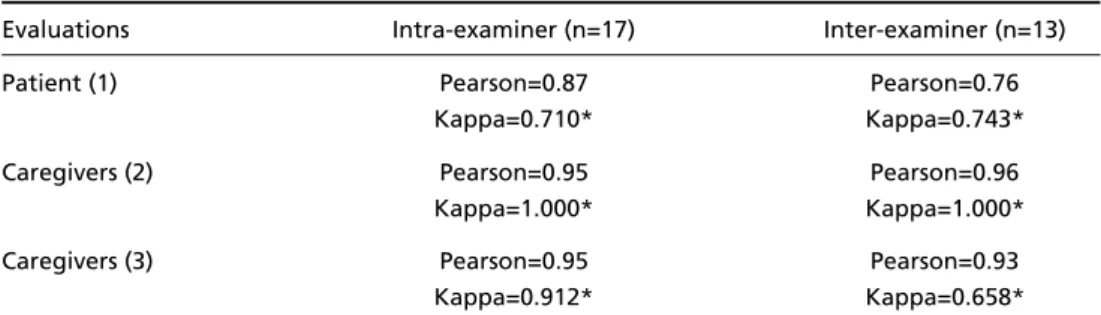
In Table 2 the coefficients of correlation of the evaluations are described, employing intra and i n t e r-examiner for each version, including one for the patient and for the family, with respect to the patient’s QOL, and one for the caregiver on their own QOL.
The test of Kappa assumes values from –1 to +1, where the negative values indicate agreement in-ferior to that expected by chance, whereas posi-tive values, superior agreement to that expected
Table 1. Agreement of means percentages between judges concerning the semantic, idiomatic, con -ceptual and cultural equivalence between the original version and the translated version of Quality of Life - AD and the coefficient of Kendall.
Equivalence evaluations Agreement of means Coefficient of Kendall Semantic and idiomatic equivalence 86.36% K = 0.343**
Conceptual equivalence 86.00% K=0.316
Cultural equivalence 78.46% K=0.359*
p<0.05* p<0.01**
Table 2. Pearson’s correlation coefficients and Kappa’s test values for patient, family and caregiver evaluations.
Evaluations Intra-examiner (n=17) Inter-examiner (n=13)
Patient (1) Pearson=0.87 Pearson=0.76
Kappa=0.710* Kappa=0.743*
Caregivers (2) Pearson=0.95 Pearson=0.96
Kappa=1.000* Kappa=1.000*
Caregivers (3) Pearson=0.95 Pearson=0.93
Kappa=0.912* Kappa=0.658*
by chance, at different levels, with 1 being perfect agreement18.
The patient’s and their caregiver’s socio-demogra-phic characteristics are presented in Table 3. In re-gard to Table 3, the identified statistical significance in comparison to the MMSE was expected since the analyses used groups with different levels of severi-ty (mild and moderate). The equivalence with sub groups was emphasized concerning the caregiver’s scholarship degree. Unfortunately, the matching of the patient’s groups and also its respective caregi-vers was not possible. Given that the scale is easy to a n s w e r, along with an adequate standardization of the questions and with an acceptable average schol-arship for the group of mild patients, we believe that the occurrence of bias in interpretation is unlikely.
The mean scores in the evaluation of QOL, and the mean time of application for the mild and moderated AD cases, are presented in Table 4.
Despite the fact that the table presents a reduc-tion in the mean score of QOL-AD in all versions, with increased severity of the disease, this differ-ence is not statistically significant probably due to the great variability of the data.
The mean time of application of the evaluation was six minutes for the patient version, five min-utes for the version of the caregiver/family, and five minutes for the caregiver version.
The alpha results were satisfactory in all versions. In the patient’s version we obtained an alpha=0.81, whilst for the relative’s version in relation to the patient’s QOL we obtained a coefficient of alpha = 0.85, and in the caregiver’s version on his/her own QOL, the alpha obtained was 0.84
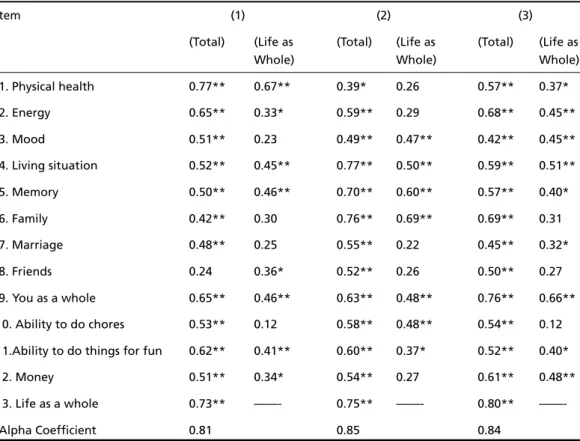
In Table 5 we present the correlation coeff i c i e n t s for each item in the patient’s report and for the caregiver/family.
DISCUSSION
The cross-cultural adaptation of an evaluation instrument goes beyond mere translation by tak-ing into consideration cultural and ltak-inguistic aspects for the target population9 - 1 1. The methodology employed in the present study followed the propo-sals made by Guillemin et al.11, where the stages are characterized by the cross-cultural adaptation of QOL evaluations.
With the presented data, we verified that the QOL-AD scale is a promising measure for investiga-tion of this variable in the disease. The instrument allows evaluation of QOL using the patient’s and the caregiver/family’s view, thereby making the assessment more comprehensive and corresponds to two out of three possible ways of evaluating the quality of life phenomenon. This study provides reli-ability and streli-ability of information in the patient’s versions, and caregiver/family’s version, in the pa-tient’s QOL and the evaluation of the caregiver’s QOL. The QOL-AD was shown to be brief and easy to administer in patients with mild to moderate Table 3. Sociodemographic profile of patients and their respec
-tive caregivers.
Socio-demographic Mild Moderate characteristics dementia dementia
(n=20) (n=20)
Age (patients) 73.20 ± 8.07 74.45 ± 5.95 Educational level 4.90 ±3.94 5.95 ± 3.95 (patients)
Gender (patients) Fem - 75% Fem - 70% Male - 25% Male - 30% MMSEa 18.80 ± 3.20 12.90 ± 3.33 Age (caregivers) 61.60 ± 13.41 55.85 ± 16.65 Educational level 7.20 ± 3.69 11.50 ± 4.28 (caregivers)
Gender (caregivers) Fem - 80% Fem - 70% Male - 20% Male - 30% Relationship Wife - 30% Daughter - 40%
Daughter - 5% Son - 15% Sister - 15% Sister - 10% Son - 5% Husband - 15% Husband - 5% Wife - 20% Granddaughter - 5%
Niece - 5%
aMMSE, Mini-Mental State Examination.
Table 4. Mean and standard deviations of the scores distributed across the 3 versions of the QOLAD, and the duration of appli -cation (in minutes) between the groups of mild and moderate dementia.
Application of QOL- AD Mild dementia Moderate dementia Patient (1) 34.95 ± 5.10 35.90 ± 5.59 Caregivers (2) 30.65 ± 6.93 29.40 ± 5.78 Caregivers (3) 36.95 ± 5.17 33.85 ± 6.59 Time of application (1) 5.75 ± 1.80 5.55 ± 1.76 Time of application (2) 5.25 ± 2.75 4.35 ± 2.73 Time of application (3) 4.50 ± 1.67 4.90 ± 1.77
AD. No patient or caregiver refused to complete the evaluation or demonstrated difficulties in un-derstanding the instrument.
The stability and the reliability of the instrument were very good. The intra and inter-examiner cor-relation coefficients, after a two-week interval, were 0.87/0.95/0.95 (p<0.001), and 0.76/0.96/0.93 (p<0.001), respectively, for the patient, the fami-ly and the caregiver versions. Comparing the results of the adapted version with those of the original instrument, we found similar values for stability of the instrument, with an intra-class of the original instrument of 0.76 for the patient, and 0.92 for the caregiver/family.
The reliability of the evaluation after the cross-cultural adaptation was excellent for the patient’s version, as well as for the caregiver/family’s version, in relation to the patient’s QOL (alpha = 0.81 and 0.85, respectively) and to the caregiver’s QOL (alpha = 0.84). Similarity was also identified in reliability on comparison of the results of the original and adapted versions of the instrument with the patient’s versions and of the caregiver/family on the patient’s QOL (alpha of 0.88 and 0.87, respectively).
The disagreement among the patient’s reports and caregiver/family’s reports found in this study has also been observed by others4 , 1 9 , 2 0, but the cor-relation in the total score was adequate. The di-sagreement among the reports could originate from the different methods of administration of the evaluation4.
We also identified that the instrument pres-ents differences of score means in all versions, al-though not to a statistically significant degree, with increased dementia severity, a somewhat ex-pected finding given the progressive nature of the disease. The importance of evaluating QOL in AD is based on the unquestionable impact of the disease on the patients’ and their family and care-givers’ daily lives. In addition, there is a need to evaluate to what extent the therapeutic interven-tions improve the QOL of the patient3,4, and also their impact on the caregiver21.
With regard to limitations of the study, we fo-und difficulties related to the sample size, which make the generalization of the data and the match-ing of the patient groups difficult. Studies with a larger sample should be conducted in the future. Table 5. Correlation coefficients between the items, and the internal consistency, of the QOL-AD.
Item (1) (2) (3)
(Total) (Life as (Total) (Life as (Total) (Life as
Whole) Whole) Whole)
1. Physical health 0.77** 0.67** 0.39* 0.26 0.57** 0.37*
2. Energy 0.65** 0.33* 0.59** 0.29 0.68** 0.45**
3. Mood 0.51** 0.23 0.49** 0.47** 0.42** 0.45**
4. Living situation 0.52** 0.45** 0.77** 0.50** 0.59** 0.51**
5. Memory 0.50** 0.46** 0.70** 0.60** 0.57** 0.40*
6. Family 0.42** 0.30 0.76** 0.69** 0.69** 0.31
7. Marriage 0.48** 0.25 0.55** 0.22 0.45** 0.32*
8. Friends 0.24 0.36* 0.52** 0.26 0.50** 0.27
9. You as a whole 0.65** 0.46** 0.63** 0.48** 0.76** 0.66** 10. Ability to do chores 0.53** 0.12 0.58** 0.48** 0.54** 0.12 11.Ability to do things for fun 0.62** 0.41** 0.60** 0.37* 0.52** 0.40*
12. Money 0.51** 0.34* 0.54** 0.27 0.61** 0.48**
13. Life as a whole 0.73** ——- 0.75** ——- 0.80**
——-Alpha Coefficient 0.81 0.85 0.84
In conclusion, the Portuguese version of the scale proposed by Logsdon et al.4seems to be a pro-mising measure for the investigation of QOL in AD in our country. The Portuguese version can be ob-tained by contacting the first author of the study. The adapted instrument was shown to be brief and easy to administer, while being stable and reliable with internal consistency of its items adequately representing the phenomenon that they intend to evaluate22. Future studies should investigate the reasons for the disagreement found between the patients’ and the caregivers/family’s report, and should determine the point at which the patient’s cognitive impairment affects the reliability of the evaluation, and finally, which symptoms have a larg-er impact on the evaluation of QOL, so that future efforts can be focused on these areas.
Acknowledgements -We thank Rebecca Logsdon for the authorization to use the scale in Brazil and for the constant assistance in the study development. We thank Drs. Cassio Machado de Campos Bottino, Marina Rodrigues Quaresma, Maria Auxiliadora Cursino Ferrari and Elisabeth Barham, that together with one of the authors (PC) comprised the committee that evaluated the equivalence of the Brazilian version. We thank those patients and their families who participated in the study, besides the colleagues of the Behavioral and cognitive Neurology Unit who referred patients for the research.
REFERENCES
1. Herrera E Jr. Caramelli P, Silveira ASB, Nitrini R. Epidemiological sur-vey of dementia in community-dwelling Brazilian population. A l z h e i m e r Dis Assoc Disord 2002;16:103-108.
2. Bottino CMC, Almeida OP. Demências: quadro clínico e critérios diag-nósticos. In Almeida OP, Nitrini R (eds). Demências. São Paulo: Fundo Editorial Byk, 1995:13-29.
3. Logsdon RG, Albert SM. Assessing quality of life in Alzheimer’s dis-ease: conceptual and methodological issues. In assessing quality of life in Alzheimer’s disease. New York: Springer, 2000:ix-xi.
4. Logsdon RG, Gibbons LE, Mc Curry SM, Teri L. Quality of life in A l z h e i m e r’s disease: patient and caregiver reports. J Mental Health A g i n g 1999;5:21-32.
5. Logsdon RG, Gibbons LE, Mc Curry SM, Teri L. Assessing quality of life in older adults with cognitive impairment. Psychosom Med 2002;64:510-519.
6. Whitehouse PJ. Quality of life: future directions. In Assessing quality of life in Alzheimer’s disease. New York: Springer, 2000:179-184. 7. Kimura M. Tradução para o português e validação do “Quality of life
Index” de Ferrans e Powers. Tese de Livre Docência. Escola de Enfermagem, Universidade Federal de São Paulo São Paulo, 1999. 8. Whitehouse PJ, Rabins PV. Quality of life and dementia. Alzheimer Dis
Assoc Disord 1992;6:135-137.
9. Walker MD, Salek S. A review of quality of Life in A l z h e i m e r’s disease. Part 1 issues in assessing disease impact. Pharmacoeconomics 1998;14:499-530.
10. Ciconelli RM. Tradução para o português e validação do questionário genérico de avaliação de qualidade de vida “Medical Outcomes Study 36- item Short-Form Health Survey (SF - 36)”. Tese, Escola Paulista de Medicina, Universidade Federal de São Paulo, São Paulo, Brasil, 1997. 11. Guillemin F, Bombardier C, Beaton D. Cross-cultural adaptation of
health-related quality of life measures: literature review and proposed guidelines. J Clin Epidemiol 1993;46:1417-1432.
12. Guillemin F. Measuring health status across cultures. Rheum Eur 1995;2:102-103.
13. Mckhann G, Drachman D, Folstein M, Katzman R, Price D, Stadlan EM. Clinical diagnosis of A l z h e i m e r’s disease: report of the NINCDS-ADR-D A work group under the auspice of NINCDS-ADR-Department of Health and Human Services Task Force on A l z h e i m e r’s disease. Neurology 1984;34:939-944. 14. American Psychiatric Association. Diagnostic and Statistical Manual of mental disorders. 3Ed. Ve r. Washington: American Psychiatric Association, 1987
15. Folstein SE, Mchugh PR. Mini mental state: a practical method for grading the cognitive state of patients for the clinician. J Psychiatr Res 1975;12:189-198.
16. Bertolucci PH, Brucki SM, Campacci SR, Juliano Y. The Mini-Mental State examination in a general population: impact of educational sta-tus. Arq Neuropsiquiatr 1994;52:1-7.
17. B rucki SMD, Nitrini R, Bertolucci PHF, Caramelli P, Okamoto IH. Normas sugeridas para o uso do Mini-Exame do Estado Mental (MEM) em nosso meio. Arq Neuropsiquiatr 2002;60:46-47.
18. B rucki SMD, Nitrini R, Bertolucci PHF, Caramelli P, Okamoto IH. Sugestões para o uso do Mini-Exame do Estado Mental no Brasil. Arq Neuropsiquiatr 2003;61:777-781.
19. Duarte YAO. Família: rede de suporte ou fator estre s s o r. A ótica de idosos e cuidadores familiares. Tese, Escola de Enfermagem, Universidade de São Paulo São Paulo, 2001.
20. Kiyak HA, Teri L, Borson S. Physical and functional health assessment in normal aging in Alzheimer’s disease: self-report vs. family reports. Gerontologist 1994;34:324-330.
21. Novelli MMPC, Nitrini R, Bahia VS, Caramelli P. Cuidadores de pacientes com demência: perfil sócio-demográfico e impacto diário. A rq Neuropsiquiatr 2001;59:(Suppl 3):3.