Videoconference in education at U.PORTO
Samuel Martins, Isabel MartinsUniversity of Porto, Porto, Portugal [email protected] ; [email protected]
Abstract - The University of Porto (U.PORTO), through is New Technologies in Education (NTE) office has available since March 2005 a Videoconference Studio. This equipment is closely related do the dissemination of the videoconference technologies at U.PORTO. Only in the years of 2007 and 2008 this equipment has registered an increase of about 300% on his usage.
Several efforts were developed by the NTE team that contributed to this high usage. We highlight especially the fluidity on the service, the multifunctional usage, the acquisition and the development of knowledge in this field and the internationalization of this service. Various educations scenarios were implemented during these past years using the videoconference infrastructure. We highlight the pedagogical scenarios that became long structured pedagogical projects with more than a year long. We had the example of a curricular unit from a Master degree between our Faculty of Economics and ISEG (Lisbon). In this case we had about twenty students in our Videoconference room during two semesters and the teacher was in Lisbon. Another example was a Doctoral curricular unit that happen between our Faculty of Sciences, IST (Lisbon) and Carnegie Mellon University (USA). In this case we had a teacher and about five students in Lisbon, one class of about five students in the USA and one student in our Videoconference Studio.
Recently it was implemented a new telepresence room (Douro HD Room) in last July 2009 and we will join this year a portable videoconference system that will offer a complete and different set of options in the videoconference field to all the academic community. With different characteristics between them, these three equipments from U.PORTO will allow an optimization in the videoconference service offer in all the University.
This segmentation on the types of videoconference contents that these equipments can give can also boost the usage of these infrastructures in the University but can also boost the pedagogical use of the videoconference technologies in all the academic community.
In the past years several activities supported by the NTE team were developed in collaboration with several international institutions and even with the integration in international organizations with high experience with videoconference. This integration permitted to increase the knowledge in this field. This internationalization component was very important to the high intensity in the usage of the videoconference infrastructure in the U.PORTO.
We can say that with this offer and this experience it’s possible to create even more opportunities of usage, especially in the Videoconference Studio of U.PORTO (due to the multifunctional characteristics) on the usage to diverse, structured and constant pedagogical scenarios that can last several years.
1 – Introduction
The increasing internationalization High Education and the creation of innovators courses demands to the University of Porto the best possible application of the videoconference Technologies in its current activities.
It’s very important to verify and evaluate the implementation of the several videoconference systems and its integration in the several activities that occur in the University of Porto environment.
From the economic perspective it’s very clear that the videoconference Technologies tends to reduce significantly the costs with the transportation and trips from the teachers, students and even technical and administrative staff’s.
But the importance of the videoconference it’s extended also to the boost of the international collaborations or even with the dinamization of new sources of financing and social intervention when these kinds of Technologies are widely used.
The use of the videoconference Technologies in education and in the educative Technologies it’s becoming a growing fact. According to D.L.Newman (2009) most of schools and High Education institutions have access or are planning to have access to any kind of videoconference technologies. This interest, mostly in the American institutions, it’s going to extend to the European institutions and consequently to the Portuguese High Education institutions due to the natural collaboration and also the competition that exists between these kind of institutions at a European, transatlantic and even global level.
In fact, most of the High Education institutions are now starting to understand the value of videoconference and its potential in the professionalization and service to education. The teachers that usually join to the informal educational practices tend to see the use of videoconference like a way to expand their mission and fulfill the needs of the generation of this millennium.
D.L.Newman (2009) says that “facing the limited resources, these teachers feel the need to develop good practices in the use of videoconference services to the teaching institutions” (Newman, 2009, p. 17).
D.L.Newman (2009) also highlights that the educational leaders start to recognize the unique potential of these kind of technologies and the benefits like the access to external resources and to different ways to improve the academic performance in problems resolutions and on the high level thinking. Equally important, the several educators are understanding the usage of videoconference like a “away to support the development of a global society, decreasing the digital and cultural differences and supporting the active learning environments that are centered on the student” (Newman, 2009, p. 30).
The great development in the broadband infra-structures in Portugal that occurred in the last years, specially in the Portuguese and international R&D network have boosted the development of the videoconference technologies. Specifically the Portuguese R&D network (RCTS) that, according to Ribeiro (2009) “connects the main Portuguese High Education institutions and the state laboratories and several R&D institutions (…) and it was the first New Generation network in the country” (Ribeiro, 2009, p. 55).
In fact, the RCTS network as a communications infra-structure is supported in 1000Km of optical fiber that offers almost unlimited communications and resources to the researchers, teachers and students in High Education. The evolution of the broadband of RCTS as been exponential and “from the beginning this aspect gave the Portuguese NREN (FCCN) the possibility to introduce new generation services that are very demanding, like the real time audio and video based services (videoconference, streaming, Vod, VoIP, etc) that demand many more network resources” (Ribeiro, 2009, p. 56) more than the Internet traditional services like e-mail or browsing.
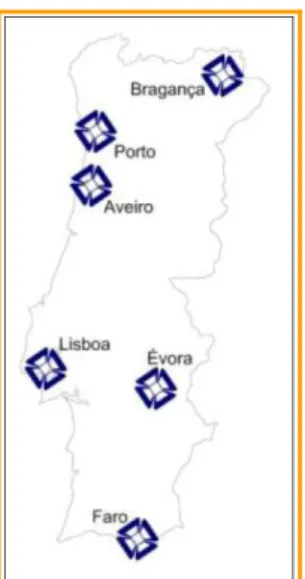
In 2004, it happens an important step to the democratization of videoconference on the RCTS when it was installed six Videoconference Studios in six Portuguese High Education institutions (Figure 1).
This Videoconference Studio networks had the objective to make available multifunctional spaces to enhance the content creation of the institutions and each one of these Studios are prepared to make several types of videoconferences, to make content capture, to present rich contents and to make experimentation on videoconference technologies, streaming applications and content creation. According to Ribeiro (2009) “still today the Videoconference Studios are very used in most of these features” (Ribeiro, 2009, p. 57).
Figure 1: The Videoconference Studios spread in Portugal.
It’s in this scenario that the University of Porto (U.PORTO) through is New Technologies in Education (NTE) Office has available since March 2005 a Videoconference Studio. This equipment is closely related to the dissemination of the videoconference Technologies at U.PORTO. It’s a free service available to all the academic community in this University and gave a technological equity between all 14 faculties and 1 business school that constitute this University. Until this time the dissemination of the videoconference technologies took place mostly in the technological faculties leaving a big gap in the rest of the University.
In 2007 the videoconference network on the RCTS evolved a little more with the introduction of HD videoconference systems. FCCN added twenty new places to this network and in this way “the videoconference equipments have arrived to almost all the High Education networks and other institutions that are relevant to the learning and research community in the country. In fact, in 2008 all the equipments were installed, the network had achieve a interesting dimension, the knowledge dissemination was achieved and several institutions were starting to acquire new equipments” (Ribeiro, 2009, p. 58).
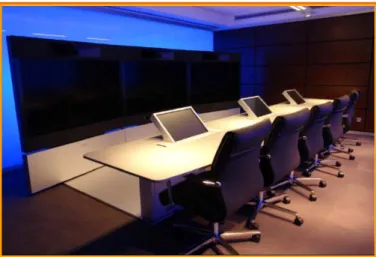
In 2009, it was made another important step in the videoconference network on the RCTS with the introduction of the two first telepresence rooms in Portugal. These new rooms are “the highest step of the videoconference technologies” (Ribeiro, 2009, p. 59). The Tejo HD room (Figure 2) and Douro HD room are installed in Lisbon (at FCCN headquarters) and in Porto (at U.PORTO) are available to all the community from RCTS to make meetings between these two places. These rooms are very comfortable and compatible with the traditional systems but they are especially prepared to achieve a high level of telepresença when they are used between them.
Figure 2: Tejo HD room
FCCN recognizes that the videoconference network at RCTS is used today to make distance learning with local and remote audiences and the teacher can have a distributed class with one or more places at once. The teacher can interact with everyone at the same time and “most of the uses of videoconference are the PhD and Master jury meetings” (Ribeiro, 2009, p. 60). The Portuguese NREN says that the use of the videoconference network at RCTS allows a significantly time and cost reduction and its use can be an important factor to the maintenance of good work relations between researchers of different institutions. “It becomes possible, using these technologies, establish long term relations that can promote very well the team work” (Ribeiro, 2009, p. 61).
Being the Portuguese institution that enhances the use of these kinds of technologies at RCTS, FCCN thinks that the use of videoconference is also a way to project internationally an institution like, for example, the participation in conferences or events that demonstrate the technical capability and availability of the institution to innovation and exchange.
However, like says Ribeiro (2009) “the use of these kind of technologies to the spread of knowledge demands more preparation work than the traditional physical environments and the videoconference tools can and should be analyzed and integrated in the institutions e-learning departments that have a cross vision of the entire institution” (Ribeiro, 2009, p. 61).
The videoconferences systems can be managed and executed by the audiovisuals services or even the informatics services but it seems necessary to overcome the horizon and transform a technological asset in a personal asset available in the institution. According to Ribeiro (2009) is important to “take out the equipment of the conferencing room usually hided and reserved and spread the existence on the institution website or in the internal mailing lists or even promote open days to experiment and increase motivation” (Ribeiro, 2009, p. 61).
The recent advances on the IT gave the education professionals the chance to use a great variety of educational methods like e-learning. In the Portuguese context one of the main observations of the study “Reforming Distance Learning Higher Education in Portugal”, ordered by the Portuguese High Education, Science and Technology Ministry to a panel of foreign specialists indicates that the potential of distance learning to expand the High Education in Portugal is enormous.
Presented in July 2009, this study indicates that distance learning in Portugal, comparing with other developed countries in Europe, as started very late and is still maintaining a low rate. Nowadays the distance learning represents only 3% of the Portuguese High Education (Bielschowsky, Laaser, Mason, Sangra, & Hasan, 2009).
degree using the computer they can also give priority to their personal affairs and, so, dedicating less time to the study (Bersin, 2004).
Other important aspect is the feedback because the absence of the teacher can leave to the decline of a quick and appropriated feedback (Bulter & Winne, 1995). And so, it is always necessary to have a system that increase the awareness of responsibility on a learning environment (Lou, Dedic, & Rosenfield, 2003).
In this context, the videoconference technologies can give a productive combination of individual work and collaborative work. According to McAndrew, Foubister & Mayes, (1996) when the students work collaboratively on the same room they realize constantly of the several needs of colleagues and they will take in count that aspect all the time. In the remote work the problematic aspects of the physical collaborative work are less prominent (McAndrew, Foubister, & Mayes, 1996).
Closely related with the development of the best practices on distance learning everything tell us that the development of the videoconference component should be supported also through a continuous and permanent process. Synnes, Söderström & Parnes (2001) tell us that in a course that is distributed through advanced technologies like the videoconference tools i tis important to have the support in the pedagogical aspects like the course design recommendations and other pedagogical and training methods. These authors also mentioned that “is so important to educate the teachers about the technology and the pedagogical aspects as having a learning environment based in the technology” (Synnes, Söderström, & Parnes, 2001, p. 9).
In the scope of distance learning and the use of videoconference the combination of synchronous and asynchronous methods seems to be the most fruitful way of working in Internet based learning environments and it is defended by these authors that enhance mostly the need to achieve a “efficient environment to learn in the Internet that include not only work technology but also a well planned course where the incentive to use the technology is very clear” (Synnes et al., 2001, p. 8).
About the students satisfaction that use videoconference in their classes Furst-Bowe (1997) give us an important research that shows students that made a course using videoconference (comparing with other students that didn’t use but use the same teaching style, the same assessment and the same projects) had been satisfied with this new way to attend to a course (Furst-Bowe, 1997). The results of the research from Furst-Bowe (1997) indicated several important aspects to the success of distance learning using videoconference like the teacher training on these kind of Technologies, the will to demonstrate presentation capabilities, create interaction opportunities, also create pedagogical learning materials adapted to this technology and use wisely the several available media. This investigation also showed that “it can be necessary to dedicate more time in class preparation that are delivered through videoconference” (Furst-Bowe, 1997, p. 204).
Despite the students levels of satisfaction it’s important to reflect about the necessary concern with the quality of teaching and learning that is made using the videoconference and the possibility of that quality be lower on teaching and learning made on the traditional classroom. A research carried out by Lee & Knipe (2002) tell us also that the local students have received more information and clarifications on the classes, they received more learning materials and did more work and presentations in groups than the remote students (Lee & Knipe, 2002).
These authors reflected about the possible reasons in these differences including the importance of physical access to the teacher and the feelings of isolation that happen due to the lack of eye contact with the teacher. However, they verified also that “the media by itself it’s not the entirely responsible by that low quality” and “ the inexperience, the bad preparation, the lack of planning and a bad training from the course creator can have a strong influence” (Lee & Knipe, 2002, p. 310)
2 – The methodology implemented
The service that the NTE team provides to the U.PORTO user aims to be the easiest possible to that user. It’s important that the user doesn’t feel difficulties in using the videoconference technologies and so all the process of preparing the videoconference is made by the NTE team. After a simple reservation process the NTE team provides all the necessary contacts and tests between the several institutions that are involved in the videoconference. The final user doesn’t take part in the videoconference setup process and only makes the videoconference when it’s all tested and fully prepared by the NTE team.
The multifunctional usage of the videoconference studio room gives a good flexibility to the use of the entire infrastructure. It can be used to several videoconferences formats and it is specially prepared to be used by a considerable large number of people like a class. About 25 people can use that space at the same time and achieve a good videoconference experience. The multifunctional capability can create several collaboration setups and it’s possible to change between several scenarios and keep a good audiovisual setup at the same time. This room gives the possibility to create several setups that include one or more remote videoconference rooms or even the need to show presentations, a formal teaching and several other methods of interactivity.
The acquisition and development of knowledge in the videoconference technologies area was a very important subject that the NTE team made during these past years. It was very important to participate on several actions promoted by reputed institutions in this field like the Internet2 organization and the Ohio State University or even FCCN (Fundação para a Computação Científica Nacional), the Portuguese NREN. Several meetings and workshops were attended by the videoconference NTE team that gave a good set of knowledge tools to be applied in this infrastructure and disseminated by the U.PORTO academic community.
2.1 - Distance learning using videoconference
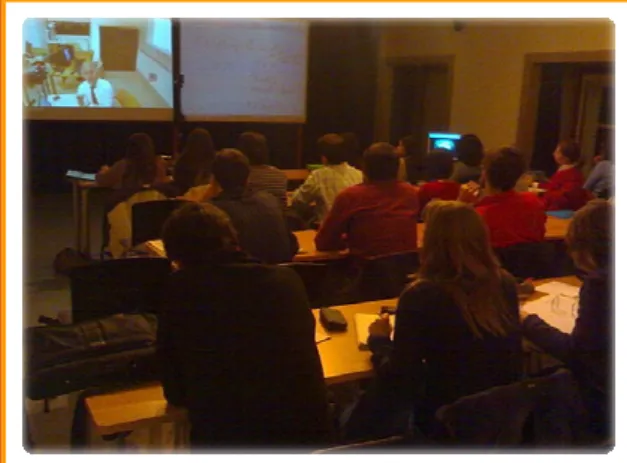
Various educational scenarios were implemented during these past years using the videoconference infrastructure. We highlight the pedagogical scenarios that became long structured pedagogical projects with more than a year long. We had the example of a curricular unit from a Master degree between our Faculty of Economics and Instituto Superior de Economia e Gestão in Lisbon. In this case we had about twenty students in our Videoconference room during two semesters and the teacher was in Lisbon (Figure 3). Another example was Doctoral curricular units that happen between our Faculty of Sciences, Instituto Superior Técnico (IST) in Lisbon and Carnegie Mellon University in the USA. In this case we had a teacher and about five students in Lisbon, one class of about five students in the USA and one student in our Videoconference Studio.
Figure 3: Videoconference classroom in the U.PORTO Videoconference Studio
Other typical scenario implemented in the Videoconference Studio is the audiovisual content production that any teacher and their students can make to include in the university e-learning platform (Figure 4). With the permanent support of the NTE team any member of the university academic community can use the Videoconference Studio to shoot and record any video footage with pedagogical purposes.
Deleted: Figure 3
Figure 4: The front stage of a content production activity in the U.PORTO Videoconference Studio
The NTE team also advises on the best way to proceed with the production process and stages the best setup to work in this room (Figure 5). When the video content is produced on the Videoconference Studio it’s evaluated by all the participants if it needs any post-production work before make it available in the university e-learning platform. If the post-production work is needed the NTE team can help also in that process.
Figure 5: The backstage of a content production activity in the U.PORTO Videoconference Studio
All the stages of a video creation is supported in this Videoconference Studio and fully supported by the university NTE team. That aspect guarantees a good quality on the technical characteristics of the audiovisual e-learning objects with the permanent pedagogical supervision of the teacher or other member of the academic community.
2.2 - Local communities relationship
The internationalization of the U.PORTO videoconference service is closely related to the relationship with the local communities that surround the university. In fact, many of the international events that occur in the Videoconference Studio involved some of the best schools in the Porto region creating exchange experiences using the videoconference technologies. Many international organizations (especially in the USA) organize videoconference events
aimed to schools and high schools and the NTE team promotes the exchange of contacts between those organizations and the schools in Porto.
One important aspect that enhances these foreign activities is the fact that most of the schools and high schools in the USA have videoconference systems and they incorporate very easily the videoconference technologies in their own curricular activities. Those activities can be used by the local schools in Porto (Figure 6 and Figure 7) to promote the exchange of experiences between students and the Videoconference Studio positions himself like a very good infrastructure to help in that process.
Figure 6: Local school students from the city of Porto brainstorming and presenting a videoconference in the Videoconference Studio
These kinds of activities are totally controlled by the local school teachers and the technical aspects related with the videoconference itself are prepared by the NTE team in close relation with the foreign organizations that belong to the several events that are organized. After a previous meeting between the NTE team and the local school staff’s aiming the preparation of the videoconferences the several events planned take place in the Videoconference Studio due to the multifunctional capabilities of this infrastructure. Some aspects are important occurring in these kinds of activities like the capability of the students to understand the English language and even speak this language.
Figure 7: Videoconference between students from a local school in the city of Porto and a school in the USA.
Deleted: Figure 6
2.3 - International collaboration
The knowledge of the U.PORTO videoconference service is also closely related to the internationalization of this service. The NTE team tried during the past years to establish several collaborations projects between some of the best institutions and organizations that usually use the videoconference in the current activities. Some of the institutions and organizations that played an important role on these collaborations were: Internet2 Commons (http://commons.internete.edu), ViDe Net (http://www.vide.net), Internet2 Arts and Humanities Initiatives (http://www.internet2.edu/arts), TERENA (Trans European Research and Education Networking Association, http://www.terena.org), Teatro Gran Liceu de Barcelona and REDIRIS (http://www.liceubarcelona.com), The Philadelphia Orchestra (http://www.philorch.org), MAGPI Educational Services and University of Pennsylvania (http://www.magpi.net), Global Consortium and Cerritos College Humanities (http://www.cerritos.edu/jhaas) or even the AccessGrid community and University of Manchester (http://www.accessgrid.org).
The NTE team also have aligned the several videoconference strategies with the institutional objectives from U.PORTO specially the E-learning strategies, the projects and events with internal and external visibility and also the relationship with the local community in the Porto region area.
In the past years several activities supported by the NTE team were developed in collaboration with several international institutions and even with the integration in international organizations with high experience with videoconference. This integration permitted to increase the knowledge in this field, and the internationalization component was very important to the high intensity in the usage of the videoconference infrastructure in the U.PORTO.
This internationalization of the videoconference service process was also accompanied by a strong communication process using some online platforms that promote and reaching the university academic community and the external people to U.PORTO. The main technological information platform is the Information and Communications Technologies Portal (http://tic.up.pt) of U.PORTO with all the technological and logistic information usually needed by all the users. Another important platform is the U.PORTO E-learning Portal (http://elearning.up.pt) that aggregates all the pedagogical information concerning with the use of videoconference and the best practices in that use.
Other platforms that the videoconference service from U.PORTO uses is the channel created on Youtube (http://www.youtube.com/videoconferenciaUP) to display some videos with examples of using the videoconference infrastructure and some best practices examples and the Linkedin Group ([email protected]) that try to aggregate several worldwide contacts in the videoconference area.
2.4 - Telepresence and emerging videoconference technologies
Recently it was implemented the new telepresence room, the Douro HD Room, (Figure 8) and is offering an interesting experience to all the academic community. Most of the jury meetings, staff meetings or even R&D meetings that can be made using videoconference can achieve a rich experience with this immersive solution. Technically it can achieve a data flux of 12Mbps with several audio and video codecs supports giving a great presence sensation. It has several content sharing and collaborative tools and a rich high-definition audio and video that enhance a good work environment. It gives a tridimensional effect to the environment and promotes the eye orientation with the person that is talking in a giving moment.
Figure 8: The new telepresence room from U.PORTO, the Douro HD Room.
This equipment is very simple to use and an ideal solution to formal situations when the eye contact and body language is very important. This equipment promotes a more relaxed environment and promotes the conversation between the users.
3 – Conclusion
The NTE team verified during the past years that the students and also the teachers considered these experiences very positive and wanted to try over and over again. The impact of meeting other cultures and exercise the English language with other students with the same age provides an important impact in these students and their teachers.
It’s very important to U.PORTO to promote these kind of activities using the videoconference technologies because they fulfill many important goals of the university, like the internationalization, the relationship with the local communities that surround the university, the possibility to work with potential future students of the university, the possibility to fill in the empty time gaps when the Videoconference Studio is not being used by the university academic community (increasing the productivity of the videoconference infrastructure), it increases the technical and practical knowledge of the NTE team himself, it promotes the use of the videoconference infrastructure in the university (alongside with the promotion of each activity that is going to happen) and ultimately it’s providing the dissemination of the videoconference technologies.
The usage and dissemination of the videoconference technologies presented significantly results during the past years. With the Videoconference Studio equipment the videoconference technologies had the possibility to be developed next to other faculties that have less technology capabilities and less technology-orientation. Only in the years of 2007 and 2008 this equipment has registered an increase of about 300% on his usage (Figure 9).
Figure 9: The U.PORTO Videoconference Studio usage (number of hours).
Comment [ i1] : Colocar border nas imagens seguintes
Several U.PORTO faculties are now buying their own videoconference systems and spreading the availability of using this technology. We believe that the work from the NTE team helped in this dissemination of knowledge process and now new challenges are coming.
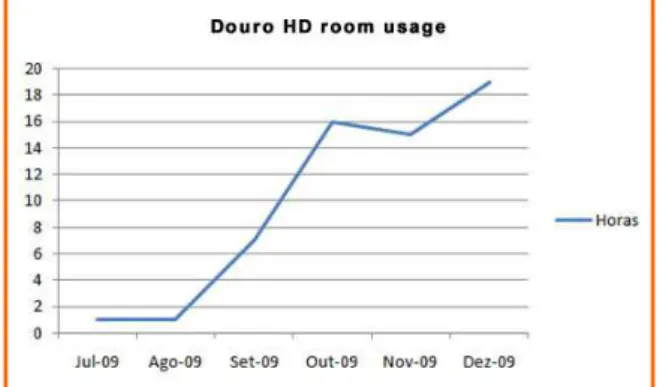
The new immersive room is increasing his usage since the inauguration, in July 2009, and gives the opportunity to the Videoconference Room to enhance the audiovisual content production. This increasing usage (Figure 10) gives good indications about the future optimization of the videoconference service in all U.PORTO specially the videoconference content segmentation between the different videoconference infrastructures.
Figure 10: The Douro HD room usage since the inauguration in 2009 (number of hours)
U.PORTO will also join this year a portable videoconference system (Figure 11) that will offer a complete and different set of options in the videoconference field to all the academic community. With this videoconference portable equipment it’s going to be possible to enhance the use of videoconference near each U.PORTO faculty and promote the dissemination of the videoconference directly in each classroom of the University. All the necessary support is assured by the NTE team that gives all the knowledge support and technical advice to use the equipment.
Figure 11: Snapshot of the new portable videoconference system available at U.PORTO
With different characteristics between them, these three equipments from U.PORTO allow an optimization in the videoconference service offer in all the University. This segmentation on the types of videoconference contents that these equipments can give can also boost the usage of these infrastructures in the University but can also boost the pedagogical use of the videoconference technologies in all the academic community. We can say that with this offer and this experience it’s possible to create even more opportunities of usage, with the possibility to reach many different kinds of people in the university.
Also to promote the creation of new opportunities using the videoconference technologies the NTE team is preparing in a near future the technological updating of the Videoconference Studio in order to fulfill the increasing quality demand that the academic community and the current technological challenges demand also. The creation of a centralized communication system managed by U.PORTO to improve a better distribution and usage of the several videoconferences between all the university campuses is also another goal that the NTE team wants to fulfill in a near future.
Deleted: Figure 10
4 – References
Bersin, J. (2004). The blended learning book – Best practices, proven methodologies, and lessons learned. San Francisco, CA, USA: Pfeiffer.
Bielschowsky, C., Laaser, W., Mason, R., Sangra, A., & Hasan, A. (2009). Reforming Distance Learning Higher Education in Portugal: Ministry of Science, Technology and Higher Education, Portugalo. Document Number)
Bulter, D. L., & Winne, P. H. (1995). Feedback and self-regulated learning: A theoretical synthesis. Review of Educational Research, 65(3), 245–281.
Furst-Bowe, J. A. (1997). Comparison of student reactions in traditional and videoconferencing courses in training and development. International Journal of Instructional Media, 24(3), 197-206.
Lee, M., & Knipe, D. (2002). The quality of teaching and learning via videoconferencing. British Journal of Educational Technology, 3(33), 301-312.
Lou, Y., Dedic, H., & Rosenfield, S. (2003). A feedback model and successful e-learning. Learning & teaching with technology – Principles and practices (open &
flexible learning series), 249–259.
McAndrew, P., Foubister, S. P., & Mayes, T. (1996). Videoconferencing in a language learning application. Interacting with Computers, 8(2), 207-217.
Newman, D. L. (2009). Videoconferencing Technology in K-12 Instruction: Best Practices and Trends. from http://avaxhome.ws/ebooks/engeneering_technology/Dianna20Trends.html
Ribeiro, R. (2009). Videoconferência na RCTS. Revista de Ciências da Computação (Universidade Aberta), 4, 55-62.
Synnes, K., Söderström, T., & Parnes, P. (2001, October 2001). Learning in Desktop