Forward Proton Detetor on D Experiment
Alberto Santoro
Laboratoriode F
isiaExperimentaldeAltasEnergias
CentroBrasileirode PesquisasF
isias
RuaDr. XavierSigaud,15022290-180 Rio deJaneiro-RJ-Brazil
E-mail:santorolafex.bpf.br
Reeived7January,2000
ThispaperdesribestheForwardProtonDetetor(FPD)proposedtobeimplementedintheDzero
Detetor,asasetofsub-detetorsonsistingof18RomanPots. Weallattentiontotheimportane
ofthestudiesofthedirativeregionofthestronginterations.
I Introdution
Sine the disovery of Hard Diration by
UA8-Collaboration [1℄, we have had a signiant
develop-ment of the Dirative Physis from both the
theo-retial and experimental point of view. From the
ex-perimental side we have the results oming from
ol-liders, likeHera(H1andZeus) [2℄ and Tevatron(CDF
andD),andfromtheoretialsidewehavemany
pa-persorontributionstothedevelopmentofthissubjet
[3℄. These results are very important for the studies
of the nature of the Pomeron, onrming that QCD
hastotakethedirativehardsatteringintoaount.
Dirativeregion onstitutesa good laboratory to
in-vestigate how we an build the two aspets, soft and
hard, of the strong interation. Pomeron appears in
bothsides.
All the above experimental results onstitute the
data sample available to be used for theoretial and
phenomenologialmodelsallowingtheomparisonwith
theoretialpreditions. Howevermanyofthese results
haveto beredone due to the poorstatistis. Someof
theproessesstudiedhavetobediretlyobservedalso.
Information about t and distributions is missing to
omplete somestudiesandonrm (or not) some
the-oretial results. This information hasastrongimpat
onfutureprojetsofolliders.
Weintend to summarize herethe ForwardProton
Detetor(FPD)projet 1
[4℄asasubsetofdetetorsto
be introdued in the D spetrometer. This projet
will hange qualitativelyour DirativePhysis data.
Thisprojetwasalsomotivatedbythenumberof
pos-sible physistopis to be studied using the FPD and
thereentdevelopmentofthesubjet.
In the following setions we desribe the FPD at
DandthemainmotivationtointroduetheseRoman
PotsonTevatronbeam-line. Weendwithaonlusion
andperspetives.
II What is the FPD and What
is our Motivation to Design
New Roman Pots
TheFPDis aset of18RomanPotsusingsintillation
bersasdetetors,onnetedtomulti-anode
photomul-tipliers. The position ofthe RomanPots on theboth
sidesoftheDdetetor(protonandanti-protonside)
willallowthediretobservationofthedoublePomeron
exhangeandonsequentlyallphysisassoiatedtothis
topologyofthedirativespetra.
The future senario of the Dirative Physiswill
beproduedbyashortnumberofexperimentsstarting
onthebeginningofthenextmillennium. Thisisshown
in thetable 1.
TheexperimentsatRHIC,TevatronandHERAwill
start taking data in the next run of these olliders in
thebeginningof thenextmillennium. Wedonothave
apreiseinformationaboutthedeisionsforLHC.
Here wesummarize the FPD projet at Tevatron,
D , as an addition to the whole upgrade of the
de-tetor. Fig. 1showsthemainmodiationsoftheD
detetor. We will have a new D detetor. The
in-terestedreaderango tothe referene[5℄ to getmore
informationaboutthegeneralhanges.
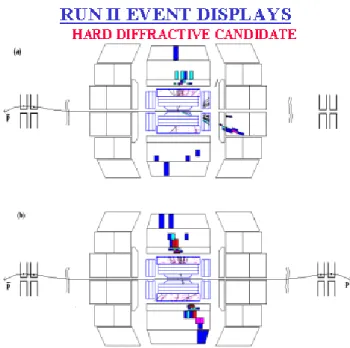
Finallyweshowanexampleofaneventdisplayfrom
Dzero Run I, with a suggestion of possible geometry
forRunII,triggeringtheeventwiththeRomanPots.
This example shows in Fig. 2a hard dirative
an-didateand adouble Pomeronexhange[4℄, one of the
topologiesto bestudied.
1
Table 1. Thistableshowsthe nextfutureexperimentsfor
DirativePhysis. Inthetable1BNL=Brookhaven
Na-tionalLaboratory,RHIC=RelativistiHeavyIonCollider,
CDFand Dare thetwodetetorsat Tevatron, DESY=
Deutshes Elektronen Synhroton, H1 and ZEUSare the
twodetetorsatHERA,andCMS,ATLAS,ALICE,arethe
detetorsofLHC=LargeHadronColliderofCERN.(*)We
donothaveinformationaboutplansforDirativePhysis
atLHC.
Lab. &Detetor Beam C.M.Energy
BNL-RHIC pxp 50-500GeV
FERMILAB pxp 2TeV
CDFandD
DESY p (e)30GeV
H1andZEUS (p)800GeV
CERN-LHC (*) pxp 14TeV
(CMS,ATLAS,
ALICE,...)
Figure1. TheDupgradeshowingthemainsetorsbeing
hanged.
WiththeFPDwewillbeabletostudyanimportant
numberofnewsubjetsandmakebettermeasurements
that will allow us to addressquestions whose urrent
datahaveleftanswered. Thesestudieswillbegenerally
oftwolassesofevents: thoseasaresultofSoft
Dira-tion (SoD) and those produed by Hard Diration
(HD). In SoD and HD we have topologies
represent-ing the Single Diration, Double Diration and the
DoublePomeronexhange. WethinkthatSoft
Dira-tion is well understood in the Regge phenomenology
framework. Hard Diration is being studied in the
present as well from the theoretial point of view as
experimentally.
Theonlypossiblemeasurementsmissingontheside
of the SoD will bedone on olliders and FPD will be
a strong tool to ahievethis goal. The possible
mea-and the t-distributions ( t = transfer momentum
betweentheinomingproton (or anti-proton)and the
satteredproton(oranti-proton)). Weunderstandthat
it would be very important to have another
measure-mentof the totalross setion beyond those made by
the CDF ollaboration and by E811 at Tevatron [6℄.
These measurements haveyet to be onrmed due to
theonsequenesfortheoldandgoodphenomenology.
Thet-distributionswouldbeanimportanthelpto get
goodmodelsonthepresent.
Hard Diration is our main interest. We think
that we anontribute to improve the understanding
ofmanyimportantsubjets,likethehardPomeron.
Figure 2. The display of a possible double Pomeron
ex-hangeonDzerodetetor.
II.1 Some Topis of Physis to be
ex-ploited by the FPD in the next Tevatron
run
Beforegoingto thephysistopis wewould liketo
stressthattherapiditygapisanimportanttoolto
iden-tifyeventsassoiatedto anspeitopology. Rapidity
gapistheintervalofrapiditywithoutpartile
produ-tionorwithoutolorativity. Inordertogeta
dira-tiveeventwithoutRomanPotswehavealmostalways
todoanoineanalysis. Werst plotthe multipliity
eventsand ountthenumberofeventswith
multipli-ityn 0. Afterthat webuildalegoplot with
variables,where,
= ln
tan
2
isthe pseudo-rapidity, referredheresometimessimply
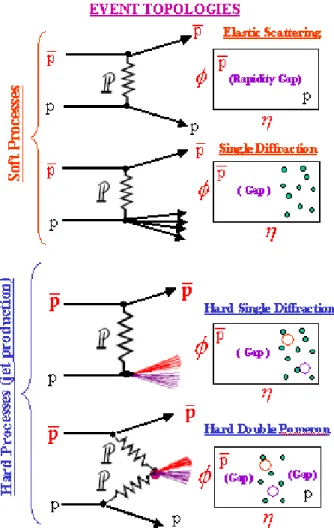
an-theharddiration,theyarejets. Weassoiatetoeah
topologyalegoplot. TheFig. 3showsthesetopologies.
Weobservethatthelegoplotorrespondingtothe
elastiproessdoesnotpresentanypartileinall
spe-trum of . The produed partilesare representedby
thedotsonthelegoplot,whilejetsarerepresentedby
thesmallirles. Thedierenebetweenhardandsoft
proessisthepreseneofjetsonthelegoplot.
Figure 3. Some of the possible topologiesand the
assoi-ated legoplot. We seeon thetop the softproesseswith
theelasti andthe singlediration. Onthe downpartof
thegureweseetheproessesofhardsingledirationand
thedoublePomeronexhange.
1. Dirative Jet prodution
JetshavebeenlargelystudiedbyQCD.The
dis-overedof dirativelyprodued jets[1℄byUA8
ollaboration was very important for dirative
physis. Itisexpetedthatsingleanddoublejet
dirativeprodution be exhaustivelystudied in
thenextfuturewithFPD,makingadistintionto
those produedbytheux ofolorinterations.
2. Low and Highjtj elastisattering
It still important to have new measurements of
the Elasti sattering. Some of the present
pro-posals for new experiments are to measure the
elasti sattering for pp and ppin the region of
lowtransfermomentum. WiththeFPD,Dwill
beableto measureboth,highand lowtfor
elas-tisattering. Thesemeasurementswill be
om-plementary to measurements from other
experi-ments. This will allowtogivealargenumberof
pointsof t-distribution. Inapartiular way, the
measurements of elastiross setions givea
di-retonnetiontototalrosssetionviathe
Op-tialTheorem. Itisimportanttoknowtheelasti
slopeof the dierentialross setion. The value
oftheslopeharaterizesaspeiproesswhih
anbeassoiatedtoapartiularprodution(e.g.
resonanesprodution).
3. Total ross setion
WehavenewonitingresultsfromTevatron[6℄
experiments.Themeasurementof the total ross
setion is very important to test the Froissart
Bound whih is derived only from the general
priniplesofphysis. An experimentisneessary
tomeasurethisrosssetionsoweanknowmore
auratelyhowtherosssetionsdependsonthe
energy. After the Tevatron only the LHC will
oeranew opportunity to make these
measure-ments. ThemeasurementsmadeattheTevatron
willhaveabigimpatonthefuturemeasurements
athigherenergies.
4. DirativeW/Z bosonprodution
Thepresent resultsfordirativelyprodued W
and Z bosons are not satisfatory. It is
impor-tanttounderstandtheseproessesbettertohave
aomparisonwiththeurrentbosonprodution.
Both CDF [7℄ and D have made progressand
the present results are motivating both
ollabo-rationsto proeednewmeasurements.
5. DirativeHeavy Flavor Prodution
Heavy Flavor physis, inluding the Dirative
prodution,haslongbeenstudied. Weould
sep-aratetheheavyavorsetorinthreetypesof
par-tilesandorrespondingphysis.
i- The -quark (harm), that although, not
heavy enough is apparently opiously
pro-dueddiratively. [8℄Charmphysisisthe
thresholdtoheavyavorphysis.
ii-Theb-quark(bottom)isheavyenoughandit
isingoodagreementwithQCDpreditions.
iii-Thet-quark(top)isveryheavy,announing
perhapsathresholdto\newphysis"
However, heavy avor physis is onsidered
avorprodutionhasnotsuÆientlybeing
stud-ied. This isduemainly totheabseneof
experi-mentalresultsinthisareaforlakofadequate
ap-paratustoobserveDirativeprodutionofheavy
avor. One interesting ratio to be measured is
studiedinreferene[8℄.
Diff:HeavyQuark
AllDiff:events >
HeavyQuarkEvents
AllEvents
6. Inlusivesingle diration
Theinlusivesinglediration,hasmanysubjets
assoiatedwith it. Partiularly fortheTevatron
detetors,theDirativemassavailable,forsingle
diration events, M
x
= 450 GeV , makes the
extration of heavy avor physis omfortable.
Inlusivesingledirationhasbeenagood
labo-ratoryforseveralproblemsindirationphysis.
We intend to use it to study jets and to
alu-lateratiosbetweenrosssetionsofdierent
pro-esses.
7. Hard DoublePomeron Exhange
An advantageof the largeDirative mass
pro-duedat Tevatron,in thisaseM
x
= 100 GeV,
is the possibility to study by diret observation
thePomeronPomeroninterationsandthe
as-soiated physis. The instrumentation proposed
by FPD/ D is appropriated to fae the
hal-lengesofthedoublePomeronmehanismto
pro-dueseveralobjetsnotyetobserved.
8. Glueballs
Sine the origin of QCD, Glueballs have
be-ingstudiedbytheoretiiansandexperimentalists.
However, we do not have a signiant progress
inthis subjet. Weneedmoreexperiments
dedi-atedtothedisoverofglueballswithout
ambigu-itywithquarkanti-quarkompetitivestates. The
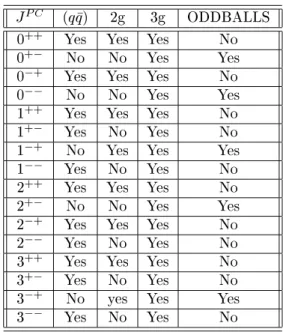
familyofglueballsisbig. Table2showsthe
glue-balls(oddballsare alsoshown). Oddballsshould
havethepriorityto beexamined dueto thefat
that they do not haveompetition with natural
qqstates,mesons,andtheqqqstates,(baryons)
withthe samequantum numbers. It isdiÆulty
to separate the ommon hadrons from the
glue-balls when theyappearin thesame physial
re-gion.
Glueballs are important for QCD that predits
theirexistene. SinePomeronanbeinterpreted
asglueballs, thestudy of hard dirationin the
QCD framework is an interesting subjet to be
developed.
9. Centauros
Centauros were have neverbeen observedin
a-eleratorpartilephysis. Theseobjetswere
dis-several unusual harateristis, like the
produ-tionofalargemultipliityofhargedpartiles
a-ompaniedbyveryfewphotons. Forexample,as
manyas100hargedpartilesandnomorethan
3 0
. [9℄We haveenoughenergyat Tevatron to
produe entauros. Sine our dirativemass is
signiativelyhighweanprodueitdiratively.
The alorimetryof the detetors anbeused to
observetheabseneofeletromagnetiativity.
10. Dirative Struture Funtions
The study of Dirative struture funtions at
Tevatron would allowaomparisonwith the
ex-istingHera results. Tounderstandthe struture
ofthePomerononemustknowitsstruture
fun-tion. This type of study has to be pursued
ex-haustivelytoget betteraurayand to be
pos-sible a lear interpretation Pomeron. How
im-portantisthegluonandthequarkomponentof
thePomeron.With thisresultsweanhave
bet-ter alulations of its ross setions[10℄. Is the
Pomeron the same in eletron proton and
pro-tonanti-protoninterations? Therearedierene
betweenthePomeronstruturein dierent
rea-tions?
Table2. Thistableshowssomeofthepossible
quan-tumnumberongurations for glueballs. The
Odd-ballsaretheglueballswithquantumnumberwithout
aompetitionwithknownhadrons.
J PC
(qq) 2g 3g ODDBALLS
0 ++
Yes Yes Yes No
0 +
No No Yes Yes
0 +
Yes Yes Yes No
0 No No Yes Yes
1 ++
Yes Yes Yes No
1 +
Yes No Yes No
1 +
No Yes Yes Yes
1 Yes No Yes No
2 ++
Yes Yes Yes No
2 +
No No Yes Yes
2 +
Yes Yes Yes No
2 Yes No Yes No
3 ++
Yes Yes Yes No
3 +
Yes No Yes No
3 +
No yes Yes Yes
3 Yes No Yes No
11. Correlationsbetween,t,M
x
,b,,x,E
T ,...
or-M
x
, b, , x, E
T
,... aswell as to obtainthe
sin-gle distributions for eah oneof these variables.
These studies are a phenomenologial soure of
investigationofthehiddendynamisofthe
distri-butions. thepseudo-rapidity,(asdenedabove)
is very useful to build the Lego Plots of
whereistheazimuthalangleoftheobjetbeing
studied (e.g. jets); t =(P
Beam P Sattered ) 2 is
thetransfermomentumbetweentheprotonbeam
and the sattered proton ; M
x =
p
p
s is the
dirativemass(450: GeVforsinglediration
and 100: GeV for double Pomeron exhange in
theenergiesoftheTevatron( p
2 TeV));bisthe
measured slope of the dierentialross setions,
whih an be seleted globally or for a
partiu-larregionoftheinvariantmassprodued
dira-tively( d dt / e b(M x )t
); = 1 x
p =
P
P isthe
fration of the momentum of the proton arried
bythePomeron;x
p
0:95isthefrationofthe
momentumoftheprotonarriedbythesattered
proton;andE
T
=isthetransverseenergyofthe
jetproduedbyharddiration.
WiththeFPD,weangetagoodsampleof
Dira-tiveeventsandarryonthesestudiesandothers
even-tually suggested. This sample an be estimated and
omparedwith thepresentexperimentsasisshown in
table3.
Table 3. Thistableshows aomparison betweenwhatwe
haveandwhatisestimatedusingFPDattheRunIIofthe
Tevatron.
Experiment Dijet Events E
T [GeV℄
UA8 100 8
HERA Hundreds 5
CDF Thousands 10
500,000 15
D/FPD 150,000 20
15,000 30
III The Forward Proton
Dete-tor
WewillgivejustanideaabouttheFPDsinewehave
alreadydesribedthestudies andprojetonreferene
[4℄.
III.1 Generalities
TheForwardProtonDetetoronsistsof18Roman
Pots arrangedonboth sidesof the Ddetetor. Fig.
4showsthe Roman Pots onbeam line. Wehave two
astles on the proton side indiated by P
1Q(S) . For
analogyP
2Q(S)
are thepots ofthedownposition. On
theanti-protonsidewehavetwosimilarastleslabeled
byA
1Q(S)
andtwoothershalfastlesonthesideofthe
dipole magnet labeled A
1(2)D
. The approximated
dis-tanesofthepotswithrespettotheinterationpoint
(indiatedby0ontheruler)areshown.
Figure4. TheRomanPotspositionontheTevatronbeam
line.
III.2 Tevatron Reonguration
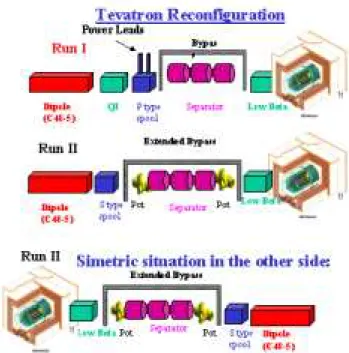
Wehadtoworkonthebeamline toopenroomfor
theFPD stations. Weshowin theFig. 5the real
po-sitionoftheCastles. Wesee thattheryogenibypass
isbigger inthe RunII.Thiswas theonly plaewhere
weouldopentheneessaryspaefortheFPD.Fig. 5
alsoshowsthatthequadrupolemagnetQ
1
isnolonger
present. Othersmallmodiationswereneessary,like
drillingaholeontheoortoallowtheinsertionand
re-movalofthebottomdetetors. SummarizingtheT
eva-tronmodiationare:
girdermodiation
newryogenibypass
removalofQ
1
quadrupole.
III.3 Roman Pots
Inthissubsetionwewilltrytogiveashort
desrip-tionofRomanPots 2
shownin theFig. 6.
2
ToavoidsomeonfusionaboutthenamesusedforourdetetorsweusethestandardnotationforRomanPots. Nevertheless,the
moretehniallysophistiatedRomanPots,obligeustonoteseveralpartswhiharebeingsystematiallyitedinthistext: aCastle
whihisshowninFig.6inwhihweputthetubewiththepot. Insideofthepotarethesintillatingbersonstitutingthedetetor.
Figure 5. The Tevatron Reonguration or the Tevatron
before and after the introdution of the Castles with the
RomanPots.
Figure 6. TheCastle andthe RomanPots. Thenumbers,
inthisguremeans,1 = ionpump;2 = wormgear;3
= Beamdiretion;4 = stepmotors;5 = theartridge
withthedetetorsinside.
Fig. 6 shows a FPD astle. The system of axes
shownindiatesthebeaminthez-diretion. Theinner
part ofthe astlewill bein the UHV (ultra high
va-uum)vauumofthebeamline. Anionpumpshownas
\1"inthegureisusedtoguaranteetheUHV.
Indiat-thatisthepieeresponsibleforthemovingmehanism
ofthepotitself. Thebeamdiretion isshownas
num-ber \3". The number \4" indiates the step motors
used to move thepots. There are 4step motors, one
foreahpot, allremotely operated. Finallyweseethe
artridgewiththepotinitsextremityindiatedbythe
number\5".
III.4 The Detetors
Fig. 7showsour detetor. The detetor is
onsti-tutedbysintillatingbersplaedintheframes
repre-sentedintheFig. 7bytheplanesXX',UU'andVV'
. The sintillating bers are onneted to lear bers
whih guide the signal up to the multi-anode
photo-multipliers as shown in the gure. We have16
han-nelsperplaneXX'and20hannels/planeUU',VV',
giving a total of 112 hannels per detetor and 2016
hannelstotal. Studies aboutthesignal,eÆieny and
resolutionhavebeenmade. Sintillating bersarethe
best optionforourdetetorsamongmanyother
possi-bletehnologies. Theframeismadeofordinaryplasti.
Thetheoretialresolutionis80mirons.
Figure 7. This gure shows our detetors and the
multi-anodephotomultipliers.
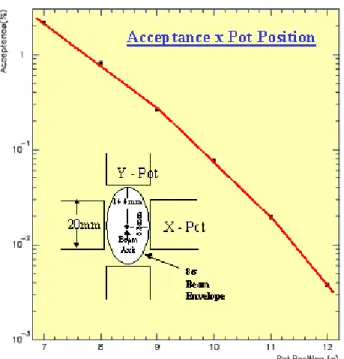
Theaeptaneofourdetetorshasbeenstudiedin
severalviews. WeshowinFig. 8theaeptaneversus
the pot position. Whilethe gure showsan elliptial
with adistane of 8 , the pointsin the plot are the
Figure8. Thisgureshowsstudiesoftheaeptaneversus
potposition.
IV Conlusion
TheprimaryphysisgoaloftheFPDistomeasurehard
diration,produingnewdata,turningthestudynew
dirativephysispossible. Ontheotherhanda
num-ber of measurements does not have enough statistis
to get more aurated results. Neverthelessit will be
possibletousetheFPDtoredueunertaintiesonthe
luminosityforallDphysisproesses.
We an also obtain results and improve old
mea-surementsatlowerenergiesand, in someases,deide
between oniting results as is the ase of the total
rosssetions. Wehavegiven, alistof possibletopis
tobeinvestigatedin bothhardandsoftdiration.
Our shedule to start the data aquisition is the
sameoftheDzeroDetetor,i.e.,bytheendoftheyear
2000.
Thisprojetwillgivethepossibilitytoupgradethe
world dirativedata sinemanynewfeatures will be
possible, like the diret observation of the Pomeron
Pomeronsattering.
Finally wewould liketo end this summary of this
talkabouttheFPDprojet,withthephotoofthe
pro-Figure9. Thisisthe nalprototypeofourRoman Potor
theCastlebuildatLaboratorioNaionaldeLuzSinhroton,
Campinas/Brazil.
Iwouldliketothanktheorganizerommitteeofthe
XX-ENFPC for givingme the opportunity to present
ourFPD projet. All theworkbehindthis paper was
done with the eort and ontribution of the D
ol-laborationin partiular to A.Brandt andM. Martens
from Fermilab. I would also like to thank our
re-gional(Brazilian)ollaborationmadeofolleaguesfrom
Universidade Federal da Bahia (N.Oliveira);
Universi-dade Federal do Rio de Janeiro (J.Barreto);
Univer-sidade Estadual do Rio de Janeiro (W.Carvalho, C.
Martins, V.Oguriand A.Sznajder); Universidade
Es-tadual Paulista (E. Gregores, T. Lungov and Sergio
Novaes);andLaboratorioNaionaldeLuzSynhroton
(R.NeuezwanderandM.Juni). Withouttheimportant
ontributionandooperationofRiardoRodriguesand
CylonGonalvesfromLNLSweouldnothavereahed
thispointinthisprojet. FinallyIwouldliketothank
myolleaguesoflaboratory,(LAFEX/CBPF)G.Alves,
M.Miranda,H.daMotta,M.SouzaandM.Vazforall
theworkthattheyaredoinginthisprojet. Wethank
CNPqandFAPERJ forpartialnanialsupport.
Referenes
[1℄ A.Brandt etal., UA8Collaboration, Nul. Inst. Meth.
A 327,412(1993); id.,Phys.Lett. B297,93(1993);
ibid.,HEP-Ex-9709015,1997,submittedtoPLB.
[2℄ ZEUS ollaboration, M. Derrik et.al., Z. Phys. C 65,
379(1995); H1 ollaboration, T. Ahmed et.al., Nul.
Phys.B439,471(1995);ZEUSollaboration,M.
[3℄ A. Brandt, H. Motta and A. Santoro
-Editors-LISHEP98- Lafex International Shool on High
En-ergyPhysis -Proeedings of Session C-February
16-20,(1998)
[4℄ A.Brandtetal. AForward Proton Detetor
Fermilab-Pub-97/377,1997
[5℄ DCollaboration,FermilabPub-96/357-E, (1996).
[6℄ C.Avila,Proeedingsof LISHEP98; Thesis:
\Measure-menttheproton-antiprotontotalrosssetionatenter
ofmass Energy of 1800 GeV" CornellUniversity 1997
and referenes therein; C.Avilez et al., Phys. Lett. B
234,158(1990);ibid.,Phys.Rev.Lett.68,2433(1992);
ibid., Phys.Rev.50, 5550, (1994); ibid. ,Phys.Lett.
B234,158(1990); ibid. ,Nul.Inst.Meth.A 360,80
(1995)
[7℄ F.Abe etal. CDFCollaboration: Phys.Rev.Lett. 78,
2698(1997)
[8℄ E.L.Berger, J.C.Collins, D.E.Soper, G.Sterman, Nul.
Phys.B286,704(1987);A.KermanandG.VanDalen,
Phys.Rep.106,297(1984)
[9℄ F.Halzen:FelixHomePage,Brazil-JapanCollaboration
-Proeedings ofthe 21st. Int.Conf.-Adelaide-Australia
vol.8,259(1990);C.M.G.Lattes,Y.FujimotoandS.
Hasegawa,Phys.Rep.65,1511980;C.E.Naviaetal.:
Phys.Rev.D40,2898(1989).
[10℄ R. J. M. Covolan and M.S. Soares, IFGW-DRCC
97/04(1997)\AStudyonthePomeronStruture