com o apoio
Abstract
This work is part of the study conducted within the research work entitled “The cluster as a theoretical and practical tool of the Portuguese International Cooperation for the Development: the case of Mozambique, East Timor, São Tomé and Principe and Angola” and the PhD thesis entitled “The influence of the clusters in the cooperation for the development at the level of aid effectiveness. The case of good governance in Guinea-Bissau” in which the main goals regard the certification of the aid effectiveness of the cooperation clusters and the conception of a strategy of implementation of the cooperation clusters. In this paper we intend to reflect about the effectiveness of the clusters in the cooperation for the development by analyzing the opinions of previous and current political leaders, leaders of the autonomous state administration and of members of the civil society involved in the adoption and implementation of the cooperation clusters in Portugal. These preliminary results point out to the need of establishing a strategy of definition and implementation of the cooperation clusters so that the goals of aid effectiveness can be achieved.
* texto em português a partir da página 20
WP 113 / 2012
THE NEW TOOL OF THE
PORTUGUESE COOPERATION:
COOPERATION CLUSTERS
O NOVO INSTRUMENTO DA COOPERAÇÃO
PORTUGUESA: CLUSTERS DA COOPERAÇÃO *
WORKING PAPER / DOCUMENTOS DE TRABALHO
CEsA
(Centro de Estudos sobre África e do Desenvolvimento/ Center for African and Development Studies) is one of the Research Centers of the School of Economics and Management of the Technical University of Lisbon (ISEG/UTL), having been created in 1982. It is dedicated to the study of economic, social and cultural development in developing countries in Africa, Asia and Latin America, although it places particular emphasis on the study of Portuguese-speaking countries, China and Pacific Asia, as well as Brazil and other Mercosur countries. Additionally, CEsA also promotes research on any other theoretical or applied topic in development studies, in other regions generally or across several regions.From a methodological point of view, CEsA seeks to foster a multidisciplinary approach to the phenomenon of development, and a permanent interconnection between the theoretical and applied aspects of research. Nevertheless, the Centre pays particular attention to the organization and expansion of research supporting bibliographic resources, the acquisition of databases and publication exchange with other research centers.
CEsA participates on educational activities at ISEG, in the Master’s on Development and International Cooperation and PhD on Development Studies. The Centre’s activities in the research and thesis supervision encompass the following topics in particular: economic growth and development, globalization and regionalism, institutions and institutional change, governance and public policies, financial systems and development financing, cooperation for development, economic and social history of colonization, migrations and Diasporas, nation and Portuguese-speaking identities, urbanization and development.
OS AUTORES
Carlos Sangreman
Economist at the ISEG/UTL, PhD in African Studies at the ISCTE - IUL, Assistant Professor at the University of Aveiro (UA) and board member of CEsA. He is Principal Investigator in several projects and technical adviser of UA rectory on Cooperation.
Sandra Silva
1. INTRODUCTION
The importance that innovation has achieved in the context of aid effectiveness raises serious challenges to the governments that intervene in the cooperation for development (Morris & Pryke, 2011). The Portuguese government has invested in new and innovative tools so as to increase the aid effectiveness after the signature of the Paris Declaration (2005) and consequent adoption of the Strategic Vision (2005). In this context, the cooperation cluster has been assumed as one of the main innovations at the level of cooperation for the development in Portugal, being thought of as “a tool which is composed by a set of projects, led by different institutions in a specific geographic area and with a common framework that promotes social and economic development of a target-region” (IPAD, 2005). Even though this tool has been conceived taking into
account the advantages of the theoretical model of Michael Porter (Porter, 1990, 1998, 2000) and many other knowledge areas have successfully adopted it, such as New Mainstream Economics (Krugman, 1991), Regional Sciences (Scott, 1996), Innovation Studies (Braczyk et al., 1998), the effectiveness of the cooperation cluster in the aid for development as not been certified yet.
This study aims at preliminarily approaching the issues of effectiveness of the clusters implemented by the Portuguese Cooperation in Angola, Mozambique, São Tomé and Principe and East Timor. More specifically, it tries to understand the subjacent criteria to their adoption and implementation strategies in order to assess the effectiveness of the cooperation clusters in the view of the donator. For the purpose, a series of interviews to former and current political leaders, leaders of the autonomous state administration and members of the civil society involved or with knowledge about the implementation of the cooperation clusters were conducted. As we will demonstrate, there is no such thing as a strategy of creation and implementation of cooperation clusters, being its definition considered to be crucial so that the goals of the aid effectiveness can be achieved.
2. THE COOPERATION CLUSTER
In this part of the study we will explore the emergence of the new concept of cooperation cluster through the revision of literature and the analysis of initiatives of clusters in developing countries. The first references to the cooperation cluster appear in the strategic document entitled “A Strategic Vision for the Portuguese Cooperation” adopted by the Portuguese Cooperation in 2005. In this document, the cooperation cluster is considered to be “a clearly innovative tool” by the Portuguese Cooperation,
presenting itself as one of the possible solutions for “the problems that result of the proliferation of random projects” (IPAD, 2011). The Portuguese Cooperation tries, this
that the concept of cluster firstly appears connected to the cooperation for the development, having been adapted from the economic area as the document of the Strategic Vision refers (IPAD, 2005). The cooperation cluster derives from the theoretical model of Michael Porter on the competitive advantage of the nations and on the international competitiveness which predicts the increase of productivity through the process of clusterization and through the intense interactions between industries (Porter, 1990, 1998). This model is later reinvented by the author when he incorporated location as a key-factor in a globalized world by the growing influence of the new technologies of communication (Porter, 2000). The clusters start being faced as “a new way of thinking about national, state, and local economies, and they necessitate new roles for companies, for various levels of government, and for other institutions in enhancing competitiveness” (idem: 16). Several actors start assuming a fundamental role in the
competitiveness of nations through their participation in the clusters. The reinforcement of the role of the state as far as the competitiveness of the nations is concerned is a core issue of this theoretical model that is incorporated by the cooperation cluster in which institutions such as universities, schools and public utilities are beginning to play a fundamental role as well.
But if, on the one hand, the adoption of this concept by the Portuguese Cooperation seems to assume some of the premises of Porter’s theoretical model regarding the geographic concentration of the several actors in the competitiveness of the nations in spite of having been reinvented as far as the geographic concentration of the several actors based on factors that promote the aid effectiveness for development; on the other hand some innovations related to the sectorial concentration of the various participants around a common object are introduced. This accurateness in the definition of the cooperation cluster is essential since the obscurity of the concept due to its vast dissemination to several areas of knowledge without a concern with its definition is one of the criticism pointed at the cluster (Martin & Sunley, 2003; Motoyama, 2008), and with this in mind the different perspectives of clusters existent in literature on the initiatives in developing countries are analyzed.
In the last decade, a growing relevance has been given to the initiatives of clusters in developing countries by the donating countries and agencies of development since they can “generate employment, income and opportunities for the local community and become drivers of broad – based local economic development” (Dijk & Sverrisson,
“commonly held to mean that enterprises are physically close to each other and that this proximity creates opportunities for collaboration, other externalities, etc” (Dijk &
Sverrisson, 2003). The experience with industrial or business clusters has testified that, in many cases, these work as “the outcome of the survival activities of very poor people who lack capital, markets, and skills for starting and running-type establishments”
(Dijk & Sverrisson, 2003) for they allow “small enterprises to overcome growth constraints and compete in distant markets but there is also recognition that is not an automatic outcome” (Schmitz & Nadvi, 1999). Yet, researchers conclude that the
developing countries need to acquire more technological abilities which allow the continuous improvement of the production and organization processes (Canie¨ls & Romijn, 2003); they also need to break the vicious circles of low qualifications and investment through the creation of an environment that stimulates and supports learning and entrepreneurship; the policymakers should assume a catalyzing role so as to decrease the difference of competitiveness between small and medium sized companies (Altenburg & Meyer-Stamer, 1999); clusterization, in an initial stage when the risk for the small companies is bigger (Schmitz & Nadvi, 1999); and of collective action and efficiency since they seem essential to cope with the new entrepreneurship pressures (Schitz & Nadvi, 1999). These conclusions are drawn from the analysis of some of the clusters that have been implemented, such as the software cluster in Bangalore, India, being the software considered to be one of the sectors with more potential to generate economic growth, particularly in developing countries (Canie¨ls & Romijn, 2003); the cluster of transforming industries in Latin-America which is presented as a very heterogeneous example (Altenburg & Meyer-Stamer, 1999); the shoes cluster in Guadalajara in Mexico and in Agra in India, which having been deeply affected by the dynamics of liberalization in trade in the decade of 90 had to reinvent itself in order to compete with a globalized world (Knorringa, 1999; Rabellotti, 1999). It is important to highlight that despite the fact that the initiatives with industrial or business clusters are very different from the initiatives with cooperation clusters, the goal of fomenting development is common to both types of clusters. In this review of literature we can also realize that collective action is another common trait to both types of clusters. The increase of cooperation between local actors through the establishment of vertical and horizontal bonds, including bilateral and multilateral relations, seems to be determinant for the success of clusters in developing countries (Knorringa, 1999; Rabellotti, 1999; Schmitz & Nadvi, 1999). The notion that the clusters should be faced as “an expression of social connectivity rather than mere spatial agglomeration” (Dijk & Sverrisson,
2003) is similar to the notion of the Portuguese Cooperation which considers that the cooperation clusters should involve a great number of actors, namely NGDOs, universities, foundations, syndicates, employer associations, councils or companies.
More specifically, the UNIDO started promoting initiatives of clusters in the mid-1990s with the goal of providing “cluster stakeholders with an enabling business environment that paves the ground for sustained growth” (UNIDO, 2010). UNIDO’s methodology of
cluster implementation is based on technical assistance and thus the main participants must be deeply involved and compromised with the initiatives. Although UNIDO emphasizes the role of the private sector in the implementation of the clusters, the public sector also plays a fundamental role since the governance, along with the confidence, are the key-factors for the success of these initiatives. In the case of UNIDO, the resemblances with the cooperation clusters reside in the fact that there is a mobilizing and coordinating institution for the cluster on the scene where the initiative is being promoted. The UNIDO works as an intermediate between the different actors of the clusters, even though it does not replace them, daily supporting them “from the
formulation of a diagnostic study to planning and implementing private sector
development activities” (UNIDO, 2010). Similarly to what happens concerning the cooperation clusters “providing network members with training, operational support, incentives and motivation as well as encouraging knowledge diffusion and providing
exposure to best practice” (UNIDO, 2010) constitute fundamental factors for the success of these initiatives in developing countries. Some of the cluster initiatives promoted by the UNIDO are: the Rivas bananas cluster in Nicaragua; the metal and wood workshops cluster in Mekelle, Ethiopia; the clothing cluster in Atuntaqui in Ecuador. The USAID started developing initiatives with clusters towards the end of the 1990s beginning in Libya in 1998, and reaching a total of 2006 countries in 2003. The initiatives of clusters in developing countries include Afghanistan, Bangladesh, Bolivia, India, Mongolia, among others (Ketels, Lindqvist, & Sölvell, 2006). To the USAID, the clusters represent a set of principles that make the increase of competitiveness possible. These principles include “the close interplay between firms, their suppliers, and the business environment; the importance of geographic proximity; building connections and relationships among firms and institutions within a cluster so that they can more effectively tackle the barriers to increased productivity; mobilizing people to re-think the way they do business; the momentum for change must be local” (USAID, 2008).
And similarly to the cooperation clusters and to the initiatives promoted by the UNIDO previously mentioned, it is fundamental the existence of “honest and trusted broker to
bring disparate parties with varied interests together”and “donor projects can credibly provide global perspective and technical expertise, but the cluster development process should be driven by the local private sector” (USAID, 2008).
Finally, the FAO only recently started to use the clusters as a tool to increase productivity in a period in which the challenges put to the “new agriculture” are immense. The agro-clusters are faced by the FAO as “a concentration of producers, agribusinesses and institutions that are engaged in the same agricultural or agro-industrial subsector, and interconnect and build value networks when addressing common challenges and pursuing common opportunities” (Gálvez-Nogales, 2010). This
agro-industry and to create an environment that improves the competitiveness of agribusiness, particularly small- and medium-scale companies” (Gálvez-Nogales,
2010). One of the examples of success of the FAO is the case of the Bio Bio cluster in Chile which congregates around 40% of the myrtle production of the whole country. Once more, the similarities with the cooperation clusters are related to the fact that there is a cluster-mobilizing institution which controls the stages of implementation and the need to establish synergies and local partnerships.
It is important; however, to highlight other common particularities to the different cluster initiatives previously analyzed which seem to differ from the cooperation clusters, namely the promotion of collective efficiency and the adoption of small-scale firms (Schmitz, 1995). Here, the collective efficiency is faced as “the competitive advantage derived from local external economies and joint action” (idem: 530). We
also emphasize that the designation of cooperation cluster was never used in initiatives promoted by the UNIDO, USAID or FAO, which makes the concept unique.
We finish this part of the study with a brief justification for the existence of these differences. The author (Perez-Aleman, 2005) refers in her study some of these differences, coinciding in this analysis with the absence of competitiveness and dynamics (Altenburg and Meyer-Stamer, 1999; McCormick, 1999; Schmitz, 1995; Nadvi, 1999) and of collaboration inter-companies (McCormick, 1999; Nadvi, 1999; Lara, 2002). What seems to justify these differences regarding the cooperation cluster is the absence of the search for economic profit as a decision-criterion (Sangreman & Carvalho, 2007). The in-depth analysis of the experiences of the Portuguese Cooperation, namely the cluster of Angola and Mozambique may allow the comprehension of the process of creation and implementation of new clusters.
3. INNOVATION IN THE PORTUGUESE COOPERATION
In this part of the study we aim at analyzing the innovation of the tool used by the Portuguese Cooperation: the cooperation cluster. This analysis derives from the investigation conducted as part of the project “The cluster as a theoretical and practical tool of the Portuguese International Cooperation for the Development: the case of Mozambique, East Timor, São Tomé and Principe and Angola”. In this section the cases of Angola and Mozambique will be analyzed in-depth since in these cases the field trips and the interviews to the main local actors were already conducted and the necessary information was already collected. The local actors interviewed are the cooperation – attachés, the diplomatic corps of the respective embassies, the personnel attached to the projects and the direct beneficiaries.
characterized by a dense agricultural and commercial occupation in a development stage with tendency to broaden due to the growing reoccupation of the territory by the populations. The agro-pastoral activities involve a large part of the population highlighting a strong bond to the land. Agriculture is generally extensive with commercial goals mainly in the irrigated areas for the growing of potato and vegetables with main focus in the commune of Chipeio.
It is important to stress that these agro-pastoral activities are developed around a set of three projects promoted by the IMVF (Institute Marquis of Valle-Flor) with the support of two main financiers, the EC (European Commission) and the PIDS (Portuguese Institute for Development Support). The USAID participates in the area of specialized technical support and of capacity building. The interaction with the local political power organs and with a small number of CSO (Civil society organizations) at the level of reinforcement of local democratic governance in the Auscultation and Social Dialogue Committees of the Municipality of Ecunha and the commune of Chipeio is also promoted.
The projects in question are the Project of Sustainable Relaunch of Production and Commercialization of the Private, Familiar and Business Livestock Products Sector in the Municipality of Ecunha; the Project of Sustainable Management of Forest Natural Resources: Consolidation and Enlargement (PSMFNR); and the Project for the Promotion of Local Democratic Governance: Dinamization of the Auscultation and Social Dialogue Committee in the Municipality of Ecunha and Commune of Chipeio (PPLDG). According to the study conducted in loco, we have concluded that the
projects are to some extent articulated between them at the level of rural development and of food security, being promoted in the territorial area of the Municipality of Ecunha. The Project of Sustained Rural Development of the Municipality of Ecunha (PSRD), which has already come to an end, was at the core of this IMVF intervention in the Municipality of Ecunha and it focused on the support to the relaunch and in the promotion of the private agricultural activity. Specifically this project has focused on the support to the increase of agricultural production and on the support and reinforcement given to the core associations in the Municipality of Ecunha, being the creation of COOPECUNHA the most meaningful output that resulted from this support. COOPECUNHA is a cooperative of farmers which has members in two communes of the Municipality: Ecunha and Chipeio. It is currently considered to be a model of “good practice” in terms of effectiveness, efficiency and sustainability of its actions aiming at the development of the agricultural sector in the region. The success of this project has thus led to the extension of its philosophy and structure through the Project for the Promotion of Local Democratic Governance and the Project of Sustained Rural Development of the Municipality of Ecunha.
projects and different activities are being produced, in a limited territory, it seems that the institutional structure that shapes the projects implemented by the IMVF in the Municipality of Ecunha is closer to the logic of an integrated project rather than that of a cooperation cluster. It is, mainly, the absence of several financiers and of a strategic intervention based on a central project that points to the existence of an integrated project in the Municipality of Ecunha rather than to a cooperation cluster. There are, however, other perspectives namely of the IMVF which considers that the initiatives developed in Angola are part of a cooperation cluster. Further research will allow an explanation of the different perspectives.
Unlike Angola, the Mozambique case is recognized by the Portuguese Cooperation as a cooperation cluster, integrated in the Indicative Cooperation Program (ICP) 2011-2012 as a complementary intervention. This complementary intervention counts with 2% of the overall budget, around 1.2 million of Euros and it aims at “contributing to the sustainable and well-balanced development of the Island of Mozambique and of the surrounding continental region (human and economic, patrimonial and environmental)1”
(IPAD, 2012). This value is an indicator that even though the last ICP 2007-2011 predicted 10% of the overall budget, only 3% was achieved. More specifically, the main goal of this intervention is the sustained development of this region through the valorization of the historical and cultural patrimony, the promotion of income– generating activities and improvement of living-conditions of inhabitants. Thus, the concentration of efforts was thought of in order to implement an integrated project in the island financed by several bilateral and multilateral actors and by the Portuguese Cooperation, designated as Development Plan of the Island of Mozambique DPIM (Sangreman & Silva, 2012). The activities are in consonance with the priority areas defined by the Mozambican Government in the pursuing of the fundamental goals of the Action Plan for the Reduction of Absolute Poverty II (APRAPII), namely, the rehabilitation of the island heritage which will allow the development of the region and the increase of the income of the population (Sangreman & Silva, 2012). This intervention is also in consonance with the UNESCO intervention which has attributed the status of World Heritage to the Island of Mozambique in 1991 as well as the intervention of other international financiers like the UNDP (United Nations Development Plan), the ADB (African Development Bank) or of countries that have helped over time the Mozambican Government to intervene in the island (Sangreman & Silva, 2012). Since the beginning of the cooperation cluster, established after the signature of the last ICP between Portugal and Mozambique in 2007, little has been done. The adjudication of the elaboration of the Development Plan for the Island of Mozambique DPIM, whose main goal was the identification of the areas and main projects for the development of the region, was only formalized in March 2008. The DPIM which points to three stages with a duration of 10 years, has generated resistance from the Mozambican Government even when the several actors participated in its
1
elaboration. Simultaneously, the evaluation report of the ICP 2007-2011 concludes that the implementation of the cluster has not been initiated yet “nor there were any efforts of mobilization or coordination regarding ongoing projects in the field”2 (evaluation
report). It is expected that the approval of the ICP 2011-2014, in which this complementary intervention is included, accelerates the intervention in the scope of the cooperation cluster in Mozambique.
This brief analysis to the cases of Angola and Mozambique allow us to conclude that the cooperation clusters are not achieving the expected results. We discuss the attempt of adopting an innovative tool with the goal of avoiding the duplication of efforts, of maximizing the impact of projects and ensuring their sustainability and finishing the random and disperse actions which have characterized the Portuguese action. Some constraints though like the change of government due to the legislative elections of 2011 and the nomination of the new State Secretary for Foreign Affairs and for Cooperation (SSFA) may be creating difficulties regarding the evolution of both initiatives, making a conclusive analysis of its innovation potential impossible.
4. THE POSITION OF THE GOVERNMENT, STATE AND CIVIL SOCIETY
In this part of the work we will analyze the interviews conducted to former and current leaders, leaders of the autonomous state administration and members of organizations of the civil society directly involved or with knowledge about the implementation of the cooperation clusters in the scope of the project “The cluster as a theoretical and practical tool of the Portuguese International Cooperation for the Development: the case of Mozambique, East Timor, São Tomé and Principe and Angola”. The goal is to retrieve information which may allow a better understanding of the problematic previously placed.
As one can analyze in Annex I, the structure of this guideline integrates questions that may allow us to gather opinions, information, perceptions regarding the effectiveness of clusters in aiding development. These are guiding-questions, and not closed-questions, which enable the interview to proceed as the interviewee considers being more pertinent. The guideline was made available to the interviewees before of the interview. There are two different groups of interviewees, in the first group we find the formulators of the clusters, namely the former and current State Secretary for Business and Cooperation (SSBC), the former and current members of the Commission of Foreign Affairs and Portuguese Communities, the IMVF and the high and intermediate board of the PIDS
2
(Portuguese Institute for Development Support)3; in the second group we find the executors of the clusters, namely the members of NGDOs. Each interview was preceded by a short explanation of its goals and theme of study. The interviewees were also asked permission so that the interview could be recorded and they were explained that the retrieved information will only be used for the purposes of the current study and investigation.
As we can observe in Table 1, so far six interviews were conducted: three in the group of the formulators of the cooperation clusters and three in the group of the executors of the cooperation clusters. We highlight the fact that we are finding it more difficult to schedule interviews in the formulators group than in the executors group, for in the first group 74% of the interviews are still awaiting confirmation.
Table 1 – Interviews to the cooperation actors in Portugal
Interviews Formulators Executors
Requested interviews 19 15 Conducted interviews 3 3 Scheduled interviews 2 5 Refused interviews 0 2 Awaiting for answer 14 5
Regarding the first group of interviewees, the formulators of the cooperation clusters, everyone that participated in the formulation of the cooperation clusters from the beginning was contacted, such as the former State Secretary for Business and Cooperation (SSBC), the former adviser of the SSBC, the former members of the Commission of Foreign Affairs and Portuguese Communities, IMVF and the high and intermediate board of the PIDS. Yet, only the intermediate leaders of the Geographical Cooperation Services II and of the Evaluation and Audit Cabinet have answered to the interview so far. We would like to refer that no former or current leader has accepted to be interviewed, as expressed in Table 2.
Table 2 – Interviews to the Group of Formulators
3
Institution Carried out
Schedule
d Refused
Awaitin g
Former State Secretary for Business and
Cooperation 2
State Secretary for Business and Cooperation 1
Former Commission of Foreign Affairs
and Portuguese Communities 3
Commission of Foreign Affairs and Portuguese
Communities 1 3
IPAD (PIDS) 2 1 4
Embassy of Portugal in Mozambique 1
IMVF 1
TOTAL 3 2 0 14
In the interviews conducted within the group of formulators to the intermediate leaders of the PIDS we highlight the existence of two common elements. Firstly, the cooperation cluster is considered by both as a tool with potentiality to promote the development of countries. Secondly, the absence of a plan of action in which the coordination, the appropriation and the complementarity are present has contributed to the failure of this tool. The potentialities identified by the intermediate leaders of the PIDS are underlined in the guidelines of the clusters, namely the concentration of aid in a context of great dispersion of resources and efforts such as in the Portuguese case. The head of direction of the Geographical Cooperation Services II, Dr. Sérgio Guimarães, considers that, regarding the aid effectiveness of the Portuguese Cooperation, “the cooperation cluster is a good answer and the models available may contribute to the canalization of help so as to obtain larger coordination and complementarity of action between the actors”4. The Head of the Evaluation and Audit Cabinet, Dr. Manuela
Afonso, believes the cooperation clusters are “an innovative tool which has potentialities in the light of what was produced in Busan”, namely, “the appropriation, the focus on results, the inclusive partnerships for development, transparency and accountability”. Some disadvantages were, however, identified and these are mainly
related with difficulties in the start of the clusters. These difficulties are, according to Dr. Manuela Afonso, financial, since no other partners were identified; of appropriation of the concept of clusters by local partners; of absence of active leadership by the PIDS and of inexistence of a structure that ensured the management of the cluster. Dr.
4
Manuela Afonso also considers that “there is no evidence of a clear implementation strategy as far as the cluster is concerned”, nor even “a plan of action, of coordination and of appropriation, i.e., these buzzwords which underpin the idea of a cluster”.
According to Dr. Sérgio Guimarães, the NGDOs end up by having a marginal intervention in the cooperation clusters. The NGDOs have been financed through “a line of financing in which the right of initiative rules has been currently used and to which there is a random selection to the clusters”.5
The interview conducted to the head of projects of the IMVF focuses mainly in the case of São Tomé and Principe, being, however, the perspective regarding the cluster favorable since it concentrates efforts in a specific geographical or sectorial area.
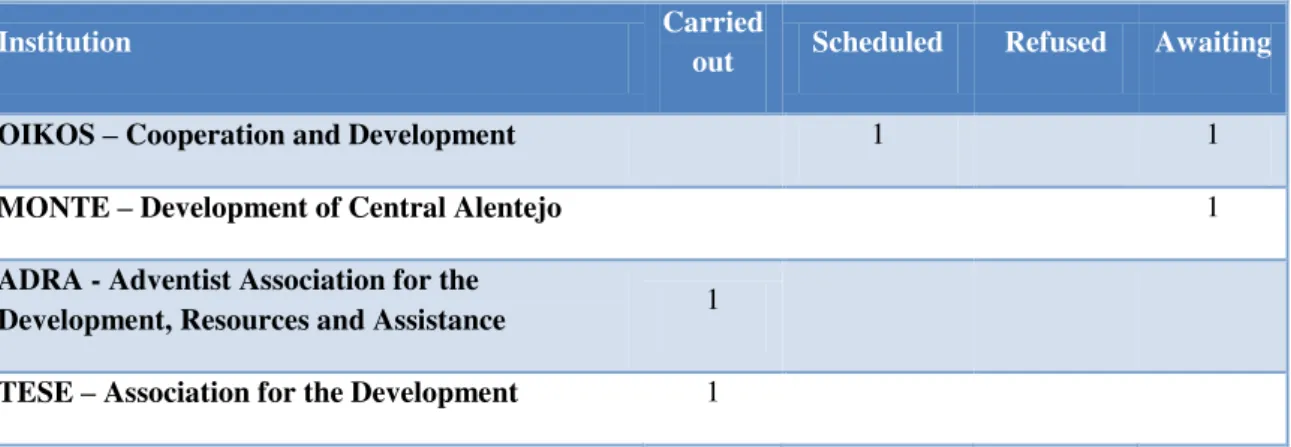
As far as the second group of interviewees are concerned, the executors of the cooperation clusters, we followed the criterion of representativity in the social organs of the Portuguese Platform of NGDOs for the selection of NGDOs. As we can observe in Table 3, unlike what happened with the first group, 53% of members has given or has scheduled the interview. It is important to mention that two NGO refused to give interviews alleging lack of knowledge regarding the cooperation clusters. The two NGDOs mentioned are AIDGLOBAL (Action and Integration for the Global Development) and FEC (Foundation Faith and Cooperation) both represented in the social organs of the Portuguese Platform of NGDOs in the Supervisory Board and with more than two decades of experience in the area of development in the case of FEC. The member of the FEC contacted to give the interview alleges that “due to the
specificity of the theme [he won’t be able] to bring significant added value for the study”
and the member of AIDGLOBAL states that he does not “have enough knowledge of the matter”.
Table 3 – Interviews to the Group of Executors
Institution Carried
out Scheduled Refused Awaiting
OIKOS – Cooperation and Development 1 1
MONTE – Development of Central Alentejo 1
ADRA - Adventist Association for the
Development, Resources and Assistance 1 TESE – Association for the Development 1
5
ACEP – Association for the Cooperation
between Peoples 1
ATA – Tropical Agricultural Association 1
FGS - Foundation Gonçalo da Silveira 1
CIDAC – Center of Anti-Colonial Information
and Documentation 1
ADPM – Association of Defense of the Heritage
of Mértola 1
GRAAL – Association of Social and Cultural
Character 1
AIDGLOBAL – Action and Integration for the
Global Development 1
Saúde em Português – Association of Professionals of
Primary Health Care of the Portuguese – Speaking Countries 1
FEC - Foundation Faith and Cooperation 1
IEEI – Institute of Stategical and International
Studies 1
TOTAL 3 5 2 5
What we stress as a common and central element to all of the interviews conducted, namely the ADRA, ATA and TESE is the fact that all of the interviewees who are members of the mentioned NGDOs believe the cooperation cluster to be an important tool for the development. More specifically, the member of ATA considers that “a politically, technically and economically well-built cluster is important for both parties but it is necessary that this is done”; the member of ADRA states that “the start idea sounds good, to have an action or geographical area which is priority because the funds are limited. If we manage to focus in two or three things which are well worked that will be better than having a huge dispersion and that is also in agreement with the Monterrey principles”; the member of TESE refers that he believes “the idea of the cluster [to be] positive. [He thinks] that for a kind of cooperation with our dimension the idea of a cluster makes sense, because it has to do with coordination, concentration and in-depth impact. The dispersion is not favorable, but that does not mean that there cannot be an ah-docs grant”.
political agreement and to ensure financial stability. Lastly, TESE refers that it is necessary to create “a stem of coordination of the cluster / a structure and it does not need to be a structure with a general manager and a cabinet, but people from both parts who play responsible roles.”
Finally, some criticism has been leveled at the acting of the Portuguese Cooperation regarding the cooperation clusters. For instance, the member of ADRA mentioned that “the cluster is a positive strategy and a suitable one provided that it involves the actors and that all have access to the same information and it seems to me that that has not been happening”. However, he adds that “it seems [to me] that the cluster ends up by being for some who have privileged access to information and who can go directly to the source, so to say, or the source goes directly to them because it chooses them. It does not seem to me that it has been an open and transparent process of application that allows people to participate, people from different parts and not just NGDOs”. In
ATA’s words “it is a sign of fragility when a cluster involves a funnel-shaped structure of execution”. TESE refers that “it does not have any visibility, it is discussed but nobody really knows what the cooperation cluster is” and that “implementation has systematically failed, but that is the Portuguese paradigm” and “it is essential to define
the scope of the interventions”.
We hence conclude that despite being considered as a tool with a lot of potential by formulators and executors within the framework of the Portuguese Cooperation, the cooperation cluster presents results far beyond the expected for there is no concerted plan of action, there is a lack of multiple financiers, a lack of coordination structures that involve the recipient countries and also due to the lack of appropriation. Thus we conclude that the issues related to management, coordination, appropriations and financing need to be reviewed in the light of aid effectiveness for an effective success of the cooperation clusters.
5. CONCLUSIONS
BIBLIOGRAPHY
Altenburg, T., & Meyer-Stamer, J. (1999). How to Promote Clusters: Policy Experiences from Latin America. World Development, 27(9), 1693-1713.
Canie¨ls, M. C. J., & Romijn, H. A. (2003). Dynamic Clusters in Developing Countries: Collective Efficiency and Beyond. Oxford Development Studies, 31(3), 275-292.
Dijk, M. P. V., & Sverrisson, Á. (2003). Enterprise clusters in developing countries: mechanisms of transition and stagnation. Entrepreneurship & Regional Development, 15(3), 183-206.
Gálvez-Nogales, E. (2010). Agro-based clusters in developing countries: staying competitive in a globalized economy. Roma: Food and Agriculture Organization of the
United Nations.
Giuliani, E., Pietrobelli, C., & Rabellotti, R. (2005). Upgrading in Global Value Chains: Lessons from Latin American Clusters. World Development, 33(4), 549-573.
Han, Z. (2009). A Model of Clustering Process in Low Income Economies.
International Journal of Business and Management 4(12), 46-51.
IPAD. (2005). Uma Visão Estratégica para a Cooperação Portuguesa.
IPAD. (2011). Cooperação Portuguesa: Uma leitura dos últimos quinze anos de cooperação para o desenvolvimento. Lisboa: Imprensa Nacional Casa da Moeda.
IPAD. (2012). Programa Indicativo de Cooperação 2011-2014 Portugal-Moçambique.
Ketels, C., Lindqvist, G., & Sölvell, Ö. (2006). Cluster Initiatives in Developing and Transition Economies. Stockholm: Centre for Strategy and Competitiveness.
Knorringa, P. (1999). Agra: An Old Cluster Facing the New Competition. World Development, 27(9), 1587-1604.
Krugman, P. (Ed.). (1991). Geography and Trade. Cambridge: MIT Press.
Martin, R., & Sunley, P. (2003). Deconstructing clusters: chaotic concept or policy panacea? Journal of Economic Geography, 3, 5-35.
McCormick, D. (1999). African Enterprise Clusters and Industrialization: Theory and Reality. World Development, 27(9), 1531-1551.
Morris, M., & Pryke, J. (2011). Beyond Paris: 11 innovations in aid effectiveness. The Australian National University.
Perez-Aleman, P. (2005). CLUSTER formation, institutions and learning: the emergence of clusters and development in Chile. [Article]. Industrial & Corporate Change, 14(4), 651-677.
Porter, M. (1990). The Competitive Advantage of Nations. New York: Free Press.
Porter, M. (1998). On competition. Boston: Harvard Business School Press.
Porter, M. (2000). Location, Competition, and Economic Development: Local Clusters in a Global Economy. Economic Development Quarterly, 14(1), 15-34.
Rabellotti, R. (1999). Recovery of a Mexican Cluster: Devaluation Bonanza or Collective Efficiency? World Development, 27(9), 1571-1585.
Rogerson, C. M. (2001). In search of the African miracle: debates on successful small enterprise development in Africa. Habitat International, 25(1), 115-142.
Sangreman, C., & Carvalho, F. (2007). Os “clusters” e a reforma da Administração Pública na Cooperação Internacional Portuguesa para o Desenvolvimento. CESA/Instituto Superior de Economia e Gestão.
Sangreman, C., & Silva, S. (2012). Os clusters como instrumento da cooperação internacional portuguesa para o desenvolvimento, O caso da Ilha de Moçambique.
CESA Working Paper, from
http://pascal.iseg.utl.pt/~cesa/files/Doc_trabalho/WP104.pdf
Schmitz, H. (1995). Collective efficiency: Growth path for small‐scale industry. Journal of Development Studies, 31(4), 529-566.
Schmitz, H., & Nadvi, K. (1999). Clustering and Industrialization: Introduction. World Development, 27(9), 1503-1514.
Scott, A. J. (1996). Regional motors of the global economy. Futures, 28(5), 391-411.
UNIDO, U. N. I. D. O.-. (2010). Cluster development for pro-poor growth: the UNIDO approach. Vienna: Business, Investment and Technology Services Branch, Programme
Resumo
Este trabalho enquadra-se na investigação realizada no âmbito do projeto de investigação intitulado “O cluster como instrumento teórico e prático da Cooperação Internacional para o Desenvolvimento portuguesa: o caso de Moçambique, Timor Leste, São Tomé e Príncipe e Angola” e da tese de doutoramento intitulada “A influência dos clusters na cooperação para o desenvolvimento ao nível da eficácia na ajuda. O caso da boa governação na Guiné-Bissau” em que os principais objetivos são comprovar a eficácia da ajuda dos clusters da cooperação e conceber uma estratégia de implementação dos clusters da cooperação respetivamente. Neste artigo pretendemos refletir sobre a eficácia dos clusters na cooperação para o desenvolvimento através das opiniões de antigos e atuais governantes, dirigentes da administração autónoma do estado e membros de organizações da sociedade civil envolvidos na adoção e implementação dos clusters da cooperação em Portugal. Estes resultados preliminares apontam para a necessidade de se estabelecer uma estratégia de definição e implementação dos clusters da cooperação para que possam ser alcançados os pressupostos da eficácia da ajuda.
O NOVO INSTRUMENTO DA COOPERAÇÃO
PORTUGUESA: CLUSTERS DA COOPERAÇÃO
1. INTRODUÇÃO
A importância que a inovação tem adquirido no contexto da eficácia da ajuda coloca evidentes desafios aos governos que intervêm na cooperação para o desenvolvimento (Morris & Pryke, 2011). O governo português tem investido em novos instrumentos inovadores para aumentar a eficácia da ajuda desde assinatura da Declaração de Paris (2005) e consequente adoção da Visão Estratégica (2005). Neste contexto, o cluster da cooperação assumiu-se como uma das principais inovações ao nível da cooperação para o desenvolvimento em Portugal, sendo encarado como o “um instrumento que é constituído por um conjunto de projetos, executados por diferentes instituições numa mesma área geográfica e com um enquadramento comum que promove o desenvolvimento social e económico de uma região alvo” (IPAD, 2005). Não obstante este instrumento ter sido concebido com base nas vantagens do modelo teórico de Michael Porter (Porter, 1990, 1998, 2000) e muitas outras áreas de conhecimento o terem adotado com sucesso, tais como New Mainstream Economics (Krugman, 1991), Regional Sciences (Scott, 1996), Innovation Studies (Braczyk et al., 1998), falta comprovar a eficácia do cluster da cooperação na ajuda ao desenvolvimento.
Este trabalho procura abordar de forma preliminar as questões da eficácia dos clusters implementados pela Cooperação Portuguesa em Angola, Moçambique, São Tomé e Príncipe e Timor-Leste. Em específico, procura perceber os critérios subjacentes à sua adoção e estratégias de implementação para de seguida avaliar a eficácia dos clusters da cooperação na ótica do doador. Para o efeito, foram conduzidas um conjunto de entrevistas a atuais e antigos governantes, dirigentes da administração autónoma do estado e membros de organizações da sociedade civil envolvidas ou com conhecimento sobre a implementação dos clusters da cooperação. Como se irá demonstrar, não existe uma estratégia de criação e implementação dos clusters da cooperação, sendo a sua definição considerada essencial para que os pressupostos da eficácia da ajuda possam ser alcançados.
2. O CLUSTER DA COOPERAÇÃO
mobilizar um conjunto de instituições em torno de uma problemática comum. É neste contexto que surge pela primeira vez o conceito de cluster associado à cooperação para o desenvolvimento, tendo sido adaptado da economia como refere o documento da Visão Estratégica (IPAD, 2005). O cluster da cooperação deriva do modelo teórico de Michael Porter sobre a vantagem competitiva das nações e a competitividade internacional, que prevê o aumento de produtividade através do processo de clusterização e das intensas interações entre indústrias (Porter, 1990, 1998). Este modelo é mais tarde reinventado pelo autor ao incorporar a localização como fator chave num mundo globalizado pela crescente influência das novas tecnologias da comunicação (Porter, 2000). Os clusters passam a ser encarados como “a new way of thinking about national, state, and local economies, and they necessitate new roles for companies, for various levels of government, and for other institutions in enhancing competitiveness” (idem: 16). Diversos intervenientes passam assumir um papel
fundamental na competitividade das nações através da sua participação nos clusters. O reforço do papel do estado no que respeita a competitividade das nações é um ponto central deste modelo teórico que é incorporado pelo cluster da cooperação, onde instituições como as universidades, escolas, public utilities passam a desempenhar um
papel igualmente relevante.
Mas se, por um lado, a adoção deste conceito pela Cooperação Portuguesa parece assumir algumas das premissas do modelo teórico de Porter no que respeita à concentração geográfica dos vários intervenientes na competitividade das nações, apesar de ter sido reinventada no que respeita à concentração geográfica dos vários intervenientes com base em fatores que promovam a eficácia da ajuda para o desenvolvimento, por outro lado, são introduzidas algumas inovações no que respeita a concentração sectorial das várias intervenções em torno de um objeto comum. Esta precisão na definição do conceito de cluster da cooperação é essencial, dado que entre outras críticas apontadas ao cluster se encontra a obscuridade do conceito devido à larga disseminação a diversas áreas de conhecimento sem que haja uma preocupação com a definição (Martin & Sunley, 2003; Motoyama, 2008), e é nesse sentido que se analisa de seguida as diversas perspetivas de clusters existentes na literatura sobre as iniciativas em países em desenvolvimento.
Na última década, uma crescente importância tem sido dada às iniciativas de clusters em países em desenvolvimento pelos países doadores e agências de desenvolvimento dado que podem “generate employment, income and opportunities for the local community and become drivers of broad-based local economic development” (Dijk & Sverrisson,
clusters industriais ou empresariais, e não os clusters da cooperação, dado que não existem referências ao termo na literatura. O conceito de cluster industrial ou empresarial não é globalmente aceite devido ao seu uso indiscriminado, no entanto tem sido “commonly held to mean that enterprises are physically close to each other and that this proximity creates opportunities for collaboration, other externalities, etc”
(Dijk & Sverrisson, 2003). A experiência com clusters industriais ou empresariais tem comprovado que, em muitos casos, este funcionam como “the outcome of the survival activities of very poor people who lack capital, markets, and skills for starting and running factory-type establishments” (Dijk & Sverrisson, 2003) dado que proporciona a
“small enterprises to overcome growth constraints and compete in distant markets but there is also recognition that this is not an automatic outcome” (Schmitz & Nadvi,
1999). Por outro lado, os investigadores concluem que os países em desenvolvimento precisam de adquirir mais capacidades tecnológicas que permitam melhorar continuamente os processos de produção e organização (Canie¨ls & Romijn, 2003); quebrar os ciclos viciosos de baixas habilitações e investimento através da criação de um ambiente que estimule e apoie a aprendizagem e o empreendedorismo; os
policymakers devem assumir um papel catalisador no sentido de diminuir a diferença de
competitividade entre pequenas e médias empresas (Altenburg & Meyer-Stamer, 1999); clusterização, numa fase inicial onde o risco para as pequenas empresas é maior (Schmitz & Nadvi, 1999); e de ação e eficiência coletivas dado parecerem essenciais para lidar com as novas pressões competitivas (Schmitz & Nadvi, 1999). Estas conclusões partem da análise efetuada a alguns dos clusters que têm sido implementados como é o caso do cluster de software em Bangalore na India, sendo o software considerado um dos setores com maior potencial para gerar crescimento económico, particularmente nos países em desenvolvimento (Canie¨ls & Romijn, 2003); o cluster das indústrias transformadoras da América Latina, que se apresenta como um caso bastante heterogéneo (Altenburg & Meyer-Stamer, 1999); o cluster dos sapatos em Guadalajara no México e em Agra na India, que tendo sido afetado fortemente pelas dinâmicas da liberalização do comércio da década de 90 teve de se reinventar para competir com um mundo globalizado (Knorringa, 1999; Rabellotti, 1999). Importa aqui realçar que, apesar das iniciativas com clusters industriais ou empresariais diferirem bastante das iniciativas com clusters da cooperação, o objetivo de potenciar o desenvolvimento é um dos elementos comuns a ambas. Nesta revisão da literatura podemos, ainda, constatar que a ação coletiva é outro dos elementos comuns. O aumento da cooperação entre os atores locais através do estabelecimento de laços verticais e horizontais, incluindo as relações bilaterais e multilaterais, parecem ser determinantes para o sucesso dos clusters nos países em desenvolvimento (Knorringa, 1999; Rabellotti, 1999; Schmitz & Nadvi, 1999). O entendimento de que os clusters devem ser encarados como “an expression of social connectivity rather than mere spatial agglomeration” (Dijk & Sverrisson, 2003) é comum ao entendimento da
Outras semelhanças podem ser encontradas aquando da análise das diversas experiências com clusters industriais que têm sido promovidas pela UNIDO (United Nations Industrial Development Organization), USAID (United States Agency for International Development) e FAO (Food and Agriculture Organization fo the United Nations) em países em desenvolvimento. Mais concretamente, a UNIDO começa a
promover iniciativas de clusters em meados da década de 90 com o objetivo de “provide cluster stakeholders with an enabling business environment that paves the ground for sustained growth” (UNIDO, 2010). A metodologia de implementação dos clusters da
UNIDO baseia-se na assistência técnica pelo que os principais intervenientes têm de estar bastante envolvidos e comprometidos com as iniciativas. Embora, a UNIDO enfatize o papel do setor privado na implementação dos clusters, o setor público surge com um papel de bastante relevo dado que a governança, juntamente com a confiança, são os fatores chave para o sucesso destas iniciativas. No caso da UNIDO, as semelhanças com os clusters da cooperação passam pela existência de uma instituição mobilizadora e coordenadora do cluster no local onde a iniciativa se encontra a ser promovida. A UNIDO funciona como intermediário entre os diferentes intervenientes dos clusters, apesar de não os substituir, apoiando diariamente “from the formulation of a diagnostic study to planning and implementing private sector development activities”
(UNIDO, 2010). À semelhança dos clusters da cooperação, “providing network members with training, operational support, incentives and motivation as well as encouraging knowledge diffusion and providing exposure to best practice” (UNIDO,
2010), constituem fatores determinantes para o sucesso destas iniciativas nos países em desenvolvimento. Algumas das iniciativas de clusters de sucesso promovidas pela UNIDO são: o cluster das bananas de Rivas em Nicarágua; o cluster dos workshops do metal e madeira de Mekelle na Etiópia; o cluster do vestuário em Atuntaqui no Equador. A USAID começou a promover iniciativas com clusters no final da década de 90 através do caso da Líbia em 1998, atingindo um total de 26 países em 2003. As iniciativas de clusters nos países em desenvolvimento incluem o Afeganistão, Bangladesh, Bolívia, India, Mongólia, entre outros (Ketels, Lindqvist, & Sölvell, 2006). Para a USAID, os clusters representam um conjunto de princípios que tornam possível o aumento da competitividade. Este princípios incluem “the close interplay between firms, their suppliers, and the business environment; the importance of geographic proximity; building connections and relationships among firms and institutions within a cluster so that they can more effectively tackle the barriers to increased productivity; mobilizing people to re-think the way they do business; the momentum for change must be local”
(USAID, 2008). E à semelhança dos clusters da cooperação e das iniciativas promovidas pela UNIDO anteriormente focadas, é fundamental a existência de “honest and trusted broker to bring disparate parties with varied interests together” e “donor projects can credibly provide global perspective and technical expertise, but the cluster development process should be driven by the local private sector” (USAID, 2008).
producers, agribusinesses and institutions that are engaged in the same agricultural or agro-industrial subsector, and interconnect and build value networks when addressing common challenges and pursuing common opportunities” (Gálvez-Nogales, 2010). Este
novo instrumento é considerado “an efficient way to develop and stabilize agriculture and agro-industry and to create an environment that improves the competitiveness of agribusiness, particularly small- and medium-scale companies” (Gálvez-Nogales,
2010). Um dos exemplos de sucesso da FAO é o caso do cluster Bío Bío do Chile que aglomera cerca de 40% da produção mirtilos de todo o país. Mais uma vez, as semelhanças com os clusters da cooperação encontram-se relacionadas com a existência de uma instituição mobilizadora do cluster que controla as fases de implementação e a necessidade de estabelecer sinergias e parcerias locais.
Importa, no entanto, realçar outras particularidades comuns às diversas iniciativas de cluster anteriormente analisadas que parecem diferir dos clusters da cooperação, nomeadamente, a promoção da eficiência coletiva e a adoção do modelo de small-scale firms (Schmitz, 1995). Aqui, a eficiência colectiva é encarada como “the competitive
advantage derived from local external economies and joint action” (idem: 530). Realçamos, ainda, que a designação de cluster da cooperação nunca foi utilizada em nenhum momento nas iniciativas da UNIDO, USAID ou FAO, tornando o termo único. Terminamos esta parte do trabalho com uma breve justificação para a existência destas diferenças. A autora (Perez-Aleman, 2005) foca no seu trabalho algumas destas diferenças, coincidindo nesta análise com a ausência de competitividade e dinâmica (Altenburg and Meyer-Stamer, 1999; McCormick, 1999; Schmitz, 1995; Nadvi, 1999) e de colaboração inter-empresas (McCormick, 1999; Nadvi,1999; Lara, 2002). O que nos parece justificar estas diferenças em relação ao cluster da cooperação é a ausência da procura do lucro económico como critério de decisão (Sangreman & Carvalho, 2007). A analise em profundidade das experiencias da Cooperação Portuguesa, nomeadamente o cluster de Angola e Moçambique devem permitir compreender o processo de criação e implementação de novos clusters.
3. A INOVAÇÃO NA COOPERAÇÃO PORTUGUESA
diplomático das respectivas embaixadas, o pessoal afeto aos projetos e os beneficiários diretos.
O caso de Angola centra-se nas atividades de agro-pecuária desenvolvidades na cooperativa COOPECUNHA que se localiza no município de Ecunha. O Município caracteriza-se por uma densa ocupação agrícola e comercial em fase de crescimento com tendência para se alargar com a reocupação crescente do território pelas populações. As atividades agro-pecuária envolvem grande parte da população, que evidencia-se um forte vínculo à terra. A agricultura, em geral extensiva, com feição nitidamente comercial, principalmente nas zonas irrigadas para a cultura da batata e das hortícolas com particular significado na comuna do Chipeio.
Interessa aqui realçar que estas atividades agro-pecuárias se desenvolvem em torno de um conjunto de três projetos promovidos pelo IMVF (Instituto Marquês de Valle-Flor) com apoio de dois financiadores principais, a CE (Comissão Europeia) e o IPAD (Instituto Português de Apoio ao Desenvolvimento). A USAID participa na área do apoio técnico especializado e da capacitação. E é promovida, ainda, a interação com os órgãos do poder político local e com um grupo reduzido de OSC (organizações da sociedade civil) ao nível do reforço da governação democrática local nos Conselhos de Auscultação e Concertação Social do Município da Ecunha e da Comuna do Chipeio. Os projetos em questão são o Projecto de Relançamento Sustentável da Produção e Comercialização do Sector Pecuário Privado, Familiar e Empresarial no Município da Ecunha (PRSPC); o Projecto de Gestão Sustentável dos Recursos Naturais Florestais: Consolidação e Alargamento (PGSRN); e o Projecto de Promoção da Governação Democrática Local: Dinamização dos Conselhos de Auscultação e Concertação Social do Município da Ecunha e da Comuna do Chipeio (PGDL). De acordo com a investigação conduzida no local, conclui-se que os projetos possuem alguma articulação entre si ao nível do desenvolvimento rural e da segurança alimentar, sendo promovidos no espaço territorial do Município da Ecunha. O Projecto de Desenvolvimento Rural Sustentado do Município da Ecunha (PDRS), que já se encontra finalizado, esteve na base desta intervenção do IMVF no Município da Ecunha, e centrava-se no apoio ao relançamento e na promoção da atividade agrícola privada. Em especifico, este projeto focou-se no apoio ao aumento da produção agrícola e no apoio e reforço às associações de base no município da Ecunha, tendo resultado como output mais significativo a criação da COOPECUNHA, uma cooperativa de agricultores que tem filiados nas duas comunas do Município: Ecunha e Chipeio. É, atualmente, considerada um modelo de “boas práticas” em termos de eficácia, eficiência e sustentabilidade das suas ações visando o desenvolvimento do sector agrícola na região. Foi o sucesso deste projeto que conduziu, por um lado, ao prolongamento da sua filosofia e estrutura através do PRSPC e PGSRN.
atividades diferentes, num âmbito territorial limitado, parece que a estrutura institucional que modela os projetos implementados pelo IMVF no município da Ecunha se aproxima mais da lógica de um projeto integrado do que de um cluster da cooperação. É, sobretudo, a ausência de vários financiadores e de uma intervenção estratégica baseada num projeto central que aponta para a existência de um projeto integrado no Município de Ecunha e não de um cluster da cooperação. Existem, no entanto, diferentes perspetivas, nomeadamente do IMVF que considera que as iniciativas desenvolvidas em Angola se tratam de um cluster da cooperação. Investigação futura permitirá explicar as diferentes perspectivas.
2011-2014, onde é incluída esta intervenção complementar, possa acelerar a intervenção no âmbito do cluster da cooperação em Moçambique.
Esta breve análise aos casos de Angola e Moçambique permitem concluir que os clusters da cooperação não estão a alcançar os resultados esperados. Falamos da tentativa de adotar um instrumento inovador com o objetivo de evitar a duplicação de esforços, maximizar o impacto dos projetos e garantir a sua sustentabilidade, e acabar com as ações avulsas e dispersas que têm caracterizado a atuação portuguesa. Alguns constrangimentos, como a mudança de governo com as eleições legislativas de 2011 e a nomeação do novo Secretário de Estado dos Negócios Estrangeiros e da Cooperação SENEC, podem estar a dificultar a evolução de ambas as iniciativas, impossibilitando uma análise conclusiva do seu potencial de inovação.
4. A POSIÇÃO DO GOVERNO, ESTADO E SOCIEDADE CIVIL
Nesta parte do trabalho iremos analisar as entrevistas realizadas a atuais e antigos governantes, dirigentes da administração autónoma do estado e membros das organizações da sociedade civil envolvidas ou com conhecimento sobre a implementação dos clusters da cooperação no âmbito do projeto “O cluster como instrumento teórico e prático da Cooperação Internacional para o Desenvolvimento portuguesa: o caso de Moçambique, Timor Leste, São Tomé e Príncipe e Angola”. O objectivo é recolher informação que possa ajudar a perceber algumas das problemáticas levantadas anteriormente.
Conforme pode ser analisado no Anexo I, a estrutura deste guião integra questões que devem permitir recolher opiniões, informações, perceções face à eficácia dos clusters na ajuda ao desenvolvimento. Trata-se de perguntas-guias e não perguntas fechadas para que a entrevista possa seguir o rumo que o entrevistado entender ser mais pertinente. O guião foi disponibilizado aos entrevistados antes da realização da entrevista. Existem dois grupos distintos de entrevistados, o primeiro grupo é o dos formuladores dos clusters que inclui o anterior e atual SENEC, os anteriores e atuais membros da Comissão de Negócios Estrangeiros e Comunidades Portuguesas, o IMVF e a direção superior e intermédia do IPAD; o segundo grupo é o dos executores dos clusters que inclui os membros das ONGD. O início de cada entrevista foi, ainda, precedido por uma breve explicação sobre os objetivos da mesma e o tema geral do estudo. Aproveitou-se, igualmente, este momento para solicitar aos entrevistados a necessária autorização para proceder à gravação da entrevista e garantir que a informação recolhida apenas será utilizada para fins de investigação.
cooperação e três entrevistas no grupo dos executores dos clusters da cooperação. Realçamos o facto de estarmos a ter maior dificuldade em conseguir entrevistas no grupo dos formuladores do que no grupo dos executores dos clusters da cooperação, com 74% das entrevistas a aguardar resposta.
Gráfico 1 – Entrevistas aos atores da cooperação em Portugal
Entrevistas Formuladores Executores
Entrevistas solicitadas 19 15
Entrevistas realizadas 3 3
Entrevistas agendadas 2 5
Entrevistas recusadas 0 2
Aguardar resposta 14 5
Relativamente ao primeiro grupo de entrevistados, os formuladores dos clusters da cooperação, foram contactados todos os que participaram na formulação dos clusters da cooperação desde o início, tais como o anterior SENEC, a ex-assessora do SENEC, os anteriores membros da Comissão de Negócios Estrangeiros e Comunidades Portuguesas, IMVF e a direção superior e intermédia do IPAD. No entanto, apenas os dirigentes intermédios, nomeadamente dos Serviços de Cooperação Geográfica II e Gabinete de Avaliação e Auditoria, e o Diretor de Projetos do IMVF realizaram a entrevista até ao momento. O que salientamos ao observar o Quadro 2, é que nenhum dos anteriores ou atuais governantes aceitou realizar a entrevista.
Quadro 2 – Entrevistas ao Grupo dos Formuladores
Instituição Realizad
a
Agendad a
Recusad a
Aguarda r
Anterior SENEC 2
SENEC 1
Anterior Comissão de Negócios Estrangeiros e
Comunidades Portuguesas
3
Comissão de Negócios Estrangeiros e Comunidades Portuguesas